%20(2)_edited.png)

A Guide to Mitigating Internal Threats from Human Capital
- Marketing Team

- 9 hours ago
- 12 min read
When leaders hear the phrase internal threats from human capital, their minds often jump to a single, malicious employee—the classic saboteur. But that picture is dangerously incomplete. The reality is that the most significant risks are rarely driven by malicious intent but by systemic issues that impact your entire workforce.
The most damaging threats are often silent liabilities baked right into your operations and culture. Think high turnover, widespread disengagement, and critical knowledge walking out the door every day. These aren't dramatic acts of sabotage; they're slow, costly drains that create significant business impact, liability, and weaken your organization from within.
Defining the Real Scope of Human Capital Threats
Your people are your greatest asset, but human-factor risk can quickly become your most significant liability if not managed proactively. The old-school focus on reactive investigations and surveillance completely misses the bigger picture, as these internal threats start with humans and must be resolved by addressing human-centric issues, not technology.
For decision-makers in Compliance, Risk, Security, Legal, and HR, addressing this is a strategic necessity. The key is to move away from expensive, after-the-fact forensics and toward intelligent, AI-driven prevention. This shift introduces a new standard of internal risk prevention that is ethical, EPPA-aligned, and non-intrusive, setting it apart from reactive or surveillance-based alternatives.
The True Face of Human-Factor Risk
Internal threats from human capital go beyond deliberate misconduct. They cover a range of operational and cultural weak points that expose an organization to significant liability and financial loss.
High Employee Turnover: The constant churn of hiring, training, and losing people isn't just an HR headache. It’s a massive loss of institutional knowledge, a direct blow to productivity, and a key indicator of underlying systemic risks.
Widespread Disengagement: A disengaged workforce is a high-risk workforce. Employees who feel disconnected are more prone to errors, less productive, and contribute to a negative culture where more severe risks like fraud or compliance failures can take root.
Knowledge and Data Loss: When employees leave, they often take valuable, undocumented knowledge with them. In some cases, they may inadvertently or intentionally take sensitive company data, creating immediate competitive and security risks.
These factors create fertile ground for severe issues to grow. The real challenge is spotting these systemic risks without resorting to invasive surveillance that destroys trust and violates regulations like the EPPA.
The most effective internal threat strategy isn't about policing your staff. It's about assessing your organization's operational health and fixing systemic vulnerabilities before they can be exploited. This proactive stance protects your business, your culture, and your employees.
This is why understanding trends in employee churn is so critical. The 2025 Mercer Turnover Survey shows that even though the average U.S. voluntary turnover rate has dipped to 13.0%, that still represents a significant amount of movement and instability.
The risk also varies wildly by industry. For example, the Retail and Wholesale sectors are facing a staggering 26.7% turnover rate, creating constant operational disruption. You can explore more about these workforce turnover trends to see how different industries are being hit.
A modern approach to human capital risk management uses AI-driven risk assessments to provide early warnings. This gives leadership the chance to act before small problems spiral into major liabilities, reinforcing prevention over reaction.
Calculating the True Cost of Ignoring Human-Factor Risks
Let’s move past the abstract and talk about what really happens when human-factor risks are left unchecked: they create clear, measurable financial damage and liability. These risks show up as tangible expenses, from recruitment and retraining costs to lost productivity and, in the worst cases, serious reputational harm.
Every time an employee walks out the door, it chips away at your profitability and creates a ripple of disruption that can be felt across the entire company.
The old-school response—launching an investigation after something goes wrong—is a fundamentally broken model. By its very nature, a reactive investigation only kicks off after the damage is done. By then, the financial and operational fallout has already hit, leaving your teams scrambling to clean up a mess instead of preventing it. You can learn more about the steep price of this outdated model in our guide on the true cost of reactive investigations.
The Financial Drain of High Turnover
High turnover is one of the most visible and painful symptoms of unmanaged human-factor risk. It’s a bright, flashing warning light telling you that systemic issues exist within the company's culture or operations. When people are leaving in droves, it's a core business threat that erodes your bottom line.
Ignoring the drivers of employee turnover is like ignoring a leaking pipe in your foundation. At first, it seems like a small drip, but over time, it compromises the entire structure, leading to catastrophic and expensive failure.
The financial hit is staggering. While turnover rates vary wildly between industries, the data shows that firms with high turnover see about 33% lower profitability. With the average cost per turnover event pegged at around $15,000—and some roles costing up to four times their annual salary to replace—the expense becomes unsustainable fast.
This chart drives home just how different the turnover challenge is across key industries, highlighting exactly where the vulnerabilities lie.
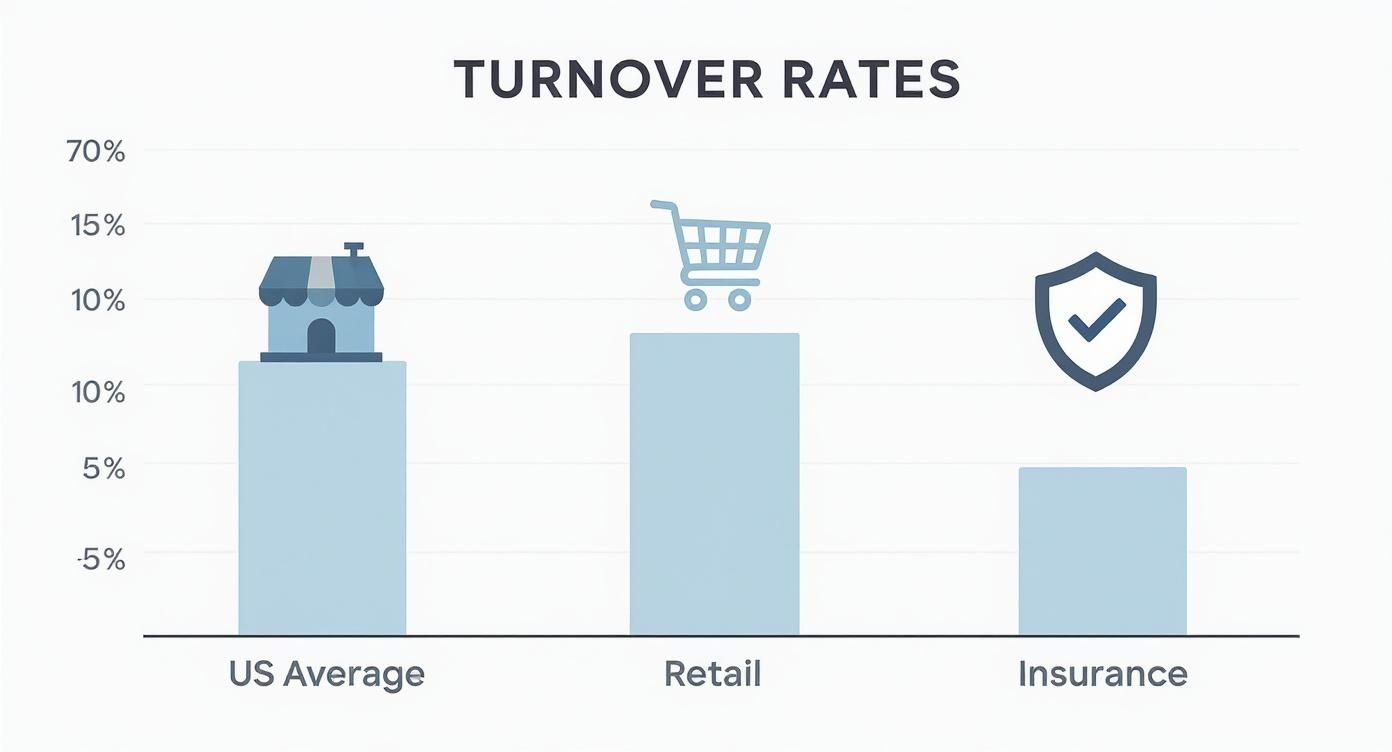
As the data clearly shows, sectors like retail are dealing with much higher churn. For them, proactive risk management isn’t just a good idea—it’s an essential strategy for survival and growth.
Beyond Direct Costs: The Hidden Impact
The true cost goes way beyond just the checks you write to recruiters. The ripple effects of unchecked internal risks are vast and often more damaging than the direct expenses.
Think about the hidden impacts:
Lost Productivity: A new hire doesn't hit the ground running at full speed. It takes time for them to reach the productivity level of an experienced employee, and during that ramp-up period, your team and the company lose efficiency.
Damaged Morale: High turnover creates a climate of instability and uncertainty. It can crush morale among your remaining employees, leading to disengagement and fueling even more departures. It’s a vicious cycle.
Institutional Knowledge Loss: When an employee leaves, they take years of valuable experience, relationships, and process knowledge with them. These are assets that are incredibly difficult and expensive to replace.
Once you connect the dots between these human-factor risks and real business outcomes, the case for a preventive approach becomes undeniable. Proactively managing your internal threats from human capital is no longer just a departmental concern; it's a core business imperative for survival and success.
The Old Playbook: Why Surveillance and Audits Fail
For years, companies have tried to manage internal threats from human capital with a playbook that’s fundamentally broken. Many are stuck using a cocktail of intrusive surveillance tools and slow-moving audits, thinking it’s enough to keep them safe. But these old-school methods aren’t just ineffective—they’re often a liability, creating legal nightmares and destroying the very trust they’re supposed to protect.
The core problem is that these approaches are built to be reactive. They are designed to identify misconduct after the fact. By the time they trigger an alarm, the damage—whether financial, reputational, or operational—is already done. It’s like having a fire alarm that only goes off once the building has already burned to the ground.
The Failures of Surveillance and Monitoring
Many legacy systems attempt to solve the human risk problem by watching employees. These tools, often branded as "insider threat detection," track everything from keystrokes and emails to network activity. In reality, they create far more problems than they solve.
Legal and Compliance Risks: Many of these systems operate in a legal gray zone, often conflicting with regulations like the Employee Polygraph Protection Act (EPPA) by creating a hostile, pressure-cooker environment.
Destruction of Trust: Constant monitoring sends a clear message: "We don't trust you." This tanks morale, kills employee engagement, and, ironically, can make disloyal behavior more likely.
Information Overload: Surveillance platforms generate a tidal wave of alerts, with the vast majority being false positives. Security and HR teams end up buried in noise, unable to distinguish a real threat from everyday work.
Relying on surveillance to manage internal threats is a losing game. You trade employee trust and ethical integrity for a false sense of security, all while opening your organization to serious legal blowback. A real strategy must be built on prevention, not policing.
The Problem with Reactive Audits and Investigations
Another go-to tactic is the periodic compliance audit or the internal investigation. While necessary for good governance, they are painfully slow and completely outmatched by today's fast-moving internal threats. An audit might uncover a fraudulent scheme six months after it started, but by then, the financial bleeding could be catastrophic.
Reactive investigations are even more flawed. They are incredibly expensive, disruptive, and adversarial by nature. They start from a position of damage control, pouring resources into assigning blame instead of fixing the systemic weaknesses that allowed the incident to happen in the first place. The cost and failure of reactive investigations make this old model unsustainable.
Reactive Surveillance vs Proactive Prevention
The table below highlights the massive gap between the old, reactive mindset and a modern, preventive strategy. Traditional surveillance methods are fundamentally reactive, focusing on identifying wrongdoing after the fact. This approach is not only ineffective but also creates a culture of distrust and legal liability. In stark contrast, a proactive, ethical approach like Logical Commander's is designed to prevent incidents from ever happening, protecting both the organization and its people.
Feature | Traditional Surveillance Methods | Logical Commander's Proactive Approach |
|---|---|---|
Core Philosophy | Reactive policing and monitoring. Assumes negative intent. | Proactive prevention and risk mitigation. Built on respect. |
Employee Impact | Creates a culture of fear and distrust. Damages morale. | Fosters a culture of integrity and psychological safety. |
Legal Posture | High risk of violating EPPA, privacy laws, and labor regs. | 100% EPPA-aligned and designed for global privacy compliance. |
Data Output | Generates massive "alert fatigue" with countless false positives. | Delivers clear, actionable risk intelligence with minimal noise. |
Timing | Detects incidents only after damage has occurred. | Identifies and flags risk indicators before an incident happens. |
Business Outcome | Leads to expensive investigations, fines, and reputational damage. | Prevents costly incidents, reduces liability, and builds resilience. |
Ultimately, the choice is clear. While reactive surveillance traps organizations in a costly cycle of blame and repair, a proactive and ethical framework empowers them to build a stronger, more resilient culture from the inside out. This is the new standard of internal risk prevention.
How Poor Management Becomes a Major Security Risk

The single biggest leading indicator of internal threats from human capital isn't a piece of software or a weak firewall. It's a manager. Poor leadership is a primary driver of employee disengagement, dissatisfaction, and turnover—three of the most significant risk factors your organization faces. When managers fail to lead effectively, they create an environment where risks are practically guaranteed to thrive.
A manager's quality directly shapes a team's stability, productivity, and overall risk profile. A huge portion of internal security risk comes from the internal environment itself. Understanding the challenges of navigating workplace relationships and stress is vital for maintaining a secure and productive environment. This sets the stage for a new approach where improving management becomes a core part of your risk prevention strategy.
The Direct Line from Leadership to Liability
Ineffective management doesn't just hit project deadlines; it fundamentally weakens your organization's defenses against internal threats. Disengaged employees are far more prone to negligence, while disgruntled ones may actively seek to cause harm. This connection isn't just anecdotal—the data proves it.
According to Gallagher's 2024 Workforce Trends Report, 66% of HR executives identify employee retention as their top challenge, framing turnover as a critical business obstacle. The root cause is often leadership, as 50% of employees who voluntarily leave cite their manager as the primary reason.
When an employee leaves due to poor management, you don't just lose a worker; you inherit a risk. That departure creates knowledge gaps, operational instability, and the potential for data exfiltration, turning a leadership failure into a tangible security event.
This highlights a critical blind spot in traditional security. While reactive tools look for suspicious file transfers, they completely miss the cultural decay that causes them. Proactive ethical risk management demands a shift in focus. Organizations need real visibility into team and leadership dynamics to address the root causes of risk before they escalate into full-blown crises requiring a costly and disruptive investigation.
An AI-driven platform can deliver these crucial insights without resorting to invasive monitoring, making management effectiveness a measurable and improvable part of your security posture.
Implementing a New Standard with AI-Driven Prevention

It’s time to throw out the old playbook for addressing internal threats from human capital. The traditional cycle of reactive investigations and invasive surveillance isn't just ineffective; it's a direct liability in today's tightly regulated world. A new standard is emerging—one built on proactive, ethical, and AI-driven prevention.
This modern approach introduces platforms like E-Commander and its Risk-HR module, which are designed to spot and neutralize human-factor risks without ever resorting to surveillance, secret monitoring, or any other methods prohibited by the EPPA. The entire focus shifts from policing people to understanding organizational health.
How Ethical AI Mitigation Works
Instead of tracking keystrokes or reading emails, this new standard uses AI to analyze operational and cultural weaknesses. It gives leadership early warnings about systemic vulnerabilities that could pave the way for fraud, data leaks, or high turnover. The system flags risk indicators in your workflows and processes, not in anyone's personal behavior.
This AI human risk mitigation approach lets you act before a risk blows up into a costly incident. It’s all about strengthening your organization from the inside out by tackling the root causes, protecting your compliance, governance, and brand reputation.
To really get the most out of this technology, it helps to have a solid grip on how it operates. A good starting point is understanding AI automation, which breaks down the core mechanics of these systems.
A Proactive and Compliant Framework
An ethical framework for managing internal threats isn't just a nice-to-have; it's a strategic must. When you adopt a system that is transparent and respects employee dignity, you build a stronger, more resilient company culture.
The goal of a modern risk platform is not to catch people making mistakes. It is to create an environment where mistakes are less likely to happen and where systemic risks are identified and resolved long before they can cause harm.
This proactive stance ensures you stay compliant while effectively managing the complex nature of internal threats from human capital. By focusing on prevention, your organization can finally break free from the endless—and expensive—cycle of reaction. Our guide on detecting insider threats with ethical AI walks through this compliant methodology in greater detail.
Partner with Us to Deliver the New Standard
Your clients are actively searching for a better way to handle internal risk. The old, reactive tools fail to address the root cause of the problem, and intrusive surveillance-based software creates far more legal headaches than it solves. They need a solution that is proactive, ethical, and actually delivers tangible business value.
This is a massive opportunity for consultants, B2B SaaS companies, and service providers in the compliance, security, and HR spaces. You can be the one to guide them away from outdated, legally questionable software and toward the new standard of preventive risk management.
That’s exactly why we built our PartnerLC program. It’s an invitation to join us in bringing a fundamentally different approach to the market—one that’s fully aligned with EPPA and built on a foundation of respect for the individual.
Expand Your Offerings and Revenue
Integrating our AI human risk mitigation platform into your portfolio isn't just about adding another tool; it's about solving a critical, high-stakes problem for your clients. You're giving them a way to reduce turnover, stop compliance breaches before they happen, and protect their hard-won reputation.
Our partnership model is straightforward and designed for mutual success:
Offer a Differentiated Solution: Stand out by providing an ethical, non-intrusive alternative to outdated surveillance tools. This positions your brand as a forward-thinking leader in ethical risk management.
Create New Recurring Revenue: Tap into a rapidly growing market by offering a high-value, AI-driven Risk Assessments Software that delivers a clear and compelling ROI to your clients.
Become an Indispensable Advisor: Deepen your client relationships by solving one of their most complex and pressing operational challenges, moving from a vendor to a strategic partner.
Joining our PartnerLC program allows you to solve a crucial client problem while positioning your business at the forefront of preventive risk management. Together, we can set a new standard for how organizations protect themselves—from the inside out.
Your Questions Answered
When you're looking at a new way to handle something as sensitive as internal risk, you’re going to have questions. It’s a major decision. Let's tackle some of the most common ones we hear from leaders, focusing on the real-world impact and the ethical backbone that defines a truly modern approach.
How Can We Identify Risks Without Employee Surveillance?
This gets to the heart of the matter. An ethical approach completely shifts the focus from watching individual employees to understanding systemic weaknesses. Instead of monitoring people, an advanced, AI-driven platform analyzes aggregated and anonymized data related to your operational integrity, communication flows, and process compliance.
It’s not about spying; it’s about spotting anomalies in your systems that create openings for things like fraud, data leaks, or high turnover. This method is fully EPPA-aligned, respects employee privacy, and gives leadership actionable intelligence to proactively strengthen internal controls—neutralizing threats before they ever become a problem and without creating a culture of distrust.
Is An AI-Driven Risk Platform Legally Compliant?
Absolutely, but only if the platform was designed from the ground up with compliance at its core. A truly EPPA compliant platform deliberately avoids any method that even remotely resembles lie detection, psychological profiling, or behavioral interrogation. The entire focus is on assessing organizational risk using objective, work-related information.
By concentrating on systemic risk factors instead of intrusive personal analysis, companies actually strengthen their compliance posture. It’s a framework that protects both the organization's interests and its employees' rights, ensuring every risk management activity is legally sound and ethically responsible.
What Is The ROI Of A Proactive System?
The return on investment for a proactive internal threat system is massive, and it goes way beyond just saving a few dollars.
Financial ROI: You drastically cut the costs tied to reactive investigations, legal battles, regulatory fines, and employee turnover—where replacing a single employee can run as high as 4x their annual salary.
Operational ROI: You get a huge boost in productivity and stability. A more engaged and resilient workforce means less disruption from constant churn and internal friction.
Strategic ROI: You safeguard your brand reputation and shareholder value by stopping damaging incidents before they can ever hit the headlines or attract regulatory scrutiny.
When you stack it up against the sky-high costs and poor outcomes of waiting for something to break, a proactive Risk Assessments Software delivers a clear and compelling return. It turns a major liability into a managed organizational strength.
Ready to adopt a new standard in proactive, ethical risk management? Logical Commander Software Ltd. provides the AI-driven platform to identify and mitigate internal threats from human capital before they cause damage.
Request a demo to see our EPPA-compliant platform in action.
Start a free trial to explore the capabilities of E-Commander.
Join our PartnerLC ecosystem to deliver next-generation risk solutions to your clients.