%20(2)_edited.png)

Build a speak up culture: unlock innovation and trust at work

Updated: Dec 12, 2025
A speak up culture is what you get when people feel genuinely safe and encouraged to share ideas, ask tough questions, and raise concerns without any fear of being punished or embarrassed. It’s the absolute bedrock of a transparent, ethical, and forward-thinking workplace, giving leaders the early warnings they need to sidestep risks and jump on opportunities.
Why a Speak Up Culture Is Essential

Picture your organization as a massive ship navigating through icy waters. A speak up culture is the crew’s collective willingness—from the engine room to the bridge—to shout "iceberg!" long before it’s a threat.
This is so much more than a dusty suggestion box or a formal whistleblower policy. It’s the organization's immune system, constantly on the lookout for problems and brilliant new ideas.
When you get this culture of open dialogue right, the benefits are huge and ripple across the entire business.
It Fuels Innovation: Your best ideas often come from the people doing the day-to-day work. When they feel free to challenge how things are done and suggest better ways, innovation isn't just possible; it's inevitable.
It Sharpens Decision-Making: Leaders who get unfiltered, on-the-ground information simply make smarter calls. Silence creates massive blind spots that lead to expensive mistakes.
It Boosts Engagement and Retention: People who feel heard and valued develop a deep sense of belonging. That kind of environment is a magnet for talent and dramatically cuts down on turnover.
The Foundation of Psychological Safety
At the very heart of a real speak up culture is psychological safety. You can't have one without the other. Understanding this culture starts with getting what psychological safety at work truly means.
It's the shared belief that it's okay to take interpersonal risks. It means no one will be shamed or punished for offering an idea, asking a question, or admitting a mistake.
Without this foundation, even the most sophisticated reporting systems will collect dust. People will stay quiet if they think raising a flag will hurt their reputation, their career, or their relationships at work.
"A healthy speak up culture goes much deeper than identifying and addressing unethical behaviors. It demonstrates the critical distinguishing factor between those companies where innovation flourishes and growth accelerates, and those companies that struggle to remain relevant."
Despite decades of corporate initiatives, getting this right is still a huge challenge. A recent workplace report found that roughly 25% of employees globally still don't feel safe enough to voice their opinions at work. That number shows a massive gap between what companies say they want and what their people actually experience. You can explore more data on this topic in the full DEI Workplace Report.
Legal and Ethical Imperatives
Beyond the clear business wins, building a speak up culture is a critical legal and ethical duty.
Regulations around the world, like the EU Whistleblower Protection Directive, now legally require organizations to provide safe and confidential ways for people to report misconduct. Failing to comply can lead to staggering fines and a public relations nightmare.
Ethically, it’s just the right thing to do. Leadership has a responsibility to create an environment where integrity comes first. A culture of silence, on the other hand, allows small problems to fester and grow into full-blown crises—from financial fraud to catastrophic safety failures.
Encouraging people to speak up isn't just good practice; it's a non-negotiable part of responsible corporate governance. This guide will give you a clear roadmap to build a culture where speaking up isn't just allowed, but expected.
The Four Pillars of a Thriving Speak Up Culture

A genuine speak up culture isn't something you can create with a single initiative or a poster in the breakroom. It’s a robust structure, and like any strong building, it rests on four interconnected pillars. If one is weak, the whole system wobbles, discouraging the very behaviors it’s meant to inspire.
Think of it like building a house—you need a solid foundation, sturdy walls, and a protective roof for it to be safe. These pillars work together in the same way. A fantastic anti-retaliation policy means nothing if your employees don't feel psychologically safe enough to raise an issue in the first place.
Psychological Safety
This is the absolute bedrock. Psychological safety is the shared belief that you won't be punished or humiliated for speaking up with ideas, questions, concerns, or even mistakes. It’s the feeling of security that makes it okay to be vulnerable.
Creating this safety has to start with leadership. When managers actively invite dissenting opinions, admit their own errors, and treat failures as learning moments, they send a powerful signal. They're modelling the very behavior they want to see, making it safe for others to take risks. For instance, a project lead could kick off a meeting by saying, "Here's my initial plan, but I'm sure I've missed something. What are the flaws? What worries you?"
This simple shift turns feedback from a threat into a gift.
Accessible Reporting Channels
Even when people feel safe, they still need clear, trustworthy ways to voice their concerns. A one-size-fits-all approach just doesn't work here; different situations demand different channels.
A truly accessible system offers multiple options, empowering employees to pick the method that feels right for them.
Open-Door Policies: Perfect for direct, trusting relationships where someone can approach their manager without fear. This builds immediate rapport and helps resolve day-to-day issues quickly.
Anonymous Hotlines: Absolutely essential for sensitive issues like harassment or fraud, where an employee might fear direct confrontation or being identified. They provide a critical layer of protection.
Dedicated Platforms: Modern software gives people a secure, documented, and often anonymous way to submit reports, track their progress, and communicate with investigators, ensuring the whole process is transparent and accountable.
The key is offering choice and making sure every single channel is actively managed and responsive.
Ironclad Anti-Retaliation Policies
Fear of retaliation is the single biggest reason people stay silent. An ironclad anti-retaliation policy is more than just a legal document; it's a public promise that needs to be clearly communicated, universally understood, and consistently enforced.
The policy must state, in no uncertain terms, that any form of punishment—demotion, social exclusion, bad assignments, or termination—for raising a good-faith concern will bring serious consequences for the person retaliating. For this to work, people have to see it in action. When a concern is raised, the organization must not only investigate the issue but also actively protect the person who reported it.
A policy is only as strong as its enforcement. When employees see that the organization protects those who speak up, trust in the entire system grows exponentially. Without this visible protection, the best-written policies are meaningless.
Visible Leadership Commitment
Finally, a speak up culture can't be delegated to HR or compliance. It has to be championed from the very top. Visible leadership commitment means executives do more than just sign off on a policy; they live and breathe it.
This looks like leaders who actively listen during town halls, respond thoughtfully to tough questions, and actually act on the feedback they get. When an employee points out a systemic problem and later sees an executive publicly address it and announce a change, it validates the entire culture.
The "tone from the top" is so critical because it signals to the whole organization that speaking up isn't just safe—it's valued. You can learn more about how tone from the top shapes an unbeatable company culture in our detailed guide. When employees see leaders embrace this mindset, it cascades down, reinforcing the other three pillars and creating a truly resilient organization.
Breaking Down the Barriers to Speaking Up
Even when you have all the right policies and reporting channels in place, you can still be met with a troubling silence. That silence isn't an accident. It’s a symptom of powerful, invisible walls that keep employees from coming forward. The first step to building a genuine speak up culture is understanding what those walls are and how to start taking them down.
The biggest and most obvious barrier is the fear of retaliation. This isn’t just about getting fired. It’s the fear of being iced out by colleagues, getting passed over for a promotion, or suddenly being assigned all the worst projects. The fear is real because the consequences—whether real or perceived—can completely alter someone's career path.
The Psychology of Silence
Beyond the direct threat of retaliation, a few other subtle but powerful forces are at play, reinforcing a culture of silence without anyone ever saying a word.
A huge factor is simple bystander apathy—the quiet assumption that "someone else will report it." When responsibility is spread thinly across a whole team or department, no single person feels the weight of it. This gets even worse when reporting processes are confusing or bureaucratic. If someone doesn't know where to go or feels like their report will vanish into a black hole, they're far more likely to just stay quiet.
An organization's history of inaction is one of the most powerful teachers. If past reports were ignored or dismissed, employees learn a clear lesson: speaking up is a waste of time and energy, and it might even paint a target on your back.
The Steep Price of Unresolved Issues
When these barriers stand tall, problems like conflict and discrimination don't just go away; they fester, poisoning the organization from the inside. Think about it: workplace disputes chew up roughly 2.8 hours of an employee’s workweek in lost productivity. Even more alarming, despite all the legal protections in place, about 75% of employees who face discrimination never report it, mostly because they're afraid of what will happen next.
These numbers paint a stark picture. Silence isn't golden; it carries a steep price in both lost time and unresolved ethical time bombs that are just waiting to go off.
How to Start Dismantling the Walls
Tearing down these barriers takes deliberate, consistent effort. Good intentions aren't enough. You have to prove it's safe to speak up through your actions, not just by promising it in an employee handbook.
Here are a few proven strategies to clear the path for open, honest communication:
Show That the System Works: When an investigation is over, communicate the general outcome (while always respecting privacy, of course). A simple announcement like, "An investigation was completed and appropriate action was taken," sends a powerful signal that reports are taken seriously and the system actually works.
Make Reporting Channels Obvious and Easy: It should be incredibly simple for anyone to find and use your reporting tools. Plaster the information everywhere—on the intranet, on posters in the breakroom, in team meetings—so everyone knows their options, especially the anonymous ones.
Train Managers How to Listen: One of the biggest hurdles is the simple fear of a tough conversation. Managers need training not just to hear feedback, but to receive it without getting defensive. In fact, giving all employees practical strategies for how to handle difficult conversations can empower them to raise issues more confidently and constructively.
Celebrate the Act, Not Just the Outcome: Publicly recognize people or teams for raising issues that lead to a positive change. This is how you shift the entire narrative. You stop seeing whistleblowing as "troublemaking" and start seeing it for what it is: a courageous and valuable contribution to the company's integrity and success.
Your Practical Roadmap to Implementation
Shifting your company's DNA from a culture of silence to one of open dialogue is a deliberate journey, not a quick fix. It takes a clear, phased approach that builds trust and momentum over time. Think of it like building a bridge—you have to secure the foundations on both sides before you can lay the road that connects them. The same logic applies here.
This journey doesn't start with a new policy memo. It starts with genuine, visible commitment from the top. Without it, any initiative is just corporate theater, destined to fail. Leaders have to be the first ones to model vulnerability and actively champion the cause.
Phase 1: Establish the Foundation
The first phase is all about creating the essential framework. This means drafting clear rules of engagement and giving people the tools they need to participate safely and effectively. It’s where you turn abstract goals into concrete policies and systems that actually work.
First, you need authentic leadership buy-in. This is way more than a simple email announcement. Leaders must publicly and repeatedly endorse the importance of speaking up, share personal stories about its value, and put real resources behind the initiative.
Next, draft a clear and accessible Speak Up and Anti-Retaliation Policy. This document has to be written in plain English, not legal jargon. It needs to spell out exactly what retaliation looks like, outline the protections for anyone who comes forward, and detail the consequences for those who retaliate.
A policy's true power is in its clarity and accessibility. If an employee can't easily understand their rights and protections, the policy offers little more than a false sense of security.
With the policy in place, the next step is designing multiple reporting channels. A strong system offers choices to fit different comfort levels and situations.
Direct Manager Conversations: For immediate, day-to-day issues in teams that already have psychological safety.
HR or Compliance Partners: For more formal concerns that require an impartial, expert hand.
Anonymous Digital Platforms: Absolutely essential for sensitive topics where the fear of being identified is the main barrier. Modern tools can offer secure, two-way communication without ever revealing a reporter's identity.
This infographic shows the typical sequence of barriers—fear, confusion, and perceived inaction—that a well-designed program has to break through.
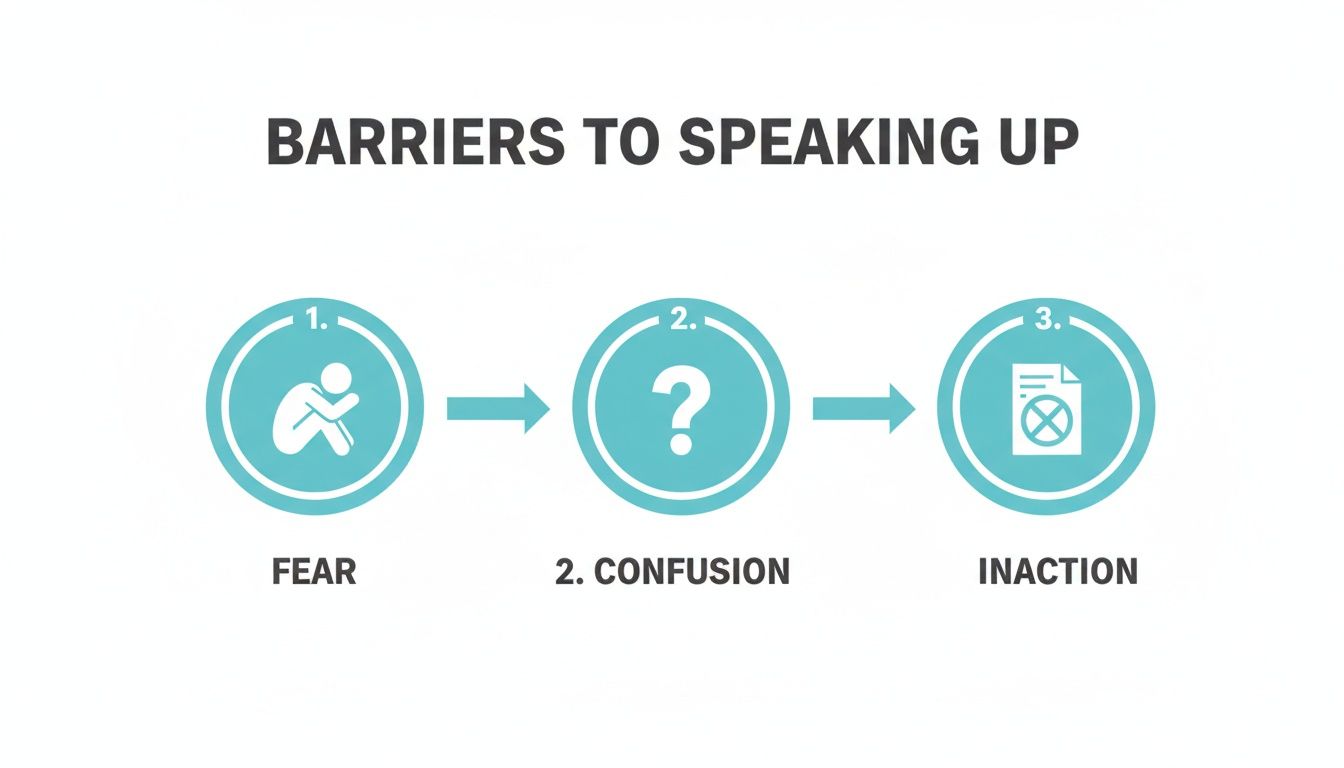
This process really highlights why having clear, easy-to-use channels is so critical. They are the key to getting employees past those initial hurdles of fear and confusion.
Phase 2: Rollout and Training
Once the infrastructure is built, the focus shifts to education and empowerment. You can't just launch a system and expect people to use it correctly. You have to actively teach them how, why, and when to engage with it.
This means delivering comprehensive, role-based training. The content has to be tailored to different audiences because their responsibilities and challenges are completely different.
For All Employees: Training should be all about building awareness. It must cover the "why" behind the speak-up culture, explain the different reporting channels available, and detail the anti-retaliation protections. Using scenarios and real-world examples makes these concepts tangible.
For Managers and Leaders: This training is much more intensive. Managers are the front line of your culture, and they have to be equipped to receive feedback constructively, even when it's critical. Training should cover active listening, de-escalation techniques, and their specific duty to act on concerns and prevent retaliation on their teams. Many organizations find that providing targeted integrity training courses for leaders is a highly effective way to build these crucial skills.
Phase 3: Sustain and Improve
A speak-up culture isn't a static achievement you can check off a list. It’s a living system that needs constant nurturing and adjustment. The final phase is about embedding these new behaviors into the organization's daily rhythm and creating ways to continuously get better.
Start with a pilot program launch in a specific department or region. This lets you test your processes, gather feedback, and make necessary tweaks in a controlled environment before going company-wide.
Finally, establish a continuous feedback loop. Use regular pulse surveys, focus groups, and data from your reporting platform to monitor the health of your culture. Track key metrics like reporting rates, time to resolution, and employee perceptions of safety. Use these insights to refine your policies, training, and communication, ensuring your speak-up culture not only survives but thrives.
How Technology Amplifies a Modern Speak Up Culture

Old-school methods like an open-door policy or a dusty suggestion box have always had a fundamental flaw. They rely entirely on an employee’s courage to attach their name to a complaint, creating a massive barrier for sensitive or serious issues.
But modern technology completely changes this dynamic. It transforms a speak up culture from a passive hope into an active, secure, and measurable system that actually works.
Dedicated software platforms serve as a digital fortress for communication, offering secure and anonymous channels that build employee confidence in ways analog methods never could. These tools are built from the ground up to protect the reporter, streamline the process, and give leaders the insights they need to act.
Building Trust Through Secure Channels
At their core, these platforms are designed to dismantle the fear of retaliation. By providing true anonymity backed by serious tech like end-to-end encryption, employees can share what they know without putting their careers on the line.
This isn’t just another feature; it's a powerful signal to the entire organization that leadership is serious about protecting those who come forward.
When an employee can submit a report, get updates, and even have a two-way conversation with investigators—all without revealing their identity—trust in the process skyrockets. That technological safeguard is often the single factor that convinces someone to report serious misconduct.
Technology transforms the act of speaking up from a high-stakes personal risk into a structured, protected, and dignified process. It assures employees that their voice will be heard, not just their name.
The impact is impossible to ignore. Anonymous reporting channels have triggered a huge shift, with incident reports surging by over 48% in recent years as employees feel safer coming forward. Even better, newer tech like AI-powered anonymous reporting is rapidly gaining employee trust, with nearly 70% expressing no concerns about these systems. You can dig into how a blueprint for a speak up culture is evolving with technology to see the full picture.
From Simple Reports to Actionable Intelligence
Modern speak up technology does far more than just collect reports. It turns scattered data points into a clear, actionable picture of your organization’s health.
For instance, automated case management ensures every single report is logged, assigned, and tracked all the way to resolution. This guarantees follow-up and kills the dreaded "black hole" effect, where reports seem to vanish without a trace.
Most importantly, these systems offer powerful analytics that can spot systemic issues and cultural hot spots without ever compromising an individual's privacy.
Trend Analysis: Are reports about bullying suddenly spiking in a specific department? This data gives leaders a chance to intervene proactively, not after the damage is done.
Case Lifecycle Tracking: How long does it take your team to resolve a case from start to finish? Identifying bottlenecks helps you streamline the process and prove your commitment to responsiveness.
Compliance and Reporting: These platforms help you meet tough data privacy laws like GDPR by managing information securely and creating an auditable trail for every action taken.
This is precisely where a modern speak up culture becomes a strategic advantage. You can see how a unified behavioral analytics platform delivers this level of insight while upholding the strictest ethical and privacy standards.
By using technology this way, organizations don't just react to isolated incidents—they learn from them, strengthening the entire ethical fabric of the business.
How to Measure Your Speak Up Culture (The Right Way)
If you want to fix something, you have to measure it first. But when it comes to a speak up culture, relying on simple metrics like the total number of reports you get each year is worse than useless—it’s dangerous.
A high number of reports could mean employees feel incredibly safe and trust the system. Or, it could signal a five-alarm fire in a culture riddled with misconduct. You can’t tell the difference just by counting.
A mature approach means looking beyond the raw numbers. It requires tracking the vital signs of trust, fairness, and efficiency to see what’s really going on beneath the surface. This is how leaders find out not just what is being reported, but how the organization responds—and whether anyone actually believes in the process.
Beyond Raw Numbers: The Quantitative Indicators
To get a clear, honest picture, you need to focus on rates and ratios that give the raw data some much-needed context. These are the metrics that let you compare performance over time and across different business units, turning a pile of data into actual intelligence. Any serious leadership dashboard should be tracking these vital signs.
Here are the quantitative metrics that truly matter:
Reporting Rate: Forget total reports. The real metric is the number of reports per 100 employees. This normalizes the data, so you can make a fair comparison between a small satellite office and your massive corporate headquarters. A healthy, consistent rate is a strong sign of engagement.
Substantiation Rate: Of all the claims you investigate, what percentage are actually found to have merit? A very low rate might mean employees are confused about company policies. On the other hand, an extremely high rate could be a red flag that people are only reporting the most severe issues, fearing retaliation for bringing up smaller concerns.
Time to Resolution: On average, how many days does it take to close a case, from the moment it’s filed to the final action? Long delays kill trust. They send a clear message that speaking up isn't a real priority for the business.
Gauging Trust: The Qualitative Measures
Numbers tell you what happened. The stories, perceptions, and feelings of your people tell you why. This is the human element—the fears, the confidence levels, the emotional reality of your culture. Without this insight, you're flying blind.
Trust is the currency of a speak up culture. Without it, even the most sophisticated reporting system will fail. You build it by listening, acting transparently, and proving that every voice matters.
To get at these crucial insights, you have to go straight to the source with methods designed to get brutally honest feedback.
Pulse Surveys: Send out short, anonymous surveys with very direct questions. A great one is, "I am confident that if I report a concern in good faith, I will be protected from retaliation." Tracking the score on that question over time is one of the purest measures of trust you can get.
Focus Groups: Get small groups of employees in a room for a facilitated, confidential discussion about their experiences with the reporting process. These sessions are where you’ll uncover the hidden roadblocks and rich context that a survey could never capture.
Your Questions, Answered
Even with a clear plan, leaders run into tricky questions when they start turning the idea of a speak up culture into a reality. Let's dig into some of the most common challenges that come up during this critical cultural shift.
How Can We Encourage Managers to Embrace Negative Feedback?
The key is to completely reframe "negative feedback" into "protective intelligence." You have to train your managers to see tough feedback not as a personal jab, but as a gift that lets them see a risk before it blows up.
This takes more than a memo; it requires specific leadership training that hammers on active listening and emotional regulation. When a manager can take a hard message without getting defensive, they send a powerful signal to their team that it’s safe to be honest. It also helps to publicly celebrate managers who act on critical feedback—this frames the behavior as a core leadership skill, not a weakness.
What Is the Difference Between a Speak Up Culture and a Complaint Culture?
This is a critical distinction, and it’s one you have to get right. A complaint culture is all about chronic negativity, finger-pointing, and a total lack of constructive ideas. It's just venting.
A speak up culture, on the other hand, is relentlessly solution-oriented. It’s about encouraging people to bring forward not just problems, but also ideas and opportunities. The focus shifts to a shared responsibility for making the organization better, safer, and more innovative. While flagging misconduct is vital, the culture also welcomes dissenting views on strategy and process.
"A healthy speak up culture is less about finding fault and more about finding a better way forward, together. It transforms potential conflict into a catalyst for growth and continuous improvement."
How Can Small Businesses Build This Culture Without a Big Budget?
A powerful speak up culture is built on trust and behavior, not pricey software. Small businesses can absolutely foster this kind of environment by focusing on simple, human-centric actions.
Here are a few low-cost, high-impact strategies that work:
Lead by Example: The CEO or owner has to openly admit their own mistakes and actively ask for feedback in every meeting. This costs nothing but has a massive impact.
Create Simple, Free Channels: A basic, confidential email address (like concerns@company.com) monitored by a trusted leader can be a great starting point.
Regular 'Ask Me Anything' Sessions: Hold weekly or bi-weekly open forums where anyone can ask leaders any question without fear of payback.
Celebrate the Act of Speaking Up: When an employee raises a tough issue, thank them publicly (with their permission) for their courage. Do this regardless of the outcome.
At Logical Commander Software Ltd., we believe technology should amplify, not replace, the human elements of trust and integrity. Our E-Commander platform provides the secure, compliant, and dignified channels that empower employees to speak up confidently, turning your organization’s ethical principles into a measurable operational reality. Learn how Logical Commander can help you build a resilient speak up culture.