%20(2)_edited.png)

Sample Conflict Of Interest Policy: A Proactive Defense Against Internal Threats

Updated: Dec 29, 2025
A solid conflict of interest policy is far more than a document you file away for compliance—it's one of your most critical defenses against internal threats and a true cornerstone of ethical risk management. It creates a formal framework to identify, disclose, and manage situations where personal interests could compromise professional judgment, ultimately protecting your organization from significant liability and reputational damage. This guide will walk you through building your own policy, starting with a full sample conflict of interest policy you can adapt to mitigate human-factor risk.
Why A Formal Conflict of Interest Policy Is Essential

Trying to manage conflicts of interest with an informal, "we'll deal with it when it happens" approach leaves your organization dangerously exposed to preventable human-factor risks. Without clear, written rules, employees might not even recognize a conflict. Worse, some may intentionally exploit gray areas for personal gain. This opens the door to significant financial, reputational, and legal liabilities that can quickly spiral from a minor ethical lapse into major fraud or misconduct. This is why reactive investigations are a failed model.
A formal conflict of interest policy serves as a fundamental governance control, crucial for proactive prevention. It makes hidden risks visible and manageable by establishing unambiguous rules of engagement, defining exactly what constitutes a conflict, and laying out a clear process for disclosure and resolution before damage occurs.
Mitigating Internal Threats Proactively
The primary business case for a formal policy is its power to mitigate internal threats before they escalate. By requiring employees to disclose potential conflicts, you shift from a reactive posture—launching costly investigations after an incident—to a preventive one. This proactive stance allows you to get ahead of issues like nepotism, biased procurement, or proprietary data leaks before they harm the business.
The data is clear: formal policies materially reduce insider risk. Organizations with written COI policies and mandatory disclosures report significantly lower rates of misconduct. For instance, one cross-sector survey found that 82% of companies with a documented COI policy took preventive action on a conflict, which directly correlated with a 28% lower incidence of internal fraud. This is prevention, not reactive forensics.
Ensuring Legal and Regulatory Compliance
A documented policy is non-negotiable from a compliance standpoint. Navigating today's evolving regulatory landscapes, such as the Corporate Transparency Act requirements, underscores how essential a formal conflict of interest policy is for ensuring legal compliance and ethical business conduct.
It serves as concrete proof to regulators, auditors, and stakeholders that your organization is serious about ethical operations and governance. This is especially critical in highly regulated industries, where the consequences of non-compliance can be crippling. Understanding the specifics of what constitutes a conflict of interest for employees is the first, most crucial step toward building this defense.
Core Components Of An Effective Sample Conflict of Interest Policy
Every conflict of interest policy worth its salt is built on a foundation of clear, enforceable components. The point is to protect the organization from human-factor risk, and simply having a document on file is not a strategy. Its real strength comes from its structure and the clarity of its parts, moving beyond theoretical content to address direct business impact.
For decision-makers in Compliance, HR, or Legal, understanding these building blocks is non-negotiable. It's the only way to draft a policy that actually mitigates tangible business liability and holds up under regulatory scrutiny. A strong policy gives everyone a practical framework for spotting and managing conflicts, ensuring every employee—from the front lines to the C-suite—knows exactly what’s expected of them.
Defining The Scope And Purpose
First, your policy needs a clear purpose statement. This is where you explain why the policy exists. This isn't just about listing rules; it's about preserving integrity, ensuring impartial decision-making, and protecting the company’s reputation and bottom line. Get this right, and you set the tone for the entire document.
Right after that, you must define the policy's scope and applicability. Who, exactly, is covered by these rules? Be explicit. State that it applies to all employees, officers, board members, and even key contractors or volunteers if relevant. Leave no room for ambiguity here.
Key Definitions And Disclosure Processes
A policy with vague language is a policy with loopholes. To avoid introducing risk, you must clearly define what actually constitutes a conflict. Your definitions must be comprehensive and cover key areas of human-factor risk:
Financial Conflicts: This includes any situation where an individual or a close relative could gain financially from a company decision, like owning stock in a vendor or receiving kickbacks.
Personal and Relational Conflicts: This covers situations involving family, close friends, or romantic partners. Think nepotism in hiring or awarding a contract to a relative’s business.
Outside Business Activities: The policy has to address what employees are doing outside of work, especially if those commitments could compete with the company or divert their focus and resources.
Once you’ve defined what a conflict is, you need a straightforward disclosure process. This is the mechanism for bringing potential conflicts into the open. It must detail how, when, and to whom employees should report a potential issue. Using a standardized disclosure form is a best practice—it creates a consistent data trail for review and AI human risk mitigation.
An effective disclosure process is the heart of proactive risk management. It transforms the policy from a static document into a dynamic tool that allows the organization to identify and address human-factor risks before they escalate into costly incidents or reputational damage.
Review Mechanisms And Consequences
So, an employee discloses a potential conflict. What happens next? The policy must spell out a clear review and management mechanism. This section should name a specific person or committee—like a Compliance Officer or an ethics committee—responsible for evaluating disclosures and deciding on a course of action. That action could be recusal from a decision, divesting a financial interest, or even reassignment.
Finally, the policy needs teeth. A section on enforcement and consequences for non-compliance is absolutely critical. It should state that failing to disclose a conflict or violating the policy will lead to disciplinary action, up to and including termination. This reinforces the seriousness of the policy and drives accountability. Properly building this out is a crucial part of any essential governance policy framework.
To pull it all together, here's a summary of the non-negotiable sections that make up a strong conflict of interest policy.
Essential Components Of A Conflict Of Interest Policy
Policy Component | Primary Purpose | Key Details to Include |
|---|---|---|
Purpose Statement | To establish the "why" behind the policy. | Explain the commitment to integrity, impartiality, and protecting the organization's reputation and assets. |
Scope & Applicability | To define who the policy covers. | Explicitly list all covered parties (employees, officers, board members, contractors, etc.). |
Key Definitions | To eliminate ambiguity about what constitutes a conflict. | Provide clear examples of financial, personal, relational, and outside business activity conflicts. |
Disclosure Process | To create a clear channel for reporting potential conflicts. | Detail the "how, when, and to whom" of reporting. Include links to any required forms. |
Review & Management | To outline the steps taken after a disclosure is made. | Designate the responsible party (e.g., Compliance Officer) and list potential remedies. |
Enforcement & Consequences | To ensure accountability and deter violations. | State the range of disciplinary actions for non-compliance, including termination. |
Think of these components as the load-bearing walls of your policy. Without any one of them, the entire structure becomes unstable and far less effective at protecting the organization from very real, and very human, risks.
Your Sample Conflict of Interest Policy Template
A well-crafted conflict of interest policy isn’t just a legal document—it’s the tool that turns governance theory into real-world practice. This sample conflict of interest policy is designed as a comprehensive template for HR, Legal, and Compliance leaders. It rolls up all the essential components into one clear, legally sound structure to prevent internal threats.
Think of this template as a solid foundation. You'll need to swap out placeholders like with your organization's specific details. And, of course, have your legal counsel review the final version to ensure it aligns with your operational reality and local laws. This is a powerful starting point for safeguarding your organization.
Part 1: Introduction and Purpose
1.1 Policy Title Conflict of Interest and Business Conduct Policy
1.2 Purpose This policy exists to protect the integrity of , along with the reputation of our company and its people. Its purpose is to ensure that every business decision is made solely in the best interest of , completely free from the influence of personal interest or gain. This document sets the framework for identifying, disclosing, and managing any actual, potential, or perceived conflicts of interest to prevent misconduct and liability.
1.3 Scope and Applicability This policy applies to all employees (full-time, part-time, and temporary), officers, and members of the Board of Directors of . It also covers any contractors, consultants, or agents acting on the company's behalf.
Part 2: Definitions of Conflicts
A conflict of interest arises whenever an individual's private interests—such as financial holdings, personal relationships, or outside activities—could improperly influence their professional judgment or decisions at . It is critical to avoid even the appearance of a conflict to maintain organizational integrity.
Common examples include, but are not limited to:
Financial Conflicts: Situations where an employee or a close relative could gain financially. This includes having a significant ownership stake (more than 1%) in a competitor, supplier, or customer, or accepting payments or loans from these entities.
Relational Conflicts: These stem from personal relationships with individuals who do business with or compete against . This covers hiring, supervising, or making business decisions involving a family member, romantic partner, or close personal friend.
Outside Business Activities: Holding a job, consulting role, or board seat with another company, especially if that company competes with , does business with it, or consumes time that interferes with job performance.
Gifts and Entertainment: Accepting gifts, meals, or entertainment beyond reasonable and customary business courtesies can create a sense of obligation. Any gift with a value over must be disclosed.
Use of Company Resources: Using company assets, information, or one's position for personal gain or to benefit an outside entity is strictly prohibited.
Part 3: Disclosure Procedures
Proactive disclosure is the bedrock of this policy. Employees have an ongoing responsibility to report any actual, potential, or perceived conflicts of interest as soon as they become aware of them. This transparency is key to neutralizing human-factor risk before it escalates.
3.1 Initial and Annual Disclosure All employees are required to complete a Conflict of Interest Disclosure Form at three key times:
Upon commencement of employment.
Annually, as part of the company's compliance cycle.
Anytime a new potential conflict arises.
3.2 Reporting Process Potential conflicts must be disclosed immediately in writing to the employee's direct manager and the . This disclosure must provide a detailed description of the situation, the parties involved, and the nature of the potential conflict.
Disclosing a potential conflict is not an admission of wrongdoing. It is an act of integrity that allows the organization to review the situation and implement safeguards, protecting both the employee and the company from potential liability and reputational harm.
Part 4: Review and Management
Once a disclosure is received, the will review the facts to determine if a conflict of interest exists. This process is designed to be fair, objective, and consistent.
4.1 Assessment The designated reviewer will analyze the disclosed information to determine the level of risk it poses to . This may involve discussions with the employee and relevant managers to obtain a full understanding.
4.2 Management Plans If a conflict is confirmed, a management plan will be developed. The goal is to manage the situation to prevent harm. Common remedies include:
Recusal: The employee will be required to abstain from any discussion or decision-making related to the conflicting matter.
Reassignment: The employee’s duties may be shifted to remove them from the area of conflict.
Divestiture: The employee may be required to sell a financial interest that is creating the conflict.
Third-Party Oversight: An independent party may be brought in to oversee transactions or decisions.
All management plans will be documented in writing and acknowledged by the employee. Crafting a policy that fits your organization's unique needs is crucial; for more in-depth guidance, you can learn more about how to create a custom conflict of interest policy tailored to your specific risks.
Part 5: Enforcement and Consequences
Compliance with this policy is mandatory. Failure to disclose a known conflict, providing false information on a disclosure form, or violating a management plan are considered serious offenses.
Any violation will result in disciplinary action. Depending on the severity, this could range from verbal or written warnings to suspension or immediate termination of employment. also reserves the right to take legal action if the company has been harmed. This strict enforcement ensures accountability and reinforces our commitment to ethical conduct and strong internal governance.
Best Practices For Policy Rollout And Management
Drafting a solid conflict of interest policy is a great start, but a document sitting in a folder changes nothing. Real prevention begins with the rollout. A policy that isn’t integrated into your company's culture is just paper, offering zero real protection against human-factor risk and its associated business liabilities.
Effective implementation turns a static document into a living part of your governance framework. It demands a strategy built on clear communication, meaningful training, and consistent enforcement. Without these, even the most perfectly written policy will fail to prevent internal threats.
Securing Leadership Buy-In and Communication
The success of any policy hinges on support from the top. When senior leaders actively champion the conflict of interest policy, it signals to everyone that this is a business imperative. This endorsement must be a consistent message in town halls, management meetings, and daily operations.
A clear communication plan is essential to ensure every employee understands the "why" behind the policy and their role in upholding it. This isn't just about broadcasting rules; it's about embedding a culture of prevention.
Initial Launch Announcement: Have a senior leader formally introduce the policy and explain its critical importance to business integrity.
An Accessible Policy Hub: Create a central, easy-to-find location on your intranet for the policy, FAQs, and related forms. Don't bury it.
Ongoing Reminders: Keep the policy top-of-mind with periodic communications, especially around annual disclosure periods.
Training and Fostering a Reporting Culture
Training must be more than reading a document and clicking "I agree." Effective training uses practical, real-world scenarios to help your team spot potential conflicts in their own roles. The goal is to build muscle memory for ethical decision-making, not just check a compliance box. This should be mandatory for new hires and a required annual refresher for all staff.
Equally critical is building a culture where people feel safe reporting potential conflicts without fear of reprisal. This psychological safety is the bedrock of transparency. It encourages early disclosure, allowing you to manage risks before they spiral into costly incidents and reactive investigations.
How you design your COI program directly impacts its effectiveness. Data shows that combining annual disclosures with event-driven updates leads to 51% more timely detection of conflicts. Integrating the policy with automated controls—like blocking a procurement approval where a conflict exists—can reduce conflicted awards by 62%. This doesn't just reduce risk; it protects the bottom line.
This proactive approach is a cornerstone of any modern compliance program. It shifts the entire focus from cleaning up messes to preventing them in the first place, which is a key principle of a strong compliance risk management framework. When you make disclosure a routine and safe part of the job, you empower your employees to become your first line of defense.
The New Standard in Proactive Risk Management
A sample conflict of interest policy is a vital starting point, but the document itself is static. Real governance demands a dynamic, forward-looking approach that traditional methods can't deliver. For decades, organizations have been stuck in a reactive loop, launching costly forensic investigations only after the damage is done. This old model is fundamentally broken; it's expensive, disruptive, and always one step behind the human-factor risks it's meant to control.
The new standard is proactive prevention. It means identifying and addressing potential conflicts and other internal threats before they escalate into misconduct or fraud. This modern approach makes risk management a real-time operational function, protecting your assets and reputation from the inside out. A conflict of interest policy is a crucial piece of a broader risk management framework designed to keep the entire organization resilient.
Ethical Prevention Powered By AI
This new standard is powered by AI-driven preventive risk management platforms. Unlike invasive surveillance tools that destroy trust and create massive legal liabilities, modern solutions like Logical Commander are ethical, non-intrusive, and EPPA-aligned. They work by analyzing contextual data and behavioral indicators to flag potential risks without resorting to secret monitoring or other legally risky methods that are against regulations.
For example, our advanced E-Commander platform can spot patterns suggesting a hidden relationship between an employee and a vendor long before a biased contract is awarded. This is a massive leap beyond manual disclosures, which depend entirely on an employee's ability or willingness to report a conflict. This is the new standard of internal threat detection.
The infographic below highlights how effective a COI policy can be when supported by solid management practices.
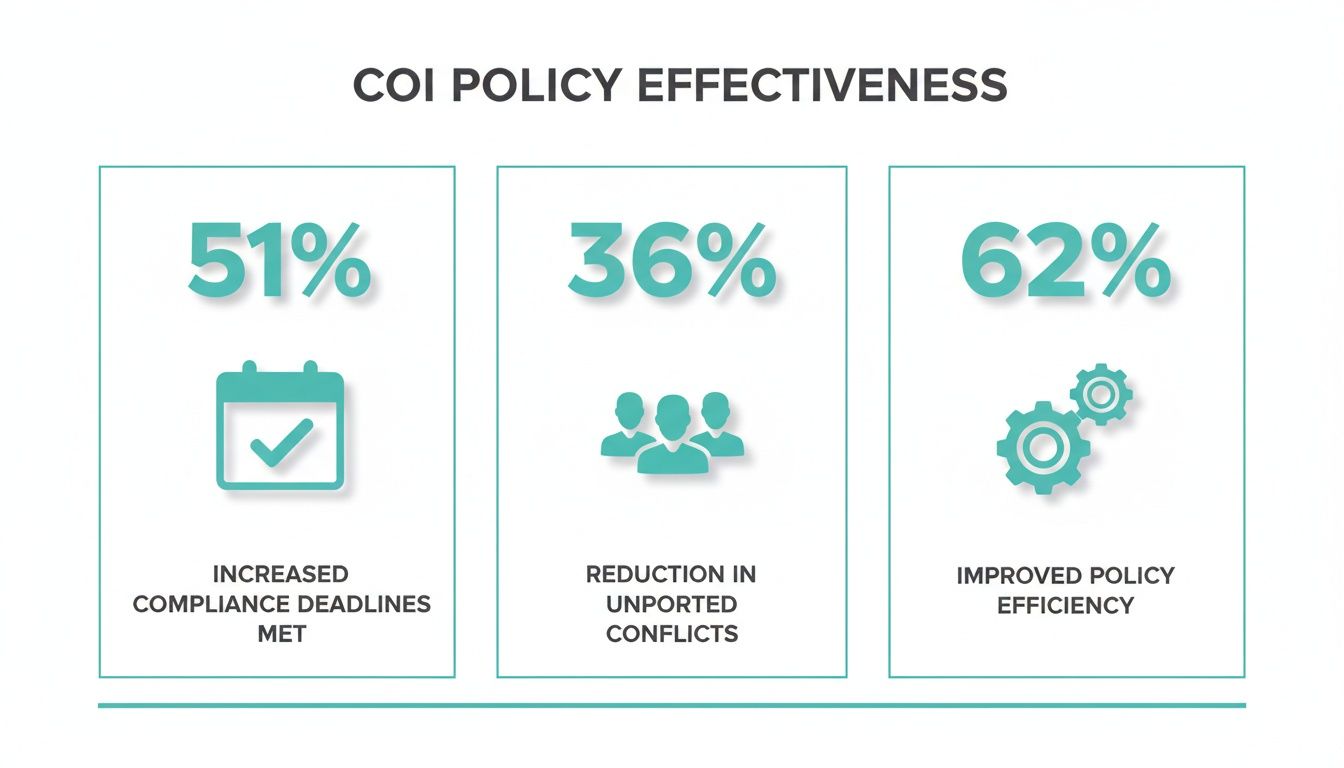
These numbers tell a powerful story. Structured, system-supported processes like annual disclosures (51%), committee reviews (36%), and automated controls (62%) dramatically boost a policy's real-world business impact.
Moving Beyond Reactive Investigations
Reactive forensic investigations are the hallmark of an outdated risk management strategy. They are incredibly resource-intensive, often tying up months of work from internal audit, legal, and HR teams—not to mention expensive outside consultants. The process can poison morale and create a culture of distrust, which starts with humans and finishes with humans.
Proactive risk platforms, like Logical Commander's E-Commander / Risk-HR, represent a fundamental shift. By providing early-warning intelligence, they empower organizations to intervene with simple administrative actions—like a conversation or a reassignment—instead of launching a full-blown investigation after a major incident.
This is the future of governance and compliance. It’s an ethical, AI-driven approach focused on AI human risk mitigation that respects employee dignity while safeguarding the organization. By adopting this new standard, companies can finally get ahead of internal threats, turning their conflict of interest policy into an active shield rather than just a historical record of failure.
Partner With Us to Deliver the New Standard in Risk Prevention
A solid sample conflict of interest policy is a great start, but it's just one piece of the puzzle. For consultants, technology integrators, and service providers, the demand for truly proactive, ethical risk management is exploding. This isn't just a trend; it's a massive market opportunity, and we want you to capture it with us.
Logical Commander's exclusive B2B SaaS Software partner ecosystem, PartnerLC, was created for this exact purpose. We invite you to join us and meet this demand head-on.
Expand Your Offerings With Proactive Prevention
Stop letting your clients rely on outdated, reactive investigation methods that are both costly and ineffective. By joining our Partner Program for B2B SaaS Software, you can offer them a genuinely different solution—an EPPA-aligned, AI-driven platform that identifies human-factor risks without ever crossing the line into invasive surveillance. It’s a powerful competitive advantage that sets your business apart from competitors still using old, intrusive methods.
You'll be equipped to deliver a modern approach to ethical risk management that protects your clients' reputation, assets, and culture. This doesn't just strengthen your existing client relationships; it opens up entirely new, recurring revenue streams built on a foundation of prevention.
Empower your clients to move beyond static policies and reactive forensics. PartnerLC provides the technology and support to deliver a truly preventive risk management framework, addressing the core of insider risk ethically and effectively.
Join our mission to set a new standard in corporate governance. Offer your clients the future of risk management and let's build a more resilient and ethical business landscape together.
Frequently Asked Questions About Your Sample Conflict of Interest Policy
Even with a rock-solid sample conflict of interest policy in hand, questions always come up when it's time to put it into practice. This section tackles the most common concerns we hear from Compliance, HR, and Legal leaders, giving you clear, actionable answers to navigate the gray areas.
What's The Difference Between An Actual And A Potential Conflict Of Interest?
An actual conflict of interest is when the line has already been crossed. A person's private interests have already influenced their professional duties, meaning a decision or action has been compromised. The damage is done, and a costly reactive investigation may be required.
A potential conflict of interest is where the risk lives. This is a situation where a person's private interests could influence their official duties down the road. A sharp policy and modern Risk Assessments Software are all about spotting and managing these potential conflicts before they become actual, damaging incidents. Proactive prevention focuses here.
How Often Should Employees Fill Out COI Disclosures?
At a minimum, require everyone to complete a disclosure form annually and upon being hired.
However, that’s not enough for effective internal threat detection. Your policy must require employees to submit a new disclosure the moment a new potential conflict arises—a spouse taking a new job, a change in investments, or starting a side business. This event-driven approach provides real-time visibility into human-factor risks.
What Are The First Steps When Someone Discloses A Conflict?
The first move is always to gather the facts from the disclosure form. If needed, a follow-up conversation can clarify details—ensure it's a discussion, not a confrontational interview.
From there, the designated reviewer—a compliance officer or ethics committee—assesses the situation against the policy's definitions. They determine the level of risk and create a management plan. That plan could include recusal from certain decisions, divestment, or reassigning duties to neutralize the human-factor risk before it escalates.
How Can We Make Sure Our COI Policy Applies To Senior Leadership Too?
Consistency is critical for governance and reputation protection. If the policy doesn't apply to the C-suite, it has zero credibility. To ensure everyone is held to the same standard, you need an independent review body, like a board-level ethics committee, to handle disclosures from senior executives.
This structure removes potential bias from direct reports reviewing their superiors. It sends a powerful message that no one is above the policy, reinforcing integrity from the top down and protecting the organization's governance framework.
Go beyond static policies and reactive investigations. Logical Commander provides the new standard in ethical, EPPA-aligned internal risk prevention. Our AI-driven platform helps you proactively identify and mitigate human-factor risks, like conflicts of interest, before they cause financial or reputational damage.
Start a free trial / get platform access
Request a demo
Partner with us / Become an ally / Join our partner ecosystem
Contact our team for enterprise deployment
Request a demo today and see how E-Commander can protect your organization from the inside out.