%20(2)_edited.png)

A Proactive Guide to Risk Assessment in HR: Preventing Threats Before They Happen

Updated: Dec 23, 2025
For many HR and compliance leaders, the sheer volume of internal threats feels overwhelming. A risk assessment in HR used to be a scheduled, annual event. Today, that reactive approach is a direct path to liability.
The human element has become the single greatest wildcard in any organization's risk profile, and that demands a completely different way of thinking. Waiting for a crisis to react is no longer a viable strategy; proactive prevention is the new standard for compliant, resilient workplaces.
Why a Proactive HR Risk Assessment Isn't Optional Anymore

Old-school methods simply can't keep up. Relying on reactive investigations—waiting for something to break before you try to fix it—is a slow, expensive, and culturally toxic way to operate. This outdated model keeps businesses stuck on the defensive, always cleaning up the last mess instead of preventing the next one. The cost and failure of reactive investigations are a massive drain on resources and morale.
To truly get ahead, leadership must shift from a reactive posture to a strategic, preventive one. This means identifying the leading indicators of human-factor risk and addressing them before they escalate into incidents. The focus must move from asking "who did this?" to "how do we prevent this from ever happening?"
Moving Beyond a Checkbox Exercise to Real Business Impact
A modern risk assessment in hr isn't a theoretical compliance exercise. It's a core business function with a direct link to your bottom line, especially for decision-makers in regulated industries. When implemented correctly, it helps sidestep critical business liabilities:
Financial Losses: Proactively identifying the early signals of potential fraud or intellectual property theft prevents millions in direct financial damage.
Regulatory Penalties: Staying ahead of compliance issues around data privacy, ethics, and workplace conduct keeps you out of the crosshairs of regulators and their hefty fines.
Reputational Damage: A single high-profile incident of misconduct can destroy a trusted brand. Proactive prevention is the best form of brand insurance and reputation protection.
Operational Disruption: Reactive internal investigations are a massive resource drain. They pull key people away from their roles for weeks or months, grinding productivity to a halt.
The core principle of modern risk management is simple: prevention will always be cheaper and less painful than the cure. By focusing on the leading indicators of risk, you can take early, non-confrontational steps to defuse a threat before it becomes a full-blown crisis.
The New Standard for Ethical Prevention
The critical question has always been: how do you gain early insight without resorting to invasive surveillance? Legally dubious tactics like employee monitoring don't just create a culture of distrust; they can land you in direct violation of regulations like the Employee Polygraph Protection Act (EPPA). These old methods are not the solution.
This is where Logical Commander's ethical, AI-driven platform changes the game. Our approach is the new standard of internal risk prevention.
By analyzing contextual and behavioral data—not reading private emails or messages—our system provides early warnings of high-risk activities. This approach is fully EPPA-aligned and non-intrusive. It respects employee dignity while giving HR and risk teams the intelligence they need to act preventively. This is not a cyber tool; it addresses the human-factor risks that are the source of most internal threats.
This new standard transforms risk assessment from a periodic audit into a real-time, protective function that safeguards both the organization and its people.
Identifying Key Human-Factor Risk Categories
A solid risk assessment in HR starts with a simple truth: not all internal threats are created equal. Human-factor risk is a complex web of behaviors and motivations that cannot be managed with a one-size-fits-all approach. To truly protect your organization, you must move beyond vague fears of "insider risk" and categorize specific vulnerabilities.
Think of it like a physician diagnosing an illness. A generic prescription is useless. A competent doctor identifies specific symptoms to find the root cause. In the same way, HR and risk leaders must sort human actions into distinct categories of potential harm to apply targeted, effective prevention strategies.
Integrity and Intellectual Property Risks
This is where you find actions that directly threaten your company’s core assets and competitive edge. These internal threats are often subtle and can build long before an employee joins a rival.
Intellectual Property (IP) Theft: An employee methodically copies proprietary client lists, product designs, or source code to a personal device. This isn't just a data security lapse; it's a profound breach of integrity that can cripple your market position.
Data Exfiltration: A team member on their way out begins forwarding sensitive internal research to their personal email. This slow, quiet bleed of valuable information can do more long-term damage than a single, noisy breach.
These integrity risks pose a direct threat to your organization’s future growth and ability to innovate.
Financial and Fraud-Related Risks
Financial risks are often the most concrete because they hit the bottom line directly through deliberate deception. These actions frequently start small but can escalate into major financial disasters if not detected early.
A classic case is expense report fraud, where someone consistently inflates mileage or claims personal meals as business expenses. This behavior signals a willingness to exploit company systems for personal gain and is often a precursor to larger schemes, like creating fake vendors or manipulating payroll. Another significant risk is procurement fraud, where an employee colludes with a supplier to approve padded invoices for kickbacks.
These financial threats are rarely one-off events. They're often symptoms of a deeper breakdown in internal controls and ethical culture, making early, non-intrusive internal threat detection a critical defensive tool.
Conflicts of Interest and Ethical Lapses
Conflicts of interest are especially dangerous because they don't always stem from malicious intent, yet they can still destroy an organization's reputation and legal standing. This category covers any situation where an employee's personal interests could improperly influence their professional duties.
Consider these scenarios:
A manager hires a family member who is less qualified than other applicants.
An employee owns a significant amount of stock in a direct competitor.
A procurement officer accepts expensive gifts from a vendor bidding on a major contract.
These situations undermine fairness, create legal exposure, and can lead to decisions that harm the company. Spotting these potential conflicts requires a nuanced view of relationships and influence—a task that modern Risk Assessments Software is built to handle. You can take a closer look at these vulnerabilities in our guide to understanding human capital risks.
By categorizing risks, your organization can shift from a reactive, damage-control mindset to a proactive prevention strategy. This framework allows you to target mitigation efforts where they’ll be most effective, tackling the root causes of human-factor risk before they lead to financial loss, regulatory fines, or a damaged brand.
The High Cost of Concentrated Human Cyber Risk
When companies think about internal threats, the mental picture is often a wide net of potential issues spread evenly across the workforce. But that picture is dangerously misleading. In reality, your greatest vulnerabilities aren't scattered everywhere—they’re concentrated in a surprisingly small group of individuals whose actions create an outsized security impact.
This concentration of human-factor risk is one of the biggest blind spots in a traditional risk assessment in HR. Why do broad, company-wide security trainings and memos so often fail? Because they treat every employee as an equal source of risk. It's an approach that wastes resources on the majority who already follow the rules while completely missing the high-risk behaviors of the few who don't. Our focus is on this human element, which accounts for over 95% of our work—this is not about cyber.
The Pareto Principle in Human Risk
You’ve probably heard of the 80/20 rule, where a small number of inputs cause the vast majority of outcomes. This principle applies directly to human-factor risk. It’s rarely about malicious intent; it’s about patterns of behavior that create vulnerabilities day after day.
Some employees might be more susceptible to phishing. Others may consistently mishandle sensitive data. A few might be careless with their passwords. These are fundamentally human-factor issues rooted in awareness, training, or a misunderstanding of consequences. This is precisely why HR is in a unique position to help fix it. The goal is to shift from policing technology to understanding and guiding human behavior.
The crucial insight for HR and risk leaders is that your organization's greatest exposure isn't evenly distributed. It’s concentrated in the actions of a select few, making targeted, ethical intervention far more effective than broad, impersonal training campaigns.
Quantifying the Concentration Effect
The data paints a stark picture. Groundbreaking research has shown that a mere 10% of users are responsible for a staggering 73% of risky actions across an entire enterprise. Let that sink in. The vast majority of your security exposure originates from a small, identifiable subset of your workforce. You can explore these startling human risk findings on livingsecurity.com.
This finding completely flips the script for an effective risk assessment in HR. Forget the scattergun approach. What you need is a precise, surgical method for internal threat detection that identifies these behavioral patterns without resorting to invasive surveillance.
Common high-risk behaviors often include:
Poor Data Handling: Routinely sending sensitive files to personal email or using unapproved cloud storage services.
Phishing Susceptibility: Repeatedly clicking on malicious links or downloading unsafe attachments, even after training.
Access Mismanagement: Sharing login credentials with colleagues or leaving devices unsecured in public spaces.
An Ethical Path to Mitigation
Identifying these patterns isn’t about catching employees. It's about preventing a catastrophic incident before it ever happens.
An ethical, EPPA compliant platform can analyze contextual signals and metadata to spot these high-risk behaviors without monitoring private communications or deploying intrusive surveillance. This allows HR and compliance teams to provide targeted support, coaching, or policy clarification to the specific individuals who need it most. Logical Commander offers this ethical risk management solution.
This proactive, non-intrusive approach respects employee dignity while dramatically reducing the organization’s attack surface. It reframes the issue from a punitive security problem into a preventive human resources opportunity, enabling you to manage your most concentrated risks effectively and ethically.
Navigating the Legal and Ethical Landscape
An effective risk assessment in HR is more than a business process. It's a tightrope walk over a minefield of legal regulations and ethical expectations. For any organization, but especially those in regulated industries, a misstep isn't just a mistake—it’s a fast track to crippling legal penalties, a shattered reputation, and a total collapse of employee trust.
Frankly, the stakes are too high to stick with outdated methods. Many old-school approaches to internal risk are now legally indefensible. Intrusive employee surveillance, secret communication monitoring, or any tool that even hints at being a "lie detector" are not only toxic to your culture but put you in direct violation of the law. Competitors might use these methods, but they breed suspicion and kill morale long before any regulator gets involved.
The EPPA Red Line
One of the brightest red lines in modern risk management is the Employee Polygraph Protection Act (EPPA). This federal law is crystal clear: most private employers are strictly forbidden from using lie detector tests. But its real impact goes much deeper, setting a firm standard against any tool or process that acts like a polygraph or puts undue psychological pressure on your people.
This means any risk assessment in HR that relies on the following is out of bounds:
Methods claiming to measure an employee's honesty or truthfulness.
Tech that analyzes physiological or behavioral cues to gauge veracity.
Any kind of coercive analysis designed to force an admission.
These aren't just ethically murky; they are legally non-compliant. The goal of ethical risk management is to mitigate risk, not to police your workforce and create an environment where everyone feels like a suspect.
Ethical Risk Management is Proactive Prevention
The new gold standard for internal risk prevention is built on a completely different foundation: one that is ethical, non-intrusive, and fully aligned with EPPA. This modern approach discards the flawed idea of surveillance and instead hones in on analyzing objective, contextual data to spot high-risk patterns before they turn into real damage.
An ethical risk framework respects employee dignity by design. It operates on the principle that you can effectively mitigate internal threats without invading personal privacy or resorting to legally dubious methods. The focus is on identifying risky actions, not judging individual character.
Take a platform like Logical Commander’s E-Commander, for example. It doesn't read an employee's emails or monitor their conversations. Instead, it might flag a high-risk pattern when an employee who is leaving the company suddenly starts downloading thousands of sensitive client files to a personal thumb drive. The system flags the risky action—the data exfiltration—giving you a clear, objective signal to intervene without ever crossing an ethical or legal line. This protects your critical assets while respecting personal privacy. To dig deeper into this, it’s crucial to understand why EPPA compliance matters in human capital risk management.
By embracing a non-intrusive methodology, you can build a powerful and compliant risk assessment in HR program. This approach lets HR and compliance leaders get ahead of potential integrity violations, conflicts of interest, and fraud without destroying the trust that a healthy, productive workplace depends on. It proves you can protect the organization and its people simultaneously.
Moving to a Continuous, AI-Powered Risk Framework
The old model of annual, static risk assessment in HR is broken. It’s like taking a single snapshot of a moving train and expecting it to tell you what’s happening in real-time. By the time you’ve analyzed the picture, the train is miles down the track, and the risks have already evolved. That's not just outdated; it's a strategic liability.
The goal is to shift from a reactive posture—where you’re always playing catch-up—to a proactive one. This means weaving an intelligent risk platform directly into your daily workflows. This gives you real-time, contextual insights into emerging human-factor risks without ever resorting to the kind of invasive surveillance that destroys trust and violates legal standards like EPPA.
This flowchart shows the strategic shift from old, intrusive methods to a modern, ethical, and EPPA-aligned risk assessment process.
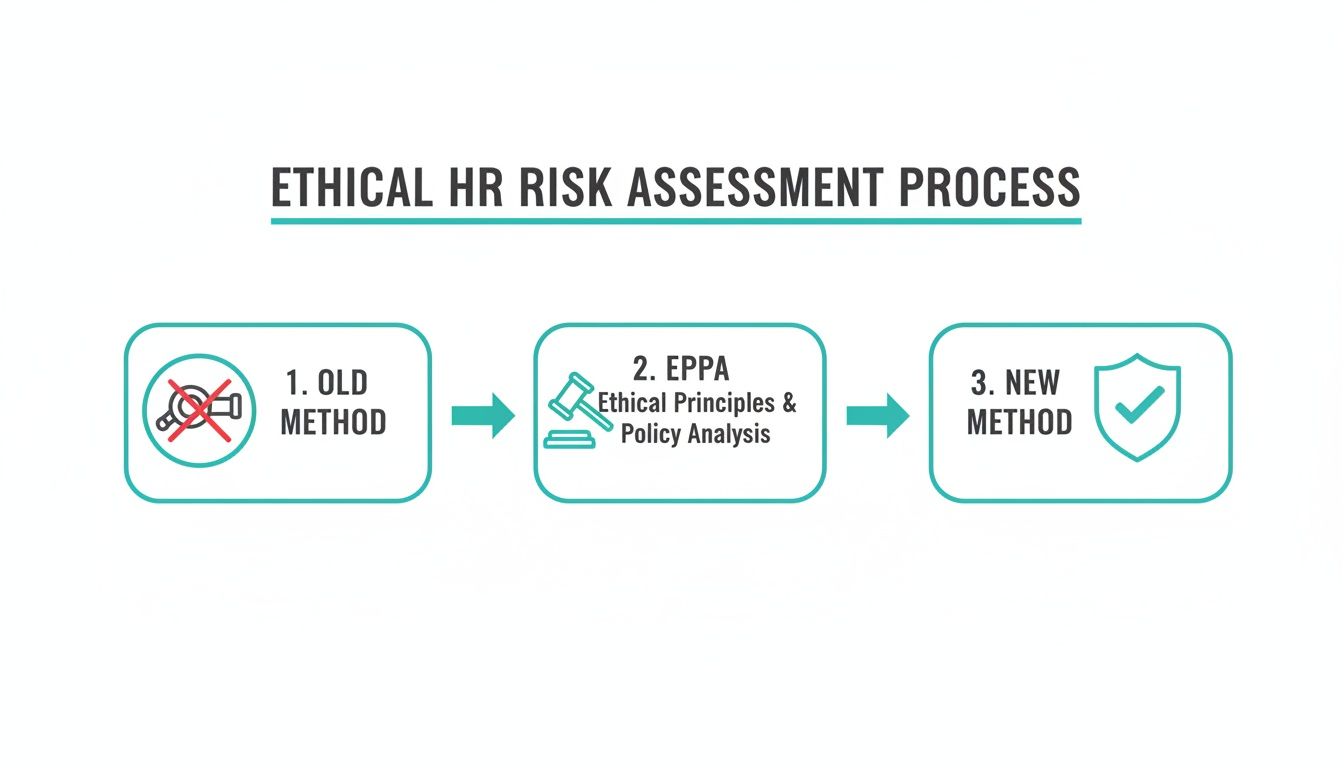
As you can see, the new standard is built on a foundation of governance, compliance, and ethical prevention. It’s about managing risk responsibly and getting ahead of problems before they start.
Using AI for Ethical, Non-Intrusive Insights
A modern AI-driven preventive risk management framework is incredibly effective at analyzing behavioral indicators without crossing ethical lines. Instead of monitoring employee communications—a practice that is both intrusive and legally treacherous—advanced platforms focus on objective, contextual data. The system isn't designed to "catch" people; it’s built to identify high-risk patterns that signal potential threats.
For instance, an AI-powered human risk mitigation system can detect things that a manual audit would miss:
Anomalous Data Access: An employee suddenly starts accessing sensitive files unrelated to their job, especially late at night.
Atypical Communication Patterns: A sudden, sharp increase in communication with external domains could signal data exfiltration.
Potential Conflicts of Interest: The system flags an undisclosed connection between an employee and a vendor during a procurement cycle.
This is the real value of AI in human risk mitigation. It delivers objective, data-backed alerts that give HR and risk teams the chance to intervene early and non-confrontationally. To dig deeper, check out our guide to AI-powered human risk management.
The power of this approach lies in its precision. Instead of treating everyone as a potential threat, it directs your attention to specific, high-risk situations, allowing for surgical, supportive interventions that solve problems before they escalate.
The Business Impact of Getting Ahead
Implementing a continuous, AI-driven risk assessment in HR delivers a return on investment that goes far beyond checking a compliance box. The business impact is tangible, creating a far more resilient and efficient organization.
First, you drastically cut the astronomical costs that come with reactive investigations. Formal inquiries are a massive drain on time, money, and morale, often costing hundreds of thousands of dollars and disrupting operations for months. By preventing incidents, you take those costs off the table entirely.
Second, you build a much stronger, more defensible compliance posture. With regulatory scrutiny on the rise, demonstrating a proactive, continuous risk monitoring process is concrete proof of due diligence. This can be a game-changer in mitigating penalties and protecting your organization’s legal standing.
Finally, this framework lets you resolve potential issues before they spiral into full-blown crises that can devastate your brand's reputation. It transforms HR and risk functions from reactive firefighters into strategic partners who actively protect the company's assets, culture, and future.
Why Traditional Workplace Investigations Are Failing
For decades, the go-to response for workplace misconduct has been a formal investigation. And while sometimes necessary, this reactive model is fundamentally broken as a primary strategy for managing internal risk.
Think about it: by the time an investigation kicks off, the damage—whether it's financial, cultural, or reputational—is already a reality.
This old-school approach keeps organizations stuck on defense, forcing them to pour massive resources into cleaning up messes that could have been prevented. Traditional investigations are notoriously slow, often dragging on for months. This paralysis grinds productivity to a halt and breeds a toxic atmosphere of suspicion and uncertainty. The cost and failure of reactive investigations are undeniable.
The Staggering Financial and Cultural Costs
The direct costs of an investigation are just the tip of the iceberg. Legal fees, settlement payouts, and regulatory fines can easily spiral into the hundreds of thousands, if not millions. But the hidden costs are often far more corrosive to a company’s long-term health.
These hidden costs pile up fast:
Lost Productivity: Key employees and managers get pulled away from their actual jobs to sit through interviews and gather evidence, disrupting critical business operations.
Damaged Morale: A formal investigation can shatter team dynamics and destroy trust between employees and leadership, leading to disengagement and higher turnover.
Reputational Harm: High-profile incidents don't just stay internal. They can tarnish a company’s brand, making it a struggle to attract top talent, keep customers, and maintain investor confidence.
Waiting for harm to occur before taking action is a high-stakes gamble that modern organizations simply can't afford to take anymore.
A reactive investigation is a clear sign that a risk assessment in HR has failed. It points to a breakdown in preventive controls and exposes the organization to massive liability that could have been spotted and mitigated much earlier.
A Rising Tide of Claims
This problem is only getting bigger. Recent data reveals that claims of discrimination, harassment, and retaliation have hit unprecedented levels, with companies now seeing an average of 14.7 issues per 1,000 employees.
The same research shows that many organizations still lack the robust processes needed to handle these claims effectively, leaving them dangerously exposed. Adopting a more structured, technology-driven approach is essential for managing this rising tide of workplace conflict. You can find more insights on effective employee relations practices on hracuity.com.
This surge in claims underscores the urgent need for a new standard of internal risk prevention.
The Proactive Alternative: The New Standard
The only sustainable solution is a fundamental shift in mindset—from reactive investigation to proactive prevention. This means moving toward non-intrusive, EPPA-aligned tools like Logical Commander's E-Commander / Risk-HR platform that can identify the early warning signs of potential misconduct, conflicts of interest, or fraud.
By spotting high-risk behavioral patterns before they escalate into formal incidents, HR and compliance teams can intervene early and non-confrontationally. This approach doesn't just prevent costly and damaging investigations; it builds a healthier, more transparent, and more resilient workplace culture. It's about solving problems before they begin, protecting both the organization and its people from unnecessary harm.
Common Questions About Modern HR Risk Assessment
When we talk about shifting from reactive investigations to proactive risk prevention, it’s natural for HR, Compliance, and Security leaders to have questions. This new approach is a big change, but it’s a necessary one. Here are some of the most common things we hear from professionals looking to adopt a smarter, more ethical strategy.
How Can We Assess Risk Without Spying on Our Employees?
This is the most important question, and the answer is simple: you stop focusing on content and start focusing on context.
Modern, ethical risk management has nothing to do with employee surveillance. It’s not about reading emails or listening to calls. Instead, a truly ethical, EPPA compliant platform analyzes metadata and behavioral patterns to spot high-risk indicators without ever touching personal communications.
Think of it this way: the system is designed to see what is happening (like unusual data access after hours or sudden transfers to a personal cloud drive), not who is saying what. This protects employee privacy completely while giving you the visibility you need to get ahead of serious internal threats like fraud or data theft.
What’s the Real Difference Between an Investigation and a Risk Assessment?
An investigation is what happens after the damage is done. It’s a costly, time-consuming scramble to figure out what went wrong and who to blame. It’s entirely reactive.
A proactive risk assessment in HR, on the other hand, is a strategic, preventive measure designed to identify and neutralize risks before they ever turn into incidents. It uses continuous, non-invasive analysis to flag vulnerabilities early, allowing you to step in with a quiet, non-confrontational intervention. The entire goal is to make costly investigations unnecessary.
How Does AI Help Without Just Automating Human Bias?
This is where a well-designed, ethical AI platform really shines. The right tool actually removes the human subjectivity that often creeps into manual reviews. Instead of relying on gut feelings or incomplete information, it analyzes huge datasets for objective, pre-defined risk indicators.
An ethically built AI is configured to look for high-risk actions and contextual clues, not personal or demographic traits.
For example, it might flag a potential conflict of interest because an employee is communicating excessively with a vendor who isn’t part of their normal workflow—a decision based purely on data relationships, not on the individual's background or identity.
By strictly adhering to guidelines like EPPA, an AI-driven tool ensures that assessments are fair, consistent, and laser-focused on protecting the business. This commitment to objective analysis is what turns risk assessment in HR from a compliance headache into a genuine strategic advantage. You build a safer, more equitable workplace where integrity is the default.
Ready to build a new standard for internal risk prevention? Logical Commander provides a non-intrusive, EPPA-aligned platform that protects your organization and your people before a risk becomes a crisis.
Request a demo to see our proactive internal threat detection in action.
Start a free trial and get platform access to experience the future of risk management.
Join our PartnerLC program and become an ally in ethical risk management.
Contact our team to discuss an enterprise deployment.