%20(2)_edited.png)

Beyond Reactivity: A Modern Guide to Internal Affairs Investigation Procedures

Updated: Dec 2, 2025
If your internal affairs investigation procedures only activate after an incident, your organization is operating on a fundamentally flawed and obsolete model. This reactive, forensic approach traps compliance, HR, and legal teams in a costly and damaging cycle of damage control, exposing the business to unacceptable financial, legal, and reputational liabilities.
For decision-makers in regulated industries, clinging to this outdated methodology isn't just inefficient—it's a direct threat to organizational stability and governance. The new standard is proactive, ethical prevention, not after-the-fact clean-up.
Why Legacy Internal Affairs Investigation Procedures Fail
In today's complex risk environment, waiting for a complaint to launch an investigation is a strategy guaranteed to fail. The moment an allegation of misconduct, fraud, or a compliance breach lands on your desk, you're already on the defensive. The subsequent investigation becomes an exercise in containing the fallout, not managing risk.
This reactive posture is a massive liability.

Legacy methods are inherently disruptive, expensive, and corrosive to employee morale. Traditional investigations, which often feel intrusive, create a culture of suspicion that undermines the very foundation of trust in leadership. More critically, they almost always begin too late to prevent the real harm, leaving your teams to manage the consequences instead of preventing the cause.
The New Standard: From Reactive Forensics to Proactive Prevention
The strategic pivot for modern risk and compliance leaders is away from this broken cycle. The new standard is an ethical, preventive framework focused on mitigating human-factor risk before it escalates into a crisis. This isn't about eliminating investigations; it's about drastically reducing the need for them.
This modern framework identifies the precursors to high-risk behavior without resorting to invasive surveillance or legally hazardous methods like lie detection. The core components are clear:
Focus on Human-Factor Risk: It acknowledges that internal threats are not a technology problem. They are a human problem, originating from human actions, decisions, and vulnerabilities.
Ethical & EPPA-Aligned: The methodology is built to be non-intrusive and fully compliant with the Employee Polygraph Protection Act (EPPA), completely avoiding surveillance, psychological pressure, or privacy violations.
AI-Driven Preventive Risk Management: It leverages AI-driven risk assessments to analyze objective patterns and identify anomalies that signal potential risks, giving decision-makers the early intelligence needed to act.
By understanding and addressing risk indicators early through an ethical, non-intrusive platform, organizations can protect their assets, reputation, and people without crossing legal or ethical lines.
Aligning Procedures with Modern Governance and Compliance
The current regulatory climate demands proactive and transparent processes. Agencies like the DOJ incentivize self-reporting and robust internal controls, making it clear that a proactive stance is not just valued but expected. See the latest on DOJ incentives for self-reporting misdeeds.
The goal is to transform your internal affairs function from a reactive, cost-intensive unit into a strategic asset. By integrating an AI-driven, EPPA-aligned platform like E-Commander, your Compliance, HR, and Security teams can finally build a culture of prevention, setting a new standard for effective, ethical risk management and reputation protection.
The Cost and Failure of Reactive Investigations
Waiting for an incident to trigger your internal affairs investigation procedures is a fundamentally broken strategy. By the time the alarm sounds, the damage is already done. This reactive approach doesn't just put you on the defensive; it guarantees a cascade of financial, operational, and reputational harm that can destabilize an organization.
The true cost of this outdated model extends far beyond direct expenses. It creates a destructive ripple effect that undermines business stability and exposes significant liabilities.
The financial bleed is the most immediate pain point. Direct costs—legal fees, regulatory fines, and settlements—can quickly escalate into six or seven figures for a single complex case. However, the indirect costs related to operational disruption and cultural decay inflict the most profound and lasting damage.

Business Impact: Operational Disruption and Cultural Decay
Investigations are messy and disruptive. Key personnel are pulled from their duties, productivity grinds to a halt, and operational momentum is lost. A lengthy investigation can derail critical projects and divert leadership's focus for months, creating significant internal friction.
This disruption is amplified by the corrosive effect on employee morale. Traditional methods, which often feel intrusive and accusatory, breed an atmosphere of suspicion and anxiety. This is where the real business impact lies:
Erosion of Trust: When employees feel they are under suspicion, trust in management evaporates. This poisons the corporate culture, making future collaboration and open communication nearly impossible.
Disengagement and Turnover: A workforce under a cloud of investigation is less engaged, less productive, and far more likely to seek opportunities elsewhere.
A Culture of Silence: Even a "by the book" investigation can deter others from raising concerns in the future, effectively silencing the very people you rely on for early risk identification.
This human-factor fallout turns a single incident into a systemic cultural problem, demonstrating the inherent failure of reactive models.
The greatest flaw in reactive models is that they are designed to assign blame after the fact, not to prevent harm in the first place. This posture leaves an organization perpetually vulnerable to the next internal threat.
The Hidden Liability of Non-Compliant Procedures
Many leaders overlook a critical liability: traditional investigative tools often operate in a legal gray area concerning regulations like the Employee Polygraph Protection Act (EPPA). Any method perceived as coercive, that applies psychological pressure, or resembles lie detection is not just unethical—it's legally hazardous.
An investigation that violates employee rights can trigger lawsuits, leading to massive penalties and reputational ruin. This turns a process meant to solve a problem into a significant liability. Explore a deeper analysis of this topic by reading our guide on the true cost of reactive investigations.
The business case for change is clear. Relying on after-the-fact investigations is a high-risk gamble. The cost of one failed investigation can dwarf the investment in a proactive, ethical risk management system that prevents incidents from ever reaching a critical stage. Proactive prevention isn't just a best practice; it's a strategic necessity that transforms internal affairs from a cost center into a powerful asset protecting the organization from within.
Navigating Global Threats within Your Internal Affairs Investigation Procedures
Your internal affairs investigation procedures can no longer be confined to internal policy violations. The modern risk landscape has shifted dramatically. What appears to be an isolated internal threat is often intertwined with sophisticated global networks, compelling compliance and security leaders to adopt a much broader perspective.
The rise of transnational risks, from economic espionage to complex financial crimes, means your internal vulnerabilities are now prime targets for external actors. A proactive, preventative approach is your only viable defense.
This paradigm shift invalidates traditional risk management. A seemingly minor case of employee misconduct could be the tip of an iceberg, masking a coordinated attack by a foreign entity or criminal syndicate. Old-school investigative frameworks, focused narrowly on internal infractions, are simply not equipped to detect these larger, more dangerous connections. You cannot afford to wait for an employee to make a catastrophic error before connecting the dots.
The Growing Influence of Foreign Actors on Insider Risk
External entities are increasingly the primary drivers of internal risk. This is not a theoretical threat; it's a measurable trend. These groups are patient, well-funded, and adept at exploiting human vulnerabilities to access intellectual property, financial systems, or sensitive data. Human-factor risk is the gateway.
The global landscape for organizational crime has transformed. Between 2021 and 2025, foreign actors represented the sharpest increase in criminal investigations, rising by 0.40 points on the Global Organized Crime Index scale. Financial crimes remain the most widespread criminal market globally in 2025, scoring 6.21, having seen the biggest expansion since 2023.
This data underscores a critical reality: your internal controls are now a frontline defense against global threats. A reactive investigation that begins only after a data breach or financial loss is not a defense—it's a confirmation of failure. It misses the critical window of opportunity to intervene when the risk is still manageable.
Connecting Global Standards to Local Defense
To counter these threats, your internal risk management must align with established global standards. This means building a framework that is robust enough to deter external attacks yet ethical enough to maintain internal trust and compliance. Proactive AI human risk mitigation is the core of this modern defense.
For a deeper dive, check out our guide on aligning global standards like ISO 27001 with AI-powered risk detection.
An ethically designed, AI-driven platform provides the early warnings needed to counter sophisticated threats. It does not spy on employees. Instead, it identifies high-risk patterns and behavioral anomalies that may suggest external influence or compromise. This is fundamentally different from reactive forensics.
It spots precursors: The system can flag indicators that an employee is being targeted for recruitment, such as unusual communication patterns or atypical access to sensitive data.
It provides context: Instead of just flagging a policy violation, it helps HR and security teams understand if an incident is a one-off mistake or part of a larger, more dangerous pattern.
It enables prevention: This early intelligence empowers leaders to intervene with supportive or administrative measures long before a full-blown, damaging investigation is necessary.
By focusing on the human factor, you can detect the subtle behavioral shifts that are often the first and only signs of a brewing external threat. This is the new standard for protecting an organization from the inside out.
Building EPPA-Compliant and Ethical Internal Affairs Investigation Procedures
Effective internal affairs investigation procedures cannot be built on a foundation of fear, suspicion, or legally questionable tactics. For any modern organization, establishing an ethical framework is not merely a matter of corporate responsibility—it's a critical defense against massive legal, financial, and reputational liability. The cornerstone of this framework is unwavering adherence to the Employee Polygraph Protection Act (EPPA).
Ignoring EPPA is a direct path to costly litigation, regulatory penalties, and the complete erosion of employee trust. Many traditional investigative methods, particularly those reliant on intrusive questioning or surveillance-like tools, operate in a dangerous gray area that directly conflicts with this crucial federal law. These methods are not just bad for morale; they are a business risk.

Ditching Legally Risky Methods for a Proactive, Non-Intrusive Alternative
The old playbook for internal investigations is a relic. Tactics that apply psychological pressure, secretly monitor employees, or profile individuals based on subjective behaviors are both ineffective and incredibly high-risk. These outdated approaches fail to address the root causes of human-factor risk and swing the door wide open for discrimination claims and privacy lawsuits.
The new standard moves in the opposite direction. It is built on principles that respect employee dignity and focus on objective, verifiable risk indicators—not subjective judgments. The approach is fundamentally non-intrusive, ethical, and, most importantly, preventive.
Key principles of an EPPA-compliant framework include:
Voluntary Participation: All interactions are based on consent. No coercion, no pressure.
Objective Analysis: The focus is on analyzing risk patterns from objective data, not attempting to interpret intent or state of mind.
Privacy by Design: The system is engineered to protect personal information, avoiding the collection of data not directly relevant to predefined risk indicators.
Transparency: The process and its purpose are communicated clearly, ensuring employees understand how risks are assessed without feeling they are under a microscope.
Adhering to these principles is non-negotiable. It’s worth taking the time to understand why EPPA compliance matters in human capital risk management to build a truly resilient process.
The goal is to create a system where risk is managed proactively and ethically. This preserves organizational trust while effectively mitigating threats, turning compliance from a constraint into a strategic advantage.
Comparing Investigative Models: The New Standard vs. The Old Guard
The difference between a traditional, surveillance-based model and a proactive, ethical one is stark. The former invites legal challenges and fosters a culture of distrust. The latter, the new standard of internal risk prevention, builds resilience and protects the organization from the inside out.
The following table contrasts these two approaches, highlighting the critical distinctions in compliance, ethics, and overall business impact.
Comparing Investigative Approaches and EPPA Compliance Risk
Attribute | Traditional Surveillance Models (Not The Standard) | Proactive & Ethical Model (The New Standard) |
|---|---|---|
Primary Focus | Reactive forensics and evidence gathering after an incident. | Proactive risk mitigation before an incident occurs. |
Methodology | Often involves monitoring, intrusive questioning, or methods that create psychological pressure (lie detection). | Relies on non-intrusive, AI-driven analysis of objective risk patterns. |
EPPA Compliance | High risk of non-compliance due to coercive methods that violate the law. | Designed for full EPPA alignment, avoiding all legally sensitive or invasive techniques. |
Employee Impact | Erodes trust, lowers morale, and creates an adversarial culture. | Preserves dignity, builds trust, and fosters a culture of shared responsibility. |
Business Outcome | Leads to costly investigations, high employee turnover, and significant legal and reputational liability. | Reduces the need for investigations, enhances operational stability, and protects brand reputation. |
By embracing a non-intrusive, EPPA compliant platform, you establish a new standard of risk management that protects both your people and your bottom line.
Using AI to Get Ahead of Risk in Your Internal Affairs Investigation Procedures
Traditional internal affairs investigation procedures are fundamentally reactive. They are designed to clean up a mess after it has already happened—an expensive, chaotic, and legally perilous approach to managing the human side of risk. The new standard in enterprise risk management flips this model, using technology to prevent incidents before they start.
This shift is driven by ethically applied AI, which functions as an early warning system, not a forensic tool. It is crucial to understand what this technology is not. It is not surveillance, secret monitoring, or a digital lie detector. An EPPA compliant platform like Logical Commander's E-Commander is built to identify objective risk patterns, never to make judgments about individuals.
By analyzing anonymized data for anomalies and specific risk indicators, this technology delivers continuous risk assessment without crossing ethical or legal boundaries. It is a tool for prevention, not policing.
From Reactive Forensics to Proactive Insights
Instead of waiting for a complaint to trigger an investigation, an AI-driven approach provides HR, Legal, and Security teams with the foresight to act before a problem escalates. This is not about predicting misconduct. It's about identifying the environmental and behavioral precursors correlated with a higher probability of human-factor risk.
A traditional investigation is like sifting through wreckage after a car crash. A proactive, AI-powered model is like a system that warns you of hazardous road conditions before you start your journey. It provides the intelligence needed to implement guardrails, offer support, or make administrative changes that mitigate the risk entirely.
This preventive capability is particularly vital against sophisticated internal threats like economic espionage. For example, law enforcement attributed as many as 80 percent of intellectual property theft cases to PRC-linked entities in 2021. An AI-based system can flag the subtle precursors—like unusual data access patterns—that a reactive investigation would only discover after the damage is done. A report from the Office of the Director of National Intelligence details these threats to U.S. national security.
Building a Stronger, More Ethical Ecosystem
Implementing this new standard of AI human risk mitigation is about more than technology; it's about building a more resilient and ethical culture. When risk management is perceived as a proactive, supportive function rather than a punitive one, it strengthens the entire organization.
This ethical, non-intrusive approach transforms risk management from a necessary evil into a strategic asset. It allows organizations to protect themselves from internal threats without sacrificing employee trust or dignity.
A unified platform like E-Commander is essential, centralizing risk intelligence and enabling HR, Compliance, and Security to work from the same objective data. Learn more about how advanced analytics are applied in our article on machine learning in fraud detection.
We are extending this new standard to our partners through the PartnerLC program. This initiative allows B2B SaaS companies and consultants to integrate our EPPA-aligned, AI-driven risk prevention technology into their own offerings. By joining our partner ecosystem, allies can provide their clients with a powerful, ethical alternative to outdated, reactive models, creating a collaborative front against insider risk.
Modernizing Your Strategy: The New Standard of Internal Risk Prevention
The final step is transforming your internal affairs investigation procedures from a reactive clean-up crew into a strategic, preventive asset. This is not about incremental improvements to an old playbook; it's a fundamental shift in mindset from after-the-fact forensics to proactive, ethical prevention. This evolution is the roadmap to establishing a new standard of internal risk prevention and safeguarding your organization from the inside out.
Transitioning to this model requires a clear, actionable blueprint. The first move is an honest evaluation of your current processes. Identify where your procedures create legal risks, foster a culture of fear, or fail to address the root causes of human-factor risk. Are your methods genuinely non-intrusive and fully aligned with EPPA? This assessment is critical for building a solid business case for a preventive model.
This process flow illustrates how AI modernizes your strategy, shifting the entire focus from reaction to prevention.
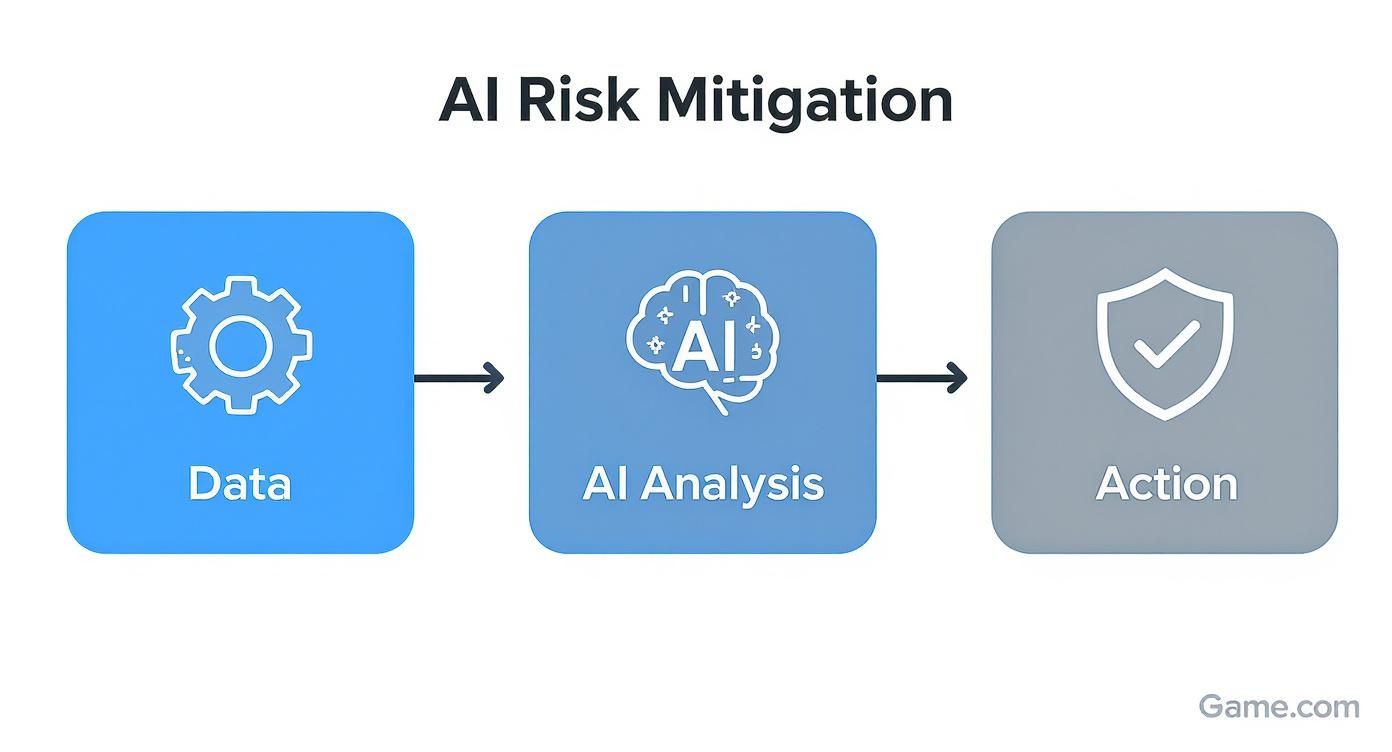
AI-driven risk mitigation moves from objective data analysis directly to actionable, preventive measures, bypassing the intrusive and legally hazardous methods of the past.
Your Action Plan for a Proactive Framework
Building a modern strategy requires a clear, multi-step approach to weave prevention into your organization's DNA. This plan will guide the transformation of your internal affairs function.
Audit Your Reactive Model's Failures: Analyze past investigations. How many could have been prevented with earlier intervention? Quantify the total costs—legal fees, operational downtime, and employee turnover—to highlight the failure points of your reactive procedures.
Eliminate EPPA Compliance Gaps: Scrutinize every tool and technique in your current arsenal. Anything that hints at surveillance, psychological pressure, or resembles lie detection creates an unacceptable liability and must be removed.
Centralize Risk Intelligence: Break down the silos between HR, Legal, Security, and Compliance. A unified Risk Assessments Software platform provides a single source of truth, enabling stakeholders to make coordinated decisions based on the same objective data.
Foster a Culture of Prevention: A proactive model requires a cultural shift. Train managers to use insights from an AI human risk mitigation system for supportive, administrative interventions—not punitive actions.
This proactive stance is crucial as internal threats grow more sophisticated. The escalation of internal affairs investigations within China's military since 2023 due to high-level corruption is a stark reminder of how internal vulnerabilities pose systemic risks. Discover more about these national security challenges on armedservices.house.gov.
Building Your Business Case for the New Standard
Armed with a clear audit of your current liabilities and a roadmap for change, you can build a powerful business case. Frame the adoption of a preventive model not as a cost, but as an investment in resilience, compliance, and organizational integrity. To enhance your digital evidence gathering within a compliant framework, consider leveraging ethical social media investigation tools that adhere strictly to privacy guidelines.
The ultimate goal is to transform your internal affairs function from a team that cleans up disasters to a strategic asset that prevents them, protecting both the organization and its people.
By embracing a non-intrusive, EPPA-aligned platform, you move beyond the limitations of outdated internal affairs investigation procedures. You establish a new standard of ethical risk management that enhances governance, protects your reputation, and builds a culture of integrity from the ground up.
Ready to shift from reactive investigations to proactive prevention? Logical Commander offers a new standard in ethical, non-intrusive internal threat management. Our AI-driven platform helps you mitigate human-factor risk before it becomes a crisis, all while ensuring full EPPA compliance.