%20(2)_edited.png)

Unethical Behavior at the Workplace: An AI-Powered Guide

Updated: Oct 14, 2025
Unethical behavior at the workplace isn't just about headline-grabbing scandals. It’s a spectrum of actions, from minor expense fraud to serious misconduct, that violate company policy and create significant financial and reputational risks. The real challenge is detecting these hidden threats before they escalate into a crisis. Traditional methods often fail, leaving organizations vulnerable. Logical Commander solves this by using ethical, non-intrusive AI to provide real-time risk indicators. Our E-Commander platform, featuring the Risk-HR solution, helps you see subtle behavioral patterns and address integrity risks proactively, all while upholding employee dignity and complying with EPPA, GDPR, and ISO 27K standards.
Unpacking the True Cost of Workplace Misconduct
When leaders think about unethical behavior, their minds often jump to major fraud cases. While those are certainly damaging, the more insidious threat often comes from the smaller, persistent issues that tend to fly under the radar.
Think about minor infractions like padding an expense report, misusing company time, or casually sharing sensitive information. On their own, they might seem trivial. But together, they're symptoms of a deeper cultural problem that can quietly erode trust, morale, and ultimately, your bottom line.
These subtle actions act like a hidden tax on your organization. They drain resources, poison team morale, and drive your best employees to leave toxic environments. Cumulatively, they snowball into significant financial losses and can expose the business to severe compliance penalties. The real challenge isn’t just reacting to major incidents; it’s about proactively identifying the patterns of behavior that signal a growing risk.
The Financial and Reputational Damage
Misconduct isn’t just an HR issue; it's a direct hit to the balance sheet. Research consistently shows that organizations lose a staggering 5% of their annual revenue to fraud each year. And that figure doesn't even touch on the indirect costs—the legal fees, regulatory fines, and the massive price tag of reputational damage in a world where bad news travels instantly.
The infographic below illustrates how these hidden costs ripple through a company, affecting everything from day-to-day efficiency to long-term brand perception.
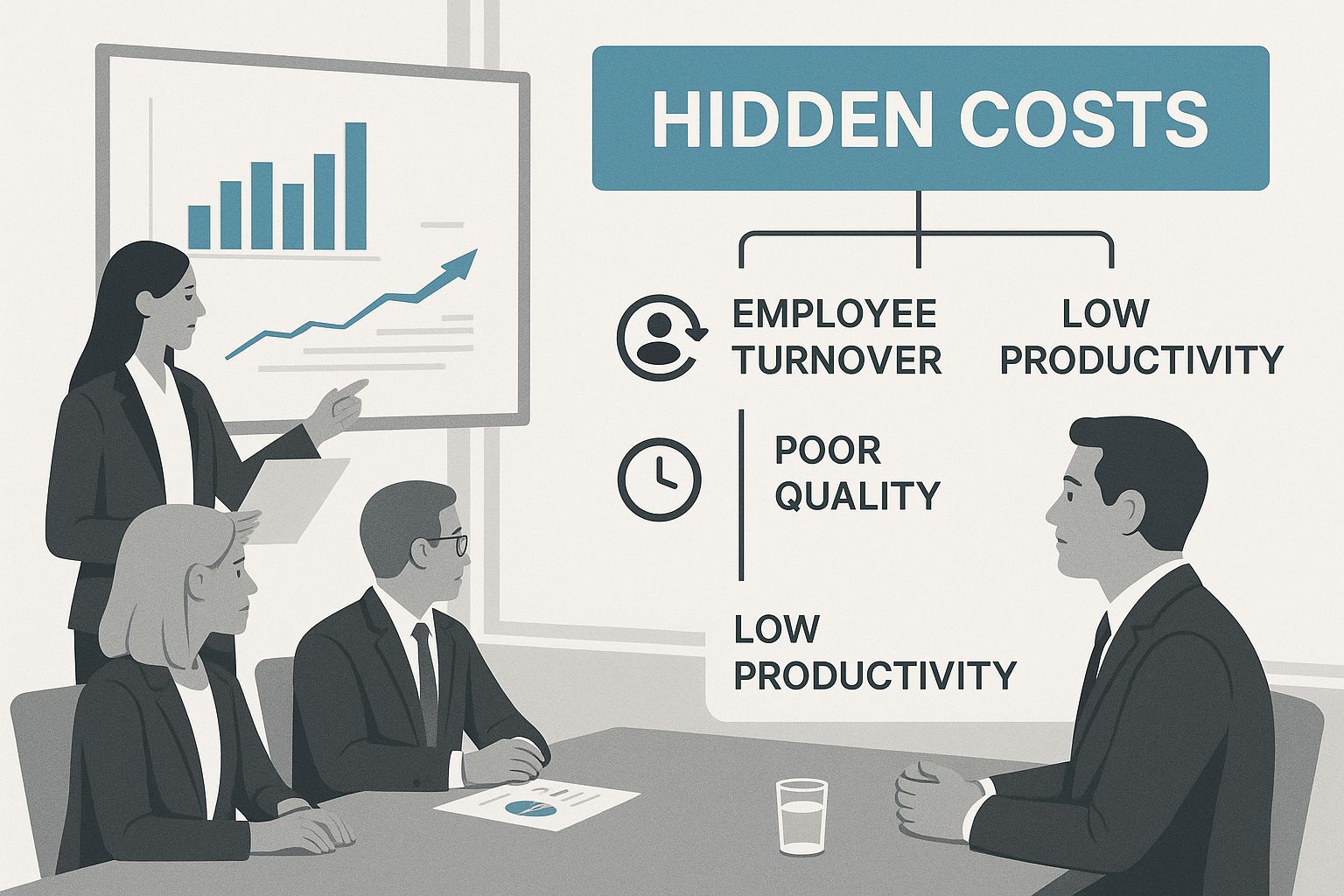
As you can see, the financial drain is just the tip of the iceberg. It leads to deeper cultural and operational decay that can cripple a company’s ability to grow.
This is exactly why a shift from a reactive to a preventive mindset is so critical. Instead of waiting for a crisis to unfold, leaders can use ethical AI to detect the earliest indicators of risk. Logical Commander's E-Commander platform, featuring our specialized Risk-HR solution, is designed to identify these subtle behavioral anomalies. Our non-intrusive, privacy-first technology helps you understand and address risks before they escalate, reinforcing a culture of integrity without compromising employee dignity. You can learn more by exploring the ROI of proactive risk detection.
Ready to protect your organization from hidden risks? Request a demo to see how our ethical AI can strengthen your compliance and integrity framework.
Understanding the Spectrum of Unethical Behavior
When we talk about unethical behavior at the workplace, it’s tempting to picture the big, headline-grabbing scandals. Massive fraud. Public harassment lawsuits. But those are just the tip of the iceberg.
For every major incident that breaks the surface, there's a huge mass of subtle, corrosive behaviors hidden from view. This is where the real danger lies.

This iceberg model is critical for any leader in HR, compliance, or security. It reframes the challenge from simply reacting to disasters to proactively seeing the whole picture. The goal is to spot the cracks in the ice before they become catastrophic breaches.
Common Types of Unethical Workplace Behavior and Their Impact
To really grasp the scope of the problem, it helps to break down the different forms that unethical conduct can take. Each category carries its own unique threat, impacting everything from the balance sheet to team morale.
Here’s a look at the most common categories, what they look like in practice, and the damage they can cause.
Category of Behavior | Specific Examples | Primary Organizational Impact |
|---|---|---|
Financial Misconduct | Padding expense reports, time theft, procurement fraud, embezzlement. | Direct financial loss, weakened internal controls, erosion of shareholder trust. |
Interpersonal Misconduct | Bullying, harassment, discrimination, gossip, creating a hostile environment. | High employee turnover, decreased productivity, legal liability, damaged employer brand. |
Misuse of Assets & Information | Using company equipment for a side business, sharing confidential data, violating customer privacy. | Data breach risks, non-compliance fines (GDPR/CPRA), intellectual property loss. |
Conflicts of Interest | Favoring a vendor run by a family member, accepting inappropriate gifts, hiding personal investments. | Compromised decision-making, reputational damage, legal and regulatory scrutiny. |
Understanding these distinctions is the first step toward building a truly resilient defense. It’s about recognizing that a seemingly minor policy violation could be an early tremor, signaling a much larger problem on the horizon.
Moving Beyond Punishment to Integrity Alignment
The old way of thinking was about catching people doing wrong. The modern approach is about creating an environment where doing the right thing feels like the only natural choice. This is integrity alignment—proactively ensuring that employee actions are always in sync with the company’s core values.
This is where Logical Commander’s technology makes a real difference.
Our E-Commander platform, powered by the Risk-HR solution, was built on a privacy-first design (ISO 27K, GDPR, CPRA). It uses ethical & non-intrusive AI (EPPA-compliant) to analyze behavioral patterns and flag risk indicators—without ever reading personal emails or violating employee dignity.
By detecting subtle shifts away from your ethical baseline, our platform gives HR, Compliance, and Security a unified view of organizational health. It enables true cross-department collaboration, allowing leaders to see the whole iceberg and act before a small problem becomes a crisis.
Actionable Insight: Start by mapping your organization’s most common "below the surface" risks. Talk to your team leads. Ask them about the subtle pressures and gray areas their people face every day. Use that intel to build policies that address real-world challenges, not just generic compliance checkboxes.
This proactive, human-centric approach is the key to building an organization that isn't just compliant, but genuinely ethical from the inside out. For more details on specific actions, understanding the facts around employee theft in the workplace can provide valuable context.
Ready to gain visibility into your organization's hidden risks? [Request a demo](https://www.logicalcommander.com/demo) of E-Commander to see how our ethical AI can safeguard your culture.
Digging into the Real Roots of Misconduct
To stop unethical behavior, you have to look past the individual and see the system that pushed them there. Misconduct rarely just happens; it's almost always a symptom of deeper problems inside the organization. Figuring out these root causes is the only way to build a culture that's genuinely resilient.
Many companies unintentionally create environments where cutting corners feels like the only way to survive. When the pressure to hit a number is overwhelming and the ethical lines are blurry, even good people can get pushed into making bad decisions.
Pressure Cooker Cultures and the Fallout
High-pressure workplaces are a huge driver of misconduct. When performance targets are nearly impossible or the culture is "win at all costs," the boundary between healthy ambition and unethical choices gets dangerously thin.
This pressure can come from a few key places:
Aggressive Sales Quotas: Pushing teams to hit unrealistic numbers often leads to fudged reports or misleading customers.
Fear of Failure: A culture that punishes mistakes instead of treating them as learning opportunities will find employees hiding problems, not solving them.
Misaligned Leadership: When leaders celebrate short-term wins over long-term integrity, they send a loud and clear message: ethics can take a backseat.
These factors mix together to create a perfect storm where employees feel they have no option but to bend the rules just to keep their jobs.
The bottom line: Unethical behavior is often a completely rational response to an irrational system. By finding and fixing these systemic pressures, you can address the cause of misconduct, not just the symptoms.
A Real-World Scenario of Unchecked Pressure
Picture a star sales team at a fast-growing tech company celebrated for consistently crushing their targets. Leadership, eager for more growth, kept setting increasingly aggressive quarterly goals with huge bonuses tied to those numbers. The pressure became suffocating. To keep up, the team started logging product demos that never happened and marking deals as "closed" weeks early to inflate their figures. For months, this went unnoticed. Eventually, an internal audit blew the lid off the scheme. The fallout was catastrophic: a major restatement of earnings, massive regulatory fines, and a complete collapse of investor confidence. The company's reputation was destroyed not by a few "bad apples," but by a system that made cheating the path of least resistance.
How Ethical AI Spots Systemic Risk Before It Breaks
An AI-powered risk management platform like Logical Commander’s E-Commander is built to spot these early warning signs of systemic pressure. Our ethical & non-intrusive AI (EPPA-compliant) analyzes communication patterns and behavioral indicators to find anomalies linked to high-risk environments—all without ever reading content or invading employee privacy.
For example, the system might flag a sudden spike in late-night activity centered on sales reporting. Or it might notice an unusual pattern of communication between specific team members right before the end of the quarter. These aren't proof of wrongdoing. They are, however, critical risk indicators that give leaders a chance to step in and ask questions before things go off the rails.
With our Risk-HR solution, HR and Compliance teams get a holistic view of the organization's health. This allows for powerful cross-department collaboration between HR, Compliance, Security, and Legal to address cultural rot before it turns into a full-blown crisis.
Here are a few actionable insights you can apply right now:
Check Your Incentives: Are your bonus structures accidentally rewarding bad behavior? Realign them to include metrics for ethical conduct and teamwork.
Get Proactive with Monitoring: Use an ethical AI solution for real-time detection of systemic risks. This lets you address pressure points before they lead to misconduct.
By focusing on the root causes, you can stop playing defense and start building a proactive strategy that creates a truly resilient and ethical organization.
Ready to see the early warning signs of risk in your organization? [Request a demo](https://www.logicalcommander.com/demo) to learn how E-Commander provides real-time detection and measurable ROI.
How Unchecked Misconduct Damages Your Business
Ignoring unethical behavior at the workplace is like leaving a small fire to smolder in a corner of the building. At first, it might seem small—a minor issue you can deal with later. But left unchecked, that fire quietly spreads, weakening the structure and filling the halls with toxic smoke until it engulfs the entire organization in a blaze that’s impossible to control.

The consequences of misconduct ripple out far beyond the initial act. They create a cascade of damage that hits every part of your business, from team morale straight to your bottom line.
The Erosion of Employee Trust and Morale
When employees see bad behavior go unaddressed, their trust in leadership evaporates. They start to question if the system is fair and wonder if the company’s stated values are just words on a wall. This is how a toxic environment takes root, sending morale plummeting and disengagement skyrocketing.
A culture of impunity sends a clear message: the rules don't apply to everyone. This kicks off a domino effect:
Productivity drops: Disengaged employees are less motivated. Their output and quality suffer.
Turnover increases: Your best performers—the ones with strong ethical compasses—are often the first to head for the exit, tired of working in a compromised environment.
Collaboration falters: Trust is the glue that holds teams together. Without it, communication breaks down and silos form as people start looking out for themselves.
This internal decay is the "toxic smoke" from the fire. It makes it harder for everyone to breathe, focus, and do their best work.
The Lasting Stain of Reputational Damage
In our hyper-connected world, a company’s reputation is one of its most valuable—and fragile—assets. A single, well-publicized ethical failure can destroy years of hard work building a trusted brand.
The damage isn't just external, either. A tarnished reputation makes it incredibly difficult to attract and retain top talent. The best candidates want to work for companies they can feel proud of, and a history of misconduct is a massive red flag. This directly impacts your ability to innovate and compete.
Unethical behavior is a debt that accrues interest over time. The longer it goes unaddressed, the higher the price you'll ultimately pay in lost talent, customer trust, and market position.
The Soaring Costs of Legal and Compliance Failures
Beyond the cultural and reputational harm, the financial penalties can be severe. Regulatory bodies are cracking down on corporate misconduct harder than ever.
Take workplace harassment, for instance. In 2023, the U.S. Equal Employment Opportunity Commission (EEOC) recovered around $664 million for workers, a staggering 30% increase from the previous year. And the most severe forms of misconduct, such as violence, cause irreparable harm, which is why it's critical to know how to prevent workplace violence.
This is where proactive tools become an essential investment, not just another cost. Platforms like Logical Commander's E-Commander and Risk-HR are designed to help you spot the smoldering embers before they become a raging fire.
Our ethical & non-intrusive AI is fully EPPA-compliant and analyzes behavioral risk indicators without ever violating employee privacy. By providing real-time detection of anomalies that signal growing risks, our platform empowers cross-department collaboration between HR, Legal, and Security. This allows you to address issues head-on, reinforcing your commitment to a safe and ethical workplace.
Actionable Insights You Can Apply:
Conduct a Cultural Health Check: Use anonymous surveys to regularly gauge employee perceptions of fairness, trust in leadership, and their comfort with reporting concerns.
Review Your Reporting Channels: Are your reporting mechanisms truly accessible, confidential, and free from the fear of retaliation? If reporting numbers are low, it might signal a lack of trust, not a lack of problems.
Don't wait for the fire to spread. [Request a demo](https://www.logicalcommander.com/demo) to see how our ISO 27K, GDPR, and CPRA compliant platform can help you protect your business from the inside out.
Using Ethical AI for Proactive Detection
Most companies deal with unethical behavior at the workplace after the fact. It’s a reactive approach that only kicks in once the damage is done—like having a fire alarm that only sounds after the building is already engulfed in flames. To get ahead, you need a modern, proactive strategy that can spot the earliest signs of risk without compromising employee privacy or creating a culture of constant surveillance.
This is where ethical AI completely changes the game. Instead of intrusive monitoring, advanced platforms analyze anonymized metadata and communication patterns to flag anomalies that correlate with internal risks. The key is that it's not about what is being said, but how and when communication happens. This technology never gets into surveillance or "truth verification," which are activities restricted by regulations like the EPPA. It's built to identify subtle shifts in behavioral indicators that signal potential integrity issues.
Privacy-First by Design
When you're dealing with sensitive workforce data, trust is everything. That’s why a privacy-first design isn't just a feature; it's the entire foundation of ethical AI. This commitment is backed by adherence to some of the world's most demanding standards.
Logical Commander's platform is built from the ground up to be compliant with:
ISO 27001 / 27701: These certifications are our proof of commitment to the highest global standards for information security and privacy management.
GDPR and CPRA: We ensure all data processing respects strict global privacy rights, giving you total confidence in your compliance posture.
EPPA (Employee Polygraph Protection Act): Our ethical & non-intrusive AI operates well within the legal lines drawn to protect employee rights, focusing on objective risk indicators, not personal judgments.
This strict, privacy-centric framework is what sets this approach apart, ensuring you can manage risk responsibly and ethically.
Demystifying AI in Risk Management
Putting AI to work for risk detection might sound complex, but its application is actually quite straightforward. Think of it as a sophisticated smoke detector for your company culture. It doesn't listen to the conversations in a room, but it can detect subtle changes in the air that signal a potential fire.
By analyzing anonymized patterns—like a sudden spike in after-hours communication between specific departments just before a major announcement—it can flag a potential risk for insider exposure without ever knowing the content of a single message.
This gives HR, Legal, and Compliance teams a unified, objective set of data points to work from, enabling true cross-department collaboration to get ahead of issues.
Real-World Scenario: A financial services firm saw a gradual rise in high-value transactions being processed by a small, isolated team late at night. An ethical AI system flagged this as a deviation from normal operational patterns. Instead of launching an invasive investigation, leadership used the insight to review their internal controls. They found a procedural gap creating unnecessary risk and fixed the process, not the people—preventing potential fraud before it even had a chance to happen.
Here are a few actionable insights you can apply right away:
Integrate AI Risk Indicators: Connect the insights from an AI compliance software like E-Commander directly into your existing HR workflows. If the AI flags a high-pressure environment in a team, HR can proactively offer support and resources, tackling the root cause before it leads to misconduct.
Focus on Measurable ROI: Track how proactive detection reduces investigation costs, cuts down on employee turnover in high-risk areas, and helps avoid potential compliance fines. This data shows the clear, measurable ROI that comes from investing in an ethical AI platform.
Ready to shift from reactive damage control to proactive risk prevention? [Request a demo](https://www.logicalcommander.com/demo) to see how E-Commander’s ethical AI provides real-time detection capabilities.
Building a Lasting Culture of Integrity
Technology is a powerful tool, but a truly resilient defense against unethical behavior at the workplace is built on a strong organizational culture. Creating an environment where integrity is the default takes more than just writing policies; it demands active leadership, transparent systems, and a genuine commitment to ethical principles, starting from the very top.
This is the final and most crucial step—moving from just reacting to problems to proactively building a culture that prevents them from happening in the first place. A culture of integrity doesn’t happen by accident. It's intentionally designed, nurtured, and reinforced through consistent actions and clear communication at every level.
Establishing Trust Through Clear and Safe Reporting
One of the biggest obstacles to fixing misconduct is fear. Employees who see something wrong often stay silent because they don’t trust the reporting process or, worse, fear retaliation. Building psychological safety isn’t just a nice-to-have; it’s non-negotiable for any organization serious about ethics.
This means you need multiple, clearly communicated channels for reporting concerns—some anonymous, some direct—so people can choose the method they feel most comfortable with. But just having the channels isn't enough. Your team must have confidence that their reports will be taken seriously, handled fairly, and won't come back to bite them.
A recent report drove this point home, finding that more than half (52%) of Gen Z employees have witnessed workplace harassment. Yet, only 51% of all respondents were willing to report an incident if they had to attach their name to it. These numbers reveal a deep-seated lack of trust in traditional reporting systems, which you can read more about in the full state of workplace harassment report.
Fostering Collaboration Across Departments
Silos are the enemy of good governance. When HR, Legal, Compliance, and Security all work in their own bubbles, critical risk signals get missed, and a cohesive response becomes nearly impossible. True integrity demands a unified approach where these departments share insights and collaborate on strategy.
This is where a unified platform becomes absolutely essential. Logical Commander’s E-Commander provides cross-departmental risk dashboards that demolish these silos. By pulling risk indicators from various sources into one place, it gives every stakeholder—from HR to Legal—a single, real-time view of the organization's health. This shared intelligence enables a collaborative governance model where teams can finally connect the dots and act as one.
By unifying data and workflows, organizations can shift from a fragmented, reactive stance to a synchronized, proactive strategy. This collaborative framework ensures that insights lead to coordinated action, strengthening the entire ethical infrastructure.
Here are a few ways to start fortifying your culture today:
Lead by Example: Leadership has to walk the walk. When leaders openly discuss ethical dilemmas and choose integrity over short-term wins, it sends a powerful message that values actually matter here.
Provide Continuous Training: Ditch the annual check-the-box ethics training. Instead, implement ongoing, scenario-based education that helps employees navigate real-world gray areas and reinforces their role in upholding company values. You can read more about the cultural ROI of integrity in our dedicated article.
Ultimately, building a lasting culture of integrity is an ongoing process of aligning your technology, policies, and people. By fostering transparency and enabling collaboration, you create an environment where ethical conduct is not just expected but woven into the very fabric of your organization.
Ready to unify your risk management and build a stronger ethical culture? [Request a demo](https://www.logicalcommander.com/demo) to see how E-Commander's cross-departmental dashboards can empower your teams.
Conclusion
Detecting and preventing unethical behavior at the workplace requires a shift from reactive punishment to proactive integrity alignment. Traditional methods often miss the subtle, systemic risks that cause the most damage over time. By leveraging ethical AI, organizations can gain real-time visibility into cultural health without compromising employee privacy. Logical Commander’s E-Commander platform provides the tools for cross-departmental collaboration, enabling HR, Compliance, and Security to address root causes before they escalate. This human-centric approach builds a resilient culture, protects your reputation, and delivers a measurable return on integrity.
Start your free trial of E-Commander today and see the future of ethical risk management.
Know First. Act Fast. Ethical AI for Integrity, Compliance, and Human Dignity.
Article created using [Outrank](https://outrank.so)