%20(2)_edited.png)

A Modern Conflict of Interest Policy Template

Updated: Dec 9, 2025
Here is a foundational conflict of interest policy template you can put to work right away. Think of it as a strong starting point for just about any organization. It covers all the essential definitions, procedures, and responsibilities you need to protect your company’s integrity and keep decision-making clean and ethical.
Your Foundational Conflict of Interest Policy Template
Establishing clear, documented guidelines is the single most important step in managing conflicts of interest. Without a formal policy, you’re leaving your team to navigate complex ethical situations on their own—a move that can expose your organization to some serious financial, legal, and reputational risks. This template gives you a robust framework you can adapt to your specific business needs.
Before we dive into the full text, it helps to understand the "why" behind each section. A well-built policy is much more than a list of rules; it's a practical guide that empowers your team to act with integrity.

Key Components of Your Conflict of Interest Policy
To give you a quick flyover, the table below breaks down the essential sections included in the template and why each one is so critical for an effective policy. Understanding these building blocks will make it much easier to customize and implement the document later on.
Policy Section | Core Purpose |
|---|---|
Purpose & Scope | Clearly states why the policy exists and who it applies to (e.g., all employees, contractors, board members). |
Definitions | Defines key terms like "Conflict of Interest," "Immediate Family," and "Financial Interest" to eliminate ambiguity. |
Employee Responsibilities | Outlines the duty of every individual to recognize, avoid, and disclose potential conflicts. |
Disclosure Process | Provides a step-by-step procedure for employees to formally report any actual, potential, or perceived conflicts. |
Review & Resolution | Describes how the organization will review disclosures and determine the appropriate course of action, such as recusal. |
Consequences for Violation | Specifies the disciplinary actions that may result from failing to disclose a conflict or violating the policy. |
Getting these core components right is what turns a document into a functional tool for your business.
Key Takeaway: A conflict of interest policy isn't about policing your people. It’s about creating a transparent environment where potential issues can be flagged and handled proactively, protecting both the individual and the organization from harm.
Why This Document Is Non-Negotiable
These policies have become a cornerstone of modern corporate governance for a reason. In fact, 87% of Fortune 500 companies have a formal conflict of interest policy, and 72% require annual disclosures from their employees. The data tells a compelling story: organizations with robust policies see 30% fewer regulatory fines and a 25% reduction in internal investigations. This highlights a direct link between clear guidelines and reduced risk.
This proactive approach is crucial. It’s not just about compliance; it’s about building a culture of trust and fairness from the ground up. When everyone understands the rules of the road and feels safe reporting potential issues, you create an environment where ethical behavior is simply the norm.
The full template below is designed to help you build that foundation. If you're looking for more inspiration, you can also check out our detailed guide on conflict of interest policy examples.
For another look at how to structure a foundational policy in a different but equally critical area, this template data protection policy guide is a great resource. It really showcases how clear documentation can be applied to other areas of risk management.
Now, let’s get to the full template text.
Getting the Template Dialed In for Your Business
A conflict of interest policy template is a fantastic jumping-off point, but its real value is unlocked when you customize it. A generic document can easily miss industry-specific risks and, just as importantly, fail to capture your company’s unique culture. Tailoring the policy isn't just a best practice—it's what turns a standard document into a functional tool that genuinely protects your organization.
This process is about more than just slotting in your company name. It's about thinking critically about the real-world situations your team members, managers, and board members actually face. A policy that feels disconnected from the day-to-day reality of your business will be ignored and forgotten.
The goal here is to craft a document that is both legally solid and practically useful—a guide people can actually turn to when they hit a tricky ethical gray area.
Refining Key Definitions for Your Context
The definitions section is the bedrock of your entire policy. Vague terms are a recipe for confusion and inconsistent enforcement. Your first job is to sharpen these definitions to kill any ambiguity and make them fit your business environment.
Take the term “Immediate Family.” For a small, family-owned business, this definition might need to be pretty broad, maybe including cousins, in-laws, and domestic partners. On the other hand, a large public corporation might stick to a narrower definition—spouses, parents, and children—just to keep the scope manageable.
Another critical one is “Significant Financial Interest.” What does that actually mean for your employees?
For a financial services firm, holding even a tiny amount of stock in a client's company could be a big deal.
In a manufacturing business, the threshold might be much higher, perhaps defined as owning more than 5% of a supplier's equity or receiving an annual payment over a specific dollar amount.
Pro Tip: Don't just copy and paste legal jargon. Sit down with your leadership team and legal counsel to set clear, practical thresholds that make sense for your industry and the financial realities of your people. This clarity prevents a world of misunderstandings down the road.
Defining the Scope: Who Is Covered?
Once your definitions are crystal clear, you have to decide who the policy actually applies to. A common mistake is stopping at full-time employees, which leaves some serious gaps in your risk management. Your policy’s reach should be as broad as your organization’s sphere of influence.
Think about everyone who acts on your company's behalf:
Full-Time and Part-Time Employees: This is the obvious starting point.
Independent Contractors and Consultants: These folks often get access to sensitive information and can make decisions that impact the company.
Board of Directors: As fiduciaries, their duty of loyalty is absolute, making their inclusion essential.
Volunteers and Interns: Even unpaid personnel can land in situations that create real or perceived conflicts.
By clearly stating who is covered, you eliminate the "I didn't know it applied to me" excuse. Everyone understands their responsibilities from the get-go.
Customizing Clauses for Real-World Risks
Beyond definitions and scope, the real customization happens in the specific rules you lay out. Your business faces unique pressures and temptations, and your policy needs to address them head-on. Generic clauses often fall short when it comes to the nuanced scenarios your team will actually encounter.
Here are a few common clauses you can add or tweak to fit your reality:
Accepting Gifts and EntertainmentInstead of a fuzzy rule against "excessive" gifts, set a hard monetary limit (e.g., $100 annually from any single vendor). Be specific about what’s okay and what’s not. For example, you might allow a business lunch but prohibit tickets to a major sporting event.
Outside Employment or "Moonlighting"Decide whether employees can take on second jobs. Your policy could require employees to disclose any outside work, especially if it's in the same industry or could compete with your business. This prevents divided loyalties and ensures their primary commitment is to your company. You can learn more by reading our guide to managing conflict of interest for employees, which offers deeper insights into this topic.
Relationships with CompetitorsWhat happens if an employee's spouse works for a direct competitor? The policy should require disclosure of these relationships. It doesn't automatically mean the employee is disloyal, but it gives the company a chance to put safeguards in place, like restricting their access to sensitive strategic plans.
By thoughtfully adapting these pieces, you create a conflict of interest policy that isn't just a document, but a living guide that actively strengthens your organization's ethical foundation.
Putting Your Policy to the Test with Real Scenarios
A policy document, no matter how well-crafted, is just words on a page until it meets the messy reality of human behavior. This is where your conflict of interest policy template comes to life. Walking through real-world scenarios is how you turn abstract rules into practical, actionable knowledge for your entire team.
Abstract principles are easy to forget, but people remember stories and concrete examples. Analyzing these situations helps employees and managers build the "ethical muscle memory" they need to spot and shut down conflicts before they escalate into serious problems.
Scenario One: The Vendor Connection
Let's start with a classic. Your marketing manager, Sarah, is in charge of picking a new digital ad agency for a huge campaign. One of the top contenders is an agency where her husband just landed a job as a senior account executive. Their proposal is strong, the price is right, and Sarah genuinely thinks they might be the best fit.
The Conflict: This is a textbook potential conflict of interest. Sarah's personal relationship with a key employee at the vendor could sway her professional judgment—or, just as damaging, create the perception of favoritism among other bidders and her own team.
Correct Procedure: According to the policy, Sarah’s first move is immediate disclosure. She must tell her direct supervisor and the compliance officer in writing, explaining the relationship. The next crucial step is recusal; Sarah has to be removed from the decision-making process for selecting this agency to guarantee impartiality.
This proactive approach protects both Sarah and the company. It allows the procurement process to move forward with integrity and kills any doubt about the final decision's fairness.
Key Insight: The point of disclosure isn't to punish the employee. It's about managing the situation with transparency. Recusal is a standard, healthy outcome that protects the business decision without questioning the employee's intentions.
Scenario Two: Hiring a Relative
David, a department head, has an open junior analyst spot on his team. His nephew, a recent graduate with a relevant degree, applied for the job. After looking at his nephew’s resume, David is convinced he’s a qualified candidate and thinks it would be a great opportunity for him.
The Conflict: This is a form of nepotism, a practice that destroys fair hiring and can seriously poison team morale. Even if the nephew is the most qualified person for the job, David's involvement creates a perceived conflict that can breed resentment and trigger claims of unfair treatment from other applicants and current employees.
Correct Procedure: David must immediately disclose the family connection to HR. He then has to recuse himself completely from the hiring process for this specific role. That means no screening resumes, no conducting interviews, and no part in the final selection. A neutral manager must take over the evaluation of all candidates, including his nephew, to ensure the decision is purely merit-based.
The Real-World Stakes of Mismanagement
These scenarios aren't just academic exercises; they represent huge business risks. A 2022 report from Transparency International found that 63% of companies had at least one conflict of interest incident in the past year, with 41% of those incidents causing financial or reputational damage.
Even more telling, the U.S. Department of Justice reported that between 2018 and 2022, 37% of corporate enforcement actions involved conflict of interest allegations, with an average penalty of $1.2 million per case. You can explore the full report for more insights into global corruption trends.
When these situations are mismanaged, the fallout can be severe, leading not just to financial penalties but also to complex and disruptive internal reviews. For a deeper dive into the procedural side of things, check out our guide on how to conduct employee investigations for proactive risk management.
Scenario Three: The Lavish Gift
Your lead salesperson, Mark, is in the final stages of negotiating a major contract. Suddenly, a high-end smartwatch arrives at his home from the potential client, sent as a "thank you" for his hard work. Mark is caught off guard. He doesn't want to offend the client, but accepting such an expensive gift feels wrong.
The Conflict: Accepting a valuable gift from someone you're actively negotiating with creates a sense of obligation, intended or not. It's a perceived conflict of interest that could suggest the contract was won through improper influence, not on the merits of your company's proposal.
Correct Procedure: Mark should not accept the gift. He must immediately report the offer to his manager, detailing the item and its estimated value. Following the policy, he should politely decline, explaining that company rules prohibit employees from accepting gifts beyond a nominal value to maintain fairness and transparency in all business dealings. This response reinforces the company’s ethical standards and protects its reputation.
Rolling Out Your Policy for Maximum Impact
You've built a solid conflict of interest policy template. That's a huge step, but the document itself is just the starting point. The real test is the rollout. A policy that just sits on a shared drive offers zero protection; its power comes from being understood, accepted, and woven into your company’s daily operations.
A successful implementation isn’t about scaring people into compliance. It's about clear communication, practical training, and building a culture where transparency feels normal, not risky. The goal is to make this policy a living, respected part of how your business runs.
The Communication and Training Strategy
How you introduce the policy sets the tone for its entire life. Just sending out an email with a PDF attachment is a surefire way to get it ignored. What you need is a real communication plan that explains the "why" behind the policy, not just the "what."
Employees have to see this as a tool for their own protection, not just another corporate mandate from on high. Frame it as a guide to help them navigate tricky situations while protecting their professional integrity.
When it comes to training, skip the dry legal slideshows. Instead, build interactive sessions around the real-world scenarios we've already covered. This is how you connect the policy’s principles to people’s actual jobs.
For Managers: Their training needs to focus on their specific responsibilities. They are your first line of defense, so give them the tools to answer team questions, spot potential conflicts, and handle initial disclosures with confidence.
For All Employees: Hammer home the practical steps for disclosure. Make it crystal clear who to talk to and what the process looks like. Your job is to demystify everything and make reporting feel safe and straightforward.
When you're thinking about the rollout, it helps to look at how other policies are put into practice. The core principles of clear communication and consistent enforcement are universal, much like when you're deploying other critical internal guidelines like a BYOD Policy. The lesson is always the same: a policy only works if people know about it and see it in action.
Policy Implementation Checklist
A structured rollout makes sure nothing critical gets missed. This checklist will guide your launch from the first approval to full company-wide integration, ensuring your new conflict of interest policy is implemented smoothly and effectively.
Phase | Key Action | Status |
|---|---|---|
Preparation | Secure final approval from legal counsel and the board of directors. | ☐ |
Preparation | Designate a primary point of contact (e.g., Compliance Officer, HR Manager) for all policy-related questions. | ☐ |
Communication | Draft a clear, concise announcement from leadership explaining the policy's purpose and importance. | ☐ |
Training | Schedule mandatory training sessions for all managers, followed by sessions for all employees. | ☐ |
Launch | Distribute the finalized policy to all employees and make it easily accessible on the company intranet. | ☐ |
Acknowledgement | Require all employees to sign a digital or physical form acknowledging they have read and understood the policy. | ☐ |
Integration | Incorporate policy training into the onboarding process for all new hires. | ☐ |
This step-by-step approach guarantees that your policy becomes an active part of your company culture rather than just another document.
A Quick Tip: Don't just launch the policy and forget it. Plan a follow-up communication 30 to 60 days after the initial rollout. This is a great time to answer common questions that have come up and reinforce the key ideas.
The Manager's Critical Role
While HR and compliance might technically own the policy, it's your managers who will make or break it on the ground. Their actions—or inaction—will signal to everyone else whether this policy is to be taken seriously. It's crucial they understand their role isn't to be an investigator, but to be a trusted, confidential resource for disclosure.
Managers must be trained to listen without judgment and to immediately escalate disclosures to the right people. If a team member feels their manager is dismissive or punitive, they’ll never come forward again. And your policy will have failed.
This simple process is what every employee should follow when they run into a potential issue.
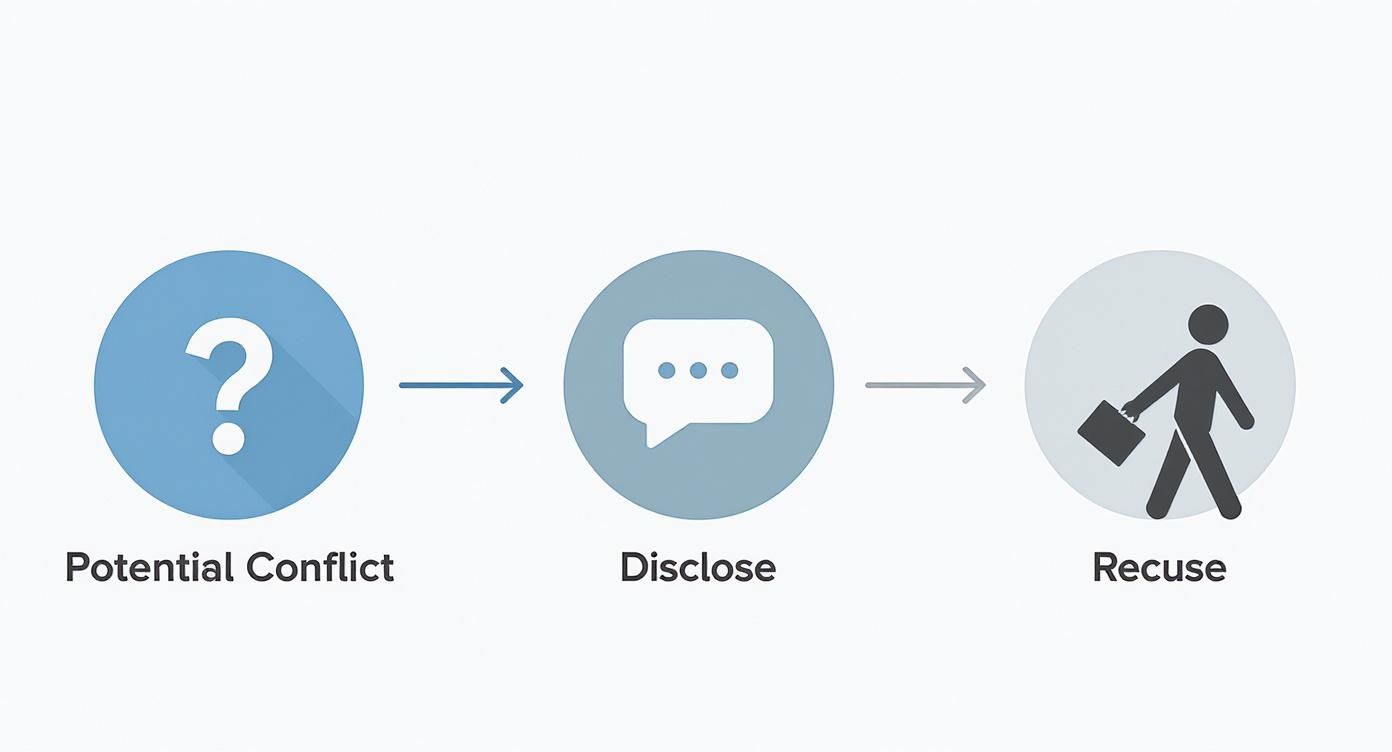
This visual makes it clear: the process is straightforward. You identify a potential problem, you bring it forward, and you step away from the decision to ensure complete fairness.
Making Disclosure Easy
The final piece of a successful rollout is the disclosure process itself. It absolutely must be simple, clear, and non-intimidating. A complex, bureaucratic form will only scare people away from coming forward.
Create a straightforward disclosure form that captures the essential information without being a burden to fill out. This form is your primary tool for documenting and addressing potential conflicts, so it's a critical part of your implementation. By making sure your rollout is thoughtful and comprehensive, you turn your policy from a static document into an active safeguard for your organization's integrity.
Keeping Your Policy Relevant and Effective
A conflict of interest policy is not a document you can file away and forget. It's a living tool that has to adapt as your organization grows, changes, and runs into new challenges. A policy that was perfect last year might be dangerously outdated today, leaving your business exposed to risks you thought you had covered.

This long-term governance is what separates a truly effective policy from a mere compliance checkbox. It’s about building a sustainable framework for integrity that evolves right alongside your business. Without a plan for maintenance, even the best policy will slowly lose its protective power.
Establishing a Regular Review Cycle
The best way to keep your policy sharp is to schedule a formal review cycle. For most organizations, an annual review is the gold standard. This predictable cadence ensures the policy stays top-of-mind and carves out a dedicated time to assess its performance and make necessary updates.
A biennial review might work for very stable, slow-moving businesses, but sticking to an annual schedule is generally much safer. It forces you to actively consider whether your definitions, procedures, and scope still line up with your current operational reality.
During this review, key stakeholders—usually from HR, Legal, and senior leadership—need to get together and answer some tough questions:
Have any laws or regulations changed that impact our policy?
Has our business model or structure shifted in a way that creates new, unforeseen conflicts?
Are the disclosure procedures working smoothly, or are they creating friction for employees?
Is our training program still effectively addressing the real-world scenarios our people actually face?
Answering these questions honestly each year is what keeps a policy both compliant and practical.
Responding to Ad-Hoc Triggers
While scheduled reviews are essential, some business events are so significant they demand an immediate, ad-hoc policy review. Waiting for the annual cycle in these cases can be a costly mistake, as a major organizational shift can instantly create new and unforeseen conflict scenarios.
Your team should be ready to reassess the policy whenever one of these triggers pops up:
Key Triggers for an Immediate Policy Review
Mergers and Acquisitions: Bringing a new company into the fold means merging different cultures, policies, and a whole new set of potential conflicts.
Expansion into New Markets: Moving into a new country or region introduces different legal standards and cultural norms around business relationships.
Major Regulatory Updates: New laws governing corporate ethics or anti-corruption can render parts of your policy obsolete overnight.
Significant Organizational Restructuring: A major shuffle in your leadership team or business units can alter reporting lines and decision-making authority, completely changing how conflicts are managed.
A policy must be agile. When your business makes a significant move, your conflict of interest policy has to move with it. Proactively updating it in response to these triggers prevents a mismatch between your rules and your reality.
Monitoring Policy Effectiveness in the Real World
So, how do you know if your policy is actually working? The answer is in the data and feedback you collect over time. Monitoring a policy's effectiveness isn't about catching people doing wrong; it's about understanding how well the system is functioning as a tool for transparency and risk mitigation.
There are several practical ways to measure this. Analyzing disclosure trends is a great place to start. A sudden drop in disclosures might signal that employees are hesitant to come forward, perhaps out of fear or because the process is confusing. On the other hand, a steady flow of disclosures often points to a healthy culture where people trust the system.
Reviewing incident reports and the outcomes of disclosed conflicts gives you even deeper insight. Are the resolutions consistent and fair? Are similar types of conflicts cropping up over and over? These patterns can reveal weak spots in your policy or gaps in your training that need to be addressed. This continuous feedback loop is what transforms your conflict of interest policy from a static document into a dynamic and effective governance tool.
A Few Common Questions, Answered
Even with a rock-solid policy template in hand, you’re going to run into questions. Applying these rules to real-world situations brings up all sorts of gray areas, and navigating the nuances between potential, perceived, and actual conflicts requires ongoing clarity.
Let's dig into some of the most common questions we hear from organizations as they get their conflict of interest policies off the ground. The whole point is to move this from a theoretical document into a practical tool that everyone—from the C-suite to the newest hire—understands.
Actual vs. Potential vs. Perceived Conflicts
One of the first hurdles is getting everyone on the same page about the different types of conflicts. They might sound similar, but each one carries a distinct level of risk, and your policy needs to address all three to be effective.
Actual Conflict of Interest: This one is straightforward. It’s when a personal interest or relationship is directly influencing an employee’s professional decisions. Think awarding a contract to a company your spouse owns. That's an actual, clear-cut conflict.
Potential Conflict of Interest: This is when a personal interest exists that could influence official duties down the road, even if it hasn’t yet. For example, an employee personally investing in a startup that might bid for a company contract in the future is a potential conflict. Nothing has happened yet, but the stage is set.
Perceived Conflict of Interest: This is often the trickiest to manage. It exists when an outsider could reasonably believe that a personal interest is swaying professional judgment, even if absolutely no improper action has occurred. Hiring a genuinely qualified friend for a role could easily be a perceived conflict, as others might assume favoritism was the deciding factor.
Your policy must demand the disclosure of all three. Transparency is your best defense—it allows the organization to get ahead of perceptions and stop potential issues from turning into actual problems.
How Should Small Businesses Adapt This Policy?
It's a common question from small businesses and startups: is a formal policy overkill for our size? The answer is a hard no, but the approach should absolutely be different. A conflict of interest policy built for a massive corporation can—and should—be simplified for a smaller team.
Focus on the core principles:
Keep Definitions Simple: Clearly define what a conflict looks like in your specific world.
Make Disclosure Easy: Create a simple reporting channel, like notifying a founder or the CEO directly.
Outline Consequences: Be direct about what happens if someone fails to disclose a conflict.
The real goal here is to build a culture of transparency from day one. Getting these ethical foundations in place early prevents massive headaches as the company grows and things inevitably get more complex.
What Are the Legal Risks of Not Enforcing Our Policy?
So, you have a great policy on the books. What happens if you fail to enforce it consistently? The legal and financial fallout can be substantial. Inconsistent enforcement doesn't just weaken your policy; it can completely undermine your company's legal standing.
First, it makes it much harder to defend the company in cases of employee misconduct, suggesting you aren’t serious about your own rules. Second, it can open you up to regulatory fines and shareholder lawsuits that allege leadership breached its fiduciary duty.
Perhaps the biggest risk, though, is that applying the policy to some employees but not others can lead to discrimination claims. If disciplinary actions aren't handled evenly across the board, it creates a powerful impression of bias, exposing the organization to serious legal liability. Consistent enforcement is simply non-negotiable.
At Logical Commander Software Ltd., we're focused on proactive, ethical risk management. Our E-Commander platform helps organizations manage internal threats, including conflicts of interest, by creating a unified system for disclosure, tracking, and resolution. It transforms scattered information into structured insight, letting you act quickly while protecting compliance and employee dignity. Find out how to strengthen your governance framework at https://www.logicalcommander.com.