%20(2)_edited.png)

How to Conduct Employee Investigations: A Guide to Proactive, Compliant Risk Management

Updated: Dec 9, 2025
Knowing how to conduct employee investigations is a high-stakes tightrope walk for any organization. One misstep in balancing legal precision with human dignity can lead to significant liability, operational disruption, and reputational damage. The core process—establishing a clear framework, gathering evidence ethically, and conducting impartial interviews—demands meticulous documentation. Getting it right leads to a fair, defensible outcome. Getting it wrong exposes your business to severe legal, financial, and compliance risks.
A proactive, compliant approach isn't just best practice anymore; it’s essential for survival in today's regulatory environment. This guide explains how to shift from costly, reactive firefighting to a new standard of ethical, preventive risk management.
Why Modern Employee Investigations Demand a New Approach

The environment for handling internal complaints has become more complex and litigious than ever. Employees are more aware of their rights and vocal about workplace issues, from harassment and discrimination to systemic compliance failures. This isn't a theoretical risk; it's a measurable trend impacting business liability daily.
Claims of discrimination, harassment, and retaliation are surging. Data from HR Acuity's Ninth Annual Employee Relations Benchmark Study shows that these allegations have hit an all-time high, with 14.7 issues reported per 1,000 employees. This wave of complaints puts immense pressure on HR, Legal, and Compliance teams, trapping them in a reactive, resource-draining cycle.
The High Cost and Failure of Reactive Investigations
Waiting for an incident to escalate into a formal complaint is a fundamentally broken, high-risk model. This reactive "firefighting" approach doesn't just resolve issues—it often creates new ones, compounding the business impact. Every reactive investigation carries a heavy price tag that goes far beyond legal fees, impacting the entire organization.
These hidden costs multiply quickly, threatening operational stability and brand integrity:
Erosion of Employee Trust: When an investigation feels biased or secretive, morale plummets. People disengage, convinced the process is rigged to protect the company, not to uncover facts.
Operational Disruption: Key employees are pulled from their duties for interviews and evidence gathering, grinding productivity to a halt and impacting revenue-generating activities.
Reputational Damage: A mishandled investigation can easily become public, poisoning your employer brand and making it nearly impossible to attract or retain top talent.
Legal and Compliance Liability: A flawed process is a gift to a plaintiff's attorney. It opens the door to costly litigation and regulatory fines, where the investigation itself becomes the star witness against you.
The greatest risk in any investigation isn't the initial incident; it's the failure to follow a fair, ethical, and defensible process. The process is the protection against liability.
Shifting to Proactive Prevention
The only way out of this costly cycle is to shift from a reactive posture to a proactive one. This means going beyond simply knowing how to conduct employee investigations and, instead, building a system that reduces the need for them in the first place. This requires a new standard—one that focuses on identifying and mitigating human-factor risk before it escalates.
By taking an ethical, non-intrusive approach, you can address potential issues at their root. This isn't about surveillance or other EPPA-sensitive activities. It's about using AI-driven ethical risk management tools to gain insight into potential compliance gaps and integrity risks, allowing leaders to act preemptively and protect the organization.
To better understand this shift, let's compare the old, reactive standard with the new standard of proactive prevention.
Reactive Investigations vs. Proactive Prevention
Aspect | Reactive Investigations (Old Standard) | Proactive Prevention (New Standard) |
|---|---|---|
Timing | Post-incident; triggered by a complaint. | Continuous; identifies risks before they escalate. |
Cost | High and unpredictable (legal fees, settlements). | Lower, predictable investment in technology and culture. |
Focus | Assigning blame for a past event. | Identifying systemic risks and promoting integrity. |
Employee Impact | Creates fear, erodes psychological safety, and lowers morale. | Builds a culture of integrity and reduces internal friction. |
Business Impact | Disrupts operations and damages brand reputation. | Strengthens governance and protects the brand. |
Legal Posture | Defensive; often creates additional liability. | Proactive; demonstrates due diligence and reduces liability. |
This table makes the contrast stark. The old model is a costly, defensive game you're forced to play. The new standard is a strategic advantage that protects your bottom line and reputation.
This strategic shift turns a necessary but costly function into a competitive edge, safeguarding the company's integrity, finances, and reputation. You can learn more about the financial impact by exploring the true cost of reactive investigations in our detailed analysis.
Building a Defensible Investigation Framework
The outcome of an employee investigation is often decided long before the first interview. A reactive, unstructured approach exposes your organization to massive liability, allowing a manageable issue to spiral into a legal and reputational crisis.
Building a defensible framework isn't about bureaucratic box-ticking. It’s about creating a fair, consistent, and legally sound process that protects the organization while upholding employee dignity. This framework becomes your procedural armor, ensuring every investigation is handled with the same objectivity and diligence. The goal is to eliminate inconsistency and bias—the primary targets in any subsequent lawsuit.
Defining Clear Objectives and Scope
Before interviewing anyone, you must define the investigation's objective. Is the goal to verify a specific policy violation? Address a behavioral complaint? Or assess a potential compliance breach? Without a clear objective, investigations lose focus and fail to reach a supportable conclusion.
Your initial plan needs to clearly outline:
The Specific Allegation: Document the exact complaint or incident being investigated.
Relevant Policies: Pinpoint which company policies or legal regulations may have been violated.
The Timeframe: Establish the period the investigation will cover to prevent scope creep.
Key Individuals: List the complainant, the subject, and potential witnesses.
This initial scoping prevents "investigative drift," where an inquiry veers into unrelated matters, wasting time and piling on legal risk. It gives the investigator a clear mandate from the start.
Selecting an Impartial Investigator
Choosing the right investigator is arguably the most critical decision. The investigator’s credibility is directly tied to the credibility of the investigation’s outcome. Bias—or even the perception of bias—can completely torpedo your findings and their defensibility.
When selecting an investigator, consider these critical factors:
Objectivity: The investigator must not have a personal or professional relationship with anyone involved. A direct manager investigating their own subordinate is a classic conflict of interest that creates significant legal exposure.
Expertise: They need training in how to conduct employee investigations, a solid grasp of relevant employment laws, and skills in interviewing and evidence gathering. This is not a role for an amateur.
Bandwidth: Your HR and Legal teams are likely already stretched thin. The investigator must have the dedicated time to conduct a thorough and prompt inquiry. Delays are a common reason investigations are challenged later.
An investigation's defensibility hinges on the impartiality of the investigator. If the process is perceived as unfair from the start, the conclusion will be dismissed, regardless of the evidence.
Mapping Out a Detailed Plan
A well-documented plan is your roadmap and proof of a structured, good-faith process. It turns a chaotic situation into a managed one.
The plan should detail the order of interviews, typically starting with the complainant, then moving to witnesses, and finally interviewing the subject of the complaint. This sequence allows the investigator to gather corroborating information before addressing the core allegations with the involved employee.
A solid plan also maps out a strategy for gathering and preserving evidence—emails, internal messages, and other relevant documents—while respecting privacy and legal boundaries.
Finally, this planning must be integrated within a larger compliance risk management framework. This ensures your investigative procedures align with the organization's broader governance and regulatory obligations. This strategic alignment shifts you from reactive problem-solving to proactive risk mitigation, establishing a process that is fair, ethical, and built to withstand scrutiny.
Executing an Ethical and Precise Investigation
Once your framework is in place, the practical phase of the investigation begins. This is where objectivity, precision, and ethics are truly tested. Proper execution means gathering evidence and conducting interviews in a way that’s not only thorough but also respects the dignity of everyone involved.
The core mission is to collect relevant facts. This means leaving outdated, intrusive techniques in the past. Old-school methods relying on intimidation, surveillance, or coercive analysis are not just unethical; they are massive liabilities that create a culture of fear, destroy psychological safety, and often violate regulations like the Employee Polygraph Protection Act (EPPA). A modern, compliant investigation is built on a non-coercive foundation that preserves employee relations while getting to the facts.
This process flow chart outlines the foundational steps for building a defensible investigation.
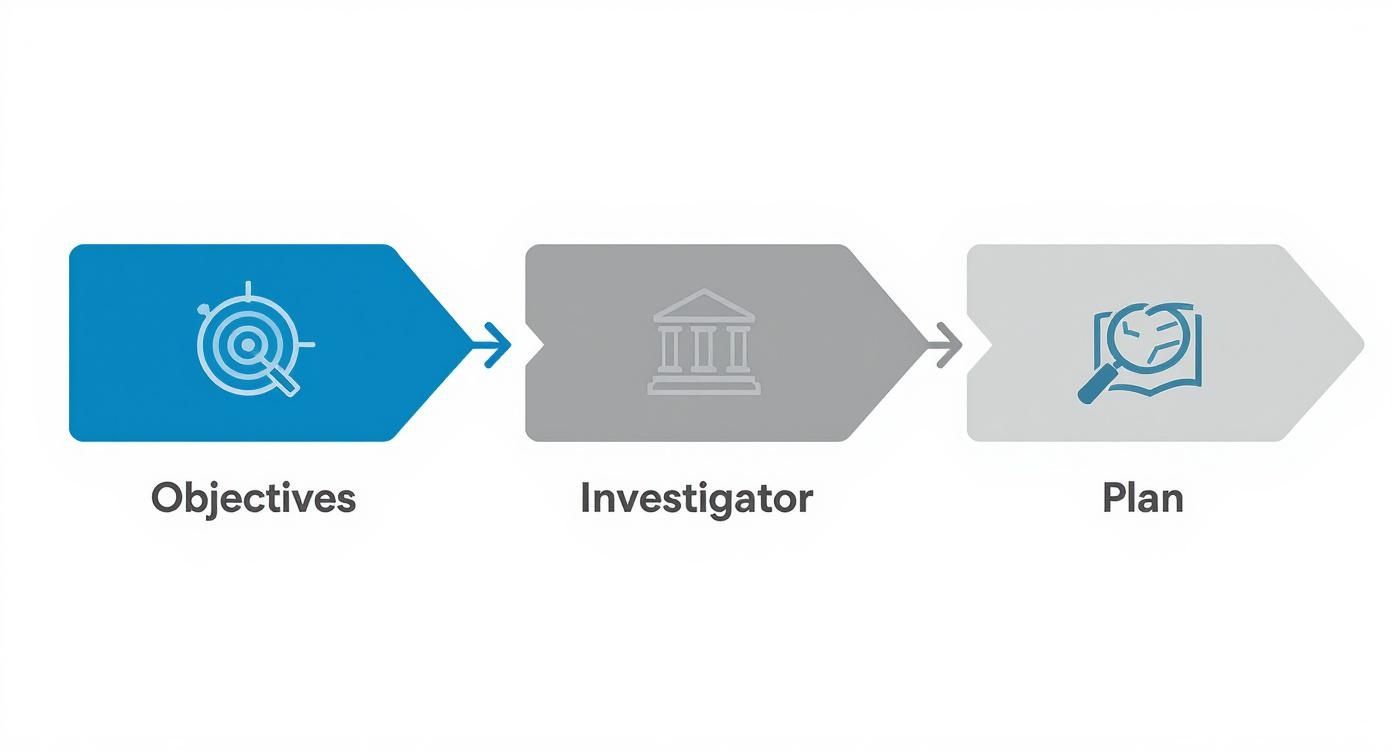
This visualization highlights a key point: a successful execution phase is entirely dependent on the quality of your initial planning—from setting clear objectives to assigning a truly impartial investigator.
Gathering and Preserving Evidence Objectively
The first step in execution is to secure relevant evidence. This is a targeted collection based on the defined scope, not a speculative fishing expedition.
Digital Communications: Company emails, messages on platforms like Slack or Teams, and other system data are critical. Work with your IT team to preserve this information in a legally defensible way without overstepping into personal privacy.
Relevant Documents: Performance reviews, policy acknowledgment forms, timecards, or project files. Focus only on documents directly tied to the specific allegation.
Physical Evidence: This may include security footage, access logs, or physical property.
Maintaining a clear chain of custody for all evidence is non-negotiable. This meticulous documentation proves that evidence was handled properly and has not been tampered with—an essential detail if the findings are challenged.
Conducting Effective and Respectful Interviews
Interviews are the heart of most investigations but also where things most often go wrong. The goal is to create an environment where individuals feel safe to share what they know, not one where they feel interrogated. A poorly handled interview can do more harm than good, creating hostility and leading to unreliable information.
To foster a non-coercive atmosphere, the investigator should:
Explain the Process Clearly: Start by explaining the interview's purpose, the investigator’s neutral role, and the importance of confidentiality. Reassure the employee that retaliation is strictly prohibited.
Ask Open-Ended Questions: Avoid leading questions. Instead of, "Did you see Alex yell at Sarah on Tuesday?" ask, "Can you describe what happened on Tuesday afternoon?" Let them provide the narrative.
Listen More, Talk Less: The investigator’s job is to listen and gather facts. They must avoid interrupting, challenging minor inconsistencies in the moment, or expressing personal opinions.
Document Responses Accurately: Take detailed, objective notes. After the interview, it is a best practice to summarize key points and ask the interviewee to review them for accuracy.
The purpose of an investigative interview is fact-finding, not fault-finding. Creating a non-adversarial environment is the most effective way to uncover credible information while upholding the organization's ethical standards.
Avoiding Common Interview Pitfalls
Even seasoned investigators can make mistakes. One common error is promising absolute confidentiality. While you should stress that information will be kept as private as possible, you cannot guarantee it won't be shared with senior leaders or legal counsel with a legitimate need to know.
Another major pitfall is failing to prepare. An investigator should have a standard list of core questions for consistency but also be skilled enough to ask probing follow-up questions. This balanced approach ensures a process that is both thorough and fair.
By focusing on an ethical, respectful, and meticulously documented process, you can conduct investigations that are compliant and reinforce a culture of fairness.
Using Technology for Compliant Investigations

Technology can be a powerful tool for investigators, but it also presents significant compliance and ethical risks. The temptation to use digital tools for sweeping surveillance is a trap that leads straight to legal challenges, EPPA violations, and the complete annihilation of employee trust.
Knowing how to conduct employee investigations today means using technology like a scalpel, not a sledgehammer. The goal is to surgically analyze specific, relevant digital evidence from company systems—not to engage in prohibited surveillance or pseudo-lie detection. Any tool that crosses this line creates far more liability than it could ever solve.
The Pitfalls of Invasive Technologies
Many legacy "internal risk" solutions are fundamentally flawed because they are not human-centric. They often rely on invasive monitoring, tracking keystrokes, or scanning private messages—approaches that are legally and ethically toxic. This is the digital equivalent of an old-school coercive interrogation and is directly at odds with EPPA principles.
The result is a workplace culture built on suspicion. Employees who feel they are being watched are less engaged, less productive, and far more likely to leave. Furthermore, evidence collected through improper surveillance can be ruled inadmissible, torpedoing an entire investigation.
Technology should support a fair process, not become a tool for policing employees. The moment your tech strategy feels like surveillance, you've already lost the trust of your workforce and the credibility of your investigation.
This problem is only getting more complex. In hybrid work environments, the temptation exists to use tools to search employee AI assistant prompts on company devices. As this technological reach expands, so does the potential for misuse and the need for a strong ethical framework.
A Proactive and Ethical Alternative: The New Standard
Instead of reacting with invasive tools, leading organizations are shifting to AI human risk mitigation. The focus moves from reacting to incidents to proactively identifying and preventing human-factor risk. This is where modern, ethical platforms change the game.
Logical Commander offers an EPPA-compliant platform designed for preventive risk management. It operates without any surveillance, monitoring, or any form of lie detection. Its AI-driven analysis helps organizations spot potential integrity risks and compliance gaps using validated information, not invasive data scraping.
This technology empowers HR, Legal, and Compliance teams to:
Assess Risk Ethically: Gain insights into potential conflicts of interest or misconduct without infringing on employee privacy.
Act Preventively: Address systemic risks before they lead to formal complaints, dramatically reducing the need for reactive investigations.
Maintain Compliance: Ensure your risk management practices are fully aligned with labor laws and ethical standards.
Leveraging Technology for Evidence Without Intrusion
Even with a preventive focus, sometimes an investigation is unavoidable. Technology's role here is to keep data collection narrow and targeted. For instance, knowing how to find metadata in photos can be invaluable for verifying the authenticity of an image submitted as evidence.
Working with IT, your investigator can ethically collect specific data directly relevant to the complaint, such as:
Targeted Email Searches: Using specific keywords and tight date ranges directly tied to the allegation.
Access Logs: Reviewing who accessed certain files or systems at specific times relevant to the incident.
Company Platform Data: Pulling conversation threads from systems like Slack or Teams that are directly cited in a complaint.
This focused approach respects privacy while ensuring the investigation is thorough. It treats technology as a strategic asset for ethical risk management, not a weapon. To learn more, explore our guide on detecting insider threats with ethical AI.
Concluding the Investigation and Taking Action
After all interviews are done and evidence is collected, the final phase—analyzing the facts and taking decisive action—tests your organization’s commitment to a fair process. How you close the loop is just as critical as how you started. An objective, well-supported conclusion is your best defense against liability.
Analyzing Evidence and Assessing Credibility
Once all information is gathered, your job is to weigh it. This isn’t about finding someone "guilty." It's about determining, based on the preponderance of the evidence, whether a policy was more likely than not violated. This legal standard simply means it is more probable than not that the events occurred as alleged.
The investigator must methodically sift through everything, looking for corroboration and consistency between statements and documentation like emails and access logs.
Conflicting stories are common. When this occurs, you must make careful credibility assessments based on concrete factors, not "gut feelings":
Plausibility: Does one account make more logical sense than the other?
Corroboration: Is there other evidence—a witness, an email, a security log—that backs up one story over the other?
Motive: Does anyone involved have a clear reason to be less than forthcoming?
Demeanor: While not definitive, an individual's demeanor during an interview can sometimes provide useful context.
This analysis must be unbiased. The investigator's role is to be a neutral fact-finder, considering every piece of information.
Compiling a Comprehensive Investigation Report
Documentation is everything. A thorough, well-written investigation report is the official record of the process and key evidence that your organization acted promptly, fairly, and in good faith. A weak report can undermine an otherwise solid investigation.
The investigation report is more than a summary; it's a testament to your process. It demonstrates that your conclusions are based on a systematic review of facts, not on assumptions or bias.
The report needs to be structured clearly and objectively. For a solid framework, consult this workplace investigation report template. A strong report will always include:
An executive summary of the allegation and the final conclusion.
A timeline of the entire investigation process.
Summaries of every interview conducted.
A clear list and description of all evidence reviewed.
A final analysis of the facts and the investigator’s conclusion based on the evidence.
This document becomes the foundation for any subsequent action, ensuring every decision is rooted in a solid factual base.
Implementing Consistent and Appropriate Action
Once the report is final, the organization must decide on the next steps. If the investigation substantiates the claims, corrective action is necessary. This action must be consistent with how similar situations have been handled in the past to avoid claims of discrimination or unfair treatment.
Depending on the severity of the misconduct, outcomes can vary:
Training or coaching for minor issues.
Formal disciplinary action, such as a written warning.
Reassignment of duties to separate the individuals involved.
Termination of employment for the most serious violations.
If the investigation is inconclusive or exonerates the employee, that outcome must also be communicated clearly. The goal is not just to close a single incident but to use the findings to strengthen the organization—perhaps by clarifying a policy, providing broader team training, or improving communication channels. This strategic follow-through turns a reactive investigation into a proactive opportunity for prevention.
The New Standard: From Reaction to Prevention with Logical Commander
The most effective way to manage employee investigations is to prevent them from happening in the first place. The old model of waiting for complaints and then scrambling to react is a direct path to financial loss, eroded morale, and significant legal exposure. True risk management is about building an environment where misconduct is less likely to occur.
This requires a fundamental shift in mindset from a defensive crouch to a proactive stance. It means embracing a smarter, more ethical standard of AI human risk mitigation. The focus must be on identifying and addressing the root causes of risk before they escalate into formal complaints. This is where modern, ethical technology provides a decisive advantage.
An EPPA-Compliant, Non-Intrusive Alternative
Many legacy "risk" tools are built on a foundation of suspicion, relying on invasive surveillance methods that violate regulations and destroy employee trust. They are not the solution; they are part of the problem.
This is why we built Logical Commander. Our E-Commander and Risk-HR platforms represent a new, ethical path forward. They provide a fully EPPA-compliant platform for proactive risk management, operating without surveillance, monitoring, or anything resembling lie detection. Our technology empowers organizations to get ahead of human-factor risks ethically and respectfully.
This isn’t about policing employees; it’s about responsible, proactive governance and internal threat detection. It's how you protect your organization and its people by identifying risk signals early. For B2B SaaS companies, integrating this new standard is seamless through our PartnerLC program, enabling you to offer your clients a forward-thinking solution for human-factor risk.
Ready to adopt the new standard in risk prevention?
Get Platform Access: Start a free trial to experience our ethical, AI-driven platform.
Request a Demo: Schedule a personalized demo with our experts to see how we can mitigate your specific human-factor risks.
Join Our Partner Ecosystem: Integrate our technology through the PartnerLC program and become an ally in promoting ethical risk management.
Contact Us: Reach out to our team to discuss enterprise deployment and protect your organization's reputation and bottom line.