%20(2)_edited.png)

A Guide to Using Behavioral Assessments for Hiring

Behavioral assessments for hiring are critical risk management tools. They help organizations evaluate a candidate’s workplace behaviors, judgment, and soft skills, moving beyond the surface-level information on a resume. Unlike technical tests that measure what someone knows, these AI-driven assessments predict how they will likely perform, interact with others, and respond to high-stakes business challenges. The goal is to gain preventive, data-driven insights into the human-factor risks that resumes and interviews completely miss.
Why Traditional Hiring Methods Create Business Risk

For decades, organizations have relied on resumes and unstructured interviews as the foundation of hiring. These methods are familiar but are dangerously unreliable predictors of who will succeed and who will become an internal threat. A polished resume highlights past accomplishments but reveals nothing about a candidate’s judgment, integrity, or ability to handle pressure in a compliant manner. It's a reactive view of a candidate's history, not a proactive assessment of their potential risk.
Standard interviews are often worse, riddled with subjective bias that creates significant liability. Hiring managers, often unconsciously, favor candidates who share similar backgrounds or communication styles. This "gut-feel" approach not only overlooks highly qualified individuals but also introduces unacceptable levels of human-factor risk. Each bad hire can cost an organization dearly in turnover, lost productivity, and the potential for compliance failures or insider threats.
The Shift to Data-Driven Risk Prevention
The severe limitations of outdated methods are driving a strategic shift. For decision-makers in Compliance, Legal, HR, and Security, moving from subjective impressions to objective, behavioral assessments for hiring is no longer a best practice—it's essential for mitigating internal threats and protecting the organization.
This evolution is about proactively managing human-factor risk before it materializes. By identifying behavioral indicators directly relevant to a role's risk profile, organizations can make defensible decisions that slash the likelihood of misconduct, compliance breaches, or other integrity-related disasters. The astronomical financial and reputational damage from these incidents makes prevention a critical business imperative, exposing the deep flaws of relying on reactive forensics. You can explore the true cost of reactive investigations in our detailed guide.
A bad hire at the management level can cost an organization more than 2.5 times the employee's annual salary. This figure doesn't even account for the damage to team morale, compliance failures, or potential reputational harm caused by poor judgment or misconduct.
Adopting a New Standard of Internal Risk Prevention
The move toward objective evaluation is the new standard in corporate governance. By 2025, an overwhelming majority of employers are expected to use skills-based and behavioral evaluations to make hiring decisions. In fact, one industry survey already shows 85% of employers adopting skills-based hiring and 76% using skills tests to validate abilities. This data points to a clear and decisive move away from resume-led screening and toward more reliable predictors of performance and risk.
Often, the failure of traditional hiring methods also comes down to broken communication. If you're struggling to connect with top talent, you might want to explore effective recruiter messaging strategies on LinkedIn.
This market-wide adoption reflects a growing understanding that proactive, ethical, and EPPA-aligned tools are necessary to identify and mitigate human-factor risks before they escalate. Logical Commander's AI-driven platform represents this new standard of internal risk prevention—a non-intrusive alternative that strengthens governance, protects the bottom line, and avoids the legal pitfalls of surveillance-based technologies.
Choosing the Right Behavioral Assessment Tool for Risk Management
Selecting the right behavioral assessment tool is a critical business decision that directly impacts your company's risk exposure, compliance posture, and hiring success. The market is flooded with options, but not all behavioral assessments for hiring are created equal. Choosing the wrong one can saddle your organization with serious liability and offer no real preventive value.
Many popular tools were never designed for high-stakes risk screening. For example, personality quizzes like the Myers-Briggs Type Indicator (MBTI) are notoriously poor predictors of job performance and lack scientific reliability for identifying internal threats. Relying on such instruments for hiring isn’t just ineffective—it's a compliance nightmare waiting to happen, as they were never intended for risk mitigation. These tools are not the new standard; they are a relic of a less risk-aware era.
Differentiating Between Tools and Their Liabilities
The key is to move beyond generic personality labels and use assessments that measure job-relevant behaviors and judgment directly tied to business impact. Even some tools that seem more scientific can hide significant legal risks, especially if they are not EPPA-aligned.
Let's break down the most common behavioral assessment methods and their associated liabilities.
A Comparison of Behavioral Assessment Methods
Assessment Type | Primary Focus | Business Application | Potential Compliance Risks |
|---|---|---|---|
Personality Inventories (e.g., Big Five) | Stable personality traits like conscientiousness, extraversion, and agreeableness. | Useful for understanding team dynamics and general work styles. | Weak link to specific job risks; easily faked with socially desirable answers. Can introduce bias if not validated for the role. Not a risk mitigation tool. |
Emotional Intelligence (EI) Assessments | Skills like empathy, self-awareness, and relationship management. | Best for leadership development and roles requiring high levels of interpersonal skill. | Narrow scope; insufficient for identifying integrity or compliance risks on its own. |
Situational Judgment Tests (SJTs) | Decision-making and judgment in realistic, job-specific scenarios. | Excellent for predicting on-the-job performance and assessing practical problem-solving. | Strong legal defensibility when well-designed, but poor design can introduce bias. |
"Integrity" Tests | Direct questions about a candidate's attitudes toward theft and rule-following. | Used for roles with access to cash or sensitive information. | High risk of violating EPPA if they function as a lie detector. Can alienate candidates and damage the employer's brand. |
As you can see, the methods vary wildly in their focus and risk profile. To see how top consulting firms evaluate these skills, you can explore these Top 10 Consulting Behavioral Interview Questions, which often use the same logic as well-designed SJTs.
The biggest danger comes from any tool that functions as a prohibited "lie detector" or engages in surveillance. Assessments that feel like interrogations, attempt to analyze a person’s psychological state, or make definitive claims about a candidate's integrity are not just unethical—they are clear violations of the Employee Polygraph Protection Act (EPPA). Adopting one of these tools exposes your company to severe legal penalties and reputational ruin.
The New Standard for Ethical and Effective Assessments
The responsible standard for modern risk management is a tool that is both ethically designed and scientifically validated to identify human-factor risk without resorting to invasive methods. This is where Logical Commander's AI-driven approach is the clear alternative to outdated and non-compliant systems.
Our platform is purpose-built for proactive risk prevention. We focus on behavioral indicators directly linked to integrity, compliance, and workplace conduct. We deliver powerful, predictive insights without ever engaging in forbidden practices:
No Surveillance or Monitoring: Our assessments are non-intrusive and are built on a foundation of respect for candidate privacy. We are not a cyber company focused on tracking digital footprints.
No Psychological Profiling: We do not evaluate mental health or create psychological profiles, which keeps our process aligned with ethical and legal standards. This is not a medical or therapeutic tool.
Strict EPPA Alignment: Our methodology is fundamentally different from lie detection, ensuring every assessment is compliant and legally defensible.
By focusing on observable, job-relevant behavioral indicators, organizations can build a hiring process that is not only more effective but also fundamentally fairer and more compliant. The goal is to mitigate internal threats proactively, not to police or punish employees.
This modern approach helps you avoid the liability of outdated personality tests and the legal minefield of non-compliant tools. For a deeper dive into selecting the right instruments, you can learn more about various pre-employment assessment tools and their specific applications.
Ultimately, choosing the right assessment is a strategic decision. It’s about protecting your organization while identifying the resilient, high-integrity talent you need to thrive.
Staying Compliant with EPPA and Ethical Standards
When implementing behavioral assessments for hiring, the conversation must begin with an unwavering commitment to legal and ethical standards. For any company, especially those in regulated industries, understanding the Employee Polygraph Protection Act (EPPA) isn't optional—it's a foundational pillar of responsible governance and risk management.
EPPA was enacted to prevent employers from using "lie detector" tests for pre-employment screening or during employment. The law's reach is broad, defining a lie detector not just as a polygraph but as any device or procedure used to render an opinion about an individual's honesty. This expansive definition places many modern assessment tools, especially those making bold claims about measuring integrity, in a position of extreme legal risk.
What Constitutes a Prohibited Lie Detector
The line between a compliant behavioral assessment and a prohibited lie detector is often much thinner than vendors are willing to admit. Any tool that measures physiological responses or uses methods to gauge the truthfulness of answers could be flagged as an EPPA violation. This includes many AI-driven tools that claim to analyze vocal stress or micro-expressions.
This is a serious red flag for any assessment that:
Claims to analyze vocal stress or micro-expressions to determine veracity.
Uses invasive or psychologically pressuring questions designed to elicit admissions.
Markets itself as an "honesty test" or "integrity screener" that produces a definitive score on an individual's character.
Using such tools is not a minor compliance misstep; it is a direct violation of federal law. The consequences include significant financial penalties, civil lawsuits, and severe reputational damage.
The flowchart below breaks down the major categories of assessments, showing how each one has a different focus.
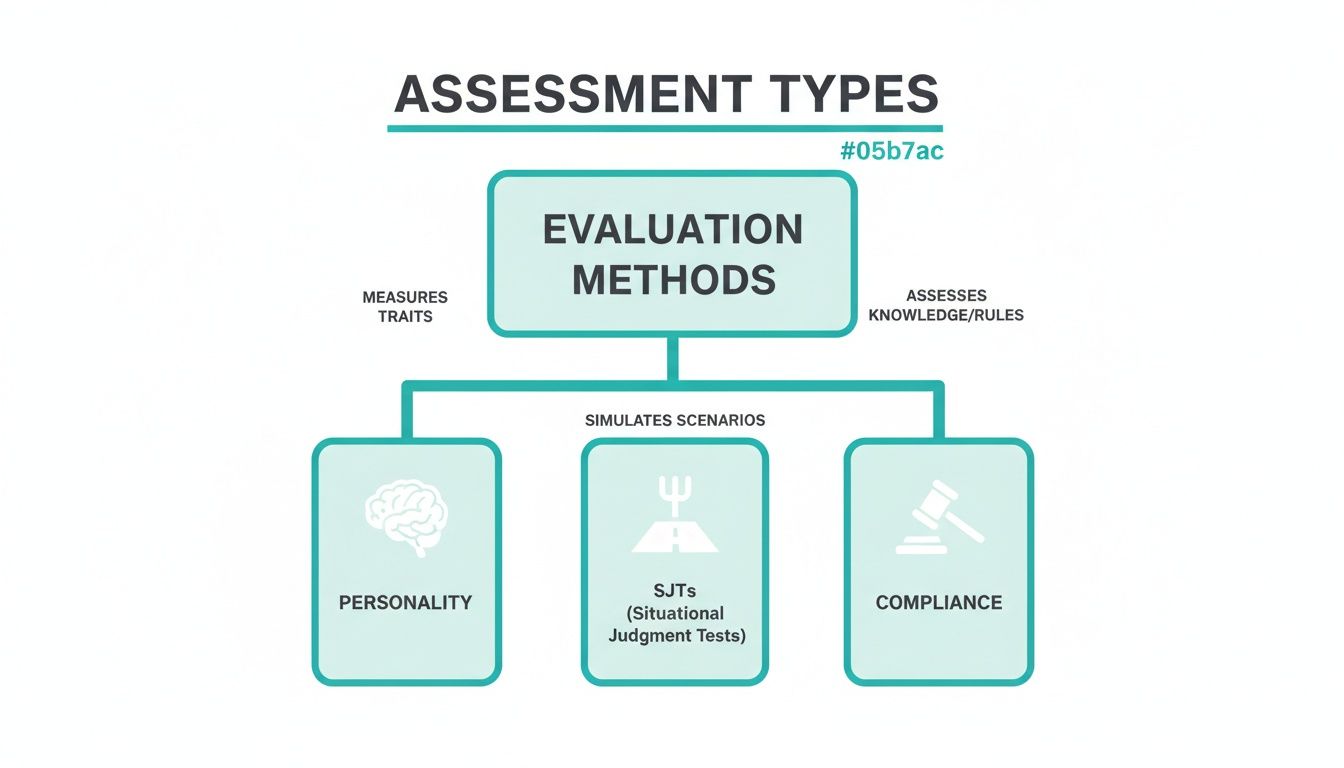
This visual makes it clear how tools range from broad personality typing to specific situational judgment tests and compliance-focused screeners. Each one carries different implications for your risk management strategy and legal defensibility.
The High Cost of Non-Compliance
The consequences of using a non-compliant assessment tool extend far beyond a simple fine. An EPPA violation can trigger a cascade of negative business impacts, including class-action lawsuits, government investigations, and a public relations crisis that erodes trust with customers, investors, and employees.
Worse, relying on tools that engage in forbidden practices like psychological profiling or surveillance-style methods creates a toxic hiring environment. It signals that your organization operates on a foundation of distrust, repelling the very high-integrity talent you aim to attract and damaging your employer brand.
Choosing a behavioral assessment is a direct reflection of your organization's ethical posture. An EPPA-aligned tool demonstrates a commitment to governance and respect for individual rights, while a non-compliant one signals a willingness to cut legal corners, creating massive liability.
The Logical Commander Difference: An EPPA-Aligned Solution
This is precisely why we engineered Logical Commander to be the new standard. Our platform was designed for preventive risk identification, operating squarely within the strict boundaries of EPPA and ethical best practices. We offer a non-intrusive alternative that strengthens your internal risk management framework without exposing your organization to legal jeopardy.
Our methodology is built on a clear set of principles:
No Lie Detection: Our assessments do not attempt to measure honesty or truthfulness. We completely avoid any function that could be interpreted as a lie detector under EPPA.
No Psychological Profiling: We focus on observable, job-relevant behavioral indicators, not on creating psychological profiles or evaluating mental health.
Respect for Dignity: Our process is designed to be non-intrusive and respectful, preserving employee dignity and building a foundation of operational integrity from the first interaction.
By adhering to these standards, we deliver a powerful ethical risk management solution for internal threat detection that is both effective and legally defensible. Our AI human risk mitigation platform analyzes behavioral patterns to identify potential human-factor risks before they escalate, all while ensuring your hiring process remains fully compliant. You can learn more about why EPPA compliance matters in human capital risk management to better protect your organization.
Ultimately, staying compliant isn't about limiting your ability to identify risk—it's about doing so intelligently, ethically, and proactively.
Using AI for Proactive Human Risk Mitigation

The term "AI" is ubiquitous, but its true power in human-factor risk management is its ability to analyze behavioral data to spot subtle patterns indicative of potential insider risk—all without resorting to invasive surveillance or legally prohibited methods. The human factor is the starting point for nearly all internal risk, not cyber vulnerabilities.
This modern, preventive approach marks a fundamental shift away from waiting for incidents to occur. Instead of launching expensive and disruptive investigations after a compliance breach or misconduct, organizations can now identify high-risk indicators before they escalate into crises. This is the core of proactive prevention over reactive forensics.
From Reactive Forensics to Preventive Intelligence
The old model of reactive forensics has failed. It is costly, damages employee morale, and only addresses problems after the damage is done. Proactive human risk mitigation, powered by ethical AI, transforms your hiring data into a strategic asset for ongoing compliance, security, and governance.
By analyzing patterns from behavioral assessments for hiring, AI platforms can extract insights that are nearly impossible for a human to detect. This isn't about predicting the future; it's about identifying statistical correlations between specific behavioral flags and known risk factors associated with internal threats.
The result is a powerful early warning system that provides the intelligence needed to act first, strengthen internal controls, and protect the organization's reputation and bottom line.
The New Standard in Ethical Risk Management
Logical Commander’s AI platform, featuring E-Commander and Risk-HR, represents this new standard. We deliver an EPPA-aligned, non-intrusive solution built specifically to identify human-factor risks without violating employee dignity or federal law. We are not a cyber company; our focus starts and ends with human risk.
Our platform was engineered from the ground up to sidestep the common pitfalls of other AI hiring tools by focusing squarely on job-relevant behavioral indicators.
No Surveillance: We never monitor employee activity. Our insights come exclusively from structured, ethical assessments.
No Psychological Evaluation: We do not build psychological profiles or assess mental health, keeping our entire process strictly compliant.
Actionable Intelligence: The platform provides clear, defensible data to support risk-based decisions for your HR, Compliance, and Security teams.
Ethical AI in risk management isn't about policing your workforce. It's about building a more resilient organization by understanding and mitigating human-factor risks before they can cause financial, legal, or reputational damage.
The rapid growth of technology in behavioral assessments for hiring during the 2020s has brought both new capabilities and much tighter regulatory scrutiny. The market has moved far beyond old-school psychometrics to include AI-assisted video analysis and integrated platforms. By 2025, industry reports suggest that 65% of employers will be using AI in their hiring processes, with over 80% of large organizations relying on online assessment platforms. This widespread adoption comes with very real concerns around algorithmic bias and data privacy, forcing companies to demand more rigorous validation and bias audits from vendors to meet rising compliance standards in global markets. You can discover more insights about hiring trends on assesscandidates.com.
By adopting a system that is compliant by design, you transform your hiring process from a simple staffing function into a core component of your enterprise risk management strategy. This allows you to build a more resilient and high-integrity workforce from day one. To explore this topic further, check out our guide on AI-powered human risk management.
How to Implement a Modern Assessment Program
Implementing a modern program for behavioral assessments for hiring is more than a software purchase; it is a strategic initiative requiring a clear, defensible roadmap. For leaders in HR, Compliance, or Security, the process must be deliberate, aligning technology with the organization's broader goals for risk management, governance, and reputation protection. The objective is to build a scalable and ethical workflow that hardens your defenses against internal threats.
First, secure executive buy-in by framing the program in terms of business impact and liability prevention. Shift the conversation from HR metrics to core priorities like compliance, governance, and brand protection. Build a compelling business case that quantifies the costs of inaction—the financial drain of reactive investigations, the reputational damage from internal incidents, and the high price of employee turnover.
Define Risk-Relevant Competencies
Before assessing any candidate, you must define precisely what you are measuring. Vague behavioral traits are insufficient and legally indefensible. Your HR and Risk teams must collaborate to pinpoint the specific, job-relevant competencies and behavioral indicators directly tied to internal threats and integrity risks.
For a role handling sensitive data, for instance, you would focus on indicators of discretion and adherence to protocol. For a leadership position, it might be ethical decision-making under pressure. This step is critical for ensuring your assessments are legally defensible and directly linked to preventing human-factor risk.
Analyze High-Risk Roles: Start by identifying positions with the greatest potential to cause financial, reputational, or compliance damage.
Map Behaviors to Incidents: Analyze past internal incidents to identify the behavioral red flags that preceded them.
Establish a Competency Framework: Create a clear, documented framework that outlines the risk-relevant behaviors for different job families.
Integrate and Train for Success
Once your framework is established, integrate the assessment platform with your existing talent acquisition systems, particularly your Applicant Tracking System (ATS). This ensures assessment data flows seamlessly into the hiring workflow, providing managers with the insights they need without creating administrative friction.
Technology alone is not enough. Training is non-negotiable. Your hiring managers must be trained to interpret assessment results ethically and effectively. This process is not about replacing their judgment but augmenting it with objective data. Training must emphasize that this data is one input among many, preventing over-reliance on a single score and reinforcing a holistic, compliant evaluation.
The goal is not to automate hiring decisions but to augment them with objective, risk-relevant data. Proper training ensures managers use these powerful insights to make better, more defensible choices, reducing subjective bias and strengthening the integrity of the hiring process.
Recent industry data shows that confidence in this approach is growing fast. Surveys in 2024–2025 reveal that organizations using structured assessments report a much stronger perception of hire quality. In fact, over 80% of enterprises now depend on online assessment platforms for data-driven hiring, with a staggering 65% using AI to administer or interpret the results. This signals a system-level reliance on these tools, but success always comes down to the quality of the implementation. You can get more details on the widespread adoption of skills-based hiring practices on naceweb.org.
Measure and Optimize for Business Impact
Finally, a successful program requires clear key performance indicators (KPIs) to demonstrate its value. These metrics must extend beyond standard HR numbers and connect directly to the risk management objectives established for executive buy-in.
Reduced Employee Turnover: Monitor turnover rates, especially within the first 12 months, for roles filled using the new assessment process.
Fewer Internal Incidents: Track the number and severity of compliance breaches, misconduct cases, and other internal problems.
Improved Quality of Hire: Use performance data and manager feedback to draw a clear line between assessment results and on-the-job success.
For organizations looking to implement this new standard of internal risk prevention effectively, Logical Commander's PartnerLC program provides the framework and expertise needed for a successful enterprise deployment. By partnering with us, you gain access to a proven, EPPA-aligned platform and the strategic support to build a best-in-class internal threat prevention program.
Frequently Asked Questions
When leaders in Compliance, HR, and Risk evaluate modern behavioral assessments for hiring, several critical questions arise. Here are the answers needed to move forward confidently with a non-intrusive, EPPA-aligned solution that strengthens your entire organization.
How Do Behavioral Assessments Differ From Traditional Interviews?
A traditional interview is often unstructured, subjective, and a poor predictor of future performance or risk. A candidate's charisma can easily mask behavioral tendencies that are misaligned with your organization's risk tolerance, exposing you to unconscious bias and significant liability.
Scientifically validated behavioral assessments for hiring provide the opposite: objective, data-driven insights into a candidate's judgment and approach to real-world situations. The process is standardized, ensuring every candidate is evaluated against the same risk-relevant benchmarks. This moves your organization from conversational guesswork to structured, preventive intelligence, leading to more reliable and legally defensible hiring decisions.
Are These Assessments Legally Compliant, Especially With EPPA?
Compliance depends entirely on the tool you choose. Many assessments make vague claims about measuring "integrity" that place them in a legal gray area under the Employee Polygraph Protection Act (EPPA). Any tool that functions as a "lie detector" or uses psychologically coercive methods is strictly prohibited and a major liability.
A truly compliant platform, like Logical Commander, is built from the ground up to be EPPA-aligned. It is fundamentally different from lie detection and completely avoids forbidden practices. This means:
No psychological profiling or mental health evaluations.
No intrusive questions designed to pressure candidates.
No surveillance or any form of secret monitoring.
By focusing only on observable, job-relevant behavioral indicators, an ethical assessment provides powerful risk insights without exposing your organization to massive legal and reputational damage. It is the new standard of ethical risk management.
Can Behavioral Assessments Really Prevent Internal Threats?
Yes, as a core component of a proactive AI human risk mitigation strategy. These assessments identify behavioral patterns statistically correlated with a higher potential for counterproductive workplace behaviors, such as misconduct, compliance breaches, or other integrity-related issues. The risk starts with the human factor, not technology.
By identifying these human-factor risks during the hiring process, you can make smarter, risk-informed decisions and implement appropriate internal controls from day one. This represents a fundamental shift from a reactive posture to one of preventive intelligence, allowing you to address potential vulnerabilities before they escalate into costly incidents.
Proactive risk mitigation isn't about eliminating every possible threat. It's about building a more resilient organization by identifying and managing human-factor risks before they can cause significant financial, legal, or reputational damage.
Will Using Assessments Alienate High-Quality Candidates?
The right assessment will do the opposite. High-integrity, top-tier candidates appreciate a hiring process that is fair, transparent, and objective. When an assessment is non-intrusive, professional, and clearly linked to job requirements, it sends a powerful signal: your organization values competence and operates with a high degree of ethical governance.
In contrast, assessments that are invasive, lengthy, or feel like an interrogation will absolutely repel top talent. The key is to select a tool that respects the candidate's time and dignity while providing meaningful data. A positive assessment experience strengthens your employer brand and attracts the high-caliber individuals you need.
How Do We Integrate Assessments Without Disrupting Our Workflow?
Modern assessment platforms are designed for seamless integration. A well-designed solution will integrate directly with your existing Applicant Tracking System (ATS), making the assessment a natural step in your hiring process. This automation removes the administrative burden from your HR and talent acquisition teams.
The workflow is straightforward and efficient:
Triggering: The ATS automatically sends an assessment invitation when a candidate reaches a specific stage.
Completion: The candidate completes the assessment via a secure, user-friendly interface.
Reporting: The results and risk insights are instantly pushed back into the candidate's profile in your ATS.
Action: Hiring managers and risk teams can access this objective data to inform their next steps and mitigate potential human-factor risk.
This streamlined approach delivers powerful risk insights without adding friction to your hiring process, making data-driven, preventive decisions a scalable reality.
Ready to establish a new standard of proactive, ethical risk prevention? Logical Commander Software Ltd. provides the EPPA-aligned, AI-driven platform you need to identify human-factor risks before they cause damage.
Request a Demo to see our non-intrusive internal threat detection in action.
Join our PartnerLC Program and become an ally in building more resilient organizations.
Contact Our Team for a strategic consultation on enterprise deployment.