%20(2)_edited.png)

Choosing the Right Referral Marketing Software for Your Business

Updated: Jan 26
Referral marketing software is a specialized tool built to do one thing exceptionally well: automate, track, and manage your word-of-mouth marketing campaigns. It takes the guesswork out of customer recommendations, transforming them into a structured and predictable revenue channel by handling everything from generating unique referral links to fulfilling rewards automatically.
Why Referral Software Is a Modern Growth Engine
Word-of-mouth has always been the holy grail of marketing, but hoping it just happens is a strategy for failure. It’s like hoping for rain to water your crops—unpredictable and impossible to scale. Modern businesses need a system to turn all that customer love into a reliable growth engine, and that’s where dedicated referral marketing software becomes non-negotiable.
Without it, you’re stuck wrestling with messy spreadsheets, manually paying out rewards, and having zero visibility into what’s actually driving new business.

This technology bridges the huge gap between a happy customer and a measurable marketing outcome. It’s designed to solve the core operational headaches that kill manual referral efforts before they even get started.
Manual Tracking Inefficiencies: Trying to track who referred whom by hand is a recipe for errors. It’s a time sink that leads to missed opportunities and frustrated brand advocates.
Inconsistent Reward Delivery: Forgetting or delaying rewards is the fastest way to kill your program’s momentum. It erodes trust and discourages anyone from ever referring you again.
Lack of Actionable Data: Without a dedicated platform, you’re flying blind. It's nearly impossible to know your share rate, conversion metrics, or the true ROI of your program.
The Strategic Shift to Scalable Advocacy
By automating these tedious processes, referral marketing software turns advocacy from a fuzzy concept into an active, high-performing customer acquisition channel. The market’s explosive growth proves just how critical this shift has become. The global referral marketing software market was valued at USD 226.9 million in 2019 and is on track to hit USD 713.3 million by 2027, growing at a CAGR of 15.5%.
This isn't just hype; it's driven by clear financial benefits. Referred customers consistently show a 16% higher lifetime value. You can dive into more of the data behind this market expansion from Fortune Business Insights.
A referral program isn't just about getting new leads; it's about acquiring better customers. These are individuals who arrive with pre-built trust, leading to higher conversion rates and stronger loyalty from day one.
Ultimately, the right software provides the infrastructure to not just encourage referrals but to optimize them. It gives you the power to identify your most influential brand ambassadors, A/B test different incentive structures, and analyze performance data to fine-tune your strategy. This data-driven approach dramatically lowers your customer acquisition costs (CAC) compared to throwing money at traditional paid advertising.
By putting a system behind your word-of-mouth, you create a sustainable, self-perpetuating loop of growth. Happy customers bring in new, high-value customers, who then become advocates themselves—making this software a cornerstone of any modern, efficient marketing strategy.
Decoding the Must-Have Features of Referral Platforms
Choosing the right referral marketing software isn't about ticking off boxes on a feature list. It’s about understanding how each part of the platform actively fuels your growth. A tool might look slick, but if its core engine doesn't match your business goals, you’re just buying a machine that will eventually stall. The real trick is to evaluate features for their strategic impact, not just their existence.
At the heart of any program that actually works is the ability to build campaigns that get people excited. It all starts with the reward itself. You need software flexible enough to move beyond a one-size-fits-all model, letting you design a program that truly clicks with your audience.
For instance, the platform must handle both single-sided and double-sided rewards without any fuss. A single-sided reward might give a loyal advocate a $25 gift card. A double-sided model, on the other hand, could give that advocate $15 and their referred friend a 10% discount on their first purchase—a win-win that can seriously boost conversion rates.
Flexible Campaign and Reward Structures
How you structure your rewards is everything when it comes to motivating advocates. A platform that only lets you offer one rigid type of incentive is tying your hands. Look for software that gives you a full menu of reward options and campaign models you can experiment with.
Tiered Rewards: This model is brilliant for incentivizing your top performers. It gamifies the experience by increasing the reward value as advocates hit new referral milestones (e.g., $10 for the first referral, $20 for the fifth), keeping them engaged and striving for more.
Multi-Step Rewards: Perfect for businesses with longer sales cycles. This structure offers smaller rewards as a referred lead moves through your funnel—maybe a small gift card for a booked demo and a bigger one when the deal finally closes.
Gamified Contests: This feature lets you run time-based competitions, offering a major prize to the advocate who brings in the most successful referrals in a given month. It’s a fantastic way to drive short, intense bursts of activity.
A non-negotiable feature is automated reward fulfillment. Manually sending out gift cards or applying account credits is a recipe for disaster. It’s slow, prone to errors, and can kill your program’s momentum and destroy advocate trust in a heartbeat. The software has to handle this entire process seamlessly.
Seamless Sharing and Powerful Analytics
Your advocates won't share if it's a pain. The best referral software makes it completely effortless, offering multi-channel sharing options right from the user’s dashboard. This means pre-populated messages for social media, one-click email templates, and a unique referral link that’s impossible to miss and easy to copy.
Just as important is a powerful analytics dashboard. This is mission control for your program, giving you the hard data you need to measure performance and prove ROI. Without clear tracking, you’re just flying blind. For a deeper look at different software options, check out our guide on the top referral programs software on the market.
Before you invest, make sure the platform provides a clear, real-time view of these core features. The table below breaks down what to look for and why it matters.
Core Referral Software Feature Evaluation Checklist
A detailed breakdown of essential functionalities to assess when comparing referral marketing software solutions.
Feature Category | Essential Functionality | Strategic Impact on Growth |
|---|---|---|
Campaign & Reward Flexibility | Supports single/double-sided, tiered, multi-step, and contest-based rewards. Offers a variety of reward types (cash, credits, gift cards). | Motivates a wider range of advocates, from casual sharers to super-fans. Prevents program stagnation by allowing for fresh, engaging campaigns. |
Sharing & Advocate Experience | Provides one-click sharing via email, social media, and unique links. Offers a clean, intuitive advocate dashboard. | Reduces friction and makes sharing feel effortless. A positive user experience encourages repeat participation and builds advocate loyalty. |
Tracking & Analytics | Delivers real-time tracking of shares, clicks, conversions, and revenue. Includes detailed performance reports for advocates and campaigns. | Provides the data needed to prove ROI, identify top performers, and optimize underperforming campaigns. Turns guesswork into a data-driven strategy. |
Automation | Automates reward fulfillment, fraud detection, and reminder notifications for advocates and new leads. | Eliminates manual work, reduces errors, and ensures the program runs smoothly without constant oversight. Builds trust through timely and accurate rewards. |
Integration Capabilities | Offers seamless integration with your CRM, e-commerce platform, and marketing automation tools (e.g., Shopify, HubSpot, Salesforce). | Creates a unified customer view and ensures referral data flows across your entire tech stack, enabling more personalized and effective marketing. |
Ultimately, your chosen platform must give you actionable data, not just vanity metrics. You need to be able to track:
Participation Rate: What percentage of your customers are actually signing up?
Share Rate: How often are advocates actually sharing their unique links?
Click-Through Rate (CTR): Are the shared links getting clicked?
Conversion Rate: Of those clicks, how many are turning into new customers?
Revenue Generated: The big one—what’s the total sales value directly tied to referrals?
This is the data that lets you spot what’s working, fix what isn't, and walk into any meeting with clear proof of your referral program's financial impact on the bottom line.
Comparing the Top Referral Software Archetypes
Not all referral marketing software is created equal. The market has split into a few distinct categories—or archetypes—each built to solve different problems at different stages of company growth. Picking the right one means being honest about your company's operational capacity, technical resources, and ultimate goals.
This decision tree should give you a quick gut check on which archetype makes the most sense as a starting point, based on the challenges you're dealing with right now.
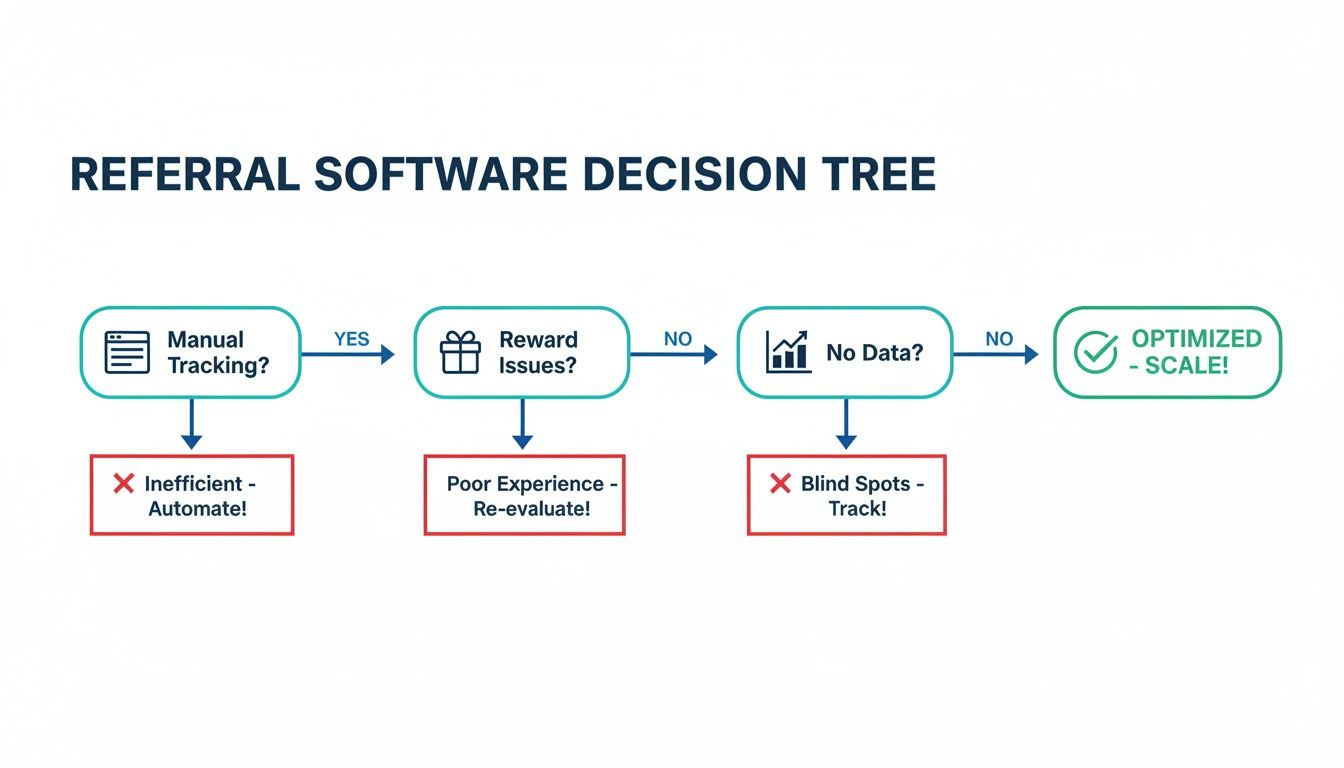
As you can see, the path moves from fixing basic manual tracking headaches to needing sophisticated, data-driven solutions. Let's dig into what defines these four key archetypes.
1 Plug-and-Play Solutions for Quick Launch
This is the entry point for most startups and small to medium-sized businesses (SMBs). Think of these as the "launch and go" tools, built for speed and simplicity over deep customization. Their entire value proposition is getting a functional referral program live in a matter of hours, not weeks.
Solutions like ReferralCandy are the classic example here. They're masters at integrating directly with e-commerce platforms like Shopify or BigCommerce, letting you set up a standard reward campaign with almost no technical heavy lifting. You can define a reward, tweak a basic landing page, and start generating referral links almost immediately.
Their focus is locked on the core necessities: automatically tracking shares and conversions, and making sure rewards get paid out reliably. You won't find advanced segmentation or deep CRM integrations, but they solve the most painful manual tracking problems with ruthless efficiency.
Key Differentiator: Speed to market is everything. These platforms are made for teams without dedicated developers, offering a straight line to automating your first referral program and proving it can work.
2 All-in-One Advocacy Platforms for Scaling Businesses
Once a business starts to grow, its needs get a lot more complicated. Scaling companies usually want to manage referrals alongside other word-of-mouth programs like affiliate or influencer marketing. This is where All-in-One platforms really shine, giving you a central command center for all your advocacy efforts.
Friendbuy is a great example of this category because it offers a much more muscular feature set. It lets you A/B test different offers, set up more granular campaign rules, and integrate deeply with your marketing automation and analytics tools. This is what allows a marketing team to move beyond a simple "one-size-fits-all" program and actually start optimizing for performance.
These platforms are perfect for businesses that have already validated their referral channel and are ready to invest in making it a significant, predictable part of their growth engine. They take more work to set up than a plug-and-play tool, but they offer a much higher ceiling for optimization and ROI. For businesses exploring different ways to build out their marketing stack, some even look at the flexibility offered by platforms that leverage a no-code development approach to create tailored solutions.
3 Enterprise-Grade Systems for Complex Integration
Large enterprises are a different beast entirely. They operate with a complex web of existing systems, ironclad security protocols, and unique customer journeys. Enterprise-grade referral software is built to handle this complexity, offering deep customization, advanced security features, and dedicated, white-glove support.
Platforms like Mention Me are built for this world. They focus on sophisticated integrations with enterprise-level CRMs and data warehouses, allowing for referral programs that feel like a native part of the brand experience. You’ll often find features like multi-language support, complex reward logic tied to customer lifetime value, and advanced fraud detection to protect the program at scale.
The pricing and implementation timeline reflect this complexity. These are not quick-launch tools; they are strategic investments for massive organizations trying to embed advocacy deep into their customer experience.
4 API-First Tools for Custom Development
Finally, some companies need total, absolute control over the user experience and referral logic. For them, an API-first platform is the only way to go. These tools provide the powerful backend infrastructure—the tracking, rewards, and rules engine—while giving your developers complete freedom to build the front-end experience from the ground up.
Talon.One is a strong example of an API-first promotion and loyalty engine that can power a referral program. It’s not a referral platform out of the box; it's a box of LEGOs. A development team uses its API to create a completely bespoke program that integrates seamlessly into a mobile app or custom web application.
This path is best for tech-forward companies with engineers to spare who see their referral program as a core product feature, not just a marketing campaign. It offers unlimited flexibility but demands the highest level of technical skill. To explore a wider range of software options and their specific applications, you might be interested in our detailed analysis of various referral marketing tools.
Software Archetype | Ideal Business Profile | Key Strength | Typical Price Model |
|---|---|---|---|
Plug-and-Play | Startups & SMBs | Speed of implementation | Flat monthly fee |
All-in-One | Scaling Businesses | Centralized advocacy management | Tiered, based on usage |
Enterprise-Grade | Large Corporations | Deep integration & security | Custom annual contract |
API-First | Tech-Forward Companies | Complete customization | Usage-based API calls |
The Role of AI in Modern Referral Marketing
The next big step for referral marketing is already here, and it's powered by artificial intelligence. For years, most referral programs have been pretty static—a simple, one-size-fits-all model that treats every customer the same. But AI changes the game entirely, turning referral software from a basic tracking tool into a smart, predictive growth engine. It automates tricky decisions, personalizes the experience for every user, and protects your program from fraud.
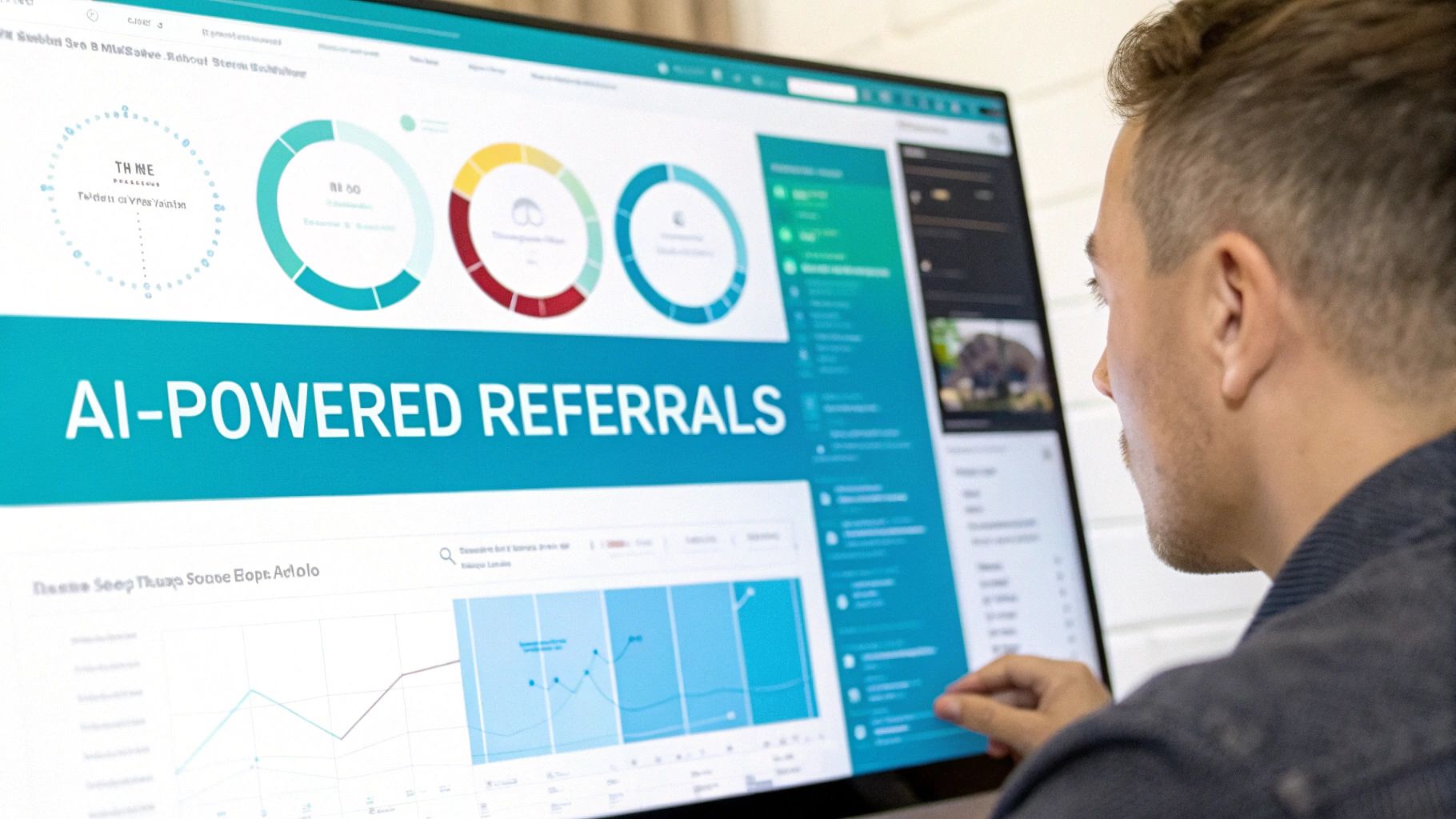
This shift is creating some serious market momentum. The value of AI and smarter integrations in referral software is exploding, with the market projected to hit USD 1.2 billion soon. That’s a massive jump from just USD 0.37 billion in 2024. This growth is fueled by machine learning that tailors incentives to each person, boosting conversion likelihood and delivering a 20-30% lift in referral rates. On top of that, AI-powered fraud detection and predictive scoring are cutting down on abuse by 40%, proving just how powerful this technology is. Discover more about the referral software market's growth and see for yourself.
AI-Powered Fraud Detection
Fraud is one of the biggest headaches for any referral program. It can be as simple as self-referrals from fake email addresses or as complex as organized schemes using bots and click farms. Trying to police this manually is a nightmare. It’s nearly impossible and eats up countless hours.
AI-driven referral software tackles this problem head-on by analyzing behavior in real-time. It spots suspicious patterns that a human would almost certainly miss, like:
A bunch of referrals coming from the same IP address.
A sudden, unnatural spike in sign-ups from just one advocate.
New users who sign up through a referral link but show zero engagement with your product.
By automatically flagging and blocking these phony referrals, AI protects your budget and makes sure rewards only go to real, high-quality advocates. This security layer is absolutely essential if you want to scale your program without opening the door to abuse.
Predictive Analytics for Advocate Identification
Why wait around for your best advocates to show themselves? AI can predict who they are before they even send their first referral. By analyzing customer data—things like purchase history, how often they use your product, and their support interactions—machine learning models can pinpoint users who have all the makings of a future super-advocate.
This lets you be proactive. Instead of blasting your entire customer base with a generic "refer a friend" email, you can send a personalized invitation to a hand-picked group of high-potential advocates. This targeted outreach feels more exclusive and gets much higher engagement.
AI doesn't just find advocates; it finds the right advocates. It identifies customers whose networks most closely match your ideal customer profile, ensuring the leads they bring in are high-quality and more likely to convert.
Personalized Rewards and Automated Triggers
Generic rewards get generic results. It's that simple. AI allows referral software to offer dynamic, personalized incentives that truly motivate people. For example, instead of a generic discount, the system could look at an advocate’s past purchases and offer them a credit toward their favorite product category.
Even better, AI optimizes the timing of when you ask for a referral. The system can watch for "peak happiness" moments in the customer journey and trigger a referral prompt at the perfect time.
After a Positive Support Interaction: A customer gives a 5-star rating to a support agent.
Upon Reaching a Milestone: A user upgrades their subscription or completes a key action in your app.
Following a Repeat Purchase: A customer makes their third purchase in two months.
By popping the question at these moments of high satisfaction, AI-powered systems make the request feel natural and timely. This dramatically increases the chances that the customer will follow through, turning every positive interaction into a potential growth opportunity.
Implementing and Measuring Your Referral Program
Kicking off a program with referral marketing software isn't a "set it and forget it" task.## Implementing and Measuring Your Referral Program
Kicking off a program with referral marketing software isn't a "set it and forget it" task. It demands a smart strategy that covers everything from the initial setup to ongoing analysis. The right platform gives you the tools, but it’s your implementation that decides whether you create a trickle of leads or a sustainable river of high-quality customers.

The first step is setting clear, achievable goals. Vague objectives like "get more referrals" are useless. You need to define specific business outcomes, like reducing customer acquisition cost (CAC) by 15% within six months or sourcing 50 qualified enterprise leads per quarter through your program.
These goals will directly shape your reward structure. The incentive has to be compelling enough to motivate action but sustainable for your business model. I’ve consistently found that double-sided rewards, where both the referrer and the new customer benefit, generate the highest engagement rates by far.
Designing a Motivating Reward Structure
Your reward should feel like a natural extension of your brand and reflect what your customers actually value. A B2C e-commerce brand might get great traction with store credit or discounts, while a B2B SaaS company will likely see better results offering cash rewards or premium feature upgrades.
Consider these proven reward models:
Fixed-Fee Rewards: Simple and predictable. For example, offer a $50 gift card for every new customer who signs up and makes a purchase. It's easy to communicate and manage.
Tiered Rewards: Gamify the experience by increasing the reward value as advocates hit specific milestones. This is a fantastic way to encourage your top performers to keep sharing.
Commission-Based Rewards: This is ideal for high-value B2B sales. Offering a percentage of the first year's contract value can powerfully motivate partners and advocates.
Your reward structure is a direct reflection of how much you value a customer's advocacy. A weak or confusing incentive tells your best customers that their recommendation isn't a priority, effectively shutting down the program before it even starts.
Once your structure is set, promotion is everything. Weave your program into every relevant customer touchpoint—think post-purchase emails, in-app notifications, and even within your customer support interactions. The easier you make it for advocates to find and share their unique link, the more successful your program will be. As you implement, it’s worth looking at advanced models like a Web3 referral program to see how decentralized growth engines are changing the game.
Measuring What Matters Most
Your referral marketing software is a goldmine of data. To measure true success, you have to track the right key performance indicators (KPIs). These are the metrics that move beyond vanity numbers and reveal the program's real financial impact.
The trend toward data-driven growth is undeniable. By 2024, over 60% of companies in the U.S. alone had integrated referral software into their sales strategies, boosting customer retention by up to 25%. This shift is powered by cloud-based solutions, which now account for 70% of deployments globally and allow for deep integrations with CRMs.
To optimize your program's performance, focus on these essential KPIs:
Participation Rate: What percentage of your customers have signed up to be advocates? A low rate might point to poor promotion or a weak incentive.
Share Rate: Of those who have signed up, how many are actively sharing their referral links? This metric helps you understand advocate engagement.
Conversion Rate: What percentage of referred leads become paying customers? This is the ultimate measure of lead quality from your referral channel.
Referral Revenue and ROI: Track the total revenue generated directly from referrals and compare it to the program's costs (software subscription plus rewards). This proves the program's financial value.
By continuously monitoring these metrics within your software's dashboard, you can identify friction points, A/B test different reward offers, and double down on what works. For more guidance on selecting the right platform, check out our guide on the best referral program software. This data-driven optimization cycle is what transforms a simple referral program into a powerful and predictable engine for business growth.
Common Questions About Referral Marketing Software
Jumping into the world of referral marketing software can bring up a lot of questions. From pricing and features to figuring out if you could just build it yourself, getting straight answers is key before you commit. This section cuts through the noise to tackle the most common questions we hear.
We'll cover what you can expect to pay, the classic "build vs. buy" debate, the critical difference between referral and affiliate programs, and a realistic timeline for seeing real results.
How Much Does Referral Software Cost?
There's no single price tag. Costs for referral marketing software can swing wildly depending on the features you need, how many advocates you're managing, and the level of support you want. The market is split into a few clear tiers, so finding the right fit for your budget is all about knowing where you stand.
Entry-Level Solutions ($50 - $200/month): Perfect for small businesses and startups just getting their feet wet. These platforms handle the essentials, like link tracking and basic reward automation, without breaking the bank.
Mid-Market Platforms ($200 - $1,000/month): Growing businesses land here. This tier offers more advanced integrations, much deeper analytics, and the flexibility to truly customize your campaigns.
Enterprise-Grade Systems (Custom Pricing): Large corporations need the whole package: dedicated support, full API access, and ironclad security. These systems are custom-quoted and often run several thousand dollars a month.
Can I Build My Own Referral System?
While building an in-house referral system might sound like a great way to save money, it's a massive undertaking that almost never makes sense for a business that wants to scale. A custom build will almost certainly lack the sophisticated, battle-tested features that make professional platforms so effective.
A DIY approach typically falls short in a few critical areas. Think automated reward fulfillment (crucial for keeping advocates happy and engaged) and robust fraud detection to stop people from gaming the system with self-referrals or bots. On top of that, the detailed analytics you get from a dedicated platform are nearly impossible to replicate without a huge, ongoing investment in your own dev team.
The real difference isn't just about features; it's about focus. Dedicated software is built from the ground up to optimize and scale referral marketing. An in-house tool will always be a side project, fighting for resources against your core product.
What's the Difference Between Referral and Affiliate Programs?
This is a big one, and the distinction is crucial. The core difference is the promoter's relationship with your brand.
A referral program leverages existing, happy customers who recommend your product to their personal network—friends, family, colleagues—based on a genuine, positive experience. The entire system is built on trust and personal relationships.
An affiliate program, on the other hand, is a purely commercial arrangement. It’s a partnership with marketers or influencers who promote a product to a broad audience they’ve built, all in exchange for a commission. The foundation here is audience reach and marketing skill, not pre-existing brand loyalty.
How Long Does It Take to See Results?
Don't expect an overnight success. While you might see a few referrals trickle in right after you launch, a well-run program generally needs three to six months to really build momentum and start delivering consistent, predictable results.
This timeline gives you enough runway to promote the program effectively across all your customer touchpoints, gather enough data to see which incentives are actually working, and tweak your strategy accordingly. Ultimately, your success rate will come down to the size of your customer base, how appealing your offer is, and how seamlessly you weave the program into your overall customer experience.
At Logical Commander Software Ltd., we know that building trust is the foundation of any successful business relationship. While our E-Commander platform is focused on preventing internal risks, the principles of ethical engagement and proactive management apply to all areas of business growth. We believe in creating systems that empower people while protecting your organization.
Discover how our AI-driven platform can help you manage human capital risks with dignity and integrity. Learn more at https://www.logicalcommander.com.