%20(2)_edited.png)

Referral Program Software: Boost Referrals and ROI

Referral Program Software feels more like a personal concierge, gently guiding your happiest customers to invite friends—and then thanking everyone for each successful introduction. It manages everything from referral tracking to reward fulfillment and performance reporting, so you can focus on strategy instead of wrestling with spreadsheets.
Discover How Referral Program Software Works

Imagine a friendly concierge showing visitors the hidden spots around town, then sending a note of appreciation every time a guest brings a plus one. That’s exactly what referral software does for your brand—directing customers to share links and ensuring both referrer and referee feel rewarded.
Guide Overview
This walkthrough takes you from the fundamentals of referral programs all the way to advanced tactics. Along the way, you’ll find clear examples, handy bullet points, and a concise benefits table to map out the entire journey.
Basic definitions explaining how software tracks and rewards referrals
Core features like link generation, reward rules, and fraud protection
Enterprise selection criteria covering scalability, integrations, and support
Implementation checklist with UTM setup, asset creation, and pilot phases
Privacy considerations for GDPR, CCPA, and data governance alignment
KPIs and ROI metrics that measure cost per acquisition and lifetime value
Vendor evaluation framework to compare pricing, features, and service levels
Why Mastering Referral Software Matters
Turning casual word-of-mouth into a dependable source of new business usually takes weeks of manual work. Referral software automates those repetitive tasks in minutes.
That means your team can spend more time tweaking rewards and refining messages instead of updating spreadsheets or chasing down data.
Dedicated referral software can boost referrals by 25%–40%, compared to manual programs.
Below is a quick look at the core advantages you’ll gain by introducing the right solution.
Key Referral Software Benefits
Benefit | Impact |
|---|---|
Cost Reduction | Lower customer acquisition cost |
Increased Referrals | Scalable word-of-mouth growth |
Automated Tracking | Saves time and reduces errors |
These benefits add up fast, freeing budget and bandwidth for higher-value marketing initiatives.
What To Expect Next
In the sections that follow, we’ll dive into each essential feature, walk through setup steps, highlight key ROI calculations, and offer a framework for comparing vendors.
How This Guide Is Structured
Every part builds on the last: you’ll move from understanding referral mechanics to designing robust enterprise workflows. Real-world examples and analogies—like picturing reward tiers as game levels—keep complex ideas clear.
Key Takeaway
Getting referral software right means channeling organic buzz into a reliable growth engine. Use this guide to turn one-off referrals into a repeatable, predictable channel—and watch new customer introductions climb.
Understanding Referral Program Software Concepts
Imagine your referral program software as the referee on a busy soccer pitch—quietly watching every pass, foul, and goal. It logs every referral event, keeps the game fair, and makes sure excitement never dips.
Behind the scenes, it replaces clumsy spreadsheets and manual checks with automated routines:
Referral Tracking records who referred whom and exactly when a conversion happens.
Reward Allocation issues incentives automatically, following the milestones or tiers you’ve set.
Performance Reporting delivers live, customizable dashboards so you spot trends and top performers in seconds.
Think of those rewards like a live scoreboard—each successful referral lights up instantly, cheering on advocates and stoking friendly competition. And the performance reports? They’re your highlight reels, letting you filter by campaign, region, or product to find winning plays and areas that need a new approach.
Market Context And Growth Drivers
More businesses now expect referral tools that feel as seamless as their favorite social apps—secure, scalable, and ready to hook into existing systems without a fuss.
A DataInsightsMarket report on referral program software trends values the market at USD 2.5 billion by 2025, forecasting growth in the low double digits from 2025 through 2033.
Key Insight Modern referral programs run on cloud-hosted, mobile-first platforms to deliver instant rewards and real-time data sync.
Here’s a side-by-side look at what top analysts predict:
Market Forecasts for Referral Program Software
Source | Forecast Year | Projected Market Size | CAGR |
|---|---|---|---|
DataInsightsMarket | 2025 | USD 2.5 B | Low double digits |
TechAnalystGroup | 2028 | USD 4.1 B | 11.2% |
MarketProjections | 2030 | USD 6.3 B | 10.5% |
These varying projections show just how fast this market is expanding. For example, a mid-size SaaS firm slashed referral processing time by 70% and stopped missed commissions altogether by swapping spreadsheets for a dedicated platform.
Cloud And Mobile First Designs
Mobile-first portals mean advocates share links with a single tap and see their reward status instantly.
At the same time, cloud-hosted architectures keep data synchronized across marketing, sales, and support—so everyone plays from the same playbook.
The result? Advocates stay engaged, admins have real-time control, and customers enjoy a smooth, transparent referral journey.
This primer sets the stage for exploring core features, implementation checklists, and integration best practices—so you can launch a referral program that drives real growth.
Core Features Of Referral Program Software
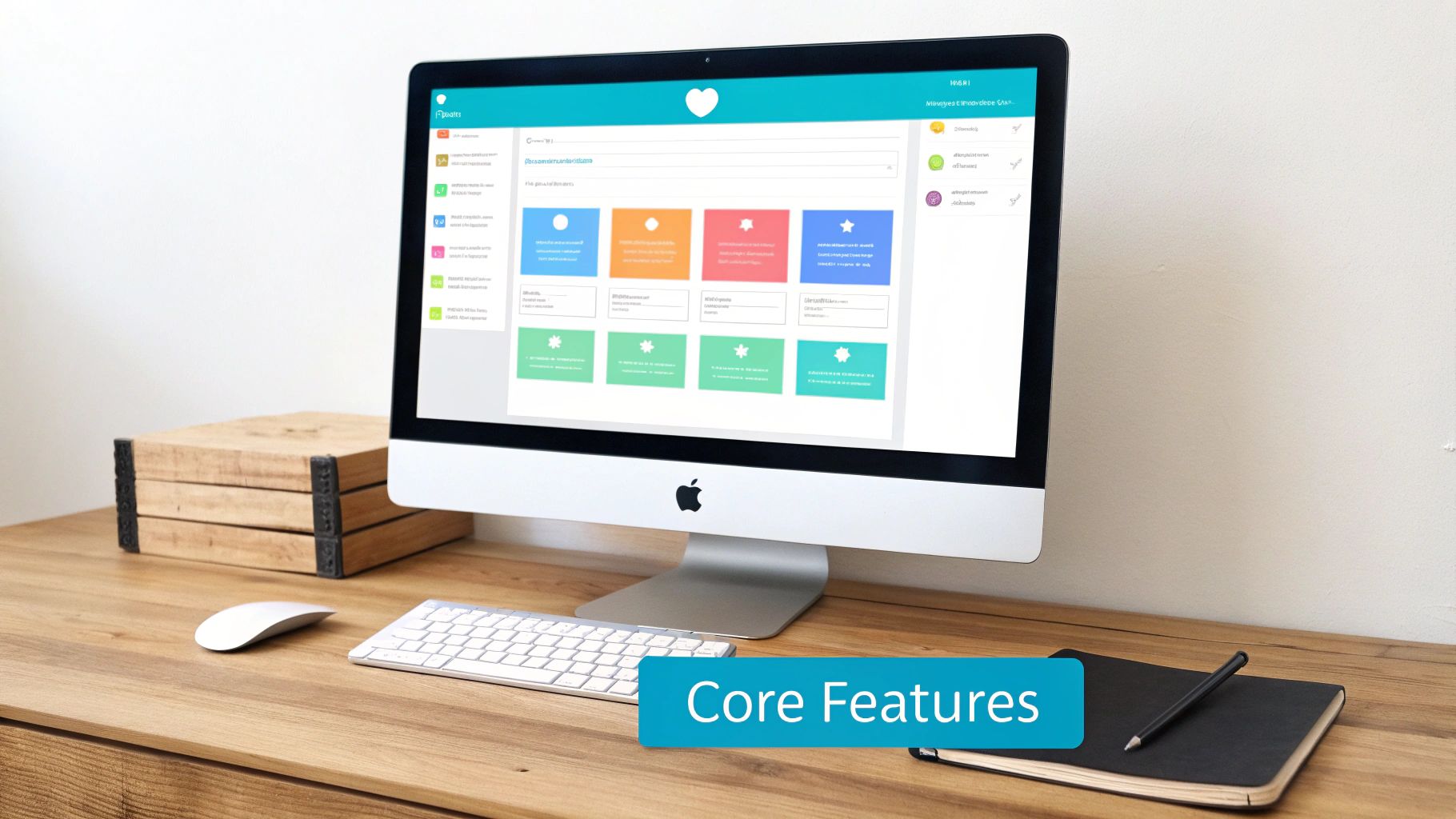
When you want word-of-mouth growth to run itself, referral program software is the engine you need. It handles link sharing, tracks each recommendation, and instantly issues rewards. That level of automation makes sure no referral slips through the cracks and keeps advocates coming back.
Think of the core features as gears inside a well-crafted watch: each one clicks into place to move the hands forward—and in this case, that forward motion means revenue and new customers.
Referral Link Generation builds unique, trackable URLs or codes ready for social posts and emails.
Reward Management triggers incentives the moment advocates hit set milestones.
Segmentation lets you group referrers by behavior, demographics, or channel for targeted messaging.
Analytics Dashboards offer real-time insights into sign-ups, conversion rates, and overall ROI.
API Integrations tie referral data back to CRMs, marketing platforms, and e-commerce systems.
These elements lay the groundwork for campaigns that launch smoothly and grow sustainably.
Structuring Motivational Game Layers
Referral software often borrows from game mechanics. The reward logic mirrors level progression:
Triggers act like power-ups, kicking off reward sequences when someone shares a link.
Milestones serve as checkpoints—think 1st, 5th, or 10th referral.
Incentives play the part of badges, coins, or prizes that users can redeem for real perks.
For instance, a SaaS company might offer a $10 credit after three referrals and unlock a free month once a user reaches ten. This tiered setup keeps engagement high and sharing frequent.
Core Feature | Game Analogy | Business Impact |
|---|---|---|
Link Generation | Starting Line | Easy shareability |
Reward Management | Reward Tiers | Advocate engagement |
Segmentation | Player Classes | Personalized messaging |
Analytics Dashboard | Scoreboard | Data-driven campaign tweaks |
API Integration | Cross-Platform | Seamless workflow |
A well-designed reward structure can boost participation by up to 40%, according to industry reports.
Once you’ve nailed these basics, you can add advanced modules for extra power and protection.
Fraud Protection uses pattern recognition to block bogus or duplicate referrals.
Multi-Tier Structures reward advocates on direct and second-degree referrals.
Branded Portals give advocates a custom-branded hub that keeps your identity front and center.
Industry data shows that large enterprises—especially in North America—are the biggest adopters, projected to hold 54.6% of the market revenue by 2025. Find the full report at FutureMarketInsights.
Data Flow And Integration
APIs work like conveyor belts, moving referral events into your existing stack. That means:
Automated lead entries in your CRM
Instant email alerts to referrers when rewards drop
Continuous syncing with analytics tools without any manual effort
Picture an e-commerce team pushing new referral data into their email service to trigger a drip sequence. That one connection can cut manual updates by 75%.
Check out our guide on referral marketing tools for vendor insights and setup tips.
Breaking features into bullets, tables, and quotes makes the overview easy to skim and digest. These core and advanced capabilities form a complete referral engine tied directly to your business goals.
By mapping each feature to specific needs—motivation, security, and data flow—you can prioritize and plan your launch in phases. Layering these pieces lets you scale campaigns quickly, hitting objectives like lower acquisition costs, higher engagement, and full visibility from the start.
Start evaluating these core features today to turn advocates into a reliable acquisition channel immediately.
Implement without delay.
Benefits And ROI Of Referral Program Software

Turning customer recommendations into a clear growth engine isn’t magic—it’s smart software doing the heavy lifting. By automating rewards and logging every introduction, you’ll see acquisition costs drop almost immediately. When referrals become your go-to channel, your marketing dollars go further.
Reduced Acquisition Costs
Referrals cut through the noise and reach people who already trust your brand. As a result:
30–50% Lower CAC: Companies commonly report these savings on their cost per customer.
Predictable Spending: You only pay rewards when a referral converts.
Controlled Budgets: Automated triggers prevent overspending on incentives.
Thanks to these efficiencies, budgets that once fueled ads can now support product innovation or other high-impact campaigns.
"Switching to referral software cut our CAC in half within two months," said the Growth Lead at SaaSCo.
For example, an e-commerce team moved $10,000 from monthly ads into referral rewards. Within eight weeks, new sign-ups jumped 35%.
Higher Retention And Lifetime Value
Friends bring friends—and they stick around longer. When someone joins through a referral:
They spend 20% More per order.
Tiered rewards keep them coming back.
Churn drops by 15% over the first year.
In fact, specialist analysts and vendor reports show that dedicated referral programs can drive 15–30% of total revenue at leading SaaS firms. For more detail, check research on Software Oasis.
Some SaaS companies attribute up to 30% of annual revenue to referral channels.
Ongoing Optimization With Analytics
The real advantage of referral software is data you can act on:
Monitor Key Metrics: Track sign-ups, referral conversions, and reward redemptions.
A/B Test Incentives: Try different rewards and timing to see what resonates.
Refine Messaging: Use performance insights to sharpen your emails, in-app prompts, and social posts.
Often, these tweaks push referral ROI past paid ads in just 3–6 months.
Check out our guide on boosting employee engagement tools to see how referral incentives can also improve morale in our article on effective tools to boost employee engagement.
Metric | Referral Software | Paid Ads |
|---|---|---|
Cost Per Acquisition | $20–$50 | $60–$120 |
Conversion Rate | 5–10% | 1–3% |
Payback Period | 3 months | 6+ months |
Comparing Referral Software And Paid Channels
When you stack referral ROI against traditional ads, the difference is clear:
250% ROI from referral spend
120% ROI from paid search
Put another way, every dollar you invest in referrals returns about $2.50, while ads bring back roughly $1.20.
Case Study Examples
Consider a mid-sized SaaS provider that flipped on referral software:
Sign-ups doubled in three months.
Referred leads converted at 12% versus 3% on non-referral campaigns.
Referrers earned product credits, fueling even more word-of-mouth.
Or a subscription service that layered in tiered bonuses:
Free months kicked in after five referrals.
Active memberships climbed 25% year over year.
The program paid for itself in just four billing cycles.
Key Takeaways On ROI
Lower acquisition costs make growth more predictable.
Stronger retention boosts lifetime value.
Built-in analytics drive continual improvement.
Referral software often outperforms ads by 2x on spend.
Even simple changes—shifting reward timing or tweaking outreach—can lift ROI by 10–20%. When you combine savings, loyalty, and data-driven tweaks, referrals become a self-reinforcing growth loop.
How to Choose the Right Referral Program Software
Picking the perfect referral program software can feel like standing in a hardware store with every tool imaginable. Where do you start? An evaluation framework built around six critical criteria will turn that overwhelming moment into a clear checklist.
Scalability ensures the platform grows with your audience.
Customization lets you fine-tune referral rules and reward tiers.
Analytics depth delivers the data you need to iterate.
Integrations tie referral activity into your CRM, email, and commerce tools.
Support quality drives quick setup and reliable troubleshooting.
Pricing structures must match your budget and ROI targets.
Evaluating Scalability And Customization
Imagine launching a global campaign and watching referrals spike by the thousands within hours. That’s when scalability really matters.
Ask if the vendor offers dynamic resource scaling or bursts of capacity on demand.
Check the SLA for uptime guarantees—downtime kills momentum in a flash.
Run through scenarios: can you craft custom reward tiers, set triggers by customer segment, or adjust rules on the fly?
Peek at the user interface. How easily can you apply brand assets, tweak messages, or preview customer journeys?
Keeping these questions in mind will surface any bottlenecks before they derail your launch.
Assessing Analytics And Integrations
Data without context is just noise. What you need is a dashboard that shows where referrals originate, how they convert, and which rewards drive the biggest lift.
Look for real-time dashboards that break down key metrics: signup rates, share clicks, coupon redemptions.
Verify connectors to your core systems: whether prebuilt integrations or open APIs, you don’t want to export CSVs by hand.
Consider embedding referral insights directly into tools your team already uses—no extra logins required.
In the end, seamless data flow and crystal-clear insights keep campaigns agile and accountable.
Running Trials And Gathering Feedback
A two-week demo or pilot campaign is your test drive. Here’s how to make the most of it:
Define your test objectives—what metrics really matter?
Run the software through a live campaign with real incentives.
Collect feedback from marketing, product, and IT via quick surveys or short interviews.
Tweak configurations and lock in service-level terms based on what you learn.
Key takeaway: Evaluate trial findings against your goals to ensure every feature earns its keep.
Learn more about innovative B2B SaaS models in our article Innovative B2B SaaS Model.
Vendor Evaluation Criteria Matrix
Before signing on the dotted line, put your top contenders into a side-by-side comparison. This matrix highlights the core capabilities and the questions you should ask each vendor.
Criteria | What to Look For | Why It Matters |
|---|---|---|
Scalability | Auto-scaling under heavy loads, global delivery options | Keeps performance steady during spikes |
Customization | Flexible rule engine, white-label branding, multi-tiered rewards | Matches your unique referral strategy |
Analytics | Real-time dashboards, cohort analysis, exportable reports | Powers data-driven optimization |
Integration | Prebuilt connectors (CRM, email, e-commerce) and open APIs | Eliminates manual work and data silos |
Support | Dedicated onboarding, 24/7 live chat, detailed documentation | Speeds up launch and minimizes downtime |
Pricing | Transparent tiers, usage-based billing, clear overage fees | Prevents budget surprises and maximizes ROI |
Use this table to align each vendor’s strengths with your business goals. It’s the fastest path from research to shortlist.
Final Recommendation And Next Steps
Once trials wrap up, rank your finalists on:
Customization roadmaps and feature release schedules.
Data privacy compliance (GDPR, CCPA) and ownership rights.
Support SLAs, including response times and escalation paths.
According to vendor benchmarks, a thorough evaluation cuts selection time by over 50%.
Next, secure flexible pricing and carve out an integration timeline. Allocate resources, plan training workshops, and map out your launch calendar.
Gather case studies to see real-world impact.
Ask for peer references in your industry.
Calculate total cost of ownership over a three-year horizon.
Proof-of-concept pilots typically lead to 30% higher adoption rates. So schedule those demos, gather evaluator scores, and pick the platform that checks every box. With the right referral software in place, you’ll turn organic word-of-mouth into a predictable growth engine—complete with clear ROI.
Start evaluating vendors with confidence today.
Implementation And Privacy Checklist For Referral Program Software
Rolling out referral program software is a bit like orchestrating a road trip: define the route, pack the essentials, and make sure everyone knows their role. This checklist walks you through every step—from setting goals to launching a pilot and staying on the right side of privacy regulations.
Goal Setting: Clarify objectives, set target referral rates, and allocate budgets.
Campaign Design: Decide on incentives, choose messaging channels, and create assets.
Technical Setup: Generate referral links, attach UTM parameters, and install tracking scripts.
Team Training: Develop guides, host workshops, and assign ownership for each milestone.
Pilot Launch: Test with a small group before scaling up.
Prepping your emails, landing pages, and social posts early keeps the entire project on track.
Campaign Design And Asset Preparation
UTM tracking is your compass here. It lets you see exactly where referrals are coming from and which campaigns move the needle.
Start by setting up dynamic UTM tags and double-checking that they feed cleanly into your analytics. Then, run a peer review on all creative assets to catch typos or broken links before launch.
Task | Best Practice |
|---|---|
UTM Setup | Use lowercase parameters and consistent naming |
Asset Review | Conduct peer review before launch |
Link Verification | Test all referral URLs in staging |
Next, plug your CRM, email platform, and analytics tool together via APIs or webhooks so referral data flows seamlessly.
“Seamless integration reduces manual tasks by 75%, improving accuracy and speed.”
Always rehearse in a sandbox environment—test event triggers, data mappings, then lock down the process. Document every step in a runbook to speed up troubleshooting.
Integration And Privacy Considerations
Privacy compliance isn’t optional—it’s the foundation of trust. Collect only the data you need and encrypt everything in transit and at rest.
Data Encryption: Secure referral records with TLS in transit and AES-256 at rest.
Policy Audit: Schedule quarterly reviews to verify GDPR and CCPA compliance.
User Consent: Build explicit opt-ins and straightforward opt-out workflows.
Define data retention rules to purge old referral records once they exceed legal thresholds. Update privacy notices before you start collecting referrals.
Pilot Testing And Team Training
Think of your pilot phase as a dress rehearsal—it reveals gaps before the main event.
Recruit volunteers from sales and support for the initial rollout.
Assign clear roles: who monitors referrals, who escalates issues.
Run hands-on sessions so the team knows how to read dashboards and fulfill rewards.
Collect feedback through quick surveys and one-on-one interviews at the end of each cycle. Use those learnings to refine incentives, messaging, and technical workflows.
Phase | Duration | Key Deliverables |
|---|---|---|
Planning | 1 week | Objectives, asset readiness |
Pilot Launch | 2 weeks | Live testing, issue logs |
Evaluation | 1 week | Feedback report, refinements |
Full Rollout | Ongoing | Performance monitoring |
Measure pilot success with referral usage rates and reward redemption metrics. If you fall below targets, adjust your timeline.
Early pilot insights can increase overall program success by 20%.
Once you’re live, track KPIs like referral conversion rate, customer acquisition cost, and customer lifetime value. Schedule quarterly check-ins to ensure privacy compliance and integration health.
With this checklist, your team can launch a compliant, fully integrated referral program that scales predictably.Start planning your next update now—review UTM strategies, refresh privacy notices, and make sure support can handle common questions and privacy requests seamlessly.
Referral Program Software FAQ
When you launch a referral program, questions about features and budgets inevitably pop up. This FAQ cuts through the clutter with straight-talk answers.
Before diving in, take a look at the process flow below—seeing the roadmap helps turn theory into action.
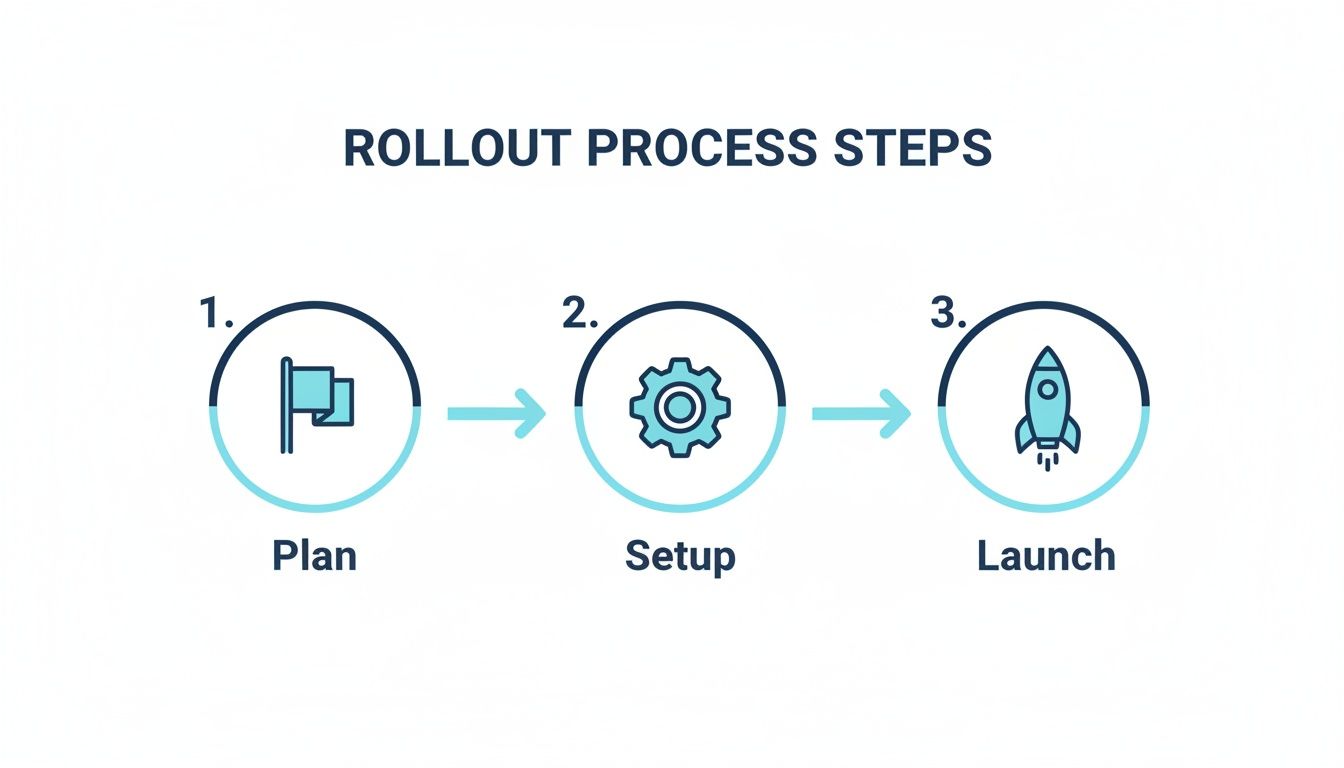
The graphic breaks the rollout into three phases: Plan, Setup, and Launch.
Key steps:
Plan objectives and budget before you invite advocates.
Setup tracking links, UTM codes and CRM integrations.
Launch across email, social and in-app prompts.
“A clear rollout plan cuts time to launch by over 30%,” notes a referral expert.
Referral Program FAQs
What budget do I need to start a referral program software trial?Most vendors offer tiered plans or free trials. For small teams, plan on $50–$200 per month, plus any one-time setup fees.
How do I measure the success of a referral campaign?Focus on the referral sign-up rate, conversion of referred leads and average order value. Modern dashboards will also automate acquisition costs and ROI reporting.
Can I integrate referral software with my existing CRM?Yes. Look for platforms with API connectors and webhooks to keep data flowing smoothly between your CRM, email tools and e-commerce systems.
When can I expect to see a return on investment?You’ll often spot an uptick within 4–6 weeks, with solid ROI in 3–6 months. Keep an eye on analytics, tweak your rewards and iterate quickly.
These pointers should guide you through setup and help you choose the right referral software with confidence.
Ready to spot risks before they escalate? Get started with Logical Commander Software Ltd. and power your referral program with confidence.