%20(2)_edited.png)

Your Guide to Referral Programs Software

Updated: Dec 1, 2025
Referral programs software is the engine that takes word-of-mouth marketing from a hopeful concept and turns it into a measurable, automated growth channel. It’s the dedicated technology that manages everything from creating unique referral links to paying out rewards the moment a new customer signs on.
Turning Word of Mouth Into a Measurable Growth Engine
Imagine trying to run a referral program with just a spreadsheet and a notepad. Manually tracking who referred whom, confirming every conversion, and calculating rewards isn't just a headache—it’s completely impossible once you have more than a handful of advocates.
This is the exact problem referral programs software was built to solve. It acts as the central command center for your entire word-of-mouth strategy, turning chaotic, manual efforts into a predictable system.
Instead of just hoping for referrals, these platforms give you the framework to actively drive them. This shift is what transforms casual recommendations into a customer acquisition channel you can actually count on.
The Automation Advantage
At its core, this software is all about automation. It handles the most repetitive, time-consuming tasks, freeing up your team to focus on promoting the program and building relationships with your top referrers.
It takes the human error and manual work out of key processes, including:
Unique Link and Code Generation: Every participant automatically gets a unique tracking link or code.
Performance Tracking: The platform monitors clicks, leads, and sales in real-time, so you always know what’s working.
Reward Fulfillment: The moment a referral is successful, the software instantly issues the reward—whether it’s a discount, cash, or store credit.
Communication: Automated emails keep your advocates in the loop, notifying them of their progress and successful referrals.
By systematizing the referral process, businesses can create a consistent and trustworthy experience for their advocates. This reliability encourages more participation and builds long-term loyalty, moving beyond simple transactions to foster a genuine brand community.
The market for this technology is exploding for a reason. As of 2025, the global referral marketing software market is valued somewhere between $506.1 million and $3.91 billion. But the real story is its growth, with projections showing it could rocket to $12 billion by 2035.
That kind of growth signals a massive shift in how businesses acquire customers, driven by the power of these automation tools. You can discover more insights about referral market growth to see where the industry is headed.
Understanding The 3 Core Referral Program Types

Not all referral programs are built the same, and the software that runs them is just as specialized. Trying to force one generic approach onto different audiences is like using a single wrench for every bolt in an engine—it’s clumsy, inefficient, and you're bound to strip something important.
The real key to getting results is matching the right program structure and referral programs software to the right group of people. Before you can do that, you have to understand the different flavors of referral programs out there. For a little inspiration, it’s worth checking out some actionable referral program ideas to see what aligns with your business goals.
Let's break down the three main types. Each one has its own goals, its own players, and its own incentives.
Customer Referral Programs
This is the one most people know. The goal is simple: turn your happiest, most loyal customers into a volunteer sales force. It’s all about customer acquisition, fueled by the kind of genuine trust that only exists between friends and colleagues.
A customer program lives and dies by its simplicity. The easier it is to share, and the more valuable the reward, the better it works.
The classic case study is Dropbox. They achieved a mind-blowing 3900% growth in just 15 months by giving users more storage space when they referred friends. The incentive was directly tied to the product's value, which created an unstoppable viral loop.
Customer referral programs hit a home run when the reward actually improves the user's experience with your product. It’s less about the cash value and more about making them love your brand even more.
Employee Referral Programs
Here, the focus shifts from finding new customers to finding top-tier talent. Companies use specialized software to let their own teams tap into their professional networks, which often becomes the single best pipeline for high-quality candidates.
The rewards are usually cash bonuses. Why? Because employees are directly helping the company slash hiring costs and fill critical roles faster. A successful employee referral program is also a powerful sign of a healthy company culture—people won't recommend their workplace to a trusted friend unless they truly believe in it.
Partner And Affiliate Programs
This is the most sophisticated category, and it’s where enterprise-grade referral software really proves its worth. These programs are built for formal business relationships with resellers, agencies, consultants, or influencers who promote your product to their own audiences.
These aren't casual arrangements. They involve managing complex commission structures, tracking lead registrations, and coordinating co-marketing campaigns. A few things set them apart:
Formal Agreements: Partners are bound by contracts with clearly defined terms.
Complex Commissions: Payouts can be tiered, recurring, or based on sales volume.
High-Volume Tracking: The software has to be rock-solid to handle a massive scale of referred leads and sales accurately.
For many B2B companies, these programs are the engine of their growth strategy, turning individual allies into a scalable, auditable, and incredibly effective sales channel. Getting a handle on the moving parts of a successful SaaS partner program ecosystem is a must for any B2B company serious about scaling up.
To make these differences crystal clear, let's lay them out side-by-side.
Comparing Key Referral Program Types
This table breaks down the key differences between customer, employee, and partner referral programs, helping businesses identify which type best suits their goals.
Program Type | Primary Goal | Typical Referrer | Common Incentive | Software Focus |
|---|---|---|---|---|
Customer | New customer acquisition | Existing happy customers | Product-related rewards (discounts, credits, features) | Simplicity, ease of sharing, viral loop creation |
Employee | Talent acquisition | Current employees | Cash bonuses, extra vacation days, company perks | Integration with HRIS/ATS, internal communication tools |
Partner/Affiliate | Scalable revenue generation | Resellers, agencies, consultants, influencers | Tiered or recurring commissions, revenue sharing | Sophisticated tracking, commission logic, lead management, payout automation |
Choosing the right type—and the right software to power it—is the first and most critical step. Each program speaks to a different audience with different motivations, and your technology needs to be perfectly tuned to that reality.
The Must-Have Features of Enterprise Referral Software
When you outgrow the startup phase, that trusty spreadsheet or basic referral plugin just can’t keep up. The sheer complexity of managing hundreds—or thousands—of advocates, partners, and payouts demands a much more powerful engine. Enterprise-level referral programs software isn't just about sharing links; it's a sophisticated suite of tools built for security, scale, and surgical precision.
Think of it as the difference between a go-kart and a high-performance race car. Sure, both get you around the track, but only one is engineered for the intense demands of professional racing. These enterprise features are the non-negotiables that keep your program running smoothly, securely, and profitably as you grow.
Seamless System Integration
An enterprise referral platform can't operate in a silo. Its real value comes from its ability to talk flawlessly with the other critical systems your business runs on. This deep connectivity automates entire workflows and creates a single source of truth for all your referral data.
The most critical connections include:
CRM Integration: This is non-negotiable. Connecting to your CRM (like Salesforce or HubSpot) lets the software automatically sync new referral leads, track their entire journey through your sales funnel, and attribute new customers back to the right person without anyone lifting a finger.
Payment Gateway Integration: To handle reward payouts at scale, the software has to connect directly with payment systems like PayPal, Stripe, or Tremendous. This is how you ensure referrers get paid accurately and on time, which is absolutely vital for keeping them engaged and trusting your program.
Advanced Security and Fraud Prevention
As your referral program gains traction, it will inevitably become a target for fraud—things like self-referrals, duplicate accounts, or clicks from automated bots. Enterprise software is built with sophisticated defenses to protect your program's integrity and, more importantly, your budget.
These systems are designed to detect and flag suspicious patterns, like a flood of referrals coming from the same IP address or a huge spike in clicks that never convert.
A secure referral program is a trustworthy one. Advanced fraud detection isn't just about saving money on illegitimate payouts; it's about ensuring your legitimate advocates know the program is fair and their efforts are valued.
Granular Tracking and Attribution
Who really gets credit for a sale? In a complex customer journey, that question isn't always easy to answer. A prospect might click a referral link today but not actually buy for another 30 days, after seeing a few ads and reading a blog post.
This is where enterprise software shines. It offers multi-touch attribution, moving way beyond the simplistic "last click" model. It can track every single touchpoint, giving you a crystal-clear picture of how referrals influence the entire sales cycle. This granular data is vital for rewarding partners fairly and understanding the true ROI of your efforts.
This level of detail ensures fairness and gives you the insights needed to optimize every piece of your referral strategy. It’s what separates a good program from a truly great one.
How to Choose the Right Referral Software
Picking the right referral software can feel a lot like choosing a new car. The options look endless, and if you make the wrong call, you're in for a world of headaches. But with a structured evaluation process, you can turn an overwhelming task into a clear, confident decision.
The secret is to know your destination before you even start looking at the models on the lot.
First, define what a "win" looks like for your program. Are you trying to flood your sales team with a high volume of qualified leads? Or are you aiming for direct, immediate sales conversions? The answer radically changes which features matter most. A lead-focused program absolutely needs tight CRM integration, while a sales-focused one demands flawless connections to your e-commerce and payment gateways.
Once your goals are crystal clear, you can build a practical checklist to keep you on track.
Create Your Evaluation Framework
Don't let yourself get sidetracked by flashy demos or endless feature lists. The key is to score every potential vendor against the same consistent framework, one that covers the absolute essentials. This keeps your decision grounded in what will actually drive results for your business.
Your framework should dig into four critical areas:
Technical Capabilities: Does the software actually play well with your existing tech stack—your CRM, marketing automation, and payment systems? Can it handle the volume of referrers and transactions you’re aiming for without grinding to a halt?
User Experience (UX): You need to look at this from two angles: your team and your referrers. Is the admin dashboard intuitive enough for your team to manage without pulling their hair out? And for your participants, is the sign-up process a breeze? Can they effortlessly share links and track their rewards? A clunky interface is the fastest way to kill adoption before you even get started.
Pricing and Scalability: Look way beyond the sticker price. You have to understand the pricing model. Is it based on how many referrers you have, the number of successful conversions, or just a flat monthly fee? Make sure the model aligns with your growth plans so you don’t get hit with painful surprise costs right when your program starts taking off.
Support and Partnership: What kind of support does the vendor really offer, both during and after implementation? Check their reviews and, more importantly, ask for references. You want a vendor who feels like a partner invested in your success, not just a faceless software provider.
Visualizing the Core System Requirements
A great way to get your head around the technical foundation is to see how all the different pieces have to connect. The diagram below shows the essential pillars that any enterprise-grade referral system is built on.
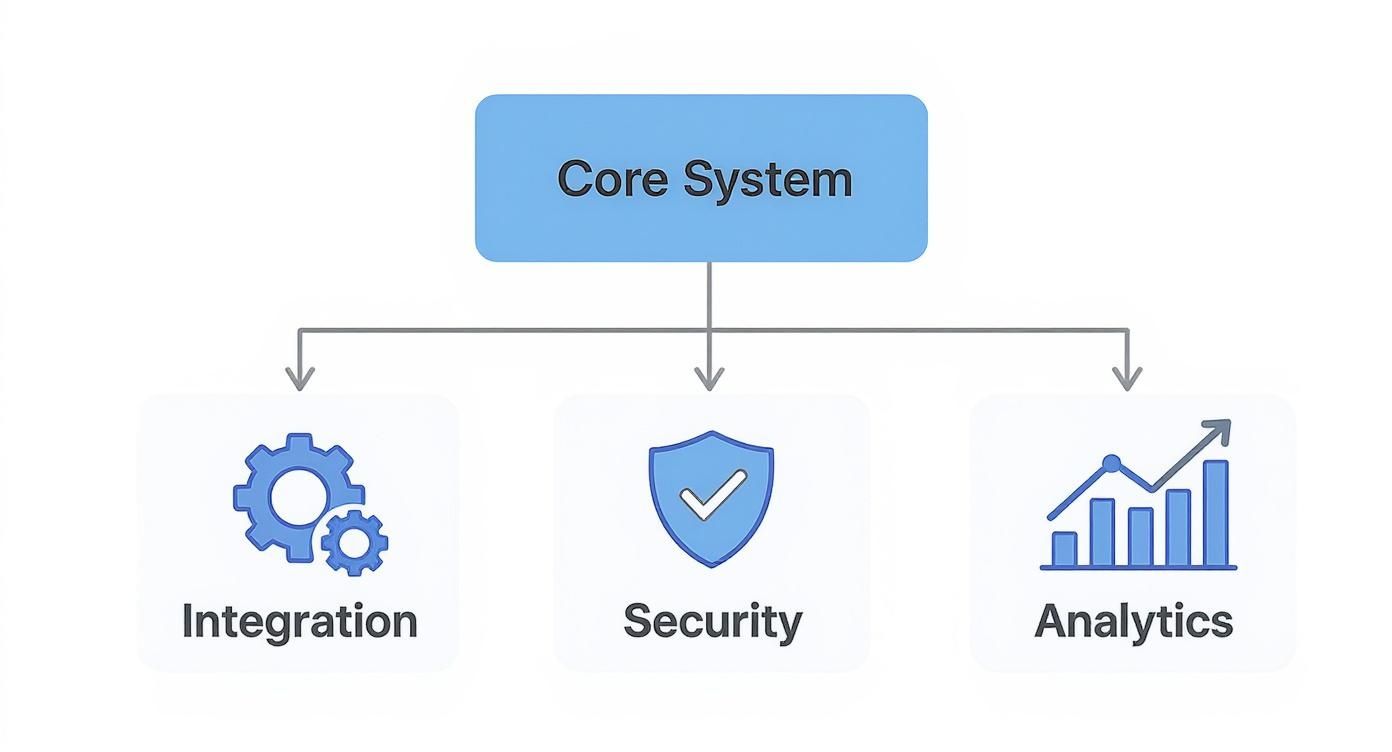
This visual makes it clear: a powerful core system has to be built on a bedrock of solid integration, security, and analytics. Without those, it simply won't function effectively as you scale.
A common mistake is choosing software based only on its current features. The best choice is a platform that not only meets your needs today but also has a clear product roadmap that aligns with where your company is headed.
By using a structured checklist and focusing on these core pillars, you can confidently filter through all the noise. This methodical approach ensures you end up with referral software that not only launches successfully but becomes a sustainable, long-term engine for your company's growth.
Getting Your New Software Off the Ground and Driving Adoption

Let's be honest—even the most powerful referral software is just expensive code if no one actually uses it. A successful rollout has less to do with flipping a technical switch and everything to do with sparking human action. This calls for a smart, thoughtful strategy that gets your potential referrers educated, excited, and empowered right from the start.
Treat your launch like an internal marketing campaign. The goal isn't just to inform people about the new platform; it's to sell them on the value it brings to them personally. A great launch connects powerful tech with a crystal-clear communication plan to drive engagement that sticks.
Building Your Launch Communication Plan
Your communication needs to be clear, compelling, and consistent. It has to immediately answer the "what's in it for me?" question for every single person, whether they're an employee, a loyal customer, or a formal business partner.
Your game plan should map out:
A Clear Launch Timeline: Lock in key dates for pre-launch teasers, the official go-live, and any follow-up nudges.
Key Messaging and Value Props: Don't use a one-size-fits-all message. For employees, talk bonuses and bringing in top talent. For customers, focus on rewards and sharing a brand they already love.
Your Channel Strategy: Figure out where you'll talk to them. Will it be through email newsletters, social media posts, in-app notifications, or a big company-wide meeting?
This kind of organized approach makes sure everyone gets the right message at the right time, building momentum instead of confusion.
The success of any referral program is built on trust and clarity. A sloppy launch kills both. Your rollout needs to feel as professional and seamless as the software itself, giving participants total confidence that their efforts will be tracked accurately and rewarded properly.
Training and Creating Shareable Assets
Once your communication plan is locked in, you have to equip your referrers to win. For internal programs, that means running training sessions that actually work. To really nail this, you can learn more about the best effective tools to boost employee engagement that can complement your training efforts.
For your external programs aimed at customers or partners, the key is to create compelling marketing assets they can share with zero effort. We're talking pre-written email templates, social media posts with slick graphics, and dead-simple instructions on how to grab and use their unique referral links.
The easier you make it for them to share, the more they'll actually do it. And remember to set realistic expectations for the first couple of months—building a great referral engine is a marathon, not a sprint.
Measuring Success and Calculating ROI
So you’ve got your referral program software up and running. Great. But that’s just the starting line. Now comes the part that really matters: proving it’s actually working. To do that, you have to move past feel-good numbers like shares and clicks. The real story isn't about activity; it's about results.
This is where you connect the dots between your program and the bottom line. A data-first approach gives you the hard evidence to justify the investment, lock in future budgets, and fine-tune your strategy on the fly. After all, the whole point of this software is its return on investment. The logic is solid: with over 72% of consumers trusting recommendations from people they know, these campaigns have built-in credibility. It's no surprise that 65% of companies see a higher ROI from referrals than they do from traditional marketing.
Defining Your Core KPIs
To get a true picture of your program's health, you need to zero in on a handful of key performance indicators (KPIs) that tell you what’s really going on. Forget the noise and focus on these essentials:
Referral Rate: This is simple but crucial. It’s the percentage of your total customers who are actually sending referrals. If this number is low, it’s a red flag that you either need to promote the program better or make it a whole lot easier for people to participate.
Conversion Rate: This is the big one. It measures the percentage of referred leads who turn into paying customers. A high conversion rate means your advocates are sending you high-quality, ready-to-buy leads—the absolute sweet spot of any referral program.
Customer Lifetime Value (CLV): You need to track the CLV of customers who came in through a referral and compare it to those acquired from other channels. You’ll often find that referred customers stick around longer and spend more, which is a powerful argument for the program's long-term value.
A successful referral program doesn't just bring in new customers; it brings in better, more loyal customers. By focusing on the CLV of referred users, you can demonstrate the long-term, compounding value your software delivers far beyond the initial sale.
Calculating Your Program ROI
The math for figuring out your return on investment is refreshingly straightforward. You simply take the total revenue generated from new referred customers and stack it up against the total costs of running the program. Those costs include your software subscription fees and whatever you paid out in rewards.
A strong, positive ROI is the ultimate proof that your program is a success. It’s the metric that transforms your referral strategy from a "nice-to-have" into a core part of your growth engine. To really nail this down, it helps to explore proven strategies to measure marketing ROI.
Ultimately, measuring these figures turns a spreadsheet of raw data into a compelling story of growth. Tracking ROI isn't just about crunching numbers; it’s about connecting your referral efforts to a stronger, more profitable business. This approach is fundamental to building a company where every action, including fostering referrals, contributes to a healthier bottom line, as we detail in our guide on the link between an integrity culture and ROI.
Your Questions, Answered
Even with the best strategy, you’re bound to have questions when you’re evaluating a new system. Let's dig into some of the most common ones we hear from leaders trying to get their referral programs right.
How Much Does Referral Programs Software Cost?
The price tag on referral software can swing wildly, so it’s all about matching the cost to what you’re trying to achieve. You'll find a whole spectrum of options out there.
For Small Businesses: Simple, almost plug-and-play tools usually start in the $50 to $200 per month ballpark. They’re a great way to get a basic program off the ground without a huge upfront investment.
For Mid-Market Companies: When you need better integrations and more customization, you’re typically looking at solutions that fall somewhere between $200 and $1,000 a month.
For Enterprise-Level Needs: For the big players who need advanced security, complex commission logic, and dedicated support, platforms can easily run several thousand dollars per month.
My advice? Always weigh the price against the potential ROI. A pricier platform that actually drives more conversions and slashes your administrative overhead is almost always the smarter long-term investment.
Should I Build Custom Software Instead of Buying It?
Building your own referral software might sound like a great idea at first, but it's a monumental undertaking. The initial build is just the tip of the iceberg. You also have to factor in the endless cycle of maintenance, security patches, fraud detection updates, and integrating it with every other tool in your tech stack as it changes.
For the vast majority of businesses, buying a dedicated, off-the-shelf solution is far more efficient and reliable. These platforms are built on the insights from thousands of customers, letting you launch faster and tap into battle-tested features that would take you years to develop from scratch.
How Soon Can I Expect to See Results?
You’ll likely see some initial buzz—new sign-ups and people sharing links—within the first few weeks, especially with a strong launch. But real, tangible business impact takes a bit more time to build.
Generally, it takes around 3 to 6 months to see a significant lift in revenue and customer acquisition. This window gives your advocates enough time to really get engaged, for their referrals to convert, and for you to collect enough performance data to start fine-tuning your incentives and messaging for maximum impact.
At Logical Commander Software Ltd., we believe that building trust has to start from the inside out. Our PartnerLC program is designed to transform your commercial expansion into a regulated and auditable model, ensuring your most valuable partnerships are always managed with total integrity. Discover how our platform reinforces ethical growth at https://www.logicalcommander.com.