%20(2)_edited.png)

Your Guide to Compliance Risk Assessment

Updated: Dec 2, 2025
A compliance risk assessment is where you get real about identifying, analyzing, and ultimately shutting down potential violations of laws, regulations, and even your own internal policies. Think of it less as a chore and more as a proactive strategy to sidestep legal penalties, financial hits, and the kind of reputational damage that sticks around for years. It’s all about finding your weak spots before they turn into full-blown crises.
Building a Rock-Solid Assessment Foundation
Before you dive into hunting for specific risks, you absolutely have to build a solid foundation. This means defining a clear, manageable scope for your assessment. Get this part wrong, and you'll end up with an overwhelming report that’s impossible to act on. Get it right, and you have a roadmap that keeps you focused on what truly matters.
A well-defined scope ensures your resources go where they’ll have the most impact, and the results will actually be relevant to how your business operates. Without that clarity, assessments wander off track, wasting time and leaving critical risks completely overlooked.
Defining Clear Objectives and Scope
First things first: what are you trying to accomplish? Are you bracing for a specific audit, scrambling to meet a new regulation like GDPR, or just doing a general health check on your compliance program? Your answer will shape the entire assessment’s depth and focus.
Next, you have to get specific about the business units, processes, and even geographical locations you're putting under the microscope. An assessment covering your entire global enterprise is a completely different beast than one zeroed in on how the finance team in Europe handles customer data.
A critical mistake I see all the time is making the scope way too broad. A tightly focused assessment on a single high-risk area almost always delivers more value than a shallow, company-wide review that doesn't dig deep enough to uncover the real issues.
To nail this down, it's helpful to break the scoping process into key dimensions. Asking the right questions at this stage prevents confusion and scope creep down the line.
Here’s a simple table to guide that conversation:
Key Scoping Dimensions for Your Assessment
A breakdown of the critical areas to define when scoping a compliance risk assessment to ensure comprehensive coverage.
Scoping Dimension | Key Questions to Ask | Example |
|---|---|---|
Regulatory Focus | Which specific laws, standards, or regulations are we assessing against? | We are focusing exclusively on GDPR and CCPA requirements for this quarter. |
Business Units | Which departments or teams are included in this review? | The assessment will cover the Marketing, Sales, and Customer Support departments. |
Geographic Reach | Which countries, states, or regions are in scope? | All operations within the European Union and the state of California. |
Processes & Systems | What specific business processes and IT systems are being evaluated? | The customer data onboarding process and our Salesforce CRM instance. |
Data Types | What categories of data are we concerned with? | Personally Identifiable Information (PII) and Protected Health Information (PHI). |
Nailing down these dimensions creates a clear charter for the assessment, ensuring everyone involved understands the boundaries and objectives from the very beginning.
Mapping Your Regulatory Universe
Knowing your specific legal and regulatory obligations isn't optional—it's the price of entry. This means creating a comprehensive map of all applicable laws, industry standards, and internal policies that your organization has to follow. And this isn't a one-and-done task; it requires constant vigilance as rules change.
This has become a massive challenge for most organizations. In fact, a staggering 85% of executives say compliance requirements have become more complex in just the last three years. Even more telling, 77% admit their companies have been negatively impacted by this growing complexity. These numbers aren't just statistics; they're a warning sign that you need a robust process.
When you're mapping out the specifics, especially for complex regulations, leveraging a detailed guide like a GDPR compliance checklist can be a lifesaver. It helps translate dense legal text into actionable requirements.
Creating Asset and Control Inventories
Once you know your scope and your obligations, you need a crystal-clear picture of what you're protecting and how you're protecting it today.
Asset Inventory: This goes way beyond just hardware. It needs to document your critical data (like PII and financial records), essential systems, key personnel, and even third-party vendors who are plugged into the processes you're assessing.
Control Inventory: This is your catalog of existing safeguards. Here, you'll document every policy, procedure, and piece of technology you already have in place to manage compliance risks. Think access controls, employee training programs, and data encryption protocols.
Having these inventories gives you a firm baseline. It immediately shows you where controls are in place and, more importantly, where the gaps are. This isn’t a static document; it needs to be updated as your business changes. A solid grasp of your current defenses is also a cornerstone of any effective compliance risk management framework.
Uncovering and Prioritizing Your Real Risks
Alright, you’ve laid the groundwork. Now comes the real detective work: hunting down potential compliance failures before they can bite you. The goal here isn't to create a static spreadsheet that gathers dust. You’re building a living, breathing risk register—a dynamic backlog of threats that your team will actively manage.
This isn't just about listing every single thing that could possibly go wrong. That’s a waste of time. Instead, think of it as a structured investigation to find the most probable and impactful threats your organization actually faces. Success here depends on pulling insights from every corner of the business, not just the compliance department.
The flow is simple but critical: a clear scope, a complete regulatory map, and a detailed inventory of assets and controls are the absolute prerequisites for an effective risk hunt.
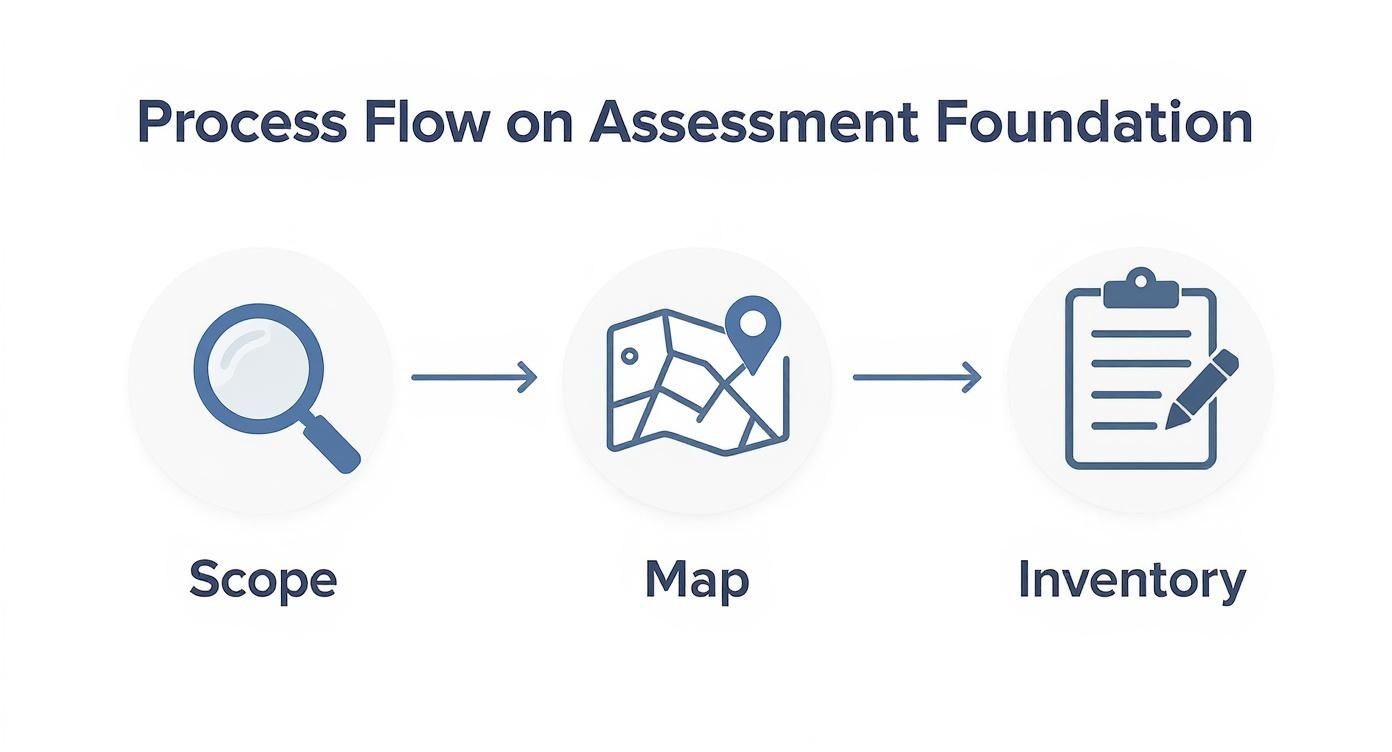
Without this foundation, you’re just guessing. With it, you can start identifying risks with precision.
Field-Tested Methods for Risk Identification
To build a truly comprehensive risk register, you have to attack it from multiple angles. Relying on a single discovery technique is a surefire way to develop massive blind spots. A multi-pronged approach is the only way to capture risks from different perspectives—procedural, historical, and what’s coming down the pike.
I’ve found these methods to be the most effective for uncovering what’s really going on:
Collaborative Workshops: Get your subject matter experts in a room—people from legal, IT, HR, and especially front-line operations. These are the folks who know where the process shortcuts are and where the official policy meets messy reality. Their ground-level insights are invaluable.
Past Audit Analysis: Your previous internal and external audit findings are a goldmine. Don’t just look at the specific issues that were flagged. Hunt for the recurring themes and root causes that point to deeper, systemic weaknesses.
Regulatory Change Monitoring: Make someone responsible for tracking new legislation and regulatory updates. A new data privacy law or an update to industry standards can introduce a whole new class of compliance risks almost overnight.
Every risk you uncover from these activities goes straight into your risk register. For each entry, you need a clear description of the risk, the potential consequences, and the business area it impacts.
Building a Practical Scoring Methodology
Once you have a list of potential risks, you’ll immediately face the next challenge: which ones do you tackle first? Here’s a hint: not all risks are created equal. Trying to fix everything at once is a classic recipe for burnout and failure. This is where a practical scoring methodology becomes your best friend.
It’s all about creating clear, consistent criteria for two key dimensions: likelihood and impact.
I've seen teams get stuck for weeks debating a perfect, overly complex scoring model. The best approach is to start simple. A 3x3 or 5x5 matrix is usually more than enough to force the right conversations and get to a prioritized list you can actually work with.
Likelihood is simply the probability of a risk actually happening. Impact measures how bad it will be if it does. The key is to define what "low," "medium," and "high" mean for your organization.
Defining Likelihood and Impact Criteria
To avoid endless, subjective arguments, you need to create a clear rubric that everyone can agree on. This simple step turns a vague "feeling" about a risk into something you can measure.
Sample Likelihood Scale (1-3):
Low/Rare: The event is highly unlikely. Maybe it happened once in the last five years or is only possible under truly exceptional circumstances.
Medium/Possible: The event could definitely happen. It has occurred occasionally, or you know there are specific weaknesses that could allow it.
High/Likely: The event is expected to occur. It happens regularly, or there's a very high probability it will happen in the near future.
Sample Impact Scale (1-3):
Low/Minor: The fallout is minimal. We're talking minor financial loss (e.g., <$50,000), a small operational hiccup, and zero regulatory attention.
Medium/Moderate: The consequences are significant. Think moderate financial loss (e.g., $50,000 - $500,000), noticeable operational disruption, and a possible inquiry from regulators.
High/Major: The consequences are severe. This means major financial loss (e.g., >$500,000), serious business disruption, severe reputational damage, and formal regulatory enforcement action.
By multiplying these two scores, you get a single risk score that instantly tells you where to focus your energy. A high-impact, high-likelihood risk goes straight to the top of the list. A low-impact, low-likelihood risk can be monitored or formally accepted. This crucial step in your compliance risk assessment transforms a long list of worries into a focused, actionable plan.
Turning Risk Analysis Into Actionable Mitigation
A perfectly scored risk register is nothing more than a well-organized list of problems. The real value of a compliance risk assessment only comes to life when you translate that analysis into concrete, defensive actions. This is the mitigation phase—where you decide how to handle each risk you’ve found and build a plan to actually strengthen your company's defenses.
Let's be blunt: an assessment without a solid mitigation plan is a wasted effort. It’s like getting a detailed diagnostic report from your doctor but never bothering to fill the prescription.
Choosing Your Risk Treatment Strategy
For every risk you've prioritized, you have four fundamental strategies to choose from. Picking the right one comes down to the risk's score, your organization's tolerance for risk, and a simple cost-benefit analysis. There's no single "correct" answer for every situation; the goal is to make a deliberate, defensible decision.
These are your core options:
Avoid: Sometimes, the only sensible move is to get rid of the risk entirely by stopping the activity causing it. For instance, if a new product line in a foreign market presents an insurmountable bribery risk, you might just decide not to enter that market at all.
Accept: For those low-likelihood, low-impact risks, the cost of fixing them might be far greater than the potential harm. In these cases, you can formally accept the risk, document exactly why you're doing it, and just agree to keep an eye on it.
Reduce: This is the most common path you'll take. You either implement new controls or beef up existing ones to bring the risk's likelihood or impact down to an acceptable level. This could be anything from rolling out new software to updating employee training programs.
Transfer: This strategy involves shifting the financial fallout of a risk to someone else. The classic example is buying cybersecurity insurance to cover potential fines from a data breach. Just remember, this only transfers the financial hit—you still own the reputational damage and the operational responsibility.
This decision-making process shouldn't happen in a vacuum. It needs to be a collaborative discussion between the business leaders who own the risk and the compliance team providing the framework.
Designing Detailed Mitigation Action Plans
Once you’ve decided to reduce a risk, you need a formal action plan. A vague goal like "improve data security" is completely useless. A strong mitigation plan is specific, measurable, and holds people accountable for getting it done.
Your mitigation plan is the bridge between identifying a problem and actually solving it. It should be so clear that anyone can pick it up, understand the objective, see who is responsible, and know exactly what needs to be done by when.
Let's say your assessment uncovered a high risk of non-compliance with HIPAA because of poor protection of patient data on company laptops. A weak plan would just say, "Enhance laptop security." A strong plan, however, breaks it down into clear, actionable pieces.
Example Mitigation Plan Components:
Specific Task: Procure and deploy endpoint encryption software for all employee laptops.
Accountable Owner: The Director of IT Security is responsible for getting this done.
Clear Timeline: Software selection must be completed by July 31, with full deployment across the organization by September 30.
Resource Needs: The plan must allocate a $45,000 budget for software licensing and 80 man-hours for the IT team to implement it.
Success Metric: 100% of company laptops are confirmed to have active encryption by the final deadline.
This level of detail turns abstract risks into manageable projects. It also creates a bulletproof paper trail for auditors and proves that your compliance risk assessment is driving tangible improvements, not just sitting on a shelf collecting dust. This proactive mindset is the foundation of a resilient and ethical company.
Putting Technology to Work in Your Compliance Framework
Trying to manage a modern compliance risk assessment with spreadsheets is like navigating a minefield blindfolded. It's a high-stakes gamble. When you rely on static documents, you create information silos, slow down your response times, and make it nearly impossible to get a real-time pulse on your risk posture. This is where technology steps in, transforming your assessment from a painful annual chore into a dynamic, continuous process.
This shift isn't just a trend; it's the new standard. A recent study found that 76% of companies are already using technology for compliance, with 82% planning to spend more. The payoff is clear: better risk visibility (64%), faster issue identification (53%), and higher quality reporting (48%). The writing is on the wall—manual methods just can't keep up.
The Power of GRC Platforms
Modern Governance, Risk, and Compliance (GRC) platforms act as the central nervous system for your entire compliance program. They’re designed to break down the walls that manual systems build, giving you a single source of truth for every risk-related activity.
Instead of wrestling with separate documents for regulations, controls, risks, and mitigation plans, a GRC tool links them all together. This integration is a game-changer. When a regulation changes, you can instantly see which controls and business processes are impacted, turning a frantic fire drill into a managed update.
These platforms also take on much of the heavy lifting. Consider what they automate:
Automated Control Testing: Forget manually chasing down evidence. The system can automatically pull data from other platforms to verify that a control is actually working as intended.
Real-Time Dashboards: Leadership gets an instant, at-a-glance view of the organization’s risk profile, with key metrics and trends displayed in visuals anyone can understand.
Streamlined Reporting: Need a report for the board or an auditor? It’s now a one-click process that pulls live data into ready-made templates.
I’ve seen this mistake happen time and again: a company buys a complex, expensive GRC platform without a clear strategy. The smarter approach is to start by identifying your biggest pain points—like regulatory mapping or control monitoring—and choose a tool that excels at solving those specific problems first.
Choosing the right technology is critical. For more guidance, check out our deep dive on selecting the right https://www.logicalcommander.com/post/compliance-risk-management-software for your needs.
Selecting and Integrating the Right Tools
Not all GRC solutions are created equal. The right tool for a global bank would be complete overkill for a mid-sized tech company. Your selection process has to be driven by your specific needs, your budget, and the technology you already have in place.
When you’re evaluating potential tools, zero in on a few key criteria:
Scalability: Will this tool grow with you? Make sure it can handle more regulations, users, and business units down the road without grinding to a halt.
Integration Capabilities: A GRC platform that can't talk to your other systems is just another silo. It must connect with your existing tools (like HR or IT service management) via APIs to automate data collection.
User Experience: If the tool is a nightmare to use, your team won’t adopt it. Look for an intuitive interface that simplifies complex tasks for business users, not just the compliance experts.
Integrating a new system also brings its own risks, especially around data privacy. For organizations using AI, understanding specific frameworks like GDPR is crucial. The Practical AI GDPR Compliance Guide is an excellent resource for getting actionable insights on this front.
Safeguarding Data Within Your New System
As you bring all your sensitive risk and compliance data into one place, securing that platform becomes paramount. Your chosen solution must meet the same tough security standards you apply to your own in-house systems.
During the procurement process, demand straight answers on the vendor’s security posture. Ask about everything from their data encryption standards and access control protocols to their incident response plan. By moving away from scattered, unsecured spreadsheets and into a secure, centralized platform, you don’t just make your compliance risk assessment more efficient—you strengthen your entire security and governance framework.
Managing Your Third-Party and Supply Chain Risks
Your company’s compliance perimeter doesn’t stop at your own front door. It stretches out to every single vendor, supplier, and partner you bring into your ecosystem, creating a complex web of inherited risk. Failing to extend your compliance risk assessment process to this network is one of the biggest blind spots I see in modern organizations.
It’s no longer enough to just get your own house in order; you have to actively manage the entire neighborhood.

The stakes have never been higher. A staggering 82% of compliance professionals say they’ve faced significant consequences from third-party screw-ups in the past year alone. In fact, failures by these external partners are the second most common source of compliance headaches, causing 18% of all problems. You can explore more on these challenges in the full report on critical CCO stats.
Integrating Due Diligence into Onboarding
The best time to manage a third-party risk is before they’re even a third party. Your first and most critical line of defense is rigorous due diligence during the onboarding process. This isn’t just a quick financial check; it’s a deep dive into their compliance posture.
Before any contract gets signed, your assessment needs to verify their controls in the areas that matter most to your business. This means asking for—and actually reviewing—evidence of their policies, procedures, and certifications.
Key areas for due diligence should always include:
Data Security Protocols: How are they protecting sensitive information? This is non-negotiable if they’ll be handling any of your customer or employee data.
Regulatory Adherence: Can they prove they comply with the regulations that impact your business, like GDPR, HIPAA, or other industry-specific standards?
Business Continuity Plans: What happens to your operations if their service goes down? A solid evaluation here is a critical piece of any complete guide to third-party risk assessment.
Classifying Vendors by Their True Risk Profile
Not all vendors are created equal, and treating them that way is a massive waste of time and resources. A "one-size-fits-all" approach to monitoring is both inefficient and ineffective. You need to classify vendors into risk tiers based on the actual nature of your relationship with them.
A simple tiered system lets you focus your energy where it’s truly needed.
Risk Tier | Vendor Description | Monitoring Level |
|---|---|---|
Tier 1 (High Risk) | Handles sensitive data (PII, PHI), critical to operations, has direct system access. | Intensive: Annual on-site audits, continuous monitoring, deep security reviews. |
Tier 2 (Medium Risk) | Provides important but non-critical services, has limited data access. | Moderate: Annual questionnaires, review of SOC 2 reports, periodic check-ins. |
Tier 3 (Low Risk) | Supplies basic goods or services with no data access or operational impact. | Minimal: Initial due diligence, review upon contract renewal. |
This tiered approach ensures your high-risk partners get the scrutiny they deserve, without overwhelming your team with pointless oversight of low-risk relationships.
Weaving Compliance Into Your Contracts
Your contractual agreements are one of the most powerful compliance enforcement tools you have. Vague promises of "best efforts" just won't cut it. Your contracts must contain specific, enforceable clauses that legally obligate your partners to meet your compliance standards.
A contract is your ultimate safety net. If a vendor's actions put you at risk, a well-written agreement gives you clear recourse. Without it, you're left with the fallout but no leverage.
Essential contractual clauses include:
Right-to-Audit Clauses: This gives you the explicit legal right to audit the vendor's controls, processes, and documentation to verify their compliance claims.
Breach Notification Requirements: Define a strict timeline (e.g., 24-48 hours) for the vendor to notify you of any security or compliance incident that could affect you.
Compliance with Specific Laws: Don't just say "comply with all laws." Name the specific regulations that are critical to your business, leaving absolutely no room for ambiguity.
Establishing Ongoing Monitoring and Attestations
The assessment doesn't stop once the ink is dry on the contract. The threat landscape is always shifting, and so are your vendors' operations. Ongoing monitoring is essential to make sure they remain compliant throughout the entire relationship.
This can be managed through periodic attestations, where vendors must formally certify their continued adherence to your requirements. Pairing these self-assessments with your right-to-audit clause creates a powerful system of checks and balances. This proactive management of your supply chain turns your compliance risk assessment into a tool for building a more resilient and trustworthy business.
Common Compliance Risk Assessment Questions
Even with a perfect framework on paper, the real world of compliance risk assessment is full of practical questions. I’ve seen teams grapple with the same nuances around timing, terminology, and who needs to be in the room.
Getting these fundamentals locked down early prevents a ton of confusion down the road. It helps align everyone from the people on the front lines to the C-suite. Let's tackle some of the most frequent questions I hear from risk and compliance leaders.
How Often Should We Perform a Compliance Risk Assessment?
The textbook answer is annually, and that's not a bad place to start. A full, comprehensive assessment every year gives you a structured, top-to-bottom review of your entire compliance posture. It’s a solid baseline.
But the most effective programs treat risk assessment as a continuous cycle, not a once-a-year event. Think of it this way: your business doesn't just change once a year, so why would your risk assessment?
You should trigger a more targeted reassessment anytime there's a significant shift in your operating environment. This could be things like:
A major new regulation being passed in one of your key markets.
Your company entering a new country or launching a high-risk product.
A big internal change, like a merger or a major process overhaul.
This dynamic approach, backed by real-time monitoring, keeps your assessment relevant and proactive. It shifts the mindset from a reactive annual chore to a living, breathing part of your strategic operations.
What Is the Difference Between Inherent and Residual Risk?
Nailing this distinction is absolutely fundamental to a meaningful assessment.
Think of inherent risk as the raw, unfiltered risk that exists in a vacuum—before you’ve applied any of your existing controls or procedures. It’s the baseline level of exposure you face just by being in business. For example, any bank has a high inherent risk of money laundering simply because of the nature of its business.
Residual risk, on the other hand, is what’s left over after your controls have done their job. It's the risk that remains once your transaction monitoring software, employee training, and internal policies have been applied. Your assessment has to measure both.
The gap between inherent and residual risk is one of the most powerful metrics you have. It clearly demonstrates the value and effectiveness of your entire compliance program, showing leadership exactly how their investment in controls is reducing the company's exposure.
Who Really Needs to Be Involved in the Assessment?
While the compliance department might lead the charge, a risk assessment can never succeed in a silo. It’s a team sport that requires input and buy-in from a diverse, cross-functional group. Limiting involvement is a recipe for an inaccurate and ineffective outcome.
Your core team should absolutely include representatives from:
Legal: To interpret regulatory fine print and potential liabilities.
IT: To give you the ground truth on system vulnerabilities and technical controls.
Finance and HR: For risks tied to financial reporting, conflicts of interest, and employee conduct.
Business Unit Leaders: This is the big one. You need the leaders of the departments you're assessing. They are on the front lines and know where the real-world operational risks are actually hidden.
Getting executive sponsorship from the very start is also non-negotiable. It ensures you get the resources you need and, more importantly, that your findings will be taken seriously and acted upon quickly.
At Logical Commander Software Ltd., we believe managing compliance risk shouldn't be a reactive, judgment-based exercise. Our AI-driven E-Commander platform helps you proactively identify internal risks and potential misconduct while preserving employee privacy and dignity. Move beyond fragmented spreadsheets and into a unified operational platform that provides real-time visibility and strengthens your governance framework. Know First, Act Fast with Logical Commander.