%20(2)_edited.png)

Enterprise Risk Management Solutions for Modern Firms

Updated: Dec 1, 2025
Enterprise risk management solutions are the frameworks and technologies businesses use to identify, assess, and mitigate risks across the entire organization. This isn't just about putting out fires anymore. The entire field has shifted away from reactive damage control and toward proactive, human-centric prevention, with a sharp focus on stopping internal, human-factor risks before they can cause real financial or reputational harm.
The Evolving Landscape of Enterprise Risk Management
For decades, the standard approach to managing internal risk was fundamentally broken. It was a painful cycle: wait for something bad to happen—fraud, data theft, a compliance breach—then launch a costly and disruptive investigation. This after-the-fact model only deals with damage that's already been done and exposes the organization to severe liability.
In today's world, that outdated methodology leaves a modern business dangerously exposed. By the time the forensic teams are called in, the company has already taken the hit. Financial losses are mounting, operations are disrupted, and the trust you've built with stakeholders and employees starts to erode. This reactive posture is a strategic failure.
Shifting from Reaction to Prevention
The new standard for enterprise risk management solutions represents a complete evolution in mindset. Instead of just cleaning up messes, forward-thinking leaders in Compliance, Risk, and HR are adopting a proactive strategy centered on people. This approach is all about understanding and neutralizing the human-factor risks that are the root cause of most internal incidents.
The goal is no longer to simply document failures for an audit trail. It’s to stop them from ever happening in the first place. This means using advanced, ethical tools that provide early warning signs of potential risk without resorting to invasive surveillance or legally risky methods.
The Business Case for a New Standard
This growing emphasis on proactive strategies is being mirrored in the market. The global enterprise risk management market was valued at around USD 5 billion in 2024 and is projected to more than double by 2034. This explosive growth makes one thing clear: organizations everywhere are shifting toward more advanced, preventive risk management capabilities to protect their bottom line. You can get more details on ERM market growth and its key drivers.
A truly effective ERM solution doesn't just manage risk; it builds organizational resilience. By focusing on prevention, companies protect their assets, safeguard their reputation, and create a more secure and ethical environment for everyone.
The table below breaks down the core differences between the old, failed approach and the new, proactive standard.
Comparing Reactive vs Proactive Enterprise Risk Management
Characteristic | Traditional Reactive Approach | Modern Proactive Solution |
|---|---|---|
Primary Focus | Incident response and costly investigations after the fact. | Early identification and prevention of human-factor risk. |
Timing | Post-incident. Kicks in after damage has occurred. | Continuous. Operates in real-time to get ahead of threats. |
Core Activity | Forensic analysis, assigning blame, and documenting failures. | Analyzing risk patterns, strengthening controls, and ethical intervention. |
Mindset | "How did this happen?" | "How can we stop this from happening?" |
Outcome | High costs, operational disruption, and reputational damage. | Reduced incidents, lower liability, and enhanced organizational integrity. |
This modern philosophy is built on a few key principles that set it completely apart from obsolete surveillance tools:
Focus on the Human Factor: Acknowledges that risks almost always start with people, requiring a solution that understands context, not personal behavior.
Ethical and Non-Intrusive: Employs technology that is EPPA-aligned, respecting employee dignity and avoiding any form of surveillance, lie detection, or secret monitoring.
AI-Driven Prevention: Uses specialized AI to analyze risk indicators and provide actionable intelligence, empowering teams to act before an issue escalates into a crisis.
Governance and Compliance: Integrates seamlessly with existing governance frameworks to strengthen compliance and protect the organization from liability.
Ultimately, the choice is between continuing a costly cycle of reaction or adopting a strategic framework of prevention. An ethical, AI-driven platform represents the new standard, giving you the tools needed to identify and address internal threats before they explode into full-blown crises.
Why Reactive Investigations No Longer Work
For years, the standard playbook for internal risk was simple: wait for an incident, then react. When fraud, a data breach, or a compliance failure surfaced, the organization would launch a full-scale investigation. This after-the-fact approach, however, is a strategic failure in today's business environment.
It’s like trying to win a race by only looking in the rearview mirror. By the time you see the problem, you’re already behind, and the liability is already incurred.
Relying on reactive investigations means you are always playing catch-up, and the damage is already done. Financial resources get consumed by costly digital forensics, legal fees pile up, and critical operations grind to a halt. These investigations can drag on for weeks or months, creating a climate of uncertainty and eroding the trust between employees and management.
This constant cycle of cleanup isn’t just expensive; it’s unsustainable. Each investigation pulls key personnel away from their strategic duties, forcing them to spend valuable time piecing together events that should have been prevented. The indirect costs—lost productivity, reputational harm, and decreased employee morale—are often far greater than the initial incident itself.
The Hidden Costs of a Reactive Model
The true price of a reactive strategy goes far beyond the immediate financial loss from an incident. The operational and cultural damage can cripple an organization long-term.
Consider these consequences:
Operational Disruption: Investigations disrupt workflows, halt projects, and divert attention from core business objectives. This downtime translates directly into lost revenue and missed opportunities.
Erosion of Trust: When incidents become public or investigations become common, it can create a culture of suspicion. Employees may feel unfairly scrutinized, damaging morale and productivity.
Compliance and Legal Liability: A reactive posture can be seen as a failure of due diligence by regulators. By the time an investigation confirms a compliance breach, the organization is already exposed to significant fines and legal action. To effectively navigate this landscape, it's crucial to understand the critical risk management best practices for banks and other regulated industries, which increasingly emphasize proactive measures.
Resource Drain: Forensic analysis and legal battles are resource-intensive, consuming budgets that could have been invested in growth and innovation.
A reactive approach treats risk management as a cost center focused on cleanup. A proactive philosophy reframes it as a strategic investment in organizational resilience, protecting the bottom line and preserving integrity before a crisis hits.
The Strategic Imperative for Prevention
Moving away from this broken model is no longer optional; it’s a business necessity. A preventive philosophy is the only logical way to protect a company’s assets, reputation, and future.
Modern enterprise risk management solutions are built on this very principle. They focus on identifying and mitigating the human-factor risks that lie at the root of most internal threats.
Instead of waiting for an alarm to sound, a proactive system provides the insights needed to address potential issues before they escalate. It shifts the focus from assigning blame after an incident to empowering leaders to make informed, preventive decisions. By understanding the true cost of reactive investigations, the value of a proactive, ethical, and non-intrusive approach becomes crystal clear.
Defining an Ethical ERM Solution

A modern enterprise risk management solution must deliver powerful results without resorting to invasive tactics. The absolute core of an ethical platform is its ability to protect the company while respecting the dignity and privacy of its people. This marks a massive departure from legacy surveillance systems that often blurred the lines between security and illegal monitoring.
True ethical risk management is built on a rock-solid foundation of compliance, especially with regulations like the Employee Polygraph Protection Act (EPPA). This isn't just about ticking a legal box; it's a strategic commitment that shapes the technology from the ground up.
An EPPA-aligned solution strictly avoids any method that could be seen as coercive or intrusive. It operates without surveillance, secret monitoring, lie detection, or any kind of analysis that tries to judge an employee's state of mind. Instead, it focuses on objective, contextual data tied to specific risk scenarios.
Moving Beyond Surveillance
For far too long, some solutions have tried to mitigate internal risk by simply "watching" employees. That approach isn't just legally questionable—it's strategically flawed. Constant monitoring creates a culture of distrust, tanks morale, and usually generates an overwhelming amount of noise with very few actionable insights.
An ethical ERM solution completely redefines the game. It empowers Compliance, Risk, and HR leaders by giving them intelligence on potential risks, not personal behaviors.
Here’s how an ethical framework is different:
Focus on Context, Not Content: It analyzes data related to risk events and patterns, rather than reading personal emails or tracking daily keystrokes.
Voluntary and Transparent: Any interaction with the system is out in the open, preserving employee autonomy and dignity.
No Psychological Profiling: It refrains from making judgments about an individual's character, focusing only on mitigating business risk.
Preserves Employee Privacy: The system is engineered to protect personal information, operating strictly within legal and ethical lines.
This shift toward ethical tech is fueling major market growth. The United States enterprise risk management market, valued at USD 1.55 billion in 2024, is expected to more than double by 2035. This surge is driven by escalating regulatory demands and the need for advanced, compliant technologies. You can explore more on the U.S. enterprise risk management market growth to see how this trend is shaping investments.
The new standard of risk management proves that you don't have to choose between security and ethics. A truly advanced platform achieves superior compliance and protection precisely because it is non-intrusive and respects individual rights.
The Role of AI in Ethical Risk Assessments
Advanced AI is the engine that makes this whole ethical approach possible. Unlike simplistic monitoring tools, a sophisticated AI can spot subtle risk indicators from contextual business data without ever needing to invade personal privacy.
For example, it can analyze access logs, transaction records, and procedural data to flag anomalies that might suggest fraud or a compliance violation. It connects disparate data points to reveal patterns that would be invisible to human teams, giving you an invaluable early warning system.
This AI-driven risk assessments software provides actionable intelligence that is:
Preventive: It identifies risks before they blow up into full-blown incidents, saving the organization from financial and reputational disaster.
Objective: The analysis is based on hard data and predefined risk parameters, removing human bias from the initial identification stage.
Efficient: It automates the painful task of sifting through mountains of information, freeing up compliance and security teams to focus on strategic mitigation.
By adopting an ethical, AI-driven ERM solution, organizations can achieve a higher standard of security and governance. It allows you to build a resilient, integrity-driven culture where risk is managed proactively and responsibly—protecting both the company and its people without compromise.
Using AI for Human Risk Mitigation
Traditional enterprise risk management solutions have always struggled with the most unpredictable variable in any organization: people. For years, the focus was locked on system vulnerabilities and external threats, but the hard truth is that a massive portion of business risk comes from within. This is where specialized, AI-driven solutions are setting a new standard, moving far beyond typical cybersecurity tools which account for less than 5% of internal threats.
This new generation of AI isn't about surveillance. It's designed to analyze contextual risk indicators without ever touching personal privacy or crossing ethical lines. It works with business-related data—like access logs or procedural documents—to spot anomalies that signal potential trouble. It starts with humans and ends with humans.
Moving From Monitoring to Intelligent Mitigation
The old approach of trying to address problems through employee monitoring is fundamentally broken. It’s invasive, breeds a culture of distrust, and usually creates more noise than actual signals. An ethical AI platform flips this entire model on its head. It augments the skills of your risk and compliance teams, giving them actionable intelligence to make proactive decisions.
This is a critical distinction. The goal isn't to watch employees; it's to build a more resilient and secure organization by understanding and mitigating risk at its source—the human element.
This approach delivers intelligence that is:
Context-Aware: It understands the nuances of your business processes, flagging deviations that could point to internal fraud, IP theft, or compliance violations.
Objective and Unbiased: By focusing on data patterns instead of personalities, it removes subjective judgment from the initial risk identification process.
Efficient: It automates the painstaking work of connecting disparate data points, freeing up your expert teams to focus on strategy and prevention instead of manual data sifting.
Practical Applications of AI in Human Risk Mitigation
So, how does this actually work in the real world? An ethical AI platform can identify a sequence of events that seem harmless on their own but represent a significant risk when combined. For example, it might flag an unusual pattern of document access from a departing employee or spot a clear conflict of interest in a vendor approval process. AI can also be powerfully applied from the very beginning, such as using AI for employee onboarding to ensure policies are fully understood and reduce early-stage compliance risks.
An advanced AI doesn't replace human judgment; it enhances it. By providing an early warning system for potential human-factor risks, it empowers leaders to intervene ethically and prevent incidents before they happen.
This capability is essential for managing a whole range of internal threats. Issues like internal fraud, IP theft, and conflicts of interest are notoriously difficult to spot with conventional methods until after the damage is done. AI-driven AI human risk mitigation provides the foresight needed to get ahead of these concerns. It allows organizations to strengthen controls, provide targeted training, or simply open a dialogue to resolve a potential issue before it blows up into a costly crisis. This intelligent approach helps businesses learn more about detecting insider threats with ethical AI while upholding a culture of respect.
By using AI to understand and mitigate risk where it starts, organizations can finally break the reactive cycle of investigation and cleanup. This is the new standard of enterprise risk management solutions—one that is intelligent, ethical, and built for prevention.
Implementing Your Proactive ERM Strategy
Moving to a modern ERM framework is a strategic leap, not just an incremental step. It’s about fundamentally shifting your organization from a reactive, fire-fighting posture to one that’s built on proactive prevention. This isn't just about plugging in new software; it’s about embedding a culture of foresight and accountability across the entire business.
The first move, and the one that makes or breaks the entire initiative, is getting your key stakeholders on board. The leaders in HR, Legal, Compliance, and Security need to see this as a unified solution to their shared headaches. A solid business case that clearly shows the painful costs of reactive investigations versus the ROI of prevention is your key to unlocking that critical alignment.
Fostering a Culture of Proactive Risk Awareness
A successful ERM implementation lives or dies by its culture. If you don't foster an environment where proactive risk management is seen as everyone's job, even the best technology will fail. It all starts with clear, consistent communication from the top, framing the strategy as a protective measure for both the company and its people—not a system for policing behavior.
Here are a few best practices for building this kind of culture:
Be Radically Transparent: Clearly explain the purpose of the ERM solution. Emphasize its EPPA-aligned, non-surveillance approach and how it protects the organization by upholding its core values.
Define Who Owns What: Make sure every team understands their specific role in the risk management process, from flagging potential issues to participating in mitigation workflows.
Integrate, Don't Isolate: Weave the principles of proactive risk awareness into your existing employee training. It should feel like a natural part of how your organization operates, not a separate, bolt-on requirement.
This approach turns the implementation of an enterprise risk management solution from a top-down mandate into a shared mission. A culture of awareness is one of your most powerful defenses, transforming your entire workforce into an active part of your risk mitigation strategy.
Integrating the Solution into Existing Workflows
For your new ERM platform to be adopted, it has to feel like it belongs. A clunky, standalone system that forces teams to change how they work will create friction and resistance. The real goal is to make proactive risk management an intuitive, seamless part of the daily grind for your Compliance, HR, and Legal teams.
This is where the right technology makes all the difference. An AI-driven process should smoothly turn data inputs into actionable, preventive measures without adding complexity.
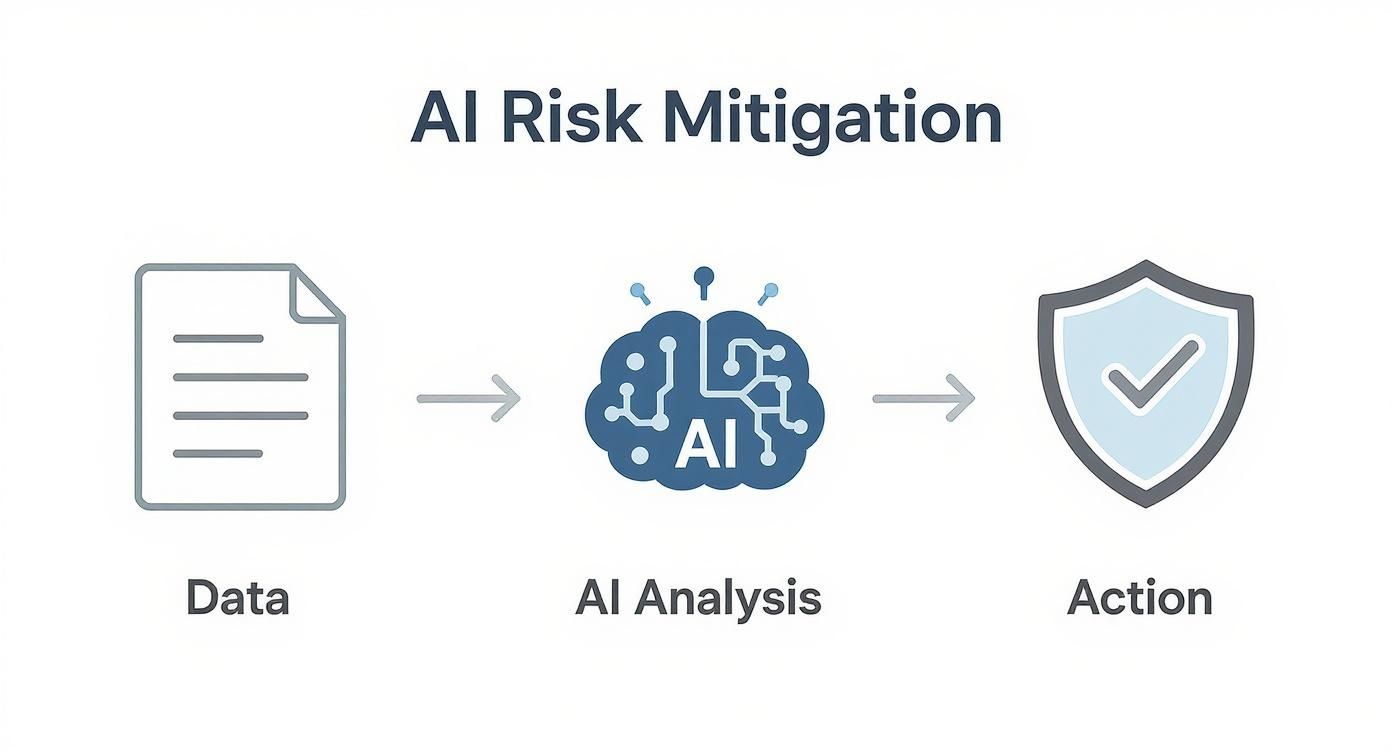
This simple flow shows how an ethical AI platform can convert raw data into protective actions without invasive monitoring. This kind of strategic integration is a core piece of building a stronger system for proactive corporate compliance and tightening up your overall governance.
To ensure a smooth rollout, it helps to have a clear roadmap. The table below outlines the key milestones for deploying a modern, proactive ERM solution.
Key Implementation Milestones for a Proactive ERM Solution
Phase | Key Actions | Primary Stakeholders |
|---|---|---|
Phase 1: Foundation & Alignment | Secure executive sponsorship. Form a cross-functional implementation team. Define success metrics and KPIs. | Executive Leadership, HR, Legal, Compliance |
Phase 2: Configuration & Integration | Configure risk models and workflows. Integrate with HRIS and other key systems. Conduct initial data mapping. | IT, Implementation Team, Department Heads |
Phase 3: Pilot & Training | Launch a pilot program with a select user group. Develop and deliver role-based training materials. Gather feedback and refine configurations. | Pilot Users, HR, IT |
Phase 4: Full Rollout & Communication | Execute a company-wide launch. Communicate the platform’s purpose and benefits. Provide ongoing support and resources. | All Employees, Internal Comms, HR |
Following a structured plan like this helps demystify the process and keeps everyone aligned, turning a complex project into a series of manageable, achievable steps.
Measuring the ROI of a Preventive Approach
Ultimately, the success of your ERM strategy comes down to tangible results. But here’s the twist: demonstrating ROI isn't just about cost savings; it's about cost avoidance. By stopping incidents before they happen, you completely sidestep the colossal expenses tied to reactive investigations, legal battles, regulatory fines, and brand damage.
A preventive ERM strategy delivers its greatest return by protecting against crises that never happen. The value is found in the avoided losses, preserved reputation, and strengthened governance that secure the organization's future.
This strategic investment mirrors what's happening in the broader market. The global risk management market was valued at USD 15.40 billion in 2024 and is projected to explode to USD 51.97 billion by 2033. This surge is fueled by an intense global focus on corporate governance and compliance, proving that getting ahead of risk isn't just a best practice—it's a business imperative.
Partner With the Future of Risk Management
Transforming how a company manages risk takes more than just smart technology; it demands a network of trusted advisors and expert partners. For B2B SaaS providers, consultants, and resellers, this shift is a massive opportunity. By joining a forward-thinking ecosystem, you can give your clients a powerful, different approach to one of their biggest headaches—mitigating internal, human-factor risk.
This is exactly why we built PartnerLC, our strategic partner program. It’s designed for firms that want to lead the charge in setting a new, ethical standard for enterprise risk management solutions. Partnering with us lets you expand your service portfolio with a unique, EPPA-aligned platform that solves a critical client need for proactive, non-intrusive internal threat mitigation.
Your Competitive Advantage with PartnerLC
Joining our partner program gives you a real competitive edge. While everyone else is still selling reactive, forensic-based tools that only clean up the mess after the fact, you can offer a truly preventive solution. This immediately positions you as a strategic advisor who gets the future of governance, compliance, and reputation protection.
The benefits of joining PartnerLC are clear:
Access to Groundbreaking AI: Give your clients an AI-driven platform that spots potential human-factor risks without any form of surveillance, setting you apart from legally questionable competitors.
Solve a Critical Client Need: Meet the growing demand for effective internal threat detection and ethical risk management—a top priority for leaders in Compliance, HR, and Legal.
Expand Your Service Portfolio: Add a high-value, innovative solution to your offerings, creating new revenue streams and making your client relationships even stronger.
Join a Visionary Network: Become part of an ecosystem dedicated to building a more secure and ethical corporate world, one client at a time.
Partnering with Logical Commander means you’re not just selling software; you’re delivering a new standard of organizational resilience. You're empowering your clients to move beyond costly reactive cycles and embrace a culture of proactive prevention.
This is about more than just technology. It’s a shared commitment to providing solutions that are as effective as they are ethical. Working together, we can help organizations protect their assets, their people, and their integrity from the inside out. To learn more about how this collaboration can benefit your business, explore the details of our partner program for AI-driven internal risk management.
Your Questions on ERM Solutions, Answered
When you're evaluating the next generation of enterprise risk management solutions, you're bound to have some tough questions. It’s a huge decision. Let's dig into the most common ones we hear from leaders in Compliance, Risk, and HR, focusing on the real-world differences that separate a modern, preventive platform from the reactive systems of the past.
How Are Modern ERM Solutions Different from GRC Platforms?
That's a great question, and it gets right to the core of the issue. Traditional Governance, Risk, and Compliance (GRC) platforms are basically digital filing cabinets. They're excellent for documenting known risks and keeping an audit trail after something has already gone wrong.
A modern ERM solution, on the other hand, is built for one thing: proactive prevention. It's designed to get ahead of the human factor. Instead of just recording the details of a fire, our AI-driven platform gives you the tools to stop it from ever starting. We focus on neutralizing the root cause—human-factor risk—ethically and without any kind of surveillance.
Is an AI-Driven Risk Solution Compliant with Privacy Regulations Like EPPA?
Absolutely, but only if it's designed that way from the ground up. Compliance isn't a feature you can bolt on later; it has to be in the platform's DNA. Our solution was engineered from day one to be a strictly EPPA compliant platform and completely non-intrusive.
We steer clear of anything that even smells like employee surveillance—no secret monitoring, no lie detection, no exceptions. Our AI analyzes contextual business data tied to specific risk scenarios, not an employee's personal emails or private behavior. This allows you to use powerful internal threat detection without violating employee rights, giving you a tool built on a foundation of total legal integrity.
How Can We Measure the ROI of a Preventive Risk Solution?
The ROI of a preventive solution isn't just measured in the money you make, but in the catastrophic costs you completely avoid. Think about the massive, spiraling expenses that come with reactive clean-up: internal investigations, legal battles, regulatory fines, and the kind of reputational damage that takes years to repair.
The most significant ROI of a preventive strategy is found in the crises that never happen. By neutralizing risks before they cause damage, you protect your balance sheet, preserve stakeholder trust, and strengthen overall governance.
We help clients track key metrics like a measurable drop in internal fraud, fewer compliance breaches, and a sharp reduction in incident response costs. By building a more secure and resilient culture, organizations also see real gains in productivity and employee retention. It's about sidestepping those financial black holes altogether.
Ready to shift from reactive clean-up to proactive prevention? Logical Commander Software Ltd. provides the new standard in ethical, AI-driven internal risk management. Our EPPA-aligned platform empowers you to mitigate human-factor risks before they cause damage.
Discover how to protect your organization without compromising its values.