%20(2)_edited.png)

Your Guide to Third-Party Risk Assessment
- Risk Analytics Team

- Oct 21, 2025
- 15 min read
Updated: Jan 15
A third-party risk assessment is the process organizations use to identify, analyze, and mitigate the risks introduced by working with outside vendors, suppliers, and partners. This isn't just a compliance formality; it's a core defense strategy for protecting your data, reputation, and operational stability from vulnerabilities originating in your supply chain.
Why Vendor Security Is Now Your Security

In today's interconnected business ecosystem, the line between your security and your vendor’s has vanished. Every partner, supplier, and contractor with access to your systems or data represents a potential vector for internal threats and human-factor risk. One weak link can expose your entire organization, making a robust third-party risk assessment program an absolute necessity for modern governance and risk management.
This isn’t an abstract threat. Data shows that breaches involving a third party are a significant and growing problem, now accounting for a substantial portion of all incidents. When a vendor’s security or compliance fails, the financial and reputational damage lands squarely on your organization, regardless of where the initial failure occurred. This reality demands a strategic shift away from reactive investigations and toward proactive, preventive risk management.
The True Cost of a Weak Link
When a vendor’s defenses are compromised, the shockwaves travel directly into your organization. The business impact extends far beyond the initial financial cost, triggering a chain reaction of liabilities that can disrupt operations for months or even years.
To fully grasp the stakes, it’s essential to understand What Is Third Party Risk Management? and its direct implications for your business. A single incident can set off numerous painful consequences:
Regulatory Penalties: Regulations like GDPR and HIPAA hold you accountable for your vendors’ compliance failures, leading to significant fines and legal liabilities.
Brand Damage: A public breach erodes customer trust and tarnishes your reputation. This reputational harm is often more expensive and difficult to repair than the initial security lapse.
Operational Disruption: If a critical service provider suffers an outage or breach, your own business can grind to a halt, impacting revenue and frustrating customers.
Moving from Reactive Audits to Proactive Prevention
The traditional method of managing vendor risk—relying on annual questionnaires and point-in-time audits—is no longer sufficient. These methods provide a static snapshot but completely miss the dynamic nature of human-factor risk, which is a primary variable in any security program. A vendor may appear compliant on paper but still harbor significant internal threats stemming from its workforce.
The most mature risk management programs recognize that vendor oversight is not a one-time checkbox activity. It is a continuous discipline focused on identifying and mitigating risks before they escalate into costly incidents.
This proactive mindset is the only sustainable approach. Instead of waiting for a vendor breach to trigger a costly and disruptive investigation, the goal is to identify early warning signs of internal risk within your partner network before they manifest. An effective third-party risk assessment strategy provides the visibility needed to address vulnerabilities before they can be exploited, protecting your assets, compliance posture, and reputation. It reframes vendor security not as an external problem, but as a critical extension of your own internal controls.
Mapping Your Third-Party Threat Landscape
Vendor risk is far more than just a cybersecurity issue. It's a complex web of potential threats that can impact every facet of your business. A comprehensive third-party risk assessment requires looking beyond firewalls and encryption to map the full spectrum of vulnerabilities your partners introduce.
Failing to analyze this complete picture is like securing your fortress but leaving the back gate unguarded.
A single vendor failure can trigger a domino effect. For example, if a key software provider experiences an outage, it doesn't just create an IT headache. Your sales team may be unable to close deals, customer support could go dark, and your brand’s reputation for reliability suffers—all from one incident.
Beyond Cybersecurity: The Four Pillars of Vendor Risk
To truly understand your exposure, you must break down risk into critical domains. Each one represents a different way a partnership can create a significant liability for your business. This structured thinking ensures no important vulnerabilities are overlooked.
A recent EY survey highlights this, revealing that 57% of companies now see business disruption as their number one third-party risk. This shift underscores how crucial operational resilience has become.
The study also found that 64% of organizations are now assessing their vendors' vendors (fourth-party risk), a clear sign that leaders recognize threats can originate deep within the supply chain. You can explore additional findings on how AI is reshaping third-party risk management to understand these evolving trends.
A vendor’s failure in one area can instantly become your company's crisis in another. A compliance misstep by a partner can lead to your operational shutdown, while their financial instability can create a reputational disaster for you.
Unpacking the Core Risk Categories
To manage this complexity, it helps to organize risks into distinct categories. This not only structures your third-party risk assessment but also clarifies ownership for mitigating identified issues. While the list of potential risks is extensive, they generally fall into the four primary groups detailed below.
Core Categories of Third-Party Risk
Thinking in these buckets helps ensure a comprehensive assessment covering all bases, from daily operations to public perception and compliance.
Risk Category | Description | Potential Business Impact |
|---|---|---|
Operational Risk | Threats to your daily business functions and ability to deliver services. | Service outages, product delivery delays, customer dissatisfaction, direct revenue loss. |
Compliance & Legal Risk | Failure by a vendor to adhere to laws and regulations that apply to your business. | Steep fines (e.g., GDPR, HIPAA), legal action, sanctions, forced operational shutdowns. |
Reputational Risk | Damage to your brand image resulting from a vendor's actions or failures. | Loss of customer trust, negative press, social media backlash, difficulty attracting talent. |
Financial Risk | Dangers related to a vendor's financial health and contractual terms. | Sudden price hikes, vendor bankruptcy, unexpected service termination, costly vendor lock-in. |
Let's break these down further.
A Closer Look at Each Risk Pillar
Operational Risks: This concerns the core mechanics of your business. If a vendor handling cloud hosting, payment processing, or logistics fails, your ability to serve customers is immediately compromised. The impact is direct, measurable, and often felt by your clients first.
Compliance and Legal Risks: Your vendors are an extension of your compliance footprint. If a partner mishandles data in violation of GDPR or fails to meet industry standards like HIPAA, your organization faces the legal and financial consequences, including crippling fines and public disclosures.
Reputational Risks: Your brand is associated with the companies you partner with. A vendor involved in an ethics scandal, using unethical labor practices, or suffering a high-profile data breach can inflict severe damage on your public image. In the digital age, this reputational harm spreads rapidly and is incredibly difficult to contain.
Financial Risks: This extends beyond the contract price. It includes hidden dangers like a vendor suddenly increasing prices, a partner going bankrupt and disrupting service, or getting trapped in a vendor lock-in situation that prevents you from migrating to a better provider.
By systematically evaluating each of these areas, you can build a complete threat landscape that provides a true, data-driven picture of your vendor-related vulnerabilities.
Building a Proactive Risk Assessment Framework
If you’re still managing vendor risk with a reactive, "firefighting" approach, you are exposing your organization to unnecessary liability. The key is to shift to a proactive stance by building a structured, repeatable framework. A solid third-party risk assessment program is not a one-off task; it’s a continuous lifecycle designed to identify, analyze, and mitigate threats before they cause harm. Think of it as a clear playbook for managing the entire vendor relationship, from initial vetting to final offboarding.
This framework makes your risk management efforts consistent, scalable, and—critically—defensible to auditors and regulators. It moves your organization from chaotic, ad-hoc reviews to a systematic approach that protects against operational, financial, and reputational damage.
The infographic below illustrates the five-step workflow that forms the foundation of any strong, proactive framework.
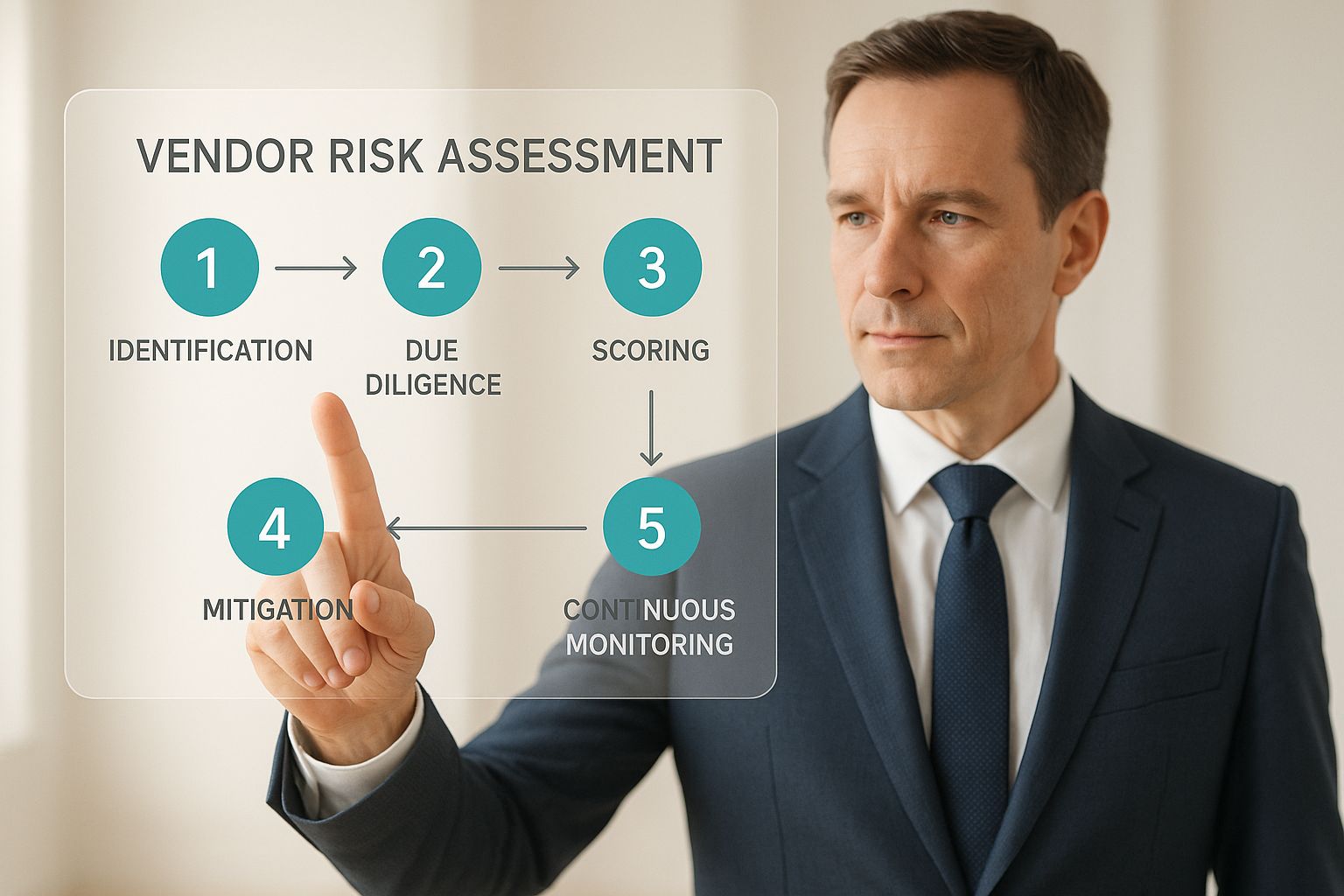
As shown, true risk management is a cyclical, ongoing discipline, not a one-time event.
Step 1: Vendor Identification and Tiering
You cannot manage risks you are unaware of. The first step is to create a complete, centralized inventory of every third party your organization engages. This process often uncovers "shadow IT" and other unmanaged vendor relationships that create significant security blind spots.
Once you have a complete list, you must acknowledge that not all vendors pose the same level of risk. This is where tiering becomes critical. It is the process of categorizing vendors based on the potential risk they introduce. A cloud provider storing sensitive customer data is in a different risk category than the company supplying office coffee and must be managed accordingly.
Criteria for tiering include:
Data Access: Does the vendor access, process, or store sensitive, confidential, or regulated data?
System Integration: How deeply is their technology integrated into your core systems? An API into your ERP system poses a higher risk than a cosmetic integration.
Business Criticality: How significant would the impact be if this vendor ceased operations tomorrow? Could your business still function?
Step 2: Due Diligence and Information Gathering
With your vendors properly tiered, the deep dive begins. This stage involves gathering the necessary information for a thorough third-party risk assessment. The goal is to collect tangible evidence of a vendor's security, compliance, and operational controls.
This typically involves sending detailed questionnaires and requesting documentation, such as ISO 27001 certifications, recent audit reports, and business continuity plans. Effective due diligence doesn't just accept "yes" for an answer; it requires verifiable proof that controls are implemented and effective.
Step 3: Risk Analysis and Scoring
With the data gathered, it's time to analyze it. This step involves evaluating the responses and assigning a quantitative risk score. This process transforms qualitative questionnaire answers into a measurable metric that helps prioritize your focus on the highest-risk areas. The scoring methodology must be consistent and aligned with your company's risk appetite.
This analysis uncovers specific gaps and weaknesses. For instance, a vendor might have strong network security but a weak employee offboarding process, creating a significant insider risk from former employees. Pinpointing these specific vulnerabilities is crucial for effective mitigation.
A vendor's risk score isn't static. It's a dynamic indicator that should be revisited whenever new information emerges, the relationship evolves, or new threats appear on the horizon.
Step 4: Risk Mitigation and Control Implementation
Identifying risk is only half the battle; addressing it is what matters. For every vulnerability uncovered, a remediation plan is required. This plan should specify the exact actions the vendor must take, complete with clear deadlines and assigned responsibility.
Mitigation can take several forms:
Contractual Safeguards: Incorporating specific security and compliance requirements directly into the vendor contract.
Remediation Plans: Requiring the vendor to resolve specific security vulnerabilities before granting them access to your systems.
Compensating Controls: If a vendor has a weakness that cannot be fixed, you can implement additional controls on your end to offset the risk.
A crucial part of any proactive framework is ensuring everyone in your ecosystem practices sound digital hygiene. You can learn more about essential cybersecurity tips for securing your digital footprint to understand what these controls look like in practice.
Step 5: Continuous Monitoring and Review
Finally, a third-party risk assessment is not a "set it and forget it" activity. The threat landscape changes daily, and a vendor that appears secure today could be the source of your next breach tomorrow. Continuous monitoring keeps you informed, providing ongoing visibility into your vendors' risk posture throughout the relationship.
This includes periodic reassessments, monitoring public breach notifications, and watching for red flags like a vendor's financial instability. This ongoing vigilance is what separates proactive prevention from reactive cleanup. Embedding this discipline into your operations allows you to manage risk more effectively at scale, a core component of a healthy internal control system. For a deeper look, see our guide on implementing a proactive fraud risk assessment.
Common Pitfalls in Vendor Risk Assessment Programs
Even well-intentioned third-party risk assessment programs can fail due to common, avoidable mistakes. The first step toward building a program that drives real business value is understanding where others go wrong. Most failures stem not from a lack of effort, but from reliance on outdated assumptions and inefficient processes.
These pitfalls are dangerous because they create a false sense of security, leaving significant vulnerabilities hidden just below the surface. By identifying these weaknesses in your own program, you can shift from a reactive, compliance-focused posture to a genuinely preventive one that protects your business from financial, reputational, and operational harm.
The Static Assessment Trap
The most common mistake is the "set-it-and-forget-it" assessment. This occurs when a company performs due diligence during vendor onboarding but fails to conduct ongoing monitoring. A vendor's risk profile is not static; it evolves with every new hire, system update, and change in their business environment.
Treating a third-party risk assessment as a one-time event is like checking smoke detectors only on the day you move into a house. It completely ignores the dynamic nature of risk, especially the human-factor risks that change daily. Without continuous oversight, you are blind to emerging threats within your own supply chain.
Departmental Silos and Blind Spots
Another major pitfall is departmental silos. When Legal, IT, Procurement, and Compliance operate independently, they each see only a small piece of the vendor risk puzzle. Legal may focus on contractual liabilities while IT scrutinizes cybersecurity controls, but no one connects the dots to form a holistic view.
This fragmented approach creates massive blind spots. A vendor might pass an IT security review but be on the verge of financial collapse—a fact the procurement team might know but never communicates. Breaking down these silos is essential for creating a unified, accurate view of third-party risk.
A vendor risk program is only as strong as its weakest link. When departments fail to collaborate, they create gaps that can be easily exploited, turning a manageable risk into a full-blown crisis.
Over-Reliance on Manual Systems
Many programs are still managed with spreadsheets and email, which may work for a handful of vendors but is completely unscalable for mid-to-large organizations. Manual processes are slow, prone to human error, and make it nearly impossible to track remediation or generate meaningful reports for leadership.
This reliance on manual work exacerbates another major problem: understaffing. The 2025 Mitratech Third-Party Risk Management Study revealed that nearly 70% of teams report being understaffed. As a result, organizations can only effectively manage about 40% of their vendor population. This resource gap, compounded by inefficient manual systems, leaves the majority of third-party relationships dangerously unmonitored. You can find more insights in the 2025 Mitratech study on vendor risk management.
The Problem of Improper Vendor Tiering
Finally, many organizations fail to properly tier their vendors, leading to a critical misallocation of resources. When every vendor receives the same level of scrutiny, teams waste valuable time performing deep-dive assessments on low-risk partners, like the office catering service.
Meanwhile, high-impact vendors with deep access to sensitive data and critical systems may not receive the intense focus they require. Effective tiering is not a "nice-to-have"; it allows you to direct your limited resources where they matter most, ensuring your biggest risks are under constant, careful review. Overcoming these common pitfalls is how you transition from a superficial compliance exercise to a truly proactive third-party risk assessment program.
Using AI for Preventive Human-Factor Insights

Traditional third-party risk assessment methods like questionnaires, certifications, and audits are fundamentally reactive. They provide a static snapshot of a vendor's claimed controls, offering almost no real insight into the most unpredictable variable: human-factor risk.
This is a massive blind spot where the most damaging risks often originate. To get ahead, organizations need a modern, AI-driven approach that ethically assesses the human-factor risk culture inside vendor organizations. It's time to shift from a reactive, check-the-box chore to a proactive, preventive discipline that protects your business from internal threats, wherever they reside.
Shifting from Reactive Audits to Proactive Prevention
The core problem with legacy assessments is their backward-looking nature. They confirm that a vendor had certain controls in place at a single point in time but cannot predict what is happening today—or what might happen tomorrow. This leaves you exposed to the internal threats and integrity risks that develop within a partner's workforce.
An ethical, AI-powered platform flips this script. Instead of waiting for an incident to trigger a costly investigation, this technology provides early warning signals of potential misconduct or compliance drift. This is the essence of prevention—addressing the root cause of human-factor risk before it escalates into a business-damaging crisis.
By focusing on the behavioral and ethical indicators within a vendor's environment, you gain a level of assurance that questionnaires and audits alone can never provide. It’s the difference between reviewing a blueprint and inspecting the building's foundation as it’s being built.
The Power of Ethical, EPPA-Compliant AI
Unlocking these insights requires technology that is both powerful and principled. A truly ethical platform must be EPPA-compliant, ensuring risk assessment is conducted without resorting to invasive surveillance or any methods that imply lie detection. This approach builds and maintains the trust essential for strong partnerships.
This type of AI human risk mitigation works by analyzing aggregated, non-personal data to identify patterns indicative of elevated risk. The focus is on organizational health, not on scrutinizing individuals.
Here’s how this approach strengthens your third-party risk assessment:
Deep Cultural Insights: It provides a genuine understanding of a vendor's internal risk culture—something a compliance certificate cannot reveal.
Early Warning System: It flags potential integrity issues or conflicts of interest long before they can lead to fraud or a data breach.
Scalable Assurance: It offers continuous, scalable oversight across your entire vendor ecosystem, helping you focus resources on the partners that pose the greatest risk.
This proactive stance has never been more critical. With 35% of directors now ranking third-party data breaches among their top three cyber threats, the pressure is on. This concern is driving a shift toward AI-driven solutions that automate risk scoring and improve efficiency, reflecting the evolving nature of vendor risk. You can discover more about the evolution of third-party risk management on diligent.com.
Integrating AI into Your Governance Framework
Adopting this technology isn't about replacing your existing framework. It’s about augmenting it with a powerful layer of intelligence that provides the "why" behind your audit findings.
A vendor might pass a security questionnaire, but an ethical AI assessment could reveal a culture of non-compliance that will eventually lead to a breach. This gives you defensible, data-driven evidence to guide your risk mitigation efforts and protect your business from preventable harm.
By finally gaining visibility into the human element of your supply chain, you can make smarter decisions, strengthen compliance, and truly protect your organization from the inside out. To learn more, see our complete guide to AI-powered human risk management.
It’s Time for a New Standard in Vendor Governance
The old playbook for third-party risk assessment is no longer effective. Relying on reactive audits and static questionnaires is like waiting for a fire to start before looking for the extinguisher. This is not a viable governance strategy; it's a costly gamble with your reputation, compliance, and operational stability.
The new standard in vendor governance demands a fundamental shift from risk identification to proactive prevention. This means going beyond surface-level checks to understand the human-factor dynamics inside your vendor network. An ethical, non-intrusive, AI-driven platform is the key to making this transition and achieving a new level of resilience.
From Reactive Firefighting to Proactive Prevention
A forward-thinking, preventive approach delivers clear, measurable business benefits that outdated methods cannot match. By focusing on preventive risk management, you move your organization from a constant state of defense to a position of strategic advantage.
The benefits are tangible:
Reduced Liability: Proactively identifying and addressing human-factor risks minimizes the likelihood of costly breaches, fraud, or compliance violations originating in your supply chain.
Stronger Governance: An AI-driven approach provides a defensible, data-driven foundation for vendor oversight, making it easier to demonstrate due diligence to regulators and stakeholders.
Protected Reputation: Preventing incidents before they happen is the most effective way to protect your brand and preserve the trust you have built with customers and partners.
This modern approach also aligns with global frameworks, ensuring your vendor governance program meets the highest international standards. You can learn more about integrating global standards like ISO 27001 with AI-powered risk detection to see how it all fits together.
Adopting a preventive model isn't just an operational upgrade; it's a fundamental change in philosophy. It redefines vendor governance as a proactive, continuous discipline that protects the organization from the inside out.
Ultimately, the cost of reacting to a vendor-induced incident far outweighs the investment in a preventive strategy. By implementing an ethical, AI-powered platform, you’re not just managing third-party risk—you’re setting a new, more resilient standard for modern vendor governance.
Frequently Asked Questions About Third-Party Risk
Building out a robust third-party risk assessment program brings up many challenging questions. Getting the answers right is the difference between a resilient, compliant vendor ecosystem and one riddled with blind spots and liability.
Here are some of the most common questions from risk, compliance, and security leaders, along with our perspective on how to address them.
How Often Should We Assess Our Vendors?
The short answer: continuously. The traditional annual check-in is not just outdated; it's dangerous in today's dynamic threat landscape. A vendor's risk profile changes with every new hire, system update, or shift in their financial health.
A modern program treats third-party risk assessment as an ongoing cycle, not a one-time event. The frequency and intensity of formal reviews should be based on the vendor's risk tier.
High-Risk Vendors: These partners have deep access to sensitive data or are critical to your operations. They require intensive, continuous monitoring and a full, deep-dive reassessment at least annually.
Medium-Risk Vendors: For this tier, a formal review every 18-24 months is a reasonable baseline, supported by automated monitoring that flags significant changes in their risk posture.
Low-Risk Vendors: An assessment every two to three years may suffice, but they must remain in your vendor inventory and be subject to basic monitoring.
What Is the Difference Between Vendor Management and Risk Assessment?
This is a critical distinction. Vendor management is the holistic discipline of managing the entire relationship with a third party. It covers everything from sourcing and contract negotiation to performance tracking and offboarding.
A third-party risk assessment is a vital component of that larger lifecycle. Think of vendor management as the entire car, while risk assessment is the engine and brakes. You need both to operate safely. Effective vendor management is impossible without a robust, continuous risk assessment process providing critical intelligence.
Vendor management ensures the partnership delivers value. Risk assessment ensures it doesn't deliver liability. The two must work in perfect sync to protect your business from operational, financial, and reputational disasters.
How Can We Manage Risk From Our Vendors' Vendors?
This is the fourth-party risk problem—a massive blind spot for many organizations. You may have a secure relationship with your direct vendor, but their critical subcontractor could be the weak link that causes your next breach. Gaining visibility this deep into the supply chain is challenging but achievable.
Here are a few effective strategies:
Write It Into the Contract: Your agreements must include clauses requiring your primary vendor to perform robust due diligence on their own critical subcontractors. A "right to audit" clause allows you to inspect these fourth parties if a red flag appears.
Use Flow-Down Provisions: Ensure key security and compliance requirements from your contract are automatically "flowed down" to any subcontractors your vendor uses. This makes your security standards non-negotiable throughout the entire chain.
Leverage Technology: An ethical, AI-driven platform can provide non-intrusive insights into the human-factor risk culture of your key vendors. This often reveals systemic issues that likely extend to their partners, giving you an early warning of potential fourth-party risk without requiring a direct assessment.
Ready to stop reacting to audits and start building a proactive defense against internal and third-party threats? Logical Commander Software Ltd. offers an EPPA-compliant, AI-driven platform that delivers deep human-factor insights without invasive surveillance. It’s time to protect your organization from the inside out.
Request a demo of our platform to see the new standard in ethical risk management.