%20(2)_edited.png)

A Guide to Conflict of Interest Management Software

Updated: Feb 11
Ignoring conflicts of interest is like playing Russian roulette with your company's reputation and bottom line. The internal threats are real, leading to staggering financial losses, crippling regulatory penalties, and reputational damage that takes years to repair. This is where modern conflict of interest management software comes in, acting as an ethical, proactive early warning system to manage human-factor risk before it spirals into a full-blown crisis.
The Hidden Costs of Unmanaged Conflicts of Interest
If you're still relying on manual checks, cobbled-together spreadsheets, and reactive investigations to manage conflicts, you're operating with dangerous blind spots. It's a strategy that's simply no longer defensible in today's complex business world. These old-school methods are painfully slow, riddled with potential for human error, and fundamentally reactive—they only find problems after the damage is done.
When an undisclosed conflict of interest finally surfaces, it's a symptom of a much deeper failure in governance, one that can poison deals, erode stakeholder trust, and silently eat away at your company's integrity. The fallout isn't contained to a single bad decision. One unmanaged internal threat can set off a domino effect of negative outcomes, impacting everything from your bottom line to market perception. The operational drag of manual processes is a constant drain on your most valuable resources, forcing compliance and legal teams to waste countless hours on administrative tasks instead of focusing on strategic risk prevention.
The True Price of Inaction
Organizations that delay implementing a systematic, preventive approach to conflict management are exposing themselves to severe consequences: multi-million dollar fines, shareholder lawsuits, and a tarnished public image. These aren't theoretical threats; they are the daily realities that keep compliance, risk, and legal leaders up at night.
These three core risks are what every organization is up against when human-factor risks are left to fester.
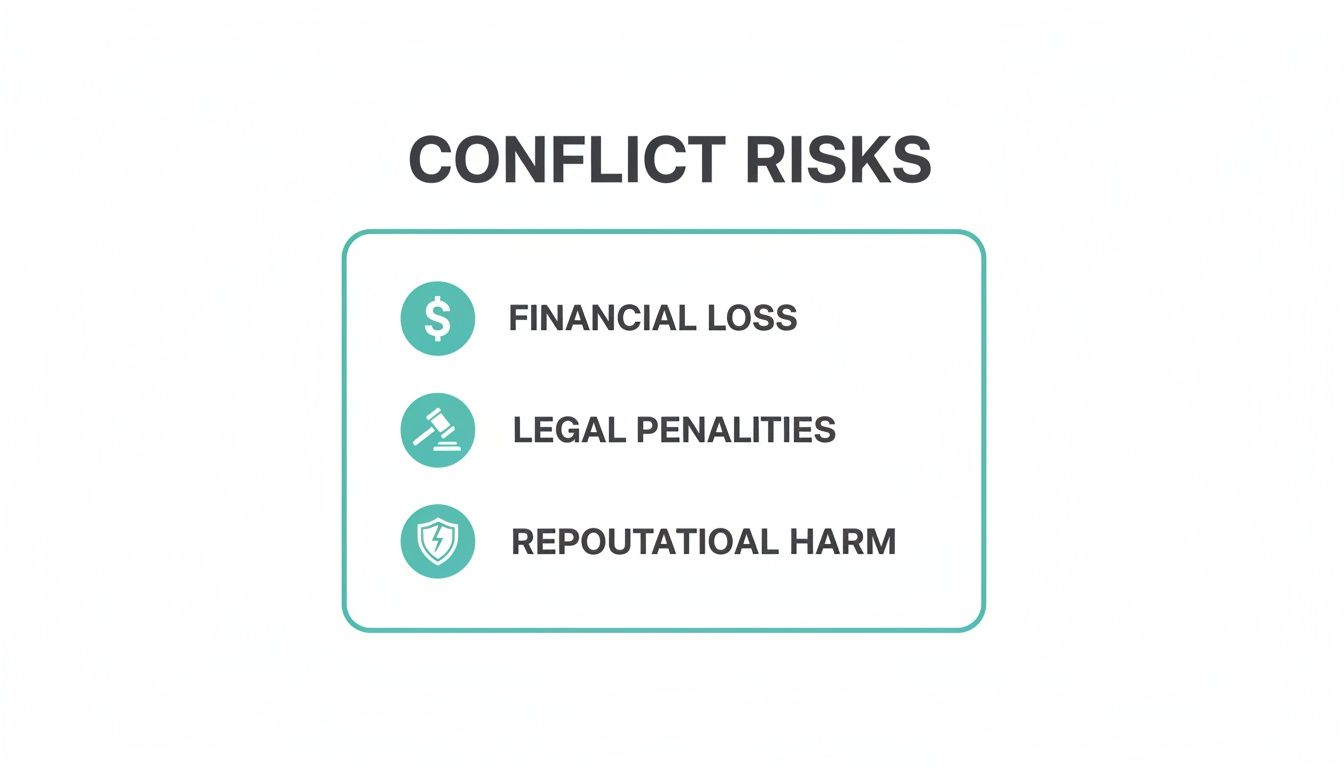
As this shows, unaddressed conflicts are a direct pipeline to financial loss, regulatory heat, and serious reputational harm. Proactive management isn't just good practice—it's a business necessity for survival and growth.
To give you a clearer picture, let's compare the old, manual way of handling conflicts with the modern, automated approach. The difference in liability and business impact is stark.
Manual vs Automated Conflict Management: A Comparison of Risk Exposure
This table breaks down the critical differences in risk, efficiency, and compliance when you stick with traditional reactive processes versus adopting dedicated conflict of interest software that sets a new standard for prevention.
Aspect | Manual Processes (The Old, Broken Way) | Automated Software (The New Standard of Prevention) |
|---|---|---|
Risk Visibility | Reactive and fragmented. You only find problems after the damage is done. | Proactive and centralized. The system identifies potential issues in real-time. |
Data Accuracy | Prone to human error, typos, and incomplete or outdated information. | High-integrity data with automated validation and updates. |
Efficiency | Extremely time-consuming. Drains resources from legal and compliance teams. | Highly efficient. Automates disclosures, reviews, and reporting in minutes. |
Audit Trail | Difficult to reconstruct. Relies on scattered documents and creates liability. | Defensible and audit-ready. A complete, time-stamped record of all activity. |
Scalability | Breaks down as the organization grows. Impossible to manage effectively. | Scales seamlessly with your business, from hundreds to thousands of employees. |
The takeaway is clear: manual methods don't just slow you down; they leave your organization dangerously exposed to internal threats. Automated software provides the robust, defensible framework needed to protect the organization from human-factor risk.
The Shift to Proactive Prevention
This escalating risk is exactly why the market for dedicated software is exploding. Valued at USD 6.8 billion in 2023, the global conflict check software market is projected to hit USD 10.5 billion by 2030. This isn't just hype; it's a direct response from businesses scrambling to get ahead of rising regulatory pressures and protect their reputation and bottom line.
The real challenge isn't just collecting disclosure forms. It's about building a living, breathing ethical framework that stops issues from festering. Proactive conflict of interest management software gives you the structure to turn policy into a defensible, everyday practice.
This is all about shifting from reaction to prevention. Instead of waiting for a problem to blow up and then launching a disruptive, costly inquiry, modern platforms help you spot and address potential human-factor risks at the earliest possible stage. To understand the massive business impact, read up on the true cost of reactive investigations.
Ultimately, adopting conflict of interest management software isn't just a tech upgrade. It's an investment in your organization's integrity, resilience, and long-term financial health.
How Conflict of Interest Software Actually Works

To understand how conflict of interest management software works, stop thinking of it as a static database. It's your organization's ethical immune system—a dynamic platform that's always scanning for the hidden connections and relationships that could create serious liability. The whole point is to move beyond simple data entry and start generating intelligent, preventive insights into human-factor risk.
This technology automates the entire disclosure lifecycle, from submission to final resolution. Gone are the days of scattered emails and spreadsheets that are impossible to track, let alone audit. In their place, the software creates a centralized, defensible system of record, ensuring every potential conflict is flagged, assessed, and managed with a consistent, documented process that protects the business.
Identifying the Full Spectrum of Conflicts
It’s a common mistake to think these platforms only catch direct financial entanglements. Modern systems are built to detect a much wider universe of human-factor risks that threaten your organization's integrity. They’re designed to look past the obvious and spot the subtle-but-powerful internal threats.
Effective conflict of interest management software is engineered to identify:
Financial Conflicts: Undisclosed ownership in vendor companies, significant stock in a competitor, or paid advisory gigs that could sway internal decisions.
Personal and Relational Conflicts: The system helps manage risks that arise when family members work for key suppliers or when personal relationships lead to favoritism in hiring and promotions.
Undisclosed Business Associations: It can flag an employee running an outside business that either competes with your organization or sells services to it, creating a clear division of loyalty.
Role-Related Conflicts: Especially common in regulated industries, where an employee’s past jobs or future prospects could improperly influence their current decisions.
By sorting and analyzing these different risk vectors, the software gives you a complete picture of potential integrity violations and insider risk—a far more robust defense than manual checks.
The Shift to Ethical Risk Management
The biggest leap forward in this space has been the move toward ethical risk management. Old-school approaches often relied on intrusive methods like surveillance that created a culture of suspicion and significant legal risk. Today’s best platforms, however, are built on a foundation of respect for employee privacy and are aligned with regulations like the Employee Polygraph Protection Act (EPPA).
This is possible because the focus is on analyzing connections within declared information, not on monitoring employee behavior. These systems are not cyber tools; they start and end with the human factor.
The goal isn’t to police employees. It's to empower them with a simple, transparent way to disclose information. A modern platform makes it easy for people to do the right thing, turning compliance from a bureaucratic chore into a shared responsibility for protecting the enterprise.
This is where advanced, AI-driven platforms really shine. They can analyze huge datasets of disclosed information—vendor lists, employee roles, corporate family trees—to flag potential issues without resorting to invasive surveillance. For example, AI can automatically cross-reference a new vendor with an employee’s declared outside business interests, instantly flagging a potential conflict for review.
This AI human risk mitigation capability lets compliance teams zero in on the highest-priority risks. The system intelligently filters out the noise, escalating only the items that truly need human judgment. It's this blend of smart automation and ethical design that makes it possible to manage internal threats at scale while building a culture of integrity.
What to Look For in a Modern Conflict Management Platform
When evaluating conflict of interest management software, it’s easy to get bogged down in technical specs. But for leaders in compliance, legal, and HR, the question is simpler: what capabilities will actually shield the organization from liability and reinforce our ethical culture? A modern platform is an active defense system against human-factor risk, not just a digital filing cabinet.
The right features build a defensible, audit-ready compliance program from the ground up. They automate the tedious work of collecting and cross-referencing data, freeing up your experts to focus on strategic risk mitigation and prevention. This shift is critical for proving due diligence to regulators who expect far more than a check-the-box effort.
Centralized Disclosure and Case Management
The bedrock of any effective system is a single, centralized hub for every disclosure and case. Old-school methods that rely on scattered spreadsheets and email chains are a recipe for disaster, creating documentation gaps that auditors and regulators will exploit. A unified platform ensures every disclosure, review, and resolution is logged in one immutable record.
This centralization delivers three massive business impacts:
A Defensible Audit Trail: You get a complete, time-stamped history of how every potential internal threat was identified, assessed, and managed. This is non-negotiable for proving due diligence.
Consistent Application of Policy: Standardized workflows ensure similar conflicts are treated the same way across the board, eliminating inconsistencies that create legal risk.
Complete Visibility: Leadership gets a real-time, organization-wide view of potential conflicts, moving from a fragmented, reactive mess to a state of informed oversight and prevention.
Automated Risk Scoring and Real-Time Alerts
Manual review processes are not just slow; they're inherently subjective. Modern conflict of interest management software removes the guesswork with automated risk scoring. You can configure the system to weigh different factors—like an employee’s role, the nature of a relationship, or the financial value involved—to assign a clear risk score to every disclosure.
This allows your compliance team to instantly triage incoming disclosures and focus their energy on the high-risk items that require human judgment. When a submission crosses a predefined risk threshold, the platform automatically fires off real-time alerts to the right stakeholders. That’s the difference between finding out about a critical internal threat during an annual review and neutralizing it before it can cause damage.
AI-Driven Analysis for Proactive Prevention
The biggest leap forward in this space is AI-driven analysis. This is what separates a basic workflow tool from a true ethical risk management platform. Instead of relying only on what employees self-report, AI can analyze vast datasets of declared information to spot invisible connections and potential red flags that no human could ever catch.
The power of AI here is its ability to connect the dots without crossing ethical lines. It analyzes the data you already have—like vendor lists, outside business interests, and board memberships—to flag potential conflicts. It does this without resorting to invasive surveillance, monitoring, or other EPPA-sensitive methods.
This AI-powered approach also slashes the false positives that plague older systems, so compliance teams aren't wasting time chasing ghosts. As data complexity grows, this capability is becoming essential. It's why the market for conflict check software is projected to hit USD 2.5 billion by 2031, driven by demand for AI-enhanced accuracy. This trend directly tackles a major challenge in eDiscovery surveys, where 21.88% of professionals cited "increasing types of data" as a top conflict.
Robust Reporting and Auditable Workflows
Finally, a top-tier platform must deliver robust reporting and analytics. Your board, audit committee, and regulators don't want a data dump; they need clear, concise insights into the health of your compliance program.
Look for a solution that offers:
Customizable Dashboards: To give you at-a-glance visibility into key metrics like disclosure rates, open cases, and emerging risk trends.
Audit-Ready Reports: That can be generated on-demand to satisfy a regulator's request without a frantic scramble for documents.
Analytics for Program Improvement: To help you spot patterns and systemic issues, so you can refine your policies and training over time.
These features transform compliance from a simple cost center into a strategic function that provides tangible value. For a deeper look, check out our guide on the broader ecosystem of ethics and compliance software. By focusing on these core capabilities, you can find a platform that not only streamlines your work but also builds a more resilient and ethical organization.
The Strategic Advantage of Proactive Prevention

Reactive investigations are the corporate equivalent of calling the fire department after the building has already burned down. They're disruptive, expensive, and do little more than document a failure that has already inflicted severe financial and reputational damage. The strategic high ground belongs to organizations that get ahead of the problem with prevention.
To see the difference, let’s walk through a tale of two companies, both on the verge of a game-changing merger.
Scenario One: The Reactive Nightmare
"Innovate Corp" still relies on annual disclosure forms living in spreadsheets. Their star project lead, a key architect of the merger, submitted his form nine months ago, noting a minor advisory role at a small startup. Nobody connected the dots.
Weeks before the merger closes, the deal collapses. The acquiring company discovers that the "small startup" on the project lead’s form has since been acquired by a direct competitor, who gained proprietary insights into Innovate Corp’s strategy.
The fallout is catastrophic:
Massive Financial Loss: Millions in legal fees and advisory services are gone. The company’s stock plummets.
Reputational Disaster: The story leaks, painting Innovate Corp as poorly governed. Trust from investors and partners is shattered.
Disruptive Internal Investigation: A costly forensic review begins, pulling key executives away from their duties and creating a culture of suspicion.
Innovate Corp’s reactive, check-the-box approach failed them. They logged the data but lacked the intelligence to see the internal threat until it was too late. This is the predictable outcome of a failed compliance posture.
Scenario Two: The Proactive Solution
Now, let's replay this with "Future Forward Inc.," an organization using modern conflict of interest management software. Their project lead has the same advisory role. However, when the competitor acquires the small startup, the system triggers an immediate alert.
Future Forward’s platform continuously cross-references employee disclosures against its internal data. The acquisition created a new, high-risk connection that was instantly flagged.
The process unfolds very differently:
Early, Quiet Intervention: The compliance team receives a real-time alert about the escalated risk.
Ethical and Transparent Resolution: The project lead is consulted, and a clear management plan is implemented, ethically walling him off from sensitive merger details.
The Deal is Saved: The acquiring company is notified of the proactively managed conflict, which reinforces their confidence in Future Forward’s strong governance. The deal closes successfully.
By shifting from static data collection to dynamic risk analysis, Future Forward transformed a potential disaster into a demonstration of corporate integrity. Their proactive stance protected shareholder value and upheld their reputation.
This narrative highlights the core value of AI human risk mitigation. It’s not about policing employees; it’s about having an intelligent system that provides the foresight needed to navigate complex human-factor risks ethically and effectively. Instead of cleaning up a crisis, Future Forward’s leadership focused on successfully closing their most important deal of the decade. This is the undeniable strategic advantage of prevention over reaction.
Selecting an Ethical and EPPA Compliant Solution
Choosing the right conflict of interest management software is a strategic decision that goes beyond a simple feature comparison. The methodology behind the platform is as critical as its functionality. For any compliance or legal leader, the question isn't just "What can it do?" but "How does it do it?" Getting that answer right is the only way to shield your organization from massive legal and reputational damage.
The market has two different camps. On one side, you have platforms that lean on methods bordering on employee surveillance, creating huge legal risks under regulations like the Employee Polygraph Protection Act (EPPA) and breeding a culture of distrust. On the other, you have modern, ethical systems like Logical Commander, built for proactive prevention without the intrusive, legally-risky tactics. Drawing a hard line between these two is essential.
The Pitfalls of Surveillance-Based Tools
Some vendors sell their software as a tool for monitoring employee communications or activities to "catch" people. These systems almost always operate in a legal gray area and are fundamentally at odds with employee privacy laws. Competitors using these surveillance-style tools directly contradict the entire point of proactive, trust-based compliance. Instead of empowering employees to do the right thing, they create an adversarial environment that tanks morale and increases organizational risk.
Choosing a vendor whose methods could be seen as coercive or invasive is a high-stakes gamble. The fallout from an EPPA violation or a privacy lawsuit will far outweigh any perceived benefit, turning a compliance tool into a massive liability.
A Checklist for Ethical Vendor Evaluation
To ensure you select an EPPA compliant platform, your evaluation must include pointed questions about methodology. This checklist provides a framework for separating ethical solutions from legally questionable ones. And just as importantly, to truly select an ethical solution, you must confirm the underlying platform itself undergoes a thorough cyber security risk assessment to protect the sensitive data it holds.
Use these questions to drive your vendor conversations:
Data Sources and Analysis: Does the platform analyze self-disclosed information and existing company data (like vendor lists), or does it monitor employee communications, keystrokes, or web activity? Demand a clear answer.
AI Methodology: If the platform uses AI, what is it actually doing? Ethical AI human risk mitigation is about finding connections within declared data, not profiling behavior or making judgments about individuals.
EPPA Alignment: Ask vendors to explain exactly how their methodology aligns with EPPA principles. They must confirm their system involves no lie detection, psychological pressure, or surveillance.
Employee Experience: What is it like for an employee to interact with the system? The process should be simple, transparent, and focused on making disclosure easy, not making employees feel like they're under investigation.
Positioning Prevention as the Superior Choice
The most effective conflict of interest management software helps you build a culture of integrity, not one of suspicion. The goal is to make transparency the path of least resistance. An ethical, non-intrusive system does this by focusing on identifying potential risks within business data, allowing for early, quiet intervention before a conflict can damage the company.
This preventive approach is not just ethically superior; it's far more effective at managing human-factor risk. It enables your organization to live up to its corporate values, protect employee dignity, and build a resilient, audit-ready compliance program that can stand up to real scrutiny.
Logical Commander: The New Standard in Ethical Prevention
Traditional approaches to internal risk are broken. Reactive investigations and old-school surveillance tools fail to address the core human-factor risks and create massive legal exposure. The new standard for enterprise integrity requires a fundamental shift to proactive, ethical prevention. This is exactly where Logical Commander’s E-Commander platform is the new standard of internal risk prevention.
Our system was built to solve the real challenges of modern governance with a unique, EPPA-aligned methodology. We empower organizations to handle their conflict of interest management software needs without resorting to the invasive tactics that put your company at risk. Our platform is non-intrusive: there is zero surveillance, no secret monitoring, and absolutely no technology that mimics lie detection or psychological profiling. We are not a cyber company; our focus starts and finishes with humans.
AI-Powered Prevention Without the Intrusion
Logical Commander operates on a simple, powerful principle: true prevention starts by understanding connections, not by policing behavior. Our AI-driven engine analyzes self-disclosed and existing organizational data—vendor lists, corporate structures, and employee roles—to identify the critical signals of human-factor risk.
It intelligently flags potential conflicts before they can escalate into costly, reputation-damaging incidents. This approach delivers tangible benefits for the teams on the front lines of governance:
For Compliance: Gain a unified view of risk intelligence, replacing fragmented spreadsheets with a defensible, audit-ready system that reinforces governance.
For HR: Implement a fair, transparent process that respects employee dignity and actively strengthens your ethical culture.
For Legal: Drastically mitigate liability with a system built on a foundation of ethical compliance and privacy, ensuring your risk management practices are legally sound.
Join the New Standard of Internal Risk Management
Logical Commander provides actionable, preventive alerts that allow you to intervene early and quietly, turning potential crises into managed situations. To learn more about our methodology, read our article on redefining human capital risk management.
Our mission is to provide the tools for ethical governance. E-Commander gives you the ability to uphold your organization's values by identifying risk signals within data, not by creating an environment of distrust through surveillance. This is the new standard in proactive prevention.
We also invite technology providers, consultants, and B2B SaaS companies to join our PartnerLC program. Our partner ecosystem is for B2B SaaS Software allies dedicated to establishing this new benchmark for ethical internal threat management. By partnering with us, you can deliver a proven solution that protects organizations from the inside out.
Your Questions, Answered
When decision-makers start looking into conflict of interest management software, a few key questions always come up. Let's tackle the most common ones, focusing on how a modern platform fits into your operations and governance structure.
How Does This Software Integrate With Existing HR Systems?
The best platforms are built for seamless integration. They use APIs to connect with the systems you already rely on, like your HRIS, CRM, and other databases holding employee and vendor information.
This connection allows the software to automatically pull in critical data—new hires, updated vendor lists, key client relationships—without manual intervention. It eliminates manual data entry, slashes the risk of human error, and ensures your conflict checks are always running on the most current information, strengthening your overall risk management framework.
Is This Software Difficult For Employees To Adopt?
Not at all, provided you choose an ethical, non-intrusive solution. Modern, cloud-based platforms are designed to be straightforward and respect employee privacy.
The key to adoption is a system that operates ethically in the background. The best platforms only require action from an employee when absolutely necessary, usually through a simple disclosure form. This low-friction approach helps build a culture of transparency and shared responsibility for protecting the organization.
Adoption really comes down to the platform's methodology. An EPPA-aligned platform that is non-intrusive and focuses on transparent disclosure is far more likely to be accepted by employees than one that makes them feel monitored. Ethical design is the bedrock of user acceptance and a healthy corporate culture.
Does This Software Only Detect Financial Conflicts?
That’s a common misconception. While financial conflicts are a huge piece of the puzzle, today's advanced systems are designed to spot a much wider spectrum of human-factor risks.
This includes conflicts arising from personal and family relationships, undisclosed side businesses, or even potential leaks of intellectual property. AI-driven platforms are smart enough to analyze connections and patterns, giving you a comprehensive shield against many forms of insider risk that go way beyond a simple financial check.
Ready to see how the new standard in ethical, proactive prevention can protect your organization? Logical Commander provides an EPPA-aligned, non-intrusive platform to manage human-factor risks before they become costly incidents.
Request a Demo to see our AI-powered platform in action.
Start a Free Trial and experience the benefits firsthand.
Join our PartnerLC Program to bring the next generation of risk management to your clients.