%20(2)_edited.png)

Insider Threats: Ethical Prevention for a New Standard of Risk Management

Updated: Feb 11
When leaders hear the term insider threats, their minds often jump to a disgruntled employee sneaking out of the building with company secrets. While that’s certainly a real danger, this classic "bad actor" scenario is only a tiny fraction of the human-factor risk your organization faces every day.
The reality is that insider threats cover a whole spectrum of behaviors, and most of them aren't driven by malicious intent at all. This is not a cyber issue; it's a human-factor risk that starts and ends with people.
Understanding Insider Threats Beyond the Stereotypes
To get a real handle on internal risk, leaders in compliance, security, and HR have to look past the villain stereotype. An insider threat is any security risk that comes from inside the organization—posed by current or former employees, contractors, or partners who have legitimate access to your systems and data. This isn't just a security problem; it's a complex human-factor issue with direct business impact and liability.
Think of it like a faulty wire hidden inside the walls of your office. The danger is invisible, and it originates from a trusted component of the building itself. The fault could be a manufacturing defect (a negligent employee), simple wear and tear (a compromised account), or even intentional tampering (a malicious actor). Whatever the cause, if you don't find it, the potential for catastrophic damage is huge.
The Three Faces of Insider Threats
Most insider incidents fall into one of three distinct categories. Each one is driven by a different motive and requires a completely different approach to manage effectively. Understanding these "faces" is the first step toward building a proactive risk prevention framework that actually works—and is ethical.
Here’s a clear breakdown of the primary threat categories, what drives them, and what they look like in the real world.
The Three Faces of Insider Threats
Threat Type | Primary Driver | Common Examples |
|---|---|---|
The Negligent Insider | Error or Carelessness | An employee clicks on a phishing link, accidentally sends a sensitive file to the wrong person, or misconfigures a cloud server, leaving data exposed. |
The Malicious Insider | Personal Gain or Revenge | A departing salesperson steals a client list to take to a competitor, a disgruntled admin sabotages a critical system, or an employee commits financial fraud. |
The Compromised Insider | Stolen Credentials | An external attacker steals a user's login details via malware, then uses that access to impersonate the employee and steal data. The employee is an unwitting pawn. |
As the table shows, The Negligent Insider is by far the most common threat, accounting for well over half of all incidents.
If your strategy is solely focused on reactive investigations to hunt for malicious insiders, you’re leaving your organization wide open to the much more frequent risks of simple human error and credential theft.
The new standard of internal risk prevention requires a fundamental shift from reactive forensics to proactive, ethical prevention. Instead of trying to catch employees after the fact, the goal is to identify and mitigate risk indicators before they escalate into costly incidents. You can learn more by exploring common insider threat indicators in our detailed guide. This new standard protects both the organization and its people, building a culture of security instead of a culture of suspicion.
The Escalating Business Impact of Insider Threats
While the motives behind an insider threat can vary wildly, the financial consequences are consistently brutal—and they're getting worse. For leaders in risk, compliance, and legal, getting a firm grip on both the direct and indirect costs is the only way to make the case for elevating human-factor risk to a top-tier priority. These aren't just hypothetical risks on a spreadsheet; they are real, escalating liabilities that hit the bottom line hard.
The financial toll has absolutely skyrocketed. The average annual cost of an insider incident is projected to climb to $17.4 million per organization in 2025. To put that in perspective, it marks a staggering 109.6% global cost increase between 2018 and 2025. North American companies are feeling the most pain, with an average price tag of $22.2 million per incident.
When you consider that the human element is a factor in 60% of confirmed breaches and 71% of organizations admit they're vulnerable, the need for proactive prevention has never been more urgent.
Beyond the Initial Breach: The Hidden Costs
The immediate financial loss from an incident is often just the tip of the iceberg. The true cost of an insider threat multiplies through a series of cascading expenses that can cripple an organization long after the initial event. These hidden costs often dwarf the direct losses, creating long-term financial strain and operational disruption.
Decision-makers have to account for these secondary impacts, which include:
Regulatory Fines and Legal Fees: Non-compliance with data protection laws like GDPR or CCPA can result in massive penalties. Legal battles, settlements, and associated fees add another significant layer of expense.
Reputational Damage: A public breach erodes customer trust and brand value. This damage can lead to customer churn, lost business opportunities, and a decline in stock value, with financial effects that linger for years.
Operational Disruption: Halting business operations to investigate and remediate a breach leads to direct revenue loss. The cost of downtime, coupled with the resources diverted from core business functions, can be substantial.
Remediation and Recovery Expenses: The financial impact of insider threats extends beyond direct losses, often necessitating costly post-incident remediation, including professional data recovery services. This also includes hiring forensic investigators, notifying affected customers, and offering credit monitoring services.
This chart breaks down where these threats are actually coming from, highlighting the root of the financial risk.
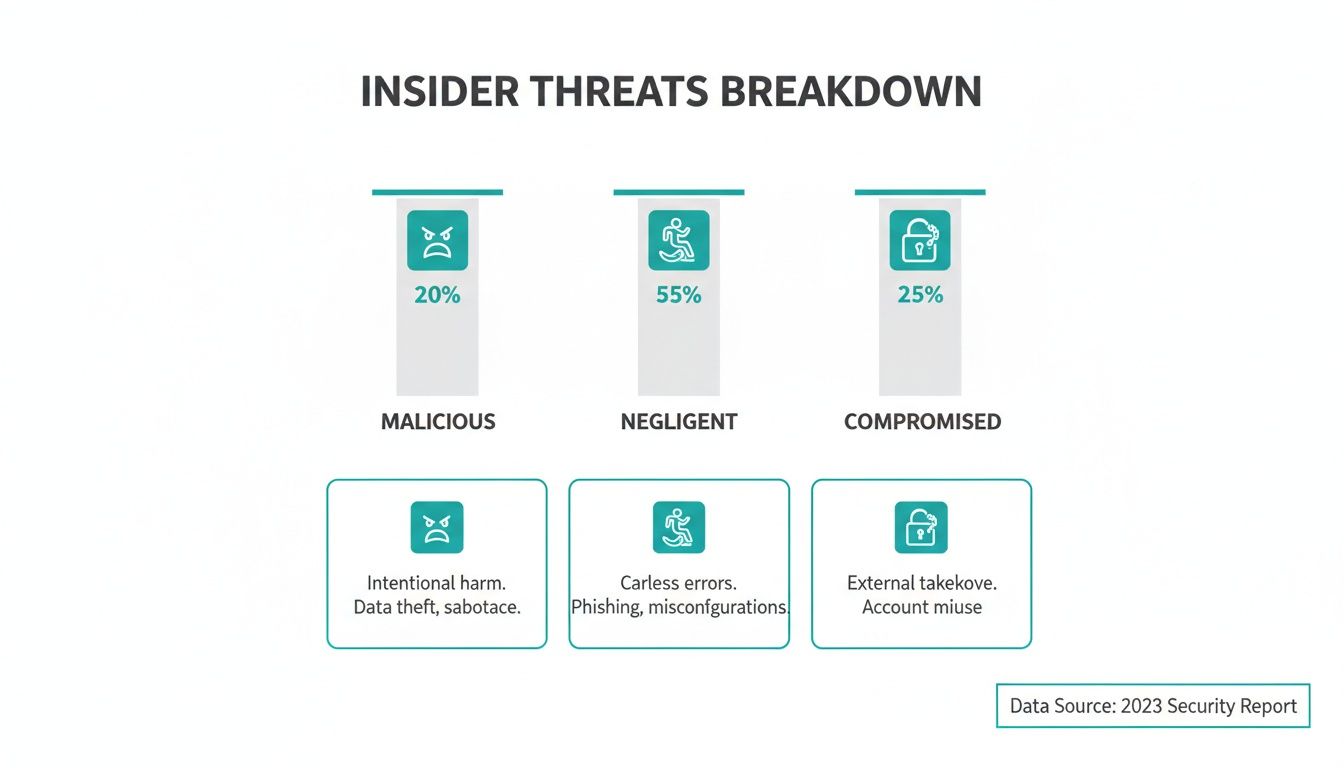
As the data shows, simple negligence is the most frequent source of incidents by a wide margin. This underscores the critical need for systems that can mitigate human error, not just hunt for malicious intent.
The Flawed Economics of Reactive Investigations
The traditional response to an insider threat is almost entirely reactive. An investigation only kicks off after the damage is done, focusing on forensic analysis to figure out what happened and who was responsible. From a business and liability standpoint, this model is fundamentally broken.
Reactive investigations are an expensive exercise in damage control, not a strategy for risk prevention. They allocate budget to cleaning up a crisis rather than preventing one, ensuring the organization always pays the highest possible price for an incident.
By the time an investigation starts, the data is gone, systems are compromised, and the reputational hit has already begun. This approach guarantees that your organization absorbs the full financial impact of the breach. You can explore a deeper analysis of the true cost of reactive investigations in our dedicated article.
A strategic shift toward proactive, EPPA-aligned risk identification is the only way to get ahead of these costs and protect your organization's financial health.
Why Traditional Insider Threat Programs Fail
Plenty of organizations think they have their insider threat programs under control. In reality, most conventional methods are outdated, ineffective, and dangerously reactive. These legacy approaches are typically built on a foundation of after-the-fact forensics and invasive employee surveillance—a combination that creates a toxic culture of distrust while exposing the company to a world of legal and ethical pain.
The core problem is that these programs were designed to investigate breaches, not prevent them. They only kick into gear after sensitive data has walked out the door, systems have been compromised, or the financial damage is done. This reactive posture guarantees you’re always one step behind, perpetually cleaning up messes instead of getting ahead of the human-factor risks that cause them in the first place.
The Flaw of Reactive Forensics
The traditional model is fundamentally broken. When an incident occurs, teams from Security, HR, and Legal scramble to piece together what happened. This forensic free-for-all is slow, expensive, and a massive disruption to the business. It’s all about finding a culprit, not addressing the systemic vulnerabilities that let the incident happen.
This approach is doomed to fail for a few key reasons:
It’s always too late: By the time an investigation starts, the damage is already done. The meter is running on remediation costs, reputational harm, and regulatory fines.
It creates operational friction: Investigations grind workflows to a halt, eat up valuable resources, and force key personnel to drop everything to assist.
It overlooks prevention: The focus stays stuck on punishment and recovery, doing almost nothing to stop the next negligent or malicious act from happening.
Legal and Ethical Minefields of Surveillance
To make up for being so reactive, many older programs turn to invasive surveillance and employee monitoring. These tactics aren't just terrible for morale; they’re a legal minefield, especially when it comes to regulations like the Employee Polygraph Protection Act (EPPA). Secretly monitoring employee activity or using tools that even imply lie detection is a direct path to litigation and steep penalties.
An approach centered on surveillance treats employees as potential adversaries rather than trusted partners in security. This "policing" mindset erodes trust, kills engagement, and can even push well-intentioned employees toward risky behaviors.
On top of that, traditional programs often ignore the impact of employee well-being. Incorporating effective workplace stress management strategies, especially for neurodivergent employees, can build a far more secure and resilient environment than any surveillance tool ever could.
The High Cost of Fragmented Workflows
Another critical failure is the fragmentation of intelligence. In most companies, crucial information about employee risk is scattered across siloed departments. HR has performance data, Legal has compliance records, and Security has access logs. Without a unified system, connecting these dots is a painfully slow, manual process just waiting for human error. This lack of a single source of truth leads to crippling delays and massive intelligence gaps.
And the frequency of these incidents is only going up. Insider threats have surged globally, with 76% of organizations reporting attacks became more frequent in the last year alone. In fact, many companies now face between 21 and 40 insider threat incidents annually. This spike throws the severe limitations of reactive, manual processes into sharp relief and screams for a modern, ethical, and proactive approach to risk management.
Adopting a proactive and ethical risk-based approach is the only way to get ahead of this growing problem.
A modern, AI-driven platform like Logical Commander’s E-Commander offers the necessary evolution. It unifies risk intelligence across departments ethically and without surveillance, enabling organizations to identify and mitigate risks before they escalate into multimillion-dollar breaches.
Adopting a New Standard of Ethical Prevention
The old models for handling insider threats—heavy on surveillance and built on suspicion—aren’t just failing. They’re actively creating legal landmines and toxic work environments. It’s time to move past this broken approach and embrace a smarter, more responsible standard.
The new benchmark for managing internal risk is proactive, AI-driven, and fundamentally ethical. It’s a strategy that is non-intrusive by design and fully aligned with regulations like the Employee Polygraph Protection Act (EPPA).
This modern framework completely shifts the focus from "catching bad employees" to identifying and neutralizing human-factor risks before they can do any harm. It operates on a simple, powerful principle: the overwhelming majority of your employees are valuable partners, not potential suspects.
Instead of invasive monitoring, this new standard analyzes operational and behavioral data to flag concrete risk indicators, like conflicts of interest or procedural deviations. This is all done while preserving employee dignity and privacy.

From Policing to Partnership
At its core, this new standard represents a philosophical shift away from a policing mindset and toward a strategic partnership in governance. Traditional methods naturally create an adversarial relationship between an organization and its people. An ethical, preventive approach does the opposite—it builds a culture of shared responsibility for security and integrity.
This is accomplished by focusing on objective risk signals, not subjective judgments. For instance, the system might flag:
Operational Anomalies: A user suddenly starts accessing or downloading unusually large volumes of data that have nothing to do with their normal job function.
Conflicts of Interest: Connections or activities are identified that suggest an employee’s personal interests might be at odds with their professional duties.
Procedural Deviations: An employee repeatedly fails to follow established security protocols, which could signal anything from simple negligence to malicious intent.
By analyzing these objective signals, organizations get the visibility they need to step in constructively. This might mean providing extra training to a negligent employee or closing a compliance gap—a far cry from launching a costly and disruptive investigation after a breach has already happened. This distinction is what defines modern, ethical risk management.
The Ethical Framework vs. Legally Risky Surveillance
This forward-thinking framework is a world away from competitors who still rely on legally questionable surveillance tactics. Many legacy "insider threat" tools are built on continuous monitoring of employee communications, keystroke logging, or even screen recording. These methods aren't just invasive; they generate a crushing volume of false positives, creating alert fatigue and breeding a culture of deep distrust.
More importantly, these surveillance-based systems often operate in a legal gray area, creating a serious risk of violating privacy laws and the EPPA.
The new standard of prevention is built on a foundation of respect for employee privacy and dignity. It empowers organizations to see and mitigate risk without resorting to intrusive methods that treat every employee as a potential threat.
The goal here is to arm leaders in HR, Legal, and Compliance with actionable intelligence that is both powerful and ethically sound. It allows them to protect the institution and its people through smart, preventive action, not reactive punishment.
This table really drives home the difference between the old, broken model and the new standard of care.
Old Approach vs The New Standard in Risk Management
Attribute | Traditional Reactive Methods | The Proactive Standard |
|---|---|---|
Focus | Investigation and forensics after an incident. | Prevention and mitigation before an incident occurs. |
Methodology | Often relies on invasive surveillance and employee monitoring. | Uses non-intrusive, AI-driven analysis of operational data. |
Employee View | Employees are viewed as potential suspects. | Employees are respected as partners in maintaining integrity. |
Legal Risk | High risk of violating EPPA and privacy regulations. | Fully EPPA-aligned and designed for legal compliance. |
Outcome | Expensive damage control and a culture of distrust. | Reduced risk, improved governance, and a culture of trust. |
Operational Impact | Disruptive, resource-intensive investigations. | Streamlined workflows and early, constructive interventions. |
By adopting this proactive standard, organizations can finally move from a position of perpetual defense to one of strategic resilience. You can discover more about the principles behind this approach in our guide to ethical insider risk management solutions. This isn’t just a better way to manage insider threats; it’s the future of enterprise governance.
Building a Resilient Organization with Unified Risk Intelligence
Throwing technology at the insider threat problem and hoping it sticks is a losing strategy. A real, lasting defense comes from something more fundamental: a unified approach that weaves together your people, your processes, and your platforms. For far too long, companies have stumbled along with fragmented risk intelligence, creating dangerous blind spots between departments that insiders can easily exploit.
It's time to break down those silos. This section is a practical roadmap for leaders in risk, HR, and compliance to build a truly cohesive defense.
The core of this shift is moving from a scattered, departmental mindset to a coordinated operational layer. This means pulling the distinct—but deeply related—insights from HR, Legal, Security, and Audit into a single, real-time stream of intelligence. When these teams operate in their own little worlds, critical signals get lost in the noise, response times drag, and the organization is left wide open.
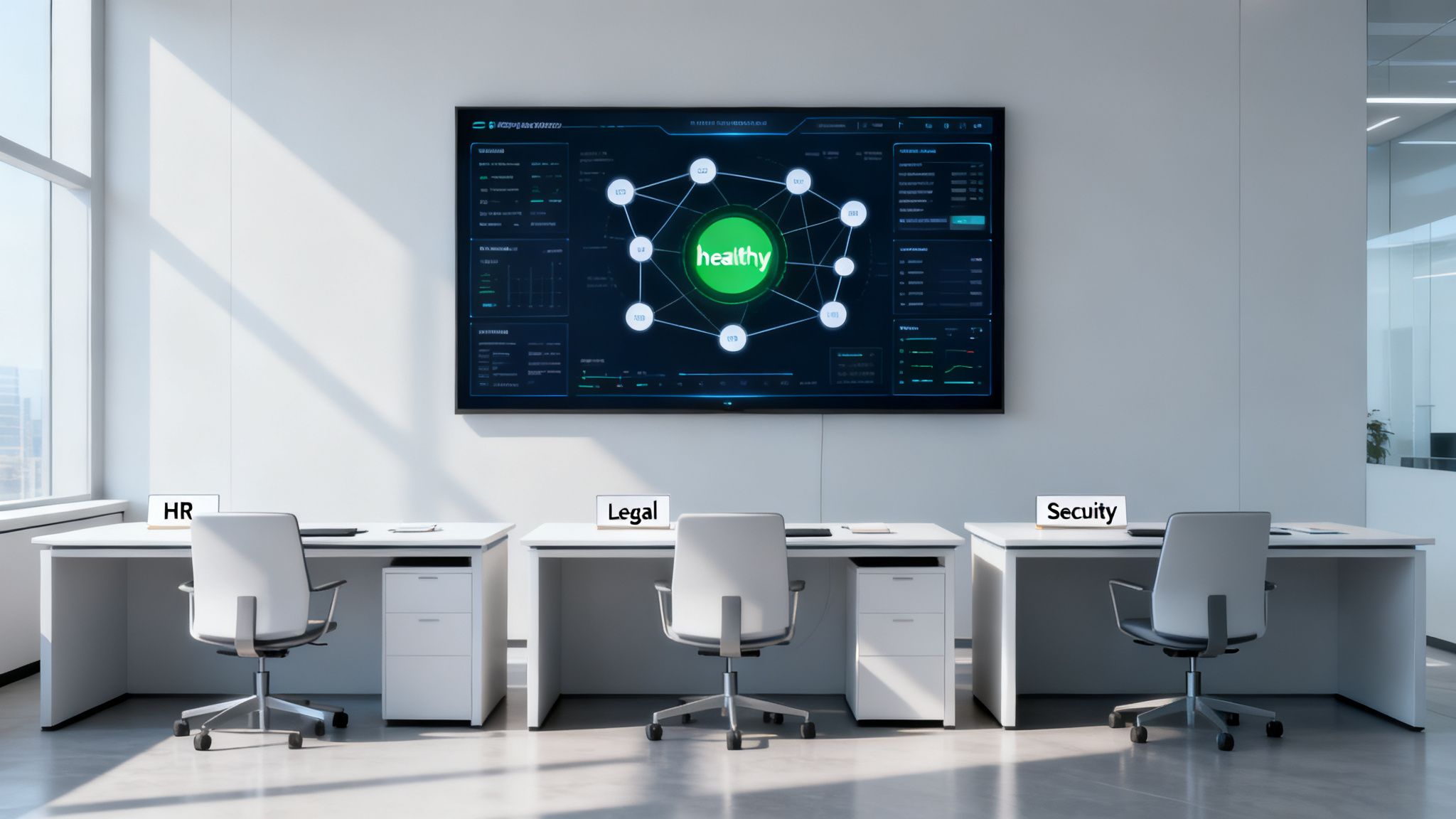
Centralizing Risk Intelligence for Real-Time Visibility
A unified platform should act as the central nervous system for your entire risk management effort. By ethically aggregating and analyzing data from multiple sources—all in an EPPA-compliant way—it gives you a complete, 360-degree view of human-factor risk across the business. This centralized intelligence is what allows your leaders to finally move faster and with greater confidence.
Instead of launching slow, manual investigations after an incident has already done its damage, a unified system spots the precursor risk signals as they emerge. This opens the door for early, constructive intervention, like targeted training or a process tweak, long before a minor issue can blow up into a major breach. The goal is to turn a pile of disconnected data points into actionable, preventive intelligence.
The Readiness Gap and the Need for Unification
Despite a growing awareness of the problem, a massive readiness gap persists in most organizations. The numbers tell a pretty scary story. While 93% of leaders see insiders as a threat equal to or greater than external attackers, a shocking 69% are still relying on informal, reactive processes to deal with it.
This disconnect is made worse by the fact that 60% of HR-security coordination is still manual, fueling alert fatigue and letting critical risks slip right through the cracks. The result? Only 23% of organizations feel strongly confident in their ability to proactively detect insider threats. You can get the full story on this readiness gap in the 2025 Insider Risk Report. This data screams one thing loud and clear: it’s time to bridge these departmental silos with a unified, intelligent platform.
This lack of cohesion is no longer sustainable. With hybrid work and cloud tools constantly expanding the attack surface, a siloed approach is a recipe for failure.
A Practical Roadmap for Implementation
Building a resilient organization with unified intelligence isn't about a single tech fix. It's a strategic progression—a way to foster a cohesive, risk-aware culture that’s supported by the right framework.
Here are the key steps to get there:
Establish a Cross-Functional Team: Your first move is to create a dedicated insider risk management group. Get stakeholders from HR, Legal, Compliance, and Security in the same room. This team will own the strategy and keep everyone aligned.
Define Clear Risk Thresholds: Work with that cross-functional team to define exactly what a risk indicator means for your organization. This ensures consistency and focuses everyone's efforts on the signals that actually matter.
Implement a Unified Platform: Deploy a solution like E-Commander to act as your single source of truth. The platform must ethically aggregate risk signals without any invasive surveillance, staying firmly in line with EPPA and preserving employee dignity.
Develop Coordinated Response Playbooks: Create clear, pre-defined workflows for how the organization will respond to different types of risk alerts. This guarantees a swift, consistent, and compliant reaction every single time.
Focus on Continuous Improvement: An insider risk program is never "done." Regularly review the program's effectiveness, using data from the platform to refine your risk thresholds, update training, and adapt to new threats as they emerge.
The ultimate goal isn't just to manage risk; it's to build a resilient organizational culture. A unified intelligence platform provides the foundation for this culture by enabling faster, more informed decisions and fostering a shared sense of responsibility for protecting the enterprise from the inside out.
By finally breaking down those departmental barriers, you can move from a reactive posture of damage control to a proactive stance of strategic prevention. That’s how you safeguard your organization’s reputation, its assets, and its people.
Partner with Us to Deliver the New Standard of Internal Risk Prevention
Your clients are looking for a better way to manage internal risk, and the old playbooks are failing them.
For consultants, B2B SaaS providers, and advisory firms, addressing the human factor in risk isn’t just a value-add anymore—it’s the entire game. Organizations are finally moving away from outdated, invasive methods for managing insider threats, and they are actively searching for forward-thinking solutions that are both effective and ethical. This shift is a massive opportunity to lead the conversation with a truly modern approach.
By integrating a pioneering, EPPA-aligned platform into your services, you deliver something your competitors can't. You give clients a proactive, non-intrusive way to manage human-factor risk, finally breaking them out of the endless, costly cycle of reactive investigations and damage control.
Join the PartnerLC Program
This is an invitation to explore a strategic alliance through our PartnerLC program. Partnering with Logical Commander is more than just adding another tool to your lineup; it’s a chance to align your entire brand with the future of compliant, ethical risk management. By joining our partner ecosystem, you’re not just reselling software—you’re equipped to solve a critical, underserved need in the market.
This collaboration allows you to:
Differentiate Your Services: Offer a unique, AI-driven platform that stands worlds apart from legally questionable legacy surveillance tools.
Enhance Client Value: Empower your clients to get ahead of risks related to integrity and conflicts of interest before they blow up into damaging incidents.
Drive New Revenue Streams: Tap into the exploding demand for proactive governance and compliance solutions.
By partnering with us, you help your clients build more resilient, ethical organizations while cementing your own firm’s reputation as a leader in the new standard of enterprise governance. This is your chance to champion a smarter, more responsible way of tackling one of the most complex challenges in business today. Become an ally and help shape the future of internal risk prevention.
Your Questions on Managing Insider Threats, Answered
As you shift your organization from reactive cleanups to proactive prevention, you’re bound to have questions. It’s a major strategic move. Leaders across Risk, Compliance, and HR want clarity on how to implement this new standard, what the legal guardrails are, and what the real-world benefits look like. Let's get right to it.
The entire philosophy here is about getting away from the legally toxic practice of employee surveillance. The focus is on ethically identifying objective risk indicators—a fundamental pivot that protects the organization and its people, builds trust, and strengthens governance all at once.
How Can We Proactively Manage Insider Threats Ethically?
Ethical insider threat management starts by flat-out rejecting intrusive surveillance. Instead, a proactive and EPPA compliant platform like Logical Commander’s E-Commander analyzes operational data for objective risk signals. Think about things like clear conflicts of interest or major deviations from established procedures—not personal opinions or feelings.
This approach is completely non-intrusive and respects employee privacy.
Rather than reading emails or tracking keystrokes, the system flags anomalies that point to a potential human-factor risk. This allows for early, constructive intervention, like offering more training, instead of launching a disruptive investigation after the damage is already done. It’s how you build a culture of security, not a culture of suspicion.
What Makes This Different From Traditional Employee Monitoring?
Traditional monitoring tools are built to watch your employees, creating a foundation of distrust and exposing you to serious legal trouble under the EPPA. They track everything from web activity to private messages, burying your security team in false positives while treating your staff like suspects. It’s a fundamentally broken model.
An ethical risk management solution doesn’t "monitor" people at all.
It analyzes operational patterns to flag specific, predefined risk indicators. The system isn't watching what an employee is writing in an email; it’s identifying if their actions—like accessing sensitive data way outside their job scope—deviate from compliance protocols in a way that creates a tangible business risk.
How Does This Approach Protect Against Both Negligent and Malicious Threats?
Both negligent and malicious insider threats leave a trail of objective operational signals. A negligent employee might repeatedly bypass security protocols out of convenience, while a malicious one might systematically access files they have no business touching. A proactive system flags these behaviors without ever needing to guess the person's intent.
By unifying risk intelligence from every corner of the organization, the platform connects the dots that would otherwise get lost in departmental silos. This gives leaders in HR and Compliance the actionable, preventive insights they need to mitigate both accidental and intentional risks long before they escalate into costly headlines.
At Logical Commander, our AI-driven platform empowers your organization to lead this new standard of ethical, proactive internal risk management. Our EPPA-aligned, non-intrusive solution helps you prevent human-factor risks—protecting your assets, your reputation, and your people. Take the first step toward a more resilient enterprise.