%20(2)_edited.png)

Enterprise and Risk Management: Protect Your Business with Proven Frameworks

Updated: Feb 5
Enterprise and Risk Management (ERM) is the unified strategy an organization uses to see and handle potential threats and opportunities. It’s less like a static rulebook and more like a ship's advanced navigation system—it’s not just about reacting to waves but about charting a deliberate course through a storm. A strong ERM program gives you a single, holistic view of your entire risk landscape.
Rethinking Enterprise and Risk Management
Traditionally, risk management was a fragmented, compliance-driven chore. Different departments—from finance to HR to operations—tracked their own risks in isolated spreadsheets, creating dangerous blind spots across the organization. This siloed approach meant that by the time a serious threat was finally spotted, the damage was often already done.
Modern ERM represents a fundamental shift. It’s no longer just about avoiding losses; it’s a proactive, strategic function aimed at creating and preserving business value. The goal is to build true organizational resilience and, when possible, turn risk into a strategic advantage. This evolution isn't happening in a vacuum; it's driven by a few powerful forces.
Drivers of Modern ERM
The pressures on today's businesses are more complex than ever, demanding a much more integrated way of thinking about risk. The key forces reshaping the field include:
Digital Transformation: As every part of the business becomes more digitized, companies face new and fast-moving threats, especially around cybersecurity and data privacy.
Regulatory Complexity: A growing web of global regulations requires constant vigilance and coordinated compliance efforts that span the entire enterprise.
ESG Demands: Stakeholders, investors, and customers now expect companies to manage environmental, social, and governance (ESG) risks transparently and effectively.
An effective ERM program is no longer a "nice-to-have" but a core component of strategic leadership. It provides the framework for making risk-aware decisions that align with long-term goals and protect the organization's reputation.
The Growing Importance of a Unified View
This shift is clearly reflected in the market's explosive growth. The global risk management market has ballooned from US$10.5 billion and is projected to hit US$23.7 billion by 2028. That’s a compound annual growth rate (CAGR) of 14.13%. This surge highlights the mounting pressures modern enterprises face, from escalating cyber threats to the urgent need for robust governance.
By weaving risk management into the core business strategy, organizations gain a clear, comprehensive understanding of their complete risk profile. This unified view allows leaders to prioritize resources more intelligently, sharpen their decision-making, and respond far more effectively to both threats and opportunities. Adopting a structured approach is simply essential for any business aiming to thrive in an unpredictable world. For a deeper look, you can learn more about building an effective enterprise risk management program.
Choosing the Right ERM Framework for Your Business

Trying to build a successful enterprise and risk management program without a solid framework is like trying to build a house without a blueprint. You need a proven structure to make sure your efforts are consistent, comprehensive, and actually work.
ERM frameworks are not rigid, academic rulebooks. Think of them as proven recipes you can adapt to your company’s unique culture, industry, and strategic goals.
These frameworks give everyone a common language and a structured way to identify, assess, and handle risks across the entire business. Two of the biggest names in the game are COSO and ISO 31000, and while they both aim to build a resilient organization, they get there from slightly different angles.
Understanding the COSO Framework
The COSO framework grew out of the world of internal controls, auditing, and financial governance. Developed by the Committee of Sponsoring Organizations of the Treadway Commission, it’s especially popular in the United States and with publicly traded companies that have to follow strict rules like the Sarbanes-Oxley Act (SOX).
COSO’s main focus is on tightly integrating ERM with business strategy and performance. It’s a bit more prescriptive, laying out five interrelated components and 20 supporting principles that guide you in designing internal controls. These controls are built to directly support your company’s strategic goals.
The core idea behind COSO is that effective risk management isn’t a separate activity—it’s a fundamental part of strategy itself. It connects risk oversight directly to creating and preserving value.
Exploring the ISO 31000 Standard
On the other hand, we have ISO 31000. Developed by the International Organization for Standardization, this framework offers a more flexible and universal set of guidelines. It’s designed to be adaptable to any organization, no matter its size, industry, or location.
Instead of a checklist, ISO 31000 is more of a philosophy built on principles, a framework, and a process of continuous improvement. It’s all about creating a risk-aware culture where risk management feels like a natural part of your existing governance and operations. This adaptability makes it a go-to choice for a huge range of global organizations.
Choosing between these two foundational models is the first step in building a truly robust risk management program. To make that choice easier, let's break down their core differences.
Comparison of COSO and ISO 31000 ERM Frameworks
This table compares the core focus, structure, and ideal application of the two most prominent Enterprise and Risk Management frameworks to help organizations choose the right model.
Attribute | COSO Framework | ISO 31000 Framework |
|---|---|---|
Core Focus | Integrating ERM with strategy and performance, with a strong emphasis on internal controls and governance. | Providing universal, principles-based guidelines for managing risk applicable to any organization. |
Structure | Prescriptive and components-based, with 5 components and 20 supporting principles. | Flexible and process-oriented, based on a set of core principles, a framework, and a continuous process. |
Ideal For | Public companies, financial institutions, and organizations needing to comply with U.S. regulations like SOX. | A broad range of organizations globally, seeking a customizable and adaptable approach to risk management. |
Outcome | A structured system of internal controls designed to provide reasonable assurance of achieving business objectives. | A dynamic, iterative process of risk management that is fully integrated into decision-making and operations. |
As you can see, your choice really depends on what you're trying to achieve and the environment you operate in. One provides a clear, structured path, while the other offers a flexible, principles-driven journey.
Making the Right Choice
Deciding between COSO and ISO 31000 isn't about which one is "better." It's about finding the "best fit" for your organization’s unique DNA.
To guide your decision, ask yourself a few key questions:
What are our regulatory requirements? If you’re a U.S. public company, COSO’s alignment with SOX makes it a very natural starting point.
What is our organizational culture? If your company thrives on flexibility and continuous improvement, the principles-based approach of ISO 31000 will likely be a much better fit.
What are our primary goals? If you need to strengthen internal controls and directly link risk to strategic performance, COSO offers a clear path. If the goal is to embed risk-based thinking into every decision, ISO 31000 provides the adaptability you need.
In the end, many organizations don't stick to just one. They often create a hybrid model, borrowing the best elements from both frameworks to build a custom ERM system that fits them perfectly. The most important step is simply to choose a path and start building.
Identifying Critical Internal Corporate Risks
Effective enterprise risk management means looking inward—often at the subtle, interconnected threats that a traditional annual audit can easily miss. While external risks like market volatility or cyberattacks grab headlines, it's the internal vulnerabilities that can quietly dismantle an organization from the inside out.
These risks are rarely isolated incidents. They're complex, human-centric problems, often deeply embedded in the company culture and operational processes. Real risk identification has to move beyond generic labels like "human error" or "fraud." Instead, it requires digging into the systemic weak points that allow these issues to fester in the first place.
The challenge is to shift from policing employee behavior to truly understanding the human and systemic vulnerabilities that create these risks. This is the first step toward building a more ethical, preventive approach to protecting the organization.
The Nuances of Human Capital Risk
Human capital risk is about so much more than just employee turnover rates. It's the gradual erosion of a company’s integrity, productivity, and knowledge base caused by unchecked misconduct, systemic burnout, or a breakdown in the ethical culture. When you’re identifying critical internal corporate risks, it's crucial to address issues like managing conflicts of interest to uphold ethical standards and maintain compliance.
Consider a few of these less obvious—but highly damaging—scenarios:
Silent Disengagement: An employee who has mentally checked out due to burnout or a toxic work environment might not quit. But their work quality plummets, creating operational gaps and dragging down team morale.
Knowledge Hoarding: Key employees can unintentionally create single points of failure by not documenting critical processes. If they suddenly leave, it becomes a catastrophic operational event.
Cultural Decay: A pattern of seemingly minor ethical lapses, like managers overlooking policy violations for top performers, sends a clear signal that the rules are optional. This slow decay in integrity creates an environment where larger misconduct becomes far more likely.
An organization's greatest asset—its people—can also become its most unpredictable vulnerability. The goal of modern risk management is not to distrust employees, but to build systems and a culture that support their integrity and well-being.
Unpacking Insider Threats and Process Gaps
The term "insider threat" often conjures images of malicious employees stealing sensitive data. While that's a real danger, a far more common—and often unintentional—threat comes from simple process gaps, especially during employee transitions. For a deeper dive into evaluating these vulnerabilities, you can learn more by reading our complete guide on how to conduct a security risk assessment.
A departing employee who fails to properly transfer project ownership or leaves access credentials unsecured isn't trying to cause harm, but the gap they leave behind creates a significant operational risk. This is where enterprise and risk management has to focus on the system, not just the individual.
Think of it this way: a leaky pipe isn't the plumber's fault if the building's maintenance schedule was ignored for years. In the same way, an unintentional data leak from a former employee is often a symptom of weak offboarding protocols. The risk was created by the system's failure, not just one person's oversight.
Compliance and Operational Blind Spots
Compliance risk isn't just about failing an audit; it's about operational processes breaking down in ways that violate legal, ethical, or regulatory standards. These blind spots often pop up in the disconnect between written policies and what people actually do every day. A company might have a robust data privacy policy, but if sales teams routinely use personal devices to store client information, a major compliance gap exists in practice.
Operational risks are similar. They are the everyday failures in processes and systems that disrupt the business—anything from an outdated software system causing constant delays to an inefficient supply chain creating production bottlenecks. Many of these issues send out subtle warning signals, like a rise in customer complaints or missed deadlines, long before they escalate into a full-blown crisis.
These internal risks—human, insider, compliance, and operational—are deeply intertwined. A burnt-out workforce (human capital risk) is more likely to cut corners on security protocols (insider risk), leading to a potential regulatory fine (compliance risk). A proactive ERM strategy is all about connecting these dots, turning isolated signals into a coherent picture of your organization's true vulnerability.
Moving from Reactive to Proactive Risk Management
For years, a lot of enterprise and risk management programs worked like an emergency room. They were incredibly good at treating injuries after they happened—running post-incident investigations, tallying up financial losses, and patching holes that had already been exploited. While you obviously need that capability, it's a fundamentally reactive way to operate. You’re always waiting for the damage to be done.
A truly resilient organization, on the other hand, acts more like a preventative health clinic. It's focused on spotting the leading indicators and subtle patterns that signal trouble long before an issue becomes chronic or critical. This is the heart of the shift from a reactive, "wait-and-see" culture to a proactive, "know-first, act-fast" strategy.
This proactive model doesn't just toss out the lessons learned from past incidents. Far from it. It uses that hard-won knowledge to hunt for the faint, early signals that always precede a major risk event. The goal is to move upstream, to identify the systemic pressures and human factors that create risk long before it shows up as a compliance breach, an operational failure, or an insider threat.
The Limits of a Reactive Stance
When you rely solely on reactive measures, your organization is perpetually on defense. By the time a risk gets flagged by a traditional audit or a whistleblower report, the negative impact has often already taken root. This almost always ends in significant financial loss, reputational damage, and a frantic scramble to contain the fallout.
Just think about the drawbacks of a purely reactive approach:
Delayed Response: Actions are triggered by an event, which means the organization is always one step behind the threat.
Higher Costs: The bill for remediation and recovery after a risk event is almost always higher than the cost of prevention.
Erosion of Trust: Repeated incidents, even if they're handled well after the fact, can destroy the confidence of stakeholders, employees, and customers.
The ultimate goal of a modern ERM program is not just to manage crises effectively, but to prevent them from happening in the first place. This requires a fundamental change in mindset, from risk mitigation to risk anticipation.
This proactive approach is especially critical for interconnected internal risks. The process flow below shows just how tightly risks in human capital, compliance, and operations are often linked.
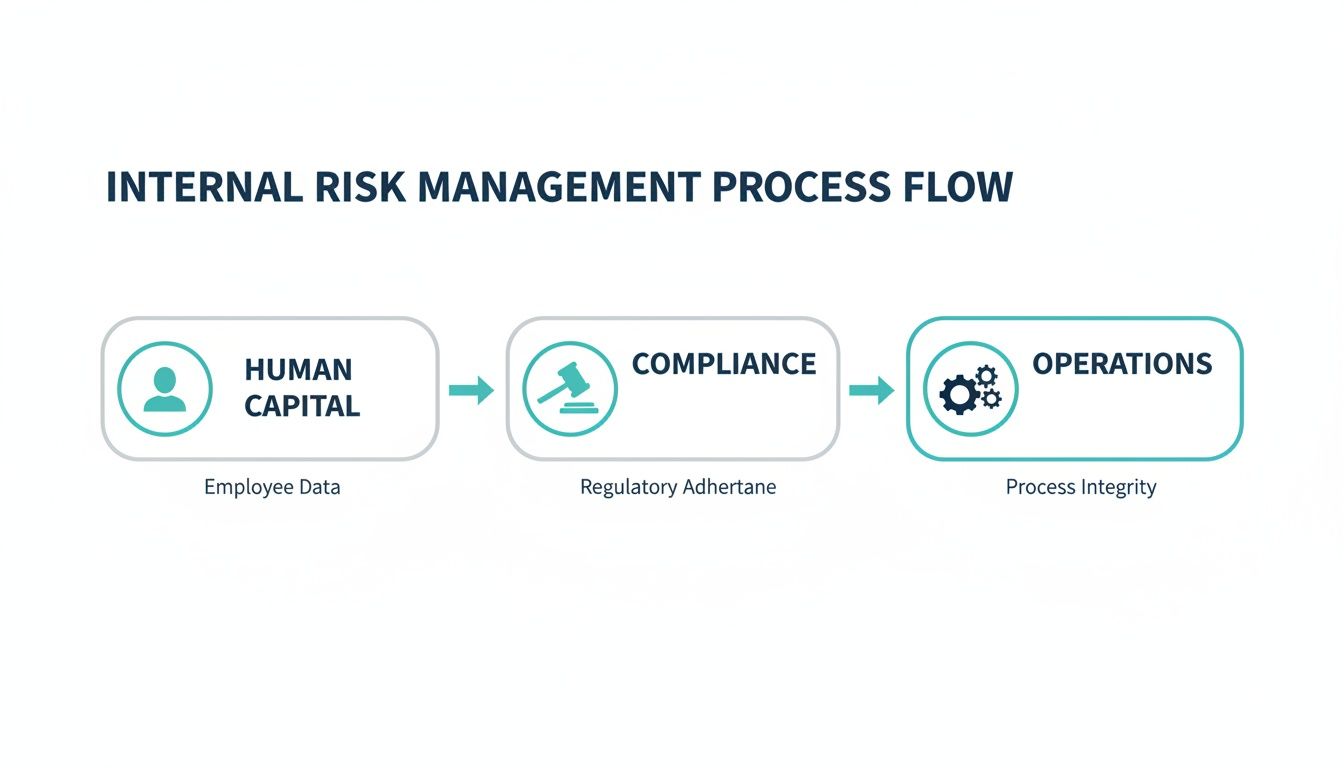
As you can see, a weakness in one area—like a human capital issue—can directly trigger compliance and operational failures down the line. It's a domino effect that highlights the need for early, cross-functional intervention.
Embracing Proactive, Ethical Prevention
The move to a proactive stance is powered by modern tools that can ethically apply AI to spot these structured risk indicators. Let's be clear: this is not about invasive surveillance or monitoring employee communications. Instead, it’s about identifying objective, predefined signals that align with established company policies and regulatory frameworks.
For instance, an ethical AI-driven platform can flag what might be called a "Preventive Risk"—an early signal of concern or uncertainty that warrants a closer look by a human decision-maker. This could be an unusual pattern in system access or a procedural deviation that, while not yet a violation, suggests a potential vulnerability.
The key is that technology's role is to surface these objective signals, not to draw conclusions or make judgments. It empowers the human experts in HR, compliance, and security with timely, traceable insights. This allows them to intervene early, verify the concern through established due process, and fix the root cause before a minor issue blows up into a major crisis.
This method transforms risk management from a discipline of forensic analysis into one of strategic foresight. By giving leaders the ability to see around corners, organizations can protect their assets, uphold their integrity, and build a culture where risks are managed with dignity, transparency, and intelligence.
How to Implement Ethical AI in Risk Management
Let's be honest. The idea of using AI in enterprise and risk management can bring up some uncomfortable images of a "Big Brother" watching over everyone's shoulder. The thought of an algorithm digging into employee behavior is unsettling, and for good reason. But a responsible, modern approach to AI isn't about spying—it’s about setting clear ethical guardrails from the very beginning.
This means the technology has to be ethical by design. You can’t just bolt on compliance features as an afterthought. The entire system must be built on a foundation of respect for human dignity and privacy. This is the only way to ensure the technology is fully aligned with tough regulations like GDPR and CCPA from day one.
Defining Ethical Red Lines
For any AI-driven risk tool to be trusted, it must operate within a strict set of non-negotiable limits. These are the "red lines" that an ethical platform should never, ever cross. They ensure technology serves human oversight, rather than trying to replace it.
A truly ethical system explicitly forbids several dangerous capabilities:
No Lie Detection: The technology must never function as a digital polygraph or try to determine if someone is being truthful.
No Emotional Profiling: AI cannot analyze or make assumptions about an individual's emotional or psychological state.
No AI-Driven Judgments: The system’s only job is to flag objective, predefined signals—not to draw conclusions, determine guilt, or make accusations.
No Covert Surveillance: All data analysis has to be transparent and aligned with company policy and legal frameworks.
The core principle is simple: ethical AI is not a replacement for human investigation but a powerful enhancement to it. It acts as a decision-support system, transforming scattered, subjective observations into traceable, objective signals that ensure due process is always followed.
A Decision-Support System, Not a Judge
This ethical framework is quickly gaining ground as businesses look for ways to build resilience without sacrificing their values. In fact, Forrester's 2025 State of ERM report found that 48% of organizations plan to invest more in data and predictive analytics. This trend aligns perfectly with tools like Logical Commander's Risk-HR module, which flags risks ethically—without judgment or psychological profiling—empowering teams to verify concerns while staying in strict compliance with CCPA and OECD principles.
Instead of delivering a verdict, the AI delivers a structured signal. For example, it might identify a potential conflict of interest based on predefined rules, which then triggers a review by a human compliance officer. The technology provides the "what," but the "why" and "what's next" remain firmly in human hands. You can read more about navigating AI ethics and compliance in HR risk management.
This approach proves that advanced technology and human dignity can and must coexist. For a broader look at AI's role in business, consider this piece on AI in business automation. By building AI on a foundation of clear ethical boundaries, organizations can get ahead of risks proactively while strengthening trust and preserving a respectful workplace culture.
Your ERM Questions, Answered
As the world of enterprise risk continues to evolve, leaders in HR, Compliance, and Security are rightly asking tough questions about how to modernize their approach. Let's dig into some of the most common ones with direct, practical answers that get to the heart of ethical prevention and proactive strategy.
What Is an Enterprise Risk Management Strategy, Really?
Think of an enterprise risk management (ERM) strategy as the central nervous system for your entire organization's risk awareness. It's a structured, top-down approach that connects every department's risk-related activities into one cohesive, intelligent framework.
Instead of letting individual teams manage their own risks in isolated silos—a recipe for massive blind spots—a true ERM strategy integrates everything. It brings traditional risk management, internal controls, and compliance practices under one roof, ensuring every risk-related decision directly supports the company's biggest goals.
How Does ERM Differ from Traditional Risk Management?
Traditional risk management is almost always fragmented and reactive. It usually lives inside specific departments, like finance or IT, and fixates on threats relevant only to that function. This siloed thinking is dangerous because it fails to see how risks connect across the organization, often leaving you vulnerable until it's far too late.
In contrast, enterprise and risk management is holistic and enterprise-wide. It's a proactive and strategic function that gives you a complete picture of all potential threats and opportunities. The point of ERM isn't just to stamp out individual fires; it’s to build genuine organizational resilience and protect the company's long-term value.
What Are the Key Components of an ERM Strategy?
While the terminology might vary between frameworks, any strong ERM strategy is built on five core pillars that work together to create a rock-solid system.
These are the absolute essentials:
Company Culture, Governance, and Values: This all starts with the "tone at the top." It’s about creating a risk-aware environment where ethical behavior isn't just encouraged—it's expected.
Strategic Planning and Goal Setting: Your ERM strategy has to be bolted directly to your business goals. This includes getting brutally honest about your risk appetite—how much risk you're truly willing to accept to achieve those goals.
The Risk Management Cycle: This is the operational engine of ERM. It’s the continuous process of identifying, assessing, responding to, and controlling for risks.
Monitoring and Continuous Improvement: An ERM program is never "done." It has to be a living thing, constantly reviewed and updated to stay ahead of new threats and shifting business priorities.
Transparency, Communication, and Reporting: Clear communication is non-negotiable. It ensures everyone from the front lines to the boardroom is informed about risks and that the program benefits from a constant feedback loop.
What Are the Most Widely Used ERM Frameworks?
Most organizations don't start from scratch. They lean on established frameworks that provide a proven structure, a common language, and a clear methodology for managing risk.
The most common enterprise risk management frameworks you'll see are:
COSO ERM Integrated Framework: Hugely popular in the U.S., this one focuses heavily on integrating ERM with overall strategy and performance, with a strong emphasis on internal controls.
ISO 31000 Risk Management Standard: This is a flexible, principles-based international standard that’s designed to be adapted to any organization, no matter its size or industry.
NIST Risk Management Framework (RMF): If cybersecurity and privacy are your top concerns, this is your go-to. It provides a robust framework for strengthening your information security posture.
COBIT ERM Framework: Developed by ISACA, COBIT is all about IT governance and risk management, helping you align your tech strategy with your business goals.
Of course, some organizations end up creating their own custom ERM frameworks, often borrowing the best pieces from these established models to fit their unique industry or regulatory needs.
How Often Should We Review Our ERM Framework?
Because your company's risk landscape is always in motion, your ERM framework needs to be reviewed at least annually.
But a yearly check-in is just the minimum. You need to conduct more frequent reviews whenever there’s a major shift in your strategy, operations, or the world outside. Things like a merger, a new product launch, or a new regulatory requirement should all trigger an immediate review of your framework.
Regular reviews ensure that your risk registers, mitigation plans, and control activities remain aligned with evolving business objectives and emerging threats. This keeps your ERM program a living, relevant part of your strategy, not a static document that gathers dust.
How Can Technology Support an ERM Strategy?
Modern technology, especially ethical AI, is a complete game-changer for enterprise and risk management. It’s what finally allows organizations to shift from a reactive, defensive posture to a proactive, preventive one by automating and sharpening key processes.
For example, a unified ERM platform can:
Centralize risk information, replacing fragmented spreadsheets with a single source of truth for all risk-related data.
Enable cross-functional collaboration by giving HR, Security, and Compliance teams a shared space to work together on threats.
Automate reporting and monitoring to track key risk indicators (KRIs) in real time, arming leaders with up-to-the-minute dashboards.
Ethically identify early signals of internal risks like misconduct or conflicts of interest, giving you the chance to intervene before real damage occurs.
By handling the heavy lifting on the data side, technology frees up your human experts to focus on what they do best: strategic decision-making, investigation, and mitigation. This makes the entire ERM process smarter, faster, and far more effective.
At Logical Commander Software Ltd., we provide a unified operational platform that helps you shift from reaction to prevention. Our E-Commander system centralizes risk intelligence and enables ethical, proactive risk management without resorting to invasive surveillance. It’s designed to help you know first and act fast, protecting both your organization and your people. Learn more about our proactive approach at Logical Commander.