%20(2)_edited.png)

How to Prevent Employee Theft: Practical Tips for Safer Workplaces

Updated: Jan 14
To stop employee theft, you need a proactive system—one that combines strong internal controls, clear policies, and a positive company culture. It’s about moving away from just reacting to losses and instead designing a workplace where theft is hard to commit and easy to spot. This means tackling the root causes, not just the symptoms.
Understanding the Real Cost of Employee Theft
When business owners think about employee theft, their minds usually jump straight to missing cash or stolen inventory. And while those are definitely serious problems, the true damage cuts much deeper. Employee theft isn't just a financial drain; it's a corrosive force that shatters trust, crushes team morale, and can permanently tarnish your company's reputation.
A lot of organizations make the mistake of treating theft as an isolated incident, blaming it all on one "bad apple." This reactive mindset is a critical error. In reality, internal theft is often a systemic issue that shines a spotlight on major weaknesses in your operational foundation. Vague policies, a lack of real oversight, and shoddy internal controls are what create the opportunities that dishonest employees exploit.
Beyond Missing Cash and Inventory
Thinking that theft is limited to physical goods is a dangerously narrow view. The modern workplace has countless avenues for misconduct, and many of them are far less obvious than an empty cash register but just as damaging.
Time Theft: This one is incredibly common. It includes everything from fudging timesheets and taking excessively long breaks to running a side hustle on company time. It quietly inflates your labor costs and tanks productivity.
Data and Intellectual Property Theft: An employee could walk out the door with customer lists, proprietary software code, or confidential business strategies to sell to a competitor. The long-term competitive damage from this can be devastating.
Fraudulent Disbursements: This is where employees manipulate the system to funnel company money to themselves, whether by creating fake invoices, padding expense reports, or messing with payroll records.
"Sweethearting": This is a subtle but costly practice where an employee gives unauthorized freebies or massive discounts to friends and family, hitting your bottom line directly with every transaction.
The data paints a stark picture of just how big this problem is, highlighting the staggering annual losses and the sheer number of businesses affected.
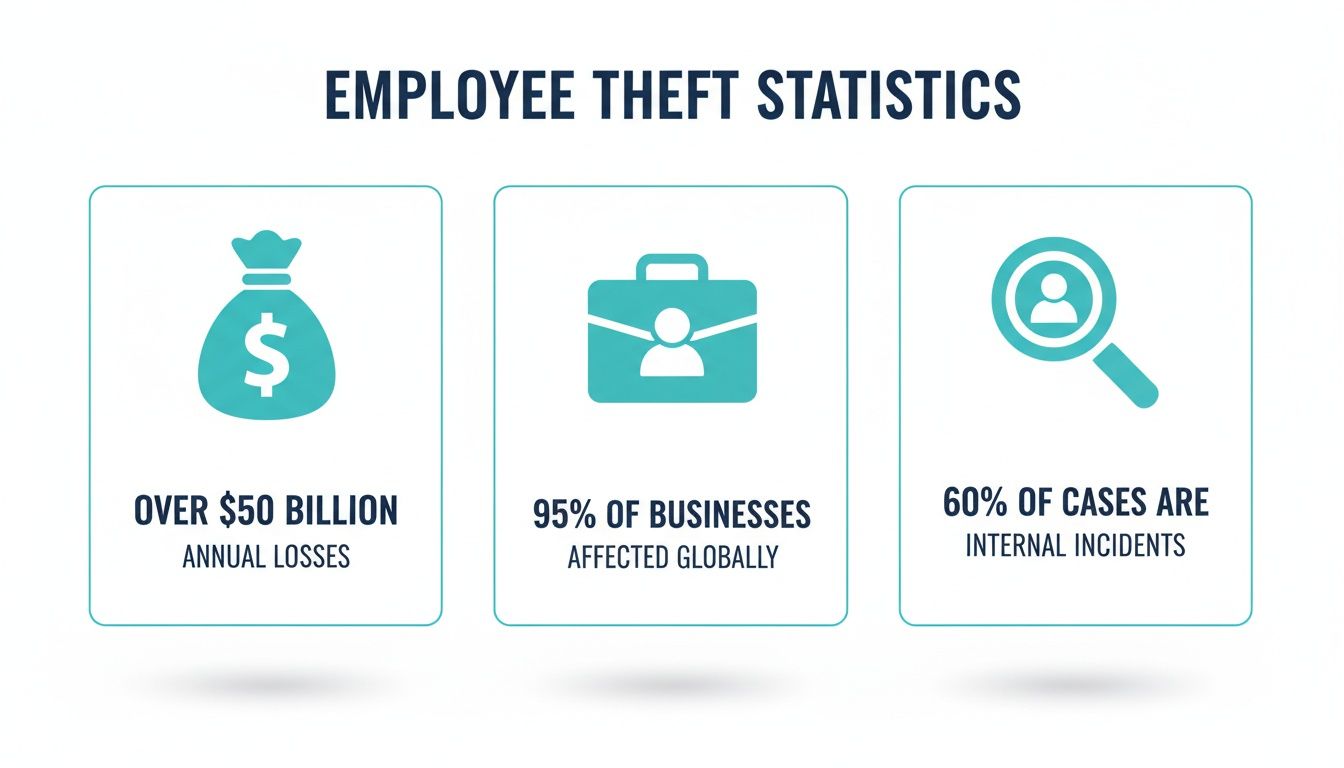
These statistics aren't just numbers; they're a clear signal that employee theft is a widespread and incredibly expensive issue. It underscores why having strong internal controls is far more effective than just reacting after the fact.
A Systemic Problem Demands a Systemic Solution
The numbers make it crystal clear: employee theft is fundamentally an internal-controls problem, not a series of isolated moral failings. Certified fraud examiners estimate that over 95% of businesses are hit by employee theft, with annual losses soaring to around $50 billion in the United States alone. On top of that, studies have shown that internal incidents account for roughly 60% of all inventory losses in certain sectors.
The table below breaks down some of the most common types of theft and their real-world consequences.
Common Types of Employee Theft and Their Impact
Type of Theft | Real-World Examples | Business Impact |
|---|---|---|
Cash Theft | Skimming from the register, stealing from deposits, creating fraudulent refunds. | Immediate financial loss, inaccurate accounting records, damaged customer trust. |
Inventory Theft | Stealing merchandise for personal use or resale, falsifying inventory counts. | Reduced profit margins, stock shortages, operational disruptions, unhappy customers. |
Data & IP Theft | Copying customer databases, trade secrets, or proprietary software. | Loss of competitive advantage, legal liability, severe reputational damage. |
Expense Reimbursement Fraud | Submitting fake receipts, inflating mileage claims, claiming personal expenses. | Increased operational costs, erosion of internal trust, financial statement inaccuracies. |
Payroll Fraud | Creating "ghost" employees, falsifying hours worked, inflating commission payouts. | Direct financial drain, compliance risks, significant damage to employee morale. |
These examples show just how varied and damaging internal theft can be, affecting every corner of the business from finance to team culture.
By framing the issue correctly, you can shift from a reactive, punitive mindset to a proactive, preventive strategy. This is about building a resilient organization from the ground up, where clear policies and an ethical culture are your first and best lines of defense. After all, as we've seen time and again, the true cost of reactive investigations often spirals far beyond the initial loss, making prevention the only financially sound approach.
Building Your First Line of Defense with Clear Policies

Your most powerful tool in the fight against internal theft isn't a high-tech camera system or a complex security setup. It starts with something far more fundamental: clear, consistent, and well-communicated company policies.
These documents are the absolute bedrock of your prevention strategy. They create a framework of expectations that leaves zero room for ambiguity. Without a strong policy foundation, every other control you implement is built on shaky ground. When rules are vague, employees are forced to interpret them, creating gray areas that can be easily exploited.
Crafting a Watertight Code of Conduct
The centerpiece of your policy framework has to be a comprehensive code of conduct. This isn't just some legal formality to be signed and forgotten; it's a living document that defines your company's ethical compass. It needs to explicitly outline what constitutes theft, fraud, and misconduct in plain, simple language.
Avoid generic, boilerplate text you pull off the internet. Your code of conduct must address the specific risks your business faces. If you run a retail store, it should detail procedures for handling cash and merchandise. If you're a tech company, it must cover the protection of data and intellectual property.
To make your code of conduct truly effective, it has to:
Define theft broadly. Go way beyond the obvious. Include examples of time theft (falsifying hours), data theft (copying client lists), "sweethearting" (giving unauthorized discounts to friends), and misusing company assets for personal gain.
Establish clear consequences. State the exact disciplinary actions for policy violations, which can range from a formal warning to immediate termination and legal action. This clarity is a powerful deterrent.
Be accessible. Your policies can't be buried in a forgotten corner of the company server. Make them easy to find in an employee handbook or a shared internal portal that everyone can access.
A policy that isn't communicated is just a piece of paper. The goal is to create a culture where every team member understands the rules, knows why they exist, and sees that they are applied fairly and consistently to everyone—no exceptions.
Developing Specific Operational Policies
Beyond a general code of conduct, you need specific, actionable policies for the high-risk areas of your business. These procedural documents turn your broad ethical guidelines into day-to-day operational rules. Think of them as the practical instructions that give your prevention efforts real teeth.
Vague procedures are an open invitation for trouble. For example, a policy that simply says "all expenses must be approved" is weak and useless. A strong policy would state, "All expense reports over $100 require dual sign-off from the employee's direct manager and a member of the finance department before reimbursement." See the difference? It's all about specificity.
Key areas requiring dedicated policies include:
Cash Handling: Detail every step for opening and closing registers, making bank deposits, and managing petty cash. A great rule is to mandate that two employees are present during cash counts to create instant accountability.
Inventory Management: Outline the process for receiving goods, conducting cycle counts, and handling returns or damaged stock. This helps you quickly spot discrepancies that could signal theft.
Expense and Reimbursement: Create strict rules for submitting expenses. Require original itemized receipts (no credit card slips!) and clearly define what constitutes a legitimate business expense.
I once worked with a company that had a loose vendor payment process. An accounts payable clerk realized they could create a fake invoice from a non-existent company, approve it themselves, and cut a check. This went on for months, costing the company tens of thousands of dollars before an external audit finally caught it.
A simple policy requiring a different person to approve invoices than the one who processes payments—a core principle known as segregation of duties—would have stopped this fraud in its tracks. This is a critical lesson in how a small gap in policy can lead to a significant financial loss, and it's a perfect example of how to prevent employee theft before it ever starts.
It’s easy to think that stopping theft is about creating a fortress, but that’s rarely the case. Real prevention is about designing a workplace where misconduct is hard to pull off and even harder to hide. Strong policies are your foundation, but the real structural support comes from smart internal controls.
These aren't complicated theories; they're practical, everyday procedures that dial down temptation and dial up accountability, making your workplace a much less appealing target for theft.
At the very heart of this is the principle of segregation of duties. It’s a simple concept: no single person should ever control every step of a critical financial process. When one employee can initiate, approve, and record a transaction, you’ve basically left the vault door wide open. Splitting up these responsibilities creates a natural system of checks and balances where team members unknowingly audit each other’s work.
The Power of Separating Key Duties
Let's look at your accounts payable process. Imagine the same person who adds new vendors to your system can also approve their invoices and cut the checks. What's stopping them from creating a shell company, submitting fake invoices, and paying themselves? This isn't a far-fetched movie plot; it’s a classic fraud scenario that plays out more often than you'd think.
Here’s a simple way to segregate those duties and slam that door shut:
Role 1 (AP Clerk): Enters new vendors and processes incoming invoices.
Role 2 (Department Head): Reviews and approves invoices for their team, confirming the company actually received the goods or services.
Role 3 (Finance Manager): Gives the final sign-off for payment after checking the approvals.
This setup makes it incredibly difficult for one person to game the system alone. No single employee has enough control to run a fraudulent scheme, and that alone is a powerful deterrent.
Bolstering Physical and Digital Defenses
Your controls can't stop at financial processes. They need to cover every company asset, both physical and digital. Access controls are all about making sure employees can only get to the areas, information, and systems they absolutely need to do their jobs—and nothing more.
On the physical side, this goes way beyond locking the main door at night. For businesses serious about securing their assets, professional solutions like advanced locks and keycard systems are a must. You might consider bringing in experts in specialized commercial locksmith services to install keycard access for high-value areas like your server room or inventory stockroom. This doesn't just restrict access; it creates a digital trail telling you exactly who went where and when.
Digitally, these controls are even more crucial. You need to operate on a principle of least privilege, meaning every employee gets the absolute minimum level of system access required for their role. A marketing assistant, for example, should have zero reason to access detailed payroll records. Things like strong password policies, mandatory multi-factor authentication, and regular audits of user access rights aren’t just best practices—they’re non-negotiable.
One of the most effective yet overlooked internal controls is a mandatory vacation policy. Forcing employees in sensitive roles to take at least one full, consecutive week off each year means someone else has to step in and handle their duties. This simple cross-training exercise is incredibly powerful for uncovering fraud schemes that depend on the original employee's constant presence to cover their tracks.
A quick check-up can reveal gaps you can patch up right away.
Internal Controls Quick Audit Checklist
Control Area | Key Question to Ask | Action if "No" |
|---|---|---|
Segregation of Duties | Is the person handling cash deposits different from the one reconciling bank statements? | Assign these tasks to separate people immediately. |
Access Controls | Are former employees' system and physical access credentials revoked on their last day? | Create a formal offboarding checklist so this is never missed. |
Transaction Monitoring | Do all expense reports over a certain amount (like $200) need a manager's signature? | Set up a multi-level approval workflow for all expenses. |
Inventory Management | Do you perform regular, unannounced spot-checks of inventory? | Schedule and conduct random inventory counts to verify your records. |
Implementing these controls isn't about micromanaging people or breeding distrust. It's about creating a fair, transparent, and secure environment that protects your honest employees and deters anyone who might be tempted. It sends a clear message that your organization takes integrity and accountability seriously.
Fostering a Culture of Trust and Integrity

While strong policies and internal controls are essential, they don't operate in a vacuum. Your most powerful and sustainable shield against internal theft is a positive work environment built on a foundation of trust and mutual respect.
When employees feel valued, fairly compensated, and connected to the company's mission, the motivation for misconduct plummets. A sense of being treated unfairly—or like just another cog in the machine—is a huge driver of dishonest behavior. Focusing on the human side of your organization isn't just a nice-to-have; it's a core prevention strategy.
This cultural defense doesn't start on an employee's first day. It begins with a thoughtful hiring process designed to bring in people who genuinely align with your company's values.
Hiring for Honesty and Integrity
Bringing the right people on board is your first and best chance to mitigate risk. A rushed hiring process that cuts corners on vetting can inject serious vulnerabilities straight into your business.
A well-structured hiring protocol should always include:
Compliant Background Checks: This is non-negotiable for any role with access to financial data, inventory, or sensitive information. Make sure your process is fully compliant with all federal and state regulations, like the Fair Credit Reporting Act (FCRA).
Thorough Reference Verification: Don’t just confirm dates of employment. Ask previous managers specific questions about the candidate’s reliability, work ethic, and integrity. You’d be amazed at what you can learn from a short, professional conversation.
This initial screening isn’t about assuming the worst. It’s about doing your due diligence to protect your team, your assets, and the very culture you’re trying to build. A single dishonest employee can unravel years of hard work.
Training That Builds an Ethical Mindset
Once you've hired the right people, ongoing training is critical for reinforcing your ethical standards. This is about far more than having new hires sign a policy document during onboarding. Effective training brings your code of conduct to life.
Use real-world scenarios to show what constitutes theft—from obvious examples like taking cash to more subtle forms like "time theft." Shockingly, one recent study revealed that 67% of employees admitted to some form of workplace theft, with misusing company time being the most common. These are losses that cameras will never catch, which underscores the need for a culture-first approach over invasive surveillance.
Building a strong ethical foundation is not a one-time event; it's a continuous process. True integrity becomes part of your company's DNA when ethical behavior is consistently discussed, modeled by leadership, and celebrated as a core component of success.
Your training must also clearly outline how employees can report concerns. People need to know there's a safe, confidential, and anonymous way to speak up without fearing retaliation. An open-door policy or a dedicated whistleblower hotline can be invaluable for uncovering issues before they escalate. You can learn more about how to calculate the cultural ROI of integrity in our detailed guide.
The Manager’s Role in Spotting Distress Signals
Managers are on the front lines of your cultural defense. They are in the perfect position to spot the early warning signs of employee distress that can sometimes precede dishonest acts.
Sudden changes in behavior, signs of financial hardship, or clear disengagement can all be indicators that an employee is under pressure. A supportive manager who regularly checks in with their team and offers resources like employee assistance programs (EAPs) can often intervene positively before someone makes a desperate and damaging choice.
This proactive, empathetic approach is the essence of a healthy culture. It turns the workplace from a place of suspicion into one of support, making it the most effective long-term strategy for preventing employee theft.
Using Technology to Proactively Identify Risks

Let's be clear: modern prevention isn't about watching your employees' every move. The old way of thinking—heavy-handed surveillance—is a dead end. It’s about making a strategic shift, moving away from reactive measures and toward spotting risks before they blow up into full-blown incidents.
The real game-changer is understanding the massive difference between intrusive monitoring and ethical risk detection. Invasive surveillance, like reading private emails or tracking keystrokes, is a fantastic way to destroy morale and cultivate a culture of deep distrust. Ethical risk detection is the polar opposite. It’s about connecting objective data points from different systems to flag situations that just don’t line up with your policies and normal operations.
Moving Beyond Surveillance to Ethical Risk Signals
Ethical risk detection platforms work by pulling together data from your existing operational systems—think HR, access control, finance, and IT—to spot specific risk indicators. These aren't judgments or accusations. They're factual, auditable events that, when pieced together, might point to a weak spot in your internal controls or a potential integrity problem.
This approach is built on a foundation of respect. It preserves employee privacy and dignity because it analyzes patterns of behavior, not the content of their conversations. It’s all about the "what," "when," and "where," never the "why."
Here are a few real-world examples of the kind of risk indicators these platforms can surface:
Unusual Access Patterns: An employee in the accounting department makes repeated attempts to access secure files on the engineering server, all happening late at night.
Policy Violations: A manager signs off on an expense report for one of their direct reports that is way over the company's stated policy limits.
Segregation of Duties Conflicts: The very same user who creates a brand-new vendor in the payment system is also the one who approves that same vendor's first invoice.
Taken alone, any one of these might just be an honest mistake. But when a system flags several related indicators for the same person in a short time frame, it gives leadership a factual basis to start a fair, structured review. You’re no longer acting on a hunch or office gossip. This is the core idea behind how technological innovation revolutionizes internal and psychosocial risk prevention, which shifts the goal from finding blame to fixing the system.
The objective is not to catch people doing wrong, but to find and fix the procedural gaps that make misconduct possible in the first place. This technology acts as a support tool for human oversight, ensuring any follow-up is based on documented evidence, not suspicion.
How Risk Detection Platforms Support Human Oversight
These platforms are not automated judges. They don't make decisions or jump to conclusions about an employee's intent. Think of them as a highly sophisticated early-warning system that turns scattered, messy data points into structured, actionable insights for your HR, compliance, and security teams.
A key piece of preventing modern employee theft involves solid processes for protecting sensitive information. That means carefully implementing secure data destruction practices for old hardware to stop data from walking out the door. In the same way, risk detection platforms help secure your digital assets by flagging risky behaviors before they turn into a data breach.
By bringing all this risk intelligence into one place, these tools ensure that any follow-up is handled consistently and in full compliance with company policy and legal standards. They create a documented, auditable trail that supports a fair process for everyone involved—a massive leap forward from disorganized investigations cobbled together with spreadsheets and hearsay.
Ultimately, this approach to preventing employee theft reinforces a culture of integrity. It shows your team that the organization is committed to transparent processes and objective risk management, not arbitrary enforcement.
Responding to Suspected Employee Theft
That gut-wrenching moment you suspect an employee is stealing from you is a critical turning point. If you react with emotion, you could torpedo your own case, violate that person’s rights, and walk your business straight into a lawsuit. But if you ignore the red flags, you’re letting a small fire grow into a blaze that could cause devastating losses.
Handling this demands a cool head and a clear plan. Your first instinct might be to confront the person on the spot—don't. Unproven accusations are a fast track to a defamation claim. Instead, the goal is to launch a structured, discreet, and fair investigation to get the facts. This isn't about playing detective; it's about following a process that protects everyone involved, including the company.
Assemble Your Response Team
Trying to handle a theft investigation on your own is one of the most common—and costly—mistakes a manager can make. You absolutely need a multi-disciplinary team to make sure every angle is covered, from legal compliance to internal policy.
Your core team should always include:
Human Resources (HR): HR professionals know how to navigate these sensitive issues. They ensure the investigation is fair, consistent with company policy, and respects the employee's rights.
Legal Counsel: Get your attorney involved from the very beginning. They can advise on legal risks, help you preserve evidence correctly, and make sure your actions don't create liability for wrongful termination.
A Senior Manager or Business Owner: Leadership needs to be in the loop to authorize the investigation and make the final call based on what you find.
This team creates a crucial system of checks and balances. It stops any one person from acting on bias or incomplete information and establishes a formal, defensible process right from the start.
Gather Evidence the Right Way
With your team in place, the focus turns to collecting evidence. The absolute key here is to gather information without violating the employee’s reasonable expectation of privacy. Stick to company-owned assets and data.
For example, you’re generally on safe ground reviewing company computer logs, security footage from common areas, or financial records. But searching an employee’s personal bag or listening to their private phone calls would almost certainly cross a legal line.
Look for objective proof in places like:
Financial Records: Are there an unusual number of voided sales or refunds being processed by one specific employee? Financial exception reports are built to spotlight these anomalies quickly.
Inventory Reports: When inventory records don’t match what’s physically on the shelf, it can point directly to missing products.
Access Logs: Digital and physical access logs can place an employee in a restricted area at an unusual time, providing a key piece of the puzzle.
Surveillance Footage: Video can be incredibly powerful, but you have to handle it carefully. Make sure your use of cameras is fully compliant with local laws and your own written policies.
Your entire investigation has to be built on a foundation of documented facts, not gut feelings or assumptions. Every piece of evidence, every interview, every step you take needs to be logged and recorded. This meticulous paper trail is your best defense if your actions are ever questioned.
Conduct the Investigative Interview
Once you have enough evidence, you'll likely need to sit down with the employee. This is the most delicate step in the entire process. It should be handled by an experienced HR professional, with another manager present as a witness.
The goal isn't to corner someone into a confession. It’s to present the facts you've found and give the employee a fair chance to explain what’s going on.
A few ground rules for a successful interview:
Plan the Meeting: Choose a private, neutral space. Have all your documentation organized and ready to go before the employee walks in.
Stay Calm and Factual: Present the facts without making accusations. Instead of, "You stole cash from the register," try something like, "We've seen a pattern of voided cash transactions on your shifts and we'd like to understand why that's happening."
Listen More Than You Talk: Give the person a real opportunity to respond without cutting them off. Their explanation—or their silence—is a critical piece of information.
Document Everything: The witness should be taking detailed notes of the entire conversation, including the specific questions you asked and the employee’s exact answers.
Based on the evidence and the interview, your response team can then make an informed decision. The outcome could be anything from more training—if it was an honest mistake—to disciplinary action, termination, or even getting law enforcement involved for serious crimes. By following a structured and fair process, you can prevent a bad situation from becoming a legal and reputational nightmare.
At Logical Commander Software Ltd., we believe in preventing internal risks before they cause harm. Our E-Commander platform provides a unified operational backbone to centralize risk intelligence and manage investigations ethically and efficiently, turning scattered data into structured, actionable insight without invasive surveillance. Know First, Act Fast with Logical Commander.