%20(2)_edited.png)

A Guide to Pre Employment Behavioral Assessments for Proactive Risk Management

You can learn a lot from a resume—credentials, past titles, technical skills. But what it can't tell you is how a candidate will act when facing real-world business pressure. This critical gap is where pre employment behavioral assessments are supposed to help. They are tools designed to look past the CV to get a sense of a candidate’s behavioral tendencies, problem-solving style, and potential risk factors to prevent costly hiring mistakes.
However, traditional assessments are failing, creating a false sense of security for the very organizations they aim to protect.
Understanding Pre Employment Behavioral Assessments

At their core, these assessments try to answer the one question a resume never can: How will this person actually behave once they’re part of our team? They shift the focus from what a candidate knows to how they are likely to act, gauging inherent tendencies and work styles.
These tools have become popular as companies grapple with the staggering cost of a bad hire. Making the wrong choice can cost a business up to 30% of that employee's first-year salary, a figure that puts immense pressure on HR, Compliance, and Risk teams to prevent human-factor risk from entering the organization.
Why Businesses Rely on Behavioral Assessments
For teams in Compliance, Risk, and Security, the use of these assessments goes far beyond finding a "good fit." It's a strategic attempt to prevent internal threats and mitigate human-factor risk from day one.
The primary goals are to:
Mitigate Human-Factor Risk: Flag candidates who might pose a higher risk for misconduct, fraud, or compliance breaches before an offer is ever made.
Predict Job Performance: Measure traits like conscientiousness and resilience, which are often better predictors of long-term success than technical skills alone.
Protect Corporate Culture: Ensure new hires align with the company’s ethical standards, reducing internal friction and turnover.
Improve Hiring Defensibility: Add objective-looking data to the hiring process to minimize the impact of unconscious bias and support more defensible decisions.
To help visualize this, the table below connects the behavioral traits these assessments measure to their direct business impact.
Key Assessment Areas vs Business Impact
Behavioral Trait Assessed | Potential Business Liability If Lacking | Positive Business Impact |
|---|---|---|
Integrity & Conscientiousness | Higher likelihood of internal fraud, data theft, or unethical conduct. | Strengthens a culture of compliance and reduces operational risk. |
Adherence to Procedure | Missed deadlines, inconsistent work quality, and poor attention to detail. | Drives reliable performance, project completion, and high-quality work. |
Resilience & Stress Tolerance | Increased burnout, high turnover, and poor decision-making under pressure. | Fosters a stable, adaptive workforce that can navigate challenges effectively. |
Teamwork & Collaboration | Departmental silos, internal friction, and difficulty achieving shared goals. | Enhances team cohesion, innovation, and cross-functional productivity. |
Problem-Solving Ability | Over-reliance on management, inability to adapt, and slow response to issues. | Promotes an autonomous and proactive workforce capable of solving challenges. |
By mapping these traits to real-world outcomes, it's clear that pre employment behavioral assessments are not just an HR tool—they are a core component of a proactive internal risk management strategy.
The ultimate goal is to build a more resilient and secure workforce from the ground up. By evaluating behavioral indicators early, organizations can proactively reduce their exposure to preventable internal risks that often originate with a single hire.
However, the traditional approach is full of holes. Many popular tools lack real predictive power or, worse, stray into legally dangerous territory by functioning as prohibited lie detectors. While some personality frameworks can be useful for team building, as this guide on the Enneagram test for business shows, their application in high-stakes hiring decisions is highly problematic.
This sets the stage for a critical discussion on the legal and ethical lines that modern organizations must navigate. It also highlights the urgent need for a new standard—a non-intrusive, EPPA-aligned way to manage human-factor risk from the very beginning. For a deeper dive, read more here: A Guide to Modern Behavioral Assessments for Risk Management.
Navigating the Legal Landscape of Hiring Assessments

Rolling out pre employment behavioral assessments without a rock-solid grasp of the legal framework is like navigating a minefield blindfolded. For leaders in HR, Risk, and Legal, compliance isn't just a box to tick—it's the bedrock of a defensible and ethical hiring strategy. Just one misstep can trigger costly litigation, regulatory fines, and lasting damage to your corporate reputation.
The terrain is governed by several key regulations, but none is more critical here than the Employee Polygraph Protection Act (EPPA). This federal law draws a firm line in the sand, and its implications reach far beyond old-school polygraph machines, directly impacting many modern AI tools.
The Long Reach of EPPA Compliance
The EPPA flat-out prohibits most private employers from using any kind of lie detector test for pre-employment screening or during employment. This is precisely where many of today's AI-driven assessment tools expose their clients to serious legal jeopardy.
The law's definition of a "lie detector" is deliberately broad. It covers any device or method that tries to render a diagnostic opinion on an individual's honesty.
This includes tools that rely on:
Voice stress analysis to infer deception.
Psychological pressure through questioning to force certain responses.
Physiological measurements like heart rate or micro-expressions to guess at truthfulness.
Any assessment vendor whose tech functions like a lie detector—no matter how sophisticated the AI—is putting your organization at direct risk of violating federal law. Choosing a platform that isn't explicitly EPPA-aligned exposes your company to massive liability, turning a well-intentioned risk prevention tool into a legal and financial hazard. You can dive deeper in our guide to EPPA compliance and its modern implications.
Choosing an assessment partner is a critical risk decision. A vendor's failure to adhere to EPPA standards becomes your organization's liability, making due diligence on compliance an absolute necessity for protecting the business.
Beyond EPPA: EEOC and Data Privacy Concerns
While EPPA is a major hurdle, it's not the only one. The Equal Employment Opportunity Commission (EEOC) has strict guidelines to prevent discriminatory hiring. Any assessment you deploy must be validated for the specific job role and must not create an "adverse impact" on protected groups.
If a test disproportionately screens out candidates based on race, gender, age, or another protected characteristic—without being a proven predictor of job performance—it can spark an EEOC investigation. This means your Legal and HR teams must be ready to defend the business necessity and validity of every single tool you use.
On top of that, data privacy laws add another layer of complexity. Depending on your jurisdiction, rules like GDPR or CCPA dictate how you collect, store, and process candidate data. Transparency is non-negotiable.
The Foundation of an Ethical Risk Prevention Strategy
Navigating these rules demands a strategic mindset. Legal compliance isn't a roadblock; it is the guardrails that keep your hiring process fair, ethical, and defensible. Understanding the full scope of regulatory compliance is vital for any business implementing new hiring technologies.
The key is to partner with providers who build their platforms on a foundation of ethical, non-intrusive principles. A truly compliant approach, like the one taken by Logical Commander, steers clear of anything resembling lie detection or psychological evaluation. Instead, it focuses on identifying risk indicators through ethical, AI-driven analysis that respects candidate dignity and adheres to the letter of the law—protecting your organization from preventable internal threats.
The Evolution of Assessments: From Personality Quizzes to AI Human Risk Mitigation
The world of pre-employment behavioral assessments has been on a long journey, one that tracks a massive shift in how businesses approach internal risk. For decades, the goal was simply to get a read on a candidate's personality. Companies leaned heavily on traditional psychometric tests to figure out if someone was a good fit.
Think of those classic personality frameworks. They were designed to give hiring managers a standardized snapshot of a candidate, adding a layer of data a resume couldn't capture. It was a step up from gut-feel hiring, but those old-school methods have serious limitations.
They only capture a person's self-perception and are notoriously easy to game with socially desirable answers. More importantly, they were never built to spot the subtle indicators of human-factor risk that keep modern Security and Compliance leaders up at night. They are fundamentally reactive tools, not proactive risk prevention instruments.
The Rise of AI in Human Risk Assessments
Artificial Intelligence was supposed to change everything. AI promised to analyze data at scale, spot patterns humans would miss, and deliver predictive insights. This tech wave has reshaped risk management, creating incredible opportunities and dangerous new traps for companies that aren't paying attention.
The first wave of AI hiring tools focused on speed. They could screen resumes in minutes or analyze video interviews. But that efficiency often came at a steep price.
Many of these systems are "black boxes." You feed data in, a recommendation comes out, and you have zero visibility into how the AI made its decision. This lack of transparency is a breeding ground for unintended bias and, worse, it can lead you straight into a legal minefield.
The core danger of a black-box AI is that it can easily become a prohibited tool under the EPPA. If an algorithm is analyzing voice stress or micro-expressions, it's effectively acting as a lie detector—creating massive liability for the employer. This is a common failure of many so-called "innovative" vendors.
Navigating the Promises and Perils of AI
The pull of advanced analytics is strong. The latest hiring trends reveal a pivot toward AI-powered tools that claim to measure complex traits, as noted in the latest hiring trends on AssessCandidates.com.
This brings us to a critical crossroads. The promise of AI is a more nuanced understanding of human-factor risk. The peril lies in platforms that blatantly cross legal and ethical lines. An AI tool that claims it can detect deception or perform a psychological evaluation isn't just risky—it's a direct violation of EPPA regulations. These platforms expose companies to severe penalties and reputational damage.
The New Standard: Ethical AI Human Risk Mitigation
The only viable path forward is one that uses AI's power while staying firmly within legal and ethical guardrails. This is where a new standard of AI human risk mitigation becomes non-negotiable. Real innovation isn’t about building a digital polygraph; it's about creating transparent, non-intrusive systems that identify behavioral risk indicators without violating the law or human dignity.
A compliant and effective platform like Logical Commander uses AI not to scrutinize people, but to ethically analyze contextual data. It focuses on spotting the precursors to misconduct and internal threats in a way that is 100% aligned with EPPA and dedicated to proactive prevention. To see this new standard in action, check out our guide on how to implement AI-powered human risk management.
This evolution—from basic psychometrics to ethical AI—marks a fundamental change. The goal is no longer just to screen candidates. It’s to build a more secure and resilient organization from day one, ensuring that technology serves your governance and compliance goals, rather than undermining them.
The Hidden Dangers of Traditional Pre Employment Behavioral Assessments
Plenty of organizations use pre employment behavioral assessments with the best of intentions, believing they are adding an objective, data-driven layer to hiring. But that confidence is often dangerously misplaced. Traditional assessments are riddled with blind spots, creating a false sense of security for Risk, Compliance, and HR leaders.
These tools promise to predict behavior, but their design can't deliver. The problem is simple: they offer a static, one-time snapshot of a candidate under ideal conditions. It's not a real picture of how they'll behave under pressure or when faced with a tough ethical choice months or years later. This single-point-in-time approach is a huge vulnerability in any serious internal risk program.
The Illusion of a Perfect Candidate
One of the biggest flaws with conventional assessments is how easy they are to "game." Smart candidates know what a hiring manager wants to hear and can easily select socially desirable answers to paint a perfect picture of themselves.
This creates a veneer of reliability that crumbles under real-world pressure. An assessment might flag a candidate as having high integrity, but that's based on self-reported answers during a high-stakes hiring process. It completely ignores the reality of human behavior, which is constantly shaped by workplace stress, personal issues, and shifting motivations.
A clean pre-hire assessment is not a permanent certification of good character. It is a single, easily manipulated data point that offers no insight into future behavior, leaving your organization completely exposed to risks that develop after onboarding. This is the failure of reactive forensics.
Inherent Biases and Predictive Failures
Beyond candidate manipulation, many traditional assessments carry their own built-in biases. Some are culturally skewed, putting applicants from different backgrounds at an unfair disadvantage. Others are built on outdated psychological models with little proven connection to actual job performance or counterproductive on-the-job behaviors.
Even well-regarded personality tests have very limited predictive power on their own. Studies show that while a trait like conscientiousness might have some link to job performance, it's a weak predictor of specific internal threats like fraud or data theft.
This leads to a critical breakdown:
False Positives: You screen out potentially great candidates because of results that have no real bearing on their ability to do the job ethically and well.
False Negatives: Even worse, individuals who pose a genuine risk can sail through. They come armed with a "validated" profile that lulls the organization into a state of complacency, making the inevitable incident even more damaging.
The Static Snapshot in a Dynamic World
Ultimately, the greatest danger in relying on traditional pre employment behavioral assessments is their static nature. Internal threats aren't static—they evolve over the entire employee lifecycle. An employee who is a model of integrity in their first year might face a personal crisis in year three, creating new risk factors that a pre-hire screening could never have predicted.
This is the central failure of a checklist approach to hiring. It treats human-factor risk as a one-time problem to be solved at the front door, not as a continuous condition that requires proactive management. This reactive mindset leaves organizations totally vulnerable, forcing them to wait for an incident to occur before they can act. Moving to a proactive, continuous framework is the only way to protect the business from the inside out.
Moving Beyond Screening to Proactive Risk Prevention
Relying only on pre employment behavioral assessments is a reactive, incomplete strategy for managing human-factor risk that provides a dangerous illusion of security. The insights from a single assessment start to fade the moment a candidate becomes an employee, leaving your organization blind to the dynamic risks that emerge over time.
The fundamental mistake is treating risk as a problem you solve once at the hiring stage. The new standard for internal risk management shifts the focus from a single decision to continuous, proactive, and ethical risk prevention across the entire employee lifecycle. This isn't about more screening; it's about building a resilient organization that can ethically identify and mitigate human-factor risks before they escalate into costly incidents.
This diagram shows the key blind spots that traditional assessments create, leading to a false sense of security for risk and HR leaders.
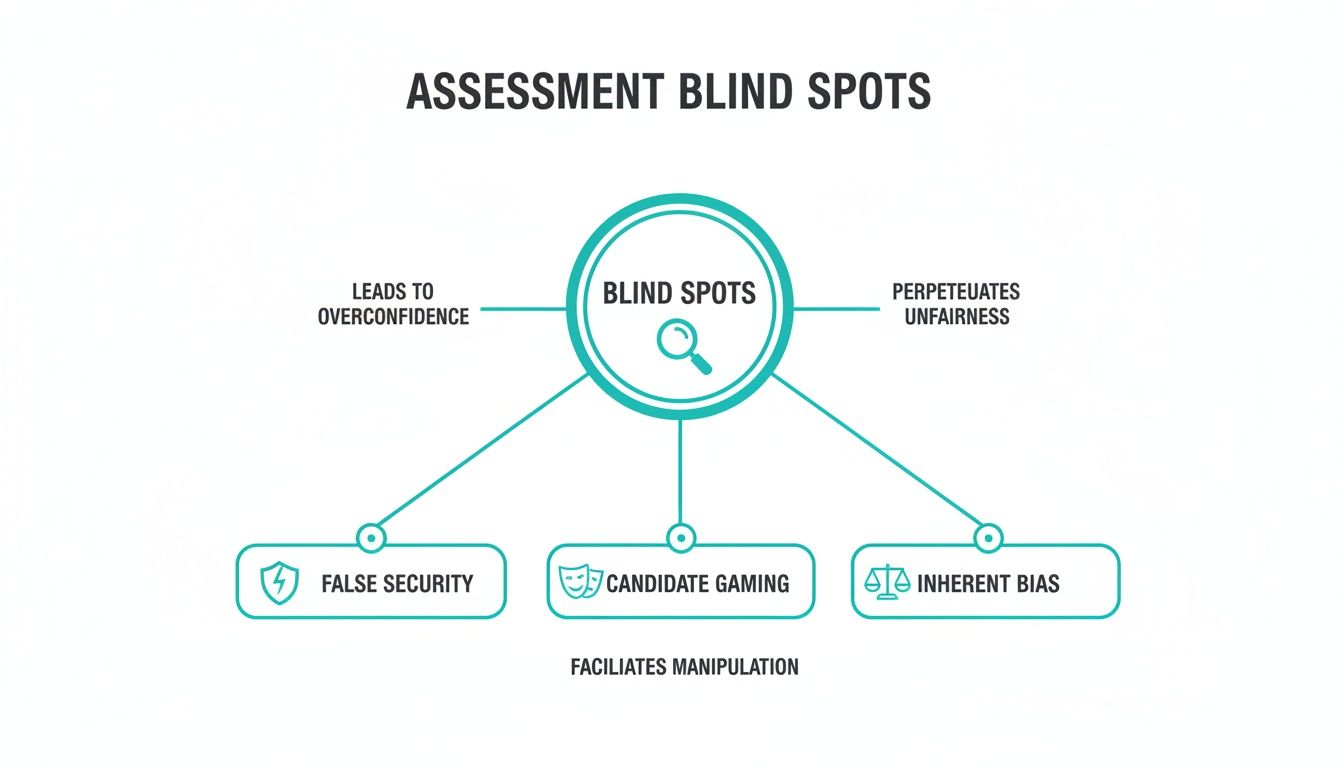
As the visualization highlights, an over-reliance on these tools leads to flawed decision-making. The issues are baked right in, from candidate manipulation and inherent bias to a complete failure to predict how someone will actually behave under real-world pressure, leaving the door open to internal threats.
Introducing a New Standard in Ethical Risk Management
To truly protect your organization, you must move beyond the limitations of pre-hire screening. This is where Logical Commander’s E-Commander and Risk-HR platforms introduce a modern, non-intrusive, and EPPA-aligned alternative. Our entire approach is built on the understanding that human-factor risk isn't a fixed personality trait—it's a fluid condition influenced by countless factors that change throughout an employee's tenure.
Instead of trying to predict future behavior with a single test, our AI-driven platform ethically identifies leading risk indicators in real-time. We deliver a continuous, preventive layer of protection that traditional assessments simply can't match.
We accomplish this without ever resorting to:
Invasive Surveillance: We never monitor employees, spy on communications, or track individuals. Our system is built to respect privacy and dignity, focusing on business-related human interactions, not personal lives.
Lie Detection or Interrogation: Our technology is designed to be fully EPPA-compliant, avoiding any methods that use psychological pressure or seek to render an opinion on honesty.
Psychological Profiling: We do not make mental health claims or conduct psychological evaluations, steering clear of legally and ethically hazardous territory.
Logical Commander operates on a simple but powerful principle: proactive prevention is always superior to reactive investigation. By ethically identifying risk signals before they escalate into incidents, we empower organizations to protect their assets, reputation, and culture without compromising on ethics or compliance.
The Clear Advantage of Proactive Prevention
The difference between a traditional assessment and a proactive risk platform is the difference between looking in the rearview mirror and looking at a real-time GPS. One tells you where you’ve been; the other guides you safely to your destination, avoiding hazards along the way.
As organizations face mounting pressure from insider risk and compliance demands, a proactive approach is no longer optional. You can explore how this preventive framework applies to different risk scenarios by reading our in-depth guide on integrity assessments for proactive human risk prevention.
The table below draws a sharp contrast between the outdated screening model and the new standard of continuous, ethical risk prevention championed by Logical Commander.
Traditional Assessments vs Proactive Risk Platforms
Feature | Traditional Assessments | Logical Commander (Proactive Platform) |
|---|---|---|
Timing | Static, one-time snapshot at hiring. | Continuous, real-time analysis throughout the employee lifecycle. |
Focus | Predicting future behavior based on self-reported data. | Identifying current, actionable risk indicators based on contextual data. |
Methodology | Often relies on self-assessments or personality quizzes. | AI-driven, non-intrusive analysis of business-related interactions. |
EPPA Compliance | High risk of non-compliance with tools that function as lie detectors. | 100% EPPA-aligned, with no surveillance or psychological pressure. |
Outcome | Creates a false sense of security that expires after onboarding. | Delivers a sustainable framework for ongoing internal risk mitigation. |
Actionability | Provides a simple hire/no-hire signal. | Offers actionable intelligence to prevent misconduct, fraud, and other threats. |
This clear distinction positions a proactive platform as the superior solution for any organization serious about building a resilient and ethical workplace culture. It shifts internal risk management from a reactive, forensic exercise to a proactive, strategic imperative.
Getting Proactive Risk Prevention Off the Whiteboard and Into Your Business
Putting the principles of proactive risk management into action is where the real work begins. It’s one thing to talk about the failures of pre employment behavioral assessments and another to weave an ethical, AI-driven alternative into the fabric of your operations. This isn't about adding another layer of process; it's about building a unified, intelligent defense against human-factor risk.
A modern platform like Logical Commander isn’t designed to replace your existing HR and security functions. Instead, it acts as a force multiplier, connecting the dots between siloed information to give you a single, clear view of potential threats in real time. This is how your teams finally get out of the reactive fire-fighting cycle and start managing risk indicators before they escalate into incidents.
Building a Governance Framework That Actually Works
To make this shift stick, you need a rock-solid governance framework. This is the rulebook that ensures the insights you get are used ethically, consistently, and effectively across the entire business.
A successful rollout boils down to a few key steps:
Define Clear Ownership: Who is accountable for the risk intelligence? Who reviews the alerts? What’s the exact protocol for escalating a serious concern? Spell it out so there's zero confusion.
Create Defensible Workflows: Standardize how you respond to identified risks. Every action needs to be documented, defensible, and perfectly aligned with company policy and legal standards.
Train and Empower Your People: Give your HR, Compliance, and Security teams the knowledge they need to interpret preventive insights and act on them with confidence.
With a structure like this, raw intelligence becomes a powerful, operational tool for stopping problems before they start, reducing liability and protecting the organization.
Fostering a Culture of Prevention, Not Policing
Technology is only half the battle. The real goal is to build a workplace culture where integrity is the default and preventing risk is a shared responsibility.
When you implement an ethical, non-intrusive system like Logical Commander, you send a clear message: we are committed to protecting our people and assets without resorting to invasive surveillance or other tactics that erode dignity. This builds a foundation of respect and encourages a proactive security mindset across the organization.
Proactive risk prevention is a team sport. By uniting HR, Risk, and Security under a single, ethical framework, you create a resilient organization that is prepared to face internal challenges head-on.
Join the New Standard with PartnerLC
For B2B SaaS providers, consultants, and managed service providers who want to bring this new standard of risk management to their own clients, our PartnerLC program offers a powerful opportunity.
By joining our partner ecosystem, you can integrate Logical Commander’s EPPA-aligned, AI-driven platform directly into your service offerings. It’s a chance to provide your clients with a truly cutting-edge solution for ethical human risk mitigation, cementing your position as a leader in proactive internal threat management.
Your Questions on Behavioral Assessments, Answered
When it comes to evaluating traditional pre employment behavioral assessments, leaders in Risk, HR, and Compliance have tough questions—and they should. Let's tackle the most common concerns that arise when decision-makers seek modern, ethical alternatives to manage human-factor risk.
How Reliable Are Pre Employment Behavioral Assessments?
Their reliability is a major point of failure. While some assessments measuring broad traits like conscientiousness might show a weak link to general job performance, their power to predict specific, high-stakes behaviors like fraud or misconduct is incredibly low. The bigger problem? Candidates can easily guess the "right" answers, creating a false sense of security and leaving the organization just as vulnerable as before. This is why a proactive, continuous approach is superior.
Are Personality Tests and Behavioral Assessments the Same Thing?
They are often used interchangeably, but they have different goals. Personality tests, like Myers-Briggs, try to map an individual's general temperament. Behavioral assessments are supposed to predict how someone might act in specific work situations. In practice, both suffer from the same flaws: they struggle with predictive accuracy, are easy to game, and are often riddled with potential bias, making them unsuitable for high-stakes risk decisions.
Despite these flaws, their use has exploded. A 2022 Talent Board report found that 45% of companies are now using them, as detailed in these pre-hiring assessment trends at Merittrac.com.
What Is the Biggest Risk in Using These Tools?
Without a doubt, the biggest risk is legal and ethical, especially concerning the Employee Polygraph Protection Act (EPPA). Many newer, AI-powered tools function as prohibited lie detectors by analyzing voice stress or micro-expressions to guess at a candidate's honesty. Using an assessment that is not explicitly EPPA-aligned is a massive gamble. It exposes your organization to serious legal liability and the kind of reputational damage that is hard to recover from.
A compliant platform should never try to render an opinion on honesty or perform a psychological evaluation. Its purpose is to identify behavioral risk indicators using ethical, non-intrusive methods that respect both employee dignity and federal law, shifting from reactive screening to proactive prevention.
Ready to move past outdated screening and adopt a proactive, ethical approach to managing internal risk? Logical Commander is setting a new standard with AI-driven, EPPA-aligned risk prevention.
Start a free trial to see the E-Commander platform for yourself.
Request a demo for a personalized walkthrough with our team.
Join our PartnerLC ecosystem and bring this new standard to your clients.
Contact us for an enterprise deployment consultation.
Learn more at https://www.logicalcommander.com.