%20(2)_edited.png)

Unlocking Proactive Defense with Enterprise Risk Management Software

Updated: Jan 5
Enterprise risk management software is the central nervous system for your company's defense against internal threats. It’s a unified platform that helps you spot, assess, and neutralize potential risks to your operations, reputation, and bottom line. It’s no longer just a tool for checking compliance boxes; it has become a strategic necessity for preventing risks, especially the complex liabilities that originate from the human factor.
The Critical Shift to Proactive Risk Management
For years, risk management was a reactive game. An incident like fraud, employee misconduct, or a compliance breach would happen, and only then would the business scramble to respond. This meant launching costly, disruptive, and often inconclusive internal investigations after the damage was already done—a model that exposes organizations to unacceptable liability.
That old model is completely broken in a business world tangled in complex regulations and ever-present human-factor risks. Today’s leaders in Compliance, Legal, and HR can't afford to wait for the fire alarm; they need a smoke detector. Modern enterprise risk management software provides that early warning. It gives you a single, real-time view of organizational threats, breaking down the silos that let internal risks fester unnoticed. Departments can finally coordinate their efforts based on shared intelligence, moving from damage control to genuine prevention.
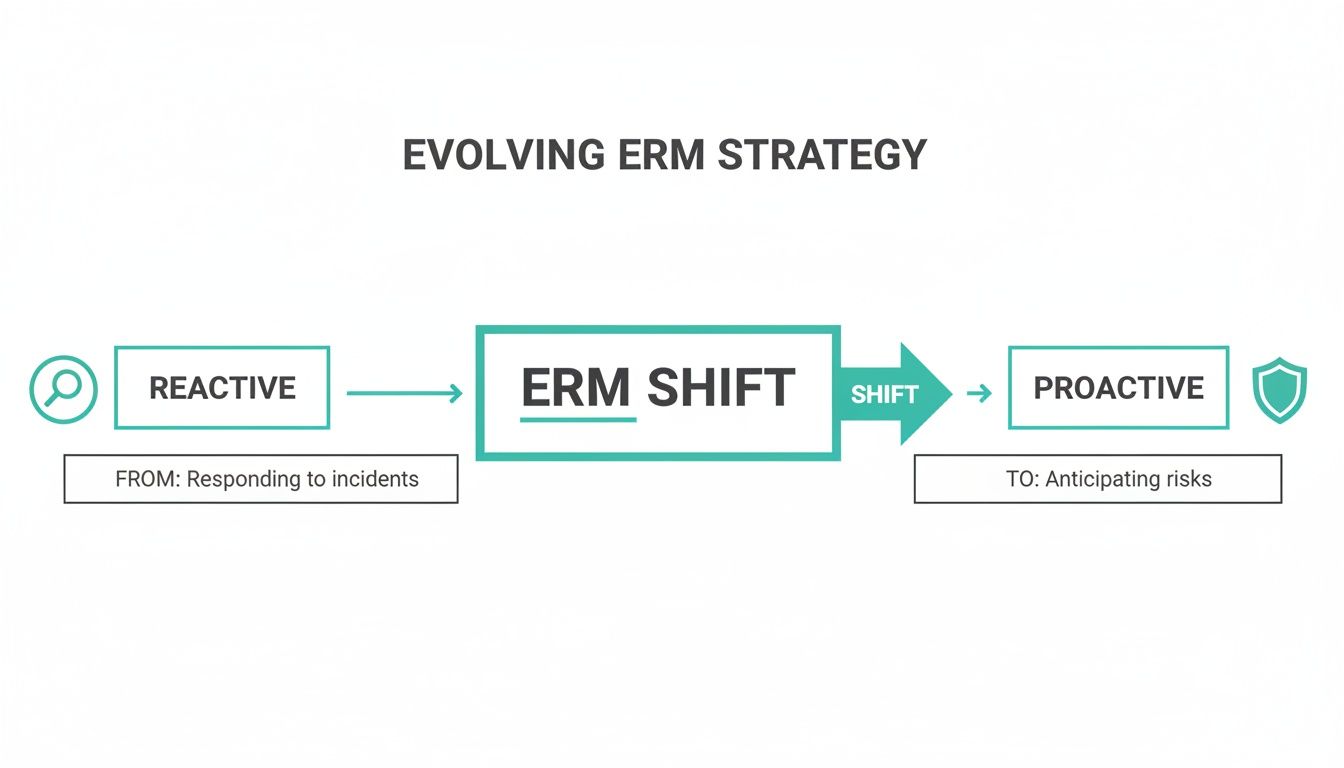
The image above perfectly captures this evolution. It shows the move away from the magnifying glass of after-the-fact investigation toward the shield of proactive defense—the core of a modern strategy for mitigating human-factor risk.
Comparing Old vs. New Approaches to Enterprise Risk Management
This isn't just a minor tweak in process; it's a fundamental change in mindset, capability, and liability management. The table below highlights the night-and-day difference between traditional reactive methods and the modern, software-driven proactive approach.
Characteristic | Traditional (Reactive) Approach | Modern (Proactive) ERM Software |
|---|---|---|
Timing | Post-incident investigation and cleanup. | Pre-incident identification and prevention. |
Data | Siloed in spreadsheets and separate departments. | Centralized, real-time data from across the business. |
Focus | Assigning blame after damage has occurred. | Understanding root causes and preventing future issues. |
Strategy | A cost center focused on damage control. | A strategic function that builds resilience and protects value. |
As you can see, the modern approach transforms risk management from a scattered, backward-looking chore into a coordinated, forward-looking strategic advantage that actively protects the organization from liability.
Driving Market Growth and Adoption
This shift toward proactive defense is fueling explosive growth. The global Enterprise Risk Management (ERM) software market jumped from USD 3.9 billion in 2023 and is projected to hit USD 7.1 billion by 2032. That’s a compound annual growth rate of 6.7%, a clear signal that businesses are desperate for smarter tools to navigate regulatory pressures and operational threats stemming from human factors.
This isn't just about buying new technology; it’s about adopting a new philosophy. To get a handle on the fundamentals, this comprehensive guide to risk management is a great place to build your foundational knowledge.
The New Standard in Risk Mitigation
The best ERM platforms today are defined by their ability to address the human element ethically and effectively. An AI-driven, non-intrusive system is the new standard for identifying and preventing internal threats before they can damage your finances, operations, or reputation. In contrast, outdated surveillance-based tools are not only ineffective but also introduce massive legal risks.
By focusing on pre-incident prevention, organizations don't just manage risk—they build a resilient culture of integrity. This ethical, EPPA-aligned approach protects the company from liability while safeguarding its reputation and its people.
This new standard goes way beyond simple compliance checklists. It arms leaders with the intelligence they need to anticipate challenges, like conflicts of interest or policy violations, without resorting to invasive methods. Our guide on proactive risk management in the enterprise dives deeper into these concepts, showing you how to build a stronger defense from the inside out.
Core Capabilities of a Modern ERM Platform
A true enterprise risk management software solution is far more than a digital filing cabinet for old compliance records. While basic tools log events that have already happened, a modern platform like E-Commander acts as a forward-looking intelligence system for your entire organization. It’s a huge leap beyond static checklists, delivering dynamic, actionable insights that help leaders prevent risks before they materialize.
These capabilities are the essential building blocks of a truly proactive defense. They work in concert to create a unified view of risk, with a special focus on the most critical and often overlooked area: the human factor. Instead of constantly reacting to incidents, you can finally get ahead of serious threats like internal fraud, conflicts of interest, and costly compliance breaches, protecting the business from significant financial and reputational harm.
AI-Powered Human Risk Identification
The biggest game-changer in ERM technology is the ethical use of AI to pinpoint human-factor risk. Traditional methods were never effective at spotting the subtle patterns that signal potential misconduct, leaving massive blind spots. A modern platform, however, analyzes operational data—without touching personal communications—to detect anomalies that point directly to emerging internal threats.
Let’s be clear: this is not surveillance. An EPPA compliant platform is built to focus on business processes and data interactions, not private lives. It’s designed to identify red flags such as:
Unusual patterns in approvals or transactions that might point to a conflict of interest.
Deviations from established compliance protocols that seem minor on their own but form a risky pattern.
Access to sensitive data that falls well outside of an employee's normal job functions.
By using AI human risk mitigation, the system provides early warnings without invading employee privacy or creating a toxic culture. This allows HR and compliance teams to address potential issues constructively, rather than launching a full-blown, reactive investigation after the damage is done. To learn more about this ethical approach, check out our detailed post on what defines a modern ERM platform.
Automated Control Monitoring
Manual control testing is a time-consuming process prone to human error. Worse, it only gives you a snapshot in time, which is often outdated the minute the audit is finished. Modern ERM software automates this, continuously monitoring your key controls to ensure they’re working as intended, 24/7.
For example, instead of quarterly audits on expense approvals, the system can watch them in real-time. If a transaction violates a predefined policy—like an employee approving their own expense report—the platform flags it for review instantly. This continuous oversight ensures that compliance isn’t just a periodic event, but an always-on part of your operations.
This shift from periodic auditing to continuous monitoring closes the very gaps where internal risks love to hide. It transforms compliance from a reactive, check-the-box exercise into a dynamic, always-on function that truly strengthens organizational governance and reduces liability.
Streamlined Incident and Case Management
When a potential risk is flagged, a fast, coordinated response is everything. A modern ERM platform acts as a central command center for managing incidents from detection to resolution. This replaces the chaotic mess of emails, spreadsheets, and siloed notes that so often hobbles an effective response.
This unified workflow ensures that everyone who needs to be involved—from Legal and HR to Compliance—has access to the same information at the same time. The platform tracks every step, creating a clean, defensible audit trail. This capability is crucial for proving due diligence and preventing failures, which is a common outcome of messy, reactive investigations.
Continuous Compliance Tracking
The regulatory landscape never stops shifting. A modern enterprise risk management software helps your organization stay ahead of the curve by mapping your internal controls directly to specific regulatory requirements. When a regulation is updated, the platform immediately highlights the affected controls, allowing your teams to proactively adjust processes. For any business in a regulated industry, this isn't just a nice-to-have; it's a critical function for avoiding crippling fines and reputational damage.
The Business Case for Proactive Risk Mitigation
Viewing modern enterprise risk management software as just another compliance cost is a strategic error. It's an investment with a clear, compelling return. The value isn't in a feature list; it's in the business outcomes it creates—stronger governance, smarter decisions, and massive operational efficiencies. It fundamentally shifts an organization from a mindset of reactive damage control to one of proactive value protection.
The single most important benefit is reputation protection. One internal incident—fraud, a compliance breach, or serious misconduct—can inflict irreversible harm on your brand. The financial and public relations fallout is infinitely more expensive than an investment in a system built to prevent it.

From Cost Center to Strategic Advantage
Risk management has long been viewed as a necessary cost center. The new generation of ERM platforms flips that script by delivering a direct financial and strategic upside. For example, identifying a gap in compliance protocols early can save millions in potential regulatory fines and legal fees.
Imagine a scenario where an AI-driven system flags a pattern of unusual vendor payments suggesting a potential conflict of interest. Addressing it early stops financial leakage and reinforces a culture of integrity. This is a night-and-day difference from the old model, which would only discover the problem during a post-mortem audit after significant damage was already done.
Quantifying the Impact of Prevention
The high costs and low success rates of traditional, reactive investigations make a powerful case for a new approach. These investigations are not just expensive in terms of billable hours; they are incredibly disruptive to operations, kill morale, and often fail to provide a clear resolution. You can learn more about the true cost of reactive investigations and see why prevention is the only viable strategy.
An AI-driven early warning system provides a clear strategic edge. It acts as an operational intelligence layer, giving leadership the foresight needed to act before a situation spirals out of control. As internal risks multiply, this proactive stance is non-negotiable for protecting the enterprise.
An investment in proactive risk mitigation is an investment in certainty and stability. It provides leadership with the confidence that the organization is not just prepared for risks but is actively preventing them from materializing.
The market’s trajectory confirms this shift. The risk management software market was valued at USD 13.05 billion in 2025 and is projected to more than double to USD 28.31 billion by 2030. A key driver is the surge in internal threats, which traditional security measures fail to address. You can find more insights on the growing risk management software market on mordorintelligence.com.
Building a Foundation for Growth
Ultimately, a robust enterprise risk management software platform does more than just stop bad things from happening. It creates a stable, well-governed environment where the business can thrive.
When leaders have clear visibility into emerging human-factor threats and can trust their internal controls, they can make bolder strategic decisions with greater confidence. This transforms risk management from a defensive necessity into a powerful engine for sustainable growth. By prioritizing ethical, non-intrusive risk mitigation, you protect your bottom line, your brand, and your people.
How to Choose the Right ERM Software Partner
Picking the right enterprise risk management software is a make-or-break decision. It’s far more than a simple technology purchase; it’s the beginning of a long-term strategic partnership that will define your company's resilience and integrity.
The right partner provides a solution that becomes a natural part of your operations, while the wrong one can saddle you with a system nobody uses, clashes with your culture, or—even worse—opens you up to new legal liabilities from invasive practices. This choice demands a deeper look than a surface-level feature comparison.
Decision-makers must look past technical specs and gauge a vendor's commitment to ethical, effective risk management. A true partner understands the goal isn't just to spot risk but to build a more resilient organization. This requires a solution designed to handle the complexities of human-factor risk without creating a culture of suspicion.
Look Beyond the Feature List
Many ERM platforms offer similar-sounding features, but the philosophy behind them can be wildly different. When evaluating potential partners, you must ask the tough questions that separate a generic tool from a specialized human risk management solution. A vendor's stance on privacy, ethics, and prevention is just as important as the software's dashboard.
Your evaluation checklist should put these areas front and center:
Ethical and Legal Alignment: Is the platform explicitly designed to be non-intrusive and EPPA compliant? Any vendor pushing solutions that hint at employee surveillance or monitoring is introducing a massive legal and cultural liability.
Focus on Human-Factor Risk: Does the software specialize in identifying risks tied to internal threats, fraud, and misconduct? Generic ERM tools lack the nuanced AI human risk mitigation needed to handle these sensitive issues ethically and effectively.
Proactive vs. Reactive Approach: Is the system built to prevent incidents or just analyze them after the fact? A real partner helps you prevent the fire, not just sift through the ashes.
Key Evaluation Criteria for Your Next ERM Partner
To ensure you end up with a partner that strengthens your governance and protects your organization, focus your procurement process on these core criteria.
Seamless Systems Integration
An ERM platform cannot be an island. It must connect smoothly with the systems you already rely on, especially your Human Resources Information System (HRIS) and other key operational platforms.
This integration is non-negotiable for creating a unified view of risk. Without it, you're stuck with manual data entry—a surefire recipe for inefficiency and human error. Ask potential vendors to show you, not just tell you, about their integration capabilities and provide real-world examples with systems like yours.
True Scalability and Future-Proofing
Your organization is going to change, and your ERM software must keep up. True scalability is about more than just adding user licenses. It’s about the platform’s ability to handle growing data volumes, adapt to new regulations, and support expansion into new markets without performance degradation.
The Enterprise Risk Management market is exploding for a reason—it's projected to climb from USD 8.4 billion in 2024 to over USD 14.4 billion by 2034. This trend underscores the need for a future-ready, cloud-based solution. You can discover more insights about this expanding market and its drivers on globalinsightservices.com.
A strategic ERM partner provides a platform that adapts to your changing risk landscape. The software should be a flexible asset that evolves with your business, not a rigid system that holds you back.
Quality of AI-Driven Analytics
Not all AI is created equal. Vague claims about "AI-powered insights" are everywhere, so you need to dig deeper. Ask vendors to explain exactly how their AI works and what it’s analyzing.
An ethical and effective system uses AI to analyze objective operational data for risk signals, not to make judgments about people. The analytics should deliver clear, actionable intelligence that empowers your teams to make informed decisions and stop problems before they spiral into a crisis.
Choosing the right partner also means looking at the ecosystem they offer. Logical Commander’s PartnerLC program creates opportunities to collaborate and grow together. You can learn more about this by exploring the possibilities of a partner program for AI-driven internal risk management. This kind of collaboration can extend the value of your initial investment significantly.
Integrating ERM Software for Maximum Business Impact
Rolling out an enterprise risk management software platform is about much more than just plugging in new tech. It’s a fundamental shift in how your organization operates and protects itself from internal threats. The software is a tool; its real power is unlocked when it demolishes the departmental silos that let human-factor risks slip through the cracks.
A successful integration unites people and processes around a single, shared mission: proactive prevention. This requires a strategic blueprint that goes beyond initial setup. The end goal is to cultivate a culture of risk awareness where your ERM platform becomes the central nervous system for coordinated action between Legal, HR, Compliance, and other key departments.
Achieving Stakeholder Buy-In Across Departments
The most common reason ERM implementations fail is resistance to change. Every department has its own workflow and priorities. Dropping a new enterprise-wide system into the mix can feel disruptive. The key to getting everyone on board is to show each group exactly how it reduces their liability and improves their effectiveness.
For Legal and Compliance: Frame the software as a tool for creating a rock-solid, defensible audit trail. Emphasize how automated monitoring and centralized incident management slash liability and make regulatory reporting almost effortless.
For HR: Position the platform as a way to gain ethical risk management insights without resorting to invasive surveillance. It’s a tool that helps them proactively address potential misconduct and protect the company culture from internal risks.
For Security: Show them how the system complements existing tools by focusing on the human factor. Explain that it provides early warnings on internal threats that technical controls were never designed to catch, starting and finishing with human-centric data.
When you tailor the message, the implementation stops feeling like a top-down mandate. It becomes a collaborative effort where every leader sees a clear win for their team.
Overcoming Common Implementation Hurdles
Even with enthusiastic buy-in, practical roadblocks will emerge. The two biggest hurdles are messy data integration and cultural resistance. A smart, phased approach can tackle both head-on.
Data Integration: Your ERM platform is only as good as the data it’s fed. Pulling clean, relevant data from disconnected systems like your HRIS or financial platforms is critical. Work with your software partner early to map out these data flows. Starting with one or two high-impact data sources can deliver a quick win, building momentum for the bigger integration push.
Cultural Resistance: It’s natural for some employees to view a new risk platform with suspicion, especially if they are used to outdated surveillance mentalities. You must be crystal clear in your communication: the goal here is proactive prevention, not policing people.
An EPPA compliant platform is specifically designed to protect both the organization and its people. It focuses on operational risk signals, not personal behavior. Reinforcing this message is essential for building trust and ensuring the software is seen as a supportive tool for maintaining integrity.
This proactive communication shifts the entire company mindset from one of fear to one of shared responsibility for protecting the enterprise.
Fostering a Culture of Proactive Risk Awareness
Ultimately, the real sign of a successful enterprise risk management software integration is when risk awareness becomes woven into the fabric of your daily operations. This is the point where the platform stops being a specialized tool for a few departments and becomes an essential part of the company's strategic DNA.
Getting there requires continuous effort. Leadership must champion this proactive approach relentlessly, celebrating early wins and reinforcing the value of prevention over reaction. Paired with regular training, this ensures everyone in the organization understands their role in the bigger picture of internal risk management.
When it’s all clicking, the software becomes much more than a system. It becomes the catalyst for a more resilient, aware, and secure organization, strengthening the entire business from the inside out.
The Future of Risk Management Is Ethical AI
Looking ahead, the entire landscape of enterprise risk management software is being redrawn by a single, powerful idea: ethical prevention. The next generation of risk management is leaping past simple automation to deliver predictive insights into complex human-factor risks, setting a new standard for how companies protect themselves from liability and reputational damage.
This evolution draws a sharp, clear line between outdated, invasive surveillance and modern, EPPA-aligned AI. Old-school monitoring tools don't just create massive legal liabilities; they poison your culture by treating employees with suspicion. As organizations adopt AI, staying ahead of legal shifts, like the upcoming EU AI Act 2025, is absolutely critical.

A New Standard for Protection
The future lies in AI that analyzes objective operational data, not personal behavior. Imagine being able to identify potential misconduct or a compliance breach by looking at impartial data patterns—things like unusual transaction approvals or someone accessing sensitive files way outside their normal job duties.
This is the very core of ethical risk management. It focuses on the risk signals buried inside your business processes, giving you an early warning system without invading employee privacy. It's an approach that lets leadership get ahead of potential issues proactively and constructively, preventing costly incidents.
The new standard is about protecting both the institution and its people. By using ethical AI, organizations can foster a culture of integrity while delivering unparalleled risk intelligence to their leadership teams. Logical Commander's E-Commander and Risk-HR platforms are leading this change.
The Contrast Between Ethical AI and Surveillance
The difference in these two approaches is a make-or-break decision for any modern enterprise. Understanding this distinction is the key to picking a platform that reduces your liability instead of creating more of it. Outdated surveillance technologies are not only against regulations but are also highly ineffective at preventing internal threats.
Characteristic | Ethical AI (The New Standard) | Invasive Surveillance (The Past) |
|---|---|---|
Focus | Objective operational data and process anomalies. | Monitoring employee communications and behavior. |
Goal | Proactive prevention and risk mitigation. | Reactive detection and evidence gathering. |
Legal Stance | Aligned with EPPA and privacy regulations. | Creates significant legal and compliance risks. |
Culture Impact | Fosters trust and a culture of integrity. | Generates suspicion and employee distrust. |
This shift represents a strategic choice. You can either cling to reactive, high-liability methods or embrace a future where technology supports a resilient, ethical, and secure workplace. True AI human risk mitigation provides the insights needed to stop incidents before they happen, safeguarding your company's finances, reputation, and—most importantly—its people. It’s a smarter, more sustainable path forward for any organization serious about governance and long-term success.
Your Questions on Enterprise Risk Management, Answered
When leaders start evaluating their options for enterprise risk management software, a few key questions always come up. The answers cut to the heart of what separates a modern, preventive platform from old, reactive tools. Getting this right is crucial for picking a solution that actually protects your organization.
How Does ERM Software Handle Insider and Human-Factor Risks?
This is a critical question, and it gets to the core of what makes a modern platform different. Effective ERM software tackles human-factor risks by analyzing operational data and workflows to spot anomalies and patterns that might point to misconduct, conflicts of interest, or even fraud.
Unlike invasive surveillance tools that create more problems than they solve, advanced platforms use AI to zero in on risk signals within business processes, not by monitoring individuals. This EPPA compliant platform approach provides an early warning about potential integrity issues, allowing HR and compliance teams to prevent a small problem from becoming a crisis—all while respecting employee dignity. This focus on proactive prevention is the new standard.
What Is the Difference Between GRC and ERM Software?
While you'll often hear the terms used together, they have distinct roles. Governance, Risk, and Compliance (GRC) software is the big-picture framework, covering everything from corporate governance and policy management to internal audits. Think of it as the overall strategic umbrella.
Enterprise Risk Management (ERM) software, on the other hand, is a more focused, operational powerhouse. It’s the engine that drives the systematic process of identifying, assessing, and neutralizing risks across the entire company. A modern ERM platform often serves as a core component of that larger GRC strategy, providing the deep, AI-driven analytics needed for internal threat detection and managing the human-factor risks that other systems completely miss.
How Long Does It Take to Implement ERM Software?
This isn’t the months-long slog it used to be. While timelines vary depending on a company’s size and complexity, the move to modern, cloud-based enterprise risk management software has dramatically sped things up. Forget the endless deployments of old on-premise solutions.
With a clear game plan and strong vendor support, an initial implementation can often be up and running in a matter of weeks, not months. The trick is to choose a scalable platform and go for a phased rollout. Start with your highest-priority risk areas to show value quickly. That early win builds the momentum needed for wider adoption across the business.
Ready to stop reacting to yesterday's problems and start preventing tomorrow's? Logical Commander offers an EPPA-aligned, AI-driven platform that sets a new standard for ethical internal risk management.
Start a free trial and get platform access to experience the future of risk prevention
Join our PartnerLC program to become an ally in ethical AI
Contact our team for an enterprise deployment consultation