%20(2)_edited.png)

Master Your Compliance Risk Assessment with a Proactive, AI-Driven Strategy

Updated: Jan 6
A compliance risk assessment is the systematic process organizations use to identify, analyze, and mitigate potential violations of laws, regulations, and internal policies. This is not just a box-checking exercise; it's a critical defensive strategy to prevent staggering fines, operational disruption, and severe reputational damage by addressing human-factor risk before it causes harm.
Why Traditional Compliance Risk Assessments Fail Your Business
For years, the standard compliance risk assessment was a static, annual event. It involved manual checklists, a round of interviews, and a review of historical incidents. This legacy model creates a dangerous illusion of security, leaving organizations exposed to the very internal threats it was meant to prevent.
These outdated frameworks are inherently reactive. They look backward at what has already gone wrong, not forward to what could happen next. This approach is especially weak at identifying human-factor risks—the subtle, nuanced threats that arise from employee conduct, conflicts of interest, or internal fraud. A simple checklist cannot capture the context behind actions or detect systemic vulnerabilities before they are exploited, leading to costly reactive investigations.
The Acceleration of Regulatory Complexity
The compliance landscape is no longer just changing; it's accelerating. Geopolitical shifts, rapid digital transformation, and a constant stream of new privacy laws create an overwhelming flood of new obligations. This complexity makes manual, backward-looking assessments obsolete and dangerous.
This isn't just a feeling. According to PwC's Global Compliance Survey, a staggering 85% of respondents reported that compliance requirements have become significantly more complex. This surge has real consequences. In a single year, global companies faced over $50 billion in penalties for non-compliance, a clear sign that legacy methods are indefensible and expose the business to unacceptable liability.
Key Takeaway: Relying on manual, checklist-based risk assessments is like navigating a minefield with an old map. The blind spots you create are not just gaps—they are open invitations for major business impact and legal liability.
The shift from these outdated methods to a modern, proactive approach is no longer optional. The differences in philosophy and execution highlight why leading organizations are making the change.
Old vs. New Compliance Risk Assessment Approaches
Characteristic | Traditional (Reactive) Approach | Modern (Proactive) Approach |
|---|---|---|
Frequency | Annual or bi-annual, static event. | Continuous, real-time intelligence and assessment. |
Focus | Backward-looking; reviews historical incidents. | Forward-looking; prevents future internal threats. |
Methodology | Manual checklists, interviews, subjective analysis. | AI-driven analysis, automated data collection. |
Risk Scope | Primarily process and system-focused. | Holistic, with a strong focus on human-factor risks. |
Outcome | Creates a point-in-time snapshot, quickly outdated. | Delivers a dynamic, up-to-date view of risk posture. |
Business Impact | High administrative burden, slow response times, costly investigations. | Reduces manual effort, enables rapid prevention, protects reputation. |
This table makes it clear: clinging to traditional methods means you're always one step behind. A modern, proactive strategy is about getting ahead of human-factor risk and turning compliance from a cost center into a strategic advantage that protects the business.
The High Cost of a Reactive Stance
When a traditional compliance risk assessment inevitably fails, the organization is thrown into a reactive cycle of damage control. Investigations are launched after the fact, consuming enormous resources and pulling key personnel away from their primary functions.
This reactive posture isn't just expensive; it’s fundamentally flawed. It only addresses the symptoms, never the root cause. You can learn more about the true cost of reactive investigations and see why a preventive strategy is always superior.
Ultimately, the failure of old methods comes down to their inability to keep pace. They are too slow, too narrow, and disconnected from the human element of risk. In an era where a single compliance failure can derail a company, a proactive, ethical, and AI-driven approach isn't just an improvement—it's essential for survival and governance.
Designing a Proactive Risk Assessment Framework
A modern compliance risk assessment isn’t about ticking boxes; it’s about crafting a strategic blueprint for your organization's resilience. It demands a shift from reactive fire drills toward a clear, intentional design that prevents problems. The first and most critical step is defining your scope.
This means asking foundational questions. Which business units are most exposed to regulatory pressure? Are you more concerned about SOX, GDPR, or specific industry mandates? Where are your processes, like procurement or hiring, most vulnerable to human-factor risk? Answering these questions brings focus and prevents wasted effort.
Defining Your Scope and Key Stakeholders
A compliance risk assessment conducted in a silo is doomed to fail. To get it right, you need a cross-functional team that brings different pieces of the risk puzzle to the table. This is a business strategy, not just a compliance exercise. Your lineup must include leaders from Compliance, HR, Legal, and Internal Audit.
Legal can map the complex web of regulations, while HR has a direct line of sight into employee-related risks like conflicts of interest. Security can identify vulnerabilities in access controls, and Compliance can orchestrate the entire process. This collaboration is your best defense against the dangerous blind spots that emerge when departments fail to communicate.
This graphic shows exactly how siloed, legacy methods create blind spots that lead directly to painful business consequences.
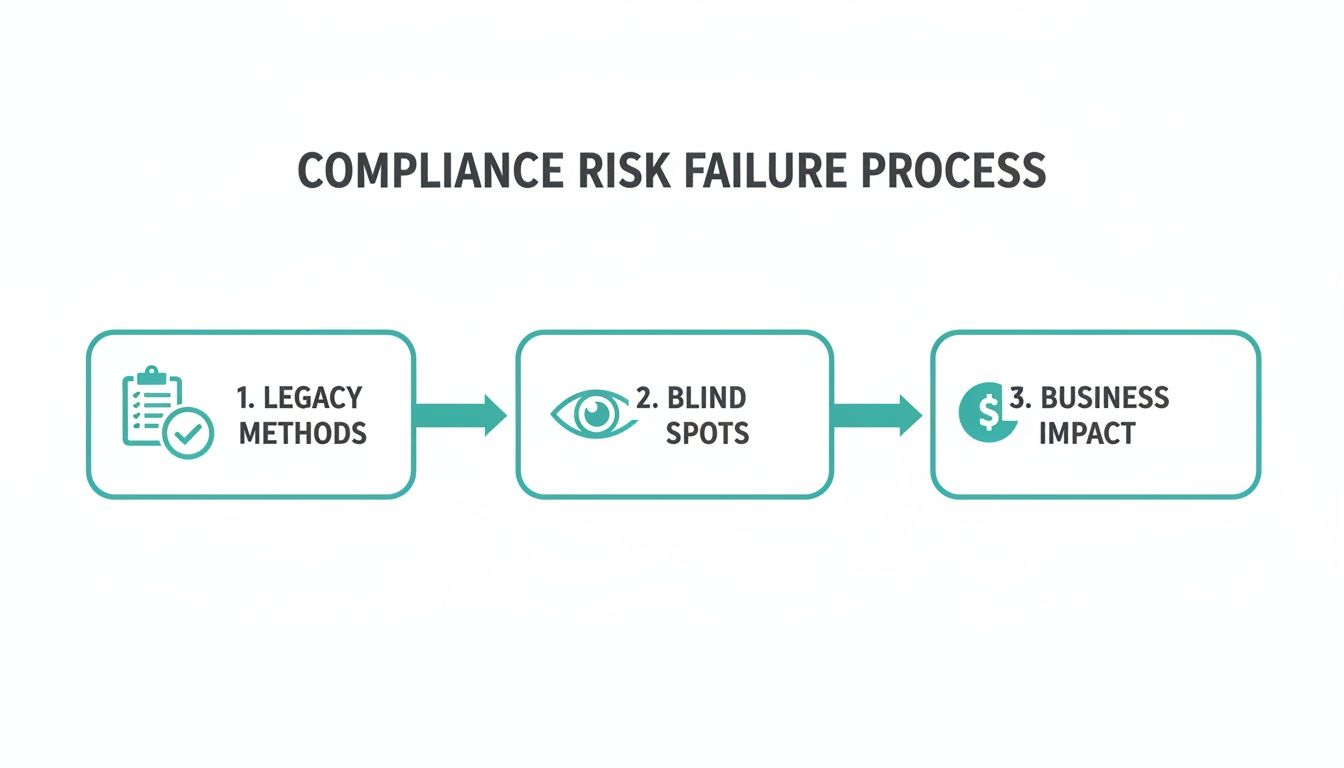
The visualization lays out a clear failure pathway, underscoring how outdated, checklist-driven thinking is the starting point for significant financial and reputational pain.
Mapping Regulations to Internal Processes
Once you've defined the scope and assembled your team, it's time to connect the dots. This is where you translate abstract legal jargon into the concrete operational risks your business faces every day.
Take a regulation like the Foreign Corrupt Practices Act (FCPA). A practical mapping exercise would break it down like this:
Identify relevant processes: This immediately points to sales operations, third-party vendor onboarding, and corporate gift-giving policies.
Pinpoint human-factor risks: Now you're looking at the potential for unauthorized sales commissions, improper payments to agents, or conflicts of interest with government officials.
Analyze existing controls: What do you have in place right now? Are there clear approval workflows for vendor payments? Can you easily pull training records for your entire sales team?
This detailed mapping highlights where your controls are solid and, more importantly, where they are weak or completely missing. A truly modern strategy requires a shift away from just reacting. Instead, you need to implement a robust proactive risk assessment that helps you see internal threats coming and neutralize them before they can do any harm.
Leveraging Non-Invasive Data Sources
A core principle of any modern, ethical framework is gathering risk intelligence without resorting to invasive employee surveillance. Many organizations mistakenly believe they must choose between security and privacy, but this is a false choice created by outdated technology. You can gain deep insights into your risk landscape by focusing on systemic and process-related data.
A Note on Ethical Data Collection: The goal is to analyze patterns and anomalies within operational data, not to scrutinize individual employees. This EPPA-aligned approach respects privacy while being brutally effective at identifying control weaknesses that lead to compliance failures. It is the new standard of internal risk prevention.
Instead of monitoring employee emails or chats—which is often illegal and always bad for morale—an ethical platform like Logical Commander analyzes aggregated data from sources you already have, such as:
Financial systems to flag unusual payment patterns.
Access logs to identify potential unauthorized activity.
HR process data to uncover systemic conflicts of interest.
This methodology delivers objective, data-driven insights that show you where your processes are breaking down. By focusing on how work gets done, you can pinpoint the root causes of risk without crossing ethical boundaries and destroying trust. This doesn't just build a more resilient compliance program; it fosters a healthier corporate culture. For more on this, explore our in-depth guide to building a compliance risk management framework.
Getting this foundational work right sets the stage for a compliance risk assessment that is both effective and principled, moving you from a defensive, reactive posture to a truly proactive and preventive one.
Getting Your Hands Dirty: Identifying and Scoring Human-Factor Risks
You've built a solid framework for your compliance risk assessment. Now the real work begins. It’s time to move from planning into the practical execution of gathering risk intelligence and determining its business impact. The mission is to uncover hidden vulnerabilities—especially those tied to the human element—without resorting to intrusive or outdated surveillance methods.
A modern, ethical approach is all about non-invasive techniques. Forget about policing individuals; you need to be looking at systems and processes for anomalies. This means digging into aggregated data from operational sources to find signals of risk. Think potential conflicts of interest, patterns that suggest internal fraud, or policy breaches—all identified without compromising employee privacy or violating EPPA guidelines.
This method is not just more ethical; it's more effective. It shows you the systemic weaknesses that individual monitoring would miss, allowing you to fix the root cause of a problem instead of just reacting to symptoms after the damage is done.

Developing a Practical Risk Scoring Matrix
Once you start flagging potential risks, you need a structured way to sort through them. Not all risks are created equal. A minor policy slip-up doesn't carry the same weight as a massive conflict of interest in your procurement division. This is where a risk scoring matrix becomes your best friend.
A risk matrix helps you cut through the noise and prioritize threats by plotting them against two critical factors:
Likelihood: How probable is it that this risk will materialize?
Impact: If it does, how severe will the business consequences be?
By assigning a score to each, you move from a gut feeling to an objective categorization of risks. A risk with high likelihood and high impact is a critical threat demanding immediate action. This systematic scoring turns your compliance risk assessment from a subjective guessing game into a data-driven strategic exercise.
This objective approach is crucial when dealing with third parties. Recent Gartner research on compliance trends is eye-opening: over 82% of compliance leaders have been impacted by third-party risks, with the average financial damage hitting $4.5 million per incident. These numbers prove that manual spot-checks are no longer a viable defense. You can explore more on critical compliance statistics and what they mean for 2025 to see just how high the stakes are.
A Sample Risk Matrix for Human-Factor Risks
To bring this to life, here’s a sample matrix tailored for human-factor risks. You can and should adapt this model to fit your organization's specific context and risk appetite.
Impact | 1 - Low | 2 - Minor | 3 - Moderate | 4 - Major | 5 - Severe |
|---|---|---|---|---|---|
5 - Highly Likely | Medium | Medium-High | High | Critical | Critical |
4 - Likely | Low-Medium | Medium | Medium-High | High | Critical |
3 - Possible | Low | Low-Medium | Medium | Medium-High | High |
2 - Unlikely | Low | Low | Low-Medium | Medium | Medium-High |
1 - Rare | Low | Low | Low | Low-Medium | Medium |
Here’s how you would put this matrix to work:
Identify the Risk: You discover an employee in procurement has a close family member who owns one of your key supplier companies—a textbook potential conflict of interest.
Score the Likelihood: If your pre-employment and ongoing screening processes are weak, the likelihood of this going unnoticed could be "Possible" (Score: 3).
Score the Impact: If that supplier handles millions of dollars in contracts, the financial and reputational fallout could be "Major" (Score: 4).
Plot the Risk: A 3 on likelihood and a 4 on impact drops this risk squarely into the "Medium-High" category. It demands immediate attention and much stronger controls.
This scoring process transforms vague worries into a clear, prioritized action plan. It gives you a roadmap for allocating your time and resources, letting you focus your efforts where they will have the greatest preventive impact.
Moving Beyond the Limits of Reactive Investigations
This entire process—from non-intrusive data gathering to methodical risk scoring—is designed to stop problems before they escalate. It's a fundamental break from the costly and chaotic world of reactive investigations. This preventive philosophy is exactly what platforms like Logical Commander’s Risk-HR module are built on.
Risk-HR is designed to ethically identify signals of misconduct and conflicts of interest by analyzing systemic data, not by policing individuals. It provides the early warnings needed to address a vulnerability before it becomes a full-blown crisis, potentially saving millions in losses and protecting your organization's reputation. That’s where the real value of a modern compliance risk assessment is found. For those looking to strengthen their internal controls, it's worth digging into the value of proactive integrity assessments as a core piece of this strategy.
Integrating AI for a Smarter Compliance Strategy
Static, annual risk assessments are a relic. They offer little more than an outdated snapshot of your risk landscape, leaving your organization vulnerable as internal threats evolve in real time. To keep pace, your compliance risk assessment must become a living, continuous process.
This is where AI-driven tools completely change the game.
Integrating AI isn't about replacing human judgment; it's about augmenting it with speed, scale, and depth of insight that manual methods can never match. The right platforms centralize risk intelligence and automate workflows, turning your assessment from a periodic chore into an ongoing, dynamic function that prevents business-damaging events.
This shift delivers powerful, practical benefits. It means identifying emerging threats faster, slashing the hours spent on tedious manual effort, and connecting disparate data points that even the sharpest human analyst would miss.

From Periodic Checks to Continuous Intelligence
The traditional approach to a compliance risk assessment is like checking the weather forecast once a year. A modern, AI-powered strategy gives you a real-time radar. Instead of waiting for an annual review to uncover a problem, you get continuous insights that flag risks the moment they develop.
This move from periodic to perpetual is a fundamental change in philosophy. AI-driven platforms like Logical Commander’s E-Commander act as a central nervous system for your entire compliance program. They can:
Automate Data Aggregation: Continuously pull relevant, non-personal data from core systems—like HR, finance, and access logs—into one unified view.
Identify Anomalies: Use machine learning to spot patterns and deviations that signal potential human-factor risks, such as conflicts of interest or policy breaches.
Trigger Proactive Alerts: Notify compliance and HR teams of emerging risk signals before they escalate into incidents, enabling early, preventive intervention.
This approach transforms your team from reactive firefighters into proactive risk managers armed with the intelligence to act decisively.
Ethical AI: The Non-Intrusive Standard
A valid concern with AI is the potential for intrusive surveillance. But the new standard of internal risk prevention is built on an ethical, EPPA-aligned foundation. Unlike surveillance tools that spy on employees, our goal is to identify and mitigate systemic vulnerabilities rooted in human risk. We are not a cyber company; our focus starts and ends with the human factor.
Key Takeaway: Ethical AI focuses on process and system data, not personal communications or behavior. It analyzes patterns of activity to find control gaps, ensuring compliance and risk mitigation are achieved without violating employee privacy or trust.
Logical Commander was designed from the ground up on this principle. Our platform provides AI human risk mitigation without surveillance, lie detection, or any form of secret employee monitoring. It’s about prevention, not policing.
The industry is rapidly moving in this direction. A recent White & Case survey highlights a major acceleration in AI adoption, with over 50% of compliance teams now using or trialing AI for risk analysis. This technology is essential for managing the skyrocketing complexity reported by 85% of firms, and AI users are already seeing 40-60% faster risk evaluations.
Implementing AI in Your Compliance Framework
Bringing AI into your compliance strategy is a strategic initiative, not just an IT project. Success hinges on a thoughtful integration that aligns the technology with your specific governance goals and business objectives.
For a playbook on how to approach this, a comprehensive guide on how to implement AI in business offers a solid, strategic framework. This ensures you're building a sustainable capability, not just adopting another tool.
The right AI partner helps you map the technology directly to your highest-priority risks. By starting with a clear focus—like preventing conflicts of interest in procurement or mitigating third-party integrity risks—you can demonstrate immediate value and build momentum. This smart, targeted approach is how you turn your compliance risk assessment into a powerful, proactive engine for organizational resilience and reputation protection.
Turning Your Assessment into Action
A completed compliance risk assessment is not the finish line; it's the starting block. Its value lies not in the report itself, but in the decisive, preventive actions it drives.
Without a clear plan to fix what you’ve found, the entire exercise becomes a resource-intensive report that gathers dust. Now, it's time to translate those findings into real change with a structured remediation approach that reduces business liability.
Crafting Reports That Actually Drive Decisions
Your findings must be packaged differently for different audiences. A granular, 100-page deep-dive might be perfect for your internal audit team, but it will be ignored by the board of directors. To make an impact, your reporting must be tailored.
For Executive Leadership and the Board: Keep it high-level and strategic. Present a sharp summary of the most critical risks, their potential business impact (financial and reputational), and the resources needed for mitigation. Use clean visuals and focus on demonstrating proactive, responsible governance.
For Operational Team Leads: Get tactical. Deliver the detailed information they need to execute. Pinpoint the specific processes, controls, or systems that need attention. Your goal is to give them the exact intelligence required to implement the remediation plan within their function.
This targeted communication ensures every stakeholder gets the right level of detail to do their part, from high-level oversight to on-the-ground implementation.
From Findings to an Actionable Roadmap
An effective remediation plan is more than a to-do list; it’s a project plan for systematically reducing risk. Every gap identified in your compliance risk assessment must be turned into a concrete action item with a clear owner and a realistic deadline.
This is where accountability is forged. Vague recommendations like "improve vendor screening" are useless. An actionable item sounds like this: "By Q3, the Procurement team will implement an automated conflict-of-interest check for all new vendors, to be reviewed and signed off by the Chief Compliance Officer."
A risk without an owner is a crisis waiting to happen. Assigning clear responsibility for each mitigation task is the single most important step in ensuring your assessment leads to meaningful improvement.
This process relies on prioritizing your efforts based on the risk scores you already developed. Critical and high-rated risks demand immediate attention. This ensures you’re applying your energy where it will have the biggest preventive impact on the business.
Measuring Success with the Right KPIs
How do you prove your mitigation efforts are working? You need to define Key Performance Indicators (KPIs) to track the effectiveness of your compliance program over time. These aren't just vanity metrics; they provide objective proof of progress and demonstrate a real return on investment to leadership.
Effective KPIs for a compliance program might include:
Reduction in Policy Exceptions: A measurable drop in the number of approved exceptions to key policies, like those for gifts or conflicts of interest.
Time to Mitigate: The average time it takes to close out an identified risk, from the moment it's flagged to confirmed remediation.
Control Failure Rate: The percentage of controls that fail during periodic testing. The goal is to see this number trend steadily downward.
Metrics like these transform your compliance function from a perceived cost center into a measurable value driver that actively protects the organization from liability and reputational damage.
Unifying Action with a Centralized Platform
Trying to manage this entire lifecycle—from flagging a risk to tracking its mitigation and reporting on KPIs—is a nightmare with spreadsheets and email chains. The process becomes fragmented, accountability gets lost, and demonstrating proactive governance to regulators is nearly impossible.
This is why a unified platform like Logical Commander’s E-Commander is essential. It centralizes the whole process, creating a single source of truth for your compliance risk assessment.
From the initial AI-driven alert that flags a potential human-factor risk to the workflow that assigns mitigation tasks and tracks them to completion, the platform ensures nothing falls through the cracks. It provides a real-time, auditable trail that proves to regulators and your board that you aren't just identifying risks—you're actively and effectively managing them as part of a modern governance strategy.
Your Questions on Modern Risk Assessments, Answered
Overhauling your compliance risk assessment is a major strategic decision. Let's tackle some of the most common questions we hear from compliance, risk, and legal leaders who are ready to build a more resilient program.
How Can We Conduct a Thorough Compliance Risk Assessment Without Invasive Employee Monitoring?
This is a critical question that separates a modern, ethical platform from outdated surveillance tools. The new standard of internal risk prevention focuses on systemic and process-level risks, not individual surveillance.
This is achieved by analyzing aggregated, non-personal data from sources like system access logs, financial transaction records, and HR process data. The aim is to spot patterns and anomalies that point to weak controls or integrity risks before they become a full-blown crisis.
For example, this approach helps you uncover potential conflicts of interest before they cause real damage. A platform like Logical Commander is built specifically for this non-intrusive, EPPA-aligned approach. Our AI is designed to detect risk signals within operational data without ever monitoring personal communications or behavior. This protects employee privacy while safeguarding the organization.
What Are the First Steps to Move from an Annual Assessment to Continuous Monitoring?
Transitioning to a continuous model can feel like a huge undertaking, but the key is to start smart. Don't try to boil the ocean.
First, identify your highest-priority risks and the data sources that provide real-time indicators for them. Begin by automating data collection and analysis for just one or two critical areas, like third-party integrity or internal conflicts of interest.
Next, implement a centralized platform, like E-Commander, to act as your single source of truth for risk intelligence. This allows you to integrate different data feeds and set up automated alerts for predefined risk thresholds.
Start small, prove the value with a pilot program, and then gradually expand the scope. This methodical approach is the key to transforming your compliance risk assessment from a static, annual event into a dynamic, ongoing process that provides continuous business value.
This strategy ensures you build momentum and get the organizational buy-in you need to succeed.
How Do We Get Executive Buy-in for a New Risk Assessment Platform?
Securing executive buy-in means framing the investment in terms of business value, not just as a compliance cost. Build a solid business case that highlights the massive financial and reputational cost of inaction. Use recent industry fines and enforcement actions to make the threat of liability real.
Emphasize the clear ROI of a proactive strategy:
Reduced Investigation Costs: Preventing issues before they require a full-blown internal investigation saves significant time, money, and resources.
Prevention of Financial Losses: Proactively identifying risks like internal fraud or conflicts of interest directly protects the company’s bottom line.
Enhanced Reputation: Demonstrating a commitment to ethical, EPPA-aligned governance strengthens your brand and builds trust with stakeholders and regulators.
Showcase how an ethical, non-intrusive platform like Logical Commander also mitigates legal risks tied to complex labor laws. Position it as a strategic investment in governance and brand protection, not just another compliance tool.
Is an AI-Driven Platform Difficult to Integrate with Existing Systems?
This is a common concern, but modern risk assessments software is built for seamless integration. Leading platforms use APIs (Application Programming Interfaces) to connect with the HRIS, ERP, and other core business systems you already have. The goal is to pull the necessary, non-personal data without disrupting your current operations.
The implementation process is a collaborative partnership. A good vendor works directly with your IT and compliance teams to ensure a smooth, secure data connection. The focus is on creating a unified view of risk, not a complicated IT overhaul. This makes the transition to AI human risk mitigation far more straightforward than many leaders assume.
Ready to transform your compliance risk assessment from a reactive burden into a proactive strategic advantage? Logical Commander offers the new standard in ethical, non-intrusive internal threat prevention.
Request a demo to see our EPPA-aligned platform in action.
Join our PartnerLC program and become an ally in building safer, more ethical organizations.
Contact our team for a confidential discussion about enterprise deployment.
Discover a smarter, more ethical way to manage human-factor risk at https://www.logicalcommander.com.