%20(2)_edited.png)

Enterprise Risk Management Software Solutions: A Proactive Guide

Updated: Nov 12, 2025
If you’re still managing risk with spreadsheets and quarterly review meetings, you’re not just behind the times—you’re leaving your organization wide open to liability and financial damage. The old way of doing things is a relic, fundamentally incapable of addressing the primary source of business risk: the human factor.
Yesterday’s risk management strategies were built on a reactive foundation. The approach was to wait for something to break—a data breach, a compliance fine, internal fraud—and then scramble to fix it. This model is fatally flawed because it only treats the symptoms, not the cause. It completely overlooks the one variable that connects nearly every internal risk: people.
Why Traditional Risk Management Is Failing Your Business
In a business landscape defined by intense regulatory pressure and operational complexity, a reactive posture is a recipe for disaster. It’s inefficient, but more importantly, it’s incredibly expensive, exposing you to significant business impact and liability.
The core failure of the traditional model is its inability to get ahead of human-factor risk. Think about it. Financial misstatements, operational breakdowns, and compliance violations almost always start and end with a person. Yet, legacy systems and surveillance tools were designed to monitor processes and machines, not to ethically understand and prevent the risks tied to human behavior. That gap is a massive vulnerability, and it's one that outdated methods simply can't close.
The High Cost of a Reactive Stance
Waiting for an internal threat to fully materialize means you've already lost. The costs pile up fast and go way beyond the initial financial hit. You’re suddenly dealing with:
Steep Investigative Expenses: The cost of reactive forensics and internal investigations is a massive drain on time, budget, and human resources.
Regulatory Penalties: Getting caught out of compliance can lead to crippling fines, sanctions, and lasting reputational damage.
Reputational Damage: The trust you’ve built with customers and partners can be shattered in an instant and take years to rebuild.
Decreased Employee Morale: A reactive, blame-first culture poisons the well, damaging productivity, loyalty, and your ability to retain top talent.
This cycle is completely unsustainable. Understanding these limitations is the first step, and you can learn more about how to transition from reactive to preventive IT to better protect your operations.
The Shift to Proactive, Intelligent Solutions
The demand for a better way is exploding. The global market for enterprise risk management software solutions was valued at $5.0 billion in 2024 and is on a sharp upward trajectory, driven by the desperate need for smarter, preventive risk mitigation.
This trend signals a huge shift toward prevention. Modern enterprise risk management software solutions use AI to identify and flag risks before they turn into costly incidents. For a deeper dive, check out our strategic guide to risk management in enterprise.
But here’s the crucial part: the new standard for these platforms has to be ethical and EPPA-aligned. It’s no longer enough to be effective; risk prevention must respect employee dignity and avoid the legal and cultural pitfalls of invasive surveillance.
What Modern Enterprise Risk Management Software Solutions Actually Do
So, what separates a real enterprise risk management (ERM) solution from a glorified spreadsheet or a simple compliance checkbox? It's the difference between passively tracking what went wrong and proactively preventing the next crisis. A modern ERM platform is far more than just a database; it’s the central nervous system for your entire organization's risk intelligence.
These platforms are designed to smash the departmental silos that let major threats fester unnoticed. They pull data from across the business—Compliance, HR, Security—into one unified view. This is how leaders finally connect the dots between seemingly random events and spot the underlying patterns that signal a much bigger problem on the horizon.
This infographic really drives home the point. It shows that while we focus a lot on systems and processes, the human element sits right at the top of the risk pyramid.
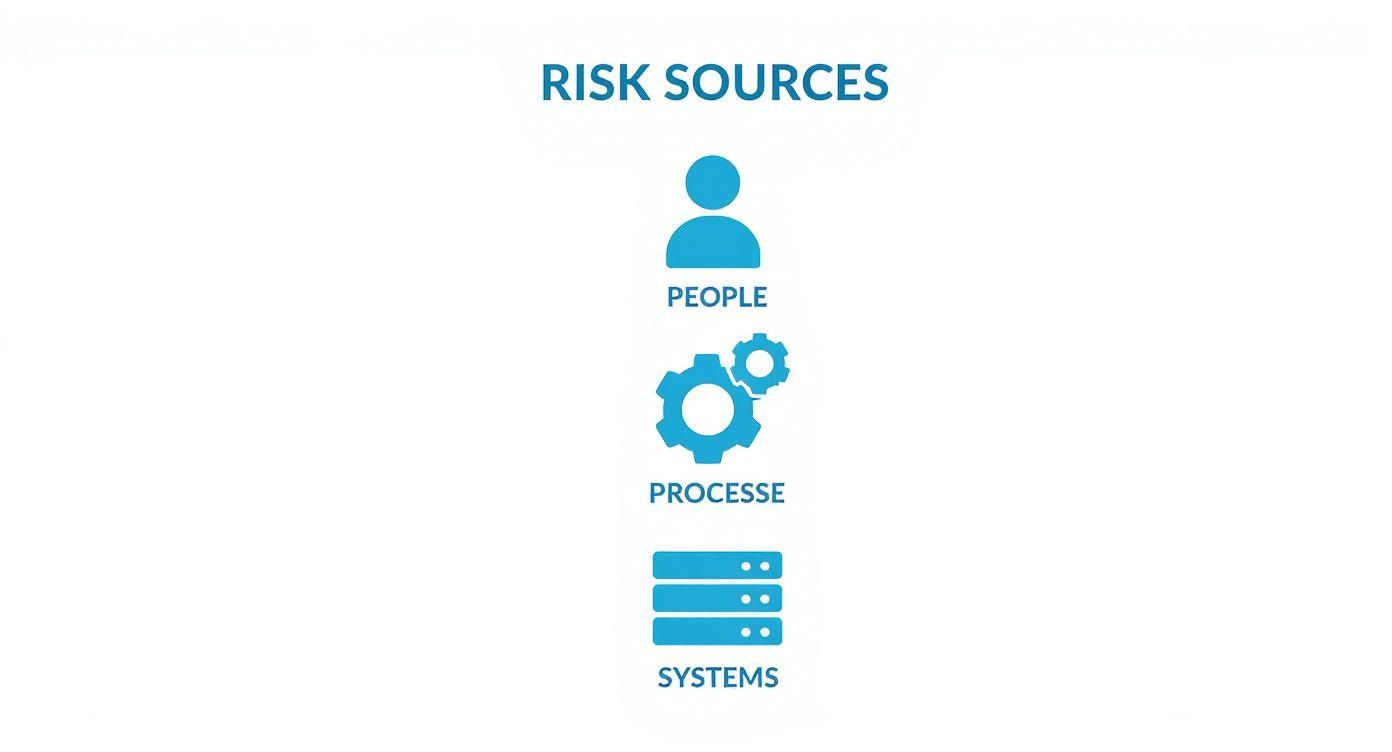
It’s a critical insight. Most technology and process failures can be traced back to a human action or decision, which makes ethical, human-factor risk assessment an absolute must-have.
AI-Powered and Ethical Risk Assessments
The best enterprise risk management software solutions use AI for one primary reason: prevention, not surveillance. Traditional risk assessments are a painful, manual process. They’re subjective, infrequent, and leave your organization vulnerable for long stretches between check-ins. An AI-driven approach, on the other hand, automates the continuous identification of risk indicators, giving you a dynamic and objective view of potential threats.
But how that AI works is everything.
Older platforms and so-called "insider threat" tools often rely on legally questionable and invasive employee monitoring techniques. These surveillance methods create massive legal liabilities and completely destroy employee trust, which is why they are not a viable solution for responsible organizations.
The new standard for risk management technology is defined by its commitment to ethical, non-intrusive principles. True prevention respects employee dignity and privacy, operating in full alignment with regulations like the EPPA.
Leading platforms like Logical Commander focus on identifying risk indicators through transparent, consent-based processes. This ethical framework ensures your organization can neutralize internal threats without treating employees like suspects. It’s a fundamental shift away from a culture of suspicion and toward one of proactive integrity. You can learn more about these different technologies in our guide to insider threat detection tools.
Automated Compliance and Intuitive Reporting
Trying to manage compliance in highly regulated industries can feel like a never-ending nightmare. Modern ERM software takes much of this burden off your plate by automatically mapping risks to specific regulatory controls and tracking your compliance status in real-time. This capability turns audit prep from a frantic, backward-looking fire drill into a routine, manageable process.
A few key features make this possible:
Centralized Control Libraries: All your compliance controls live in a single, organized repository. This makes them a breeze to manage, update, and audit.
Automated Evidence Collection: The system can automatically pull and link evidence of compliance, saving your team hundreds of hours of manual grunt work.
Real-Time Alerts: You get instant notifications when a control fails or a new compliance risk pops up, allowing for immediate corrective action.
Essential ERM Software Features and Their Business Impact
Moving from outdated, manual methods to a modern ERM platform isn't just an upgrade—it's a complete transformation of how you manage risk. The table below breaks down the core capabilities of today's software, showing the real-world business impact of leaving old problems behind.
Core Capability | Traditional Approach (The Problem) | Modern Solution (The Benefit) | Business Impact |
|---|---|---|---|
Risk Identification | Manual, infrequent assessments. Relies on subjective interviews and static checklists. | Continuous, AI-driven monitoring of risk indicators across the entire organization. | Proactive Threat Prevention: Identifies risks before they escalate, reducing the likelihood of costly incidents and liabilities. |
Compliance Management | Disconnected spreadsheets and documents. A frantic, manual scramble before every audit. | An automated, centralized control library with real-time tracking and evidence collection. | Audit Readiness: Drastically cuts audit prep time and costs, while minimizing compliance violations and fines. |
Data Integration | Siloed information across departments. No single view of risk, leading to critical blind spots. | A unified platform that integrates data from HR, Security, and IT into a single source of truth. | Holistic Visibility: Enables leaders to connect the dots and see the full risk picture, improving strategic decisions. |
Reporting & Analytics | Static, dense reports that are quickly outdated and difficult for leaders to interpret. | Intuitive, customizable dashboards with visual trends and actionable insights. | Informed Leadership: Translates complex data into clear business intelligence, empowering executives to steer the company safely. |
Ultimately, this shift is about turning risk management from a reactive, operational chore into a strategic advantage that protects the company's finances, reputation, and future. This powerful data is worthless, though, if no one can understand it. That’s why intuitive, customizable dashboards are a non-negotiable feature. They must translate complex risk data into clear, actionable insights for your executives, board members, and department heads.
Calculating the True Cost of Reactive Risk Management
Many organizations mistakenly believe the cost of a risk event is just the immediate financial damage—a fine, a settlement, or the direct loss from misconduct. That view isn't just incomplete; it's dangerously shortsighted. The real price of reactive risk management is far higher, bleeding into every corner of the business long after the initial mess is supposedly "resolved."
Waiting for a problem to blow up before you act isn't a strategy; it's a guaranteed way to rack up massive, often hidden, expenses. Every reactive measure, from a forensic audit to a frantic public relations campaign, is a sign that your preventive strategy failed. The true cost isn’t just a line item on a budget; it's a cascade of consequences that can cripple your future.

Uncovering the Hidden Financial Drains
Beyond the obvious penalties, the financial fallout of being reactive spreads like wildfire. These secondary costs are often tougher to nail down, but they can be far more destructive over the long haul.
Consider the resources you're burning through:
Massive Investigative Overheads: Launching an internal investigation consumes immense resources. You're suddenly paying for legal teams, external forensic accountants, and the significant time your own leaders must pull away from revenue-generating activities.
Operational Disruption: Investigations don't happen in a vacuum. They disrupt workflows, grind projects to a halt, and pull your best people away from their core duties, leading to a major drop in productivity.
Soaring Insurance Premiums: A history of incidents makes your company a higher risk to insure. As a result, your premiums for D&O, E&O, and liability coverage are likely to skyrocket.
These expenses all point to one critical truth. While a proactive enterprise risk management software solution requires an upfront investment, it pales in comparison to the spiraling, unpredictable costs of cleaning up a disaster. For a deeper breakdown, explore our article on the true cost of reactive investigations.
The Erosion of Trust and Reputation
Perhaps the most damaging cost of a reactive posture is the one you can't easily measure on a balance sheet: the loss of trust. When your organization is constantly putting out fires related to compliance failures or internal misconduct, your reputation takes a massive hit.
A proactive risk culture, supported by ethical and non-intrusive technology, is a competitive advantage. It signals to the market, your partners, and your employees that your organization is built on a foundation of integrity and foresight.
This reputational damage shows up in a few key ways:
Stakeholder Confidence Plummets: Investors, board members, and partners get nervous when an organization seems to have no control over its internal environment.
Customer Churn Increases: Customers are far less likely to do business with a company that keeps appearing in headlines for the wrong reasons.
Employee Morale Suffers: A reactive, blame-focused environment creates a culture of fear and suspicion. Your best talent will leave, seeking organizations that foster psychological safety.
At the end of the day, every dollar spent on reactive measures is a dollar that could have been invested in growth and innovation. The shift to an AI-driven preventive risk management platform isn't just about avoiding fines; it's about protecting the very foundation of your business—its reputation, its people, and its competitive edge.
How to Choose the Right Enterprise Risk Management Software Solution
Picking the right enterprise risk management software solution is a make-or-break decision. It’s a move that will define your company's resilience, its integrity, and its ability to grow safely. This isn't just about buying a tool; it's about adopting a strategic philosophy. The wrong choice can saddle you with a system nobody uses, one that clashes with your company culture, or—even worse—one that opens you up to new legal liabilities.
The selection process must go beyond a simple feature checklist. You need to ask the hard questions—the ones that reveal a vendor’s real philosophy on risk, ethics, and employee privacy. The mission is to find a platform that doesn't just put out today’s fires but helps you prevent tomorrow's blaze from ever starting.
Prioritize Ethical and EPPA-Aligned Technology
First, you must draw a hard line between platforms that prevent risk and those that monitor behavior. It's the most critical distinction. Too many legacy systems are built on a foundation of employee surveillance, using invasive methods that are not only legally risky but also toxic to your company culture. These outdated approaches are completely misaligned with modern workplace expectations and regulations like the Employee Polygraph Protection Act (EPPA).
When vetting vendors, be direct:
Does your platform engage in any form of employee monitoring or surveillance?
How does your methodology ensure full compliance with EPPA and other labor laws?
Is your risk assessment process transparent and built on consent?
A platform like Logical Commander is built on an ethical, non-intrusive framework from the ground up. It’s designed to pinpoint and neutralize internal threats and human-factor risks without ever crossing the line into surveillance. This proactive, consent-based approach protects employee dignity and shields your organization from the huge legal and reputational blowback that comes with invasive tools.
Assess Scalability and Deployment Models
Your risk management needs are not static. They will change as your company grows, enters new markets, or faces new regulations. A solid ERM solution must be able to grow with you. This is precisely why the market is ditching rigid, on-premises systems and moving toward flexible, cloud-based deployments.
We’re seeing a massive shift in the enterprise risk management software solutions market toward cloud-based models for their scalability, flexibility, and cost-effectiveness. The subscription pricing and ready-to-go templates offered by cloud solutions have made robust risk management accessible to a much wider range of companies. You can learn more about the projected 21.30% compound annual growth rate for cloud solutions in this full risk management software market analysis.
Moving to a cloud-based solution isn’t just about convenience; it’s about future-proofing your entire risk strategy. It gives you the agility you need to support a modern, distributed workforce while delivering rock-solid security and seamless updates.
Ensure Seamless Integration and User-Friendly Design
An ERM platform cannot be an island. To give you a complete, 360-degree view of risk, it must integrate seamlessly with the systems you already use—especially your Human Resource Information System (HRIS). This connection is vital for creating a single source of truth and automating processes between your HR, Compliance, and Security teams. Without it, you're stuck with manual data entry, a recipe for inefficiency and human error.
Furthermore, even the most powerful platform is worthless if your team finds it difficult to use. User adoption is a primary obstacle for any new enterprise software. A clunky, confusing interface guarantees low engagement and incomplete data, sinking your investment. Look for solutions with intuitive dashboards, clear reporting, and a design that makes it easy for non-technical users to contribute and pull insights. For more on this, check out our guide on effective software risk management strategies.
In the end, the right choice is a solution that empowers your teams, respects your people, and gives you a clear, proactive way to tackle the human-factor risks that truly matter.
The New Standard: Proactive Prevention Over Reactive Forensics
The world of enterprise risk management software solutions is crowded, but a clear dividing line has formed. On one side, you have the old-guard platforms and surveillance tools that are legally problematic and treat employees as liabilities. On the other, a new standard is taking hold—one built on proactive, ethical risk prevention designed for the modern workplace.
This new benchmark is a complete departure from the outdated, reactive models that only kick in after the damage is done. Instead of relying on invasive methods that create legal liabilities and shatter trust, the focus is now on ethically identifying and mitigating the human-factor risk at the heart of most business disruptions.

What defines this modern approach is an unshakeable commitment to ethical principles and regulatory alignment, especially with standards like the Employee Polygraph Protection Act (EPPA). It flat-out rejects the flawed idea that you must compromise employee dignity to manage risk effectively.
E-Commander and Risk-HR: The New Standard
Leading this shift is Logical Commander's E-Commander platform, powered by our Risk-HR module. This AI-driven system was built from the ground up to get ahead of issues like internal fraud, conflicts of interest, and other misconduct without ever stepping into the prohibited territory of employee surveillance.
Our methodology is intentionally non-intrusive. We don’t engage in employee monitoring, secret data collection, or any kind of analysis that could be construed as a psychological evaluation. We focus on human risk, not cyber threats.
The core principle is simple: true prevention empowers an organization to understand its internal risk landscape through transparent, consent-based processes. It’s about building a culture of integrity, not one of fear.
This approach directly addresses the failings of traditional and surveillance-heavy solutions by:
Focusing on Prevention: We identify risk indicators before they turn into expensive incidents, protecting both the company and its people from harm.
Ensuring EPPA Compliance: Our technology is designed to be fully compliant, sidestepping the legal and reputational minefields associated with prohibited methods used by other vendors.
Preserving Employee Dignity: We offer a powerful alternative that respects privacy and helps create a healthier, more productive work environment.
A Human-Centric Approach to Risk
Ultimately, internal risks are human problems. They start with human decisions and actions, which is why any real solution must be human-centric. This means technology should be a tool that supports better governance and ethical behavior, not a system for policing staff.
The Logical Commander platform puts this philosophy into action. It gives HR, Compliance, and Security leaders the intelligence they need to act decisively and preemptively. By centralizing risk data and delivering clear, actionable insights, it transforms risk management from a scattered, reactive chore into a coordinated, strategic advantage. For those looking to add another layer of quantitative analysis to decision-making, understanding tools like Monte Carlo simulation can provide deeper insights into potential outcomes and their likelihood.
Why Ethical Prevention Is the Only Path Forward
The enterprise risk management software solution you choose is a direct reflection of your company's values. Picking a platform built on surveillance sends a clear message of distrust to your team, which can have a devastating impact on morale, retention, and innovation.
Conversely, adopting an ethical, EPPA-aligned platform like Logical Commander demonstrates a real commitment to integrity. It proves your organization is serious about protecting its assets and reputation while valuing its most important resource—its people. This balanced approach isn't just a best practice; it's the new standard for resilient, forward-thinking companies.
Your Questions on Enterprise Risk Management Software Solutions, Answered
When evaluating different enterprise risk management software solutions, you're bound to have questions. It's a significant decision. Let's tackle some of the most common ones we hear from leaders, focusing on the real-world business impact and the ethical backbone that defines a truly modern platform.
What Is The Main Benefit Of ERM Software?
The primary benefit is making the critical shift from a reactive to a proactive posture. For too long, companies have been stuck in a costly cycle: wait for an incident—like fraud, a compliance breach, or misconduct—and then scramble to clean up the mess. That approach is not just expensive; it’s a losing game that exposes the organization to severe liability.
A modern enterprise risk management software solution flips the script. It provides a single, clear view to identify, assess, and mitigate risks before they escalate. This is especially true for the complex world of human-factor risk. You gain the ability to neutralize a potential threat before it can cause serious financial or reputational damage, turning risk management from a defensive cost center into a strategic advantage.
How Do Modern ERM Solutions Handle Human-Factor Risks Ethically?
This is a critical question, and it gets to the heart of what separates a cutting-edge platform from an outdated surveillance tool. The best solutions are built to mitigate risk ethically, operating within a strict legal and moral framework that always prioritizes employee privacy and dignity.
For example, a leading platform like Logical Commander uses non-intrusive, AI-driven assessments that are fully EPPA compliant. This means there is absolutely no employee surveillance, no secret monitoring, and no legally questionable behavioral analysis. The entire focus is on identifying objective risk indicators through transparent, consent-based processes.
The new standard is clear: you can protect your organization from internal threats without destroying employee trust or exposing your company to legal jeopardy. Ethical prevention isn’t just a nice-to-have; it’s essential for building a resilient and principled organization.
This approach allows you to safeguard the organization against internal threats while fostering a culture of integrity, not suspicion. It’s a definitive step away from a policing mindset and toward smart, responsible governance.
Are Cloud-Based ERM Solutions Secure?
Yes, and in many cases, they’re far more secure than what most companies could build and maintain on their own. Reputable cloud-based enterprise risk management software solutions deliver incredibly robust security, often exceeding what's practical for on-premises systems, especially without a large, dedicated IT security team.
Top-tier cloud providers use a layered security strategy to protect your sensitive data. Key protocols you should expect as standard include:
End-to-End Encryption: Your data is encrypted and unreadable both in transit and at rest.
Strict Access Controls: Role-based permissions ensure that individuals can only access the specific information necessary for their roles.
Regular Third-Party Audits: Independent security firms continuously test the platform’s defenses against the latest threats, ensuring ongoing security.
These measures deliver enterprise-grade security while providing the flexibility and accessibility a modern, distributed team needs.
Partner with Logical Commander to Deliver the New Standard in Risk Prevention
Your clients are searching for a better way to handle internal risk. The old, reactive tools fail to address the root cause, and surveillance-based software creates more legal problems than it solves. They are actively seeking solutions that are proactive, ethical, and deliver real business value.
For consultants, tech providers, and service firms in compliance, security, and HR, this represents a significant opportunity. You can be the one to guide them away from outdated, intrusive software and toward the new standard of prevention.
This is why we created the PartnerLC program. We invite a select group of B2B SaaS partners and resellers to join us in bringing a fundamentally different risk management platform to the market—one that’s fully aligned with EPPA and built on a foundation of respect for the individual.
Join a New Standard in Ethical Risk Mitigation
Partnering with us is about more than just adding another product to your portfolio. It's about becoming a key player in a shift toward a more intelligent standard of internal risk prevention. You'll be offering an AI-driven technology that is completely different from the rest of the market—one that focuses on human-factor risk without being intrusive.
The benefits of joining our PartnerLC ecosystem are clear:
Offer a Differentiated Solution: Provide a platform that stands apart from the surveillance-based competition. It gives you a powerful edge with clients who are serious about mitigating risk without creating a toxic culture.
Build Competitive Recurring Revenue: Our partnership models are designed to create a sustainable and profitable revenue stream for your business.
Receive Comprehensive Support and Training: We arm you with the knowledge, marketing materials, and technical support you need to succeed.
This partnership is built for forward-thinking firms ready to lead their clients toward a more resilient and ethical future. By offering Logical Commander, you position yourself as a true leader in proactive risk management.
By adding our AI-driven, EPPA-compliant platform to your offerings, you solve one of your clients' biggest and most complex challenges. You can help them protect their reputation, strengthen governance, and build a culture of integrity. It’s your chance to become an indispensable advisor by delivering a solution that is both powerful and principled.
Ready to lead the change? Take the first step toward transforming how your clients manage risk.
Request a Demo to see our ethical, AI-driven platform in action.
Join our PartnerLC Program and become an ally in proactive risk prevention.
Get Platform Access to start a free trial and experience the new standard.
Contact Our Team for a strategic discussion about enterprise deployment.