%20(2)_edited.png)

Secure Growth with enterprise risk management solutions

Updated: Dec 22, 2025
Trying to steer a massive ship through stormy seas with nothing but a paper map is a recipe for disaster. An enterprise risk management (ERM) solution is your modern-day command center—the GPS, radar, and advanced weather forecasting system all rolled into one, giving you the intelligence to chart the safest and most efficient course.
Charting Your Course Through Business Risks
At its heart, an enterprise risk management solution is an integrated software platform that helps an organization see, understand, and manage the full spectrum of risks it faces. It’s a huge leap forward from the old world of fragmented spreadsheets and siloed checklists, which always leave dangerous blind spots between departments.
Those manual methods are like navigating with disconnected pieces of a map. One team sees the rocks, another sees the storm clouds, but nobody sees the whole picture until it’s too late. An ERM solution stitches those pieces together into a single, cohesive view.
This transforms risk management from a disjointed, reactive chore into a proactive and strategic discipline.
Moving Beyond Reactive Checklists
The traditional approach to risk was often just a compliance exercise—a box to be checked after a problem had already exploded. Modern ERM solutions completely flip that script. They’re built to centralize information and create a comprehensive risk profile that actually aligns with your company's strategic goals.
This holistic view empowers leaders to make smarter, more confident decisions. The key benefits of moving to a centralized ERM platform are immediate:
Unified Risk Visibility: It pulls risks from every corner of the business—financial, operational, compliance, and strategic—into one single source of truth.
Proactive Threat Identification: Advanced analytics and real-time monitoring help you spot potential issues long before they escalate into costly crises.
Strategic Alignment: It ensures your risk management efforts directly support key business objectives instead of operating in a vacuum.
An effective ERM program moves an organization from a state of reactive damage control to proactive strategic foresight. It answers not just, "What went wrong?" but also, "What could go wrong, and how do we prepare for it?"
This shift is everything. By weaving risk management directly into strategic planning and daily operations, businesses can start turning potential threats into opportunities for improvement and growth. This guide will explore exactly how these powerful platforms make that happen, from their core capabilities to their measurable return on investment, helping you turn risk into a true competitive advantage.
What's Really Under the Hood of a Modern ERM Platform?
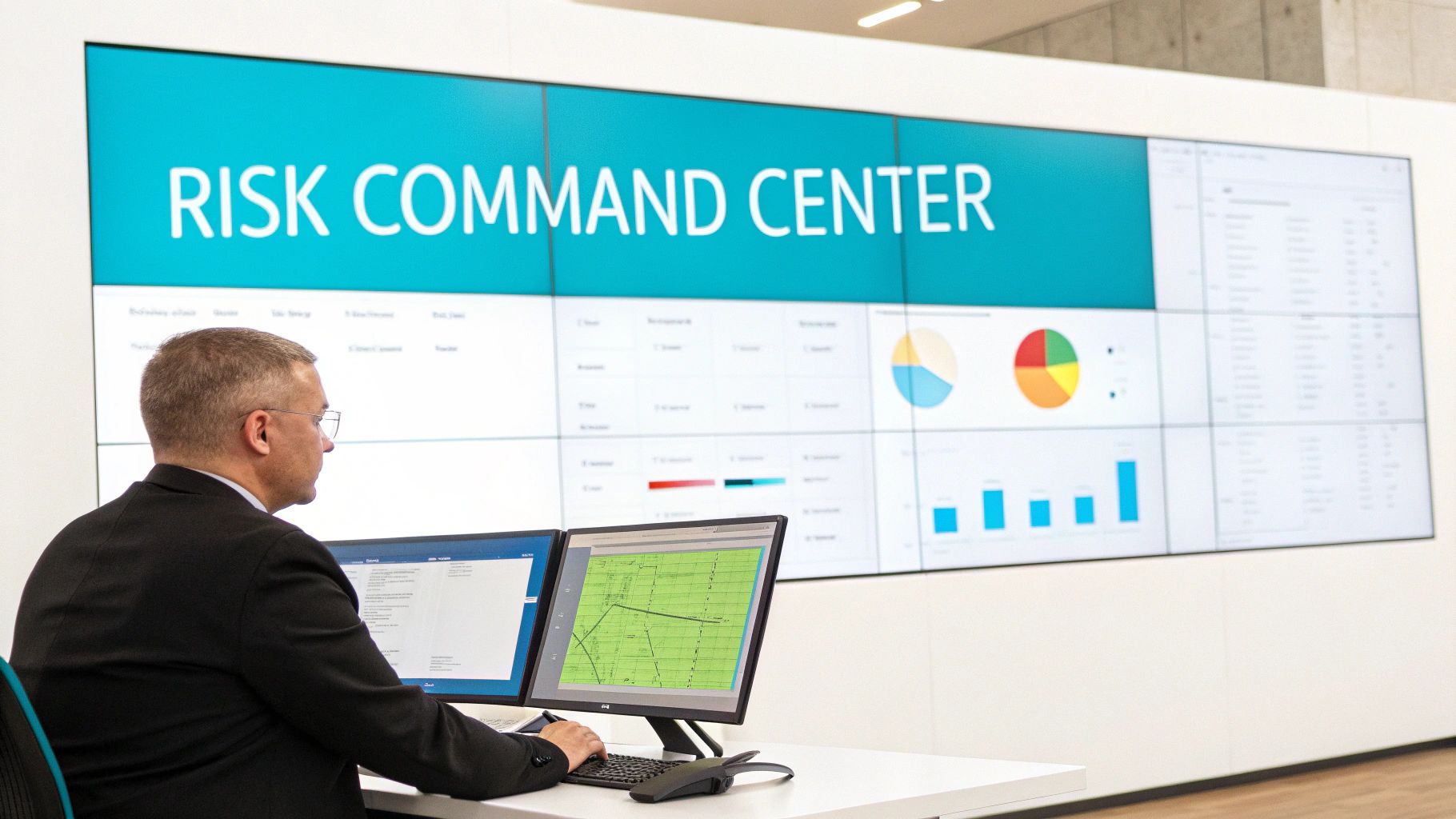
A top-tier enterprise risk management solution is much more than a glorified spreadsheet for tracking problems. Think of it as an active command center for your entire organization, giving you a unified, real-time view of every potential threat simmering beneath the surface.
These platforms are designed to pull risk management out of its siloed, manual past and turn it into a smart, strategic function. To do that, they rely on a few core capabilities that all work together.
Seeing Around Corners: Advanced Threat Identification
The first job of any ERM platform is to answer a simple question: what could possibly go wrong? Traditional methods like workshops and interviews are still useful, but they’re slow and can easily miss subtle, interconnected threats.
Today's solutions are different. They use data analytics and AI to constantly scan your operations and the external environment, flagging risks that a human team might never spot. An ERM platform, for example, can sift through millions of transactions to find the tiny anomalies that hint at fraud. This is proactive defense—getting ahead of a problem before it has a chance to blow up.
Once a risk is flagged, the platform gives you the tools to properly assess it, weighing its potential impact against the likelihood it will happen. This is how your teams know exactly where to focus their energy.
Turning Static Data Into Real-Time Intelligence
Identifying risks is one thing, but keeping an eye on them is another. The days of relying on stale, quarterly risk reports are over. Modern enterprise risk management solutions serve up live dashboards and automated alerts that transform a sea of data into genuine, actionable intelligence.
This shift toward dynamic monitoring is a big reason the global ERM market is projected to jump from USD 5.17 billion in 2025 to USD 7.28 billion by 2029. Leaders everywhere are recognizing that you can't manage today's risks with yesterday's tools.
These dashboards give executives an at-a-glance view of the company's entire risk posture. They track key risk indicators (KRIs) that send up a red flag the moment a metric starts drifting toward a danger zone.
A modern ERM platform acts like a central nervous system for the organization, sensing changes in the risk environment and sending immediate signals to the right people so they can respond quickly and decisively.
From Insight to Action: Mitigation and Collaboration
Spotting and watching risks is only half the battle. The real value is created when you turn that insight into decisive action. That's where built-in mitigation workflows and collaboration tools come in.
When a risk needs attention, the system can automatically assign tasks, set deadlines, and track every step toward resolution. This creates clear accountability and finally breaks down the walls between departments.
Imagine a new cybersecurity vulnerability is found. The platform can instantly create a ticket for the IT security team, loop in the compliance officer for oversight, and keep the chief risk officer in the loop—all from one single source of truth.
To make these workflows even smarter, many platforms now use Intelligent Process Automation (IPA) solutions to handle the routine work. For a closer look at the technologies that make this possible, check out our deep dive into essential enterprise risk management tools.
To bring it all together, let’s break down these core functions and the value they deliver.
Essential Capabilities of ERM Solutions
Capability | Description | Business Value |
|---|---|---|
Risk Identification | Using AI and data analytics to proactively uncover hidden threats across the organization. | Moves from a reactive to a preventive stance, reducing the likelihood of surprises and major incidents. |
Real-Time Monitoring | Live dashboards and automated alerts that provide an up-to-the-minute view of the risk landscape. | Enables faster, more informed decision-making and eliminates the blind spots created by outdated reports. |
Mitigation Workflows | Automated, trackable workflows that assign tasks and ensure follow-through on risk responses. | Creates clear accountability, streamlines remediation efforts, and ensures nothing falls through the cracks. |
Collaboration Tools | A unified system for cross-functional teams to communicate and coordinate on risk management activities. | Breaks down departmental silos, improves communication, and ensures a cohesive response to threats. |
Ultimately, these capabilities work in concert to transform risk management from a disconnected, compliance-driven chore into a strategic driver of organizational resilience.
How to Choose the Right ERM Solution
Picking the right enterprise risk management solution is less like buying a piece of software and more like choosing a strategic partner. This isn't just about a feature list; it's a decision that will define your company's resilience for years to come. The goal is to find a platform that plugs into the very fabric of how you operate.
The whole process has to start with integration. A platform that can't talk to your core systems—your ERP, CRM, and HR platforms—is just another data silo waiting to happen. Real integration creates a single source of truth for risk, letting you see how a disruption in the supply chain could ripple through your financial forecasts, or how a new hire impacts your compliance standing.
Prioritizing Scalability and User Experience
Your business is always evolving, and your risk landscape right along with it. The ERM solution you choose has to be able to grow with you. That means digging into its scalability and flexibility. Can the platform adapt on the fly to new regulations, expand to cover new business units, or handle a massive spike in data without breaking a sweat?
A rigid system that can’t keep up with your strategy will become a liability almost overnight. Look for solutions that offer configurable workflows and reporting. The tool has to mold to your processes, not the other way around.
Just as critical is the user experience (UX). The most powerful enterprise risk management solutions are useless if they're too clunky for your teams to actually use. A clean interface, clear dashboards, and simple navigation are what drive adoption across the organization—and that's the only way you build a truly risk-aware culture. If your front-line managers and department heads hate using the tool, they just won't, and your investment goes down the drain.
A great ERM solution should feel like a natural extension of your team’s workflow, not an obstacle to overcome. The key is to find that perfect balance between powerful functionality and everyday usability.
Evaluating Vendor Support and Partnership
Finally, you have to look beyond the software and size up the vendor. A real partner does a lot more than just sell you a license. They should be there to provide solid support through the entire lifecycle of your relationship.
This includes:
Implementation and Onboarding: A clear, structured process to get your team up and running without any headaches.
Ongoing Training: Easy access to resources that help both new and existing users get the most out of the platform.
Strategic Guidance: A partner who actually understands your industry and can give you advice on best practices, not just on how to use their tool.
Choosing an ERM solution is a serious commitment. By focusing on integration, scalability, user experience, and the quality of the vendor partnership, you can find a platform that not only solves today's problems but also gives you the confidence to navigate whatever risks tomorrow throws at you. This thoughtful approach makes sure your chosen solution becomes a genuine asset for sustainable growth.
The Growing Impact of AI in Risk Management
Artificial intelligence isn't just a buzzword in risk management anymore—it's the engine powering the smartest enterprise risk management solutions available today. This technology is completely changing how businesses see and handle threats, moving the entire field from a reactive, backward-looking chore to a proactive, forward-looking strategy.
Instead of waiting for a risk to blow up into a full-blown crisis, AI-driven platforms serve as a constant early-warning system. They scan mountains of data—from global news and social media feeds to obscure regulatory filings—to spot emerging threats before they make headlines. This gives leaders the critical time they need to act decisively.
From Anomaly Detection to Predictive Insight
Internally, machine learning algorithms are incredibly good at finding subtle anomalies inside company data that a human analyst would almost certainly miss. These tiny deviations from normal operational patterns can be the very first signs of potential fraud, process failures, or even insider threats.
This capability turns raw, noisy data into clear, actionable intelligence. It's a massive shift, with AI now taking center stage. In fact, by 2025, an estimated 70% of risk managers will place AI at the heart of their strategies. We're already seeing the impact, as organizations using AI-driven ERM report 35% fewer compliance violations.
This infographic breaks down what companies look for when choosing an ERM solution, showing that core needs like integration, scalability, and user experience are top priorities.
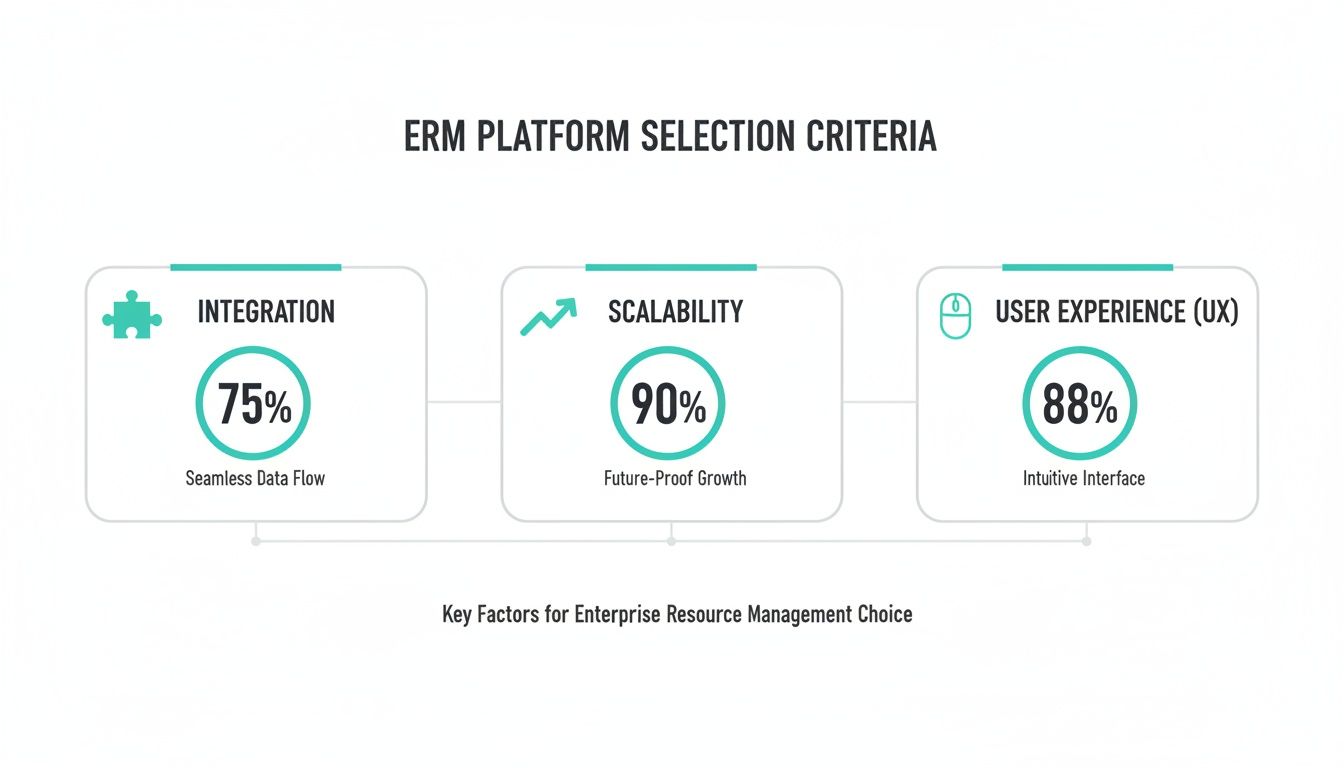
It’s a clear reminder that for an ERM platform to be successful, it has to plug into existing systems seamlessly while being easy to use and ready to grow with the business.
Harnessing AI for Proactive Human Risk Management
AI's reach now extends deep into managing human-related risks, an area that has always been tough to get a handle on. Modern systems can now identify patterns and risk indicators that point to potential misconduct or integrity issues without ever resorting to invasive employee surveillance. You can check out our guide on AI-powered human risk management to learn more.
This is where ethical AI design is non-negotiable. The goal isn't to monitor people; it's to identify the structural and procedural weak points that allow risk to fester in the first place. This approach helps protect both the organization and its employees by getting to the root of the problem.
AI enables ERM to move from being a system of record for past failures to a system of insight for future resilience. It provides the ability to connect seemingly unrelated dots across the enterprise to form a clear picture of emerging threats.
To really get a feel for this evolution, it helps to understand the wider trends in AI software development and its future impact across different industries. By bringing these advancements into your strategy responsibly, you can build a more resilient and ethically sound defense against an increasingly complex risk environment.
Putting ERM Solutions into Practice Across Your Business
This is where the theory hits the road. To see the real power of enterprise risk management solutions, you have to look at how they solve specific, everyday problems for departments across the entire organization—not just for a central risk team.
When an ERM platform is woven into the fabric of your business, it demolishes the walls that traditionally keep departments siloed. It creates a common language and a shared view of risk, turning disconnected efforts into a unified strategy for building true resilience.
Unifying Human Resources and Integrity Risk
Human Resources (HR) sits at the nexus of some of the most complex human-related risks an organization faces, from talent retention and employee safety to protecting the very culture of the company. An ERM platform completely changes how HR tackles these challenges.
Instead of just reacting to incidents, HR can use the system to proactively spot procedural weaknesses or cultural trends that might lead to misconduct down the line. For instance, the platform can flag early indicators of ethical risk or potential conflicts of interest based on structured data, giving leadership a chance to intervene before a small problem blows up.
Let's be clear: this isn't about surveillance. It’s about creating a fairer, more transparent environment where risks are addressed at a systemic level.
An integrated ERM solution empowers HR to move beyond administrative tasks and become a strategic guardian of the organization's integrity, using data to build a healthier and more resilient workforce.
Streamlining Compliance and Finance
For compliance and finance teams, getting ready for an audit can feel like a mad dash to collect evidence from a dozen different systems and a hundred different people. An enterprise risk management solution transforms this chaotic fire drill into a smooth, continuous workflow.
Think about dense regulations like the Sarbanes-Oxley Act (SOX) or GDPR. The platform automates the heavy lifting of tracking and documenting compliance activities all year long.
Automated Control Monitoring: It constantly checks that your internal controls are working as they should, sending out alerts the moment something deviates from the norm.
Centralized Evidence Repository: All the evidence an auditor could ever want is stored in one secure, easily accessible place. No more last-minute scavenger hunts.
Clear Audit Trails: Every single action taken within the system is logged, creating a transparent and defensible record that makes auditors happy.
Fortifying IT and Vendor Risk Management
The IT department is on the front lines, facing a constantly shifting threat landscape that ranges from sophisticated cyberattacks to the risks introduced by every new third-party vendor. An ERM platform gives them a centralized command center to manage this sprawling, complex ecosystem.
It allows IT to run comprehensive risk assessments on new vendors, track their security posture over time, and manage contract compliance—all in one place. When a new vulnerability is discovered, the platform can trigger automated workflows to ensure the risk is assessed, assigned to the right person, and fixed fast, keeping the entire organization secure.
Measuring the True ROI of Your ERM Investment
Justifying an investment in an enterprise risk management solution isn’t a simple cost-benefit calculation. How do you actually prove that getting ahead of risk is paying off? The real return on investment (ROI) shows up in both hard numbers on your balance sheet and powerful strategic advantages that protect your company’s value.
On one hand, you have the straightforward financial wins. These are the direct gains you can point to and quantify.
Reduced Regulatory Fines: Stronger compliance controls and clear, defensible audit trails directly cut your risk of facing costly penalties.
Lower Insurance Premiums: When you can demonstrate a mature, proactive approach to managing risk, insurers often reward you with much more favorable terms.
Minimized Business Disruption Losses: By anticipating and neutralizing operational risks before they hit, you avoid the massive expense of downtime and lost revenue.
Beyond the Balance Sheet
But honestly, the less tangible benefits are often where the real magic happens. These strategic gains are what build long-term resilience and give you a serious competitive edge. Think of them as the hidden dividends you get from building a strong risk culture.
The most profound value of an ERM solution lies in its ability to transform risk from an unpredictable threat into a strategic asset. It equips leaders with the foresight to make smarter, more confident decisions that drive sustainable growth.
This is more critical than ever. The global Enterprise Risk Management (ERM) market is set to explode from USD 5.21 billion in 2025 to USD 8.73 billion by 2035. This surge is being driven by threats like data breaches, which now cost an average of USD 4.45 million per incident. That number is pushing over 70% of major enterprises to finally bake ERM into their core strategic planning.
A solid ERM program does more than just stop bad things from happening. It strengthens your corporate reputation and gives investors the confidence they need to bet on your future. To see how these efforts connect to real-world outcomes, check out our article on the ROI of building an integrity culture. When you frame your ERM investment this way, you can build a business case that shows its true value as a direct driver of growth.
Your Questions, Answered
When you're looking at enterprise risk management solutions, you're bound to have questions. Let's dig into some of the most common ones we hear from decision-makers who are trying to get ahead of risk.
How Long Does This Actually Take to Implement?
There’s no magic number here. A full implementation can take anywhere from a few months to over a year, and it really depends on the size of your company, the complexity of your data, and how many systems need to talk to each other.
That's why most organizations don't try to do it all at once. They take a phased approach, focusing on the highest-priority risks first. This way, you start seeing value right away, and your teams get a chance to adapt and give feedback before you roll it out company-wide.
Is ERM Software Just for the Big Guys?
Not anymore. It used to be that only massive corporations had the budget and resources for a true ERM platform, but modern, cloud-based solutions have completely changed the game. Now, these powerful tools are well within reach for mid-sized businesses.
In fact, for a company on a growth trajectory, an ERM solution isn't just a nice-to-have; it's essential. It gives you a scalable foundation to manage the new complexities that come with expansion, making sure your risk management grows right alongside your business.
The real difference between basic compliance software and a genuine ERM solution comes down to strategy. Compliance tools are usually reactive, designed to check boxes for specific regulations. An ERM platform is proactive and holistic, giving you a strategic view of all business risks so you can make smarter decisions.
This proactive approach is what turns risk management from a simple cost center into a strategic function that both protects the business and helps uncover new opportunities.
Ready to transform your risk management from reactive to proactive? Discover how Logical Commander Software Ltd. provides an AI-driven, ethics-by-design platform that helps you identify and mitigate human-related risks before they escalate. Learn more and protect your organization at https://www.logicalcommander.com.