%20(2)_edited.png)

Ethics in the Workplace: A Guide to Proactive Risk Prevention

Updated: Dec 15, 2025
Peel back the layers of any resilient, high-performing organization, and you'll find a strong ethical core. Ethics in the workplace are not just a dusty policy manual; they are the living principles that steer every decision, action, and interaction, directly impacting business liability and success.
This foundation is a critical driver of long-term value, influencing everything from employee loyalty and brand reputation to the bottom-line financial health of the business. It’s the difference between managing risk and being managed by it.
Why Ethics in the Workplace Is Your Greatest Asset
In today's high-stakes business environment, a genuine commitment to ethics is a core imperative. Companies that move beyond basic compliance to build a deeply embedded ethical culture don't just avoid legal trouble; they gain a significant competitive edge by proactively managing human-factor risk.
This is about creating an environment where employees feel secure, customers feel confident, and the business can grow sustainably, protected from the internal threats that derail unprepared organizations.

The stability and growth seen in ethical organizations stand in sharp contrast to the high-cost game of reactive investigations. If you’re waiting for an incident to happen, you’ve already lost. The financial penalties, reputational damage, and shattered morale will always cost far more than a proactive investment in prevention.
The True Value of an Ethical Framework
An authentic ethical framework delivers clear benefits that protect the entire organization from insider risk. It separates businesses that merely react from those that lead their industry with integrity and foresight.
Key business impacts include:
Enhanced Brand Reputation: A solid ethical standing builds trust with customers and partners, protecting your brand from the fallout of misconduct.
Improved Employee Engagement: When people believe their company operates with integrity, they are more engaged and productive, reducing human-factor risk.
Reduced Operational & Legal Risk: Ethical cultures naturally mitigate the human-factor risks that lead to fraud, misconduct, and costly compliance breaches.
Attraction of Top Talent: High-performing professionals actively seek employers with a reputation for integrity, reducing hiring costs and improving workforce quality.
Trust as a Business Metric
Public perception is a critical measure of a company's health and its vulnerability to reputational damage. The Edelman Trust Barometer Global Report shows that perceptions of business ethics have shot up by 19 percentage points since 2020, making business the most trusted institution globally.
But that trust is fragile. The same report reveals that business is viewed as 81 points less ethical among groups with high grievances. This highlights the immense reputational and financial liability of a single ethical failure. You can explore the full study about global trust perceptions to see how these dynamics play out.
An ethical workplace doesn't just prevent problems; it creates opportunities. It transforms risk management from a defensive liability into a strategic driver of growth and lasting value.
This modern approach to managing human-factor risk means moving away from outdated, invasive surveillance and toward intelligent, AI-driven insights that respect employee privacy and align with EPPA regulations. This sets a new, proactive standard in corporate governance, where ethical integrity and business success are intertwined.
Moving From Reactive Investigations to Proactive Prevention
For too long, organizations have treated internal risks like fires. They wait for an alarm—a whistleblower report, a failed audit, or a media leak—before scrambling to manage the damage. This reactive posture is a failing strategy, where a single incident can spiral into a full-blown crisis, creating massive liability.
The problem with this approach is its focus on the aftermath, not the cause. By the time an investigation begins, the damage is done. The financial losses, reputational harm, and cultural corrosion are already spreading through the organization.
The True Cost of Waiting for an Incident
The costs of being reactive go far beyond financial penalties. Waiting for an incident to erupt forces a company into a defensive position, leading to a cascade of negative consequences that cripple growth and expose the organization to further risk.
These consequences almost always include:
Massive Financial Drain: Investigations are incredibly expensive, involving legal fees, forensic audits, and potential regulatory fines that can easily run into the millions.
Reputational Damage: News of misconduct shatters trust with customers and investors, hammering brand value and creating long-term business impact.
Cultural Disruption: Lengthy, stressful investigations create a culture of suspicion that poisons morale, tanks productivity, and drives your best talent away.
Operational Paralysis: Key leaders are pulled away from their actual jobs to manage the crisis, stalling innovation and grinding business growth to a halt.
This cycle of reacting to problems is completely unsustainable. You can learn more about the true cost of reactive investigations in our detailed analysis, which breaks down the hidden financial and operational burdens.
Shifting Focus to Human-Factor Risk
Technology is rarely the root cause of an internal crisis. The primary driver is almost always the human factor—the decisions and behaviors of people inside your organization. Whether it’s fraud, a compliance breach, or a conflict of interest, the risk originates with a human choice.
Relying solely on reactive investigations is like navigating a minefield by waiting for explosions. A proactive strategy gives you the map to see and neutralize internal threats before you take a wrong step.
Traditional methods like surveillance and forensics fail because they are designed to look backward. They analyze events that have already happened, trying to piece together a puzzle after the damage is done. This is a fundamentally flawed approach to modern internal threat detection and risk management.
The Proactive Advantage with Ethical AI
A modern framework for ethics in the workplace requires foresight. It demands a shift from cleaning up messes to preventing them. This is where AI-driven preventive risk management offers a decisive advantage over outdated methods.
Unlike intrusive surveillance tools that create a legal and ethical minefield, a truly ethical, non-intrusive platform operates differently. It uses AI to provide insight into systemic vulnerabilities without monitoring individual employees. This approach is designed to be fully aligned with regulations like the Employee Polygraph Protection Act (EPPA), safeguarding both the company and its people. This is the new standard of internal risk prevention.
By using ethical risk management and AI-powered assessments, organizations can:
Identify potential risk indicators before they escalate into incidents.
Address systemic vulnerabilities in processes and policies.
Foster a culture of integrity and trust, not one of suspicion.
Protect financial stability and brand reputation proactively.
This preventive model empowers Compliance, HR, and Legal leaders to break free from the endless cycle of reaction and build a more resilient, ethical, and secure organization from the inside out.
Building a Framework for Ethical Risk Management
A truly ethical workplace is built with intention. The difference between a company that merely talks about ethics and one that lives them is a robust framework for managing human-factor risk. This is what protects your organization and reduces liability.
This framework stands on four pillars: transparency, fairness, accountability, and a deep respect for privacy. Weaving these principles into your risk management strategy creates a system that is inherently compliant with regulations like the Employee Polygraph Protection Act (EPPA). It’s a deliberate move away from legally hazardous surveillance and toward a culture of genuine integrity.
The diagram below illustrates the required shift from a reactive, damage-control mindset to one focused on proactive prevention.
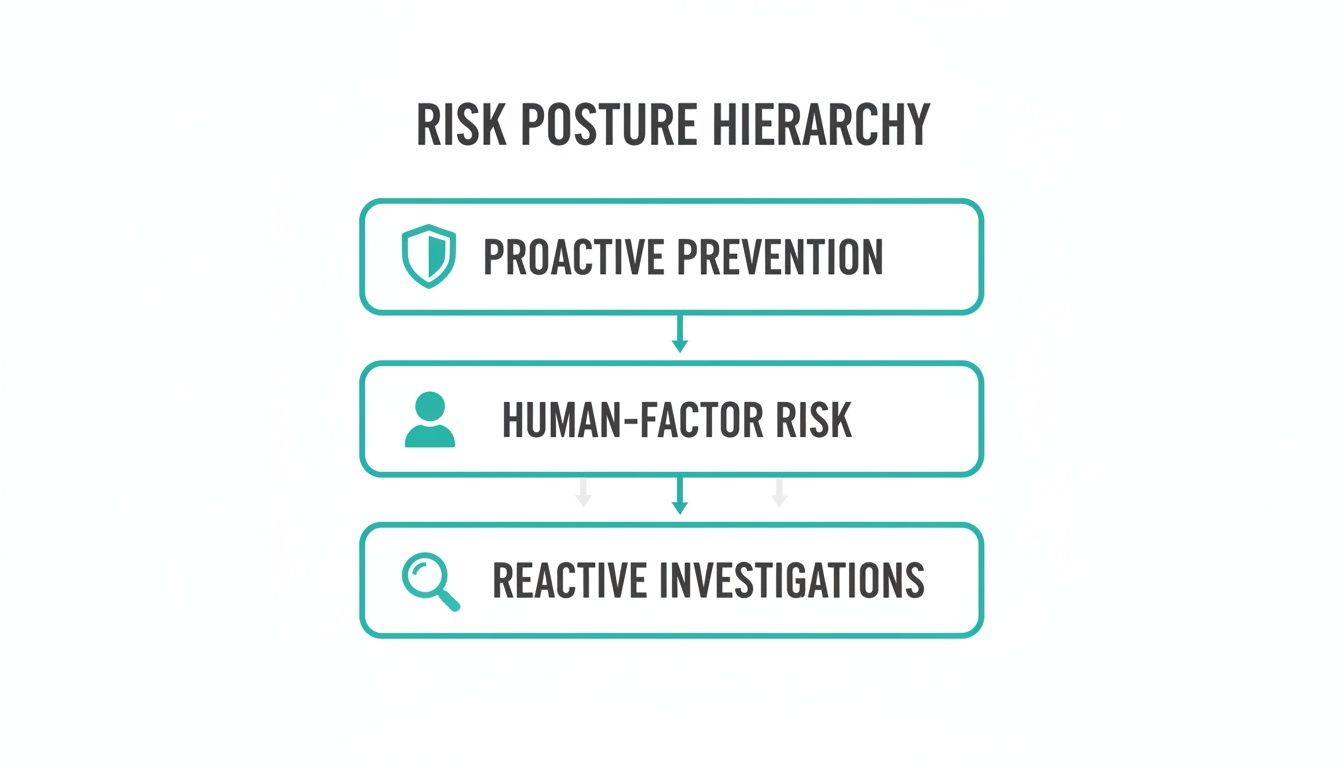
This hierarchy makes it clear: by prioritizing proactive prevention, you address human-factor risk at its source, dramatically reducing the need for costly and damaging reactive investigations.
The Foundational Pillars of an Ethical Framework
Let’s look at how these pillars function in the real world to mitigate business impact and liability.
Transparency: Clear, open communication is essential. Employees need to understand the "why" behind policies and decisions. * Success Story: A company introduces a new conflict of interest disclosure process. Leadership clearly explains the goal is to protect both employees and the company from reputational damage, not to police personal lives. The process is straightforward, leading to high adoption. * Failure Scenario: An organization rolls out a vague "integrity policy." Employees see it as a tool for arbitrary punishment, breeding fear and a reluctance to report real concerns, which increases internal risk.
Fairness: Rules and consequences must be applied consistently across the entire organization, from the intern to the CEO. * Success Story: When a code of conduct violation occurs, the company applies its disciplinary process uniformly, whether the person is a junior employee or a senior executive. This reinforces that nobody is above the rules. * Failure Scenario: A top salesperson violates expense policies but gets a pass. Other employees see that the rules don't matter. Morale plummets, and misconduct is implicitly encouraged.
Accountability and Respect for Privacy
Accountability ensures people take ownership of their actions, while respect for privacy guarantees that your risk management program doesn’t become intrusive employee monitoring.
An ethical framework is built on the belief that you can protect the organization without compromising the dignity of its people. It's about empowering good decisions, not just reacting to bad behavior.
Holding people accountable is crucial, but the how separates a healthy culture from a toxic one. An approach grounded in ethical risk management focuses on fixing systemic issues, not just placing blame. You can learn more in our detailed guide on creating a culture of accountability.
This brings us to the most critical pillar:
Respect for Privacy: Modern ethics in the workplace standards demand a non-intrusive approach. This means no surveillance, secret monitoring, or other tactics that destroy employee trust and violate EPPA regulations. These methods are what our competitors often use, exposing their clients to significant legal risk. * Success Story: Instead of monitoring communications, a firm uses an AI-driven, consent-based risk assessment platform to find vulnerabilities in its compliance controls. The focus is on strengthening systems, not on policing individuals. * Failure Scenario: A company installs keylogging software. This move destroys trust, leads to high turnover, and exposes the company to massive legal liability under privacy and labor laws.
By building your framework on these pillars, you create a sustainable system for internal risk management—one that fosters integrity, ensures compliance, and protects your business.
How an Ethical Culture Impacts Your Bottom Line
Many leaders still see investing in an ethical culture as a cost center. That perspective misses the point entirely. A culture of integrity isn't an expense; it's a powerful driver of financial performance that directly impacts profitability, reduces liability, and increases long-term value.
Frankly, it’s one of the smartest investments an organization can make. Companies that put ethical practices at their core consistently outperform their peers. This advantage is the direct result of reducing major internal risks while unlocking growth opportunities.

The Financial Benefits of Proactive Ethics
When you get proactive about ethics in the workplace, you see tangible financial returns. By addressing human-factor risks before they become crises, you sidestep the staggering costs of fraud, litigation, employee turnover, and regulatory fines.
The financial advantages are clear:
Reduced Litigation and Compliance Costs: An ethical framework minimizes misconduct, drastically lowering your risk of expensive lawsuits and penalties.
Lower Employee Turnover: People are more loyal to organizations they see as fair. Lower turnover slashes recruitment and training expenses.
Enhanced Brand Value: A solid ethical reputation attracts loyal customers, creating a durable competitive advantage that fuels revenue.
Attraction of Top Talent: High-performers actively seek ethical employers, giving those companies an edge in the war for talent.
The Quantifiable 'Ethics Premium'
This financial edge isn't theoretical; it's measurable. Research from Ethisphere has quantified this as the "Ethics Premium," proving that its honorees consistently outperform their global peers. From January 2020 to January 2025, these ethical leaders showed a 7.8% higher market performance.
This isn't based on feelings. The data is backed by metrics from over three million employees and analysis of more than 240 Ethics Quotient points across ESG and compliance.
An investment in an ethical framework is a direct investment in business resilience. It moves risk management from a defensive function to a strategic enabler of sustainable growth and profitability.
The numbers don't lie: an ethical workplace is a profitable one. To drive this home, you can learn how to demonstrate the ROI of ethics training and other integrity initiatives. Understanding The Cultural ROI of Integrity helps leaders reframe these investments as a crucial part of their financial strategy.
How to Embed Ethics into Your Organizational DNA
Having a policy document is not enough. You must build a living culture where people make the right call, even when no one is watching. The real work begins when you move ethics in the workplace from theory to action, weaving it so deeply into your operations that it becomes part of your company’s DNA.
This requires a united front from Compliance, HR, and Legal leaders to create a practical roadmap that every employee can follow.
The journey must start at the top. Ethical behavior has to be championed relentlessly by leadership, not just in emails but in every decision they make. When leaders model integrity, they send a powerful message: this is non-negotiable.

That commitment is the foundation, but a solid framework built into core processes is needed to make it stick. The goal is to make ethical thinking a natural part of the daily workflow. A healthy workplace is essential; exploring strategies for improving overall workplace culture can support this initiative.
Operationalizing Your Ethical Framework
To get your ethical framework into practice, it must show up at every stage of the employee lifecycle. This creates consistency and reinforces that integrity is a key performance metric.
Key moments for integration include:
Hiring and Onboarding: Screen for integrity from the start. Use behavioral questions in interviews to assess how candidates handle ethical dilemmas, and make your code of conduct a central pillar of onboarding.
Performance Reviews: Stop focusing only on what employees achieve and start looking at how they achieve it. Make ethical conduct a formal part of every performance review cycle.
Promotions and Recognition: The people you promote tell everyone what you truly value. Reward and elevate individuals who demonstrate strong ethical leadership. This signals that integrity is the path to advancement.
Unfortunately, this is where most companies fail. There's often a disconnect between policy and reality, especially at the middle-management level.
LRN's Global Study on Ethics & Compliance Program Maturity found that only 31% of organizations formally evaluate ethical behavior in performance reviews. This creates a dangerous chasm between what a company says it values and what it actually rewards, increasing liability.
Failing to connect ethics to performance is a critical vulnerability. Without that link, your ethics program is just an idea—it has no teeth.
Empowering Middle Management as the Crucial Link
Middle managers are the essential bridge between C-suite strategy and frontline reality. If they aren’t equipped to champion and enforce ethical standards, the entire structure will collapse. They translate high-level policies into day-to-day reality.
Empowering them demands dedicated training and clear communication so they can confidently navigate gray areas and reinforce the right behaviors. Providing them with the right tools is non-negotiable. Boost their skills with our guide on integrity training courses designed for managers.
Fostering a Culture Without Suspicion
One of the toughest challenges is embedding these standards without creating a culture of fear. Your goal should be an environment of psychological safety where people feel comfortable speaking up about concerns without worrying about retaliation.
This requires a fundamental shift from a punitive to a preventive mindset. Instead of focusing on "catching" bad actors, the emphasis should be on empowering good decisions and strengthening the systems that prevent misconduct. An ethical culture thrives on trust, not surveillance. By weaving ethical guardrails into how you hire, review, and promote, you make integrity a tangible, measurable part of your company's identity.
Setting a New Standard in Ethical Risk Prevention
The future of managing internal risk is about proactively building a resilient, ethical workplace. For too long, companies have relied on traditional methods—costly, disruptive investigations that only begin after the damage is done.
This old model is broken. It creates a culture of suspicion, exposes companies to immense liability, and fails to address the root cause of the problem: the human factor.
The new standard is here, built on prevention, powered by AI, and designed to be ethical. It’s a move away from outdated and invasive surveillance tactics that destroy trust and violate regulations. The focus is on understanding and neutralizing systemic vulnerabilities before they can be exploited. This is how you create a stronger, more secure operational environment.
The E-Commander and Risk-HR Advantage
This new standard is what Logical Commander’s E-Commander platform, with its flagship Risk-HR module, was built for. It’s a complete shift in how organizations can get ahead of human-factor risk. Our platform is engineered to be EPPA-aligned and non-intrusive by design, ensuring your risk management practices are both effective and ethical.
We provide a powerful alternative to the legal and cultural minefield of employee monitoring. Our AI-driven preventive risk management system operates on transparency and consent, empowering you to strengthen your defenses without compromising employee dignity.
The goal is to move from a posture of policing individuals to one of protecting the entire organization. By identifying systemic risks, you build a culture where integrity is the path of least resistance.
Elevate Your Offerings with PartnerLC
For B2B SaaS providers, security consultants, and strategic allies, this evolution presents a massive opportunity. The demand for ethical risk management solutions is exploding as decision-makers recognize the liabilities of old-school methods. By joining our PartnerLC program, you can lead this critical shift in the market.
Partnering with Logical Commander allows you to:
Deliver Advanced Solutions: Offer clients a cutting-edge, AI human risk mitigation tool that sets you apart from competitors pushing reactive or intrusive technologies.
Enhance Client Value: Help clients build more resilient, ethical, and profitable organizations by addressing human-factor risk at its source.
Drive New Revenue Streams: Tap into a growing market of compliance, HR, and legal leaders seeking proactive, non-intrusive solutions.
This is your chance to be at the forefront of a new era in corporate governance—a more intelligent, compliant, and fundamentally ethical way to protect organizations from the inside out.
Answering the Tough Questions on Workplace Ethics
When building an ethical culture, leaders often face the same challenging questions. Let's tackle them head-on, providing direct answers aligned with a modern, proactive approach to managing internal risk.
How Can We Measure the ROI of an Ethics Program?
Measuring the ROI of an ethics program is about quantifying both cost savings and value creation. The most direct returns come from slashing costs tied to litigation, internal fraud, compliance penalties, and high employee turnover. When you prevent misconduct, those expenses disappear.
The indirect value is just as powerful. A strong ethical culture is a magnet for top talent, driving down recruitment costs and boosting productivity. It also builds brand trust, strengthening customer loyalty and contributing to higher market valuations. Modern Risk Assessments Software shows its value by quantifying the reduction in potential incidents, proving its worth long before a crisis erupts.
Is Using AI for Human Risk Another Form of Surveillance?
This is a critical distinction that separates modern, effective solutions from legally hazardous ones. Surveillance-based AI is the old way—secretly monitoring employee communications, creating massive legal and ethical nightmares under regulations like the EPPA. That approach is invasive and toxic to trust.
An ethical, EPPA compliant platform, in complete contrast, is built on consent and transparency. It doesn't monitor behavior or track individuals. Instead, it uses structured, objective assessments to analyze systemic risks and find organizational weak spots. The goal isn't to police individuals; it's to strengthen the company’s resilience by understanding risk factors. This approach protects the organization while safeguarding employee privacy.
What Is the Biggest Mistake Companies Make with Ethics Programs?
The most damaging mistake is treating ethics like a static, check-the-box compliance task dumped on HR or Legal. An ethics program isn't just a policy document; it must be a living part of your culture.
This failure becomes obvious when policies exist on paper but leaders don't champion them in daily operations. When ethical behavior isn't a factor in performance reviews and promotions, the program becomes a joke to employees. That disconnect breeds cynicism and sends a clear message that the rules don't actually matter, rendering the program useless for stopping real-world risk and increasing liability.
At Logical Commander, we provide the tools to build a proactive and ethical workplace culture. Our AI-driven, non-intrusive platform helps you identify and mitigate human-factor risk before it escalates, all while upholding employee dignity and ensuring regulatory compliance.
Ready to set a new standard for integrity in your organization?
Request a demo of our platform
Join our PartnerLC program
Start a free trial / get platform access
Contact our team for enterprise deployment