%20(2)_edited.png)

Mastering foreign corrupt practices act training: A practical compliance guide

Robust foreign corrupt practices act training is far more than a legal formality—it's one of the most critical shields you can build around your business. In a global marketplace, a single compliance slip-up can lead to devastating fines and permanently tarnish your brand. That's why proactive education isn't just a good idea; it's an essential defensive strategy.
Why FCPA Training Is Your Best Defense
Let's get one thing straight: hoping your team "just knows" the rules is a recipe for disaster. The Foreign Corrupt Practices Act (FCPA) has incredibly broad jurisdiction and is aggressively enforced. Ignorance is never an excuse.
A well-designed training program needs to move beyond dry legal jargon. It should provide a practical playbook that helps build a culture of integrity—one that actually works in the real world.
The goal is to empower everyone on your team, from the C-suite to the frontline sales reps. They need to be able to spot red flags, ask the right questions, and make the right call when they're under pressure. This isn’t about memorizing statutes; it’s about understanding the tricky real-world scenarios where good intentions can easily cross a serious legal line.
This visual shows how proactive risk identification flows directly into training, which then acts as a protective shield for the entire organization.
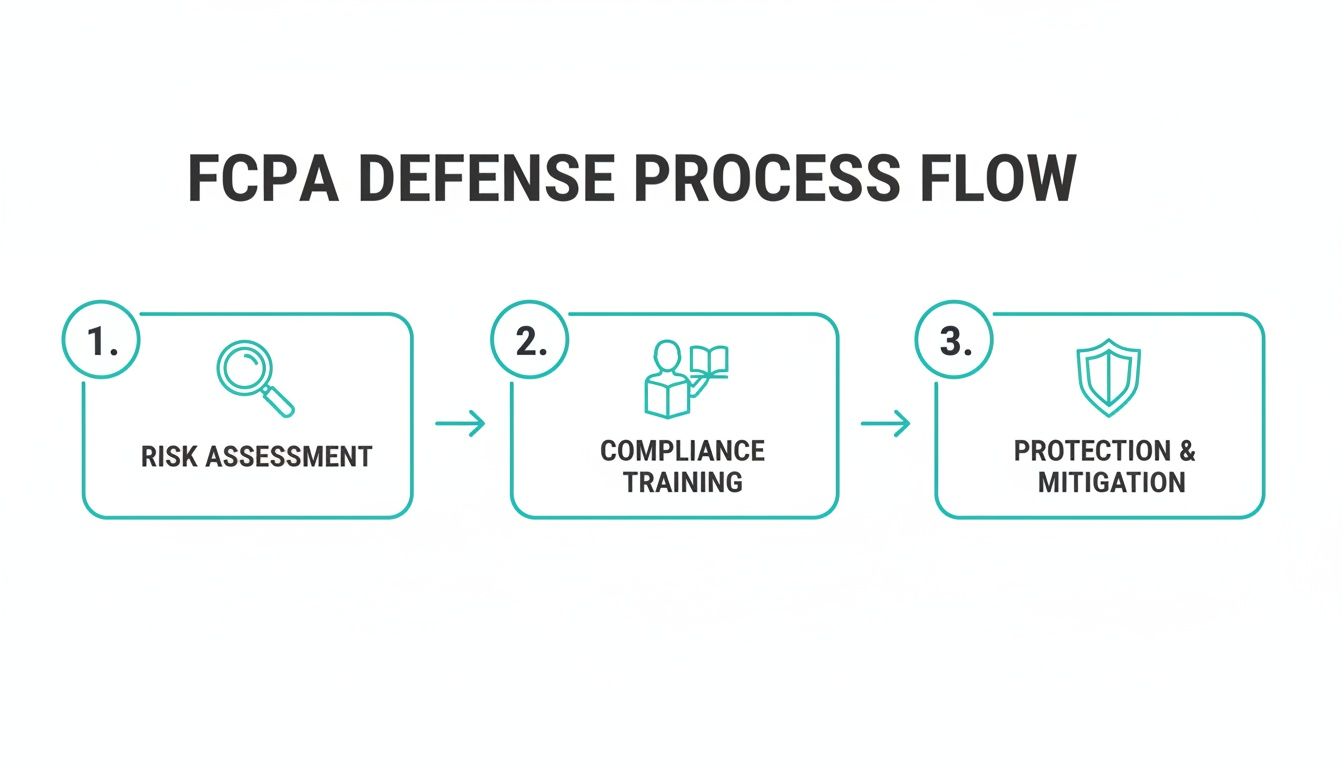
The graphic illustrates a simple but powerful truth: effective training is the bridge that connects identifying potential corruption risks to establishing a truly defensible compliance posture.
Shifting from Reaction to Prevention
In the past, many companies saw compliance training as a reactive measure—something you did after an issue popped up. The modern approach, which is strongly favored by regulators like the Department of Justice (DOJ), is all about prevention.
Having a documented, robust training program is often a key mitigating factor if an investigation ever occurs.
This proactive stance does more than just tick a box. It demonstrates a genuine commitment to ethical business practices and serves as tangible proof that you've taken reasonable steps to prevent and detect violations. Even more importantly, it fosters an environment where employees feel confident reporting concerns without fearing retaliation.
A strong compliance culture, cultivated through consistent and relevant training, is one of the most effective deterrents against misconduct. It signals to everyone that ethical behavior is non-negotiable.
Core Benefits of a Strong Program
Implementing a comprehensive training program delivers tangible benefits that go far beyond just avoiding fines. A well-structured initiative helps:
Protect Brand Reputation: A single FCPA violation can cause immense reputational harm that takes years, and millions of dollars, to repair.
Empower Employees: Clear guidance gives your team the confidence to navigate complex situations involving third-party agents, gifts, and hospitality.
Create a Defensible Position: Should an issue arise, a well-documented training history can demonstrate good-faith efforts to comply with the law.
Improve Operational Integrity: It reinforces ethical standards across all business functions, from sales and marketing to procurement and finance.
Ultimately, investing in a high-quality foreign corrupt practices act training program is a strategic business decision. It's a key part of building a resilient and ethical organization, which you can learn more about in our guide to an effective anti-bribery and anti-corruption program.
Building a Foundation on Real-World Risk

Before you even think about designing a training module, you have to get brutally honest about where your company’s real vulnerabilities are. A one-size-fits-all approach to foreign corrupt practices act training isn’t just inefficient; it leaves dangerous blind spots that regulators love to find.
The most effective programs are all built on the same thing: a practical, business-specific risk assessment. This isn’t a box-checking exercise. It’s a strategic deep dive into your operations to identify the specific roles, regions, and business activities that carry the highest potential for corruption. This process becomes the blueprint for your entire training strategy, making sure you focus your time and money where they’ll actually make a difference.
Pinpointing Your High-Risk Areas
The first step is to look beyond the obvious. Sure, your international sales teams are a clear area of focus, but corruption risks can pop up in some of the most unexpected corners of your organization. A thorough review will help you uncover these hidden tripwires.
To do this right, you need to look at your business from multiple angles. Analyze your geographic footprint, the nature of your industry, and how much you rely on third-party agents and intermediaries. The goal is to move from a general awareness of FCPA rules to a concrete understanding of how those rules apply to your unique business context. To dig deeper into this process, check out our detailed guide on how to conduct a proper compliance risk assessment.
Don’t forget these often-overlooked high-risk functions:
Procurement and Supply Chain: The teams negotiating with international vendors or managing logistics in high-risk countries.
Finance and Accounting: Staff who approve and process payments to foreign agents, consultants, or partners.
Marketing and Business Development: Employees managing event sponsorships or promotional activities that could involve foreign officials.
Local Operations Management: In-country managers who handle permits, licenses, and other routine government interactions.
An effective risk assessment doesn't just list potential problems; it prioritizes them. It tells you exactly where to focus your training efforts first and most intensely, ensuring your program is both efficient and impactful.
Segmenting Your Audience for Maximum Relevance
Once you’ve mapped out your risks, the next move is to segment your audience. Not every employee needs the same firehose of information. Blasting a detailed legal breakdown to a low-risk domestic employee is a waste of their time, while a quick overview for a high-risk international agent is dangerously negligent.
Smart audience segmentation makes the training relevant, engaging, and directly applicable to what people do every day. This targeted approach dramatically increases retention and makes it far more likely that employees will actually apply what they've learned when it matters.
Here’s a practical way to group your employees for training:
Audience Group | Training Focus | Example Roles |
|---|---|---|
High-Risk Employees | In-depth, scenario-based training on bribery, third-party due diligence, and gifts. | International sales, business development, procurement leads. |
Management & Leadership | Focus on "tone from the top," oversight responsibilities, and responding to red flags. | C-suite, board members, regional directors. |
Financial & Support Staff | Training on accurate record-keeping, payment controls, and identifying suspicious transactions. | Accounts payable, finance managers, internal auditors. |
General Employee Population | Foundational awareness of the company's anti-corruption policy and reporting procedures. | All other employees. |
This kind of segmentation ensures your foreign corrupt practices act training becomes a targeted tool for risk mitigation, not just an annual chore. Effective Risk Management is the bedrock of any strong FCPA compliance program, allowing you to proactively identify and neutralize potential exposures.
This is exactly what regulators want to see. Robust, targeted training has been shown to slash violation rates by up to 50% in proactive companies. It equips employees to spot the bribery risks in third-party dealings, which is critical when those relationships account for nearly 70% of all FCPA violations.
Designing a Curriculum That Actually Sticks
An effective foreign corrupt practices act training curriculum isn't a legal lecture. That's the fastest way to get your employees to tune out. Instead, think of it as a practical toolkit designed to help them navigate the messy, gray areas they'll face in the real world.
A curriculum that just recites the law is destined to be forgotten minutes after the session ends. But one that tells stories, solves problems, and gives people a clear path of action? That’s what sticks.
Your goal is to translate dense legal definitions into clear, actionable guidance. Don't just define "bribery." Instead, walk your team through a tense scenario where a so-called "facilitating payment" to speed up a customs clearance feels necessary but could easily cross the line into an illegal act. This approach is what turns abstract rules into memorable, hard-wired lessons.
Breaking Down Core FCPA Concepts
For your program to be defensible—and genuinely effective—it has to cover the core pillars of the FCPA. These topics are the absolute foundation of any robust anti-corruption effort, and your training needs to hit each one with total clarity, using examples that make sense for your industry.
Don't treat these as separate, siloed lectures. They're interconnected modules that should build on one another, each packed with scenarios that reflect an employee's daily responsibilities.
Key topics must include:
Defining Bribery and "Anything of Value": You have to go way beyond cash. Explain that "value" can be a lavish gift, a job for a government official's relative, a directed charitable donation, or even covering extravagant travel expenses. The definition is broad for a reason.
Navigating Gifts, Travel, and Entertainment: Give people clear, bright-line rules and a simple pre-approval process. Use concrete examples. A modest, company-branded pen is fine. Front-row concert tickets for a foreign official and their entire family are not.
Managing Third-Party Risks: This is non-negotiable, since third parties are involved in a massive number of FCPA cases. Your training has to cover due diligence, contractual safeguards, and the specific red flags to watch for when you bring on agents, consultants, or distributors in high-risk markets.
The Books and Records Provision: Explain this in simple business terms. It’s not just an accounting issue; it’s about making sure every payment is recorded accurately and transparently. A mislabeled payment intended to hide a bribe is a direct violation of the law.
Your curriculum's primary job is to close the gap between knowing the rule and knowing what to do. An employee might know not to bribe someone, but do they know how to politely refuse a government official's request for an "expediting fee"? That's the gap you need to fill.
Making the Lessons Memorable With Real-World Scenarios
The secret to a curriculum that actually changes behavior is context. Adult learners retain information when they can see its direct application to their job. This is exactly where generic, off-the-shelf training modules fall flat.
Ditch the theoretical discussions. Build your training around realistic case studies—ideally, ones drawn from your own industry or even sanitized versions of past internal incidents. This makes the risk feel immediate and real, not like a problem that happens to other companies.
For instance, a sales team in the medical device industry will get far more value from a scenario about providing "samples" to a state-owned hospital than a generic example about construction permits. The closer the scenario is to their reality, the more potent the lesson.
To help you structure your content, here’s a breakdown of essential topics to include in your training curriculum.
Core Topics for Your FCPA Training Curriculum
This table outlines the essential training modules, their objectives, and the key audiences they should target.
Module | Learning Objective | Primary Audience |
|---|---|---|
FCPA Fundamentals | Understand the core anti-bribery and accounting provisions of the act. | All Employees |
Gifts & Entertainment | Learn to identify appropriate vs. inappropriate expenditures and follow approval protocols. | Sales, Marketing, Business Development |
Third-Party Due Diligence | Recognize red flags and know the process for vetting and monitoring agents and partners. | Procurement, Legal, International Operations |
Accurate Record-Keeping | Understand the importance of transparently and correctly documenting all transactions. | Finance, Accounting, Audit |
Speaking Up | Know the internal channels for reporting concerns without fear of retaliation. | All Employees & Leadership |
Think of this table as a starting point. The real magic happens when you customize these modules with scenarios and language that speak directly to each audience.
Centralizing Your Training for Consistency and Audits
As you build out these crucial modules, using a centralized platform is no longer a "nice-to-have"—it's essential. Juggling different versions of slideshows, documents, and videos across various departments is a recipe for inconsistency and a complete nightmare during an audit.
A unified platform ensures everyone is learning from the same approved materials, creating a single source of truth for your entire anti-corruption program. This isn’t just about convenience; it’s a critical component of a defensible compliance strategy.
When regulators come knocking and ask you to prove who was trained, on what, and when, a centralized system with detailed logs provides that evidence instantly. To learn more about creating a program that holds up under scrutiny, explore our guide on how to build an ethical corporate compliance training framework. This unified approach is fundamental to proving a genuine, systematic commitment to compliance.
Choosing Delivery Methods That Drive Engagement

You can have the most buttoned-up curriculum in the world, but it’s worthless if the delivery method sends people straight to sleep. How you present your foreign corrupt practices act training is every bit as critical as what you’re teaching. To really boost retention and build a proactive compliance culture, you have to move beyond the dreaded "death by PowerPoint."
The smartest approach is a blended one, mixing and matching different formats to fit specific teams and goals. This ensures everyone, from the C-suite to the front lines, gets the right information in a way that actually sticks. It’s all about picking the right tools for your company’s culture and specific risk profile.
The Power of Live Workshops for High-Risk Teams
For your people in high-risk roles—think international sales, procurement, or business development—nothing beats the impact of a live, interactive workshop. These sessions are perfect for deep dives into complex scenarios that are full of nuance and gray areas.
The real magic happens in the room. Live training opens the door for tough Q&A, lively group discussions, and role-playing exercises that mimic the high-pressure situations your team might actually face. It’s one thing to read about a bribery red flag on a slide; it's a completely different experience to navigate that ethical minefield with a facilitator guiding the conversation in real-time.
This is how you build critical thinking and reinforce the "tone from the top" through direct, face-to-face engagement with compliance leaders.
Scalable E-Learning for Foundational Knowledge
As powerful as live sessions are, they aren’t practical for getting foundational knowledge out to the entire organization. This is where well-designed e-learning modules really shine, offering a scalable, consistent, and cost-effective way to train a global workforce.
But modern e-learning is light-years beyond static slides and a final quiz. The most effective platforms weave in:
Interactive Quizzes: Short, frequent knowledge checks to lock in key concepts as they’re introduced.
Ethical Dilemma Simulations: Branching scenarios where users have to make a choice and see the immediate fallout from their decisions.
Embedded Video Content: Quick interviews with leadership or case study summaries to break up the text and add a much-needed human touch.
This approach guarantees every single employee gets the same core message about your anti-corruption policies and reporting channels, creating a documented baseline of understanding across the company.
The goal of any training isn't just completion; it's comprehension and application. Blending different formats creates multiple touchpoints, reinforcing lessons and making compliance a continuous part of the conversation, not a once-a-year event.
Microlearning for Continuous Reinforcement
Let’s be honest—the lessons from annual training can fade fast. That's where microlearning comes in, keeping compliance top-of-mind all year round. We’re talking about short, focused bursts of content: a two-minute video, a quick-read infographic, or a single-question quiz delivered via email or Slack.
Imagine sending a short video to the sales team covering best practices for gift-giving right before they head to a major international trade show. This "just-in-time" reinforcement is incredibly effective at turning abstract policies into immediate, practical action.
This strategy is even more powerful when supported by modern compliance tools that can flag risks in real time. For instance, some platforms offer modules that identify preventive risks, highlighting the need for targeted, FCPA-aligned training. The data backs this up. The Association of Corporate Counsel found that companies with effective training can slash their exposure by as much as 60%—a massive incentive to invest in continuous learning.
You can discover more insights on FCPA compliance trends that underscore the importance of these proactive measures. By choosing the right mix of delivery methods, your foreign corrupt practices act training becomes a dynamic, ongoing dialogue instead of a static requirement.
Measuring Success and Staying Audit-Ready
Rolling out your foreign corrupt practices act training is a huge milestone, but it's only half the battle. If you can't prove that the training actually works and maintain meticulous records, regulators will see your entire program as mere window dressing.
Effective measurement goes way beyond simple completion rates. It's about seeing if anyone actually absorbed the material, whether their behavior on the job changes, and—most importantly—creating a defensible audit trail that can withstand intense scrutiny.
Without a bulletproof system for documentation, your whole training program is built on a shaky foundation. A chaotic jumble of spreadsheets and sign-in sheets just won’t cut it when an auditor comes knocking.
Moving Beyond Simple Completion Rates
The most common mistake companies make is confusing course completion with actual understanding. Just because someone clicked through every slide doesn't mean they know how to apply that knowledge when faced with a high-pressure, real-world dilemma.
To get a real sense of your program's impact, you need to look at both knowledge retention and behavioral shifts. This dual focus gives you a much clearer picture of your return on investment and helps you spot exactly where your training needs to be sharper next time.
Here are a few practical ways to measure what really matters:
Pre- and Post-Training Assessments: Before the training kicks off, give your team a quick assessment with scenario-based questions. After the training, give them a similar—but not identical—test. A big jump in scores is powerful, tangible evidence that real learning took place.
Helpline and Reporting Trends: Take a hard look at the data coming from your ethics hotline or internal reporting channels. A sudden increase in thoughtful questions about gifts or third-party due diligence isn't a bad sign; it’s a great one. It shows that training is raising awareness and making people comfortable enough to seek guidance.
On-the-Job Observations: For your high-risk teams, managers can be trained to observe and document how employees are applying their new knowledge. For instance, are salespeople now more rigorous about getting pre-approvals for travel and entertainment expenses involving foreign officials?
A defensible training program is one you can prove is working. Data from assessments, helpline queries, and behavioral changes transforms your training from an expense into a documented, risk-mitigating asset.
Building an Unshakeable Audit Trail
When regulators start digging into a potential FCPA violation, one of the first things they'll ask about is your training program. And they won't just ask if you have one; they will demand proof. A clean, organized, and easily accessible audit trail is your single best defense.
Your documentation has to tell a clear and compelling story of your commitment to compliance. This means tracking every last detail. Firms with quarterly training for high-risk staff—covering policies enforced via 'tone from the top'—reported 50% faster issue resolution, creating compliance networks that encourage preemptive whistleblowing.
The stakes are massive. Since 2014, FCPA sanctions have totaled $25.5 billion, with non-U.S. entities bearing $18.4 billion of that cost. You can read the full findings about global anti-corruption enforcement trends on arnoldporter.com.
A truly defensible audit trail must include:
Detailed Training Logs: Who was trained, on what specific topics, when, and by whom?
Assessment Scores: Keep records of pre- and post-training quiz results to show knowledge improvement.
Material Version Control: Document which version of the training materials each employee received, especially as laws change.
Certifications and Attestations: Store signed acknowledgments from employees confirming they got the training and understood it.
This screenshot shows a dashboard from a centralized platform, illustrating how data on risk indicators can be organized and tracked.
This kind of unified view is critical. It transforms scattered data points into a coherent, audit-ready narrative of your compliance efforts and lets you connect training initiatives directly to risk mitigation activities.
The Power of a Centralized System
Trying to manage this level of documentation with manual tools is a recipe for disaster. It's nearly impossible and incredibly prone to human error. A centralized compliance platform like E-Commander flips the script, turning record-keeping from a liability into a strategic advantage. It gives you a single source of truth for every training activity.
This integration is especially critical for global companies. To ensure your FCPA compliance program is truly audit-ready, it's vital to use certified document translation for all critical legal and financial records in different languages. A centralized system helps manage and track these essential documents right alongside your training records.
By automating record-keeping and connecting training data to your broader risk management workflows, you create an organized, easily searchable, and powerful defense against any regulatory inquiry.
Your FCPA Training Questions, Answered
Even with the best-laid plans, real-world questions always pop up when it's time to roll out your foreign corrupt practices act training. Getting clear, straightforward answers is the key to building a program that isn't just compliant on paper but actually works for your teams on the ground.
Let's cut through the noise and tackle the most common questions we hear from compliance and HR leaders about logistics, audiences, and the pitfalls to avoid. Getting these right from the start will save you headaches and help you build a much more defensible program.
How Often Do My Employees Really Need This Training?
There’s no magic number here. The right frequency is always dictated by your risk assessment. Don't let anyone tell you otherwise. That said, there are some solid best practices you can use as a guide.
As a baseline, every single new hire needs foundational FCPA training during their onboarding. Period. This sets the standard from day one and establishes a baseline of awareness before they even get started.
For your people in high-risk roles—think international sales, procurement, business development, or finance—training has to be annual. The risk landscape is always shifting, and their constant exposure to potential red flags means they need frequent, in-depth reinforcement.
For employees in lower-risk positions, a refresher course every 18 to 24 months usually does the trick. The goal is to keep compliance top of mind without creating training fatigue, which is a very real problem.
But don’t forget ad-hoc training. Your program needs to be nimble. If you're entering a new high-risk market, the law gets an update, or an internal issue uncovers a knowledge gap, you need to be ready to deploy targeted training on the spot. This isn't a "one-and-done" event; it's about continuous reinforcement.
This risk-based approach shows regulators you're focusing your resources where they're needed most, which is exactly what they want to see.
Okay, So Who Actually Needs to Be Trained on the FCPA?
Good training is never a one-size-fits-all affair. A smart program segments its audience to deliver content that’s not just relevant, but genuinely impactful. While everyone in the organization needs a basic understanding, some groups require a much deeper dive.
At the bare minimum, every employee should get awareness training on your company's anti-corruption policy and, most critically, know exactly how to report a concern without any fear of retaliation. That's non-negotiable.
Beyond that baseline, you need to deliver more intensive foreign corrupt practices act training to a few key groups:
Senior Leadership and the Board: Their training is all about championing the "tone from the top." They need to grasp their oversight responsibilities and know precisely how to respond when a serious red flag is raised.
High-Risk Functions: Your people in roles like government relations, international business development, and supply chain management need realistic, scenario-based training that mirrors the tough situations they could actually face.
Finance and Accounting Staff: This group needs detailed training on the books and records provision. The focus here is on proper payment controls, ironclad documentation, and how to spot transactions that just don't smell right.
Third Parties: This is a big one. Any agents, consultants, or distributors acting on your behalf in foreign countries absolutely must be trained. They represent your company, and their actions can create direct liability for you.
When you tailor the training this way, it stops being a generic compliance chore and becomes a valuable tool that people actually pay attention to.
What Are the Most Common Mistakes Companies Make with FCPA Training?
It’s frustrating, but many well-intentioned training programs fall completely flat because of a few common and totally avoidable mistakes. Spotting these pitfalls is the first step toward building a program that genuinely reduces risk instead of just checking a box.
One of the biggest blunders is using generic, off-the-shelf content. If your training doesn't speak to the specific risks, industry quirks, and geographic realities your business deals with, employees will tune it out immediately. It has to feel relevant to their world.
Another killer is a lack of visible and vocal support from leadership. When executives don't actively participate in and champion the training, it sends a loud and clear message that compliance isn't a real priority.
Here are the top pitfalls you need to sidestep:
Too Much Legal Theory: This isn’t law school. Training must be practical. Ditch the dense legal jargon and use real-world scenarios that employees might actually run into.
Forgetting About Third Parties: A huge number of FCPA enforcement actions involve third-party intermediaries. Failing to train and monitor them is like leaving the back door wide open.
Sloppy Record-Keeping: If you can't prove who was trained, on what material, and when they completed it, your program is worthless in the eyes of regulators. Meticulous documentation is absolutely essential.
An effective foreign corrupt practices act training program is always practical, tailored to your specific risks, championed by leadership from the top down, and documented with precision.
At Logical Commander Software Ltd., we know that strong compliance is built on proactive prevention, not reactive cleanups. Our E-Commander platform helps you integrate your training efforts with a unified system for risk intelligence, evidence documentation, and compliance tracking, ensuring your program is always audit-ready and defensible. Strengthen your governance and empower ethical decision-making without resorting to invasive surveillance. Learn how Logical Commander can help you Know First and Act Fast by visiting https://www.logicalcommander.com.