%20(2)_edited.png)

Corporate compliance training: Build an Ethical, Low-Risk Program

Updated: Dec 14, 2025
Corporate compliance training is all about proactively educating employees on the laws, regulations, and internal policies that govern their day-to-day roles. You can think of it as a fundamental defense system, designed to head off legal violations, ethical missteps, and serious reputational damage before they ever happen.
Why Corporate Compliance Training Is a Strategic Asset
Imagine a ship's captain setting sail into treacherous waters without a compass or reliable charts. It would be reckless, right? In the same way, a business operating without robust compliance training is navigating a complex regulatory sea completely blind, risking collisions with massive fines, lawsuits, and a total loss of public trust.
But this kind of training is much more than a simple checklist of rules. It’s about embedding a culture of integrity deep within the organization’s DNA. When your team understands not just what the rules are but why they exist, they’re empowered to make the right ethical decisions on their own. This creates a resilient workforce that acts as your first line of defense against risk.
More Than Just Avoiding Fines
While steering clear of legal trouble is a huge driver, the real benefits of a well-designed corporate compliance training program go much deeper. It’s a direct investment in your company's long-term health and stability, and the market itself is waking up to this reality.
The global corporate compliance training market, valued at US$6.4 billion, is on track to nearly double to US$12.0 billion by 2030. This boom is being fueled by tougher global regulations and a clear understanding that cutting corners on compliance leads to devastating financial and reputational harm. You can dig deeper into these numbers with this research on global compliance training trends.
This growth signals a critical shift in how leaders view compliance. They now see that effective training delivers a powerful return on investment.
Here's a quick look at the primary forces pushing organizations to build out their compliance training programs.
Key Drivers for Investing in Compliance Training
This table outlines the primary forces compelling organizations to develop robust corporate compliance training programs.
Driver | Description | Primary Business Impact |
|---|---|---|
Regulatory Mandates | Governments and industry bodies impose strict rules (e.g., GDPR, HIPAA) with severe penalties for violations. | Avoids crippling fines, sanctions, and potential operational shutdowns. |
Mitigating Legal Risk | Proactive training provides a defensible position against lawsuits alleging negligence or corporate misconduct. | Reduces litigation costs, settlement figures, and liability exposure. |
Reputation Management | A single public compliance failure can destroy brand trust that took decades to build. | Protects brand equity, customer loyalty, and shareholder confidence. |
Building an Ethical Culture | Training reinforces organizational values and empowers employees to act with integrity. | Improves employee morale, attracts top talent, and reduces internal misconduct. |
Ultimately, a strong training program isn't just about playing defense. It transforms compliance from a cost center into a true competitive advantage.
An organization's culture of integrity is its ultimate immune system. Compliance training isn't just about teaching rules; it's about strengthening that immune system to repel ethical infections and regulatory threats before they can take hold.
It’s about building a foundation of ethical resilience that supports sustainable growth, protects your most valuable assets, and solidifies your company's standing as a responsible corporate citizen. This isn't just a necessary expense—it's a vital part of modern strategic management.
Building a Modern Compliance Training Curriculum

A truly effective corporate compliance training program isn't just a jumble of legal documents and company policies thrown into a folder. Think of it more like a well-organized library, where every section is built to tackle a specific, high-stakes business risk.
A modern curriculum gets rid of the old checklist mentality. Instead, it organizes learning into practical themes that your team can actually understand and use in their day-to-day work. This isn't about memorizing regulations; it's about connecting the dots between the training and the real-world challenges employees face. Knowing how to create effective training materials is what brings these themes to life in a way that sticks.
This structure also keeps your program nimble. When a new risk pops up, you can slot a new module into the right theme without having to tear down and rebuild the entire curriculum.
Protecting Your Digital Fort
In our hyper-connected world, data isn't just an asset; it's the crown jewels. Protecting it is non-negotiable. This theme is all about building a digital fortress, covering every angle of security and privacy to defend against outside attacks and internal slip-ups.
It’s no surprise that a recent PwC survey found cybersecurity is a top priority for 51% of compliance leaders, with over 82% of companies relying on training as their core defense.
Here are the must-have modules:
Cybersecurity Awareness: This is your front line. It’s about training people to spot phishing emails, use strong passwords, and avoid the dangers of public Wi-Fi.
Data Privacy and GDPR: You need to teach your team the rules of the road for handling customer and employee data, especially with regulations like GDPR and CCPA.
Incident Reporting: When something goes wrong—and it will—employees need a clear, simple playbook for reporting a suspected breach. A fast response is everything.
Ensuring Financial Integrity
Financial misconduct can sink a company. We're talking massive fines, shattered investor confidence, and even criminal charges. This part of the curriculum is laser-focused on creating a culture of financial transparency and ethics from the ground up.
The key is to make it real. For example, a training module could walk a sales manager through a scenario where a client offers them an over-the-top gift. This forces them to think through the company’s anti-bribery policy in a practical way, turning abstract rules into something they can actually use. For a deeper dive, check out our guide to modern integrity training courses that reduce human risk.
A strong compliance curriculum doesn't just tell employees what not to do; it gives them the framework and confidence to ask the right questions when faced with ethical gray areas.
Cultivating a Respectful Workplace
A great organization is built on a foundation of respect, safety, and inclusion. This theme tackles the human side of compliance, focusing on how people treat each other inside the company. It’s all about creating an environment where every single employee feels valued and safe.
Essential topics to cover include:
Anti-Harassment and Discrimination: Provide crystal-clear definitions, real-world examples, and straightforward reporting procedures to shut down unlawful behavior.
Diversity, Equity, and Inclusion (DEI): This is about more than just checking a box. It’s about fostering a culture that genuinely values different perspectives and backgrounds.
Workplace Health and Safety: From industry-specific OSHA standards to general emergency plans, this training protects your team’s physical well-being.
How To Select The Right Training Methods
Even the most brilliant training curriculum will fall flat if the delivery method doesn't connect with your people. Choosing the right training method for your corporate compliance training is like picking the right tool for a job. You wouldn't use a hammer to turn a screw; it’s frustrating, ineffective, and misses the point entirely. The secret is to match the method not just to the topic, but to the daily reality of your teams.
A blended approach, where you mix and match different formats, is almost always the winning strategy. It lets you tailor the experience to various learning styles and job functions, making sure the information actually sticks. After all, the real goal here is to change behavior, not just to check a box on an audit report.
Matching The Method To The Message
The content itself should be your primary guide for how you deliver it. Complex, nuanced topics demand deeper engagement, while quick policy reminders need to be fast and easy to access. Getting this alignment wrong leads to wasted time, eye-rolls, and zero retention.
For instance, if you're trying to teach a complex skill like identifying potential conflicts of interest, a simple video just won't cut it. This is where interactive, scenario-based e-learning shines. You can drop employees into realistic dilemmas, letting them practice their judgment in a safe, controlled space.
On the other hand, for a straightforward update—say, a minor change to the travel expense process—a short, animated microlearning video is perfect. It delivers the key facts to a busy workforce in minutes without pulling them away from their actual jobs, making it a powerful tool for quick reinforcement.
Engaging The Modern Learner
Let's be honest, today's workforce is used to dynamic, on-demand content. A passive, lecture-style approach to mandatory training is a guaranteed recipe for disengagement. To make corporate compliance training truly land, you have to capture and hold their attention.
Gamification is a powerful tool that can transform a mandatory task into an engaging challenge. By incorporating elements like points, badges, and leaderboards, you introduce a sense of competition and achievement that can dramatically improve knowledge retention and participation.
Instead of just presenting rules, create an experience. This shift from passively consuming information to actively participating in it is the key to building a compliance culture that lasts.
Consider these engaging formats:
Live Workshops (Virtual or In-Person): Best for complex topics that need real-time Q&A and group discussion, like rolling out new leadership ethics training.
Self-Paced E-Learning Modules: Ideal for foundational knowledge that employees can complete on their own schedule, covering topics like anti-harassment or data privacy basics.
Microlearning Videos: Perfect for quick refreshers or single-point lessons, like how to report a security incident, delivered in digestible two-to-three-minute videos.
Comparing Compliance Training Delivery Methods
Choosing the best way to deliver your training requires a careful balance of effectiveness, cost, and scalability. Each approach has its own strengths and weaknesses, depending on what you’re trying to achieve and who you’re trying to reach.
This table offers a side-by-side comparison to help you choose the most effective training delivery approach for your organization.
Method | Best For | Pros | Cons |
|---|---|---|---|
In-Person Workshops | Deep-dive topics, role-playing, and building team cohesion. | High engagement, immediate feedback, and interactive discussions. | Costly to scale, logistically complex, and difficult for remote teams. |
E-Learning Modules | Foundational knowledge, consistent delivery, and flexible scheduling. | Scalable, cost-effective, and provides detailed tracking and analytics. | Can feel isolating and lacks the nuance of live interaction. |
Microlearning | Reinforcing key concepts, just-in-time training, and mobile learners. | High retention rates, easy to digest, and minimal disruption to workflow. | Not suitable for complex or introductory subjects on its own. |
Gamification | Increasing engagement, motivating completion, and assessing knowledge. | Boosts participation and makes learning enjoyable and memorable. | Requires careful design to avoid being distracting or trivializing content. |
Ultimately, the best strategy is rarely a single method. By blending these approaches, you can create a comprehensive program that addresses different needs, keeps your workforce engaged, and builds a stronger, more resilient culture of compliance.
How to Measure the Real Impact of Your Program
Just tracking who completed a course isn't going to cut it. Not anymore. To really measure the impact of your corporate compliance training, you have to move past simply ticking a box and start looking for tangible results. You need cold, hard proof that the training actually changed behaviors, strengthened your culture, and reduced real-world risk.
Think of it like a new fitness program. Simply showing up at the gym (your completion rate) doesn't guarantee you're getting stronger. The real proof is in better endurance and lower health risks. In the same way, effective training measurement is all about proving your program is making the organization healthier and more resilient.
This shift to data-driven assessment is a huge reason the corporate compliance training market is expected to grow by USD 5.6 billion. With the average cost of non-compliance now at a staggering $14.82 million per incident, companies are demanding proof that their training investment is actually paying off.
Moving Beyond Completion Rates to Knowledge Retention
The first real step past basic tracking is to measure what your people actually learned and, more importantly, what they remembered. This is where you start connecting the dots between your training and employee understanding, giving you the first layer of meaningful data.
Post-training quizzes are the most direct way to get this done. A well-designed quiz doesn't just test rote memorization; it throws real-world scenarios at employees that force them to apply what they've learned. For instance, instead of asking for a textbook definition of "phishing," show them a suspicious-looking email and ask them to pinpoint the red flags.
The goal here isn't to punish anyone for getting an answer wrong. It's about spotting knowledge gaps across the entire organization. If 70% of a department bombs a specific question, that's not an employee problem—it's a bright, flashing sign that you need to reinforce that topic with more targeted training.
This approach turns a simple quiz into a powerful diagnostic tool, helping you constantly refine and improve your program.
Gauging Behavioral Shifts with Surveys
Knowing the rules is one thing. Actually putting them into practice is something else entirely. The next level of measurement is all about gauging shifts in employee attitudes and behaviors—the leading indicators of a genuine cultural change.
Anonymous surveys are your best friend here. By asking a few carefully crafted questions both before and after a training initiative, you can get a clear read on changes in perception and self-reported behavior.
Consider asking questions like:
"On a scale of 1-5, how confident are you in your ability to spot a potential conflict of interest?"
"Do you feel comfortable using the company's anonymous hotline to report a concern?"
"Have you seen managers in your department actively discussing the importance of data privacy?"
When you compare the answers over time, you get a clear picture of whether the training is actually influencing the daily mindset and actions of your team. This data gives you crucial insights into your compliance program's overall effectiveness and how to improve it.
This flow shows how you can move from simple knowledge checks to analyzing real-world performance.
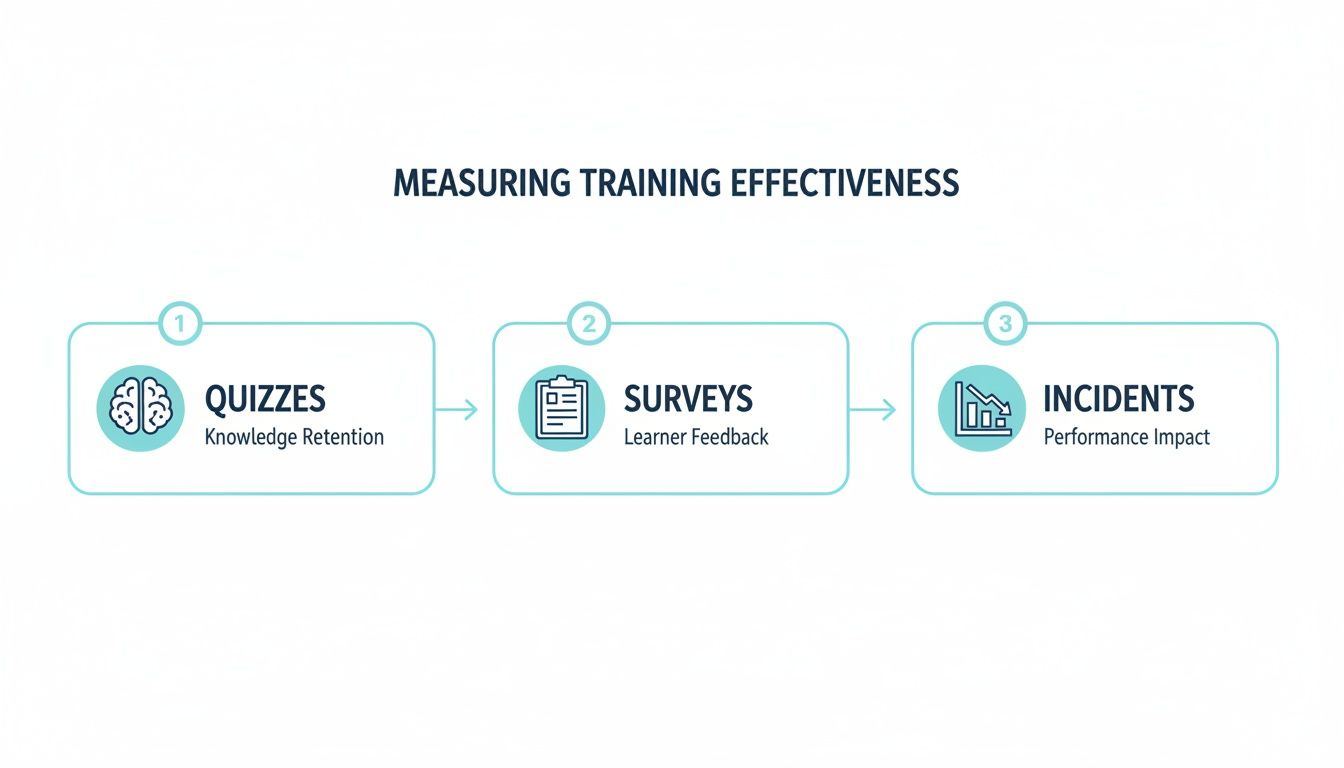
This model lays out a clear path from measuring what people know, to what they believe, and finally, to what they actually do.
Tracking Incident Rates for Tangible ROI
At the end of the day, the ultimate measure of success is a real, demonstrable drop in compliance-related incidents. This is where you connect your training program directly to business outcomes and prove its return on investment. The key is to track specific, relevant metrics that line up with your training goals.
If you roll out a new cybersecurity training module, you should be tracking the number of employees who click on your simulated phishing emails. A successful program will lead to a measurable decrease in that click-through rate over the next few months. In the same way, after rolling out anti-harassment training, you might monitor trends in HR complaints or feedback from exit interviews.
By linking training initiatives to these key performance indicators, you build a powerful, data-backed case for your program's value. To really dig in, a practical guide on measuring training effectiveness can offer models and KPIs that go way beyond simple completion rates. This approach finally shifts the conversation about training from a cost center to a strategic tool for mitigating risk.
Integrating Training into Your Risk Management Ecosystem

Advanced corporate compliance training is about more than just annual refreshers and scheduled courses. It should be a living, breathing part of your organization's central nervous system—fully plugged into your broader risk management ecosystem. This approach turns training from a reactive, check-the-box activity into a dynamic, proactive defense.
Think of your training platform like a fire extinguisher. In the old model, it just sits on the wall, and you only teach people how to use it once a year. In an integrated model, smoke detectors (your risk management tools) are wired directly to a sprinkler system (your training platform), automatically dousing the threat the moment it's detected.
This is the future of effective compliance: a powerful, closed-loop system where risk intelligence directly fuels targeted, just-in-time training interventions.
Creating a Proactive Feedback Loop
The core idea here is to connect your learning management system (LMS) with your internal risk and security platforms, like E-Commander. This link allows real-world risk signals to automatically trigger relevant training assignments, creating a smart and responsive learning environment.
This proactive feedback loop is crucial for building organizational resilience. It ensures your training efforts are always zeroed in on the most immediate and relevant threats, not stuck on a static, one-size-fits-all curriculum that can go stale in months.
By linking risk detection directly to training deployment, you shift from a culture of annual compliance to a state of continuous readiness. This integration turns scattered data points into a coordinated, actionable strategy for preventing misconduct before it escalates.
Just-in-Time Training in Action
Let’s walk through a practical scenario. Your internal security system detects a sudden spike in sophisticated social engineering attacks targeting your finance department. In a disconnected system, this information might lead to a company-wide email warning a week later—long after the damage is done.
With an integrated ecosystem, the process is immediate and targeted:
Risk Detected: The system flags the unusual threat pattern and identifies the specific employees being targeted.
Training Triggered: The risk platform instantly communicates with the LMS, automatically assigning a short, mandatory microlearning module on that exact type of social engineering attack to the finance team.
Risk Mitigated: Employees are armed with the precise knowledge they need to fend off the current threat, dramatically reducing the organization's vulnerability in real time.
This isn't just about speed; it's about precision. You're delivering the right training to the right people at the exact moment they need it most.
Streamlining Audits and Demonstrating Due Diligence
One of the most powerful benefits of an integrated system is the creation of an impeccable audit trail. When a regulator or auditor asks how you addressed a specific risk, you can provide a clear, documented, and time-stamped record of your actions.
This documented trail is your proof of commitment to due diligence, showing:
Risk Identification: The exact moment a potential threat was identified.
Training Intervention: The specific training module that was deployed in response.
Employee Acknowledgment: Verifiable records of who completed the training and when.
This level of auditability is nearly impossible to pull off with fragmented spreadsheets and manual processes. It also strengthens the internal feedback loop, as a strong reporting mechanism is essential for employees to feel safe raising concerns. Building this trust is fundamental, and you can learn more about fostering a speak up culture in our detailed guide. An integrated system reinforces this by showing that concerns lead to concrete, positive action.
Handling Ethics and Data Privacy in Your Training
The way you design and deliver your corporate compliance training says a lot about what your company truly values. This isn't just about teaching ethics; the whole process has to be ethical. From the content you create to how you handle the data, every step should be a living example of the integrity you want to build.
This gets really serious when it comes to employee training data—things like quiz scores, completion records, or even responses to behavioral scenarios. This information needs to be managed with total responsibility and transparency. Its purpose is to find and fix knowledge gaps across the business, not to single out or punish individuals. The moment you misuse that data, you shatter trust and make the entire program worthless.
Using Training Data Responsibly
The data your compliance program generates is an incredibly valuable diagnostic tool. Think of it as an X-ray of your organization's ethical health. It shows you exactly where the weak points are so you can strengthen them with targeted support, not blame.
For example, if the quiz results reveal that an entire department is bombing a specific anti-corruption scenario, that’s not a performance issue—it’s a program design issue. That data should trigger a review of the training module itself, not a stern memo to the department head. The key is to frame the data as a collective learning opportunity.
Here are the guiding principles for handling this data the right way:
Transparency: Be upfront with employees about what data is being collected and exactly how it will be used to make the training better for everyone.
Anonymity: Whenever you can, use anonymized or aggregated data to spot trends without putting individual performance under a microscope.
Purpose-Driven Analysis: Every piece of data analysis should be squarely focused on improving the training content, its delivery, and the program's overall effectiveness.
Designing Inclusive and Respectful Content
Beyond the data, the training content itself has to embody respect and inclusion. A patronizing or culturally tone-deaf module can do more harm than good, causing employees to check out and resent the very process meant to help them. People only engage when the content feels relevant, respectful, and empowering.
A compliance program that talks down to its audience will never build a culture of trust. The goal is to create a partnership in ethical conduct, treating every employee as a capable and valued guardian of the company's integrity.
Your training materials have to be developed with a global, diverse workforce in mind. This is about more than just translating text. It means making sure your examples, scenarios, and even the imagery you use are culturally appropriate and relatable to all employees, no matter where they are. By showing respect within the training, you reinforce the very behaviors you expect to see in the workplace, building a foundation of mutual trust at every step.
Your Questions, Answered
When you're building out a corporate compliance training program, you're bound to run into some practical questions. Let's dig into a few of the most common ones we hear from leaders trying to create a program that actually works—one that sticks with people and genuinely strengthens the organization.
These are the details that separate a check-the-box exercise from a program that builds real institutional resilience.
How Often Should Employees Get Compliance Training?
There’s no magic number here, because the right frequency is all about creating a continuous learning loop, not just a one-time event. The industry standard is a foundational training session for all new hires, followed by a comprehensive refresher course for all staff annually.
But that's just the baseline. For your people in high-risk roles—think finance, sales, or anyone in procurement—or for fast-moving topics like data privacy, you need more frequent touchpoints. Think about rolling out quarterly microlearning modules or targeted workshops for these groups to keep the most critical knowledge fresh. The goal is to get away from the "once-a-year" scramble and build a culture of ongoing awareness.
Effective compliance isn’t a single sprint; it's a marathon of consistent, timely reinforcement. The more dynamic the risk, the more frequent the training should be.
What's the Best Way to Make Mandatory Training Engaging?
Let's be honest: most mandatory training is a passive, click-through chore. To rescue it, you have to prioritize engagement and shift from telling people the rules to showing them why they matter. Ditch the static slides and dense blocks of legal text. Instead, use storytelling with relatable, real-world case studies that your employees can actually see themselves in.
Then, you need to get them involved with interactive elements that demand their attention:
Branching Scenarios: Put employees in realistic ethical dilemmas where their choices have real consequences. This lets them practice decision-making in a safe space.
Polls and Quizzes: Use quick knowledge checks and opinion polls to break up the content and make them think, not just click.
Gamification: Simple elements like points, badges, or leaderboards can tap into a natural sense of accomplishment and friendly competition, which does wonders for motivation and retention.
How Can a Small Business Run Effective Compliance Training?
Small businesses can absolutely build a powerful compliance program without a massive budget. The key is to focus on scalable, cost-effective solutions. You don't need a huge in-house team to get this right.
Many learning management systems (LMS) offer subscription models with pre-built, expert-designed course libraries covering the core topics like anti-harassment, cybersecurity, and workplace safety. This approach completely sidesteps the need for expensive custom content. Start with your highest-risk areas and then supplement your program with the excellent free resources that regulatory bodies like the EEOC or OSHA provide.
What Role Does Leadership Play in a Program's Success?
Leadership's role is non-negotiable, and it goes way beyond just approving the budget. When your executives are visibly taking the exact same training as everyone else, it sends a powerful signal: compliance is a core value here, not just a rule for the rank-and-file.
This "tone from the top" is easily the single most important factor in whether a program succeeds or fails. Leaders need to champion the training in company-wide communications, talk about why it matters, and make sure ethical conduct isn't just taught but is also visibly recognized and rewarded. Their authentic buy-in is what transforms a mandatory chore into a shared commitment.
At Logical Commander Software Ltd., we know that effective training is just the first step in a proactive risk management strategy. Our E-Commander platform helps you connect training outcomes to real-world risk signals, creating an integrated ecosystem that turns compliance into a strategic asset. Discover how to move from reaction to prevention.