%20(2)_edited.png)

A Guide to Functional Behavioral Assessments in the Workplace

Updated: Dec 12, 2025
A functional behavioral assessment is a structured way to get to the bottom of why a recurring, high-risk behavior is happening in the workplace. Instead of just reacting after something goes wrong, this approach digs into the root cause, focusing on environmental factors instead of just blaming the individual. It’s a powerful, proactive method for getting ahead of human-factor risk, but traditional methods are operationally impractical and legally risky for modern businesses.
What Are Functional Behavioral Assessments in a Business Context?
A proactive approach, grounded in the principles of a functional behavioral assessment (FBA), starts with a much smarter question: Why does this keep happening?
That’s the core of using FBA principles in a corporate setting. It’s a systematic process for understanding the purpose a risky behavior actually serves. Is an employee skipping a security step because they’re trying to hit an impossible deadline? Does a team sidestep a compliance check because the official process is a confusing, bureaucratic nightmare? An FBA isn't about analyzing an individual's psychology; it's a detective for broken processes and systemic vulnerabilities that lead to internal threats.
Understanding the ABC Model
The classic framework used in functional behavioral assessments is the ABC model. It’s a simple but incredibly effective way to examine the environmental factors that surround a specific action:
Antecedent: This is the trigger—the event that happens right before the behavior. It could be anything from a stressful deadline or an unclear instruction to a clunky, poorly designed user interface. This is a systemic, not a human, starting point.
Behavior: This is the specific, observable action you’re concerned about, like an employee failing to wear personal protective equipment or sharing their login credentials.
Consequence: This is the outcome that immediately follows the behavior. Critically, this outcome often unintentionally reinforces the risky action—like saving five minutes of time or avoiding a frustrating software system.
This model brilliantly shifts the focus from an employee's personal intent to the environmental variables that are shaping their choices. The goal is not to conduct a psychological evaluation but to perform an operational analysis. That distinction is absolutely crucial for maintaining an ethical, EPPA-aligned risk management program and protecting corporate reputation.
By understanding these three components, an organization can redesign the antecedents and consequences to naturally guide employees toward safer, more compliant behaviors. The insights from behavioral risk analytics can be a huge help in spotting these patterns before they lead to a major incident.
From Reaction to Prevention
Functional behavioral assessments are anything but new. They’ve been used in clinical and educational settings for over 85 years. Study after study has validated the ABC model, with research finding that about 87% of published studies used it to understand behavior. This research also confirmed that behaviors were often driven by reinforcement, like escaping demands or gaining attention. You can explore the full findings on behavior functions in this comprehensive study.
In a corporate environment, this translates directly to understanding how workplace systems might be unintentionally rewarding non-compliant actions. This is the new standard of internal risk prevention: moving from human-centric blame to system-centric solutions.
This foundational knowledge is what allows an organization to finally break free from a constant state of reactive fire-fighting and build a sustainable strategy of prevention. Understanding how FBA principles apply across different business functions provides powerful insights, and there are many proven strategies for recruiters that align perfectly with these concepts. By addressing the real root causes of human-factor risk, businesses can build a more resilient, ethical, and secure operation.
Understanding the Three Core Methods of Behavioral Assessment
To really get a handle on how functional behavioral assessments work in a modern company, you have to look at the traditional methods they grew out of. These classic approaches come straight from clinical psychology, and while they’re great at figuring out the why behind an action, they are often wildly impractical and legally dangerous in a corporate setting. They represent the old, failed approach to managing human-factor risk.
Broadly, these methods fall into three buckets, each with a different level of intensity and accuracy. They range from simple interviews to direct, hands-on experimentation. While effective in a therapist's office, dropping them straight into the workplace is a recipe for wasted resources, compliance violations, and legal liability.
Indirect Assessments: Gathering Clues from a Distance
The most common starting point is the indirect assessment. This method is all about collecting information about a behavior without actually watching it happen. Think of it like a detective gathering witness statements and background info to build an initial theory of the case.
Common techniques include:
Interviews: Talking to managers, coworkers, or anyone else who has seen the behavior firsthand. This can feel like an interrogation and is EPPA-sensitive.
Checklists and Rating Scales: Using structured forms to get a sense of the frequency, intensity, and context of certain actions.
Record Reviews: Digging into existing data like incident reports or performance logs to spot any emerging patterns.
This approach is popular because it’s less intensive than the others. In fact, research shows that 75.2% of Board Certified Behavior Analysts consistently use indirect assessments to get a first read on a situation. The big drawback, however, is its reliance on memory and subjective opinions, making it the least accurate of the three methods. For a business, this can lead to flawed conclusions that don't solve the real problem and create business impact.
Direct Observation: Watching Behavior in Its Natural Habitat
Direct observation is the next logical step: watching the behavior as it actually happens in the real world. This is a form of surveillance. This gives you far more objective data because you’re relying on what you see, not on secondhand stories. It’s like a safety inspector watching the workflow on the factory floor instead of just reading a report about it.
The main tool here is ABC recording, where an observer notes the Antecedent (what happened right before), the Behavior itself, and the Consequence (what happened immediately after). This structure helps build a clear hypothesis about why the behavior is happening. For instance, does an employee skip a safety check (Behavior) right after a high-pressure production target is announced (Antecedent), which results in them saving a few minutes (Consequence)?
While more reliable than indirect methods, direct observation is a huge time sink and requires specially trained observers. In a corporate environment, this quickly becomes intrusive surveillance, eroding employee dignity and creating massive legal risks if not handled with extreme care. Plus, people often act differently when they know they’re being watched, which can throw off the results entirely.
The diagram below breaks down this simple but powerful sequence of Trigger, Behavior, and Outcome that observers are trying to map.
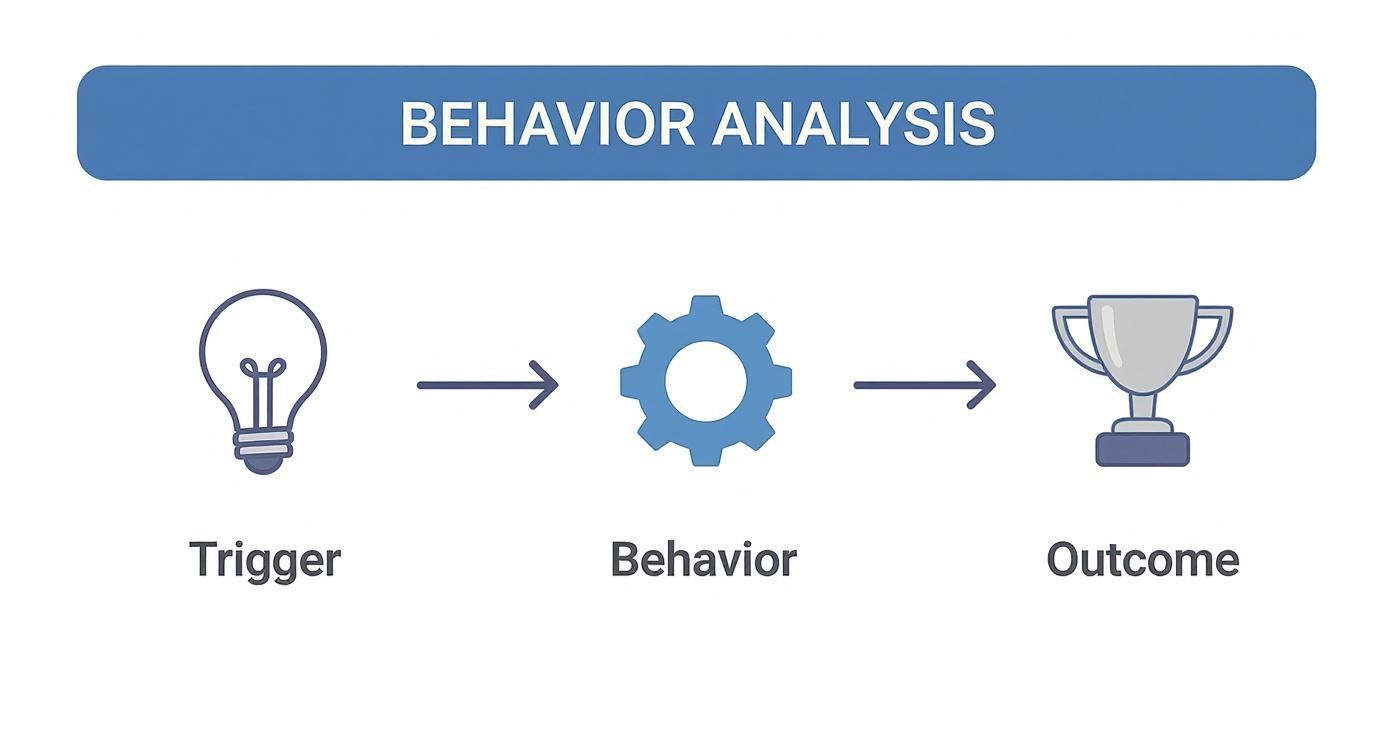
This model makes it clear: to change a behavior, you either have to change the trigger that sets it off or change the outcome it produces.
Functional Analysis: The Experimental "Gold Standard"
Functional analysis is the most rigorous and conclusive method of the three. It goes beyond just watching and involves systematically manipulating potential triggers and consequences to prove what’s really driving a behavior. If you think an employee is ignoring a security protocol to save time, a functional analysis would test that theory by creating a scenario where following the protocol is actually faster and seeing if the behavior changes.
While this is considered the gold standard for accuracy, it's almost completely impractical and ethically toxic in a business setting. The very idea of deliberately manipulating an employee’s environment to trigger a risky behavior sets off immediate alarm bells under regulations like the Employee Polygraph Protection Act (EPPA). It is a form of psychological pressure and is not EPPA-aligned.
To appreciate how different assessment methods can create a safer workplace, it helps to consider the core activities of an occupational hygienist, who evaluates and controls workplace hazards without resorting to direct human experimentation.
The legal and ethical minefield of conducting a true functional analysis on employees is enormous. These methods, while clinically sound, were never designed for the modern workplace or the legal protections employees have. This is precisely why businesses need a different path—one that delivers the same deep insights without the invasive and risky techniques. This is a gap that modern, ethical pre-employment assessment tools are designed to fill.
Comparing FBA Assessment Methods in a Corporate Context
To put it all together, this table breaks down how these three traditional FBA methods stack up when viewed through the lens of corporate risk management. It highlights the stark differences in resources, accuracy, and legal exposure that make these approaches a non-starter for modern businesses.
Method | Description | Resource Intensity | Ethical/Legal Risk (EPPA) | Best Use Case |
|---|---|---|---|---|
Indirect Assessment | Gathers information through interviews, checklists, and record reviews without direct observation. | Low. Quick to deploy but relies on subjective, secondhand information. | Low. Non-intrusive, but the risk lies in making poor decisions based on inaccurate data. | Initial fact-finding to form a preliminary hypothesis about a low-stakes issue. |
Direct Observation | Directly watches and records a behavior (and its context) as it happens in the natural work environment. | High. Extremely time-consuming and requires trained, objective observers. | Moderate to High. Can be perceived as invasive surveillance, eroding trust and raising privacy concerns. | Verifying an initial hypothesis when the risk of being watched won't alter the behavior itself. |
Functional Analysis | Systematically manipulates environmental variables to experimentally confirm the function of a behavior. | Very High. Requires a controlled environment and expert implementation. | Very High. Ethically and legally prohibited in most corporate settings; violates EPPA principles. | Strictly for clinical or controlled research environments; not suitable for the workplace. |
As the comparison shows, the methods that offer the highest degree of accuracy also carry the heaviest burdens in terms of cost, time, and legal liability. This trade-off is what ultimately drives the need for new, technology-driven solutions that can provide deep behavioral insights in an ethical, scalable, and legally compliant way. This is the new standard of AI-driven preventive risk management.
Building a Proactive FBA-Informed Prevention Strategy

Putting the theory of functional behavioral assessments into practice means building a structured, proactive roadmap. You don't need to turn your risk team into behavioral psychologists. The real goal is to become better architects of your work environment to mitigate insider risk.
This is all about shifting from expensive, after-the-fact investigations to a sustainable, preventive posture. It’s a move away from blame and toward systemic analysis—a core principle of effective human capital risk management.
Instead of waiting for a major incident, a proactive strategy hunts for the small, recurring deviations in your operational data that signal a weak process or flawed policy that can lead to significant liability.
A proactive, FBA-informed strategy doesn't ask, "Who is responsible for this problem?" Instead, it asks, "What environmental factors are making this risky behavior the path of least resistance?" This subtle but powerful shift is the foundation of modern, ethical risk prevention.
This structured approach transforms how organizations address human-factor risk, making prevention a measurable and repeatable process for compliance and governance.
Step 1: Pinpoint Concerning Behavioral Patterns
First, you have to define the specific, observable behavior that’s creating risk. Vague labels like "carelessness" or "negligence" are completely useless here. You need precision.
For example, a concerning pattern isn't "poor data handling." It's "employees consistently emailing sensitive documents to personal accounts instead of using the secure file-transfer portal." That level of detail is non-negotiable for a real analysis.
Finding these patterns means digging into operational data from different sources:
Compliance Audits: Look for recurring failures in specific procedural checks that could lead to fines.
IT System Logs: Uncover unusual access patterns or clear process workarounds that signal internal threats.
Safety Reports: Document the repeated minor violations that often precede major incidents and worker's comp claims.
This data-driven approach moves you out of the realm of opinion and into objective reality, showing you exactly where the systemic friction is.
Step 2: Form a Hypothesis About the Behavior’s Function
Once you've nailed down the specific behavior, the next move is to figure out why it's happening. What does the employee or team gain—or avoid—by doing it this way? The key is to keep the focus squarely on the environment, not on judging individual intent.
Let’s go back to our example of employees emailing sensitive files. A reactive manager might assume laziness or malicious intent. An FBA-informed leader, on the other hand, develops hypotheses based on the process itself:
Hypothesis A (Escape/Avoidance): The secure file-transfer portal is slow, clunky, or requires too many steps. Emailing the file is a logical workaround to avoid a frustrating and inefficient process.
Hypothesis B (Access to Tangibles): Employees need to work on these documents from home, but the company's remote access system is inadequate. The behavior lets them gain access to the materials they need to do their job.
This analytical step is critical. It makes sure that your solution addresses the root cause—the broken process—rather than just slapping a bandage on the symptom.
Step 3: Design and Implement a Targeted Intervention
With a solid hypothesis in hand, you can finally design an intervention that fixes the environment. The goal is simple: make the compliant behavior the easier, more logical choice. This is where the strategy delivers real business impact.
Forget about generic retraining sessions. They almost never work if the underlying process is the real problem. Instead, the interventions become highly specific:
If Hypothesis A is correct, the solution is to streamline the secure portal. You'd work with IT to improve the user experience, slash the number of login steps, and boost its speed.
If Hypothesis B is correct, the fix is to improve remote access. That might mean deploying a better VPN or adopting a more effective cloud-based collaboration tool.
This approach ensures you invest resources in solutions that actually fix the problem. By modifying the system, you naturally guide behavior toward safer, more compliant outcomes—all without resorting to punitive measures.
How FBA-Based Interventions Drive Business Value
Understanding the why behind a high-risk behavior isn’t just an analytical exercise—it delivers real, measurable business value. Interventions built on the principles of functional behavioral assessments are leagues more effective than generic, one-size-fits-all policies. Why? Because they solve the actual problem instead of just punishing the symptom.
When you know why a policy violation is happening, your response becomes surgical. Let’s say a team is skipping a critical compliance check. A traditional approach might mandate more training. But an FBA might reveal they’re under immense pressure to meet an impossible deadline.
Armed with that insight, you can intervene intelligently. Instead of another pointless training session, you can redesign the workflow, adjust the deadline, or provide better tools. This proactive approach creates a powerful return on investment by directly targeting the operational friction that creates human-factor risk in the first place.
Reducing Costs and Lowering Liability
A huge chunk of any risk management budget is burned on reactive measures. Internal investigations are slow, expensive, and disruptive, often costing thousands of dollars per incident while pulling your best people away from their core duties. The cost and failure of reactive investigations is a major drain on resources.
An FBA-informed strategy slashes these costs. By identifying and fixing the environmental triggers for risky behavior, you prevent incidents from ever happening. This proactive posture has a clear financial upside:
Fewer Internal Investigations: Preventing problems means you stop spending time and money on costly after-the-fact forensic work.
Lower Liability Exposure: When you proactively address systemic risks, you reduce the likelihood of compliance breaches, safety incidents, and data leaks that lead to fines and legal action.
Reduced Employee Turnover: A work environment that feels fair and logical—where processes are designed to help employees succeed—improves morale and cuts the high turnover costs that come with a punitive culture.
Strengthening Ethical Culture and Reputation
Beyond the direct financial savings, designing better systems builds a stronger, more resilient ethical culture. When employees see the organization is focused on fixing broken processes rather than just assigning blame, it fosters psychological safety and a sense of shared ownership. This is key for reputation protection.
This approach reinforces that compliance and safety are collaborative goals, not just a set of rules to be enforced from on high. A strong ethical culture is a powerful reputational asset, signaling to clients, partners, and regulators that your organization is built on integrity and operational excellence. It transforms risk management from a policing function into a strategic business enabler.
The most effective interventions are those that make the right behavior the easiest behavior. By understanding behavioral function, organizations can redesign systems to naturally guide employees toward safer, more compliant actions, safeguarding both the company's bottom line and its reputation.
This isn't just theory; the data backs it up. A rigorous review of 25 studies found that a stunning 68% of experiments documented positive effects from interventions based on functional behavioral assessments, with none showing negative outcomes.
These findings make it clear: using FBA principles to decrease problematic behaviors is a proven strategy. This evidence makes a clear business case for adopting a more analytical and preventive approach to risk management.
Achieving Ethical and EPPA-Aligned Risk Assessment

The core ideas behind a functional behavioral assessment are incredibly powerful, but applying them in a corporate setting walks you straight into a minefield. Modern risk management has to operate within a tangled web of legal and ethical rules, with the Employee Polygraph Protection Act (EPPA) sitting right at the center. This federal law puts strict guardrails on how employers can assess their people, making most traditional FBA methods completely unusable.
Any strategy that even smells like lie detection, invasive surveillance, or psychological arm-twisting is a dead end for a compliant business. The legal fallout and reputational wreckage from a single misstep can be catastrophic. This reality forces a critical question on every compliance officer and HR leader: how do we get the behavioral insights we need to stop risk without crossing these bright red lines?
The answer is to shift your focus completely—stop analyzing people and start analyzing the systems they work in. That’s the new standard for ethical risk assessment and internal threat detection.
Navigating the Prohibitions of EPPA
The EPPA was put in place to stop employers from using coercive or intrusive methods that stomp on employee rights and dignity. It flat-out forbids the use of lie detector tests for pre-employment screening or during employment, with only a few narrow exceptions. But its spirit extends much further, covering any practice that acts like a lie detector or puts an individual under undue psychological stress.
This makes old-school FBA techniques like direct observation or functional analysis legally radioactive in the workplace. These methods were born in clinical environments and were never built to navigate corporate compliance frameworks.
Direct observation can easily feel like invasive employee monitoring or surveillance, which torches employee dignity and kicks up a storm of privacy concerns.
Functional analysis, where you deliberately tweak the environment to test a behavioral theory, is ethically unthinkable and legally indefensible in a business context.
Organizations need a new path—one that keeps the analytical spirit of an FBA but ditches its legally hazardous methods. For a deeper look into this critical area, you can learn more about why EPPA compliance matters in human capital risk management.
The New Standard for Ethical Human Risk Mitigation
A modern, ethical approach to understanding human-factor risk has to be fundamentally non-intrusive. Logical Commander's E-Commander platform is the new standard of internal risk prevention. It uses advanced AI to analyze contextual and systemic data instead of individual behaviors. This isn't just an upgrade; it's a complete paradigm shift away from reactive investigations and invasive monitoring.
An AI-driven platform like E-Commander applies the core logic of an FBA—figuring out the function of a behavior—to operational data, not people. It looks at workflows, systemic pressures, and environmental factors to find risk drivers without ever tracking individuals or making psychological judgments. It is not surveillance technology; it is a Risk Assessments Software that starts with the human and ends with the human.
This new standard of internal risk prevention isn't about policing employees; it's about architecting a safer, more ethical work environment. By analyzing systemic vulnerabilities, it allows organizations to fix the root causes of risk before they lead to an incident, fully aligning with EPPA principles.
This technology allows companies to get out in front of internal threats by understanding the "why" behind risk patterns, all while holding the highest standards of employee dignity and privacy.
AI-Driven Analysis of Systemic Factors
Instead of watching an employee, our advanced AI platform analyzes anonymized event data to spot systemic weak points. For instance, if several employees are bypassing the same security control, the system doesn’t flag the people. It flags the control itself as a potential point of friction.
From there, it forms a hypothesis about the function of this pattern:
Is the control badly designed and a huge pain to use, causing employees to find a shortcut just to get their work done?
Are there conflicting incentives, like extreme time pressure, that make sidestepping the control the only logical way to hit performance targets?
This approach delivers deep, actionable insights for risk prevention. It tells you where your processes are breaking down so you can actually fix them. This focus on systemic analysis, not individual scrutiny, is the only sustainable way for enterprises to conduct functional behavioral assessments in a way that is both effective and ethically sound. It’s the definitive path for organizations committed to proactive governance and rock-solid compliance.
Build a Proactive Future with Us
The way we manage internal risk is broken. For too long, organizations have relied on reactive investigations and invasive surveillance—methods that are not just outdated, but fundamentally flawed. It's time for a new standard, one that empowers companies to get ahead of human-factor risks ethically and proactively. We're inviting you to lead this change.
Traditional workplace functional behavioral assessments are a legal minefield and an operational nightmare. They drain resources and expose companies to massive legal risks under regulations like the EPPA. On the other hand, reactive forensics only kicks in after the damage is done, measuring the high cost of failure. There has to be a better way, and it starts with technology that delivers preventive insights without compromising your values.
Join the PartnerLC Ecosystem
Our PartnerLC program is built for consultants, service providers, and technology partners who are ready to deliver this forward-thinking, EPPA-aligned solution to their clients. This is far more than a simple reseller program; it's a strategic alliance to set a new global benchmark in ethical risk management.
By joining our partner ecosystem, you get access to:
A Genuinely Differentiated Platform: Offer an AI-driven solution for human risk mitigation that is completely non-intrusive and respects employee dignity.
A Shared Mission: Align with a community dedicated to building safer, more resilient, and more principled workplaces.
New Revenue Streams: Grow your business by offering a powerful Risk Assessments Software that solves the core challenge of internal threats.
Help your clients break free from the reactive cycle and embrace a truly proactive approach to managing their most complex human-factor risks. Together, we can build a future where risk is prevented, not just investigated after the fact.
By becoming an ally, you position your firm at the forefront of the shift toward AI human risk mitigation. You’ll deliver unmatched value to your clients, strengthen their organizational integrity, and lead the way in building a new standard. Let’s build it together.
Your Questions Answered
Are Functional Behavioral Assessments Legal in the Workplace?
Yes, the core idea behind a functional behavioral assessment—understanding why an action occurred—is perfectly legal. Where companies get into trouble is with the methods they use.
Any approach that feels like an interrogation, applies psychological pressure, or relies on surveillance can quickly run afoul of regulations like the Employee Polygraph Protection Act (EPPA). This is exactly why a modern, non-intrusive platform is so essential. It applies the analytical spirit of an FBA to systemic data, giving you the insights without the legal headaches of old-school, person-centric methods.
How Can AI Apply FBA Principles Without Doing Interviews?
This is a key distinction. An advanced AI platform doesn't conduct a clinical FBA on an individual person. Instead, it applies the foundational FBA principle—identifying the drivers of risk—by analyzing anonymized operational and contextual data at a systemic level.
The system searches for environmental patterns that correlate with high-risk events to figure out their function. For instance, is a specific non-compliant behavior driven by a desire to get around a ridiculously cumbersome process? This kind of insight lets you fix the root cause and prevent future issues, all without direct employee interaction, ensuring total privacy and EPPA compliance.
Is This Just Another Form of Employee Monitoring?
Absolutely not, and it’s a critical difference. Employee monitoring and surveillance tools are built to track individual activity, often on a continuous basis. Our ethical risk management approach is the complete opposite.
Our platform is a non-intrusive system that never monitors individuals. Instead, it analyzes specific, isolated events and the context surrounding them to understand systemic risks. The entire focus is on improving processes, policies, and work environments to proactively reduce risk—not policing individual employees. This ethical framework was specifically designed to prevent risk while respecting employee dignity.
At Logical Commander Software Ltd., we provide a new standard in proactive, ethical risk management. Our AI-driven platform helps you understand and mitigate human-factor risks without surveillance or invasive techniques.
Start a free trial of our Risk Assessments Software.
Join our PartnerLC ecosystem and become an ally in ethical risk prevention.
Contact our team for enterprise deployment and strategy sessions.