%20(2)_edited.png)

How to Reduce Employee Turnover and Mitigate Internal Risk

To truly get a handle on employee turnover, you have to stop reacting to resignations and start proactively identifying the root causes of why people leave. This requires moving beyond the traditional exit interview and addressing the core issues that impact your organization's stability and security.
It’s about building an environment that actively encourages growth, recognizes contributions, and gets ahead of critical human capital risks before they escalate into a two-week notice. The goal is to build a culture where loyalty is earned every day, not just assumed, transforming your retention strategy into a pillar of your governance and compliance framework.
The True Cost of High Employee Turnover

Looking at a high turnover rate on a spreadsheet is one thing. Understanding the cascading damage it does to your entire business is another. The obvious costs of recruiting, hiring, and onboarding a replacement are significant—often estimated to be anywhere from 50% to a staggering 200% of an employee's annual salary.
But for leaders in Risk, Compliance, and Security, those direct expenses are just the tip of the iceberg. Each departure is a potential crack in your organization's foundation, creating liabilities that stretch far beyond the HR budget. The real damage happens in the hidden costs, silently eroding your company's stability and security posture.
Beyond Replacement Costs: The Hidden Liabilities
When an experienced employee walks out the door, they take a massive amount of institutional knowledge with them—undocumented processes, nuanced client relationships, and project histories. This knowledge gap forces the remaining team to scramble, which is a fast track to burnout, plummeting productivity, and a serious hit to morale.
This constant cycle of departures and backfilling creates a state of perpetual disruption. It frays team cohesion and leaves even your most dedicated people feeling overworked and undervalued, eventually pushing them to look for the exit, too. This is the domino effect that makes high turnover so destructive.
Furthermore, every offboarding process is a security vulnerability. In the rush of a departure, access credentials might not be revoked promptly, or sensitive company data could remain on personal devices. A disengaged or disgruntled employee can quickly become an insider risk, whether they expose data by accident or with intent. This is the critical link between high employee turnover and human-factor risk.
The biggest risk isn’t just losing a person; it’s the institutional memory, security protocols, and team stability that evaporate with them. A reactive 'exit interview' approach only documents the damage after it's done—it does nothing to prevent the next incident.
Shifting to a Proactive Risk Framework
The traditional model of dealing with turnover after someone has already quit is simply not defensible in a modern risk environment. It’s like treating a symptom—the resignation—while completely ignoring the underlying disease. A truly effective strategy for how to reduce employee turnover demands a fundamental shift to a proactive, ethical risk framework that connects HR and security.
This new standard stands in stark contrast to outdated methods like employee surveillance, which are intrusive, ineffective, and legally perilous. The table below breaks down the difference between a costly reactive model and a strategic, preventive one.
Reactive vs Proactive Approaches to Turnover Risk
Attribute | Reactive Approach (Outdated) | Proactive Approach (The New Standard) |
|---|---|---|
Timing | Acts after an employee resigns. | Identifies risks before they lead to departure. |
Focus | Individual departures and exit interviews. | Systemic issues, team integrity, and cultural health. |
Data Source | Subjective feedback from departing employees. | Objective, ethical AI-driven insights into human-factor risks. |
Goal | Document reasons for leaving. | Prevent resignations and mitigate associated security risks. |
Outcome | High replacement costs, knowledge loss, and security gaps. | Improved retention, stronger security posture, and a more resilient culture. |
A modern, proactive standard involves:
Identifying Systemic Issues: Instead of obsessing over individual departures, the goal is to spot broader patterns of disengagement or integrity risks at a team or department level before they boil over.
Ethical AI-Driven Insights: Using non-intrusive, EPPA-aligned platforms to get objective insights into human-factor risks without resorting to invasive surveillance that destroys trust and creates liability.
Preventive Action: Arming leadership with the intelligence they need to make targeted interventions, improve management practices, and fix cultural problems long before they trigger a wave of resignations.
By directly linking the human side of retention to your governance and risk management strategy, you build a more resilient, stable, and secure organization. This proactive stance doesn't just hold onto your top talent; it insulates the entire company from a whole class of preventable internal threats.
Strengthening Leadership to Prevent Voluntary Exits

It’s one of the oldest sayings in HR: people don’t quit companies; they quit managers. This isn't just a cliché; it's a critical vulnerability for any organization. Ineffective leadership is a direct pipeline to employee turnover, creating environments where disengagement, frustration, and ethical lapses thrive.
When a manager fails to lead, the damage ripples far beyond a single team. Poor communication, a lack of recognition, and shifting expectations breed an atmosphere of instability. This environment doesn't just push good people to leave—it dramatically elevates your internal risk. Disengaged employees are far less likely to follow compliance protocols or report misconduct, weakening your defenses from the inside out.
From Poor Management to Increased Internal Risk
The link between leadership quality and retention is undeniable. A staggering 50% of employees who are actively job hunting are doing it primarily to get away from their manager. That single statistic reveals that one of the most powerful ways how to reduce employee turnover is to focus on the manager-employee relationship.
Bad leadership creates fertile ground for human-factor risk. An unsupportive or unethical manager can inadvertently encourage shortcuts, suppress concerns, and foster a culture of silence. This directly undermines governance and opens the door to compliance breaches, conflicts of interest, and even fraud.
A manager who lacks transparency or fails to address team issues becomes a single point of failure for both retention and risk management. Investing in leadership development is not a 'soft' HR initiative; it is a core component of your internal threat mitigation strategy.
To truly reduce turnover, organizations must invest in building managers who can lead with integrity and skill. This means moving past generic leadership seminars and implementing structured, ongoing development programs.
Actionable Strategies for Building Better Leaders
Creating a roster of effective leaders is an intentional process. It requires a commitment to giving managers the tools, feedback, and support they need to succeed. The goal isn't just to manage tasks, but to build environments of psychological safety and professional growth.
Here are a few practical strategies:
Implement Structured Coaching and Mentorship: Pair new or struggling managers with seasoned leaders who can offer practical, real-world guidance. This provides a confidential sounding board for navigating tricky team dynamics.
Utilize 360-Degree Feedback: Give managers a clear, well-rounded view of their performance by gathering anonymous feedback from their direct reports, peers, and superiors. This data is invaluable for uncovering blind spots.
Establish Clear Communication Protocols: Train leaders on how to run effective one-on-ones, deliver constructive feedback, and communicate organizational changes with transparency. Reinforce this by setting the right tone from the top.
Leveraging Ethical AI for Leadership Support
Strengthening leadership doesn't mean putting managers under a microscope. Invasive surveillance tools are completely counterproductive—they erode the very trust you’re trying to build and are often not EPPA-aligned. This is where a proactive, ethical approach becomes a game-changer.
Platforms like Logical Commander’s E-Commander offer the new standard. By ethically analyzing aggregated, anonymized data, the system provides high-level insights into team health and potential integrity risks without ever targeting individuals. For instance, it might flag a department with an unusually high rate of reported conflicts or a sudden spike in disengagement indicators.
This intelligence empowers senior leadership to step in constructively. Instead of reacting to a resignation letter, they can proactively offer a specific manager additional coaching or resources. It lets the organization address the root causes of turnover and risk before they escalate, reinforcing the importance of effective leadership in the modern workplace. This ethical, non-intrusive method builds foundational trust, ensuring your efforts to reduce employee turnover are both effective and respectful.
Building Career Pathways to Foster Loyalty
Career stagnation is a silent killer of retention. Vague promises on a careers page don't cut it anymore, especially with a workforce that prioritizes growth and development. To genuinely figure out how to reduce employee turnover, you have to build tangible, transparent career pathways.
Investing in these opportunities is one of the most powerful moves you can make. Millennials and Gen Z are quick to leave when they feel stuck, and they now make up the majority of the workforce. A recent study found that 74% of these younger employees would likely quit within a year if they don't see clear paths for skill-building and advancement.
When you consider that this demographic already makes up 51% of the workforce and averages just 2.5 years per employer, their expectations are a huge driver behind today’s turnover rates. You can find more insights on this in 2025 employee retention trends on incentco.com.
When employees feel invested in, they become more engaged and loyal. That commitment goes beyond simple job satisfaction; it directly strengthens your organization's risk posture. An employee with a clear career trajectory is far less likely to become a human-factor risk.
Designing Clear Internal Mobility Programs
A well-defined internal mobility program is the foundation of a strong retention strategy. It's about creating a culture where employees see their next great role being within the company, not somewhere else. This requires a deliberate, structured approach.
Here are a few practical steps to get started:
Skill Gap Analysis: Pinpoint the critical skills your organization will need in the future and compare them against your current workforce's capabilities. This helps you design targeted training that benefits both the employee and the business.
Transparent Promotion Criteria: Clearly define the competencies, experiences, and performance metrics required for advancement. When the process is transparent, it builds trust and motivates people to work toward specific goals.
Internal Talent Marketplace: Create a system where employees can easily find open roles, project opportunities, and mentorship connections, empowering them to take ownership of their career development.
The Role of Mentorship and Reskilling
Beyond formal promotions, mentorship and reskilling initiatives are crucial for building loyalty. A strong mentorship program connects high-potential employees with experienced leaders, accelerating their growth and deepening their connection to the company culture.
Reskilling programs are just as important. They prove to employees that you're willing to invest in their future, which is far more cost-effective than constantly hiring externally for new skills and builds a more agile workforce.
An employee who is actively learning and being mentored is an engaged employee. This engagement is your first line of defense against both voluntary turnover and the internal risks that come with a disengaged workforce.
These programs don't just improve retention—they're a core part of your internal threat management strategy. An employee who feels valued and sees a path forward is a lower risk. They're more invested in the company's success and more likely to adhere to compliance and ethical standards. You can learn more about effective tools to boost employee engagement in our related article.
Using AI to Ethically Guide Talent Development
Building these programs at scale can be a serious challenge. This is where modern, ethical AI platforms can make a huge impact. Unlike invasive tools that track individuals, a non-intrusive system like Logical Commander provides powerful, aggregated insights to guide your talent strategy.
Our platform can ethically analyze anonymized organizational data to help you:
Identify Future Leadership Gaps: Pinpoint departments or roles where a lack of succession planning could create future risk.
Spot Skill Deficiencies: Highlight systemic skill gaps across teams, letting you create proactive reskilling programs before those gaps become critical.
Align Development with Business Needs: Ensure that your talent development initiatives are directly tied to your strategic goals and risk management priorities.
This AI-driven approach is fully EPPA compliant, providing valuable intelligence for succession planning without ever performing psychological evaluations or monitoring individuals. It transforms talent development from a subjective HR function into a data-informed, strategic pillar of your GRC framework, ensuring your efforts to reduce employee turnover are both effective and ethical.
Implementing a Data-Driven Retention Strategy
If you're still relying on exit interviews to understand why people leave, you’re playing a losing game. To meaningfully figure out how to reduce employee turnover, risk and HR leaders must stop reacting and start predicting. This means building a formal retention program grounded in intelligence, not intuition.
It's about tracking the right metrics, finding patterns in your existing data, and centralizing your human risk intelligence. When you do this, retention stops being a siloed HR task and becomes a core pillar of your entire governance, risk, and compliance (GRC) framework.
Moving Beyond Exit Interviews
Think of traditional exit interviews as a rearview mirror—they tell you why you crashed after you're already in the ditch. A data-driven strategy, on the other hand, is your early-warning system. It spots hazards ahead and helps you reroute before you lose your best people. The goal is to build a predictive model that flags the subtle, early warnings of disengagement or burnout. Understanding and addressing systemic issues like workforce burnout is a non-negotiable part of this.
You're likely already sitting on the data you need. Look for patterns in metrics like:
Absenteeism Rates: A sudden spike in unscheduled absences on a particular team is often a clear signal of declining morale or poor management.
Performance Metrics: When a consistent top performer's output starts to dip, it’s a classic sign of disengagement, long before they update their resume.
Project Completion Delays: If one department is constantly missing deadlines, it could point to resource shortages or leadership friction that’s driving people to frustration.
The Power of Predictive Human Risk Intelligence
Building a formal retention strategy with predictive analytics gets right to the root of turnover. This is absolutely critical when you realize that 47% of organizations don’t even have a formal strategy, even though 68% are losing talent faster than they expected in 2024.
With frontline turnover hitting a staggering 87% in quick-service and 81% in retail, preventive tools are essential. They're how you spot problems like 'quiet quitting'—that state of checked-out disengagement affecting an estimated 59% of all employees. You can see more data behind this trend in SecondTalent's employee retention report.
These numbers point to a massive operational blind spot. Relying on gut feelings when the data shows a clear and present danger isn't just bad strategy; it's a serious liability. A proactive approach isn't a luxury anymore—it's essential for survival.
The infographic below drives home just how much career stagnation fuels turnover.
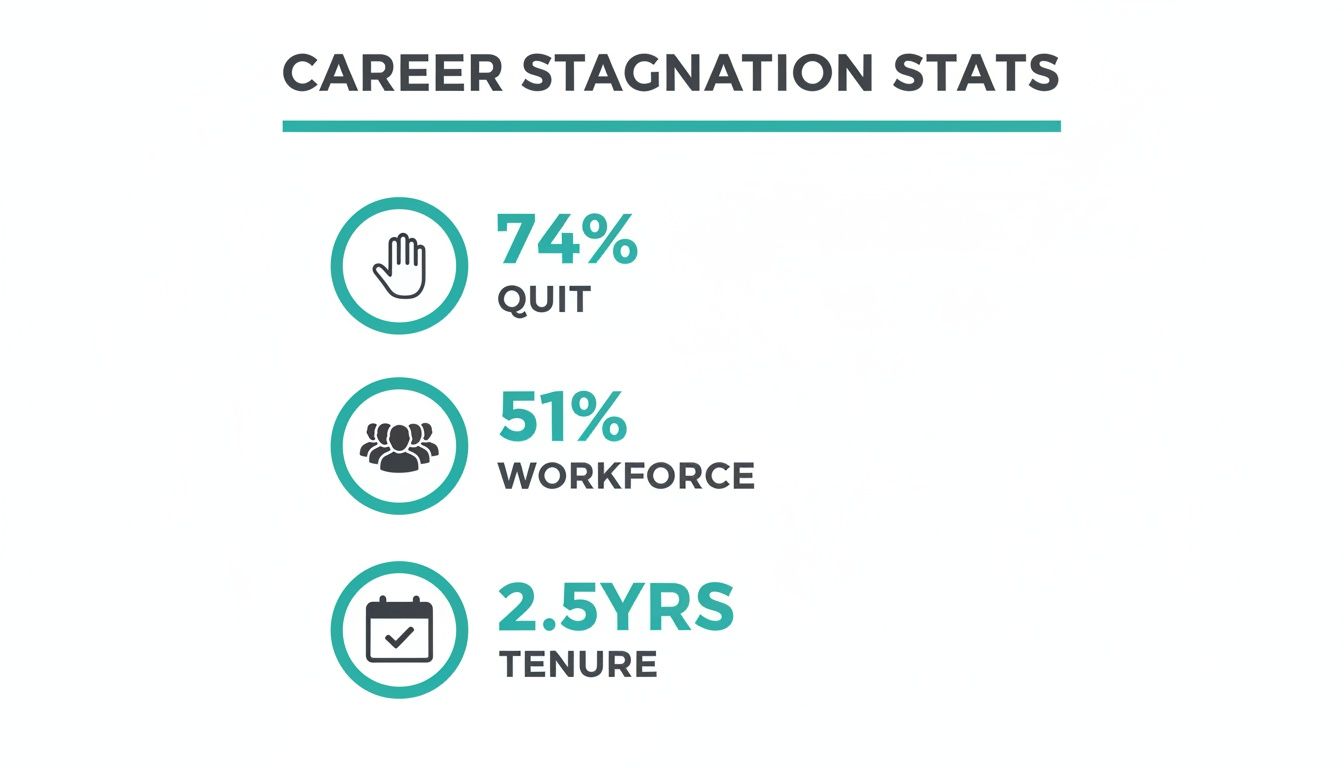
The message here is loud and clear: if your people can't see a future with you, they'll find one somewhere else.
By the time an employee hands in their notice, the real problems have been festering for months. An effective, data-driven strategy uncovers these systemic issues at the source, giving you a chance to intervene before the decision to leave is even made.
Ethical AI as the Core of Your Strategy
This is exactly where Logical Commander's Risk-HR module changes the game. Our platform uses EPPA-compliant AI to ethically analyze aggregated, anonymized data from your existing operational systems. It’s designed to identify patterns related to disengagement and other human-factor risks without ever using invasive employee monitoring or surveillance.
For instance, our system might flag:
A department showing a significant correlation between missed compliance training and a rise in integrity-related incidents.
A pattern of high turnover clustered around a specific manager, pointing to a clear need for leadership intervention.
An uptick in potential conflict-of-interest scenarios that could signal deeper cultural issues.
This is a fundamentally different approach. We don't analyze personal emails or make judgments about individuals. Risk-HR delivers objective, high-level intelligence that empowers your leaders to make informed, strategic decisions. It lets you see the whole forest, not just the individual trees. Our guide on the value of a behavioral analytics platform explores this ethical framework in much greater detail.
By centralizing this human risk intelligence, you connect the dots between HR, Compliance, and Security. This unified view ensures your efforts to reduce employee turnover become a critical part of your enterprise risk management program.
Ditching the Broken Playbook for Proactive Prevention
Let’s be honest: the traditional ways of managing employee turnover and internal threats are fundamentally broken. Reactive investigations, invasive surveillance, and annual engagement surveys share the same fatal flaw—they only address problems long after the damage is done. If you really want to learn how to reduce employee turnover and protect your organization, you must discard that outdated, ineffective playbook.
The new standard is proactive, ethical, and intelligent. It’s built on the understanding that the human factors that drive both voluntary turnover and insider risk are deeply intertwined. A disengaged employee isn't just a flight risk; they are a potential compliance gap, a morale drain, and a security vulnerability.
Old Methods vs. the New Standard
For far too long, companies have relied on tools and strategies that create more problems than they solve. Surveillance systems destroy trust, create a hostile work environment, and push companies into legally gray areas. And after-the-fact forensic investigations? They're incredibly costly, disruptive, and only serve to document a failure that has already occurred. This reactive posture is a massive liability.
The core failure of traditional risk management is its focus on policing behavior rather than preventing the conditions that create it. The new standard flips this script, focusing on fostering a culture of integrity and support that inherently minimizes risk.
An ethical, proactive framework operates on a completely different philosophy. It prioritizes prevention over punishment and insight over intrusion.
The Pillars of a Modern, Proactive Framework
Adopting this new standard isn’t just about new tech; it’s a strategic shift in how you view the relationship between your people and your risk posture. It’s about building a resilient organization that is strong by design, not by enforcement.
This modern approach is defined by a few key principles:
Ethical AI-Driven Intelligence: This is about using advanced analytics to spot systemic risks without ever targeting individuals. For instance, an AI human risk mitigation platform can identify patterns of disengagement or potential conflicts of interest at a departmental level, giving leadership a chance to intervene constructively.
EPPA-Compliant by Design: The entire framework must adhere to the highest ethical and legal standards, like those in the Employee Polygraph Protection Act (EPPA). This means absolutely no surveillance, no lie detection, and no tools that make psychological evaluations. This protects both employee dignity and your company's legal standing.
A Focus on Human-Factor Risk: This is the understanding that all internal risk—from compliance breaches to data loss—starts and ends with people. Therefore, the most effective prevention strategy addresses the root causes of human behavior, like poor management, a toxic culture, or a lack of growth opportunities.
Integrated Risk Management: This approach breaks down the silos between HR, Compliance, Security, and Legal. Using a unified platform for internal threat detection like Logical Commander’s Risk-HR module ensures everyone is working from the same intelligence, creating a coordinated and effective GRC strategy.
Join the New Ecosystem with PartnerLC
The shift to proactive, ethical risk management represents a massive opportunity not just for enterprises but for the entire B2B SaaS ecosystem. Technology providers, consultants, and service firms are recognizing that their clients need better, more ethical solutions to manage human-factor risk.
To meet this demand, we’ve launched PartnerLC, our exclusive partner program. PartnerLC is designed for B2B SaaS companies and service providers who want to integrate our cutting-edge, EPPA compliant platform into their own offerings.
By joining our partner ecosystem, you can:
Provide your clients with a new standard in ethical risk management.
Differentiate your services with a unique, AI-driven preventive solution.
Create new revenue streams by addressing the urgent need for non-intrusive internal risk prevention.
This is more than just a partnership; it’s a movement to build a new global standard for managing internal risk ethically and effectively. We invite you to become an ally in this mission.
Your Questions, Answered
When you connect the dots between employee turnover, internal risk, and ethical AI, a few key questions usually come up. Decision-makers from risk, compliance, and HR often want to know exactly how this new proactive approach works in the real world. Let's tackle some of the most common ones.
How Can AI Help Reduce Turnover Without Monitoring Employees?
This is the most critical distinction. Ethical AI platforms like Logical Commander do not function like surveillance tools. They aren’t reading emails, tracking keystrokes, or monitoring individual employee activities.
Instead, they focus on anonymized, aggregated data from HR and operational systems to spot systemic risk patterns that are often the invisible drivers of resignations.
An AI human risk mitigation tool can flag a department with a sudden spike in integrity incidents or identify a growing pattern of conflicts of interest. These are symptoms of a deeper problem. This gives you the high-level intelligence needed to fix the root causes of turnover—like a problematic manager or a broken process—rather than resorting to invasive and trust-destroying surveillance.
It's about prevention, not policing. You're addressing the why behind people leaving, which naturally boosts retention and strengthens your entire governance framework.
What Is the Link Between Employee Turnover and Insider Risk?
High employee turnover is a massive, often underestimated, gateway to insider risk. Every time an employee leaves, especially if they're disgruntled, they represent a potential vector for data theft, IP loss, or operational disruption.
In high-turnover environments, the offboarding process itself becomes a critical point of failure. It's often rushed or mishandled, leaving security gaps wide open.
But it goes deeper. A "revolving door" culture steadily erodes your institutional knowledge, leading to weaker security protocols and a less vigilant workforce. By proactively addressing the reasons people leave, you're not just solving an HR problem; you're hardening your defenses against both malicious and accidental insider events. Retention becomes a core pillar of your internal threat detection strategy.
How Does This Approach Maintain EPPA Compliance?
Our platform was engineered from the ground up to be fully EPPA compliant. This is non-negotiable.
It does not perform lie detection, conduct psychological evaluations, or engage in any form of employee surveillance. These methods are not only legally risky but are also completely ineffective at building a culture of integrity.
The system delivers preventive risk intelligence based on objective, operational data—not subjective judgments about an employee's character or state of mind. All decision-making authority stays exactly where it should: with your HR and legal teams. This ensures you can manage human-factor risk proactively while upholding the highest standards of employee dignity and sidestepping the massive legal pitfalls of invasive tech. It’s the new benchmark for ethical risk management.
At Logical Commander, we believe protecting your organization and respecting your people are two sides of the same coin. Our EPPA-aligned platform provides the proactive intelligence you need to reduce employee turnover and neutralize internal risks before they can do any harm.
Ready to see the new standard in ethical risk prevention?