%20(2)_edited.png)

How Tone from the Top Shapes an Unbeatable Company Culture

Updated: Dec 11, 2025
"Tone from the top" isn't just another piece of corporate jargon—it's the ethical and behavioral blueprint leaders create for an entire organization. This tone is set not by what leaders say in a memo, but by what they actually do. It’s about their visible actions, their decisions when the pressure is on, and the standards they hold everyone to, day in and day out.
So, What Does 'Tone from the Top' Actually Mean?

Think of a leadership team like the general contractor on a major construction project. The company's values and policies are the official blueprint. But the real integrity of the building comes down to what happens on the worksite every single day. Do they cut corners on materials to save a few bucks? Are safety rules enforced for everyone, or just for the junior crew?
The finished building always reflects their daily behavior, not just the fancy plans they started with.
In the same way, your company’s culture is a direct result of how its leaders behave. A healthy tone from the top is the active, visible demonstration of integrity. This becomes the true north on the cultural compass for every single employee, shaping how the entire organization operates far more powerfully than any policy manual ever could.
The Building Blocks of Leadership Tone
A strong leadership tone really comes down to three connected pillars. When they're all in sync, they create a culture where doing the right thing is the default, not the exception.
Communication: This is more than sending out emails. It’s about leaders clearly and consistently talking about the organization's values and ethical expectations—in big meetings, in public statements, and in one-on-one conversations.
Actions and Decisions: This is where the "walk" meets the "talk." It's about how leaders handle a crisis, what they do when faced with a tough ethical call, and whether their big strategic moves actually line up with the company's stated principles.
Accountability: This pillar is what makes the standards real. It’s about consistently rewarding ethical behavior and dealing with misconduct, even when it involves a star performer or a senior executive. Everyone has to play by the same rules.
The cultural and ethical standards of a company are a direct reflection of its leadership. When leaders model integrity, they create a powerful ripple effect that reinforces ethical behavior throughout the entire organization.
You really can't overstate how much this kind of role-modeling matters. Research shows that employees put a huge amount of responsibility on their senior leaders to set the right example. In fact, a staggering 88% of employees expect their CEOs to be excellent communicators, and 84% believe CEOs are responsible for modeling the behaviors that shape the whole workforce.
The table below breaks down what a healthy tone looks like in practice compared to a negative one. It’s all about observable actions.
Observable Indicators of Positive vs Negative Tone
This table contrasts the clear, observable behaviors and outcomes associated with a healthy 'tone from the top' versus a detrimental one, helping leaders quickly self-assess.
Indicator | Positive Tone (Walks the Talk) | Negative Tone (Says One Thing, Does Another) |
|---|---|---|
Decision-Making | Ethical principles consistently guide business strategy, even if it’s the harder path. | "Do whatever it takes" mentality prevails; ethics are secondary to hitting targets. |
Accountability | Misconduct is addressed swiftly and fairly, regardless of an employee's rank or performance. | Rules are selectively enforced; high-performers or senior leaders often get a pass. |
Communication | Open, honest, and frequent communication about values and performance—good and bad. | Information is siloed; leaders avoid tough conversations and spin negative news. |
Resource Allocation | Budgets and resources are visibly invested in compliance, training, and ethical programs. | Compliance and HR are seen as cost centers; their budgets are the first to be cut. |
Crisis Response | Leaders take ownership, act with transparency, and prioritize long-term integrity. | Leaders deflect blame, minimize the problem, and focus on short-term damage control. |
Seeing these behaviors side-by-side makes it clear that tone isn't an abstract concept—it’s a collection of daily actions and decisions with real consequences.
Why This Matters for Your Organization
At the end of the day, the tone from the top sets the unwritten rules of your company. It gives employees the real answers to critical questions: What kind of behavior is actually valued around here? What really happens when someone breaks the rules? Do our leaders practice what they preach?
For those looking to go deeper on these foundational principles, this comprehensive leadership guide offers some fantastic insights.
When leadership’s actions are authentic and consistent, they build a bedrock of trust. That trust is what empowers people to speak up about concerns, report potential issues, and make the right choices on their own—creating a resilient and high-integrity organization from the ground up.
Why a Strong Leadership Tone Is a Business Imperative
A positive leadership tone is so much more than a "nice-to-have" cultural element. It’s a powerful and direct driver of business performance. When leaders consistently model integrity, they aren't just setting a moral example—they're implementing a core strategic advantage that profoundly impacts the bottom line.
This connection isn't abstract. An integrity-first culture, championed from the C-suite, directly reduces the likelihood of costly compliance failures and insider threats. It cultivates an environment of psychological safety, where employees feel secure enough to report concerns and flag issues before they spiral into catastrophic scandals.
Without that safety, small problems fester. Employees who fear retaliation will stay silent, allowing minor risks to grow into major liabilities. A strong tone from the top acts as an organization's early warning system, powered by the trust and confidence of its people.
The Financial Upside of Ethical Leadership
Organizations that prioritize and demonstrate ethical leadership consistently outperform their competitors. The data clearly shows a powerful correlation between a strong ethical foundation and superior financial results. This isn't a coincidence; it's a consequence of building a resilient, high-trust organization.
For example, companies celebrated as the 'World’s Most Ethical Companies' have demonstrably outperformed their peers by 12.3% over a five-year period. This data reinforces that ethics is not merely a moral choice but a crucial business imperative. The effectiveness of this message is amplified when multiple executives—from the CEO to HR and Legal leaders—consistently communicate its importance, boosting employee buy-in. You can discover more insights on how ethics drives financial performance on ethisphere.com.
This financial success stems from several key areas that a positive leadership tone directly influences.
Talent Attraction and Retention: Top performers are drawn to environments where they feel respected and where fairness is the norm. A toxic or inconsistent tone drives away elite talent and increases costly turnover.
Customer Loyalty and Trust: Customers are increasingly savvy about the ethics of the companies they support. A reputation for integrity builds an unshakable bond with your customer base, making them more likely to remain loyal even during challenging times.
Reduced Regulatory and Legal Costs: An organization where people are empowered to do the right thing naturally has fewer compliance breaches, lawsuits, and regulatory fines. This proactive risk mitigation saves millions in potential legal fees and penalties.
"A strong tone from the top is the bedrock of a high-performing organization. It transforms the concept of integrity from a compliance checkbox into a tangible business asset that fuels sustainable growth and builds lasting stakeholder trust."
From Cultural Ideal to Strategic Advantage
Ultimately, the tone from the top is what transforms a company’s values from words on a poster into lived reality. It dictates how the organization navigates challenges, treats its people, and earns its place in the market.
When leaders prioritize ethical behavior, they create a self-reinforcing cycle of positive outcomes. Engaged employees deliver better customer service, which builds loyalty. A strong reputation attracts better talent, which drives innovation. You can learn more about how to calculate the cultural ROI of integrity in our detailed guide.
This cycle is the engine of sustainable growth. By reframing ethical leadership as a non-negotiable business imperative, organizations unlock a powerful competitive edge that is incredibly difficult for others to replicate. It's an investment in a resilient culture that pays dividends across every single facet of the business.
How a Weak Tone Creates Hidden Organizational Risks
A weak leadership tone doesn't show up as a sudden, headline-grabbing scandal. It’s more like a slow-acting poison, silently seeping into the cultural bedrock of an organization and creating risks that are invisible until it’s far too late. It’s a quiet corrosion that eats away at trust, disengages employees, and creates the perfect breeding ground for misconduct.
This damage almost always starts with the ‘say-do gap’—that dangerous space between what leaders publicly preach and what they privately practice. When employees see executives championing fiscal prudence while approving lavish, unnecessary expenses for themselves, a seed of cynicism is planted.
That disconnect sends a powerful, unspoken message: the rules are for some, but not for all. Over time, this erodes the very foundation of organizational integrity.
The Ripple Effect of Inconsistent Standards
One of the most damaging failures of leadership is the tendency to reward toxic high-performers. When a top salesperson who bullies their colleagues or a brilliant engineer who ignores safety protocols is celebrated for hitting their numbers, the company's stated values become completely meaningless.
The real message employees hear is that outcomes matter more than ethics. This creates a culture where others feel pressured to bend the rules to succeed, opening the door to a whole host of insider threats. Employees start rationalizing their own minor policy violations, which can slowly escalate into far more serious issues.
This is where the hidden risks start to multiply.
Increased Compliance Violations: When policies are seen as suggestions rather than requirements, employees are far more likely to cut corners on everything from data privacy to financial reporting.
Fertile Ground for Misconduct: A cynical environment makes it easier for individuals to justify actions like expense fraud or intellectual property theft, believing the system is rigged anyway.
Suppressed Reporting: Employees become hesitant to use speak-up channels. They fear their concerns will be ignored or, worse, that they will face retaliation—especially if the issue involves a protected "star."
A weak tone from the top essentially gives tacit permission for misconduct. It tells every employee that the organization’s ethical compass is broken, and that successfully navigating the company means knowing which rules you can get away with breaking. You can explore how these vulnerabilities escalate by learning more about conducting a thorough fraud risk assessment.
Breeding Cynicism and Disengagement
When leadership actions consistently contradict their words, the biggest casualty is employee trust. Cynicism becomes the default mode of operation. Engagement plummets because people are unwilling to invest their best efforts in an organization they see as hypocritical.
This disengagement isn't just a morale problem; it's a massive operational risk. A disengaged employee is less likely to be vigilant about security protocols, less committed to quality control, and far less willing to go the extra mile to protect the company's interests. They simply aren't invested in a positive outcome.
The most dangerous risks in an organization are not born from malice, but from apathy. A weak tone from the top manufactures this apathy by showing employees that their commitment to integrity is not valued by those in charge.
This problem is made worse by serious challenges in the global leadership landscape. With 77% of companies reporting leadership shortages, there's immense pressure to promote and retain leaders, even if their style is problematic. Furthermore, with women holding only 32.2% of senior leadership roles, a lack of diverse perspectives at the top can perpetuate exclusionary behaviors and cultural blind spots. These factors create a precarious environment where a poor tone can easily take root and spread. Discover more insights about global leadership statistics on kapable.club.
Ultimately, a weak tone from the top is a systemic failure. It dismantles the cultural immune system of an organization, leaving it vulnerable to a host of internal threats that thrive in environments of inconsistency and distrust.
A Practical Framework for Setting an Ethical Tone
Establishing a strong tone from the top doesn't happen by magic. It requires a deliberate, structured approach where leaders consciously build and reinforce the cultural behaviors they want to see. This framework rests on four essential pillars that, when combined, create a self-sustaining cycle of integrity.
These aren't just concepts; they're action-oriented principles that guide day-to-day leadership. They turn the abstract idea of an ethical tone into a repeatable process for building a high-integrity workplace.
Pillar 1: Authentic Role-Modeling
The first and most important pillar is authentic role-modeling. Your employees are incredibly perceptive. They don't measure leadership by inspiring speeches but by consistent, observable actions—especially when the pressure is on. Authenticity is the bridge between saying the right thing and doing the right thing.
To be an authentic role model, a leader has to walk the talk in high-stakes moments. This means making the difficult, ethical choice over the easy, profitable one and being open about the reasoning behind it. For any leader looking to cultivate a truly impactful environment, understanding what is authentic leadership is the first step.
This flowchart shows how a weak tone, often rooted in inauthentic leadership, can snowball into major organizational failures.
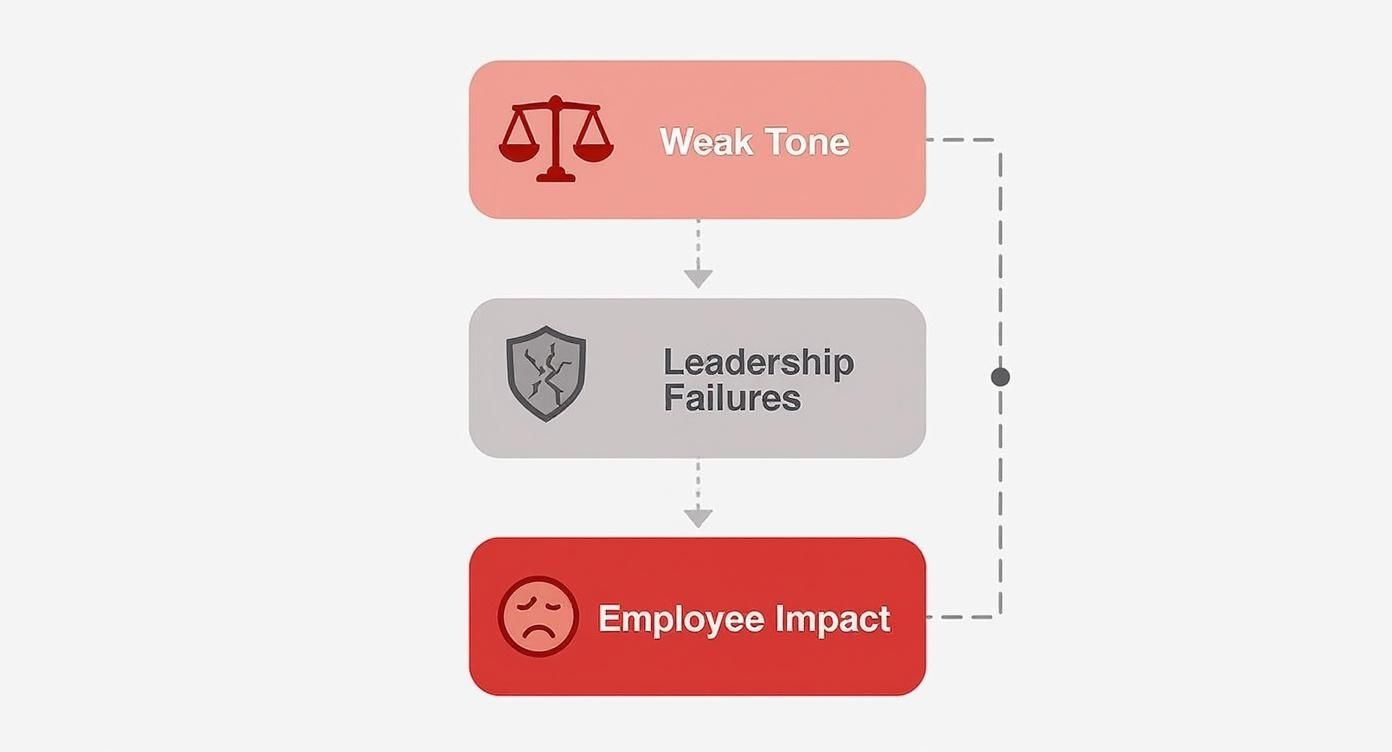
As the diagram makes clear, leadership failures have a direct line to employee impact, creating a culture where distrust and disengagement take root.
Pillar 2: Clear Communication
While actions speak loudest, clear and consistent communication is what gives those actions context and reinforces expectations. Leaders have to move beyond plastering generic values on a wall and start talking openly about ethics in a practical, relatable way.
This means weaving ethics into the fabric of the business:
Make it part of the daily dialogue. Discuss ethical guardrails during project kickoffs, team meetings, and strategy sessions. Normalize it.
Celebrate ethical wins. Publicly recognize employees who demonstrate integrity—the ones who flag a compliance risk or choose transparency over a shortcut.
Keep the door open. Ensure people know how and where to ask questions or raise concerns without any fear of retaliation. Communication has to be a two-way street.
Clear communication ensures the desired tone from the top isn't just demonstrated but is also understood and internalized at every level of the company.
Pillar 3: Aligned Incentives
No matter what leaders say, your company's incentive structure reveals what it truly values. If bonuses and promotions are tied only to hitting financial targets, it sends a loud, clear message: how you hit those targets doesn't really matter. This is a critical failure point for any ethical culture.
To build a strong ethical tone, incentives must be explicitly aligned with company values. This means baking ethical conduct and integrity right into the formal performance management system.
Here are a few ways to start:
Overhaul Performance Reviews: Include specific metrics on ethical behavior, collaboration, and policy adherence. Make these a weighted part of the overall score.
Rethink Bonus Structures: Tie a portion of bonuses to qualitative factors, like fostering a respectful team environment or proactively mitigating risks.
Scrutinize Promotion Criteria: Ensure leadership candidates are assessed not just for their numbers, but for their demonstrated commitment to integrity. A toxic high-performer should never get the promotion.
When you do this, ethical behavior becomes a non-negotiable part of what it means to succeed at your company.
Pillar 4: Unwavering Accountability
The final pillar, unwavering accountability, is what gives the other three their power. Without it, the best role-modeling, communication, and incentives will eventually crumble. Accountability means the rules and ethical standards apply to everyone, equally and without exception.
This is often the hardest pillar to uphold, as it forces leaders to make tough calls, especially when misconduct involves a senior executive or a top salesperson. But a single instance of looking the other way can destroy years of trust-building in an instant.
Unwavering accountability comes down to:
Consistent Enforcement: Applying policies fairly across the board, from the front lines to the C-suite.
Transparent Processes: Conducting investigations into misconduct with fairness, thoroughness, and impartiality.
Meaningful Consequences: Ensuring that consequences for violations are significant enough to serve as a real deterrent.
These four pillars form a powerful, interconnected system for building a resilient, high-integrity culture. For organizations ready to put these principles into action, our guide on creating a https://www.logicalcommander.com/post/high-integrity-workplace-framework provides even more detailed strategies.
How to Measure Your Tone from the Top

You can't fix what you can't see. And while tone from the top might feel like an invisible cultural force, it absolutely leaves a measurable footprint. The trick is to stop guessing and start measuring, transforming this vague concept into a tangible asset you can actively manage.
To do this right, you have to move beyond gut feelings. A real understanding of your organization's cultural health comes from blending two types of signals: qualitative insights that tell you what people are thinking and feeling, and hard quantitative data that shows you what they are actually doing.
Gathering Qualitative Insights
Qualitative data gives you the why behind the numbers. It’s how you hear the whispers and read the room, uncovering the real-world impact of your leadership's actions. But to get an honest read, you have to create channels where people feel genuinely safe to speak up without fear of backlash.
Some of the most effective ways to gather this feedback include:
Anonymous Employee Surveys: Don’t just ask about satisfaction. Get pointed. Ask about leadership integrity, if decisions feel fair, and whether your leaders actually live the company values.
Confidential Focus Groups: Small, facilitated discussions can uncover nuanced issues that surveys always miss. They're perfect for digging into specific topics, like whether senior leaders are truly held accountable.
360-Degree Leadership Reviews: This is where leaders get anonymous feedback from their direct reports, peers, and managers. It provides a powerful, well-rounded view of how their behavior is really perceived across the organization.
These tools are your early-warning system, flagging any disconnect between the tone you think you're setting and the one your employees are actually hearing.
Measuring culture isn't about finding a single score. It's about collecting diverse signals that, together, paint a clear and actionable picture of your organization's health and integrity.
Analyzing Quantitative Data
While qualitative feedback tells you what people think, quantitative data shows you what they do. These are the hard numbers, the objective evidence of how your culture is operating on the ground. They are the tangible results of your leadership’s tone.
By digging into your operational data, you can spot trends and identify hotspots where the message from the top isn't landing.
Key metrics you should be tracking include:
Ethics Hotline and Speak-Up Data: Look at the volume, type, and source of reports. A sudden drop in reporting doesn’t always mean fewer problems—it can be a red flag for a loss of trust.
Policy Violation Trends: Track the number and type of breaches by department and seniority. Are certain teams or leaders repeatedly showing up in the data?
Employee Turnover and Retention Rates: High turnover, especially in one department, is a massive indicator of poor local leadership, which often points back to a weak overarching tone.
Internal Audit Findings: Pay close attention to recurring issues. They often signal systemic cultural weaknesses that leadership has failed to address.
When you bring all these different methods together, you move from guesswork to a data-driven strategy. The following table breaks down how to structure your audit effectively.
Effective Methods for Auditing Your Leadership Tone
Method Type | Specific Tool/Technique | What It Measures |
|---|---|---|
Qualitative (Perception-Based) | Anonymous Culture Surveys | Employee perception of fairness, leadership integrity, and value alignment. |
Qualitative (Perception-Based) | Confidential Focus Groups | Nuanced cultural themes and the underlying reasons for employee sentiment. |
Qualitative (Perception-Based) | 360-Degree Leadership Reviews | How a leader's specific behaviors are perceived by reports, peers, and superiors. |
Qualitative (Perception-Based) | Exit Interviews | Honest, unfiltered feedback on why employees are leaving, often tied to management. |
Quantitative (Behavior-Based) | Ethics Hotline & "Speak-Up" Analytics | The volume, type, and location of reported misconduct; gauges trust in reporting channels. |
Quantitative (Behavior-Based) | Policy Violation Data | Concrete evidence of where and how often rules are broken; highlights accountability gaps. |
Quantitative (Behavior-Based) | Employee Turnover & Attrition Rates | Areas of the business with potential leadership or cultural toxicity. |
Quantitative (Behavior-Based) | Internal Audit & Control Failure Data | Systemic weaknesses in processes that leadership has failed to adequately oversee. |
By combining these streams, you can build a holistic cultural dashboard. This allows for targeted, effective interventions and, just as importantly, lets you track whether your efforts to improve the tone from the top are actually working.
A Leader’s True Legacy
At the end of the day, shaping the tone from the top is the most critical work a leader will ever do. It’s the invisible architecture that holds up everything else, from big-picture strategy all the way down to day-to-day operations.
There’s an unbreakable link between a leader's actions, the health of the culture, and the company's ability to shut down risk. A strong ethical tone isn’t a project with a start and finish line; it’s a daily commitment to integrity, reinforced through every decision, communication, and moment of accountability.
It’s about building a resilient organization that thrives long after any single leader is gone. This is what creates an environment where people feel safe enough to innovate, to speak up, and to bring their best work to the table. It builds a legacy not of numbers on a spreadsheet, but of trust, respect, and excellence.
An organization's culture is nothing more than a reflection of what its leaders are willing to tolerate. A strong tone from the top makes it clear that integrity isn't just a poster on the wall—it's the only acceptable standard.
Every leader, no matter their title, has the power to shape this culture. The real work is to consciously own that impact and take deliberate, consistent steps to build a workplace defined by trust. That’s how you create a legacy that actually lasts.
Your Questions, Answered
Even when everyone agrees on the importance of tone from the top, turning that idea into reality is where the real work begins. Let's tackle some of the most common questions and sticking points that leaders run into when building an ethical culture.
How Can a New Leader Fix a Pre-Existing Negative Tone?
A new leader has to move fast, but with precision. The first move should always be a "listening tour"—not just with the C-suite, but with employees at every level. The goal is to diagnose the root causes of the negative culture from their perspective. This simple act shows respect and gives you the unvarnished truth you need to act.
Next, you have to publicly acknowledge the past failures. Be direct. Then, immediately articulate a new, clear vision centered on integrity and transparency.
But words are cheap. The final, most critical step is backing them up with visible, decisive action. This could mean overhauling unfair policies, holding previously untouchable individuals accountable for misconduct, or publicly rewarding people who live the new values. Every decision from that point on must reinforce the new direction to methodically rebuild trust.
What Is the Role of Middle Management in Shaping Culture?
Middle managers are the make-or-break link in the chain. They are the ones who amplify the tone from the top—or kill it before it ever reaches the front lines. They translate executive messaging into the day-to-day reality for the vast majority of your workforce.
Senior leaders set the weather, but middle managers create the climate in each department. Their direct influence on individual teams cannot be overstated.
Because they're so critical, senior leadership's job is to equip, empower, and train them to be culture carriers. This means giving them clear talking points, practical training for handling tough ethical dilemmas, and the authority to enforce standards. And just as importantly, their performance reviews and incentives have to be tied directly to how well they foster a healthy, ethical climate on their teams.
Can Technology Help Improve an Organization's Tone?
Yes, absolutely—but only when it’s used as a supportive, ethical tool. The right kind of platform can analyze anonymized organizational data to give you a real-time read on cultural health. It can spot early warning signs of a disconnect between what you say and what’s actually happening. For example, technology can detect communication breakdowns or shifts in sentiment, allowing you to intervene proactively.
However, technology is a compass, not a captain. It complements authentic human leadership; it never replaces it. Any platform must be used ethically to provide insights that support cultural goals while fiercely protecting employee privacy and dignity. Ultimately, the responsibility for setting and sustaining the right tone always rests with leaders, not algorithms.
Ready to transform your cultural health from an abstract goal into a measurable, manageable asset? Logical Commander Software Ltd. provides the AI-driven platform to help you identify early-warning signals and manage insider risk ethically and proactively. Our E-Commander platform gives you the visibility to act fast while preserving employee dignity and privacy.