%20(2)_edited.png)

What is an Insider Threat? A Guide to Proactive, Ethical Prevention

So, what exactly is an insider threat? It’s any risk originating from people who already have legitimate access to your organization's systems and data—your employees, contractors, or partners. Whether through deliberate action or unintentional error, they can misuse that access and cause significant harm to your operations, finances, or reputation.
Understanding the Modern Insider Threat
When leaders in Risk, HR, and Compliance hear "insider threat," their minds often jump straight to a malicious actor stealing trade secrets. While that happens, it’s a dangerously narrow view that misses the much larger, more common source of human-factor risk.
The vast majority of insider incidents aren’t driven by malice. They are the result of everyday human error—simple mistakes, accidental policy violations, and honest negligence.
Think of it this way: An external cyber threat is like a burglar trying to kick down your front door. It’s loud, obvious, and you have alarms set up to stop it. An insider threat, however, is far more subtle, like a slow leak inside the walls. It can go unnoticed for months, quietly causing foundational damage that’s incredibly complex and expensive to fix once it’s finally discovered.
This distinction is everything. A reactive, policing-based approach leads to invasive surveillance and a culture of distrust—a strategy that is not only ineffective but also a legal minefield. The focus must shift from reacting to incidents to proactively and ethically managing human-factor risk before it escalates.
The Two Faces of Insider Threats
A modern insider threat isn't a single problem; it's a spectrum of behaviors. At a high level, these threats break down into two main groups, as this flowchart shows.
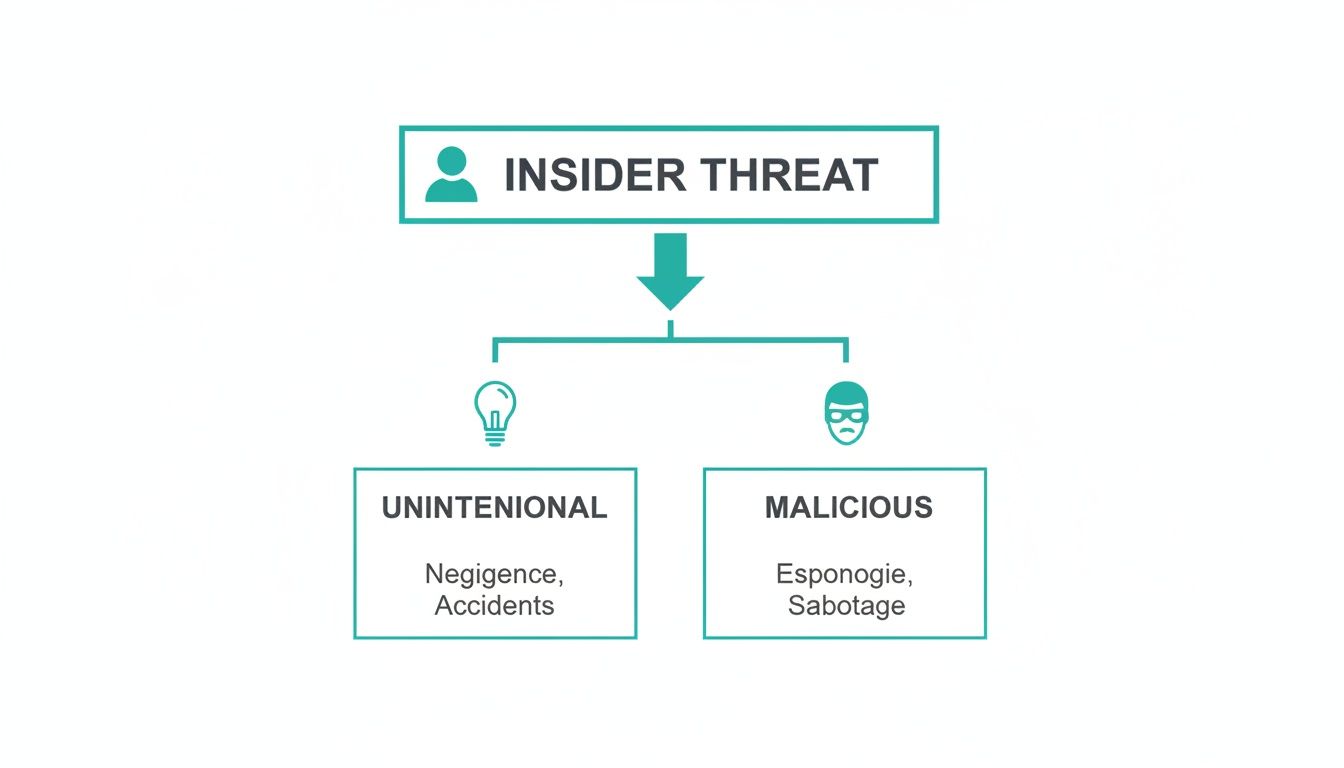
As you can see, both unintentional mistakes and deliberate sabotage can lead to significant business damage, which is why a comprehensive risk prevention strategy is non-negotiable.
Here’s a quick breakdown of the different types of insider threats and the kind of business impact they can have.
The Spectrum of Insider Threats
Threat Type | Primary Motivation | Common Business Impact |
|---|---|---|
Accidental Insider | No harmful intent; often due to negligence, lack of training, or a simple mistake. | Data leaks from misconfigured cloud storage, falling for phishing scams, sending sensitive info to the wrong person. |
Compromised Insider | An external attacker steals an employee's legitimate credentials to gain access. | Data exfiltration, ransomware deployment, and lateral movement across the network—all under the guise of a trusted user. |
Malicious Insider | Deliberate intent to cause harm, driven by financial gain, revenge, or ideology. | Theft of intellectual property, sabotage of critical systems, fraud, and leaking confidential company plans. |
Each of these scenarios requires a different response, but they all highlight the same critical need: identifying risky behaviors and procedural gaps before they turn into a full-blown crisis.
A Growing, Expensive Problem
The frequency and cost of these incidents are climbing at an alarming rate. Insider-related incidents have surged, with 71% of companies facing between 21 and 40 incidents in 2023 alone.
This human element is a massive factor in business disruptions, contributing to about 60% of all incidents. The financial hit is staggering, with costs in North America reaching an average of $22.2 million per incident. These aren’t just abstract numbers; they signal a clear and present danger that demands a new standard of human-factor risk management. For more details, you can explore these insider threat statistics.
Ultimately, understanding what an insider threat is means recognizing the wide range of motivations and actions behind them. The key is learning to spot the subtle behaviors and procedural gaps that signal potential harm. To better prepare your team, you should learn more about the common insider threat indicators that often show up long before a major incident occurs.
Calculating the True Cost of an Insider Incident
Knowing what an insider threat is and understanding what it can actually cost your business are two completely different things. When an incident hits, the damage isn't a single event—it's a cascade of financial, reputational, and operational consequences that ripples through every department.
The first wave of costs is always the most obvious. You're immediately hit with the steep expenses of a reactive investigation, which means pulling in digital forensics teams, paying for legal consultations, and losing immense productivity as key people are diverted to manage the crisis. If you're in a regulated industry, you can also expect severe fines for any compliance failures.
But these upfront expenses are just the beginning. They're merely the tip of the iceberg, and the true financial devastation hiding beneath the surface is staggering.
The Escalating Financial Damage
Recent data paints a clear and troubling picture: this problem is getting worse, fast. The total average annual cost of insider incidents has exploded to $17.4 million in 2025. That's a massive jump from $8.3 million just a few years ago in 2018.
This represents a more than 109.6% increase, a number that should grab the attention of any leader in Risk, Compliance, or HR. Malicious incidents now cost an average of $715,366 per event. For industries like healthcare, the average breach cost has climbed to a painful $9.77 million. These figures aren't just statistics; they're a clear warning.
This dramatic rise in costs proves that traditional, reactive approaches are a losing battle. By the time an investigation begins, the most significant damage—financial, reputational, and operational—has already been done.
Beyond the Balance Sheet: Reputational and Strategic Costs
The most profound damage often has little to do with direct financial payouts. These intangible costs can cripple a company's long-term health, market position, and strategic goals.
Erosion of Customer Trust: A single data breach or fraud incident can shatter the trust you’ve spent years building, leading to customer churn and making it incredibly difficult to win new business.
Brand and Reputational Harm: The public fallout from an insider event can tarnish your company's reputation for years, directly impacting shareholder value and your standing in the market.
Loss of Intellectual Property: Stolen IP can give competitors an unfair advantage, completely derailing your product roadmap and market strategy. For more on this, it's worth exploring these strategies for protecting intellectual property rights.
Decreased Employee Morale: Nothing poisons a work environment faster than a reactive investigation. The resulting culture of suspicion kills morale, tanks productivity, and drives your best talent to the door.
When you look at the full picture, the business case for shifting from a reactive posture to a proactive one becomes undeniable. The astronomical price of after-the-fact forensics and the expense of inaction far outweigh the investment in a modern, ethical risk management platform. To understand why outdated methods are so costly, read our guide on [the true cost of reactive investigations](https://www.logicalcommander.com/full-blog/the-true-cost of-reactive-investigations). The focus has to be on prevention.
Why Traditional Detection Methods Are Failing
For years, organizations have tried to solve the insider threat puzzle with the same old set of tools, mostly centered around surveillance and data monitoring. But these legacy approaches are proving to be expensive, ineffective, and legally risky. They were built for a different era, one focused on watching data move instead of understanding the human behaviors that actually precede risk.

This outdated model creates a ton of friction between security goals and a healthy company culture. It forces security and HR teams into the role of internal police, breeding a culture of distrust that kills morale and tanks productivity. Worse, these tools are fundamentally reactive. They only flag an issue after sensitive data is already on the move, which is usually far too late to stop the damage.
The Pitfalls of Surveillance-Based Tools
Traditional cyber tools like Data Loss Prevention (DLP) and User Activity Monitoring (UAM) operate on a simple, flawed premise: watch everything and hope to catch something suspicious. DLP systems are designed to block sensitive data from leaving the network. UAM tools go even further, tracking keystrokes, screen activity, and app usage.
While that sounds protective in theory, here’s why it falls apart in the real world:
Overwhelming Alert Fatigue: These systems generate a relentless firehose of alerts, the vast majority of which are false positives. Security professionals report being completely overwhelmed, making it nearly impossible to spot a genuine threat in all that noise.
Invasive and Legally Risky: Constant monitoring easily crosses legal and ethical lines, especially with regulations like the Employee Polygraph Protection Act (EPPA) in the U.S. This kind of surveillance creates an adversarial relationship with employees and can expose the organization to significant legal liability.
Blind to Human Context: These tools have zero understanding of intent. They can't tell the difference between an employee accidentally emailing the wrong file and one deliberately stealing intellectual property. They miss the subtle human-factor risks—the real leading indicators of an incident. While some solutions try to layer on voice analysis, you can discover more about why voice signals alone are not a solution for risk management in our detailed article.
Traditional surveillance fails because it focuses on the what (data movement) instead of the why (human risk factors). It’s like installing cameras only on the emergency exits while ignoring suspicious behavior inside the building.
The New Standard: Ethical Prevention
The obvious shortcomings of these old methods have paved the way for a much-needed evolution in insider risk management. The new standard flips the script, shifting the focus from reactive surveillance to proactive, ethical prevention. This modern approach is built on a foundation of respecting employee privacy while gaining the critical risk intelligence you need.
This isn’t a cyber problem; it's a human-factor risk that demands a human-centric solution. Rather than monitoring employees, a modern AI human risk mitigation platform analyzes procedural and behavioral risk indicators without resorting to invasive techniques. It empowers HR, Legal, and Compliance teams to understand and address risks constructively before they ever have a chance to escalate.
This table highlights the fundamental differences between the old way and the new standard.
Comparing Approaches to Insider Risk Management
Attribute | Traditional Surveillance and Forensics | Modern Ethical Prevention (Logical Commander) |
|---|---|---|
Focus | Reactive (after the incident) | Proactive (before the incident) |
Methodology | Invasive surveillance, data monitoring | Non-intrusive risk assessments |
Employee View | Assumes adversarial intent | Preserves dignity and collaboration |
Legal Posture | High risk of EPPA/privacy violations | Fully EPPA-aligned and ethical |
Outcome | Alert fatigue, costly investigations | Actionable intelligence, risk mitigation |
By embracing this new standard, organizations can build a more resilient and trustworthy environment. The goal isn't to police your staff but to create a culture of integrity where risks are identified and managed responsibly—protecting both the institution and its people. This is the heart of effective ethical risk management.
Adopting the New Standard of Ethical Risk Prevention
If you’re still thinking about insider risk with a reactive, policing mindset, you’re already behind. The old surveillance-based model is broken—it breeds distrust, creates legal liabilities, and often fails to stop a threat until after the damage is done. A fundamental shift is long overdue.
The new standard for managing the human element of what is an insider threat moves away from after-the-fact forensics and toward proactive, ethical prevention. This modern philosophy is built on a powerful idea: you can protect your organization without compromising employee dignity or poisoning your company culture.

This approach isn’t about catching people doing wrong; it’s about identifying and fixing procedural and behavioral risks before they can escalate into costly disasters. It’s a strategic pivot that benefits everyone, turning risk management from a game of cat and mouse into a pillar of organizational health.
The Core Principles of Ethical Prevention
An ethical risk prevention model is defined by its unwavering commitment to non-intrusive methods and full legal compliance. It’s a framework that delivers the critical risk intelligence you need while treating your workforce with respect.
EPPA-Aligned Methodology: Every process must be fully compliant with the Employee Polygraph Protection Act (EPPA). This means absolutely no lie detection, psychological profiling, or coercive analysis. The goal is risk assessment, not interrogation.
Non-Intrusive by Design: The system completely avoids invasive surveillance, secret monitoring, and tracking of employees’ personal activities. It focuses squarely on organizational risk indicators, not policing individual behavior.
Preservation of Dignity: Employees are treated as partners in security, not as potential adversaries. This reinforces a positive company culture where collaboration is the cornerstone of operations. For an example of how a company can transparently detail its commitments, you might look at resources like Shorepod's Trust Center.
This ethical foundation isn't just a "nice-to-have"—it's a legal and operational necessity for any organization looking to build a resilient and sustainable insider risk program.
By prioritizing ethical, non-intrusive methods, organizations can gain the insights needed to prevent incidents without creating the legal liabilities and cultural damage associated with traditional surveillance. It’s about being effective, not invasive.
How AI Enables Proactive and Ethical Risk Management
The engine driving this new standard is purpose-built AI. Unlike the blunt instruments of the past, modern AI human risk mitigation platforms are designed with precision and ethics at their very core. They can analyze huge sets of procedural data to spot patterns that correlate with high-risk situations, all without ever crossing privacy boundaries.
This technology doesn't "watch" employees. Instead, it functions as a sophisticated Risk Assessments Software, looking for anomalies and risk indicators within established business processes.
For example, an AI-driven system can identify:
A sudden spike in access requests to sensitive files from a department with no business need to be there.
Unusual patterns in vendor approvals that might signal a conflict of interest.
Procedural shortcuts that could signal negligence or a deliberate attempt to bypass internal controls.
This is fundamentally different from reading emails or tracking keystrokes. The AI isn’t making judgments about an individual's character or intent. It is simply flagging deviations from established, low-risk baselines, giving objective data points to the human experts in HR, Legal, and Compliance for review.
Unifying Risk Intelligence for Decisive Action
One of the biggest weaknesses of legacy systems is that they operate in silos. Cyber security has its tools, HR has its processes, and Legal works on its own track. This fragmentation means no one ever has the complete picture of the human-factor risk facing the organization.
The new standard solves this with a unified platform that centralizes risk intelligence. It pulls insights from across the business into a single operational view, enabling cross-functional teams to finally collaborate effectively.
When a potential risk is flagged, the right stakeholders in HR, Compliance, and Legal are automatically equipped with the context they need to take appropriate, constructive action. This integrated approach ensures that risks are addressed holistically and preventively, transforming the entire practice of modern internal threat detection. It allows leaders to move from a state of constant reaction to one of strategic mitigation—safeguarding the company’s assets, reputation, and culture before the damage can occur.
To truly get a handle on the complexities of what is an insider threat, leaders in Compliance, Risk, and HR need more than just a vague idea—they need a clear, actionable game plan. Building a successful program isn't about just deploying another piece of software. It’s about embedding a new, proactive philosophy deep into your company's culture.
This isn't just a checklist; it's a strategic roadmap designed to move your organization from a reactive, forensic-based posture to one of intelligent, ethical prevention. This is a deliberate process. It demands alignment across departments and a serious commitment from leadership to protect the business without resorting to invasive, trust-destroying methods.
Securing Executive Buy-In
First things first: you absolutely must get genuine buy-in from your executive team and the board. This isn't a conversation about policing employees. Frame it for what it is—a strategic initiative for business preservation and continuity.
You need to present the program as a modern solution to mitigate very real financial, legal, and reputational risks. Use the hard data on the skyrocketing costs of insider incidents and the clear failure of traditional surveillance to build a compelling business case. Emphasize that an ethical, EPPA-compliant approach isn't just the moral high ground; in today's environment, it's a legal and competitive necessity.
Forming a Cross-Functional Governance Team
Insider risk is not a problem for one department to solve in a silo. It takes a collaborative effort from the leaders who understand the human, legal, and procedural DNA of your organization. An effective insider risk program has to be governed by a cross-functional team.
This core group is your brain trust. It should include leaders from:
Human Resources (HR) to manage the human-factor elements and ensure employee dignity is always at the forefront.
Legal and Compliance to guarantee that every policy and action is airtight when it comes to regulations like EPPA and other privacy laws.
Risk and Security to weave the program into the bigger picture of enterprise risk management.
This unified team ensures all perspectives are on the table, creating a balanced and robust governance structure. This kind of collaboration is the heart and soul of a comprehensive insider risk management strategy.
Developing Clear Policies and Communication
Your program’s success lives or dies on transparency. You have to develop clear, accessible policies that spell out the organization's approach to insider risk. These policies need to explicitly state your commitment to non-intrusive methods and EPPA compliance, making it crystal clear that the focus is on identifying procedural risks, not monitoring people.
A proactive communication plan is just as vital. Educate your employees about the program's real purpose: to protect the organization and its people from harm, whether it's accidental or intentional. This kind of transparency builds trust and can turn employees from potential liabilities into your most active partners in risk mitigation.
An effective program is built on a foundation of clear rules and open communication. When employees understand the 'why' behind the initiative—business protection, not suspicion—they are more likely to support and participate in creating a secure environment.
Integrating a Non-Intrusive AI Platform
With solid governance and clear policies in place, the next step is to bring your strategy to life with technology. This is where an EPPA compliant platform like Logical Commander's E-Commander becomes absolutely essential. Integrating a non-intrusive, AI-driven solution automates the hard work of identifying high-risk procedural and behavioral patterns without ever resorting to surveillance.
This Risk Assessments Software acts as the central nervous system for your program. It provides objective, data-driven insights to your governance team, flagging anomalies that drift away from established low-risk baselines. It's the critical intelligence you need to finally act preventively.
Creating Constructive Workflows
The final piece of the puzzle is establishing clear, constructive workflows for what to do when a risk is identified. When the AI platform flags a potential issue, your governance team needs a pre-defined process for assessment, review, and mitigation. No guesswork.
These workflows must be designed to be supportive, not punitive. The goal is to get to the root cause of the risk—is it a gap in training? A flawed business process? A need for employee support?—and address it constructively. This approach not only neutralizes immediate risks but also fortifies your organization's overall resilience, turning every identified risk into a genuine opportunity for improvement.
The New Standard: Proactive Prevention Over Reactive Forensics
The world of insider risk is crowded, but a clear dividing line has formed. On one side, you have the old-guard platforms and surveillance tools that are legally problematic and treat employees as liabilities. On the other, a new standard is taking hold—one built on proactive, ethical risk prevention designed for the modern workplace.
This new benchmark is a complete departure from the outdated, reactive models that only kick in after the damage is done. Instead of relying on invasive methods that create legal liabilities and shatter trust, the focus is now on ethically identifying and mitigating the human-factor risk at the heart of most business disruptions.
The principles of modern, ethical risk prevention detailed throughout this guide are not theoretical—they are the operational foundation of Logical Commander's E-Commander platform. Our technology was built from the ground up to get ahead of issues like internal fraud, conflicts of interest, and other misconduct without ever stepping into the prohibited territory of employee surveillance.
Our EPPA compliant platform delivers actionable insights to HR, Legal, and Compliance teams without resorting to invasive surveillance. This is the core of effective ethical risk management.
Take the Next Step
For enterprise leaders, seeing this new standard in action is the best way to understand its power. We invite you to request a demo or start a free trial to experience how E-Commander can fortify your organization from within.
Join Our Partner Ecosystem
For consultants, MSSPs, and B2B SaaS providers, our PartnerLC program offers a unique opportunity. Join our ecosystem to deliver cutting-edge AI human risk mitigation solutions to your clients, differentiating your services with a truly preventive approach that moves beyond outdated and intrusive tools.
Don’t wait for an incident to force your hand. Contact our team for an enterprise deployment consultation and begin future-proofing your business today.
Common Questions About Insider Risk
When leaders in Compliance, Risk, and HR start building a modern strategy, a few key questions always come up. Let's tackle some of the most common ones about what is an insider threat and how to manage it the right way. The answers all point back to the same core idea: an ethical, proactive approach is the only one that works.
What Is the Difference Between an Insider Risk and an Insider Threat?
Think of insider risk as the potential for something to go wrong from within your organization. It’s the unaddressed vulnerability—maybe a gap in training, an employee's accidental negligence, or a stolen password. It's the dry tinder waiting for a spark.
An insider threat is what happens when that spark hits. It’s the moment the potential risk becomes a real, damaging event, whether it was an accident or a malicious act. A smart program is all about finding and mitigating those insider risks before they can ever become active threats. It’s a far more effective—and much less expensive—way to operate than cleaning up the mess after the fact.
How Can We Manage Insider Risk Without Violating EPPA or Employee Privacy?
This is the most critical question, and the answer lies in a fundamental shift away from invasive surveillance and toward non-intrusive risk assessment. Forget tools that track keystrokes or read private messages. An EPPA compliant platform uses AI to analyze procedural and behavioral risk indicators without ever touching prohibited methods like lie detection or psychological analysis.
This ethical method identifies high-risk patterns and provides actionable intelligence to HR and compliance teams while fully respecting employee dignity and privacy laws. It's about evaluating process risk, not policing people.
By focusing on process, not people, your internal threat detection methods stay firmly on the right side of legal and ethical lines, building a culture of collaboration instead of eroding it.
Is Our Existing Cybersecurity Stack Enough to Handle Insider Threats?
Your cybersecurity stack is essential for keeping external attackers out, but it was never designed to understand the human nuances of insider risk. These incidents often involve ethics violations, conflicts of interest, or simple negligence—human-factor problems that typical cyber security software is completely blind to.
An effective strategy demands a dedicated, human-centric approach that connects the dots for HR, Legal, and Risk teams. Your security tools see data packets and network traffic; they have no idea about the human context behind an action. You need a specialized Risk Assessments Software to provide that critical intelligence and get to the root cause of insider risk, moving far beyond the limits of your traditional security setup.
Ready to adopt the new standard of ethical, proactive risk prevention? Logical Commander provides an EPPA-aligned, non-intrusive platform to help you identify and mitigate human-factor risks before they cause harm.
Request a Demo: See how our AI-driven platform provides actionable risk intelligence.
Join PartnerLC: Become a partner and deliver cutting-edge solutions to your clients.
Contact Us: Discuss an enterprise deployment to future-proof your organization.
Take control of your internal risk landscape by visiting https://www.logicalcommander.com today.