%20(2)_edited.png)

Best governance risk and compliance software: Top picks for 2026

Updated: Jan 13
In today's complex landscape of evolving regulations, heightened ESG expectations, and sophisticated internal threats, relying on spreadsheets and siloed processes for governance, risk, and compliance (GRC) is no longer a viable strategy. Modern organizations require unified, intelligent platforms that not only manage risk but do so ethically and proactively. Choosing the right GRC software is a critical decision that impacts everything from regulatory standing to corporate reputation and employee trust. This guide cuts through the noise, providing a detailed analysis of the best governance risk and compliance software available.
We'll explore solutions that range from comprehensive enterprise suites to specialized tools focused on ethical insider risk management. Our evaluation dives deep into practical use cases, implementation realities, and crucial modern criteria like privacy-by-design, non-surveillance principles, and the ethical application of AI. For a comprehensive understanding of the strategic value of these platforms, consider A Data-Driven Executive Guide to Governance Risk and Compliance Solutions from Visbanking, which provides a valuable executive overview.
This resource is designed to help you select a partner that strengthens both your compliance posture and your organizational integrity. Each entry in our list includes a detailed overview, key features, potential drawbacks, and ideal use-case scenarios to inform your decision. You will find screenshots for a visual reference and direct links to each platform, ensuring you have all the information needed to move forward. We've structured this list to be your go-to guide for finding the GRC solution that precisely fits your organization's unique operational and ethical requirements.
1. Logical Commander Software Ltd.
Logical Commander’s E-Commander platform distinguishes itself as one of the best governance risk and compliance software solutions by focusing on proactive, ethical, and privacy-first internal threat prevention. Instead of reactive monitoring, it equips organizations with an AI-driven system designed to surface early warning signals of insider misconduct and integrity violations, converting abstract risks into structured, auditable workflows. This approach empowers cross-functional teams, including HR, Compliance, and Security, to intervene before minor issues escalate into significant incidents.
The platform's architecture is a key differentiator, built on a foundation of privacy-by-design that explicitly prohibits surveillance, behavioral profiling, or coercive methods. This ethical framework ensures compliance with stringent regulations like GDPR, CCPA/CPRA, and the Employee Polygraph Protection Act (EPPA), making it a trusted choice for multinational enterprises and government bodies operating in complex legal environments.
Key Strengths and Use Cases
E-Commander excels in unifying fragmented GRC processes. Its modular design allows organizations to start with core functionalities and expand as needed, integrating modules like Risk-HR, EmoRisk for emotional distress signals, and the SafeSpeak whistleblower channel. This creates a single source of truth for managing everything from routine compliance checks to sensitive internal investigations.
Proactive Insider Risk Management: A global financial group can use E-Commander to identify subtle but significant risk indicators, such as conflicting statements or deviations from established protocols, allowing them to address potential fraud or data exfiltration risks before they materialize.
Streamlined HR and Compliance Workflows: A government agency can leverage the platform to manage employee integrity checks and reduce turnover in secure roles by ensuring a fair, transparent, and non-invasive process, as supported by case studies showing a 45% reduction in turnover.
Unified Global Operations: A multinational corporation can deploy E-Commander across 47+ countries with multilingual support, ensuring consistent application of corporate governance standards while respecting local privacy laws.
Implementation and Access
Logical Commander offers a free trial without requiring a credit card, allowing teams to experience its core capabilities firsthand. Full enterprise deployment is priced based on scale and customization, requiring a consultation to determine the total cost of ownership. The platform's immediate ROI is a significant selling point, with customers reporting value from day one through actionable insights and streamlined decision-making. For a deeper dive into GRC strategies, explore their guide on how to conduct a compliance risk assessment.
Pros:
Ethical, Privacy-First Design: Non-invasive detection that forbids surveillance and aligns with major global privacy and labor laws.
Proactive, Actionable Insights: Delivers early-warning signals and structured workflows for immediate, measurable ROI.
Enterprise-Grade Compliance: Certified (ISO 27001/27701) and secure with end-to-end encryption and anonymization features.
Unified and Modular: Consolidates GRC functions across departments and scales from SMBs to large enterprises.
Cons:
Requires Human Governance: The system is a decision-support tool; it flags risks that need human verification to ensure due process and avoid false positives.
No Public Pricing: As is common with enterprise software, pricing is customized and requires direct engagement for a quote.
Website: https://www.logicalcommander.com
2. OneTrust
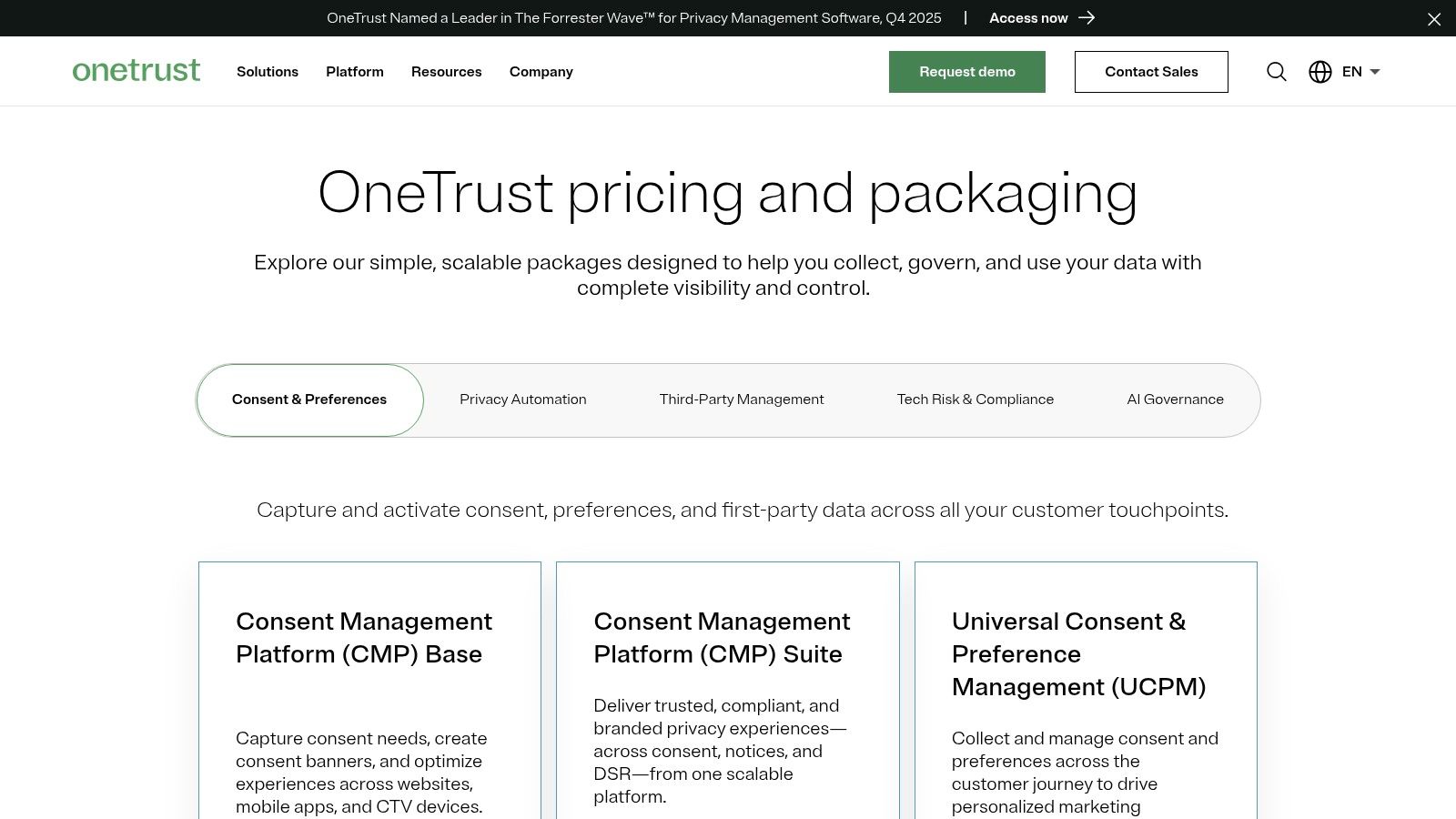
OneTrust has established itself as a significant player in the GRC software market, particularly for organizations prioritizing data privacy and emerging AI governance. Its platform offers a comprehensive suite that integrates risk management, policy lifecycle automation, and compliance monitoring into a unified system. This approach helps teams move beyond siloed spreadsheets and manual tracking to a more cohesive, automated GRC strategy.
OneTrust’s key differentiator is its deep focus on privacy regulations like GDPR and CCPA, alongside pioneering tools for AI governance. This makes it one of the best governance risk and compliance software choices for businesses navigating complex data ethics and new technological risks. The platform provides a single view of risk across assets, processes, and third-party vendors, helping to identify and mitigate threats before they escalate.
Key Features & Use Cases
Extensive Template Library: Leverage over 50 pre-built templates for standards and regulations, complete with guided tasks to accelerate implementation and ensure comprehensive coverage.
Centralized Risk Identification: Gain a unified view of risks across your entire organization, including data, IT assets, and critical business processes, to facilitate proactive management.
Policy Lifecycle Management: Automate the entire policy lifecycle, from creation and review to approvals and employee attestations, ensuring policies are current and acknowledged.
Pros and Cons
Pros | Cons |
|---|---|
Strong focus on privacy, data ethics, and AI governance. | Pricing is quote-based and can be complex. |
Highly scalable, suitable for mid-market to large enterprises. | Successful implementation requires significant stakeholder buy-in. |
Rich content libraries and templates reduce setup time. | May be overly comprehensive for very small businesses. |
OneTrust's strength lies in its ability to address both traditional GRC needs and modern challenges like AI compliance, a critical aspect of modern business compliance strategies.
Website: https://www.onetrust.com/pricing/
3. Archer (Integrated Risk Management)
Archer is a highly mature and configurable Integrated Risk Management (IRM) platform designed for large organizations with complex GRC programs. It provides a robust framework for managing enterprise risk, compliance, audits, and third-party vendor relationships. The platform excels at engaging first-line-of-defense users, streamlining data collection and participation from across the business.
What makes Archer one of the best governance risk and compliance software options is its no-code approach to building custom applications and data integrations. This allows mature GRC teams to tailor the solution precisely to their unique operational workflows and risk models without extensive development resources. Its persona-driven dashboards ensure that every user, from executives to operational staff, receives relevant, actionable insights.

Key Features & Use Cases
No-Code Configuration: Build and modify applications, workflows, and data integrations to align perfectly with your organization's specific GRC processes.
Persona-Driven Dashboards: Deliver tailored reports and interactive dashboards that provide role-specific risk and compliance data to different stakeholders.
Archer Engage Module: Simplify data collection from business users and vendors with an intuitive interface, improving first-line engagement and data accuracy.
Pros and Cons
Pros | Cons |
|---|---|
Mature, comprehensive platform for complex GRC needs. | Can have a steep learning curve for advanced configuration. |
Strong first-line engagement tools for collecting risk data. | Pricing is quote-based and tailored for enterprise budgets. |
Highly configurable without requiring coding expertise. | May be too extensive for smaller organizations with simple needs. |
Archer is ideal for large enterprises that need a powerful, adaptable solution to unify their enterprise risk management framework.
Website: https://www.archerirm.com/solutions
4. MetricStream
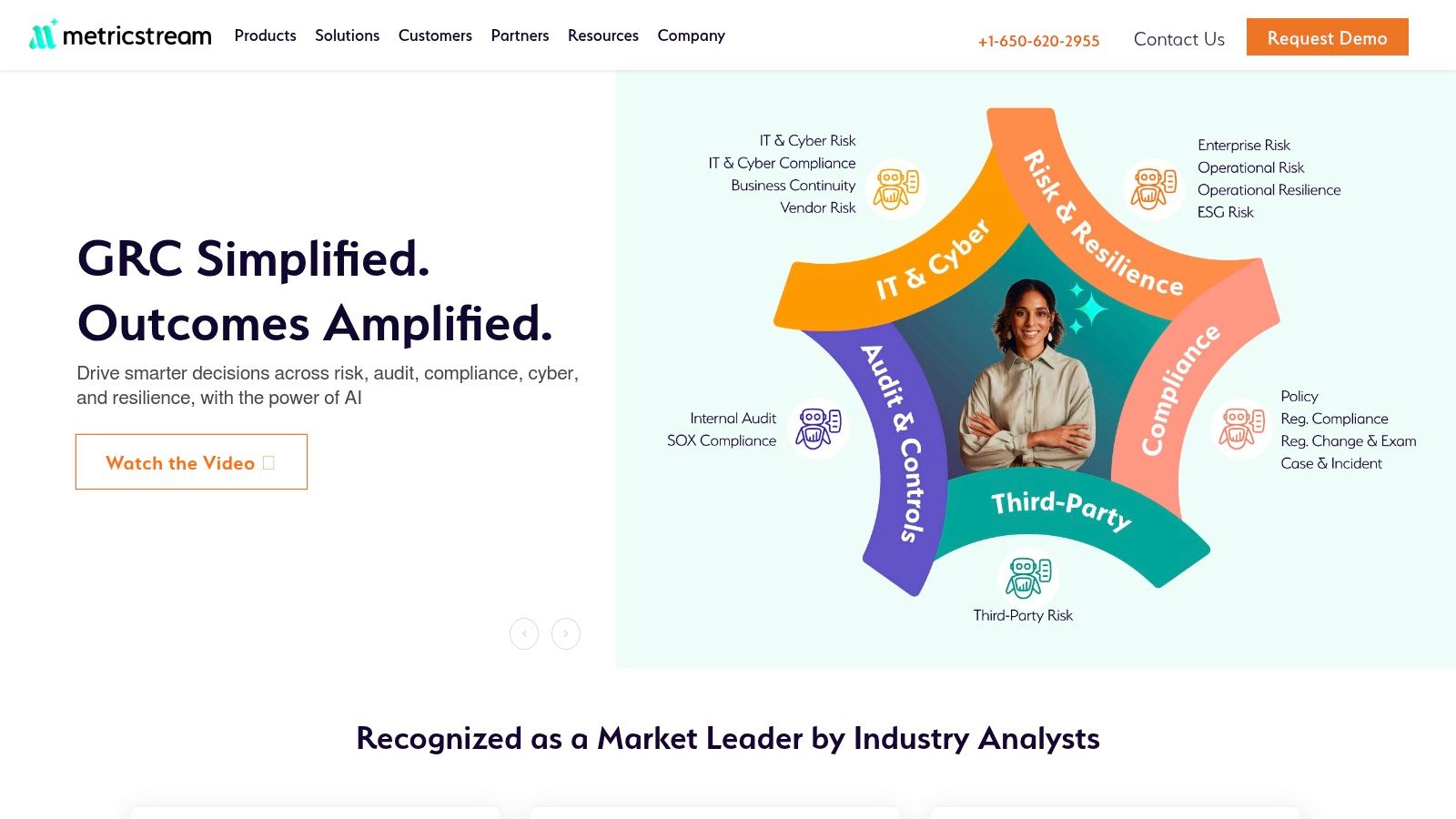
MetricStream positions itself as an enterprise-grade GRC powerhouse, designed for large, global organizations operating in highly regulated industries. Its integrated suite covers the full spectrum of risk, compliance, audit, and third-party management, enabling a federated yet centrally managed GRC program. This approach provides a single source of truth, helping to break down organizational silos and unify risk intelligence across different business units.
What makes MetricStream one of the best governance risk and compliance software options for large enterprises is its sheer breadth and scalability. The platform is engineered to handle complex, multi-module deployments that span numerous geographies and regulatory frameworks. It provides robust workflow automation and advanced reporting capabilities, giving risk and compliance leaders the visibility needed to make strategic decisions and demonstrate due diligence to regulators.
Key Features & Use Cases
Full-Suite GRC Modules: Offers comprehensive modules for Integrated Risk Management (IRM), audit, compliance, regulatory change, and third-party risk.
Advanced Workflow & Reporting: Automate complex GRC processes and generate in-depth reports that provide a holistic view of risk posture across all business domains.
Global Deployment Ready: Architected to support large-scale, international rollouts with complex organizational structures and diverse regulatory requirements.
Extensive Partner Ecosystem: Leverages a wide network of implementation partners to assist with complex deployments and industry-specific configurations.
Pros and Cons
Pros | Cons |
|---|---|
Built for global enterprise scale and regulated industries. | Pricing is custom and typically at the enterprise level. |
Extensive partner ecosystem supports complex rollouts. | Implementation can be time-intensive in complex environments. |
Highly configurable to meet specific organizational needs. | May be too robust and costly for small to mid-sized businesses. |
MetricStream is best suited for mature organizations seeking a comprehensive, all-in-one GRC solution to manage a wide array of interconnected risks on a global scale.
Website: https://www.metricstream.com/
5. NAVEX One
NAVEX One offers a unified platform that excels in integrating ethics and compliance programs. It consolidates disparate GRC functions, such as policy management, incident reporting, employee training, and third-party risk, into a single, cohesive system. This holistic approach empowers organizations to foster an ethical culture while ensuring comprehensive regulatory adherence.
What sets NAVEX One apart is its strong emphasis on the human element of compliance. By connecting hotline and incident management directly with policy and training modules, it provides a closed-loop system for identifying and addressing behavioral risks. This makes it one of the best governance risk and compliance software choices for organizations focused on building a "speak-up" culture and proactively managing ethics-related compliance.
Key Features & Use Cases
Integrated Ethics & Compliance: Manage whistleblowing hotlines, policy attestations, and compliance training within a single platform to gain a holistic view of organizational integrity.
Third-Party Risk Management (TPRM): Streamline due diligence, monitoring, and risk assessment for vendors and partners to ensure your supply chain meets compliance standards.
SMB 'Compliance Essentials' Package: Access a bundled solution designed for smaller businesses, simplifying the adoption of foundational GRC tools without overwhelming complexity.
Pros and Cons
Pros | Cons |
|---|---|
Comprehensive coverage from speak-up to policy and training. | Pricing requires direct contact with the sales team. |
Bundles and SMB options simplify startup for smaller teams. | Buyer experiences vary on the speed of the sales cycle. |
Strong analytics for consolidated compliance workflows. | May offer more features than a simple risk register requires. |
NAVEX One is particularly powerful for organizations seeking to operationalize their code of conduct and ethics programs through an interconnected technology stack.
Website: https://www.navex.com/en-us/
6. Diligent (Diligent One Platform)
Diligent offers a unique proposition by merging board management with core GRC functions like risk, audit, and compliance into its Diligent One platform. This integrated approach is designed to bridge the gap between executive leadership and operational GRC activities, providing board-level intelligence and analytics that drive strategic decision-making. The platform aims to create a single source of truth that aligns management workflows with board oversight.
Diligent’s core differentiator is its focus on executive-level reporting and its ability to connect governance directly to operational risk. This makes it one of the best governance risk and compliance software options for organizations prioritizing board-to-management alignment, especially in areas like ESG and market intelligence. The platform’s integrations with over 100 providers and its proprietary data feeds offer a broad perspective on external and internal risk factors.
Key Features & Use Cases
Unified Board & GRC Workflows: Combine board reporting, risk management, internal audit, and compliance tasks within a single, interconnected platform to ensure strategic alignment.
Extensive Integrations & Market Intelligence: Leverage over 100 third-party integrations and proprietary market data to enrich risk analysis and inform executive strategy.
Executive & ESG Reporting: Generate comprehensive reports tailored for board members and executives, focusing on high-level risks, performance metrics, and ESG insights.
Pros and Cons
Pros | Cons |
|---|---|
Facilitates board and executive reporting aligned with GRC. | Pricing and packaging are sales-led and require a quote. |
Useful for ESG and market intelligence use cases. | Multi-module configurations may extend rollout time. |
Strong focus on connecting leadership to operational risk. | May be more governance-focused than some teams require. |
Diligent is ideal for organizations seeking to elevate their GRC program to the board level, ensuring that risk and compliance data directly informs top-tier strategic conversations.
Website: https://www.diligent.com/pricing
7. LogicGate Risk Cloud
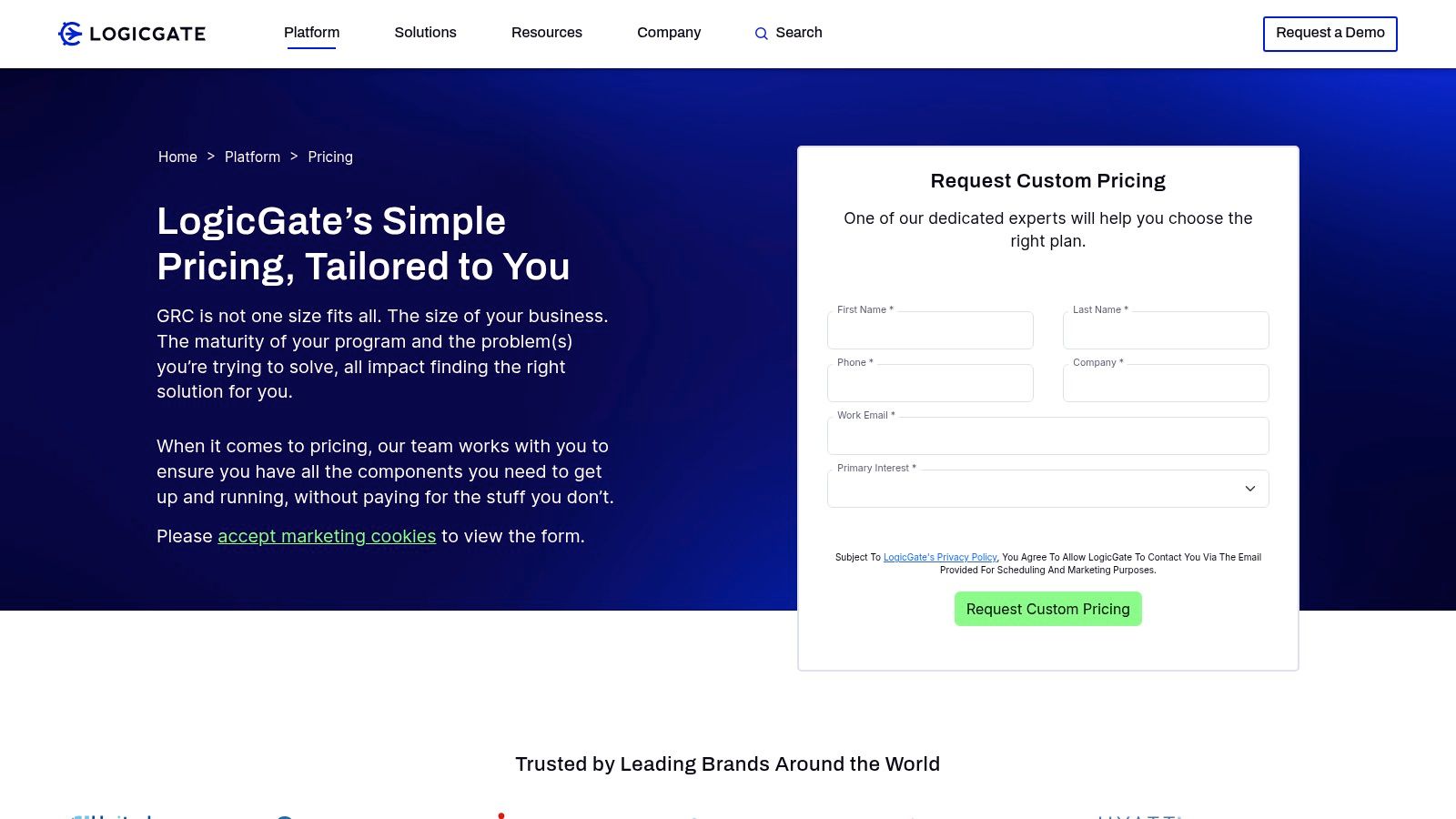
LogicGate Risk Cloud offers a highly flexible, workflow-centric GRC platform built on a modular application model. Instead of a rigid, one-size-fits-all system, it allows organizations to construct their GRC programs using pre-built or custom "apps" tailored to specific use cases like enterprise risk management, third-party risk, and policy management. This approach empowers teams to design and automate processes that precisely match their operational needs.
The platform's standout feature is its cost-efficient user model, which charges only for administrative "Power Users" while including unlimited standard and external users at no extra cost. This makes LogicGate Risk Cloud one of the best governance risk and compliance software options for companies that need to collaborate broadly across departments and with external partners. The focus on customizable, no-code workflows ensures the platform can adapt as an organization's GRC maturity evolves.
Key Features & Use Cases
Modular Application Design: Build a tailored GRC program by selecting from a library of solution applications for specific risk and compliance needs, or create your own.
Cost-Effective User Licensing: Only "Power Users" who build and manage workflows require a paid license, making it affordable to involve unlimited stakeholders in GRC processes.
No-Code Workflow Automation: Design and automate complex GRC workflows with an intuitive, drag-and-drop interface, reducing reliance on IT for configuration.
Pros and Cons
Pros | Cons |
|---|---|
Cost-efficient user model for broad collaboration. | Pricing is quote-based with no public list. |
Highly flexible and workflow-focused design. | May require significant upfront design and configuration for best fit. |
Strong reporting and dashboard capabilities. | The sheer flexibility can be overwhelming for teams new to GRC. |
LogicGate Risk Cloud is ideal for organizations seeking a customizable platform that fosters widespread participation in risk and compliance activities without incurring prohibitive user-based fees.
8. AuditBoard
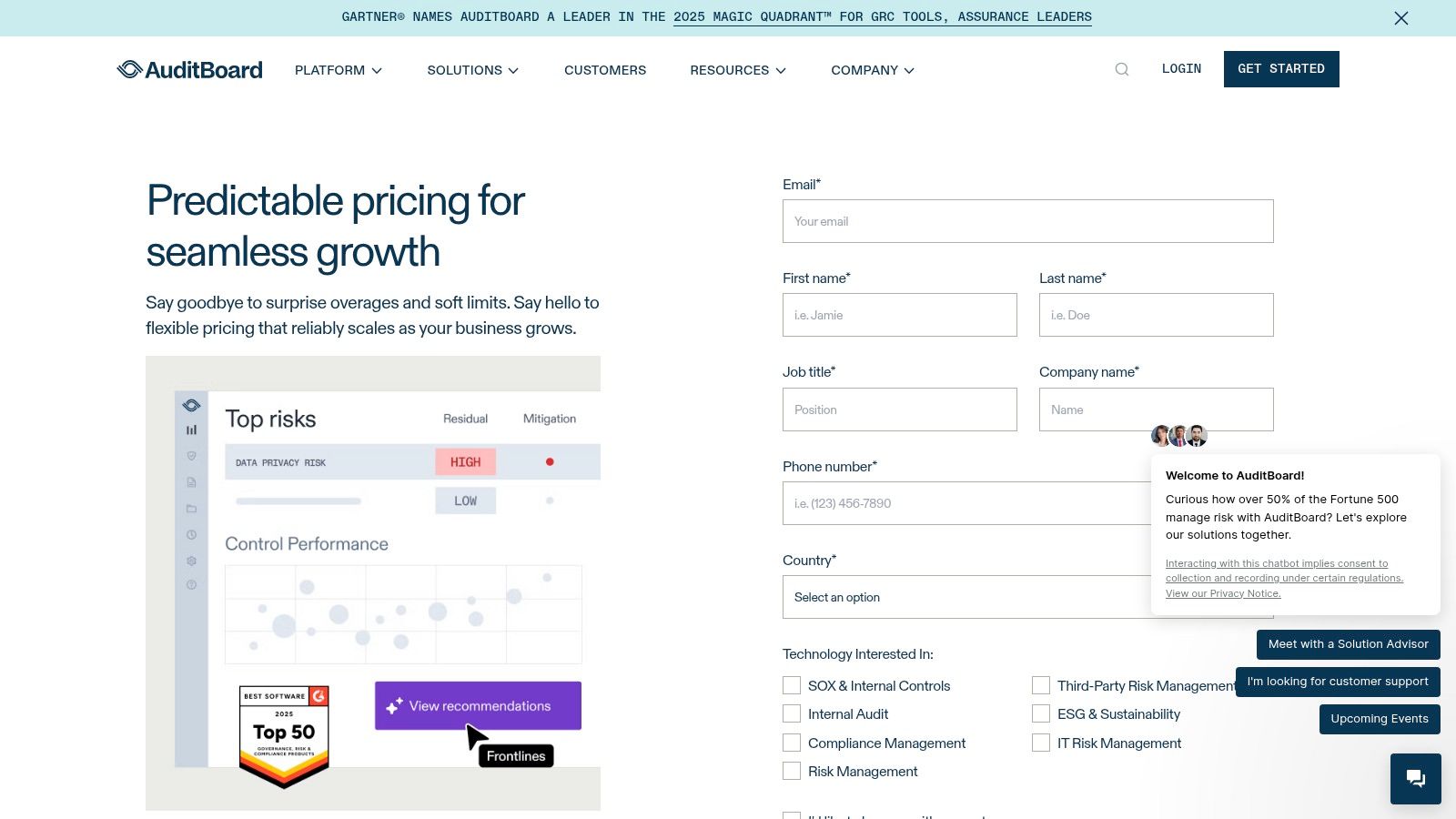
AuditBoard stands out with its connected risk platform designed by former auditors and risk professionals. This practitioner-centric approach focuses on streamlining audit, SOX compliance, risk management, and IT security into a single, cohesive system. Its intuitive design and AI-first methodology aim to accelerate adoption and deliver immediate value to internal audit, risk, and compliance teams.
The platform's strength lies in unifying disparate GRC functions, enabling real-time visibility and collaboration across departments. By connecting audit findings directly to risk assessments and compliance controls, AuditBoard helps organizations move away from siloed operations. This makes it one of the best governance risk and compliance software solutions for enterprises looking to enhance the efficiency and impact of their GRC programs through a user-friendly, integrated platform.
Key Features & Use Cases
Connected Platform: Unify audit, SOX, risk, and TPRM data in one place to create a single source of truth and eliminate redundant work across GRC functions.
AI-Enabled Analytics: Leverage artificial intelligence for automated reporting, analytics, and issue management, helping teams identify trends and prioritize critical risks more effectively.
Practitioner-Built Workflows: Utilize workflows and templates designed by industry experts to simplify complex processes like audit planning, control testing, and risk assessments.
Pros and Cons
Pros | Cons |
|---|---|
Known for fast adoption and high user satisfaction. | Pricing is sales-led and can vary significantly by module. |
Practitioner-focused design enhances usability for GRC teams. | The total cost of ownership depends on the scope and modules. |
Widely adopted by large enterprises and recognized by analysts. | May be more focused on audit and SOX than broader GRC needs. |
AuditBoard's emphasis on a connected, user-friendly experience makes it a powerful choice for teams aiming to modernize their audit and risk management practices.
Website: https://www.auditboard.com/pricing/
9. Drata
Drata is an AI-native compliance automation platform designed for companies seeking to build and maintain a strong security posture. Its primary focus is on streamlining the path to audit readiness for frameworks like SOC 2, ISO 27001, HIPAA, and GDPR. By automating evidence collection and control monitoring, Drata helps organizations prove their compliance continuously, moving beyond point-in-time assessments to a state of perpetual assurance.
The platform stands out for its emphasis on speed and efficiency, making it one of the best governance risk and compliance software options for tech-focused companies and startups needing to achieve certification quickly. Drata’s integration-driven approach connects directly with a company's cloud services, code repositories, and HR systems to pull evidence automatically. This reduces the manual burden on internal teams and accelerates the audit process significantly.
Key Features & Use Cases
Automated Evidence Collection: Connect to over 100 applications and systems to automatically gather proof of compliance, drastically reducing manual effort for audits.
Continuous Control Monitoring: Gain real-time visibility into your security controls to identify and remediate gaps before they become critical issues.
Trust Center & AI Questionnaires: Build a public-facing Trust Center to showcase your security posture and use AI to quickly respond to security questionnaires from prospects.
Pros and Cons
Pros | Cons |
|---|---|
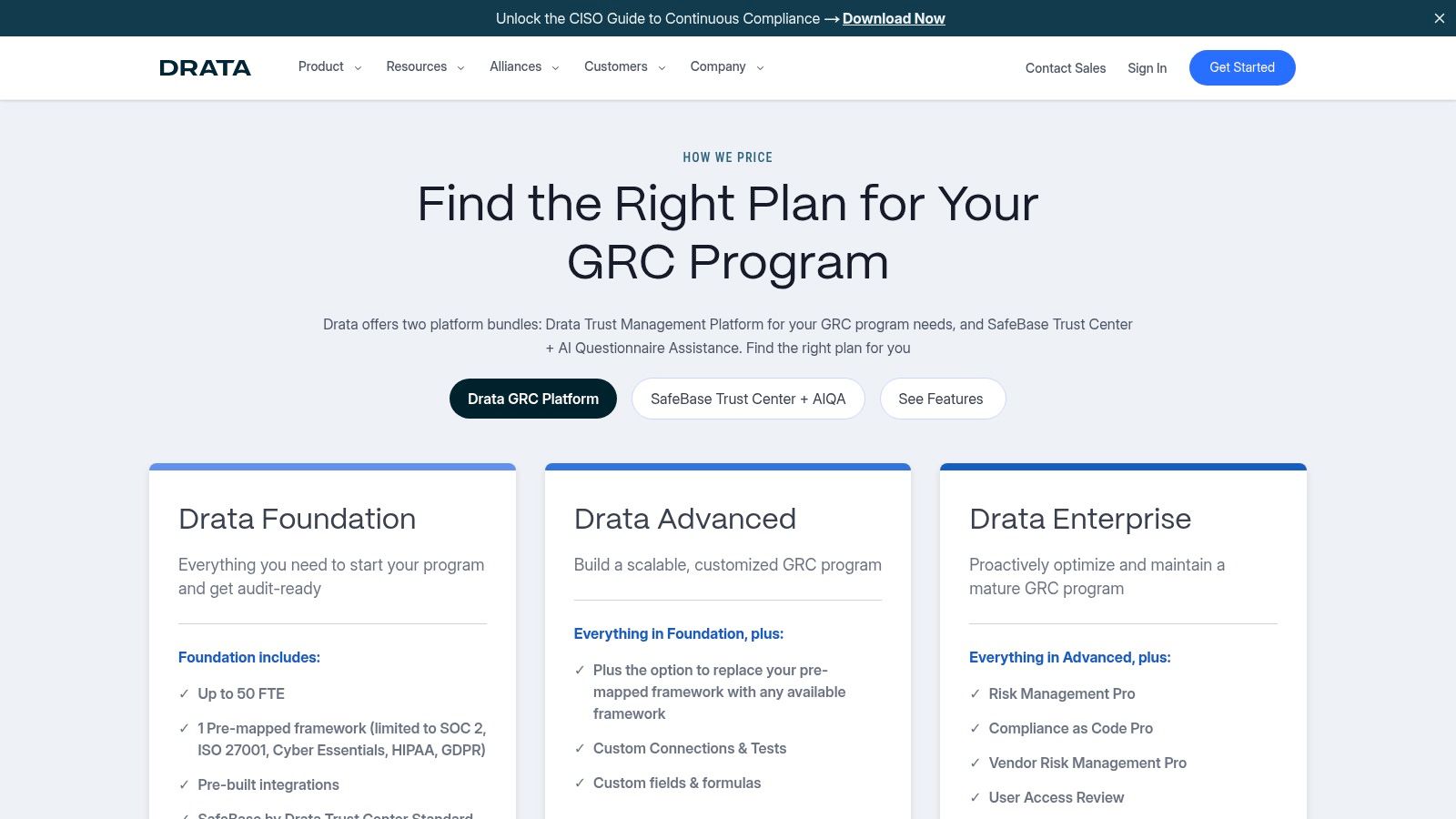
Excellent for achieving fast time-to-audit for key frameworks. | Add-ons for risk management or additional frameworks can increase total cost. |
Strong automation capabilities significantly reduce manual tasks. | While plans are public, exact pricing often requires a quote. |
Clear entry-tier plans are well-suited for growing businesses. | Focus is primarily on security compliance automation, less on broader GRC. |
Drata’s core strength is providing a clear, automated path to compliance, making it ideal for organizations where demonstrating security assurance is a key business driver.
Website: https://drata.com/plans
10. ServiceNow Governance, Risk, and Compliance
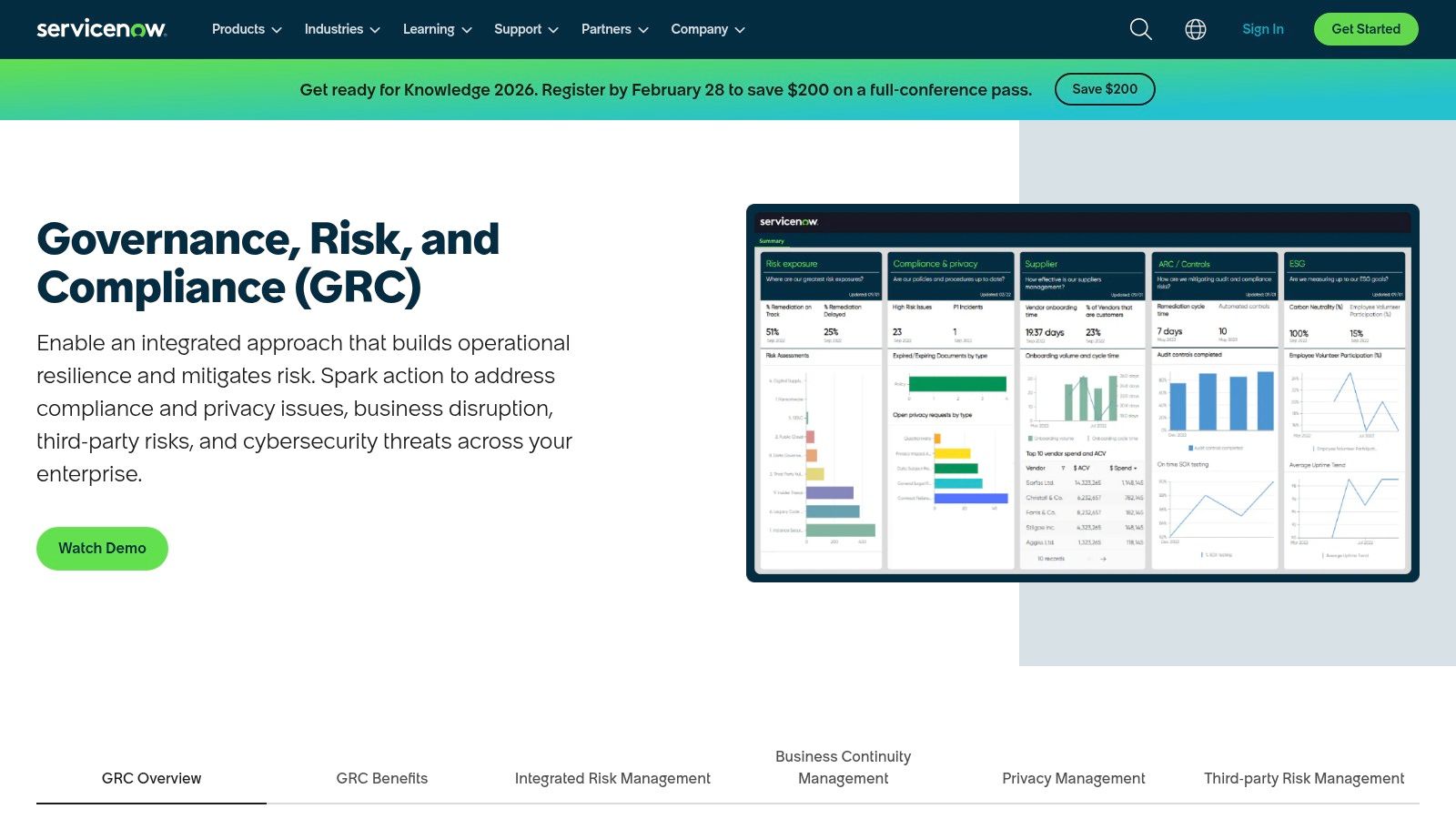
For organizations already embedded in the ServiceNow ecosystem, its Governance, Risk, and Compliance (GRC) module is a natural and powerful extension. Built on the Now Platform, it leverages a single data model and AI-driven workflows to unify GRC activities across the enterprise. This approach is ideal for businesses that want to integrate risk management directly into their existing operational and IT service management processes, eliminating data silos.
ServiceNow’s key differentiator is its ability to serve as the enterprise workflow backbone. This integration makes it one of the best governance risk and compliance software choices for companies seeking to connect GRC functions with broader business operations like IT, HR, and customer service. It provides real-time visibility into risk and compliance postures, enabling continuous monitoring and automated responses within familiar workflows.
Key Features & Use Cases
Unified Data Model: Consolidate risk, compliance, business continuity, and third-party risk data on a single platform to gain real-time, comprehensive insights.
Workflow Automation: Utilize AI-powered experiences and automated workflows to streamline risk assessments, control testing, and issue remediation.
Broad Ecosystem: Extend GRC capabilities with a vast marketplace of applications and integrations available through the ServiceNow Store.
Pros and Cons
Pros | Cons |
|---|---|
Strong fit when ServiceNow is the enterprise workflow backbone. | Requires platform alignment and governance at scale. |
Broad ecosystem and extension marketplace for added functionality. | Pricing is quote-based and typically enterprise-oriented. |
Integrates GRC seamlessly with IT and business operations. | May be overly complex if not using the wider ServiceNow platform. |
ServiceNow GRC excels in large enterprises where centralizing workflows and data on a single, scalable platform is a primary strategic goal.
11. AWS Marketplace – Governance, Risk & Compliance Category
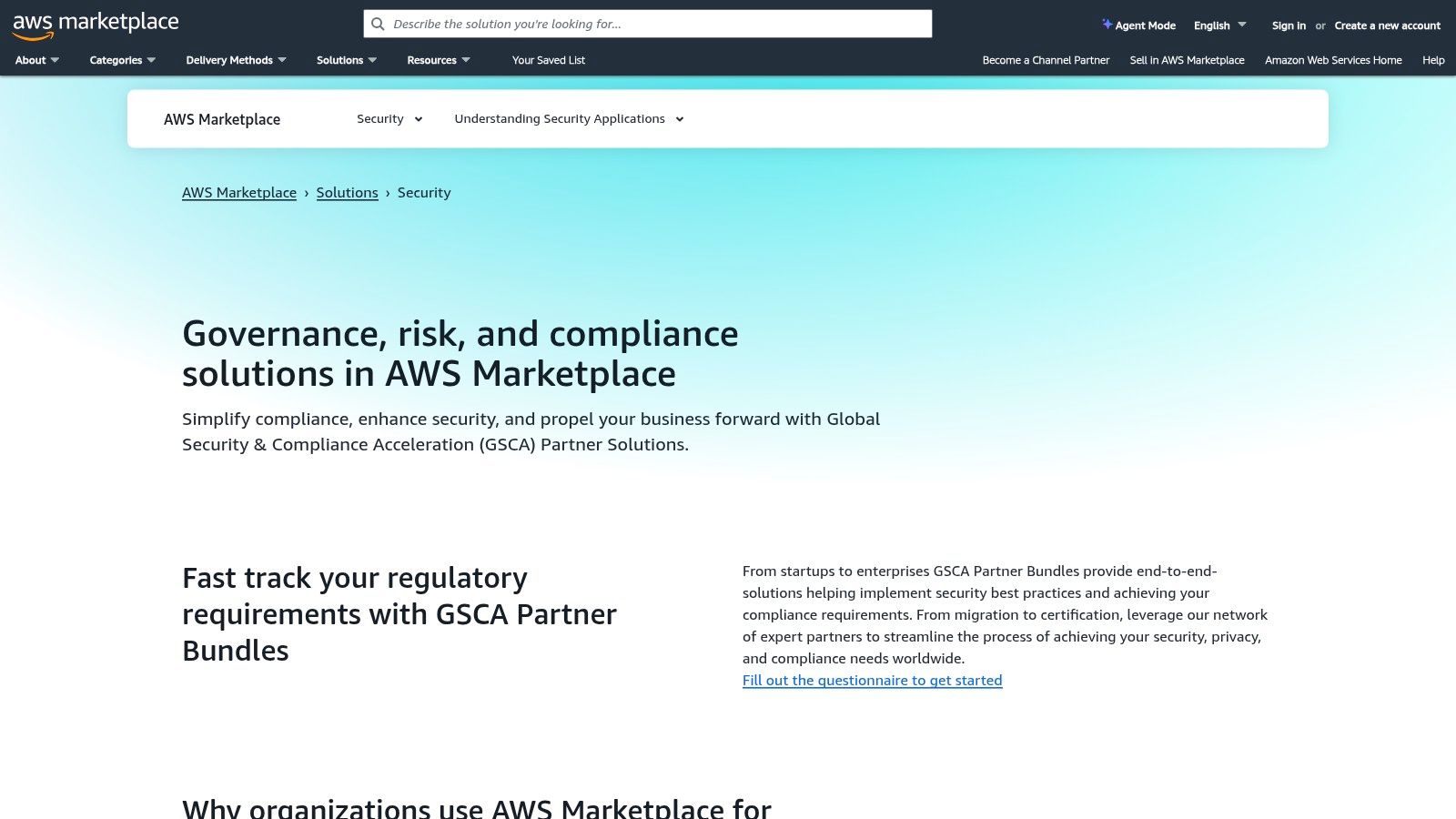
For organizations deeply integrated into the Amazon Web Services ecosystem, the AWS Marketplace offers a streamlined way to find, procure, and deploy GRC solutions. Instead of being a single software, it's a digital catalog where you can discover various GRC tools that are pre-vetted for AWS compatibility. This approach simplifies procurement by consolidating billing through your existing AWS account and often speeds up the vendor validation process.
The key advantage of using the AWS Marketplace is its transactional efficiency. It enables organizations to leverage features like Private Offers for customized pricing and terms, and Vendor Insights to access security and compliance data about sellers. This makes it a compelling choice for teams looking to centralize their GRC software acquisition and management within their cloud environment, ensuring that the chosen tools integrate smoothly with their existing infrastructure.
Key Features & Use Cases
Centralized Procurement: Find, buy, and deploy GRC software from dozens of vendors directly through your AWS account, simplifying billing and contract management.
Vendor Insights & Private Offers: Expedite due diligence with curated security profiles of vendors and negotiate custom pricing and licensing terms through private, direct deals.
Curated GRC Listings: Explore a dedicated category of GRC tools, from niche compliance solutions to comprehensive platforms, with some offering free trials and transparent pricing.
Pros and Cons
Pros | Cons |
|---|---|
Streamlined procurement and consolidated billing via AWS. | Selection depth varies significantly by vendor and region. |
Faster vendor validation with security and compliance data. | Not all enterprise GRC leaders list public pricing or options. |
Simplifies deployment for AWS-native environments. | Best suited for organizations already committed to AWS. |
The AWS Marketplace is less of a GRC tool itself and more of a strategic procurement hub, making it one of the best governance risk and compliance software discovery platforms for AWS-centric businesses.
12. G2 – Best GRC Software Category
While not a GRC platform itself, G2 serves as an essential meta-resource for any team evaluating their software options. It is a comprehensive buyer marketplace that aggregates peer reviews, rankings, and detailed feature comparisons across the entire GRC landscape. This allows organizations to build an initial vendor shortlist based on real-world feedback before ever engaging with a sales team.
G2’s key value is its user-driven data, which provides candid insights into implementation experiences, customer support quality, and feature effectiveness. For anyone searching for the best governance risk and compliance software, G2’s category grids and filters are invaluable for surfacing both major enterprise players and innovative niche tools. It helps cut through marketing jargon to understand how a platform performs in a live environment.
Key Features & Use Cases
Extensive Peer Reviews: Access a large volume of user reviews to gauge overall satisfaction, identify common implementation patterns, and uncover potential hidden costs or challenges.
Vendor Comparison Tools: Use filters and side-by-side comparison grids to evaluate vendors based on specific features, company size, industry, and user ratings.
Category-Specific Rankings: Explore curated "Best GRC Products" lists and reports for adjacent categories like ERM, Third-Party Risk Management (TPRM), and ESG reporting.
Pros and Cons
Pros | Cons |
|---|---|
Provides current, user-driven insights useful for shortlisting. | Review quality can be mixed and may include marketing noise. |
Surfaces both major enterprise players and niche GRC tools. | G2 is not a direct seller; procurement still happens via vendors. |
Free to access for research and comparison purposes. | Can be overwhelming without a clear set of evaluation criteria. |
G2 is the ideal starting point for market research, helping teams create an informed, data-backed list of potential GRC software partners to evaluate further.
Top 12 GRC Software Comparison
Vendor | Core Features | Experience ★ | Value/Price 💰 | Target Audience 👥 | Key Differentiator ✨ |
|---|---|---|---|---|---|
E‑Commander: early‑signal detection, traceable workflows, Risk‑HR, whistleblower, multilingual | ★★★★★ | 💰 Free trial (no CC) → enterprise pricing | 👥 HR, Compliance, Risk, Legal, Security; SMB→Enterprise, Government | ✨ Privacy‑by‑design; prevention (not surveillance); regulatory/aligned; decision‑support | |
OneTrust | Privacy & AI governance, policy mgmt, 50+ templates | ★★★★☆ | 💰 Quote‑based; scalable | 👥 Privacy, legal, GRC teams; mid→enterprise | ✨ Extensive templates & deep privacy/AI controls |
Archer (IRM) | No‑code app builder, persona dashboards, broad IRM modules | ★★★★☆ | 💰 Quote‑based enterprise | 👥 Enterprise risk programs; complex configurations | ✨ Highly configurable, mature IRM platform |
MetricStream | Full GRC suite, workflows, reporting, partner ecosystem | ★★★★☆ | 💰 Enterprise/custom pricing | 👥 Regulated industries; global multi‑module deployments | ✨ Designed for global scale and regulated sectors |
NAVEX One | Whistleblowing/hotline, training, policy, TPRM | ★★★★☆ | 💰 Bundles & SMB packaged options | 👥 Ethics & compliance teams; SMB→Mid | ✨ Comprehensive speak‑up + training bundles |
Diligent (Diligent One) | Board management + GRC, integrations, market intel | ★★★★☆ | 💰 Tiered / sales‑led pricing | 👥 Boards, execs, governance & risk leaders | ✨ Board‑to‑management alignment & ESG insight |
LogicGate Risk Cloud | App/solution approach, flexible workflows, Power User licensing | ★★★★☆ | 💰 Quote; Power Users billed (cost‑efficient) | 👥 Risk & ops teams seeking flexible workflows | ✨ Cost‑efficient licensing for broad collaboration |
AuditBoard | Audit, SOX/compliance, AI analytics, practitioner workflows | ★★★★☆ | 💰 Sales‑led; module pricing | 👥 Audit, SOX, risk teams; large enterprises | ✨ Fast adoption, practitioner‑built workflows |
Drata | Compliance automation (SOC2, ISO, GDPR), evidence automation | ★★★★☆ | 💰 Public tiers (Foundation→Enterprise); add‑ons possible | 👥 Security/compliance teams aiming fast audit readiness | ✨ Clear tiers + automated evidence collection |
ServiceNow GRC | Unified data model, AI workflows, IRM/BCM/TPRM modules | ★★★★☆ | 💰 Enterprise/quote (platform alignment) | 👥 Enterprise IT/GRC; orgs on ServiceNow | ✨ Now Platform ecosystem & extension marketplace |
AWS Marketplace – GRC | Curated GRC listings, private offers, consolidated billing | ★★★☆☆ | 💰 Billing via AWS; some transparent listings | 👥 Procurement teams, AWS‑centric organizations | ✨ Streamlined procurement, Private Marketplace & Vendor Insights |
G2 – Best GRC Category | Peer reviews, rankings, comparison filters, vendor links | ★★★★☆ | 💰 Free insights; links to vendors | 👥 Buyers researching/shortlisting vendors | ✨ Large volume of user reviews and category grids |
Choosing Your Path: From Reactive Compliance to Proactive Integrity
Navigating the crowded market to find the best governance risk and compliance software is a pivotal step in securing your organization's future. As we've explored, the landscape is vast and varied. It ranges from all-encompassing, enterprise-grade platforms like ServiceNow and Archer to specialized, compliance automation tools such as Drata, and forward-thinking, ethical systems like Logical Commander. The right choice is not about finding a one-size-fits-all solution; it's about aligning a tool's capabilities with your organization's unique risk appetite, regulatory environment, and cultural values.
The core takeaway is this: modern GRC is evolving beyond a simple checkbox exercise. It's transitioning from a reactive, audit-focused function to a proactive, strategic enabler of business integrity. This shift demands tools that can unify disparate functions, provide real-time visibility, and foster a culture of transparency rather than one of surveillance.
Key Considerations for Your Final Decision
As you narrow down your options, move beyond feature lists and marketing promises. Your evaluation should be a strategic assessment focused on long-term value and cultural fit.
Scalability and Integration: Does the platform grow with you? Consider its ability to integrate with your existing technology stack, including HRIS, ERP, and security information and event management (SIEM) systems. A siloed GRC tool creates more problems than it solves.
User Experience (UX): A GRC system is only effective if people use it. An intuitive, user-friendly interface is critical for adoption across all departments, from frontline employees reporting an incident to executives reviewing risk dashboards. Clunky, complex software will be ignored.
Focus on Prevention vs. Detection: Traditional GRC tools are excellent at detecting issues after they occur. However, a modern approach, exemplified by platforms like Logical Commander, emphasizes prevention. These systems are designed to identify and manage the early signals of insider risk, enabling you to "Know First, Act Fast!" and intervene before a minor issue escalates into a major crisis. This ethical, non-surveillance methodology respects employee privacy while fortifying organizational defenses.
Data Governance and Lifecycle Management: A crucial, yet often overlooked, aspect of GRC is how you manage data at every stage of its lifecycle. This includes secure data handling during its active use and its responsible disposal when no longer needed. To move from reactive compliance to proactive integrity, it's essential to understand and implement comprehensive data sanitization standards like NIST SP 800-88 for all retired IT assets. This ensures sensitive information doesn't become a liability, closing a critical gap in your risk posture.
Your Actionable Next Steps
Selecting the best governance risk and compliance software is a journey, not a destination. Use the insights from this article to guide your next phase of evaluation.
Shortlist Your Top 3-4 Contenders: Based on your specific needs for risk management, audit, and compliance, select a few vendors for a deeper dive.
Request Personalized Demos: Insist on demonstrations tailored to your industry and specific use cases. Ask tough questions about implementation, support, and the total cost of ownership.
Conduct a Proof of Concept (POC): If possible, run a pilot program with a small, focused team to test the software's real-world usability and effectiveness in your environment.
Ultimately, your goal is to invest in a partner, not just a product. The right GRC software will become the operational backbone for your ethical framework, empowering your teams, protecting your brand, and building a resilient organization founded on a culture of integrity. Choose wisely, implement thoughtfully, and lead your organization toward a more secure and accountable future.
Ready to shift from reactive detection to proactive, ethical prevention? See how Logical Commander Software Ltd. unifies HR, Legal, and Compliance to manage insider risk without surveillance. Learn more about the E-Commander platform and schedule your demo today.