%20(2)_edited.png)

Security and Risk Assessment: Proactive Internal Threat Detection and Compliance

Updated: Feb 5
When we talk about a modern security and risk assessment, we’re really talking about a fundamental shift in mindset. It’s the process of finding, analyzing, and dealing with potential internal threats and human-capital risks before they blow up into a crisis. This isn't about updating a spreadsheet; it’s about moving away from outdated, reactive methods and adopting a proactive framework that actually protects your company's integrity, assets, and reputation.
Why Your Approach to Risk Assessment Needs an Upgrade
Let's be honest: the old playbook for corporate risk is obsolete. Staring at spreadsheets while complex internal threats twist and evolve simply isn't a viable strategy for any serious organization. The entire business environment has changed, making traditional, reactive security measures feel like bringing a knife to a gunfight.
This isn't happening in a vacuum. Powerful forces are reshaping how companies operate and what stakeholders demand. Digital transformation has massively expanded the threat surface, while tough privacy laws like GDPR have raised the stakes for handling data. At the same time, soaring ESG (Environmental, Social, and Governance) expectations mean that ethical conduct and corporate integrity are under a microscope 24/7.
The Dangers of Fragmented Processes
The biggest problem with most risk assessment programs today? They rely on fragmented, manual processes that create dangerous blind spots. When your HR, Compliance, Legal, and Security teams are all stuck in their own silos, critical information gets lost, early warning signs are missed, and your response times become cripplingly slow.
This outdated model fails because it’s designed to react to problems after they’ve already happened. It’s like trying to patch a leak while the ship is already taking on water. This approach just can't keep up with the subtle, early indicators of human capital risk, like undeclared conflicts of interest or the behavioral signs of someone under pressure.
A recent study found that a staggering 61% of U.S. companies have experienced a data breach caused by one of their vendors or third parties. It’s a perfect example of how interconnected risks—both internal and external—can easily bypass old-school, siloed security.
Adopting a Proactive and Ethical Stance
To truly protect an organization, you have to shift from investigation to prevention. This means building a unified framework that allows your teams to "know first to act fast." A modern approach doesn't use invasive surveillance; it prioritizes early detection through ethical, indicator-based systems that provide a single source of truth. This empowers decision-makers with structured, actionable intelligence.
This proactive stance turns risk management from a defensive chore into a real strategic advantage. It allows you to:
Spot potential issues before they escalate into full-blown crises.
Ensure compliance with global regulations by baking privacy and ethics directly into your process.
Build organizational trust by handling sensitive matters with fairness and due process.
Ultimately, upgrading your security and risk assessment strategy is about building genuine resilience. To help fine-tune your approach and identify vulnerabilities, a professional cyber security consultation can be invaluable in making sure your framework is robust and ready for what’s next.
Building Your Internal Risk Assessment Framework
Let’s move from theory to practice. A solid framework for security and risk assessment isn't about invasive surveillance; it’s about building a smart, ethical early-warning system.
Think of it this way: you’re installing a smoke detector that senses the faintest wisp of trouble, not putting a camera in every room. It’s about prevention, not policing.
This whole process starts with defining your scope. You have to decide exactly which assets, processes, and people fall under the assessment. Are you focused on protecting intellectual property, stopping financial fraud, or locking down regulatory compliance? A scope that’s too narrow will miss interconnected risks, while one that's too broad becomes impossible to manage.
Once you’ve got the scope nailed down, the next step is to identify your critical data sources. The key here is to use existing, non-invasive information—operational data your organization already has. This isn’t about snooping on emails or private messages. It's about ethically connecting the dots.
Identifying Key Data Sources and Indicators
An effective framework pulls from a variety of ethical sources to build a complete picture of potential risk. This data is then used to create clear risk indicators—the specific signals that might suggest a problem is brewing.
Common data sources include:
Access Logs: Looking at who accessed sensitive systems and when, flagging unusual patterns like activity way outside of normal working hours.
HR Records: Analyzing data on promotions, role changes, or declarations of conflicts of interest.
Financial Records: Monitoring expense reports or procurement data for weird anomalies that could point to misconduct.
From these sources, you can establish specific indicators. For example, an employee in finance who suddenly starts accessing project files from a completely unrelated department could be a flag. This isn't an accusation; it's simply an indicator that calls for a closer, structured look. This methodical approach is what makes the process objective and defensible.
Aligning with Global Standards
A world-class security and risk assessment program also has to align with international standards and principles. This move doesn’t just strengthen your security; it ensures you meet global compliance obligations.
Frameworks like ISO 27001 offer a superb model for information security, while OECD principles provide guidance on ethical conduct and anti-corruption.
Integrating these standards shows that top-tier security and rigorous compliance are two sides of the same coin. It transforms your risk assessment from a simple internal procedure into a globally recognized mark of operational integrity.
This structured approach is absolutely vital in today's environment. Threats are no longer contained by geography. Recent intelligence from government security assessments shows how geopolitical tensions are creating a 'convergent' security landscape, blurring the lines between physical and digital threats. This trend puts all businesses at greater risk, where a single breach can disrupt entire supply chains.
The graphic below shows just how vulnerable the old, spreadsheet-driven methods really are.
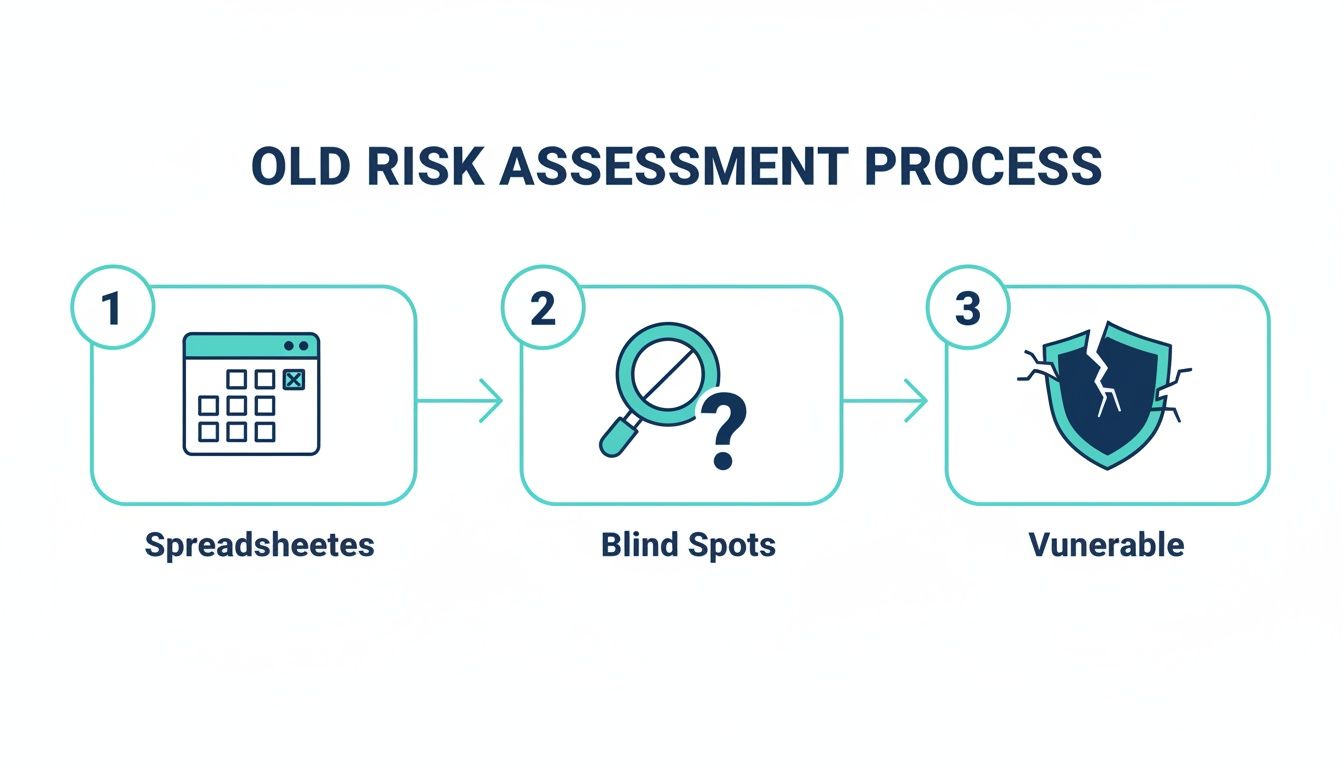
As you can see, relying on manual, fragmented tools inevitably creates blind spots, leaving your organization wide open.
Developing a Fair Risk Scoring Methodology
The final piece of the puzzle is a clear, objective way to score risks. A consistent scoring system makes sure every indicator is evaluated fairly, stripping subjective bias out of the process. This is crucial for maintaining employee trust and making sure the entire system is transparent and auditable.
A simple scoring model might look something like this:
Low Risk (Score 1-3): A minor deviation from policy with little potential impact. Requires standard monitoring.
Medium Risk (Score 4-6): A notable anomaly that could signal a potential issue. Requires follow-up and verification.
High Risk (Score 7-10): A significant indicator of a potential threat. Requires immediate, structured review by relevant stakeholders.
By creating this kind of systematic framework, you move your organization away from reactive panic and toward proactive, disciplined risk management. To go deeper on this critical function, you might find our guide on risk management in the enterprise helpful.
Shifting from Reactive Investigation to Proactive Prevention
Traditional security and risk assessment often feels like archaeology. Security teams spend their days digging through the aftermath of an incident, trying to piece together what went wrong long after the damage is done. This reactive model is fundamentally broken. It concedes the first move to the threat, locking your organization into a constant state of defense.
Imagine trying to drive a car by only looking in the rearview mirror. You'd only see hazards after you’ve already passed them. This is exactly how many companies run their internal risk programs, responding to fraud, misconduct, or data loss only when the alarms are already blaring. This approach isn't just inefficient; it's incredibly costly.
A modern framework flips this script completely. It’s built to identify the subtle, early signals of risk—the quiet indicators that appear long before a situation escalates into a full-blown crisis. It's about creating a system that lets you see the road ahead, not just the wreckage behind you.
To illustrate the difference, here is a breakdown of the old, broken model versus the new standard of proactive prevention.
Reactive vs Proactive Risk Assessment Approaches
This table contrasts the outdated, reactive methods of internal risk management with modern, proactive, and ethical approaches.
Aspect | Reactive Approach (Traditional) | Proactive Approach (Ethical AI) |
|---|---|---|
Timing | Post-incident, after damage has occurred | Pre-incident, identifying early warning signs |
Goal | Assign blame and conduct costly forensics | Prevent incidents and mitigate vulnerabilities |
Methodology | Intrusive surveillance and after-the-fact investigation | Non-intrusive, indicator-based risk analysis |
Focus | "Who did it?" | "Where are our systemic weak points?" |
Legal Risk | High; potential for EPPA violations and privacy lawsuits | Low; designed for EPPA compliance and privacy protection |
Cultural Impact | Creates a culture of fear, suspicion, and distrust | Fosters a culture of integrity and psychological safety |
Outcome | Constant fire-fighting and operational disruption | Builds institutional resilience and protects the bottom line |
The contrast is stark. A proactive model doesn't just manage risk more effectively; it transforms the entire culture from one of enforcement to one of integrity.
Ethical Detection Versus Invasive Surveillance
A common misconception is that proactive detection means invasive employee monitoring. This couldn't be further from the truth. A sharp, clear line must be drawn between ethical, indicator-based systems and forbidden methods like employee surveillance or psychological profiling.
Ethical prevention focuses on structured, objective data points your organization already has. It’s about connecting the dots between disparate pieces of information, not snooping on your people.
Here’s how they differ:
Ethical Indicators: An analyst might see a potential conflict of interest when an employee in procurement suddenly begins accessing sensitive R&D files completely unrelated to their job function. This is an objective, verifiable event.
Invasive Surveillance: This would involve reading that employee's private messages or using software to monitor their keystrokes—a gross violation of privacy that is often illegal.
The goal is to analyze patterns of behavior against established policies and controls, not to make judgments about an individual's character or intentions. True proactive prevention is built on a foundation of respect, privacy, and due process.
Understanding Preventive and Significant Risks
To put this proactive approach into practice, it’s essential to distinguish between different types of risk signals. Not every anomaly is a five-alarm fire. This distinction empowers your teams to act with precision and proportionality, ensuring that every concern is handled appropriately without overreacting.
Think of it like a health screening. An unusual reading on a blood test doesn't automatically mean a serious illness. It’s an early signal that requires further, more specific investigation by a professional.
A proactive security and risk assessment operates on the same principle. It distinguishes between an early signal that needs verification and a confirmed threat that demands immediate action, ensuring human oversight always remains in control.
Let’s break down the two primary types of signals your system should identify:
Preventive Risk: This is an early, low-level signal or an indicator of uncertainty. It could be a minor policy deviation or a procedural vulnerability that needs to be addressed. It's a "yellow flag" that prompts a closer look, not an accusation.
Significant Risk: This is a much stronger signal suggesting possible involvement in or knowledge of a serious issue. It’s a "red flag" that requires a formal, structured verification process by the right stakeholders, like HR, Legal, or Compliance.
This tiered approach ensures your response is always measured. It prevents alert fatigue and allows your teams to focus their resources on the issues that truly matter. It also reinforces a culture of fairness, as every signal is treated as an indicator requiring verification, not as proof of guilt.
Understanding the true cost of reactive investigations further highlights why this preventive shift is so critical. This methodology empowers you to "know first to act fast," turning your risk management function from a cost center into a powerful strategic asset that protects both the organization and its people.
When your HR, Legal, and Security teams are stuck in their own silos, working from different spreadsheets and disconnected systems, you're playing a dangerous game of telephone with your biggest risks. Critical context gets lost, early warning signs are missed, and the full picture of an internal threat never comes together. This kind of fragmentation isn't just inefficient—it's a gaping hole in your security and risk assessment strategy.
The problem is that without a single, shared system, there's no single source of truth. HR might be dealing with a performance issue, Legal could be looking into a conflict of interest, and Security might have flagged weird data access patterns—all for the same person. If those dots are never connected, a serious insider threat stays invisible until it’s far too late.

From Scattered Data to Actionable Intelligence
A unified platform knocks down those walls, creating one central hub for risk intelligence, compliance, and mitigation. It takes all those scattered data points and turns them into structured, actionable intelligence that every authorized stakeholder can see and act on together.
Imagine this scenario: a project manager with keys to sensitive client data gets flagged for repeatedly breaking company expense policies.
HR's View: They see a pattern of misconduct that needs a disciplinary review.
Security's View: They notice the same person has been trying to access project files far outside their job scope.
Legal's View: They know this employee previously failed to disclose a side business, creating a clear conflict of interest.
In a siloed world, these are three separate headaches. On a unified platform like E-Commander, they snap together to form one clear, high-risk profile demanding a coordinated response. The platform isn't making accusations; it’s just laying out the objective facts in a single, auditable timeline.
This central hub gives everyone a common language for talking about risk. It pulls teams away from subjective hunches and toward data-driven decisions, making sure every action is documented, justified, and perfectly aligned with your internal governance.
A Real-World Collaboration Scenario
Let's see how this actually works. When the unified platform flags the combined risk indicators for our project manager, it kicks off an automated, structured workflow. HR, Legal, and Security get notified at the same time and are given access to a secure digital case file.
A unified system ensures that accountability is never ambiguous. Every action, comment, and decision is logged, creating a fully traceable audit trail that protects both the organization and the employee by ensuring due process is followed meticulously.
Now, the teams can collaborate in real-time right inside the platform. Legal advises on the proper procedural steps, HR preps for a formal review, and Security temporarily restricts the employee’s access to critical systems as a smart precaution. No more frantic emails or missed calls. The response is swift, coordinated, and dramatically faster than any manual process could ever hope to be.
This unified defense is more critical than ever, as threats grow more complex and unpredictable. The U.S. Intelligence Community’s 2025 Annual Threat Assessment paints a picture of a dangerous environment where both state and nonstate actors target critical infrastructure, showing how global risks can impact any organization. You can explore the full threat assessment to grasp the bigger picture. By getting your internal defenses in sync, you build real resilience against this volatile landscape.
The Benefits of a Single Source of Truth
Bringing everyone onto a central risk platform delivers concrete benefits that make your entire organization stronger. It's not just about better tech; it's about building a more resilient and trustworthy culture.
The key advantages are clear:
Complete Visibility: Leadership gets a real-time, company-wide view of internal risks without having to piece together conflicting reports.
Clear Accountability: Every step in the mitigation process has a clear owner, which kills confusion and ensures nothing falls through the cracks.
Enhanced Speed: Response times shrink from weeks or months down to days or even hours, containing potential damage before it spreads.
Preserved Trust: By ensuring a fair, documented, and consistent process, the organization builds and maintains trust with its employees.
Ultimately, a unified platform transforms your security and risk assessment from a fragmented, reactive chore into a strategic, proactive function. It connects your most important teams, arming them with the shared intelligence they need to protect the organization's integrity from the inside out.
Navigating Global Compliance and Data Privacy Laws
For any modern organization, compliance isn't just a bureaucratic headache; it’s a foundational pillar of trust and a real competitive advantage. A proper security and risk assessment has to be built on a deep understanding of the tangled web of global regulations that govern employee data and privacy. Ignoring these laws is a direct threat to your reputation and your bottom line.
This means you have to move beyond a simple checkbox mentality and truly embrace a "privacy by design" philosophy. Instead of trying to bolt compliance measures onto an existing process, the most resilient organizations build their risk frameworks around regulatory requirements from day one. This proactive stance ensures that every single step, from data collection to mitigation, is both ethical and legally sound.
The Why Behind Global Regulations
Getting a handle on the major regulatory frameworks is absolutely essential. Laws like the EU's General Data Protection Regulation (GDPR) and California's Consumer Privacy Act (CCPA/CPRA) have set a new global standard for data privacy. They give individuals real power over their personal information and place strict obligations on the companies that handle it.
These regulations aren't just about data storage; they fundamentally shape how a security and risk assessment can even be conducted. They strictly prohibit invasive and pseudoscientific methods that violate an individual's dignity and privacy. This includes:
Banning lie detection: Any mechanism that claims to function as a polygraph or truth evaluator is explicitly forbidden under frameworks like the Employee Polygraph Protection Act (EPPA).
Prohibiting undue psychological pressure: Coercive methods designed to extract information or influence behavior have no place in an ethical assessment.
Preventing emotional profiling: Using AI or other tools to make judgments about an individual's emotional state or character is a clear violation of privacy principles.
These rules exist for a good reason: to ensure risk assessments remain objective, fair, and focused on verifiable facts—not on subjective interpretations of someone's character.
An ethical framework isn't a limitation; it's a strategic asset. By adhering to global standards, you build a risk management process that is not only effective but also defensible, transparent, and trusted by both your employees and regulators.
Aligning with Key ISO Standards
Beyond data privacy laws, international standards provide a blueprint for excellence in security and governance. Two of the most important for internal risk are ISO 27001 and ISO 37003.
ISO 27001 is the gold standard for an Information Security Management System (ISMS). It provides a systematic approach to managing sensitive company information so that it remains secure.
ISO 37003 offers specific guidelines for managing internal investigations, ensuring they are conducted with integrity, impartiality, and fairness.
Adopting these standards sends a clear message that your organization is committed to the highest levels of operational integrity. That commitment is crucial in a world where security threats are increasingly global and interconnected. For instance, in 2024, the Asia-Pacific region accounted for a staggering 34% of all reported cyber incidents worldwide, driven by its central role in global supply chains. As you can learn more from the IBM X-Force 2025 Threat Intelligence Index, a disruption in one region can have a massive ripple effect across the globe, making standardized security practices more important than ever.
By weaving these legal and regulatory requirements into the very fabric of your risk assessment program, you transform compliance from a burden into a powerful tool. It strengthens your security posture, protects your organization from legal and financial penalties, and, most importantly, fosters a culture of trust and integrity. To explore this topic further, you can read our guide on achieving global compliance in business.
Your Actionable Checklist for Risk Assessment Success

Strategy is just a plan on paper until you execute it. This is where we get practical. Let's move from the high-level framework to a structured, repeatable process you can put into action right away.
This checklist is your go-to resource for conducting a thorough internal risk assessment. Think of it as your roadmap, covering everything from initial planning to long-term monitoring and ensuring every step you take is methodical and easy to audit.
The Five-Step Assessment Process
Follow these steps to build an effective workflow that gives you clear, data-driven results. No guesswork, just a solid process.
Define Scope and Objectives: First things first, know what you're protecting. Clearly identify the specific assets, departments, or processes under review. Are you focused on intellectual property? Financial data? Or meeting specific regulatory requirements? Get this crystal clear from the start.
Identify and Catalog Risks: Now, start brainstorming. What could go wrong? Think through all the potential internal threats relevant to your scope. This includes everything from unauthorized data access and conflicts of interest to simple policy violations and gaps in your procedures.
Analyze and Score Risks: Not all risks are created equal. Evaluate each one based on its potential impact and the likelihood it will happen. Using a consistent scoring matrix—like a simple 1-5 scale for both impact and likelihood—helps you objectively prioritize the threats that truly matter.
Develop Mitigation Plans: For your high-priority risks, create specific, actionable plans to neutralize them. Assign a clear owner for each plan, set a realistic deadline, and define exactly what a successful outcome looks like. Accountability is key here.
Monitor and Review: Risk isn't a one-and-done problem; it's always changing. You need to continuously monitor how well your mitigation plans are working and schedule periodic reviews of your entire risk landscape. This ensures your defenses adapt as new threats pop up.
For certain high-stakes operations, like taking old infrastructure offline, a detailed guide is non-negotiable. A great example is this 10-Step Server Decommissioning Checklist, which is invaluable for making sure no critical security or compliance steps are missed.
Measuring What Matters: Key Performance Indicators
To prove your risk management program is actually working, you have to track the right metrics. Forget vanity numbers. We're talking about KPIs that show real, tangible improvements in your security posture.
A successful security and risk assessment program doesn't just find problems—it proves its value by showing measurable reductions in risk exposure and improvements in response time.
Here are the key performance indicators you should be tracking:
Time to Detect Potential Risk: How long does it take from the moment a risk indicator appears to when it's officially logged? A shorter timeframe means your detection capabilities are getting sharper.
Reduction in Policy Violations: This one is simple: track the number of documented policy breaches over time. If that number is consistently dropping, your controls and training are working.
Mitigation Task Completion Rate: What percentage of your assigned mitigation tasks are getting done on schedule? This KPI is a direct reflection of your organization's commitment to actually fixing the vulnerabilities you find.
Cross-Departmental Collaboration Efficiency: When a risk involves HR, Legal, and Security, how long does it take for them to get in a room (virtual or otherwise) and act? Faster collaboration means a more unified and effective response system.
By putting this checklist into practice and tracking these KPIs, you give your organization the tools to build a fully auditable risk management function. This structured approach transforms your security and risk assessment from a theoretical exercise into a core operational discipline that actively protects the business.
Your Questions, Answered
Even with the best strategy, shifting to a modern security and risk assessment framework brings up tough questions. Leaders often run into the same roadblocks when moving from comfortable manual habits to a proactive, unified approach. Let's tackle the most common points of confusion so you can move forward with confidence.
Getting these answers right clears the path, ensuring your new risk program is effective, ethical, and has the backing it needs across the entire organization.
How Do I Get Executive Buy-In for a Proactive Approach?
Getting the C-suite on board means you have to speak their language. Stop talking about the cost of software and start talking about the value of resilience. A proactive system isn’t just another security expense; it's a strategic asset that makes the entire organization stronger.
Frame the business case around clear, tangible outcomes that matter to them:
Slash Financial Losses: Show them the numbers. Proactive detection stops costly disasters like fraud or litigation before they ever happen, delivering a clear and powerful return on investment.
Protect the Brand: Remind them that reputation is everything. An ethical, compliant program is a massive competitive advantage that builds unshakable trust with customers, partners, and investors.
Unlock Operational Efficiency: Point out the wasted hours your best people spend digging through spreadsheets and chasing ghosts. A unified platform frees up your expert teams to focus on high-value work, not manual grunt work.
When you connect your program to risk reduction and overall business health, you’re no longer asking for a budget—you're presenting a core business strategy.
Is Ethical Monitoring Just Another Name for Surveillance?
No, and this is probably the most critical distinction to get right. Ethical monitoring is the exact opposite of invasive surveillance. Surveillance means watching everything an employee does, often without any real cause, which is not only creepy but frequently illegal.
Ethical, indicator-based platforms work on a completely different principle. They are built to be non-invasive. The focus is entirely on objective, verifiable events—based on your own policies—that might signal a risk.
An ethical security and risk assessment platform connects the dots between structured data your company already owns, like access logs or expense reports. It’s about finding patterns in objective facts, not making subjective calls about people.
This approach is specifically engineered to comply with strict regulations like GDPR and EPPA, which flat-out forbid surveillance and psychological profiling. It’s all about upholding due process and dignity, not creating a culture of suspicion.
What Are the First Steps to Transition from Spreadsheets?
Ditching spreadsheets can feel like a massive project, but the key is to start small and build momentum. Don't try to boil the ocean. A structured, phased approach will get you much further, much faster.
Kick things off with a focused pilot program:
Pick a High-Impact Area: Start with a single department or a specific risk, like conflicts of interest in the procurement team. A narrow scope makes it much easier to prove success.
Define Your Indicators: Get the stakeholders in a room and agree on the key risk indicators for that one area. What objective signals should the system be looking for?
Map Your New Workflow: Document how you handle things now, then design the streamlined process inside a unified platform. Make sure everyone in HR, Legal, and Security knows their role.
This first project becomes your proof of concept. It will demonstrate the incredible value and efficiency of a unified system in a way that gets the whole organization excited to get on board.
At Logical Commander Software Ltd., we provide the E-Commander platform to help your organization transition to a proactive, ethical, and unified risk management framework. Learn how to move beyond spreadsheets and build true organizational resilience.