%20(2)_edited.png)

Inspector of General: A Quick Guide to the inspector of general's Powers

An Inspector General, or IG, is essentially an independent watchdog inside an organization, given one critical mission: to hunt down and stop fraud, waste, and abuse. Think of them as an impartial referee with the power to make sure everyone—from the C-suite to the front lines—is playing by the rules of integrity and efficiency.
What Is an Inspector General and Why Should You Care
Picture your organization as a massive, intricate machine with thousands of moving parts. An Inspector General is like a highly specialized diagnostic engineer who operates completely separately from the people running the machine day-to-day. They aren't just checking for routine maintenance issues. Their job is to find the deep-seated, systemic problems—the faulty gear causing slowdowns (waste), the diverted power line siphoning off energy (fraud), or the critical component being used for the wrong purpose (abuse).
Their goal isn't to disrupt operations but to make them stronger by enforcing accountability and transparency. For corporate compliance, HR, and security teams, understanding the IG role isn't just some academic exercise. It's a vital piece of modern risk management.
The Mandate for Independence
The single most defining feature of an IG is their independence. They are structurally insulated from the very leadership they oversee, and that’s by design. This separation is what gives them the freedom to conduct investigations without worrying about internal politics, pressure, or retaliation.
An Inspector General’s office is designed to be a powerful tool for discovering, preventing, and eliminating misconduct. Its effectiveness hinges on its ability to operate without internal interference, providing an unbiased view of an organization's health.
This model has become especially relevant as internal threats grow more sophisticated. Workplace misconduct discovered through digital footprints is a massive concern. Alarming data shows that more than 1 in 20 job candidates show online warning signs of potential misconduct, and signals of violent threats have tripled year-over-year. This trend underscores the urgent need for a robust, independent oversight function that can spot issues standard internal processes are guaranteed to miss.
Relevance Beyond Government
While the IG role is traditionally tied to government agencies, the principles behind it offer a powerful blueprint for the private sector. The need to maintain trust, manage risk, and uphold ethical standards is universal. By understanding how an IG operates, your organization can build stronger internal controls and foster a culture where integrity isn't just a policy—it's a core operational principle. For a deeper dive, you might be interested in our guide on Office of Inspector General oversight and its foundational principles.
Understanding An Inspector General's Powers And Jurisdiction
An Inspector General isn't just another auditor; they're a powerful, independent investigator. To really get what they do, you have to understand the specific authorities they carry and where their operational reach begins and ends.
Think of it this way: your internal audit team is there to make sure everyone is playing by the company's existing rules. An IG, on the other hand, has the power to question the rules themselves if they suspect waste, fraud, or abuse.
This authority is more than just symbolic. An Inspector General comes equipped with a distinct set of tools designed to uncover the truth, even when it's buried deep. These powers are legally mandated, giving them serious leverage during an inquiry and making cooperation a non-negotiable.
This concept map breaks down the core functions of an Inspector of General into three key actions.
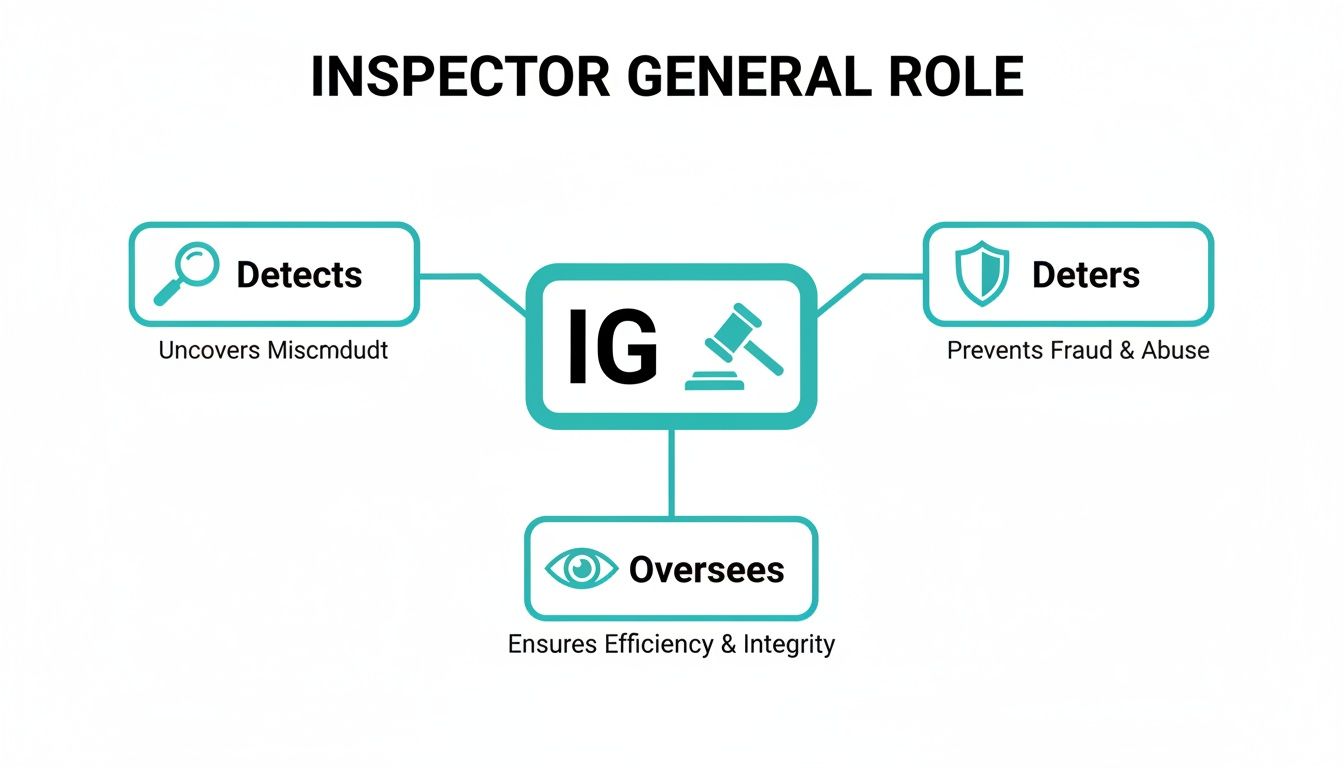
As it shows, the IG's world revolves around detecting misconduct, deterring future wrongdoing, and providing the kind of continuous oversight needed to maintain real organizational integrity.
An IG's Core Investigative Powers
The authority of an IG’s office is built on a few fundamental powers that let them slice through bureaucratic red tape and overcome internal resistance. These tools are what ensure their investigations are thorough, evidence-based, and frankly, unavoidable.
Their key powers typically include:
Access to All Records: An IG can demand any and all documents, records, communications, and data relevant to an investigation, without obstruction. This includes everything from sensitive financial data and internal reports to employee emails.
Subpoena Authority: When records aren't handed over willingly, IGs have the legal authority to compel their production from both the organization and outside third parties. This is a critical tool for getting to the bottom of things.
Administering Oaths: The IG can require employees and anyone else involved to provide testimony under oath. This simple act makes providing false statements a serious offense and ensures everyone takes the interview process seriously.
These powers create a level of investigative rigor that goes far beyond a standard internal review. For organizations looking to build a more robust compliance framework, you can learn more about how to establish strong internal controls to prevent fraud.
An IG's jurisdiction isn’t arbitrary; it is triggered by credible allegations or evidence of significant wrongdoing. They don't launch investigations on a whim but follow a clear mandate to protect organizational and public interests from serious harm.
Defining An IG's Jurisdiction
The jurisdiction of an Inspector General defines what they can investigate. While their powers are broad, their focus is laser-targeted on serious issues that threaten to undermine an organization's mission and integrity.
An IG investigation is almost always kicked off by specific triggers. They don't go looking for trouble, but they definitely respond when it's flagged. Common triggers include:
Whistleblower complaints and hotline tips
Evidence of significant financial mismanagement or contract fraud
Allegations of serious employee or executive misconduct
Systemic failures in programs that lead to substantial waste
Congressional requests or mandates
Ultimately, an IG's power and jurisdiction combine to create a formidable oversight mechanism. Their ability to compel testimony and access any record gives them unparalleled reach, while their jurisdiction ensures these powers are focused squarely on the most critical threats to organizational integrity.
Using The IG Framework To Strengthen Internal Risk Programs
Instead of seeing an Inspector General as a purely external threat, what if you could adapt their model to fortify your own organization from the inside? The IG framework—built on a foundation of independence, broad access to information, and an unwavering integrity mandate—is a powerful blueprint for any serious internal risk or compliance program.
It’s about building a function that mirrors the same rigor of a formal IG’s office.
This means shifting your company from a reactive posture, where you’re constantly cleaning up messes, to a proactive one. By adopting this model, you can spot and shut down risks long before they escalate into the kind of crisis that gets an actual Inspector General knocking on your door. The whole idea is to embed a culture of accountability that is disciplined, auditable, and fundamentally ethical.
Creating an Internal IG Function
To truly emulate an IG's effectiveness, an internal program has to have genuine authority. It can't be just a suggestion box or a symbolic committee. This requires intentional structural design to make sure it can operate without fear of internal politics or pressure from management.
Key structural elements include:
Independent Reporting Lines: The head of your internal investigations or integrity unit should report directly to the board's audit committee or a similar high-level, independent body—never to the managers they might one day have to investigate.
Unrestricted Access: Grant this function the explicit authority to access all necessary data, documents, and personnel required for an investigation. Any attempt to obstruct them must be treated as a serious policy violation.
A Clear Mandate: The program's charter has to clearly define its purpose: to detect and deter fraud, waste, abuse, and serious misconduct, protecting both the organization and its stakeholders.
This is the structure that ensures your internal "watchdog" has the teeth it needs to be effective.
An organization that waits for an external body to enforce integrity has already lost control of its own culture. The strongest companies build their own internal inspector general, not as a threat, but as a guardian of their ethical foundation.
By establishing this framework, you not only strengthen your defenses but also send a powerful message about your commitment to good governance. This proactive stance is the ultimate form of risk management, and as we explain in our guide, it’s a critical part of proving compliance program effectiveness to regulators and stakeholders.
How to Navigate an Inspector General Investigation

Getting a notice from an Inspector General’s office is a high-stakes moment that demands a fast, disciplined, and professional response. It’s the kind of event where panic and misinformation can spread like wildfire, creating unnecessary legal exposure. The key is having a clear playbook ready to go long before you ever need it.
Your first move, without exception, should be to engage legal counsel. Get experienced attorneys on the line immediately to guide your response, help preserve legal privilege, and make sure every action you take is compliant. This isn't just about building a defense; it’s about navigating the process correctly from the very first minute.
At the same time, you must issue a legal hold notice. This is a directive that instructs all relevant employees to preserve every document, email, and byte of data related to the investigation. Failing to do this, even by accident, can be seen as obstruction and lead to severe penalties.
Preparing for Information Requests and Interviews
With legal guidance secured, your focus shifts to cooperation and preparation. An Inspector General has broad authority to request documents and conduct interviews. Your response has to be organized and thorough, balancing transparency with the need to protect your legal rights.
When you get an information request, follow these steps:
Centralize Control: Designate a single point of contact—usually someone in Legal or Compliance—to manage all communications and document submissions to the IG's office.
Verify the Scope: Work with your attorneys to get a crystal-clear understanding of what’s being asked for. Provide exactly that—nothing more, nothing less.
Maintain a Master Copy: Keep an exact, pristine copy of every single document and piece of data you turn over. This audit trail is non-negotiable.
Getting employees ready for interviews is just as critical. They need to be instructed to be truthful, stick to the facts, and only answer the question asked without speculating or guessing. Make sure they understand their rights, including the option to have company counsel present when appropriate.
The worst mistake an organization can make during an investigation is attempting to conceal information or influence witness testimony. These actions can turn a manageable inquiry into a criminal matter, destroying trust and exposing the company to far greater jeopardy.
Managing Internal Communications and Employee Rights
Transparent internal communication is essential for shutting down rumors and keeping morale from tanking. But it has to be carefully managed to avoid compromising the investigation or violating employee privacy.
Think about it this way: workplace harassment is a persistent issue, with 52% of employees having experienced or witnessed misconduct. Critically, only 58% of those incidents are ever reported, creating massive institutional blind spots that an IG is often tasked with uncovering. This is a stark reminder of why internal issues must be handled with extreme care from the start. You can discover more insights about the impact of underreported misconduct and its consequences.
Protecting employee privacy is both a legal and ethical obligation. Personal information that isn't directly relevant to the inquiry must be redacted or otherwise protected. This move demonstrates good faith and helps reinforce a culture of respect, even under the intense pressure of an external investigation.
When an Inspector General comes knocking, the investigation doesn't happen in a vacuum. It’s governed by a complex web of legal and regulatory rules that dictate every single move, from how evidence is gathered to how your people are treated. For any organization facing an inquiry, understanding these frameworks isn't just a good idea—it's absolutely essential for survival.
At the top of the list are the robust whistleblower protection laws. These regulations are designed to create an iron shield around employees who report misconduct, protecting them from any form of retaliation, including termination, demotion, or harassment. IGs take these protections incredibly seriously, and any action that even hints at retaliation can turn a standard inquiry into a much larger, more dangerous legal battle.
The legal jeopardy for mishandling this process is immense. A clear, auditable trail that proves you’ve followed due process and acted fairly is simply non-negotiable.
Navigating Data Privacy and Dignity
At the same time, your organization has to manage the intricate web of data privacy regulations. Laws like the General Data Protection Regulation (GDPR) in Europe or the California Consumer Privacy Act (CCPA) put strict limits on how sensitive employee data can be handled, even during an official investigation.
This means you can't just hand over entire personnel files or dump a whole email archive on the investigators. Data must be carefully reviewed and redacted to ensure only information directly relevant to the inquiry is shared. This is about protecting employee dignity and privacy while staying on the right side of the law.
These dual obligations create a tricky balancing act: you have to be completely transparent with the IG while rigorously protecting your employees' rights. A misstep on either side can weaken your legal standing and do serious damage to your reputation.
The High Cost of Non-Compliance
Make no mistake, the enforcement environment is getting tougher. Agencies are cracking down more aggressively on misconduct, a trend that highlights the immense financial and reputational risk for organizations that don't get their house in order.
Today's regulatory climate leaves no room for error. Demonstrating a commitment to legal and ethical standards during an investigation is as important as the outcome of the inquiry itself. A procedural mistake can be just as damaging as the initial misconduct.
For example, one major enforcement body recovered around $664 million in claims for workers victimized by workplace harassment in a single year—a 30% jump from the year before. This escalating enforcement signals a new reality where external bodies, including IGs, are more willing than ever to impose significant penalties. To get a better sense of this trend, you can explore detailed findings on rising workplace harassment claims.
This reality makes proactive compliance and careful navigation of any external inquiry more critical than ever before.
Building a Culture of Proactive Integrity
Ultimately, the goal isn't just to survive an Inspector General investigation but to build an organization where one is never needed in the first place. Viewing the IG framework as purely an external threat is a massive missed opportunity.
Instead, think of it as a blueprint for creating a culture of proactive integrity. The best defense against external oversight is a robust internal "immune system" built on ethical governance and genuine accountability.

This means moving far beyond mere compliance checklists. It requires leadership to champion systems of transparency that actually empower employees. When people trust they can report issues without fear and believe those issues will be handled fairly, the organization begins to self-correct.
Championing Internal Accountability
Getting this right means every department has a role to play. A critical piece of fostering this culture is embedding effective security awareness training for all personnel. This gives your teams the tools and confidence to identify and report risks ethically and responsibly.
The strongest defense against external scrutiny is an unwavering internal commitment to transparency. An organization that can identify and resolve its own issues with integrity rarely needs an outsider to do it for them.
This approach completely transforms how your organization responds to risk. It shifts the focus from reacting to audits to building a foundation of operational discipline.
By embedding the principles of independence, accountability, and thoroughness—the very hallmarks of an effective Inspector General—into your own programs, you start spotting and fixing problems long before they can attract external attention. This protects your reputation and builds lasting institutional trust from the inside out.
Your Inspector General Questions, Answered
Even when you understand the Inspector General's role in theory, things get complicated when they actually show up at your door. Let's dig into some of the most common questions we hear from compliance, HR, and security leaders who find themselves navigating this high-stakes world.
What’s the Real Difference Between an IG and Internal Audit?
The two biggest differences are independence and power.
Your internal audit team reports up through the company’s management structure. Their job is to make sure everyone is playing by the rules your company has already set—checking financial controls, confirming process compliance, and so on. They’re making sure the game is being played correctly.
An Inspector General, on the other hand, is an independent watchdog, often with legal authority granted by the government. They don't report to your CEO. They can compel people to testify and demand access to pretty much any record they need to investigate systemic problems like fraud, waste, and abuse.
In short, they have the power to question the game itself.
What Triggers an IG Investigation Into a Private Company?
Inspectors General are focused on government agencies and the money they spend. So, an IG investigation usually gets kicked off when a private company has a direct financial tie to public funds or federal programs.
Some of the most common triggers we see are:
Receiving federal grants or other government funding.
Holding a major government contract.
Serious allegations of fraud or misconduct tied to a federally regulated program.
A credible whistleblower complaint related to any of the above.
How Should We Prepare Employees for an IG Interview?
Your focus here has to be on clarity, honesty, and protecting legal rights—both the employee's and the company's. Advise employees to be completely truthful but to answer only the specific questions asked. This is not the time for speculation, opinions, or friendly chatter.
Crucially, you must make sure they understand their right to have legal counsel present during the interview.
Most importantly, you need to create a non-retaliatory environment. Make it clear that cooperation is company policy, but do it in a way that protects everyone's legal interests.
The single most important step you can take before an Inspector General comes knocking is to build a rock-solid, independent internal compliance and investigations program. Proactive governance is your best defense, as it helps you solve issues internally before they ever attract outside attention.
This approach dramatically cuts the chances of a problem escalating to a level where an external investigation becomes inevitable.
At Logical Commander Software Ltd., we believe proactive integrity is the only sustainable defense. Our E-Commander platform helps you build a robust internal framework to identify and mitigate risks ethically and efficiently, turning potential threats into manageable, auditable processes. Know First, Act Fast with Logical Commander.