%20(2)_edited.png)

The Role of the Office of Inspector General Explained

Updated: Feb 11
An Office of Inspector General (OIG) is essentially an independent watchdog inside a government agency or a large organization. Its entire reason for being is to detect and deter fraud, waste, abuse, and misconduct, making sure everything runs efficiently and with integrity.
Think of an OIG as a neutral referee. Their job is to make sure everyone plays by the rules.
The Role of an Independent Watchdog
Picture a massive ship—say, a major government department or a multinational corporation. The captain and crew are all focused on getting to their destination, which is the organization's mission. The OIG acts as the ship's independent surveyor.
They're the ones checking the hull for cracks, ensuring the lifeboats are functional, and verifying the navigation charts are accurate. They don’t steer the ship, but they make damn sure it’s seaworthy and on the right course.

This independence is the OIG's most critical feature. It’s what allows them to conduct impartial audits and investigations without being swayed by the very leadership they’re tasked with overseeing. They have a dual role: find the problems and recommend how to fix them, acting as a catalyst for real accountability.
Why OIGs Matter in Today's World
In a world tangled in complex regulations and intense public scrutiny, the need for robust oversight has never been clearer. An OIG provides a structured way to maintain trust between an organization, its people, and the public it serves. This isn't just about catching wrongdoers; it's about building a culture of integrity from the ground up.
And the impact is very real. For instance, the U.S. Department of Health and Human Services (HHS) OIG reported a monetary impact of $16.61 billion in its Spring 2025 Semiannual Report to Congress. That staggering number comes from recoveries and prevented losses, showcasing just how valuable independent oversight can be in safeguarding public funds.
Core Functions of an OIG
While the specific duties can vary, most OIGs are built on a few key pillars. These functions work in tandem to create a comprehensive oversight framework that protects both assets and reputation. You can read more about how the Inspector General role is integrated into organizations in our detailed guide.
To give you a clearer picture, here's a quick breakdown of what a typical OIG does.
OIG Core Functions at a Glance
This table sums up the primary responsibilities, showing how each function contributes to the overall mission of integrity and efficiency.
Function | Objective | Typical Activities |
|---|---|---|
Audits | Assess efficiency, economy, and effectiveness of programs. | Conducting financial and performance audits of operations and contracts. |
Investigations | Uncover and address allegations of wrongdoing. | Investigating claims of fraud, misconduct, and other violations. |
Evaluations | Identify systemic weaknesses and areas for improvement. | Performing targeted reviews and inspections of specific programs or policies. |
Prevention | Proactively mitigate risks before they cause harm. | Promoting best practices, offering training, and recommending stronger controls. |
These core functions aren't just separate tasks on a checklist. They form a continuous cycle of review, correction, and improvement that is essential for any large, complex organization to maintain its integrity and public trust.
Why Office of Inspector General Oversight Is Essential for Integrity
An Office of Inspector General (OIG) isn’t just another department with a fancy title. Its power is anchored firmly in law, and that legal foundation is what separates it from every other oversight function. It’s what gives the watchdog its teeth—and the independence to bite down when necessary.
This legal framework ensures an OIG can operate without interference. It’s the rulebook that guarantees investigators can follow the facts, no matter how inconvenient they might be for those in power.
In the United States, the cornerstone of this power is the Inspector General Act of 1978. This wasn't just another piece of legislation; it was a landmark response to rampant waste and fraud discovered deep inside federal agencies. The act created a blueprint for independent oversight, establishing a network of OIGs designed to be fiercely autonomous and accountable to both their agency head and Congress.
But the act didn't just create an office; it armed it with a specific set of tools—legal authorities—that are absolutely essential for digging deep and getting to the truth.
The Pillars of OIG Authority
The entire effectiveness of an Office of Inspector General depends on its statutory powers. These aren't just suggestions; they are legal mandates that compel cooperation and guarantee access to information. Think of them as an investigator's master keys, unlocking doors that would otherwise stay sealed shut.
The most critical of these powers include:
Unrestricted Access to Records: An OIG has the legal right to access all records, reports, audits, and any other documents belonging to its parent organization. No file is off-limits, which is fundamental for conducting a thorough investigation.
Subpoena Power: When an organization or individual outside the agency won't cooperate voluntarily, an OIG can issue a subpoena. This is a legal order that forces them to produce documents or provide testimony, a crucial tool for following a trail of evidence wherever it leads.
Authority to Administer Oaths: During interviews, OIG investigators can place individuals under oath. This makes it a crime to lie or provide false statements, adding serious legal weight to every piece of testimony they gather.
These authorities are non-negotiable. They ensure an OIG can gather evidence and establish facts without being stonewalled or misled. Without this legal backing, an oversight body would be completely toothless and unable to enforce accountability.
An OIG’s legal authority is not about power for its own sake. It is about creating an environment where facts can be pursued without fear or favor, ensuring that oversight is objective, credible, and capable of driving meaningful change.
Global Adoption of OIG Principles
While the Inspector General Act of 1978 is a U.S. law, its core principles have inspired similar oversight bodies around the globe. Major international organizations like the United Nations and the World Bank have established their own independent investigative functions modeled on this framework.
Their authority is similarly grounded in foundational charters and legal agreements, empowering them to root out fraud and corruption across sprawling global operations.
Even large corporations have adopted the model, creating internal OIG-like functions to signal a serious commitment to integrity. While these internal teams may not have statutory subpoena power, their authority is enshrined in corporate bylaws and policies, granting them broad access to internal records and personnel. This structure assures stakeholders that a truly independent body is safeguarding their interests.
Ultimately, the power of any Office of Inspector General flows directly from the legal and policy framework designed to guarantee its independence and effectiveness.
How an OIG Is Structured for Success
An effective Office of Inspector General (OIG) isn't just a department; it's a purpose-built machine. Its structure is meticulously designed for independence, precision, and multidisciplinary strength, ensuring it can tackle complex issues from every conceivable angle. This internal architecture is the secret to its success in upholding integrity and accountability.
Think of an OIG as a special operations team. It’s not a single, monolithic unit but a collection of specialists, each playing a distinct and vital role. This structure guarantees that every audit, investigation, and review is handled by pros with the right expertise, all driving toward the same mission.

This collaborative model allows an OIG to function as far more than just an oversight body; it becomes a center of excellence for organizational integrity.
The Core Leadership and Key Divisions
At the very top of the org chart sits the Inspector General (IG). The IG is the commander of the entire operation, appointed to lead with unflinching impartiality and independence. This person sets the strategic direction, reports findings directly to the agency head and legislative bodies, and serves as the public face of the OIG’s mission.
Reporting directly to the IG are several specialized divisions, each forming a pillar of the OIG's operational strength. While the exact names might change from one organization to the next, the core functions are remarkably consistent.
The primary divisions usually include:
Office of Investigations: This is the law enforcement and fact-finding arm. Staffed by investigators who are often credentialed special agents, this team handles allegations of serious criminal activity, misconduct, and fraud. They are the boots on the ground—conducting interviews, gathering evidence, and building cases for potential prosecution.
Office of Audits: This division is home to auditors who scrutinize financial statements, program effectiveness, and operational efficiency. They follow the money and the data trails to determine if programs are hitting their goals and if taxpayer or company funds are being spent wisely.
Office of Counsel: The legal experts in this division provide essential guidance on every facet of the OIG's work. They ensure investigations and audits comply with all laws and regulations, advise on thorny legal issues, and help prep cases for referral to prosecutors.
The Multidisciplinary Team Approach
Beyond these core units, many OIGs also have an Office of Evaluations or Inspections. This team conducts deep dives into specific programs or systemic issues that might not trigger a full-blown audit but still pose a risk to the organization.
The real strength of an OIG lies in its multidisciplinary team. It’s the seamless collaboration between investigators, auditors, lawyers, and analysts that allows it to uncover complex fraud schemes and identify systemic vulnerabilities that a single-function department would almost certainly miss.
This structure ensures an OIG is a dynamic and adaptable force. For example, an audit might uncover financial irregularities, which are then handed off to the investigations team to figure out if fraud was committed. All the while, the legal team provides counsel to make sure every step is defensible and legally sound.
This integrated approach is the engine that drives an Office of Inspector General. Each division brings its unique expertise to the table, but it's their combined effort that truly protects organizational integrity and maintains public trust.
How an OIG Differs from Internal Audit, Compliance, and Other Functions
In any large organization, you’ve got a handful of departments all working to keep things on the straight and narrow. But they’re not all doing the same job. It’s a common point of confusion: how is an Office of Inspector General (OIG) different from Internal Audit or Compliance? While they all want to protect the organization, their missions, methods, and authority are worlds apart.
Think of it like a hospital's medical team. The Compliance department is like the hospital administrator, making sure all policies and procedures meet the letter of the law. Internal Audit is the specialist who reviews a specific department’s processes—say, the cardiology wing—to make sure they’re efficient and effective.
The OIG, however, is the independent medical examiner called in when there’s a suspicion of serious wrongdoing. They have the authority to investigate any department, without interference. Getting these roles straight isn't just academic; it’s critical for creating a unified front for integrity instead of sparking turf wars.
Distinguishing Mission and Scope
The core difference comes down to their primary mission and scope. Internal Audit and Compliance are fundamentally management tools, designed to help leadership run the organization better. Their focus is internal, aimed at improving processes and making sure people stick to company policies.
Compliance, for instance, lives to prevent violations by ensuring the organization follows external laws and internal rules. Internal Audit evaluates operational risks and the effectiveness of internal controls, often working to improve efficiency and financial accuracy. For a deeper dive, check out our guide on internal audit best practices and procedures.
An Office of Inspector General operates on a completely different plane. Its mandate is usually statutory, giving it a level of independence other departments can only dream of. Its prime directive is to detect and deter fraud, waste, abuse, and misconduct, with a scope that can stretch all the way to criminal investigations.
While Internal Audit asks, "Are we doing things right?" and Compliance asks, "Are we following the rules?", an OIG asks a tougher question: "Is there evidence of criminal wrongdoing or systemic failure that requires independent intervention?"
This isn't just a subtle distinction—the results speak for themselves. For instance, the HHS-OIG's Fall 2025 Semiannual Report to Congress revealed an eye-watering $19.04 billion in monetary impact in just six months. This massive figure came from recoveries tied to over 500 criminal actions and other preventive measures. That’s a scale of financial recovery and fraud prevention that goes far beyond what a traditional internal audit team is built to handle. You can read the full report to see the scale of HHS-OIG's financial impact and fraud prevention efforts.
Comparing Independence and Reporting Lines
Another massive differentiator is independence. Internal Audit and Compliance typically report up through the management chain, often to the CEO, CFO, or a board committee. While they have a degree of autonomy, they are ultimately part of the very management structure they are reviewing.
An OIG, especially in the public sector, has statutory independence. The Inspector General is often appointed by an external body and can only be removed for specific, documented cause. This structure insulates the OIG from internal political pressure, allowing it to conduct investigations without fear of reprisal from the very leadership it oversees.
This table breaks down the key distinctions between an OIG and other corporate oversight functions, clarifying their unique roles.
OIG vs Other Corporate Functions: A Comparative Overview
Function | Primary Mission | Scope | Independence Level | Reporting Structure |
|---|---|---|---|---|
OIG | Detect and deter fraud, waste, abuse, misconduct. | Broad, including potential criminal investigations. | High (Statutory/Independent) | Agency head and legislative body (e.g., Congress). |
Internal Audit | Evaluate and improve operational efficiency and controls. | Focused on financial and operational processes. | Moderate (Organizational) | Management and Audit Committee. |
Compliance | Ensure adherence to laws, regulations, and policies. | Focused on regulatory and policy adherence. | Moderate (Organizational) | Chief Compliance Officer or General Counsel. |
By defining these clear lanes, an Office of Inspector General can work effectively with other oversight functions. Instead of competing, they can share information where appropriate, ensuring that issues get routed to the team best equipped to handle them. This collaboration is what ultimately strengthens an organization's entire integrity framework.
The OIG Investigation Process from Tip to Final Report
An Office of Inspector General (OIG) investigation rarely starts with a bang. It almost always begins with a single thread—a tip from a confidential hotline, a quiet referral from another department, or a finding from a routine audit that just doesn’t feel right. That initial spark is what kicks off a structured, methodical process designed to uncover facts with total impartiality.
The journey from a raw allegation to a final, polished report is governed by incredibly strict ethical and legal standards. The entire system is built on a foundation of due process, which guarantees fairness for everyone involved while protecting the investigation's integrity from start to finish.
The flowchart below shows how different internal functions typically feed into the OIG's investigative pipeline.
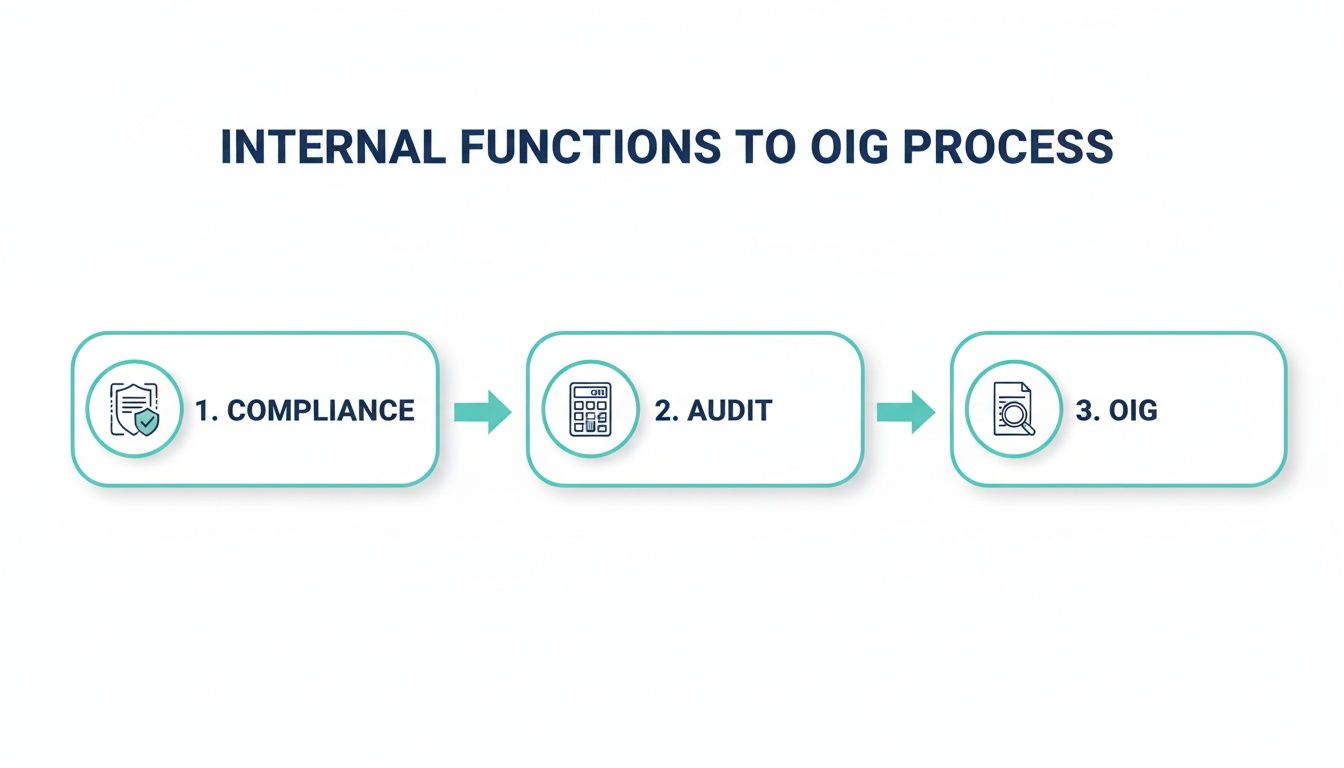
As you can see, while compliance and audit teams handle routine oversight, the OIG is the specialized unit brought in to tackle the most serious claims of fraud, waste, and abuse.
From Allegation to Action
Once a complaint comes in, the first critical step is intake and initial assessment. OIG staff carefully review the details to figure out if the issue falls within their jurisdiction and actually warrants a closer look. Not every tip becomes a full-blown investigation; many are referred back to management or other departments for a more appropriate resolution.
The bedrock of this whole process is whistleblower protection. OIGs are legally required to protect the confidentiality of their sources, creating a safe channel for employees and the public to report wrongdoing without fearing retaliation.
If an allegation is deemed credible and serious enough, a preliminary inquiry gets underway. This phase is all about discreet fact-gathering to determine if there's enough evidence—or "predicate," as it's called—to justify committing the resources for a full investigation. This is a crucial filter that separates rumor from reality.
The Full Investigation Unfolds
When that preliminary work confirms that "where there's smoke, there's fire," a full investigation is launched. This is where the specialized skills of the Office of Inspector General really come into play. The process typically follows a clear, defensible sequence:
Investigation Planning: A detailed plan is drafted, outlining the scope, objectives, and methods. This roadmap keeps the team focused, ensuring they collect the right evidence efficiently and legally.
Evidence Collection: Investigators use their authority to gather evidence, which can mean obtaining documents, analyzing financial records, seizing electronic data, or conducting formal interviews. Every single piece of evidence is meticulously documented to maintain a clear, unbroken chain of custody.
Analysis and Findings: With all the evidence in hand, investigators piece together the facts of what happened. They analyze the information against relevant laws, regulations, and policies to either substantiate or refute the initial allegations.
Reporting: The process ends with a formal report of investigation. This document presents the findings in a clear, objective manner and is delivered to management. If warranted, it's also sent to prosecutors for potential criminal charges or civil action.
From Findings to Actionable Recommendations
An OIG's job doesn't stop at just identifying problems. For example, the U.S. Department of Commerce OIG's Semiannual Report to Congress detailed audits that not only confirmed clean financial statements but also flagged vulnerabilities in 15% of the cybersecurity processes they reviewed. This led directly to specific, corrective actions.
This cycle of review and recommendation is fundamental to how an OIG drives accountability and makes an organization stronger and more effective. If you're interested in the nuts and bolts of similar procedures, you can learn more about a parallel framework in our guide on the internal affairs investigation process.
Key Signs Your Organization Needs an OIG Function
Deciding to create an internal function like an Office of Inspector General is a serious strategic move, not just a knee-jerk reaction to a crisis. It signals a shift from a defensive, reactive compliance posture to a proactive commitment to institutional integrity. But how do you know when your organization has hit that tipping point?
Certain red flags and operational realities are clear signals that a more robust, independent oversight function is needed. Ignoring them can expose your organization to staggering financial, legal, and reputational harm.
You Operate in a High-Stakes Environment
The most obvious trigger is the nature of your industry. If you work in a heavily regulated field, the need for an OIG-like function is practically a given. Here, the risk of non-compliance isn't just about fines; it can spiral into devastating legal battles and a complete loss of public trust.
This need is especially sharp in a few key sectors:
Healthcare and Pharmaceuticals: You're navigating a minefield of complex laws like the federal Anti-Kickback Statute. Even a well-meaning program, like offering sign-on bonuses to caregivers, can be misconstrued as improper remuneration if not structured with surgical precision.
Government Contracting: Managing large public contracts brings intense scrutiny. An independent oversight body is essential for ensuring every single dollar is accounted for and all contractual obligations are met without even a whiff of fraud or waste.
Financial Services: In an industry literally built on trust and regulatory adherence, an internal OIG function provides that extra layer of assurance that ethical lines are never, ever crossed.
If your organization fits one of these profiles, the question isn't if you need independent oversight, but how you're going to build it.
Recurring Integrity Issues and Blind Spots Keep Popping Up
Another unmistakable sign is a pattern of recurring problems that your existing departments just can't seem to stamp out. Are you dealing with the same types of fraud, misconduct, or ethical breaches over and over again? This points to a systemic weakness that needs a deeper, more independent investigation than what traditional HR or compliance teams are equipped to handle.
When the same problems keep surfacing, it often means the root cause is hidden from standard oversight. An independent OIG function is designed to dig into those systemic blind spots and recommend fundamental changes, not just patch symptoms.
Think of it this way: if your compliance team keeps finding small fires, an OIG is the function you bring in to find out who’s leaving matches and gasoline lying around. They have the independence and authority to investigate systemic issues without being shackled by internal politics or awkward reporting structures.
A Quick Checklist for Leadership
Leaders in Compliance, Legal, and HR can use these questions to get a gut check on their organization's risk exposure and figure out if an OIG-like function is warranted:
Complexity of Operations: Have our operations become so complex that our existing oversight functions are visibly struggling to keep up?
Frequency of Misconduct: Are we seeing a noticeable jump in hotline reports or internal investigations that hint at systemic rot?
Third-Party Risk: Do we rely heavily on third-party vendors or partners, creating a risk landscape that's nearly impossible to monitor through conventional methods?
Reputation and Trust: Is our organization’s reputation a critical asset that would be shattered by a single major integrity failure?
If you answered "yes" to a few of these, it’s a strong signal that it's time to seriously consider establishing a dedicated, independent integrity function. This isn't just about protecting the organization; it's about building a framework for trust and accountability that your stakeholders can actually believe in.
Common OIG Questions, Answered
Even when you understand the big picture, the day-to-day realities of an Office of Inspector General can bring up some practical questions. Let's dig into a few of the most common ones to make these concepts crystal clear.
What Happens After an OIG Issues a Report?
An OIG report isn't the final word; it’s the starting gun for action. Once a report is published—whether it's from an audit or an investigation—it lands on the desk of the organization's leadership. These documents don’t just point out what’s wrong; they provide specific, actionable recommendations for fixing the underlying problems.
Management is then on the clock. They are required to formally respond, usually within a specific timeframe, with a concrete plan detailing how they will implement every single recommendation. The OIG doesn't just walk away at this point; they track this progress meticulously to ensure the issues are truly resolved, driving a cycle of accountability and continuous improvement.
How Is Confidentiality Protected in OIG Complaints?
Confidentiality is the absolute bedrock of the entire OIG process. Federal laws, like the Inspector General Act, offer powerful protections for whistleblowers who step forward to report fraud, waste, or abuse. An OIG is legally bound to protect a complainant's identity to the fullest extent possible.
Protecting a source's identity isn't just a courtesy; it's a legal and ethical mandate. This promise encourages people with firsthand knowledge of wrongdoing to come forward without fearing retaliation, which is absolutely essential for bringing hidden problems into the light.
This shield creates a safe channel for employees and citizens to report highly sensitive information, ensuring the OIG gets the tips it needs to launch impactful work.
How Does an OIG Measure Its Own Effectiveness?
An Office of Inspector General doesn't just judge others; it holds itself to rigorous standards. It measures its success through a blend of hard numbers and qualitative impact, often laid out in their Semiannual Reports to Congress or other public documents for full transparency.
You can see their performance through a few key indicators:
Monetary Impact: This is a big one. It tracks everything from funds recovered for the government through fines and settlements to the potential savings generated by their recommended process improvements.
Investigative and Audit Outcomes: This includes the number of successful criminal prosecutions, civil lawsuits, and administrative actions (like employee suspensions or debarments) that stem directly from their findings.
Implementation of Recommendations: The percentage of OIG recommendations that the agency actually adopts is a crucial yardstick for measuring its real-world influence in driving change.
Systemic Improvements: Beyond the numbers, an OIG evaluates its long-term impact on making agency programs more effective, strengthening internal controls, and fostering a deeper culture of integrity.
These metrics aren't just for show. They demonstrate the tangible value an OIG delivers, proving its role as a vital guardian of public and organizational trust.
At Logical Commander Software Ltd., we believe in proactive, ethical risk management. Our E-Commander platform helps HR, Compliance, and Security teams identify internal threats and integrity risks early, preserving employee dignity while protecting your organization. Instead of reacting to damage, gain the foresight to act first. Learn more about our dignifying, compliance-driven approach at https://www.logicalcommander.com.