%20(2)_edited.png)

What Is Insider Threat: A Guide to Human-Factor Risk Prevention
- Marketing Team

- 7 hours ago
- 14 min read
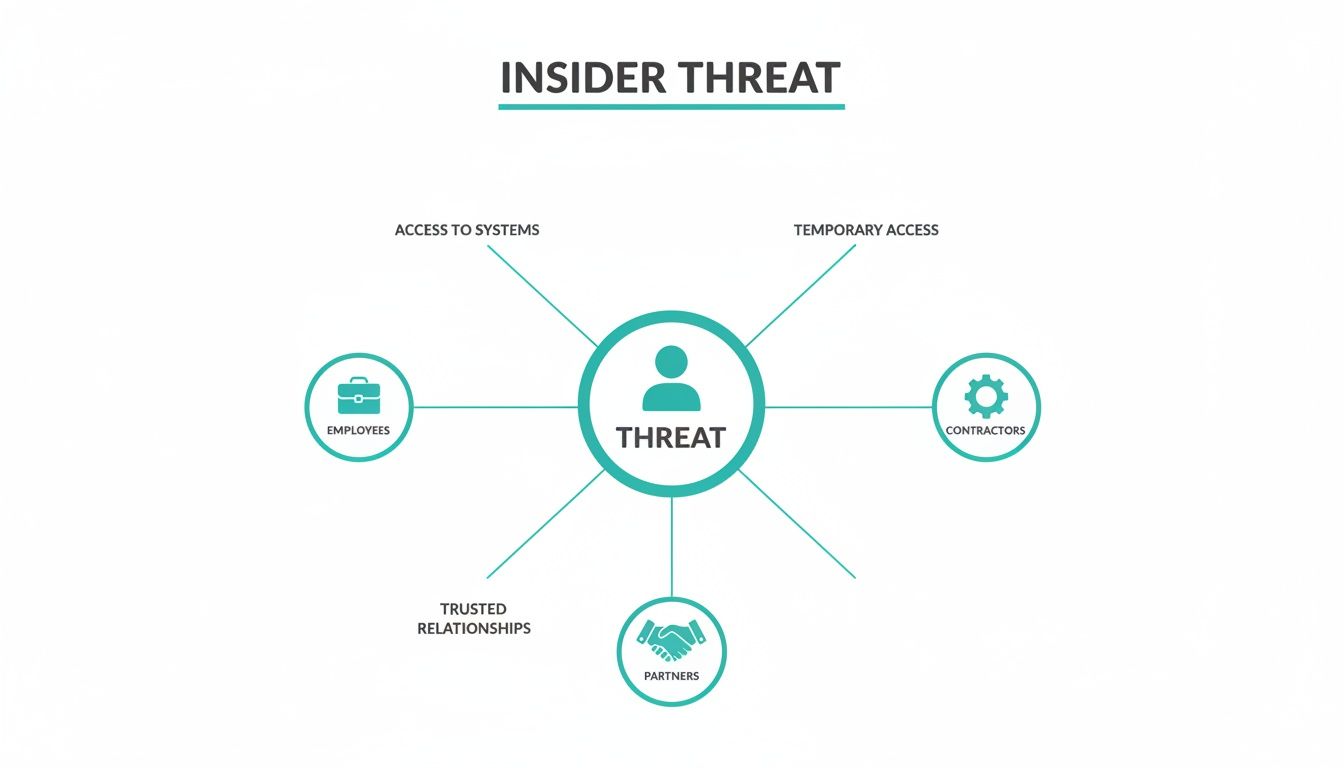
An insider threat isn't just a cybersecurity buzzword; it's a fundamental business risk stemming from the people you trust most—current or former employees, contractors, and partners with legitimate access to your company’s systems and data.
This is a human-factor challenge, not a technology problem. While malicious acts grab headlines, the reality is that unintentional human error often causes the most frequent and severe financial, reputational, and operational damage. Failing to address this risk proactively creates significant business liability.
Defining What Is an Insider Threat in a Business Context
When leaders hear "insider threat," they often picture a disgruntled employee selling company secrets. While that scenario is a real risk, it's a narrow and dangerously incomplete view.
A more accurate understanding of what is an insider threat is any human-factor risk posed by individuals with authorized access, regardless of their intent. This definition shifts the focus from a niche cyber issue to a core business and compliance concern that impacts the entire organization.
It could be a sales manager who accidentally emails a sensitive client list to the wrong recipient. It might be a contractor who misconfigures a cloud server, leaving proprietary data exposed. These incidents, driven by negligence or simple mistakes, are the everyday realities that cause significant and costly damage far more often than deliberate sabotage.
To frame this in clear business terms, let's break down the core components.
Insider Threat At a Glance
The table below breaks down the core components of insider threats, framing them as tangible business risks that demand a human-centric, not cyber-centric, prevention strategy.
Threat Component | Description |
|---|---|
Origin | Current/former employees, contractors, or partners with legitimate access. This risk starts and ends with humans. |
Nature of Risk | Human-factor challenge, encompassing malicious, negligent, and accidental actions. |
Primary Vulnerability | Authorized access to sensitive data, systems, and intellectual property. |
Business Impact | Financial loss, reputational damage, operational disruption, and regulatory penalties. |
Prevention Challenge | Risky behaviors often mimic normal business activities, making reactive surveillance and forensics ineffective and obsolete. |
This at-a-glance view highlights why a narrow, tech-only approach is bound to fail. The risk is deeply tied to people and processes, demanding a holistic strategy focused on proactive prevention.
The Business Impact Beyond Data Breaches
Failing to manage this risk creates consequences that ripple across the entire organization, creating serious business liability. The damage is multi-faceted and goes way beyond technical cleanup.
Financial Loss: Direct costs include regulatory fines, legal fees, and expensive forensic investigations. But the indirect costs—lost business, a tanking stock price, and diminished investor confidence—are often far more severe.
Reputational Damage: A single high-profile incident can wipe out decades of customer trust and brand loyalty, hobbling long-term growth and your position in the market.
Operational Disruption: Business can grind to a halt. Teams are pulled from strategic work to contain the damage, investigate what happened, and restore critical systems, killing productivity.
Regulatory Penalties: For companies in regulated industries like finance or healthcare, an insider incident can trigger severe compliance violations and painful audits from governing bodies.
An effective strategy for mitigating these risks must be proactive and human-centric. It requires shifting focus from after-the-fact investigations to a preventive posture that identifies risk signals before they escalate into costly incidents.
Moving from Reactive Investigations to Proactive Prevention
For too long, the standard approach has been to rely on invasive employee surveillance and reactive investigations. This model is fundamentally broken. By the time you detect a threat this way, the damage is already done.
Worse, these surveillance methods create a culture of distrust and can violate critical regulations like the Employee Polygraph Protection Act (EPPA), exposing your organization to even more legal risk. The new standard in internal risk management is ethical, non-intrusive, and—most importantly—preventive. For a deeper dive, you can learn more about the complete insider threats definition in our detailed guide.
This modern, human-centric approach protects both the organization and its people. It gets to the root cause—human behavior—without compromising privacy or destroying morale.
The Three Faces of Insider Risk
Not all insider threats are cut from the same cloth. Understanding the differences is the first real step toward building a defense that actually works. To get a handle on what insider risk truly means, you have to look past a single, generic profile and see the distinct motivations—or complete lack thereof—that drive these incidents.
They generally fall into three buckets, and each one demands a totally different preventive response.
When you start to see these distinct personas, you can finally move away from a culture of blame. It lets you build strategies that cover the full spectrum of human-factor risks, from deliberate sabotage all the way to a simple, honest mistake.
The Malicious Insider
This is the classic villain of the insider threat story—the person who acts with the clear intent to do harm. Their reasons can be all over the map, from straight-up financial gain and corporate espionage to pure revenge after being fired or passed over for a promotion.
Because they’re acting deliberately, malicious insiders often try to cover their tracks, making their activity difficult to spot with traditional surveillance, which often generates too much noise. They might be stealing intellectual property, sabotaging critical systems, or selling sensitive data to a competitor. While they represent a smaller slice of the incident pie, the damage they can cause is often catastrophic.
The Negligent Insider
Far more common than the malicious actor is the negligent insider. This is the well-meaning employee who unintentionally creates risk through carelessness, lack of awareness of a policy, or just a simple mistake. They aren't trying to hurt the company, but their actions can be just as damaging.
This group is, by a huge margin, the most common source of insider incidents. In fact, data shows that a staggering 55% of incidents come from mistaken or careless employees, costing companies an average of $8.8 million a year. These unintentional actors account for 62% of all insider incidents, with the most common slip-ups being:
Falling for a phishing email (37%)
Mishandling sensitive data (29%)
Using weak or reused passwords (22%)
It’s an everyday human-factor problem with a massive price tag.
Think about it in real-world terms. It’s the employee who clicks a suspicious link, loses a company laptop, uses an unapproved cloud service for work files, or accidentally sends a confidential report to the wrong email address.
The sheer frequency of these events makes the negligent insider one of the biggest and most expensive risks for any organization. The right response isn't blame; it's building a culture of awareness backed by proactive, supportive, and smarter systems.
The Inadvertent or Accidental Insider
The third face of insider risk is the accidental—or compromised—insider. This person is an unwitting pawn in an attack launched by an external party. A hacker steals their legitimate credentials and then uses that access to walk right into your network.
To your security systems, the attacker’s activity looks perfectly legitimate because it’s coming from a trusted employee’s account. The employee has done nothing wrong, yet they’ve become the key that unlocked the door for a serious breach.
This type of threat highlights the importance of strong identity and access controls. It also proves why focusing only on employee behavior with surveillance tools is a flawed strategy for managing your company’s overall human capital risks.
By breaking down insider threats this way, you can develop much smarter, more effective, and more ethical risk management programs. Instead of a one-size-fits-all approach that treats every employee like a potential suspect, you can build nuanced strategies that actually address the specific human-factor risks posed by each type.
Why Traditional Internal Threat Detection Methods Fail
The old playbook for managing insider risk is completely broken. If you're still relying on a strategy of reactive investigation and invasive surveillance, you're not just falling behind—you're exposing your organization to staggering costs and serious legal jeopardy.
By the time these old-school, surveillance-based systems flag a potential problem, the damage is already done. Your data has walked out the door, systems have been breached, and the internal trust you've built is shattered. It’s like having a smoke detector that only goes off after the building has already burned to the ground.
This reactive posture traps you in a cycle of endless, expensive cleanup and fails to prevent the next incident.
The Problem with a Reactive Posture
Waiting for an incident to happen before you act is a fundamentally flawed strategy that guarantees business disruption. The moment an insider threat materializes, the organization is thrown into crisis mode, forced to drain valuable resources on damage control.
This after-the-fact scramble typically involves:
Costly Forensic Investigations: Your teams must drop everything to piece together what happened, a time-consuming and expensive process that grinds normal business operations to a halt.
Mounting Legal Fees: Suddenly you're dealing with regulatory inquiries, potential lawsuits, and compliance breaches, all of which come with a hefty financial price tag.
Brand and Reputation Repair: The public fallout from an insider incident can destroy customer trust overnight and take years to rebuild, hitting your long-term revenue and market position hard.
This entire model is built on containment, not prevention. It accepts damage as inevitable and focuses on minimizing the fallout instead of stopping the incident from ever happening in the first place.
The Soaring Cost of a Flawed Strategy
The financial consequences of sticking with this outdated approach are staggering, and they just keep climbing. Recent data shows just how severe the problem has become, with organizations reporting a sharp increase in both the frequency and impact of insider threats.
The financial toll is alarming: average annual costs climbed to $17.4 million per organization, up from $16.2 million in 2023 and a whopping 109.6% rise since 2018. Detection remains a major challenge, averaging 77 days to identify an incident, which is more than enough time for significant damage to occur. You can discover more insights about these insider threat statistics on brightdefense.com.
These numbers paint a crystal-clear picture: the traditional, reactive approach isn't just inefficient; it's unsustainable. It’s a losing game that forces your organization to absorb ever-increasing costs while failing to address the root of the problem—the human factor.
The Hidden Dangers of Invasive Surveillance
Beyond the financial drain, many legacy internal threat detection tools, particularly those from cyber companies, create their own set of serious problems. Invasive surveillance and employee monitoring might seem like a solution, but they often do more harm than good by focusing on the wrong signals.
First, these methods can easily run afoul of critical regulations like the Employee Polygraph Protection Act (EPPA). Using any technology that functions as a "digital polygraph," creates psychological pressure, or implies lie detection puts your organization at significant legal risk. These approaches are not EPPA compliant platforms, and relying on them can lead to severe penalties.
Second, constant monitoring creates a toxic culture of distrust. When employees feel they're being spied on, morale plummets, productivity suffers, and the collaborative environment you need to succeed is destroyed. This adversarial dynamic is the exact opposite of what you want when building a secure and resilient organization.
The new standard of effective risk management lies in moving away from these failed strategies. It is proactive, ethical, and built on prevention rather than reaction. This modern approach, centered on AI human risk mitigation, protects the organization without compromising employee dignity or creating unnecessary legal exposure.
Recognizing Early Indicators of Insider Risk
Proactive prevention isn't about pointing fingers or making accusations. It’s about learning to spot the subtle risk indicators long before they snowball into a real problem. A modern approach zooms in on observable, non-intrusive signals that HR, Compliance, and Security teams can ethically identify.
These aren't proof of wrongdoing. Think of them as contextual clues that might signal a need for supportive, preventive intervention.

When you view these signals as opportunities for early engagement, you can mitigate risk before it ever materializes. It’s a fundamental shift away from waiting for a damaging event and toward building a culture of support, not suspicion.
Contextual and Behavioral Signals
Effective and ethical insider threat detection steers clear of surveillance. It has nothing to do with monitoring keystrokes, reading emails, or spying on employees. Instead, it focuses on contextual indicators that, when pieced together, can point to elevated risk. Most of the time, these are simply noticeable changes from an individual's normal patterns.
A few key indicators that can be ethically identified include:
Sudden Changes in Work Habits: An employee who was once a team player suddenly becomes isolated. Or maybe someone starts working unusually late hours or shows a sharp decline in performance. These can all be signals that something is amiss.
Unusual Access Requests: An employee trying to access data or systems that fall way outside their job description is a significant and observable red flag.
Expressions of Significant Discontent: Everyone has bad days. But persistent, strong expressions of disgruntlement, anger toward management, or feelings of being wronged can sometimes be precursors to malicious action.
The goal is not to police employee emotions but to understand when professional dissatisfaction could translate into tangible business risk. This proactive stance is a core tenet of modern ethical risk management.
Personal Stressors and Policy Adherence
It’s impossible to talk about what is an insider threat without acknowledging the human factor at its core. Severe personal stress—whether from financial trouble, family issues, or health problems—can have a massive impact on an individual's judgment and their ability to follow company policies.
A person under extreme duress might be more likely to make a negligent error or, in rare cases, feel pushed to engage in malicious activity. An organization that recognizes these pressures can offer support through employee assistance programs, reinforcing its commitment to its people while simultaneously reducing risk.
For a deeper dive, you can learn more about key insider threat indicators in our specialized guide.
This approach isn't about prying into personal lives. It's about creating a system that can identify when external pressures might be creating internal vulnerabilities for the business. By doing so, you can offer support that benefits both the employee and the company.
The best risk management programs are the ones that can spot these subtle shifts without violating privacy. An AI human risk mitigation platform that is aligned with EPPA standards can analyze contextual data from structured interactions to flag potential risks, enabling leaders to intervene constructively before a policy is ever broken. This protects the organization and upholds employee dignity.
Adopting a Proactive and Ethical Prevention Strategy
The old playbook for managing risk is broken. For too long, companies have been stuck in a reactive loop—waiting for something to go wrong, then scrambling to figure out who to blame. This after-the-fact approach doesn't just fail to stop threats; it creates a culture of suspicion that poisons trust and introduces legal liability.
The new standard is a decisive shift away from investigation and toward prevention. It’s about getting ahead of human-factor risks through structured, dignified interactions that fully respect employee privacy. Imagine a system that gives you early visibility into emerging threats without deploying invasive surveillance. That’s not a far-off idea; it's what modern, AI-driven, EPPA-compliant platforms are doing right now.

This forward-thinking strategy focuses on contextual risk signals, letting you address the root causes of insider threats before they ever materialize. It protects both the company and its people, standing in stark contrast to legacy surveillance tools that often create more problems than they solve.
The New Standard in Risk Management
The conversation around what is an insider threat has changed. It's no longer good enough to just react faster. The goal is to stop incidents from happening in the first place by understanding the human elements that drive them. This requires a new philosophy grounded in ethical principles.
This new standard is defined by a few key ideas:
Proactive Prevention: The system is designed to spot and address risk signals before an incident happens, shifting resources from costly investigations to smart, strategic mitigation.
Ethical and Non-Intrusive: It operates without surveillance, spying, or secret monitoring. All interactions are transparent and dignified, respecting employee privacy and trust.
EPPA Alignment: It strictly follows regulations like the Employee Polygraph Protection Act, making sure all risk assessments are legally sound and don't involve lie detection or psychological pressure.
AI-Driven Intelligence: It uses AI human risk mitigation to analyze contextual indicators from structured interactions, providing actionable insights without collecting invasive personal data.
This model builds resilience from the inside out. It fosters a culture of integrity and support—not one of suspicion and fear. Logical Commander's E-Commander and Risk-HR platforms are the new standard for this modern, ethical approach.
Contrasting Proactive Prevention with Reactive Forensics
The difference between a proactive and a reactive strategy couldn't be more stark. It's the difference between installing a fire prevention system and simply buying a better fire extinguisher. One addresses the cause; the other just deals with the consequences.
By focusing on prevention, organizations can avoid the immense financial and reputational costs associated with reactive forensics. The goal is to get ahead of the problem, not just get better at cleaning up the mess.
The stats on malicious insiders show just how urgent this shift is. These threats cost an average of $715,366 per malicious incident, making them the most expensive subtype. Globally, 68% of organizations find insiders harder to fight than external threats, with total annual insider risk costs hitting $17.4 million. To make matters worse, 60% of HR-security coordination remains manual, leaving dangerous gaps.
Implementing a robust Privileged Access Management (PAM) solution is a critical technical control to mitigate these risks. But technology alone isn't enough. The human element requires a dedicated, ethical approach. For more on this, you can read our guide on ethical insider threat detection.
Ultimately, choosing an ethical and proactive strategy is about making a strategic choice. It's a decision to invest in a resilient, secure, and positive culture—one that's ready to face the human-factor challenges of today and tomorrow.
Your Questions on What Is an Insider Threat, Answered
When you're dealing with insider threats, a lot of questions come up. Leaders in Compliance, Risk, and HR need clear answers to cut through the noise. Here are a few of the most common ones we hear, with straightforward answers that get right to the point.
What Is the Difference Between Insider Risk and an Insider Threat?
It's the difference between a fire hazard and an actual fire. One is the potential for something bad to happen, and the other is the event itself.
Insider Risk is the collection of human-factor vulnerabilities your organization has simply because people work there. This could be anything from a gap in your access controls to an employee going through a tough time personally, which might cloud their judgment. It's the "what if."
An Insider Threat is what happens when that risk becomes reality. It's a human action—whether it was malicious, a simple mistake, or just careless—that ends up hurting the company's security, finances, or reputation.
Smart, modern risk management is all about spotting and fixing those underlying risks before they have a chance to ignite into full-blown threats.
Is an Insider Threat Always Malicious?
Absolutely not, and this is one of the most important things to understand. The classic "bad actor" who sets out to cause damage is real, but they are a very small piece of the puzzle. The hard truth is that over 60% of incidents come from well-meaning employees who made a mistake.
We're talking about someone falling for a clever phishing email, accidentally sharing sensitive data, or unintentionally breaking a company rule they didn't fully understand. A solid strategy has to account for the full spectrum of human risk, not just the rare saboteur.
Why Can't We Just Rely on Technical or Cyber Controls?
Firewalls, access controls, and other technical systems are non-negotiable, but they're only half the story. They were built to stop attackers from getting in and to manage who has keys to which doors. They were not designed to understand the complexities of human behavior, intentions, or context.
An employee with legitimate access can walk right past many of those technical defenses. More importantly, these systems can't tell the difference between someone doing their job and someone who's about to make a huge mistake or is acting with bad intent. This is precisely why you need a dedicated AI human risk mitigation strategy that can see the human context that technical and cyber tools completely miss.
How Can We Manage Insider Risk Without Spying on Employees?
This question gets to the very heart of modern, ethical risk management. The goal is to stop threats without creating a paranoid, "Big Brother" culture or breaking privacy laws like the EPPA. Invasive surveillance is a dead end that creates liability.
A forward-thinking, ethical approach doesn't involve monitoring emails, tracking keystrokes, or listening in on private chats. Instead, it uses structured, transparent, and dignified interactions to get a clear picture of risk.
An ethical framework focuses entirely on observable, work-related signals and contextual data to see where risk is elevated. This allows for supportive, helpful intervention long before an incident can even happen, building trust while simultaneously protecting the organization.
Platforms like Logical Commander's E-Commander are designed to be non-intrusive from the ground up. They ensure that your risk management program actually supports a healthy, productive workplace instead of undermining it, setting the new standard for internal risk prevention.
Ready to move from reactive investigations to proactive, ethical prevention? Logical Commander provides the AI-driven, EPPA-compliant platform to help you manage human-factor risk without surveillance.
Get Platform Access: Start your free trial to experience the new standard in risk management.
Request a Demo: See our E-Commander and Risk-HR modules in action.
Join our PartnerLC Program: Become an ally and join our partner ecosystem for B2B SaaS software.
Contact Us: Our team is ready to discuss enterprise deployment for your organization.