%20(2)_edited.png)

How to conduct workplace investigations: A Practical Guide to Fair Process
- Marketing Team

- 3 days ago
- 17 min read
Updated: 22 hours ago
A solid workplace investigation hinges on a structured process. It moves from a confidential intake, through impartial evidence gathering, all the way to a well-documented resolution. The goal is to be thorough, fair, and consistent every single time. Get this right, and you protect both your employees and the organization from serious legal and cultural blowback.
Why a Structured Investigation Process Is Non-Negotiable
Welcome to the definitive guide on conducting workplace investigations that are fair, compliant, and actually work. This isn't just about ticking boxes; it's about safeguarding your organization's integrity and fostering a culture of trust. An ad-hoc, disorganized approach is a direct path to legal exposure, brand damage, and cratering employee morale.
In today's workplace, the stakes have never been higher. Recent data shows a staggering all-time high in discrimination, harassment, and retaliation claims, hitting 14.7 issues per 1,000 employees.
That surge shows exactly why a structured, repeatable process is non-negotiable. While 88% of organizations say their investigators follow required practices, only 57% actually mandate them. That gap creates a massive amount of risk.
A methodical approach guarantees every complaint gets the same level of seriousness and diligence—the very foundation of a fair process. It turns a potentially chaotic situation into a manageable workflow, giving clarity to investigators and reassurance to employees.
This simple flowchart shows the core phases of any modern, effective investigation.
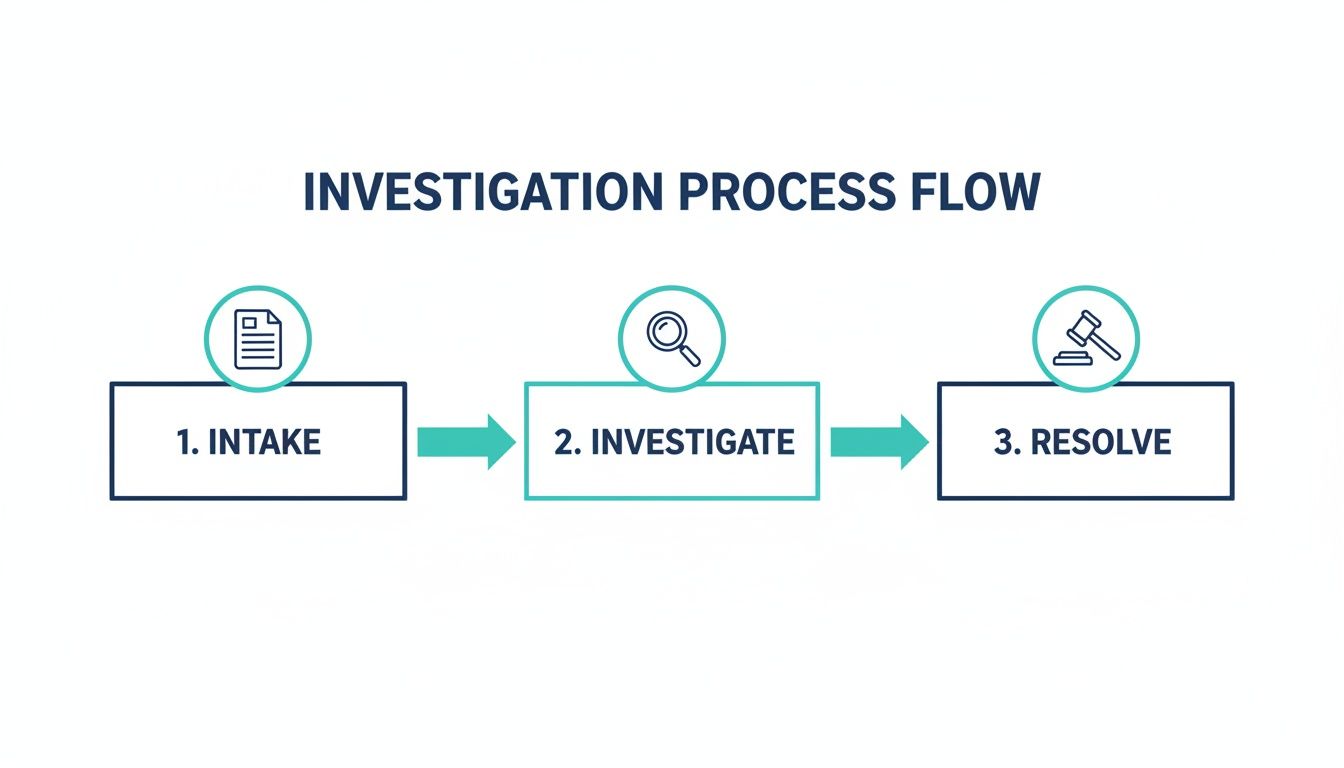
This simple flow—Intake, Investigate, Resolve—forms the backbone of any defensible and ethical inquiry, making sure no critical step gets missed.
The Core Phases of a Workplace Investigation
To break it down further, every investigation follows a logical progression. The table below outlines these essential stages at a high level, showing how each phase builds on the last to ensure a thorough and compliant outcome.
Phase | Objective | Key Action |
|---|---|---|
Intake & Triage | To receive, document, and assess the initial complaint or report. | Securely capture all details of the allegation and determine the scope, severity, and urgency of the issue. |
Investigation Planning | To create a clear, strategic plan for conducting the investigation. | Identify the investigator(s), define the scope, and outline the steps for evidence collection and interviews. |
Evidence Collection | To gather all relevant facts and documentation impartially. | Collect and preserve physical documents, digital records (emails, messages), and other pertinent evidence. |
Interviews | To obtain firsthand accounts from the complainant, witnesses, and the subject. | Conduct structured, neutral interviews to gather detailed information and assess credibility. |
Analysis & Findings | To evaluate all collected evidence and make a finding based on the facts. | Weigh the evidence, determine if a policy violation occurred, and document the rationale for the conclusion. |
Reporting & Remediation | To communicate the outcome and implement corrective actions. | Prepare a final investigation report and take appropriate remedial steps to address the issue and prevent recurrence. |
Following these core phases consistently is what transforms an investigation from a reactive scramble into a controlled, professional process.
The Foundation of a Defensible Process
A structured process does more than just shield you from legal threats; it actively builds a healthier company culture. When employees see a clear, fair, and confidential system in place, they're far more likely to report concerns early—before they escalate into full-blown crises. This transparency builds psychological safety and reinforces a shared commitment to a respectful workplace.
The key benefits really stack up:
Consistency and Fairness: Every case is handled using the same high standards, crushing any perception of bias or favoritism.
Improved Documentation: A defined process ensures all evidence, interviews, and decisions are meticulously recorded in a centralized, auditable format.
Enhanced Efficiency: Investigators can work faster and with more confidence, knowing they're following a proven, compliant playbook.
A great investigation isn't just about finding the right answer. It’s about running a credible process that gives people confidence in the outcome, regardless of what that outcome is.
Ultimately, the goal is to create a system that is both defensible in court and trusted in the breakroom. Understanding the true cost of reactive investigations really highlights how crucial this proactive structure is for long-term organizational health. By establishing a clear playbook, you equip your HR, Legal, and Compliance teams to handle sensitive issues with the professionalism and care they demand.
Building Your Investigation Foundation
A workplace investigation is often won or lost before the first interview ever takes place. The initial moves you make—setting up a reliable intake system, triaging the complaint, and planning your strategy—are what lay the groundwork for a fair, defensible process. Get this foundation right, and you prevent the kind of early missteps that can compromise the entire inquiry.
The first piece of the puzzle is a confidential and accessible intake process. Employees have to feel safe coming forward, knowing their concerns will be handled seriously and discreetly. This means offering multiple reporting channels, like a dedicated email, a confidential hotline, or a direct line to a specific person in HR or Compliance. A process that’s convoluted or intimidating is a barrier that just discourages reporting, allowing serious issues to fester.
Triage and Initial Assessment
Once a complaint lands on your desk, the goal isn’t to jump straight into interviews. The first, most critical step is a careful triage. You have to assess the complaint's severity to figure out the right response, because not every issue calls for a full-blown formal investigation.
Start by asking a few key questions:
What is the nature of the allegation? Are we talking about harassment, discrimination, theft, or a minor policy violation?
What is the potential risk to the business and employees? A claim of systemic bullying carries a different weight than a dispute over break times.
Is there an immediate threat? In cases involving threats of violence or severe harassment, you might need to take immediate action, like separating employees, just to ensure everyone's safety.
This triage helps you categorize the issue. A simple misunderstanding between colleagues, for example, might be better resolved with mediation. An allegation of illegal activity, on the other hand, immediately triggers a formal investigation and probably means getting legal counsel involved from day one. This initial assessment dictates the urgency, scope, and resources you'll need.
An investigation is like building a house. A flawed foundation will cause problems at every subsequent stage. The intake and triage process is your concrete and rebar—get it right, and the structure will be sound.
Assembling the Right Team and Defining Scope
With the severity assessed, it's time to assemble an unbiased investigation team. The investigator(s) you choose must be impartial, properly trained, and completely free of any conflicts of interest. Involving someone with a close personal relationship with either the complainant or the subject of the investigation instantly torpedoes the credibility of the entire process.
For high-stakes cases, especially those involving senior leadership, bringing in a neutral third-party investigator is often the smartest move you can make. A solid foundation for any workplace investigation relies heavily on constantly honing essential practical skills.
The team’s first job is to define the precise scope of the inquiry. A vaguely defined scope leads to "investigation creep," where the inquiry spirals into unrelated issues, wasting time and resources.
Your investigation plan should clearly lay out:
The specific allegations being investigated.
The company policies that may have been violated. You can learn more about creating and managing effective workplace policies in our detailed guide.
A preliminary list of individuals to interview.
The types of evidence to be collected (e.g., emails, security footage, documents).
This planning phase is also the time to tackle any legal and privacy constraints. For instance, reviewing employee emails or personal devices requires a crystal-clear understanding of company policy and local privacy laws to avoid legal violations. By setting these parameters upfront, you create a roadmap that keeps the investigation focused, efficient, and compliant from start to finish. This disciplined approach builds a defensible record and shows a real commitment to a fair and structured process.
Gathering and Protecting Crucial Evidence
Every credible investigation is built on a foundation of solid evidence. Once you have a plan, your focus has to shift to the meticulous work of collecting, preserving, and documenting the facts—ethically, legally, and in a way that can stand up to scrutiny. This isn't about just grabbing a few emails. It's about piecing together a coherent narrative that can withstand challenges from all sides.
The game has gotten more complicated. Evidence no longer lives neatly in a filing cabinet. Today, the story is told through emails, Slack messages, collaboration platform logs, social media posts, and security camera footage. Handling this digital trail the right way is absolutely essential.
Navigating the Digital Evidence Landscape
Collecting digital evidence is a delicate dance between being thorough and respecting employee privacy. You absolutely have to operate within the lines drawn by your own company policies and data privacy laws like GDPR or the CCPA. An overzealous search that crosses a privacy line can torpedo your entire investigation before it even gets started.
Before you touch a single file, confirm what your policies allow. Typically, this means you’re on solid ground with:
Company-Owned Devices: Emails, files, and messages on company-issued laptops and phones are generally fair game for legitimate business purposes, including investigations.
Corporate Networks: Data flowing through the company’s network, including chat logs from platforms like Teams or Slack, can usually be reviewed.
Social Media: Publicly available information is one thing, but trying to access private accounts or pressuring an employee for their password is a massive legal and ethical red flag. Don't do it.
While you're in the process of gathering evidence, it's critical to ensure all sensitive data is handled in line with privacy regulations. This is where tools like GDPR compliant HR software can be invaluable for maintaining legal integrity.
Maintaining an Unbroken Chain of Custody
Evidence is only as strong as its integrity. That’s where a chain of custody comes in. Think of it as a formal, chronological log that tracks every single piece of evidence from the second you collect it until the case is closed. This document is your proof that nothing has been tampered with, altered, or lost along the way.
A single break in this chain can get a critical piece of evidence thrown out in court. Imagine you find the smoking-gun email, but you can't prove who accessed it, when, or why. Instantly, its credibility is shot.
For every piece of evidence, your log needs to capture:
A clear description of the item.
Who collected it, with the exact date and time.
Where it was found (e.g., a specific email account, file server, or device).
How it’s being stored to keep it safe and unaltered.
A running list of anyone who accessed it and for what purpose.
Think of your evidence like a patient's medical chart. Every interaction must be logged with precision. Any gaps in the record create doubt and undermine the diagnosis.
Centralizing Your Documentation for Clarity
As evidence pours in, it can quickly spiral into a chaotic mess of files, interview notes, and screenshots scattered across different drives and inboxes. This kind of disorganization is a huge risk. It’s how you miss crucial connections, make inconsistent analyses, and create a nightmare for yourself if you ever face an audit or legal discovery.
This is exactly why modern teams use a centralized investigation management platform. It replaces scattered spreadsheets and siloed documents with a single, secure, and auditable system of record.
This dashboard from E-Commander shows how a platform can centralize workflows and manage evidence for your entire team.
A unified system gives HR, Legal, and Security a common operational picture, ensuring everyone is working from the same set of facts.
This centralized approach transforms a jumble of data points into a coherent, traceable record. It enables secure collaboration, creates an automatic audit trail, and ensures that your final report is built on a solid foundation of well-managed evidence. That structure is what allows you to conduct a fair investigation and defend your process if it’s ever challenged.
Mastering the Investigative Interview
The interview room is where an investigation lives or dies. All the planning and evidence collection you’ve done leads to these conversations—this is your chance to get firsthand accounts, size up credibility, and nail down the facts. Frankly, this is more art than science, demanding a sharp blend of structured technique and genuine human connection.
The goal is simple: create an environment where people feel safe enough to be honest and recall details clearly. A successful investigative interview isn't a TV-style interrogation designed to squeeze out a confession. It’s a fact-finding mission where you guide the conversation, listen like your job depends on it (because it does), and document every single thing that’s said.
Setting the Stage for Candor
The environment you create—both physically and psychologically—has a massive impact on the quality of information you'll get. A tense, adversarial vibe will make people clam up immediately. A calm, professional setting, on the other hand, encourages openness.
Start by introducing everyone in the room and clearly explaining the interview's purpose without getting into sensitive specifics. You have to reassure the interviewee that the process is confidential (to the greatest extent possible) and that retaliation is strictly forbidden. This initial groundwork is vital for building trust and psychological safety, especially as employees are more vocal than ever about the mental health toll of an investigation.
Your most powerful tool is the open-ended question. These questions are designed to get narratives, not just "yes" or "no" answers, which are nearly useless for digging into the facts.
Avoid: "Did you see Alex yell at Jamie?" (This is a leading, yes/no question.)
Instead, ask: "Can you describe what you observed in the marketing department last Tuesday afternoon?" (This is open-ended and neutral.)
This non-leading style lets the interviewee tell the story in their own words. You’ll be surprised by the context and details that surface—things you never would have known to ask about.
Tailoring Your Questioning Approach
While your goal is always impartiality, you’ll naturally shift your approach depending on who is sitting across from you. The complainant, any witnesses, and the subject of the investigation each require a slightly different strategy to pull out the most accurate information.
Interviewing the Complainant
Your first priority here is to get a complete, chronological story of what allegedly happened. Use questions that push for specifics.
"Walk me through what happened, starting from the very beginning."
"Who else was present when this occurred?"
"How did this behavior make you feel?"
"Are there any documents, emails, or messages related to what you've described?"
Interviewing Witnesses
Witnesses can be hesitant to get involved, so hammering home the confidentiality piece is critical. Your questions should focus only on what they personally saw or heard—not what they think happened or what others told them later.
"Where were you when the incident took place?"
"Describe exactly what you saw and heard."
"Did you speak to anyone about this afterward?"
Interviewing the Subject of the Investigation
Here, you need to give the subject a clear picture of the allegations without necessarily naming the complainant. Your tone has to stay completely neutral and fact-focused. The goal is to give them a full and fair chance to respond to every single allegation.
"An allegation has been raised regarding your communication during the team meeting on May 15th. Can you share your recollection of that meeting?"
"It was reported that [describe specific behavior]. What is your response to that?"
A key technique for assessing truthfulness is asking an interviewee to recount their story in reverse chronological order. It’s a simple cognitive trick; truthful accounts are easier to recall backward, while fabricated stories often fall apart under this kind of scrutiny.
Managing Difficult Conversations and Documentation
Investigative interviews can get emotional. Fast. People might become defensive, angry, or just plain distressed. Your job is to stay calm, professional, and empathetic while steering the interview back on track. If things get too heated, don’t be afraid to call for a short break.
Throughout every interview, meticulous note-taking is non-negotiable. Don’t ever rely on your memory. Your notes should be detailed, legible, and objective, capturing direct quotes whenever you can. These notes become a cornerstone of your investigation file and are absolutely essential for writing your final report and defending your process if it’s ever challenged down the line.
After the interview, ask the interviewee to review your notes for accuracy and sign them. This simple step can shut down future arguments about what was said and locks in the integrity of your documentation. By combining a smart questioning strategy with professional empathy and rock-solid documentation, you can master the interview and uncover the facts you need to reach a fair conclusion.
Analyzing Findings and Reaching a Conclusion
Once the interviews are done and all the evidence is in your hands, the most critical part of the investigation truly begins. This is where you pivot from simply gathering facts to actually making sense of them. Your job now is to weave every piece of information—interview notes, emails, system logs, and physical documents—into a coherent narrative that leads to a fair, defensible, and well-supported conclusion.
This isn't about picking a side or going with your gut. It's a methodical process of weighing evidence, carefully assessing the credibility of each person's account, and connecting the dots to determine if the alleged behavior actually happened. A rushed or flawed analysis can completely undo all the careful work you've put in, exposing the company to legal risk and shattering employee trust.

Weighing Witness Credibility
Let's be clear: not all testimony is created equal. A huge part of your analysis is assessing the credibility of the complainant, the subject, and every witness you spoke to. This isn't about deciding who is a "good" or "bad" person; it’s about objectively evaluating how reliable their statements are.
To do this right, you need to apply a consistent set of factors to each person's story:
Plausibility: Does their account make logical sense on its own? Is it consistent with other undisputed facts?
Demeanor: While never a foolproof indicator, did the person seem candid and direct, or were they evasive, cagey, or contradictory?
Motive to Falsify: Is there any clear reason this person might have to lie, exaggerate, or bend the truth? Think about personal grudges, professional rivalries, or fear of reprisal.
Corroboration: The big one. Does other evidence—an email chain, a security log, another credible witness's testimony—back up their story?
Past Record: Does the individual have a documented history of similar behavior or, conversely, a history of making false claims? This is a sensitive area and should be weighed carefully, but it can be relevant.
A single inconsistency doesn't automatically sink someone's credibility, but a clear pattern of contradictions or a strong motive to be untruthful must be documented and considered in your final analysis.
Making a Determination Based on Evidence
A workplace investigation isn't a criminal trial. You don’t need proof "beyond a reasonable doubt." The standard here is the preponderance of the evidence.
It’s a much simpler concept: you just need to determine whether it is more likely than not that the alleged conduct occurred.
Think of it as a scale. Once you’ve placed all the credible evidence for and against the allegation on either side, which way does the scale tip, even just slightly? If the evidence suggests a greater than 50% probability that the incident happened as described, the "preponderance of the evidence" standard has been met. This is precisely why your detailed analysis of credibility and corroborating facts is so vital.
The goal isn't absolute certainty, which is rarely possible. The goal is a reasoned judgment based on the available facts. Your conclusion must be logically derived from the evidence you have collected.
Documenting Your Findings in a Clear Report
The investigation report is the official, final record of your entire process. It’s much more than a summary; it's a defensible document that methodically explains what you did, what you found, and exactly why you reached your conclusion. A poorly written, biased, or incomplete report can undermine even the most thorough investigation.
Your report must be clear, concise, and relentlessly objective. Stick to the facts. Avoid emotional language, personal opinions, or speculation. For a deeper look at how to structure this critical document, our guide with a comprehensive workplace investigation report template is an excellent resource.
A strong, defensible report almost always includes these key sections:
Executive Summary: A brief, top-line overview of the complaint, your ultimate finding, and the recommended actions.
Background: Core information about the complainant, the subject, and the initial allegation that triggered the investigation.
Investigation Process: A detailed, chronological account of the steps you took, including who you interviewed (by role/title), what evidence you reviewed, and when.
Summary of Findings: A neutral presentation of the relevant facts you gathered from both interviews and other evidence.
Analysis and Conclusion: This is the heart of the report. It’s your assessment of the evidence, your credibility determinations, and your final conclusion based on the preponderance of the evidence standard.
Recommendations: Your suggested corrective and remedial actions based directly on your findings.
Recommending Remediation and Aftercare
Your job isn’t quite finished once the report is written. The final, crucial step is to recommend appropriate remedial actions. These actions should be designed not just to address the specific incident but also to prevent anything similar from happening again.
This could mean anything from disciplinary action and targeted training to policy revisions or even team mediations. The key is that the remedy must be consistent with how the organization has handled similar situations in the past. Inconsistent enforcement is a fast track to claims of discrimination or unfair treatment.
Aftercare is also essential. This means checking in with the involved parties after the investigation is closed to ensure there is no retaliation and to help reintegrate them into the workplace. A shocking 52% of employees have experienced or witnessed misconduct, but with resolution rates falling, this follow-through is more important than ever. Companies are responding by increasing their use of employee relations data to identify and fix these gaps. You can discover more insights about workplace misconduct trends and their impact on organizations.
Common Questions About Workplace Investigations
Even with the best playbook in hand, workplace investigations are full of tricky situations that can throw even seasoned professionals for a loop. Knowing how to conduct a workplace investigation isn’t just about following steps; it’s about anticipating the curveballs before they’re thrown.
This section tackles some of the most common—and critical—questions we hear from HR, compliance, and legal teams. We'll give you straight, practical answers to help you navigate these complex scenarios with confidence and keep your process rock-solid.
How Long Should a Typical Workplace Investigation Take?
Anyone who gives you a single magic number is oversimplifying things. There isn't one. The right timeline is dictated entirely by the case's complexity. A simple policy violation might be wrapped up in a few days, but a deep-seated harassment claim or a complex fraud case could easily and justifiably take several weeks.
The real goal here is to be prompt without ever rushing the process. A good benchmark to aim for is completing most investigations within 30 to 60 days.
What matters most, though, is managing expectations. Keep everyone involved in the loop on the expected timeline, and if a delay is necessary, communicate it immediately. Using a centralized platform can seriously speed things up by making team collaboration and evidence management smoother, all without cutting corners on due process. Remember, the key is thoroughness, not just speed.
What Are the Biggest Mistakes to Avoid During an Investigation?
The road to a botched investigation is paved with common, avoidable errors. The first step to sidestepping these landmines—and protecting the credibility of your findings—is knowing what they are.
These are the most frequent and damaging mistakes we see:
Delaying the Start: Hesitation is your worst enemy. The longer you wait to kick things off, the more legal risk you rack up. Evidence degrades, and witness memories fade.
Showing Bias or Pre-Judging: Walking into an investigation with your mind already made up is the fastest way to kill its integrity. You have to be impartial from start to finish.
Failing to Maintain Confidentiality: Loose lips don't just sink ships; they sink investigations. Breaches of confidentiality can poison the well, scare off witnesses, and open the door to serious retaliation claims.
Poor or Inconsistent Documentation: If you didn't write it down, it didn't happen. Sloppy or inconsistent notes make your findings incredibly difficult to defend if they're ever challenged.
Not Following a Consistent Process: When you apply different standards to different cases, you’re practically inviting claims of unfair treatment or discrimination.
The investigation process itself is just as important as the outcome. Employees need to feel heard and trust that the system is fair, regardless of the final determination. A credible process builds confidence in the organization.
Avoiding these missteps demands a disciplined, structured approach and a firm commitment to being neutral at every single stage. It’s all about building a process that is not only fair in practice but is perceived as fair by everyone involved.
When Should We Involve External Investigators or Legal Counsel?
Knowing when to call for backup is a critical judgment call that can save an investigation from going off the rails. Your internal team might be perfectly capable of handling most issues, but some situations absolutely demand the credibility and specialized expertise of an outside party.
Bringing in outside help isn't a sign of weakness; it's a smart, strategic move.
Consider an external investigator when:
A complaint involves senior leadership or a member of the HR team. An external party removes any perception of a conflict of interest.
The allegations are extremely sensitive or high-profile and carry a major risk to the company's reputation.
Your internal team simply lacks the time, resources, or specific expertise needed for a particularly complex case.
Engage external legal counsel when:
The issue involves potential criminal activity, such as theft, fraud, or assault.
There is a high likelihood of litigation, or a lawsuit has already been filed.
The investigation touches on legally thorny areas like systemic discrimination, whistleblower retaliation, or intricate regulatory violations.
The decision should always come down to a clear-eyed assessment of risk and a commitment to ensuring the investigation is impartial, thorough, and legally defensible. Sometimes, the smartest move is admitting what you don't know and bringing in an expert who does.
At Logical Commander Software Ltd., we believe in turning reactive processes into proactive, ethical risk management. Our E-Commander platform provides a unified operational backbone for HR, Compliance, and Legal teams, centralizing evidence, streamlining workflows, and ensuring every investigation is conducted with consistency and integrity. It’s not just about solving problems—it’s about building a more trustworthy and resilient organization from the inside out. Know First, Act Fast with Logical Commander.