%20(2)_edited.png)

A Clear Workplace Ethics Definition for Modern Companies

When you hear the term workplace ethics, it’s easy to think of a dry, formal rulebook. But that’s a dangerously outdated view. In its simplest form, workplace ethics is the collection of moral principles and values that guide how people behave and make decisions inside an organization. It's the unwritten code that separates right from wrong and fair from unfair in a professional setting.
What Does Workplace Ethics Truly Mean Today
Moving past the textbook definition, workplace ethics is really a company's moral compass. It’s the invisible framework guiding how employees treat each other, how leaders manage their teams, and how the entire organization interacts with its customers and the outside world. It’s not just a list of rules; it's a powerful cultural force.
Think of it as the operating system for your company culture. It runs quietly in the background, making sure every department and every individual is aligned on integrity, respect, and fairness. When that "operating system" is strong and healthy, it fosters an environment of trust and genuine psychological safety.
The Shift From Rules to Culture
Not long ago, "ethics" was seen as a static document you signed during onboarding and then promptly forgot. Today, that’s completely changed. The concept has evolved into a dynamic cultural framework that’s alive and breathing within the organization.
The focus has shifted from merely avoiding legal trouble to actively building a resilient, trustworthy organization. This is a critical pivot for navigating the pressures of the modern business world, from ESG expectations to the demand for digital transparency.
A recent global ethics survey revealed a clear consensus: people define business ethics as “abiding by moral principles; doing the right thing; and being honest, truthful, and transparent.” With around 70% of respondents stating that business ethics is more important now than just a few years ago, the message is loud and clear. People demand authentic integrity. You can learn more about these evolving ethical expectations in the full report.
Core Components of Modern Workplace Ethics
Today's understanding of workplace ethics is built on several foundational pillars. These aren't just buzzwords; they are the active ingredients that, when combined, create a principled environment where doing the right thing is the default, not the exception.
The table below breaks down these core components, showing what they mean in theory and how they play out in the real world.
Core Components of Workplace Ethics | ||
|---|---|---|
Ethical Pillar | Definition | Business Implication |
Integrity and Honesty | The commitment to acting truthfully and consistently, even when no one is watching. It's about aligning actions with values. | Builds trust with colleagues, customers, and investors. A reputation for integrity is a powerful competitive advantage. |
Accountability | Taking full ownership of one's actions, decisions, and their outcomes—both the wins and the losses. | Fosters a culture of responsibility where problems are solved, not hidden. It drives continuous improvement and reduces recurring errors. |
Respect and Fairness | Treating every person with dignity, regardless of their role, background, or viewpoint. It means applying rules and policies equitably. | Boosts morale, improves collaboration, and is essential for attracting and retaining top talent in a diverse workforce. |
Transparency | Communicating openly and honestly about decisions, company performance, and policies. It’s about being clear, not secretive. | Creates a culture of psychological safety where employees feel informed and valued, leading to higher engagement and loyalty. |
Each of these pillars is essential for building a culture where ethical behavior is simply how things are done.
By seeing workplace ethics as a living, breathing part of your culture, you can finally move from a compliance-obsessed mindset to one centered on genuine organizational integrity. This foundation doesn't just manage risk—it fuels long-term, sustainable growth.
Why Strong Ethics Are a Strategic Business Asset
Too many leaders still see workplace ethics as a defensive game—a rulebook you pull out just to sidestep lawsuits and fines. This view doesn't just miss the point; it misses a massive opportunity. A strong ethical foundation isn't a cost center or a compliance burden. It's one of the most powerful strategic assets you can possibly build.
When ethics graduate from a dusty policy binder to become a core piece of your operational DNA, they start driving real business performance. Your organization stops playing defense, constantly putting out fires, and starts proactively building sustainable value from the inside out.
Boosting Performance and Building Trust
A culture built on integrity and fairness is a magnet. It attracts top talent, forges unbreakable customer loyalty, and creates an environment where people feel safe enough to innovate. Employees who feel genuinely respected and psychologically secure are more engaged, more committed, and more invested in the company's success. This isn't feel-good HR talk; it directly impacts productivity and slashes costly turnover.
The data backs this up. Research shows that organizations with the strongest ethical cultures outperform their peers by a staggering 40% across key metrics like employee loyalty and customer satisfaction. The same study found that when trust is high, employees are eight times more likely to stick to ethical standards, even when the pressure is on.
A strong ethical culture creates a powerful feedback loop: trusted employees deliver exceptional service, which builds customer loyalty, driving sustainable growth and enhancing brand reputation.
Mitigating Risk and Enhancing Reputation
In an era of intense scrutiny, a single ethical lapse can shatter a reputation that took decades to build. Proactive ethical governance acts as a powerful shield, helping you spot potential issues long before they erupt into public crises. It's the difference between quietly navigating a minor internal issue and managing a full-blown media scandal.
This proactive stance goes way beyond just following the law. It means building a system where integrity is the default setting for every decision. A clear workplace ethics definition, when truly operationalized, helps you:
Reduce Legal Exposure: By staying ahead of compliance mandates and addressing misconduct internally, you minimize the risk of costly litigation and regulatory penalties.
Strengthen Stakeholder Confidence: Investors, partners, and customers are increasingly drawn to businesses with a proven, unshakeable commitment to ethical conduct.
Improve Employee Well-being: Companies that put ethics first often excel at employee satisfaction by fostering a healthy work-life balance, which is a huge strategic asset in its own right.
Ultimately, investing in ethics is an investment in long-term resilience. By understanding the cultural ROI of integrity, leaders can finally champion ethics not as a necessary evil, but as the critical driver of competitive advantage it truly is.
Facing the Reality of Ethical Failures at Work
Having a workplace ethics policy is a good start, but let's be honest—a document on a server somewhere doesn't magically create an ethical workplace. The gap between what a policy says and what actually happens day-to-day can be massive. For any leader serious about building a culture of integrity, understanding this gap isn't just important; it's everything.
The hard data shows that ethical lapses aren't just a few bad apples. They're often symptoms of deeper, systemic pressures and a pervasive fear of speaking up. For anyone in HR, Compliance, or Internal Audit, confronting these numbers is the first step toward real change. It’s what moves you from constantly fighting fires to proactively building a framework that stops them from starting in the first place.
And right now, the numbers paint a pretty sobering picture.
Misconduct Isn't a Rare Event—It's on the Rise
Recent data confirms a troubling trend: workplace misconduct is climbing. According to the 2023 Global Business Ethics Survey, a staggering 65% of employees across the globe reported seeing misconduct on the job. That’s the highest level of observed wrongdoing the survey has ever recorded in its three-decade history.
You can explore the full findings on business ethics realities to really grasp the scale of this. What this tells us is that despite all the investment in compliance programs, many organizations are still failing to turn their stated values into everyday reality.
The Crippling Fear of Speaking Up
Observing misconduct is only half the story. The other, more damaging half is the fear that keeps people from reporting it. Even when employees see something wrong, they often stay silent, more worried about the personal fallout than confident in the system meant to protect them. This is where small problems fester and grow into full-blown crises.
The real measure of a company's ethical health isn't the absence of problems, but the willingness of its people to bring those problems forward without fear.
The same survey found that of those who did report misconduct, a shocking 46% said they faced retaliation. That number has been stubbornly high for years, creating a powerful disincentive for honesty. When your team believes that speaking up will get them punished, you lose your single most valuable line of defense against risk. This is exactly why a clear workplace ethics definition is useless unless it's backed by secure, non-retaliatory ways for people to actually report what they see.
Navigating Everyday Ethical Dilemmas
An abstract workplace ethics definition is a good starting point, but it doesn't prepare anyone for the messy, gray areas of daily work. Real ethical strength isn't tested when the choice is between obvious right and wrong. It’s tested in the subtle, high-pressure moments that truly define an organization's character.
The goal is to move beyond theory and give your people a practical playbook for making sound choices. We need to equip employees and managers with the confidence to recognize these situations, pause, and act with integrity, even when the "right" path isn't immediately obvious.
Common Ethical Scenarios in the Workplace
Most ethical challenges aren't about grand criminal conspiracies. They’re far more common and subtle, often starting as small compromises that can snowball into major problems if they aren't handled correctly. Just understanding these common scenarios is the first step toward building resilience.
Here are a few dilemmas your team might run into:
Subtle Conflicts of Interest: An employee is reviewing vendor proposals, and one of the bidders is a close family friend. Even if they act impartially, the mere appearance of a conflict is enough to damage trust.
Handling Sensitive Data: A manager peeks at confidential employee salary information out of pure curiosity, not for any legitimate business reason. This is a serious breach of privacy that shatters psychological safety.
Pressure to Cut Corners: A project lead is facing a brutal deadline and feels tempted to skip a mandatory quality check. They know it’s unlikely to be caught, but it could create a real risk down the line.
Interpersonal Conflicts: A team member consistently takes credit for a colleague's ideas in meetings. This creates a toxic environment where collaboration dies.
A Framework for Ethical Decision Making
When someone is facing a dilemma, having a simple, clear process helps them make a principled choice instead of a reactive one. Encourage your team to ask a few fundamental questions before they act.
The most challenging ethical decisions are rarely a choice between right and wrong. More often, they are a choice between two competing 'rights' or two undesirable 'wrongs'.
This kind of structured thinking can turn a moment of ambiguity into a manageable process.
To make this more concrete, let's look at a few common situations, the principles at stake, and the best way to handle them. The table below offers a simple guide for navigating these tricky spots.
Navigating Common Ethical Dilemmas | ||
|---|---|---|
Ethical Dilemma | Core Principle at Stake | Recommended Action |
Gift from a Vendor | Objectivity & Fairness | Politely decline the gift and refer to the company's official gift policy. Disclosing the offer to a manager promotes transparency. |
Witnessing Harassment | Respect & Safety | Document the incident with specifics (date, time, individuals involved). Report it through a designated secure channel, such as HR or an ethics hotline. |
Pressure to Misrepresent Data | Integrity & Honesty | Refuse to alter the data. Present the accurate information to your manager and explain the ethical and business risks of misrepresentation. |
Ultimately, successfully navigating these everyday challenges comes down to one thing: creating a culture where speaking up is not just safe but actively encouraged.
Secure, non-retaliatory reporting channels are non-negotiable. They provide the essential foundation for employees to raise concerns with confidence, turning your ethics policy from a document on a shelf into a lived, breathing reality.
Building an Ethical Culture That Lasts
An ethical workplace doesn't just happen. It's built, brick by brick, through deliberate action and constant reinforcement. This process is about moving beyond a simple workplace ethics definition and weaving integrity into the very fabric of your company. It all starts with a clear, actionable framework that everyone understands and, more importantly, actually lives by.
First up is your Code of Conduct. This can't be some dense legal document that collects dust on a shelf. It needs to be a living guide, written in plain language that connects with the real-world situations your employees face every day. This code sets the baseline for every decision.
But a document alone changes nothing. It has to be brought to life with ongoing, engaging training that actually sticks. Forget the once-a-year slideshow. We're talking about interactive scenarios and real discussions that build practical skills, preparing people to navigate those tricky gray areas with confidence.
From Policy to Daily Practice
To turn ethics from a concept into a daily reality, you need transparent governance and clear accountability. This means leadership has to walk the walk, consistently modeling the exact behaviors they expect from everyone else. When leaders champion integrity, it sends an unmistakable message that cutting corners is not an option.
Just as critical is a system for fair and consistent enforcement. Your employees need to see that the rules apply to everyone, regardless of their title or seniority. This is how you build real trust and prove the company is serious about its values.
A huge part of this is prioritizing employee well-being and psychological safety. When you invest in things like effective workplace stress management strategies, you show a genuine commitment that goes beyond the bottom line. You can learn more about how to address these critical issues in our detailed guide on psychosocial risks in the workplace.
This simple flow chart breaks down the core steps for working through an ethical problem.
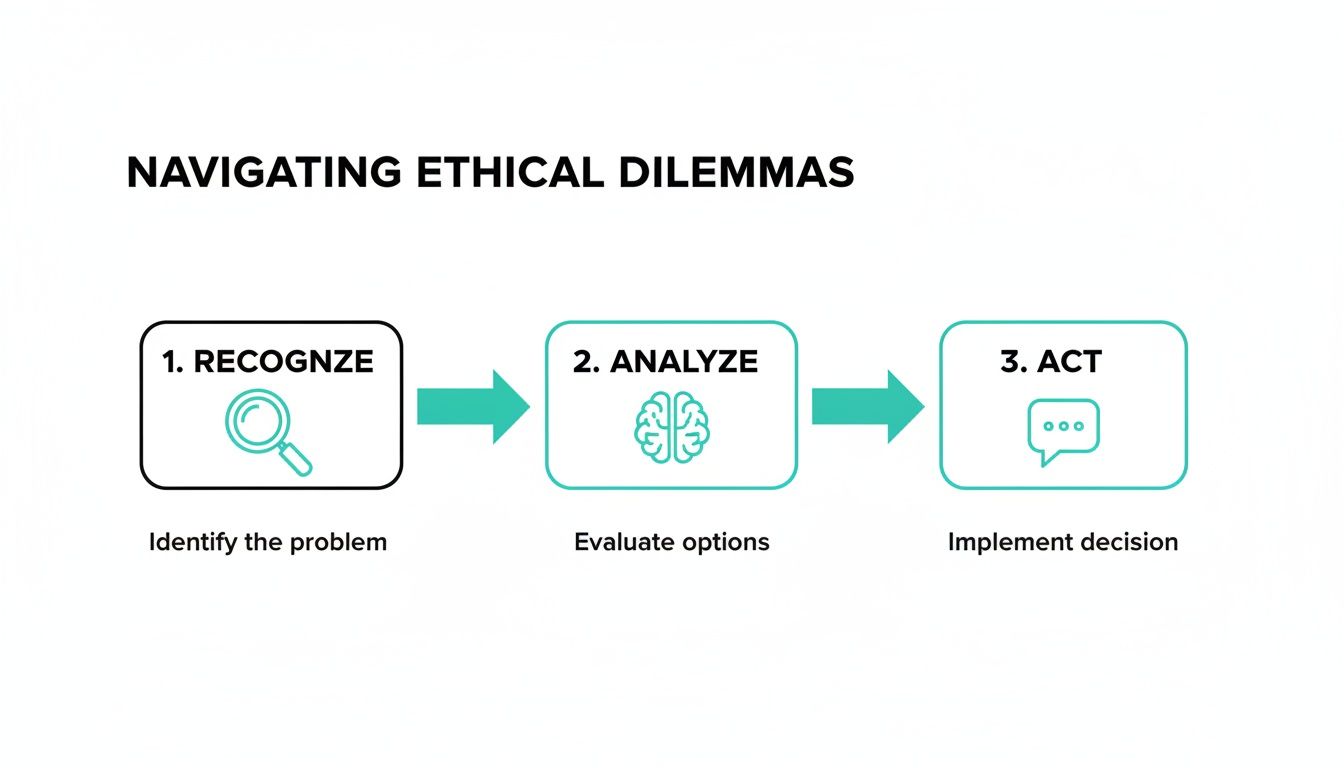
The image underscores why a structured approach is so crucial—you have to move from awareness to analysis before you can ever take meaningful action.
Ultimately, the strength of an ethical culture is measured by what people do when they think no one is watching. It’s about creating an environment where doing the right thing is the easiest and most natural choice.
This requires establishing secure, non-retaliatory reporting channels. People must have absolute confidence that they can raise a red flag without fear of punishment. When your team feels safe enough to speak up, you finally transform your ethical vision from a document into a powerful cultural reality.
The Future of Proactive Ethical Risk Management
In today's business world, waiting around for an ethical crisis to blow up is a losing strategy. The old-school approach of reacting to misconduct only after the damage is done is no longer sustainable. It’s a reactive scramble that costs a fortune. The future is all about flipping the script—shifting from a defensive posture to a proactive one by using technology to get ahead of ethical risks before they escalate.
This modern approach has nothing to do with invasive surveillance or secretly monitoring employee communications. Not at all. It’s about putting platforms in place that are ethical by design. These systems create structured, auditable, and dignified processes for spotting the early warning signs of trouble, turning abstract ethical principles into a concrete operational reality.
From Scattered Data to Centralized Intelligence
One of the biggest challenges for any large organization is that risk signals are usually scattered across different departments. HR has one piece of the puzzle, Compliance has another, and Legal and Security hold the rest. No one sees the full picture until it’s far too late, leading to countless missed opportunities for early intervention.
Proactive risk management tools solve this fragmentation by centralizing risk intelligence. They create a unified operational platform where all the relevant information is structured and made accessible to the right people. This empowers your teams to finally connect the dots and see potential issues as they emerge, not after they’ve become full-blown incidents.
This shift allows organizations to "Know First, Act Fast," a core principle for protecting both your people and the company’s reputation. By having a clear, auditable trail from the very beginning, leaders can ensure due process is always followed, preserving employee trust and dignity every step of the way.
The goal is to transform risk from a hidden threat into strategic information that can be managed with discipline, fairness, and clarity. This protects the organization’s most valuable assets: its people and its reputation.
The High Cost of Waiting
Let’s be clear: waiting to act has real, tangible consequences. The financial and cultural damage from a reactive investigation—where misconduct has already occurred—can be immense. You can learn more about the true cost of reactive investigations and see for yourself why a proactive stance is a strategic imperative. It provides a framework to address concerns early, preventing small issues from spiraling into major crises.
By operationalizing your workplace ethics definition with the right technology, you can build a far more resilient and trustworthy organization. This is the future of ethical governance: proactive, principled, and designed to protect everyone involved.
Workplace Ethics FAQs
When you start digging into organizational integrity, a few key questions always pop up. Here are some straight answers to the most common queries we hear from leaders and employees trying to navigate the real world of workplace ethics.
How Is Workplace Ethics Different from Legal Compliance?
It’s a great question, and the distinction is critical. Think of legal compliance as the absolute floor—it's the bare minimum required by law to avoid fines and penalties. It’s what you have to do.
Workplace ethics, on the other hand, is the ceiling you should be aiming for. It’s a higher moral standard built on fairness, respect, and integrity that guides your decisions in all those tricky gray areas where the law doesn’t have an answer.
Who Is Actually Responsible for Upholding Ethics at Work?
Everyone is. Period. While senior leadership is responsible for setting the tone, building the ethical framework, and modeling the right behaviors, it doesn't stop there.
Every single employee, from the C-suite to the front lines, has a part to play in creating and maintaining an ethical culture. It’s a collective commitment to doing the right thing, making accountability a truly shared value.
A company's ethical health isn't determined by its policy manual, but by the thousands of small, principled decisions made by its people every single day.
Can a Strong Ethical Culture Really Help the Bottom Line?
Absolutely. An ethical culture isn’t a "soft" benefit; it’s a powerful business asset that pays real dividends.
For starters, it creates a trustworthy environment where great people want to stay, which slashes the high costs of employee turnover. Even more, a strong reputation for integrity attracts loyal customers and top talent, directly fueling long-term, sustainable growth and profitability.
At Logical Commander Software Ltd., we believe proactive, ethical risk management is the future. Our E-Commander platform helps organizations identify early warning signs of misconduct while preserving employee dignity and privacy. Know First, Act Fast with Logical Commander.