%20(2)_edited.png)

A Guide to Compliance in Business Definition
- Marketing Team
- 6 hours ago
- 13 min read
Business compliance is all about following the rules—the laws, regulations, standards, and even your own internal policies that govern how you operate. It's the framework that keeps a company running legally and ethically, shielding it from some pretty serious risks.
What Does Business Compliance Really Mean?
Think of your business as a tall, ambitious skyscraper. The sleek design and the top-floor views get all the attention, but the building's true strength comes from its foundation. That invisible structure is what keeps it stable, secure, and able to handle immense pressure. Business compliance works the exact same way; it’s the essential foundation for sustainable growth.

This is far more than a dry list of rules or a box-ticking exercise. Real compliance is a strategic game plan that means following all relevant laws, industry regulations, and your own internal policies and codes of conduct.
Beyond the Textbook Definition
At its heart, compliance is about building trust and shutting down risk. When a company gets serious about its compliance framework, it sends a powerful message to customers, partners, and employees that it operates with integrity. This isn't just a defensive move; it's a proactive strategy for long-term success.
And the scope of these obligations is only getting bigger. A recent PwC Global Compliance Survey found that 85% of compliance professionals say regulatory requirements have become more complex, with 90% stating their responsibilities have expanded right along with them.
Compliance is not just about avoiding penalties; it's about creating an operational environment where doing the right thing is the default, fostering a culture of accountability from the top down.
This proactive stance turns compliance from a cost center into a genuine business enabler. It provides the stability needed to innovate, expand, and thrive in an increasingly complicated world. To give you a clearer picture, here are the core pillars that make up a solid compliance program.
Core Pillars of Business Compliance
At a high level, business compliance can be broken down into a few fundamental areas. Understanding these pillars is the first step toward building a program that covers all your bases.
Pillar | Description |
|---|---|
Regulatory Compliance | Adhering to all local, national, and international laws and regulations relevant to your industry. |
Industry Standards | Following the specific guidelines, best practices, and certifications set by industry bodies (e.g., ISO, SOC 2). |
Internal Policies | Enforcing your own company's code of conduct, data handling procedures, and ethical guidelines. |
Data Privacy & Security | Protecting sensitive customer and company data in line with laws like GDPR and CCPA. |
Financial Compliance | Ensuring all financial reporting and practices meet legal standards like SOX to prevent fraud. |
Each of these pillars is a critical building block. Together, they form a comprehensive framework that protects the organization from every angle.
Grasping this fundamental concept is the first step toward building a resilient and trustworthy organization, a topic we explore further in our comprehensive guide to business compliance.
Why Compliance Is a Strategic Advantage
Too many leaders see compliance as a defensive chore—a cost center built just to keep the company out of trouble. While it absolutely protects you from severe penalties, that view is incredibly shortsighted.
Thinking of compliance as just a cost is like saying a ship’s hull is only there to prevent holes. In reality, a strong hull is what allows the ship to cut through rough seas and reach new, profitable destinations.

It's the same with your compliance framework. It's not just about avoiding failure; it’s an engine for success. A robust program turns the very compliance in business definition from a dusty rulebook into a strategic asset that builds a more resilient, reputable, and profitable company. Businesses that get this gain a massive edge over competitors who still treat it as an afterthought.
Shielding Your Business From Severe Risks
First, let's be clear about the defensive power of compliance. The consequences of getting it wrong are brutal and they go way beyond a simple slap on the wrist.
Massive Financial Penalties: Regulators can levy staggering fines that cripple a business. Just one email violating the CAN-SPAM Act can trigger penalties up to $53,088, showing how fast the costs of a seemingly small mistake can skyrocket.
Lasting Reputational Damage: A single compliance failure can shatter customer trust that took you years, or even decades, to build. News of a data breach or an ethical lapse can permanently tarnish your brand, sending customers straight to your competitors.
Legal Trouble for Leaders: Non-compliance isn't just a corporate headache. In many cases, executives and directors can be held personally liable, staring down the barrel of costly legal battles and even criminal charges.
These are the risks that make a foundational compliance program completely non-negotiable for survival.
By proactively managing regulatory requirements, companies don't just dodge bullets—they build a reputation for integrity and reliability that becomes a core part of their brand identity.
Building a Competitive Edge Through Trust
Beyond just keeping you safe, proactive compliance creates real business opportunities and strengthens your position in the market. When done right, a strong compliance culture becomes a key differentiator that attracts customers, partners, and investors.
This advantage shows up in a few powerful ways. For instance, a company with transparent and ethical data practices is far more likely to win over privacy-conscious consumers. That trust translates directly into deeper customer loyalty and a much stronger brand.
It also drives operational efficiency. Think about it—implementing compliance controls forces you to streamline and document your processes. This cuts down on errors and creates more predictable outcomes, which not only satisfies regulators but makes the entire operation run smoother.
Finally, compliance opens doors to new markets. Many large enterprises and government agencies will only work with vendors who can prove they meet specific standards. In this world, demonstrating strong compliance isn't just good practice; it's a prerequisite for growth. It turns a regulatory hurdle into a powerful sales and marketing tool that drives long-term success.
The Building Blocks of an Effective Compliance Program
A powerful compliance program doesn't just happen by accident; it has to be engineered. Just like building a sturdy house requires a solid blueprint and the right materials, creating a lasting culture of compliance depends on several essential, interconnected components. These elements work together to form a framework that not only stops violations but also builds a stronger, more resilient organization from the inside out.
An abstract commitment to compliance is not enough. Success demands a practical roadmap that guides behavior, manages risk, and establishes clear accountability at every single level.
The Foundation: Leadership Commitment
Everything starts at the top. When executives and the board visibly champion and invest in compliance, it sends an unmistakable message that ethical conduct is non-negotiable. This "tone at the top" is the single most critical factor in a program's success.
This involves far more than just signing off on a budget. It means leaders actively participate in compliance discussions, hold themselves to the same high standards they expect from others, and consistently communicate why integrity is so important to the company's strategy.
A compliance program without genuine leadership buy-in is like a beautiful car with no engine—it looks good on the surface but won't get you anywhere. It's destined to become a "paper program" that fails the moment it's put under real-world pressure.
Identifying and Managing Risks
You can't protect your organization from threats you don't even see. A systematic risk assessment is the process of identifying, analyzing, and prioritizing the specific compliance risks your business faces. This isn't a one-time event but an ongoing process that has to adapt to new regulations, market changes, and internal shifts.
For example, a fintech company might zero in on financial fraud and data security risks, while a manufacturing firm will naturally focus more on workplace safety and environmental regulations. This tailored approach makes sure resources are aimed where they'll have the greatest impact.
Crafting Clear Policies and Procedures
Once you know what your risks are, the next step is to create clear rules of the road. Well-defined policies and procedures translate your compliance goals into actionable guidelines for your employees. These documents need to be easy to understand, readily accessible, and directly relevant to people's day-to-day roles.
Developing a clear and comprehensive IT security policy, often starting with an IT security policy template, is a fundamental building block for defining your organization's security posture and ensuring adherence to compliance standards. The key is to ditch the dense legal jargon and create practical guides that people can actually use.
Training and Communication
A policy sitting on a shelf is completely useless. Effective and continuous training ensures that every single employee understands their compliance obligations, knows how to spot potential issues, and feels empowered to speak up. The goal is to embed compliance thinking so deeply that it becomes part of the company's DNA.
To make this happen, successful organizations use a mix of methods:
Role-Specific Training: Providing targeted education that addresses the unique risks faced by different departments, like sales, finance, or HR.
Engaging Formats: Moving beyond dull slide presentations to include interactive scenarios, workshops, and real-world case studies that actually make the material stick.
Consistent Communication: Reinforcing compliance messages through regular newsletters, team meetings, and updates from leadership.
Putting these components together is the first step toward building a truly effective compliance program that can withstand scrutiny and drive sustainable growth.
Understanding The Different Types Of Business Compliance
When you hear the word "compliance," it’s easy to picture one giant, intimidating rulebook. But in reality, it's not a single beast. Think of it more like a set of distinct, overlapping responsibilities that touch every corner of your business.
Getting a handle on these different layers is the first real step toward building a compliance program that actually works—one that protects you instead of just creating busywork. Some rules are handed down by governments, others are born from contracts you sign, and some you even create for yourself. Each one demands its own strategy.
Regulatory Compliance
This is the one most people think of first. Regulatory compliance is all about following the laws and regulations set by governments and other official bodies. It’s completely non-negotiable, and the penalties for getting it wrong are often the most severe.
Data Privacy Laws: Rules like GDPR in Europe or CCPA in California are perfect examples. They set strict guidelines on how you must collect, store, and manage personal data.
Financial Regulations: If you’re a publicly traded company, you live by laws like the Sarbanes-Oxley Act (SOX), which demands absolute transparency in financial reporting.
Industry-Specific Rules: Some sectors have their own ultra-specific mandates. Healthcare has HIPAA for patient data, and finance has FINRA for market conduct. There’s no escaping them.
Contractual And Internal Compliance
Beyond the government, your business has other promises to keep. These self-imposed or agreed-upon standards are just as important for maintaining trust, operating smoothly, and keeping your partners happy.
Contractual compliance is about making good on the agreements you sign with clients, vendors, and partners. If you don't meet these terms, you’re looking at lawsuits, lost revenue, and torched business relationships. For instance, earning a SOC 2 Type II certification isn't just a badge of honor; it’s often a contractual requirement to prove your data security controls are solid.
Then there's internal compliance. This is about following your own rules—the code of conduct, expense policies, IT security protocols, and so on. This layer is what builds an ethical culture and ensures your operations are consistent and predictable, no matter who is doing the work.
Compliance isn't monolithic. It's a multi-layered framework where legal, contractual, and ethical obligations intersect to create a resilient and trustworthy organization.
This process chart shows how a healthy compliance program flows from the top down. It starts with leadership setting the tone, which then informs the policies that guide the company, and finally cascades into training that makes sure everyone is on the same page.
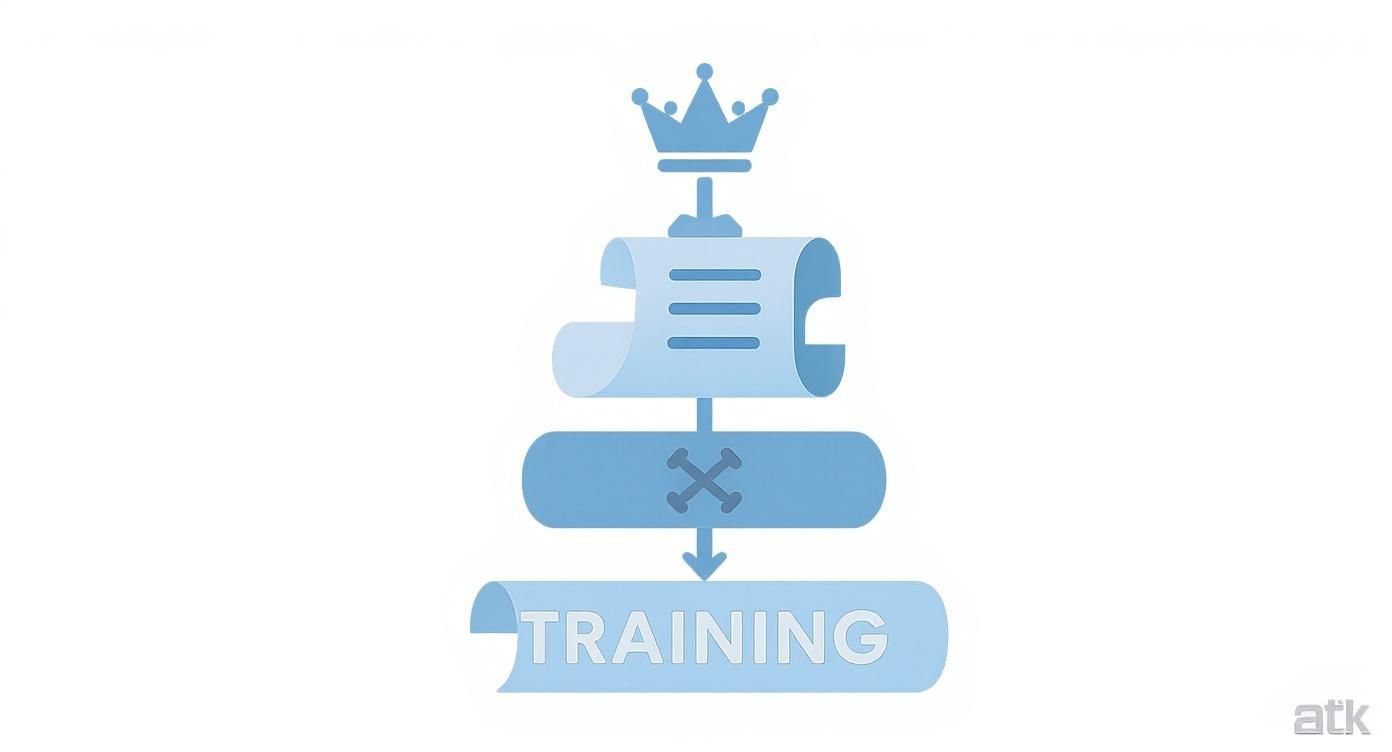
As the visual makes clear, executive buy-in is the foundation. Without it, policies are just paper and training is just a formality. Each type of compliance requires a slightly different approach, as you can see in the breakdown below.
Regulatory vs Contractual vs Internal Compliance
To bring it all together, this table shows how the three main types of compliance stack up, highlighting their unique focus, real-world examples, and what's at stake if you fall short.
Compliance Type | Primary Focus | Key Examples | Risk of Non-Compliance |
|---|---|---|---|
Regulatory | Adhering to governmental laws and regulations. | GDPR, HIPAA, SOX | Fines, legal action, operational shutdown. |
Contractual | Honoring terms of business agreements. | Service Level Agreements (SLAs), vendor contracts. | Lawsuits, financial penalties, loss of partners. |
Internal | Following the company's own policies and code of conduct. | Employee handbooks, ethical guidelines. | Inconsistent operations, poor culture, fraud. |
Ultimately, a strong compliance program isn't about perfectly managing just one of these areas. It’s about creating a unified system that addresses all of them together, building a business that’s not just compliant, but also resilient and trustworthy from the inside out.
The True Cost of Non-Compliance
Viewing compliance as just another expense is one of the most dangerous financial mistakes a business can make. It’s like griping about the cost of a fire suppression system in a new building—sure, it's an expense, but it's also a critical investment that prevents a total loss. When compliance is an afterthought, the costs aren't just theoretical; they are real, staggering, and can threaten a company's very existence.

The financial penalties alone can be absolutely devastating. Regulators across the globe are ramping up their enforcement efforts, handing out fines that can easily run into the millions or even billions. And these aren't just reserved for corporate giants; even small operational missteps can trigger crippling financial consequences.
The Ripple Effect of Financial Penalties
The direct hit from a fine is often just the beginning. A single compliance failure creates a cascade of hidden costs that can bleed a company dry long after the initial penalty is paid.
Legal and Remediation Costs: Beyond the fines, businesses face enormous legal fees, the expense of forensic audits, and the cost of implementing corrective actions mandated by regulators.
Increased Insurance Premiums: A history of non-compliance makes a company a high-risk client in the eyes of insurers, leading to drastically higher premiums for liability and cyber insurance.
Loss of Business Opportunities: Many government contracts and major enterprise partnerships are completely off-limits to companies with a poor compliance record, shutting down major revenue streams.
These compounding costs are exactly why a proactive approach is so crucial. The sheer scale of financial penalties and increased enforcement activity worldwide—from bodies like the U.S. SEC and European regulators—shows just how badly compliance failures can hit business operations. Global anti-money laundering (AML) fines have amounted to billions, and GDPR enforcement resulted in over €1 billion in fines in a single year. You can learn more about the significant stats every compliance officer should know from our friends at Compliance & Risks.
Investing in Prevention vs Paying for Failure
When you actually compare the costs, the choice becomes crystal clear. The investment in a proactive compliance program—which includes the right people, training, and tools—is just a fraction of the cost of a single major violation.
Proactive compliance spending is not an expense; it is a high-return investment in risk mitigation, brand protection, and long-term shareholder value. It’s one of the smartest financial decisions a modern business can make.
Ultimately, truly understanding the compliance in business definition means recognizing this financial reality. It’s about shifting from a reactive, penalty-avoidance mindset to a strategic one that sees compliance as a core function for protecting assets and ensuring sustainable growth.
How to Build a Strong Compliance Culture
Moving from theory to reality is where the rubber meets the road. Policies and frameworks are just documents until you breathe life into them by building a genuine compliance culture. This is the point where doing the right thing isn't just a rule to follow—it's the default behavior for everyone in the organization.
But building this kind of culture is a journey, not a one-off project. It starts with a few foundational, common-sense steps that create momentum and show you’re serious about integrity.
Secure Executive Buy-In
First things first: your leadership has to be on board. When executives visibly and vocally treat compliance as a strategic priority, not a back-office chore, employees take it seriously. This "tone at the top" is what gives your program the authority and resources it needs to actually make a difference.
Without that backing, even the most brilliant compliance program will struggle for relevance and eventually fizzle out.
Designate a Compliance Leader
Accountability is everything. You need to designate a specific person or team to own the compliance function. This individual becomes the go-to resource for questions, training, and oversight, ensuring the program has a clear direction and someone is steering the ship.
Think of this leader as the central hub, coordinating efforts across different departments and keeping things on track.
Building a strong compliance culture isn't about creating an environment of fear or suspicion. It's about fostering an atmosphere of shared responsibility where employees feel safe to ask questions and raise concerns without fear of retaliation.
Start with a Risk Assessment
You can't fix everything at once, so don't even try. The smart move is to focus on what matters most. Conduct an initial risk assessment to identify the most significant compliance vulnerabilities your business is facing right now. This lets you prioritize your efforts and channel resources where they’ll have the biggest impact first.
This pragmatic approach helps you score early wins and builds confidence in the entire program.
Roll Out Foundational Training
Finally, you have to equip your team with the knowledge they need to succeed. Develop and deliver straightforward training that explains your core policies, highlights the key risks they'll encounter, and clarifies everyone's role in upholding company standards.
This initial training lays the groundwork for everything that comes next. As you build this foundation, it's vital to boost integrity in a workplace and build a resilient ethical culture by weaving these principles into the very fabric of your daily operations.
Your Questions, Answered
Even when you’ve got the core concepts down, compliance can get complicated in the real world. This section tackles some of the most common questions we hear, giving you straight answers to help you build an organization that’s both compliant and operates with integrity.
What Is the Difference Between Compliance and Ethics?
This is a big one. While they're closely linked, compliance and ethics aren't the same thing.
Think of compliance as the baseline—it’s about following the specific laws and regulations you must obey. It’s the legal floor, the bare minimum.
Ethics, on the other hand, is about the moral principles that guide how you act, especially in those gray areas where there’s no hard-and-fast rule. It's about what you should do. A truly effective program weaves them together, making sure the business isn't just legally sound, but also a place where people do the right thing.
How Can a Small Business Manage Compliance with Limited Resources?
Small businesses often feel overwhelmed, but the key is to avoid trying to boil the ocean. You need a targeted, scalable approach that starts with your biggest pain points first.
Prioritize Your Risks: Run a simple risk assessment. If you run an e-commerce store, data privacy is your biggest alligator. Start there.
Lean on Technology: You don't need an enterprise-level budget. Use affordable, scalable compliance software to automate policy tracking and take the manual grind off your plate.
Don't Go It Alone: Lean on industry associations. They often provide templates and guidance designed specifically for small businesses like yours.
Keep It Simple: Your internal policies should be crystal clear. If they're too complex for a small team to follow, they’re useless.
The goal isn't perfection on day one. It's about building a solid foundation you can continuously improve as you grow.
How Is Technology Changing Business Compliance?
Technology is completely changing the game. It’s shifting compliance from something you do once in a while—like a periodic manual audit—to a proactive, real-time function. AI-powered tools can sift through huge amounts of data to spot potential red flags, automate regulatory reporting, and even deliver customized training to employees.
This shift toward "continuous compliance" helps businesses finally get out of reactive mode. Instead of just cleaning up messes, you're building a smarter, less error-prone system that spots risks before they can do real damage, embedding compliance right into your daily operations.
At Logical Commander Software Ltd., we provide AI-driven tools designed to help you build a proactive and ethical compliance framework. Our E-Commander platform enables you to identify internal risks early, manage mitigation workflows, and maintain a culture of integrity—all while preserving employee dignity and privacy. Know First, Act Fast with Logical Commander.