%20(2)_edited.png)

A Guide to Enterprise Risk Management Platform
- Marketing Team

- Dec 2, 2025
- 15 min read
Updated: Dec 6, 2025
An enterprise risk management (ERM) platform is the central command for your organization's risk strategy. It’s a unified system designed to help you identify, assess, and mitigate risks across every department. This is what shifts a company from a reactive, fire-fighting mode to a proactive posture where managing risk becomes a strategic advantage that drives business goals.
What a Modern Enterprise Risk Management Platform Actually Does
Let's be clear: a modern ERM platform is not just a digital risk register or a collection of disconnected spreadsheets. It’s a comprehensive software solution that centralizes all risk-related activities, giving leadership a complete, real-time view of the company’s entire risk landscape.
To understand its impact, you must grasp the fundamentals of What Is Risk Management in Business?. A modern platform amplifies these core principles, breaking down the operational silos between Compliance, Internal Audit, HR, and Security by pulling them into one cohesive system.
Instead of teams operating in isolation, an enterprise risk management platform creates a single source of truth that mandates collaboration. This integration is essential for managing the complex, interconnected risks modern businesses face. The market agrees—the global ERM market was valued at USD 4.95 billion in 2024 and is projected to hit USD 8.30 billion by 2034, driven by intense regulatory pressure and the demand for integrated, preventive solutions.
The Shift from Traditional to Modern ERM
The evolution from outdated risk management to modern ERM platforms represents a fundamental change in mindset. The old way was fragmented and reactive, focused on documenting incidents after the damage was done. The new standard is predictive and preventive, using AI-driven technology to identify human-factor threats and neutralize them before they can impact the business.
The table below breaks down this evolution, showing how we moved from siloed, manual processes to the integrated, intelligent platforms that define the new standard of internal risk prevention.
Shift from Traditional to Modern ERM
Characteristic | Traditional (Siloed) Approach | Modern ERM Platform Approach (New Standard) |
|---|---|---|
Focus | Reactive (incident response, forensics) | Proactive (risk anticipation, strategic prevention) |
Data Structure | Disconnected spreadsheets, manual reports | Centralized, real-time data from across the business |
Collaboration | Departmental silos, limited communication | Cross-functional collaboration in a unified system |
Technology Use | Basic record-keeping tools, invasive surveillance | AI-driven analytics, automated workflows, predictive insights |
Reporting | Static, outdated reports | Dynamic, customizable dashboards with actionable intelligence |
Human Risk | Managed with invasive tools, post-incident investigations | Addressed ethically with proactive, non-intrusive methods |
This is especially critical when it comes to the unpredictable human element. Traditional methods like surveillance are not only ineffective at addressing human-factor risk—a leading cause of compliance failures, fraud, and reputational disasters—but they also create immense legal liability. A modern enterprise risk management platform closes this gap by incorporating ethical, AI-driven tools built for proactive prevention, not after-the-fact blame.
An effective ERM platform doesn't just manage risk—it turns it into a strategic advantage. By providing clear visibility and actionable intelligence, it empowers leaders to make smarter decisions that protect the organization and drive sustainable growth.
The real difference is the methodology. Instead of falling back on outdated surveillance tactics that violate EPPA regulations and destroy employee trust, forward-thinking platforms are EPPA-aligned and non-intrusive. They focus on identifying the behavioral warning signs of risk without crossing ethical lines. This proactive stance is what separates a simple management tool from a true strategic asset.
What a Modern ERM Platform Actually Does
Let's be clear: a modern enterprise risk management platform is not just a digital filing cabinet for your risk data. Plenty of legacy systems do that, acting as little more than a place to document failures after the fact. A real ERM platform moves your organization from a reactive, clean-up-the-mess posture to one that is proactive and genuinely preventive.
It’s the difference between documenting a disaster and preventing it from ever happening in the first place.
The whole point of an ERM platform is to bring the entire risk lifecycle under one roof. It creates a continuous loop where you identify, assess, and mitigate risks—not just once a year, but constantly.
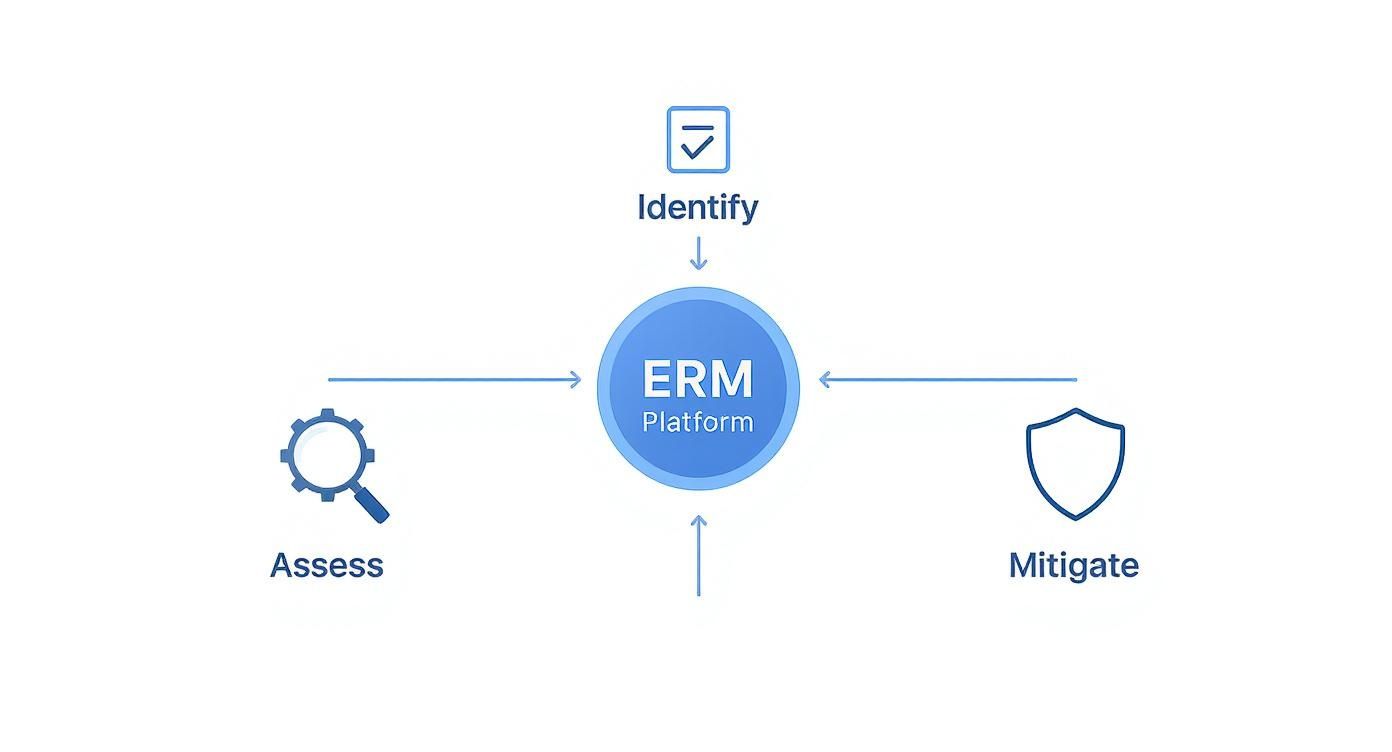
This workflow is all about creating a dynamic, always-on system. It breaks down the old-school model of static, periodic reviews and replaces it with a living, breathing hub for risk intelligence.
A Single Source of Truth for Risk
At its very core, an enterprise risk management platform must provide a single, unified view of all organizational risks. It’s designed to smash the dangerous information silos that inevitably form between departments like Compliance, Security, and HR. Forget the chaos of fragmented spreadsheets and disconnected reports; all data flows into one centralized system.
This unified view is what powers sophisticated Risk Assessments Software capabilities. Instead of relying on slow, subjective manual reviews, a modern platform automates the heavy lifting of identifying and scoring risks based on their potential impact and likelihood.
You should expect key features like:
Automated Workflows: The system guides everyone through standardized assessment processes, which guarantees consistency and completeness across the board.
Real-Time Risk Registers: Risks are logged, tracked, and updated in the moment, giving you an accurate, up-to-the-minute picture of your company’s risk posture.
Control Mapping: The platform directly connects identified risks to the internal controls meant to stop them, instantly flagging any dangerous gaps in your defenses.
Getting Ahead of Human-Factor Risk
Here’s where the biggest evolution in ERM technology has happened: its ability to finally address the human element of risk. Traditional platforms either ignored this massive vulnerability or tried to solve it with invasive surveillance tools that create a legal and ethical nightmare. That approach is a liability.
The new standard is ethical risk management that puts employee privacy first. This is built on non-intrusive, EPPA compliant platform technology. It uses AI to identify the behavioral precursors to risk without monitoring personal communications or activities. The focus is on how decisions are made, not what is being said or done.
By analyzing behavioral patterns, organizations get an early warning system for potential bombshells like fraud, compliance breaches, or conflicts of interest. This allows for preventive intervention—like targeted training or process tweaks—long before an incident happens and triggers a costly, reputation-shattering investigation.
This capability is an absolute game-changer for internal threat detection. It enables a preventive strategy grounded in AI human risk mitigation, protecting the organization from the inside out while building a culture of integrity. You can see exactly how this works by exploring the core concepts of a modern behavioral analytics platform.
Turning Risk Data into Strategic Intelligence
Finally, a top-tier enterprise risk management platform doesn’t just collect data; it transforms that raw information into strategic business intelligence. It moves way beyond simple operational reports to give leaders the clear insights they need to make smart, informed decisions.
This is done through a few critical features:
Customizable Dashboards: Executives can see high-level risk trends at a glance, while managers can drill down into the specific issues affecting their teams.
Predictive Analytics: AI-driven models can forecast emerging risks by analyzing internal and external data, helping you prepare for threats that are still over the horizon.
Compliance Reporting: The platform automates the creation of reports demanded by regulators, which can save hundreds of hours and slash the risk of human error.
By tying risk management directly to your company's strategic goals, these capabilities ensure ERM is no longer just a compliance checkbox. It becomes a critical engine for business resilience and growth.
The Strategic Value of Proactive Risk Management
Let’s move past the features and talk about what really matters to leadership: strategic value. An enterprise risk management platform isn't just another operational tool. It's a strategic asset that fundamentally flips your organization from a reactive, costly defensive crouch into a proactive, value-creating stance. That shift has a direct and measurable impact on your bottom line, liability, and long-term brand integrity.
The real value here is escaping the old, broken model of after-the-fact investigations. Traditional investigations are a business liability—notoriously inefficient, wildly expensive, and they rarely deliver a clear resolution. They burn through immense resources like legal fees and executive time, all while crushing employee morale and exposing the business to massive legal and reputational harm.

A proactive approach, driven by a modern enterprise risk management platform, rewrites that script completely. The focus is on spotting and neutralizing the precursors to risk, especially human-factor risk, before they can blow up into full-blown incidents. The ROI isn’t just in catching problems earlier; it’s in preventing them from ever happening in the first place.
Quantifying the ROI of Prevention
How do you calculate the return on investment for a strategy that’s all about prevention? It’s about measuring the cost of disasters that never happened. This means tallying up the direct financial losses from fraud you avoided, the regulatory fines for non-compliance you never had to pay, and the brand equity you preserved by sidestepping a public scandal. Those savings are immense, and they compound over time.
Think about these tangible benefits:
Smarter Strategic Decisions: With real-time risk intelligence, leadership gets a clear, holistic view of the organization’s entire risk landscape. This allows for more confident strategic planning and smarter resource allocation, because potential human-factor threats are being proactively managed.
A Boost in Operational Efficiency: Automating compliance tasks, risk assessments, and reporting frees up your most valuable people. Teams can stop drowning in manual, repetitive work and shift their focus to high-value initiatives that drive growth and resilience.
A Bulletproof Brand Reputation: In an age of intense public scrutiny, a single major compliance failure or ethical lapse can permanently shatter stakeholder confidence. A proactive ERM framework is a powerful statement about your commitment to sound governance and corporate responsibility.
The market’s explosive growth reflects this strategic shift. The global risk management market is projected to hit USD 51.97 billion by 2033, climbing at an impressive CAGR of 14.6%. This growth is being driven by rising operational complexity and a global focus on corporate governance, with cloud-based platforms leading the pack. You can see more on this trend in the full risk management market report from Grand View Research.
Building a Bulletproof Business Case
For risk and compliance leaders, framing the investment in an enterprise risk management platform is everything. The business case can't be positioned as a cost center. It's a strategic enabler for sustainable growth—an investment in resilience, integrity, and long-term profitability.
The most expensive incident is the one you could have prevented. Proactive risk management isn't about eliminating all risk—it's about building an organization that is intelligent and resilient enough to anticipate and neutralize threats before they inflict damage.
By taking a forward-looking approach, organizations can finally move beyond a simple compliance-driven mindset. Instead of just checking boxes, they can build a robust framework that truly safeguards assets, empowers ethical decision-making, and locks in their competitive advantage. This strategic pivot is essential for thriving in today’s complex business world. For a deeper dive, our guide on Proactive Risk Management in Enterprise offers more insights. An ethical, non-intrusive platform is the cornerstone of this modern strategy, protecting the organization and its people from the inside out.
How to Choose the Right ERM Platform
Picking the right enterprise risk management platform is a make-or-break decision. It’s a move that will define your company's resilience, its integrity, and its ability to grow safely. The market is flooded with options that all look pretty similar at first glance, boasting features like risk registers and analytics.
But the single most critical differentiator isn't a feature—it's the vendor's core philosophy on managing human-factor risk.
Your evaluation has to go way beyond a simple checklist. The real question you need to ask is whether a platform is built for documenting disasters after they happen or for proactively preventing them. An effective solution doesn't just help you clean up a mess; it gives you the intelligence to stop it from happening in the first place.
Start with the Core Philosophy, Not Features
Before you get lost in demos and feature comparisons, you have to dig into the vendor’s approach to internal and human-factor risk. Many legacy systems, and even some newer ones, are built on outdated, invasive ideas that create more liability than they solve.
These platforms often rely on some form of employee monitoring that can run afoul of labor laws like the Employee Polygraph Protection Act (EPPA). Worse, they can completely destroy the culture of trust you’ve worked so hard to build.
A modern, forward-thinking enterprise risk management platform is built on a foundation of ethical, non-intrusive principles. Instead of surveillance, it uses AI to pinpoint the behavioral precursors to risk, giving you an early warning system that respects employee privacy. This distinction is absolutely crucial for protecting your organization from massive legal and reputational damage.
Key Questions to Ask Every Vendor
To cut through the marketing fluff and find a truly preventive and ethical solution, your team needs to ask direct, pointed questions. The answers you get will reveal a vendor's true methodology and tell you if their platform is aligned with modern governance standards.
Here are the essential questions that should guide your evaluation:
Ethical Framework: How does your platform address human-factor risk without resorting to employee surveillance or monitoring?
Compliance and Legality: Is your methodology 100% EPPA compliant? Can you guarantee it performs no function that could be interpreted as lie detection or psychological evaluation?
Data and Privacy: What specific data does your AI analyze, and how do you ensure employee privacy is protected every step of the way?
Preventive vs. Reactive: Can your system identify the behavioral precursors to an incident before it happens, or is it mostly a tool for post-incident investigation?
Integration: How easily does your platform connect with our existing HRIS and other enterprise systems to create a unified, holistic view of risk?
These questions force the conversation away from generic features and toward the core principles that define an effective and responsible enterprise risk management platform. For more on evaluating different security solutions, you can explore our guide on selecting the best enterprise security software.
A platform's commitment to ethical, non-intrusive risk management is not just a 'nice-to-have'—it's a fundamental requirement for protecting the organization from legal liabilities and fostering a healthy corporate culture.
Choosing the right ERM platform means finding a partner whose technology and philosophy align with your commitment to integrity and proactive governance. To help structure this process, we've put together a checklist to guide your conversations with vendors.
ERM Platform Evaluation Checklist
This checklist is designed to help you and your team compare different ERM solutions, focusing on the ethical and preventive criteria that matter most for long-term resilience and compliance.
Evaluation Criteria | Key Questions to Ask Vendors | Why It Matters |
|---|---|---|
Ethical Framework | How does your AI identify risk without surveillance? Is your approach consent-based and transparent to employees? | Avoids creating a toxic, low-trust culture and ensures the platform is a tool for integrity, not a policing mechanism. |
Legal Compliance (EPPA) | Can you provide documentation proving your methodology is fully EPPA compliant and avoids any form of lie detection? | This is non-negotiable. Non-compliance exposes your organization to severe legal penalties and reputational harm. |
Data Privacy | What specific data points are collected? How is personally identifiable information (PII) protected and anonymized? | Protects employee privacy, ensures compliance with laws like GDPR/CPRA, and builds trust in the risk management process. |
Preventive Capabilities | Can you show concrete examples of how your platform identifies the precursors to risk, not just the incident itself? | The goal is prevention, not just better documentation of failures. This is the core ROI of a modern ERM system. |
System Integration | How deep is your integration with major HRIS platforms? Does it require custom development or is it out-of-the-box? | Seamless integration creates a single source of truth, eliminates manual data entry, and ensures a holistic view of risk. |
User Experience (UX) | Is the platform intuitive for non-technical users in HR and Compliance? Can we customize dashboards and reports easily? | If the platform is difficult to use, it won't be adopted. Poor adoption leads to incomplete data and a failed investment. |
Ultimately, this decision comes down to investing in a partner who champions prevention over reaction and ethics over intrusion. This strategic choice will empower your organization to not only manage risk but to build a more resilient and trustworthy enterprise from the inside out.
Integrating Human-Factor Risk Into Your GRC Strategy
Many traditional Governance, Risk, and Compliance (GRC) programs are operating with a massive blind spot—their entire workforce. They’re laser-focused on technology stacks, regulatory checklists, and process controls, treating failures in these areas as the primary source of risk. But that perspective misses a fundamental truth: nearly all organizational risk starts and ends with people.
Process breakdowns and tech failures are usually just symptoms of a much deeper issue: a failure to manage human-factor risk. A misconfigured server, a missed compliance deadline, or a data leak are rarely just system errors. They are the downstream consequences of human decisions, oversights, or behaviors. A truly effective enterprise risk management platform must move beyond a purely technical view and pull the human element directly into its GRC strategy.

This human-centric approach turns GRC from a static, box-checking exercise into a dynamic engine for building real organizational resilience.
Why Traditional GRC Fails to See the Full Picture
Old-school GRC frameworks are great at documenting known risks and mapping them to controls. Where they fall apart is in anticipating the unpredictable nature of human behavior, which is the root cause of so many of the costliest business incidents. This gap exists because legacy tools were never designed to ethically assess and mitigate risks that start with people.
This creates a dangerous disconnect. Organizations pour money into technical defenses while leaving the front door wide open to internal threats stemming from:
Unintentional Errors: An employee clicking on a phishing link or misinterpreting a complex policy.
Compliance Drift: A gradual, almost invisible deviation from established procedures that quietly accumulates risk over time.
Ethical Lapses: Conflicts of interest, fraud, or data theft driven by individual choices.
Trying to plug these human gaps with invasive surveillance or employee monitoring is a failed strategy. These methods don't just destroy trust; they create huge legal liabilities under regulations like the EPPA, turning a risk management problem into a full-blown legal and cultural crisis.
The New Standard AI-Driven, Ethical Risk Mitigation
Pioneering ERM platforms are finally closing this GRC gap by integrating ethical, AI-driven assessments of human-factor risk. This is the new standard for internal threat prevention—one that is fully aligned with privacy and labor laws. Instead of spying on employees, this technology identifies the behavioral precursors to risk without any invasive monitoring.
A human-centric GRC strategy acknowledges that your greatest asset—your people—can also be your most significant vulnerability. The goal is not to police individuals but to build a resilient system that anticipates and mitigates risk at its human source, ethically and proactively.
This modern approach analyzes patterns related to decision-making and operational conduct to flag potential issues long before they escalate. It might spot indicators associated with a heightened risk of fraud or compliance breaches, allowing for preemptive intervention. This could mean targeted training, clarifying a process, or adding a layer of oversight—not reactive, punitive investigations. For a deeper look into this area, check out our guide on human capital risk management.
Strengthening Governance from the Inside Out
By integrating human-factor risk into your GRC strategy, an enterprise risk management platform delivers a far more complete and accurate picture of your organization's health. It strengthens governance by making sure risk assessments aren't just theoretical exercises but are grounded in the reality of how your business actually runs day-to-day.
This proactive stance reinforces compliance by identifying and addressing the root causes of potential violations. Beyond managing these internal dynamics, a robust GRC strategy also emphasizes understanding the benefits of meeting security compliance across all its facets. Ultimately, this human-centric model builds a stronger, more resilient organization—one that protects its assets, reputation, and people by addressing risk where it truly begins.
Your Questions on ERM Platforms, Answered
When you're evaluating an enterprise risk management platform, you're bound to have questions. It's a critical decision that impacts liability and operational integrity. Let's tackle some of the most common questions we hear from Compliance and Risk leaders, cutting through the jargon to give you straight answers.
The need to get this right is only getting more intense. The U.S. market for ERM is projected to climb at a 10.4% clip every year, hitting an estimated USD 8.3 billion by 2033. That's not just a number—it’s a signal that large organizations are scrambling to get a handle on their increasingly complex risks. You can get a closer look at the growth of the US risk management market and what's driving it.
How Is an ERM Platform Different from GRC Tools?
This is a great question because the lines can seem blurry. Think of it this way: traditional GRC tools are often about record-keeping. They’re great for documenting risks that have already been identified and managing compliance checklists—it’s a reactive posture that documents failures.
A modern enterprise risk management platform is built for proactive prevention. It’s an integrated system that uses AI to spot the early warning signs of risk, especially human-factor risks that lead to liability. This lets you get ahead of incidents instead of just cleaning them up. It becomes the central intelligence hub for your risk strategy, informing decisions across the entire business.
Is an Enterprise Risk Management Platform Difficult to Implement?
It depends on the platform, but the days of painful, multi-year rollouts are largely behind us. Modern cloud-based platforms are designed to be much easier to integrate into your existing environment.
The key is to look for a solution with strong API capabilities. This ensures it can connect smoothly with the systems you already rely on, like your HRIS and IT infrastructure. A good vendor will also provide a clear, structured onboarding plan and have a dedicated support team to make sure the launch and user adoption go off without a hitch.
How Can an ERM Platform Manage Human-Factor Risks Ethically?
This is the most important distinction of all. It comes down to the platform's core methodology. You absolutely must avoid systems built on employee surveillance or monitoring. Not only do they destroy trust and create a toxic culture, but they also open your organization up to massive legal liabilities and EPPA violations.
The new standard is an EPPA compliant platform that uses non-intrusive AI to ethically analyze behavioral data. This ethical approach identifies risk patterns and allows for preventive action without violating employee privacy or legal boundaries. It's about protecting the organization while respecting its people.
What Is the Typical ROI for an ERM Platform?
The return on investment shows up in a few powerful ways. The biggest win is in cost avoidance—preventing a single major incident like fraud, a data breach, or serious misconduct can save millions in direct losses, legal fees, and regulatory fines.
Beyond that, you’ll see tangible gains in operational efficiency as compliance tasks get automated. And, of course, there's the direct savings from reducing fines and penalties for non-compliance.
But the real value goes deeper. Protecting your brand's reputation from a risk-related scandal delivers immense, long-term worth that dwarfs the initial investment. Preserving stakeholder confidence is often the most valuable outcome of a modern enterprise risk management platform.
Ready to See the New Standard in Action?
Stop chasing risks after the fact. Logical Commander's E-Commander platform offers an ethical, EPPA-aligned, and non-intrusive approach to proactively manage human-factor risk. Move from reactive investigations to AI-driven prevention and protect your organization from the inside out.
Get Platform Access and Start a Free Trial
Request a Personalized Demo
Join our PartnerLC Program for B2B SaaS Software
Contact Our Team for Enterprise Deployment