%20(2)_edited.png)

Mastering the Internal Affairs Investigation Process
- Marketing Team

- Dec 1, 2025
- 12 min read
Updated: Dec 4, 2025
For decades, the traditional internal affairs investigation process has been stuck in a reactive loop. It’s a cumbersome, backward-looking framework that only activates after an incident has caused damage. This old model forces compliance and HR teams to piece together facts, conduct interviews, and assign blame—a costly cycle that drains resources, exposes the organization to liability, and leaves it just as vulnerable to the next human-factor risk event.
Why the Traditional Internal Affairs Investigation Process Fails
Let’s be direct—the old way of handling internal affairs is broken. When misconduct is reported, a reactive process lurches into motion. This approach isn’t just inefficient; it’s a direct threat to your organization’s bottom line and reputation. It creates massive legal liabilities, invites public scrutiny, and shatters the trust of your workforce.
Nothing erodes a healthy workplace culture faster than an investigation that feels slow, biased, or inconsistent.
The real problem is baked into the reactive process itself. It’s designed to clean up messes, not prevent them. With its forensic focus, this model guarantees that by the time an investigation even starts, the operational, financial, and reputational damage is already done.
The High Cost of Reactionary Forensics
Reactive investigations are notoriously expensive and disruptive. The direct costs are obvious—legal fees, investigator hours, and potential settlements. But that's just the tip of the iceberg. The indirect costs are often far worse, showing up as lost productivity, tanking morale, and higher employee turnover. The business impact is severe, as detailed in the true cost of reactive investigations.
These outdated processes are also riddled with flaws that destroy their credibility. The most common points of failure include:
Inconsistent Procedures: Without a standardized framework, investigations can vary wildly depending on who’s in charge. This is a recipe for perceived bias and legal challenges.
Protracted Timelines: Investigations that drag on for weeks or months create an environment of anxiety and workplace tension, paralyzing teams.
Subjective Human Judgment: A heavy reliance on traditional interviews and manual analysis opens the door for unconscious bias to influence the outcome, compromising fairness.
A History of Ineffective Outcomes
This isn't a new corporate headache; the issue has deep roots in public sector accountability. Historical reviews of Internal Affairs Units in major U.S. cities have consistently found huge shortcomings in both effectiveness and transparency.
For example, the St. Clair Commission’s review of 250 IA cases revealed a sustained complaint rate of less than 6%, meaning the vast majority were dismissed. These investigations were often slammed for being cursory, delayed, and poorly documented—all of which gut institutional trust. You can discover more insights about these historical IA findings.
This cycle of costly reaction is unsustainable. It positions HR and compliance teams as internal "police" rather than strategic partners in risk prevention. The only way to break this cycle is to shift from a reactive posture to a proactive one that prioritizes the prevention of human-factor risk.
Establishing a Defensible Investigation Framework
A successful internal affairs investigation is built on a solid foundation long before the first interview. Those initial moments after a complaint is filed are critical; a single misstep can taint the entire process and open the door to accusations of bias or unfairness.
Establishing a structured, defensible framework from day one is non-negotiable. It’s the only way to protect the organization from liability and ensure a just, evidence-based outcome.
Documenting, Scoping, and Assembling the Team
This all starts with meticulously documenting the initial complaint. Every detail matters—the who, what, when, and where. This intake process must be standardized to prevent inconsistencies that could be challenged later.
A well-defined scope is just as important. Without clear boundaries, an investigation can easily spiral into a prolonged, costly, and unfocused ordeal that only amplifies workplace anxiety and risk.
Next, you must select an unbiased investigation team. The individuals chosen must be completely impartial, with zero personal involvement or conflicts of interest. Their objectivity is the bedrock of a credible internal affairs investigation process and is essential for maintaining workforce trust.
Defining Scope and Preserving Confidentiality
A clear plan is your best defense against procedural failures. This plan should outline:
The Specific Allegation: What policy was allegedly violated?
Key Individuals: Who needs to be involved, from the complainant to potential witnesses?
The Timeline: A realistic but prompt schedule for gathering facts and concluding the process.
Confidentiality is a must at every stage. It protects everyone involved and preserves the integrity of your findings. Any breach doesn't just damage reputations—it can lead to serious legal liabilities and undermine the entire investigation.
The Pitfalls of a Poorly Planned Investigation
Think about traditional, reactive investigations. They often fail because they lack structure from the get-go, leading to biased outcomes, painfully long timelines, and completely eroded trust. Invasive, surveillance-based methods only make this worse.
This flow chart shows the all-too-common failure points in a reactive internal affairs investigation.
An investigation that starts with bias is destined to become a lengthy, damaging ordeal. It ultimately breaks the very trust it was meant to uphold, which is why a proactive, structured, and ethical framework is vital.
Modern Risk Assessments Software can systematize this foundational phase. Platforms like E-Commander provide a centralized system for intake, planning, and documentation. This ensures every investigation follows a consistent, fair, and EPPA-compliant methodology from the moment it begins, moving beyond the failures of legacy systems.
By standardizing the initial framework, you replace subjective, ad-hoc procedures with an objective, repeatable process. This strengthens your legal position and demonstrates a genuine commitment to fairness and procedural justice—a stark contrast to surveillance-based competitors.
A defensible framework isn't just about compliance; it's about building a culture where employees trust that concerns will be handled with integrity. This proactive approach moves your organization from reacting to problems toward preventing internal threats.
Ethical Evidence Gathering and Management
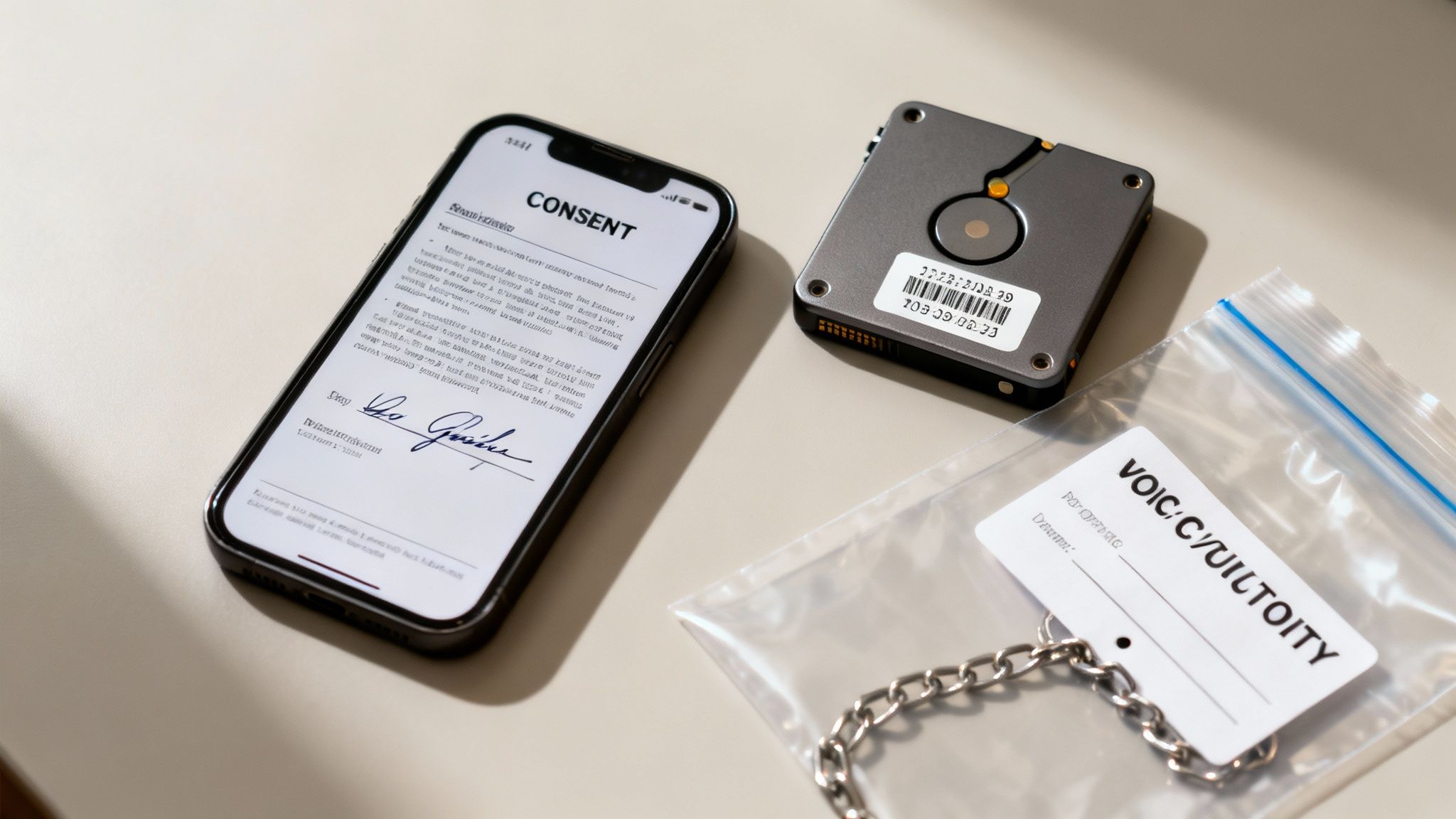
Navigating evidence collection during an internal affairs investigation process is a minefield of legal and ethical risks. One wrong step can invalidate your entire case, expose the company to liability, and shatter employee trust. The objective is to uncover facts ethically, not to build a case against someone through invasive tactics.
This requires a delicate balance between being thorough and respecting individual privacy. Old-school, high-risk methods like covert employee surveillance or demanding access to personal devices create a hostile environment and often violate regulations like the Employee Polygraph Protection Act (EPPA). These approaches treat employees like suspects and are the hallmark of outdated, ineffective risk management.
A modern, ethical approach is built on consent and transparency. It’s about collecting relevant business information while upholding employee dignity, ensuring the entire process is legally defensible and aligned with a culture of prevention.
Comparing Evidence Gathering Methodologies
The methods you choose for evidence collection define your organization's culture and its commitment to fairness. Let's compare the old, intrusive way with a modern, EPPA-aligned approach—the new standard for internal threat detection.
Methodology | Risk Profile | Ethical Consideration | EPPA Compliance |
|---|---|---|---|
Traditional Surveillance | High - Exposes the organization to lawsuits and regulatory fines. | Creates a culture of suspicion. Treats employees as suspects to be "policed." | Non-compliant. Often violates employee privacy and labor laws. |
Demand for Personal Devices | High - Blurs the line between professional and personal life, inviting legal challenges. | Invasive and disproportionate. A clear sign of a broken, reactive culture. | Non-compliant. Can be seen as a form of coercion, which is forbidden. |
Ethical Analytics & Consent | Low - Focuses on business-related data with employee awareness and consent. | Upholds employee dignity and privacy. Builds a culture of integrity. | Compliant. Aligned with EPPA and data protection laws. The new standard. |
Review of Company Assets | Low - Examines company-owned equipment and data within clear policy guidelines. | Transparent and expected as part of employment. | Compliant. Falls within the established scope of company policy. |
As the table makes clear, shifting to ethical, consent-based methods isn't just about avoiding legal trouble. It's about building a stronger, more resilient organization where integrity is the default and human-factor risks are managed proactively.
Maintaining the Chain of Custody
From the moment you collect a piece of evidence, its integrity is critical. The chain of custody is the chronological paper trail proving who handled the evidence, when, and why. This documentation is non-negotiable; without it, your evidence is worthless in any legal or procedural review.
A broken chain of custody can torpedo an investigation. To prevent this, every item—whether digital or physical—must be:
Logged Immediately: Record the date, time, location, and the person who collected it.
Secured Properly: Store all evidence in a secure, access-controlled location.
Tracked Meticulously: Document every time the evidence is viewed, moved, or analyzed.
Digital vs. Physical Evidence
The type of evidence dictates how it must be handled. Physical documents need careful preservation, while digital evidence from company assets (laptops, emails) requires specialized handling to prevent alteration.
It's also critical to ensure you're compliant with data protection regulations, which is where tools like GDPR compliant HR software solutions become essential. Proper digital forensics can preserve metadata, but this must be done within the clear boundaries of company policy and privacy laws.
The core principle is simple: collect only what is necessary and directly relevant to the investigation's defined scope. Overreaching or "fishing expeditions" are a fast track to legal challenges and a complete loss of credibility.
This structured approach also drives efficiency. In the United States, many police departments mandate that internal affairs investigations be completed within specific timeframes, often between 30 and 180 days. However, a 2022 survey found that just over half require regular updates, highlighting a major lack of standardization.
Shifting to Non-Intrusive Methods
Instead of falling back on invasive surveillance techniques that treat employees with distrust, smart organizations are adopting proactive, non-intrusive tools. Systems that provide ethical behavioral analytics help identify human-factor risks without resorting to surveillance or other EPPA-sensitive methods. This preventive approach allows you to address potential issues before they escalate into costly investigations.
This strategy isn't just about compliance; it's about building a culture of integrity and prevention. By focusing on identifying risk indicators with ethical, EPPA-aligned tools, you protect both the organization and its people, turning risk management from a reactive headache into a strategic advantage.
Conducting Fair and Effective Interviews

The human element is the most challenging and high-stakes part of any internal affairs investigation process. Interviews are not interrogations. Their purpose is not to extract a confession or apply psychological pressure, but to hold a structured, fact-finding conversation to gather information fairly.
Forget the coercive tactics used by outdated investigative services. The goal here is to create a professional environment where individuals can share what they know without feeling pressured. This means shifting away from a confrontational style and toward a respectful, objective dialogue.
A successful interview uncovers facts and corroborates evidence while upholding the dignity of everyone involved. This ethical approach is legally defensible and avoids the intimidation tactics that can derail an entire investigation and expose the organization to liability.
Structuring Non-Coercive Conversations
Proper planning is everything. Before anyone sits down, you need a clear game plan that prioritizes fairness and consistency. An unstructured interview can easily veer into biased territory, leading to inconsistent outcomes and legal challenges.
To keep the tone objective and non-coercive, stick to these best practices:
Establish a Neutral Setting: The interview location must be private and free from distractions. Confidentiality and focus are non-negotiable.
Explain the Process Clearly: Start by outlining the purpose of the interview. Explain your role as a neutral fact-finder and set clear expectations for professional conduct.
Use Open-Ended Questions: Avoid leading questions or anything answerable with a simple "yes" or "no." You want narrative responses, so ask questions like, "Can you walk me through what happened on that day?"
This methodical approach ensures every participant is treated with the same level of respect, which is critical for maintaining the integrity of the internal affairs investigation process.
Analyzing Statements Without Prohibited Judgments
Once interviews are complete, you must analyze statements and corroborate information without making prohibited judgments about an individual's character or intent. The focus must remain locked on the evidence and verifiable facts. This is where old-school methods fail, relying on subjective interpretations that can be swayed by unconscious bias. Invasive competitors may claim to "detect" things, but these methods are often against regulation.
The objective is to determine what happened based on credible evidence, not to pass judgment on individuals. This distinction is vital for a fair process and is a core principle of any EPPA-aligned investigation.
Modern AI human risk mitigation tools offer a systematic, ethical alternative to these outdated assessments. Platforms like E-Commander can help analyze human risk factors based on objective, business-related data, providing a consistent and ethical framework.
This technology supports investigators by identifying patterns and risks without resorting to prohibited methods like lie detection or psychological evaluations. It enhances the objectivity of the investigation while keeping the organization firmly compliant with labor regulations, setting a new standard for ethical risk management.
Delivering Clear and Actionable Findings
How an internal affairs investigation process concludes is just as critical as how it begins. This is where accountability is either cemented or lost. Your final report isn't just a summary; it’s the definitive document that must stand up to intense scrutiny from legal teams, regulators, and other stakeholders.
An incomplete or poorly constructed report can invalidate all the meticulous fact-finding you’ve done. The goal is to create a document that supports a fair outcome, whether that means recommending corrective action or exonerating an individual based on the evidence.
Compiling a Defensible Investigation Report
The final report must be a tightly structured narrative built strictly on a foundation of evidence. This is not the place for opinions, assumptions, or subjective interpretations. Every conclusion you draw must be directly and clearly tied to the facts you’ve gathered and corroborated.
To ensure your report is defensible and actionable, it must include these non-negotiable components:
A Clear Summary of the Complaint: Start by outlining the initial allegation, involved parties, and specific policies allegedly violated.
The Investigation Scope: Clearly define the boundaries of your inquiry to demonstrate a focused and fair process.
A Chronology of Actions: Document every step taken, from the first interview to the last piece of evidence analyzed, creating an unassailable audit trail.
An Unbiased Presentation of Evidence: Lay out all relevant facts—including conflicting information—to demonstrate objectivity.
A Conclusion Based on a Preponderance of Evidence: State clearly whether the evidence supports or refutes the allegation, based on the established standard of proof.
Using a proven framework can be a lifesaver. This workplace investigation report template is an excellent resource for ensuring you cover all critical bases.
Supporting Fair Outcomes and Rebuilding Trust
The findings of an investigation carry immense weight. The data backs this up. A report from the U.S. Bureau of Justice Statistics covering 2018 to 2023 showed 4,790 incident reports related to internal investigations. Of those, 15% resulted in termination, and another 6.5% led to criminal convictions, highlighting the high stakes involved. You can read the full report on these investigation outcomes to see the data.
A defensible report is your organization's proof of procedural justice. It demonstrates that a fair, evidence-based process was followed, which is essential for protecting the organization from liability and rebuilding trust with employees.
Finally, closing the loop is crucial for demonstrating fairness and transparency. While maintaining confidentiality, communicating the conclusion to relevant stakeholders is a must. This simple act sends a powerful message: the organization takes concerns seriously and is committed to upholding its policies. It helps restore confidence and reinforces a culture of integrity and prevention, no matter the final outcome.
Shifting From Reactive Investigations to Proactive Prevention
Mastering the internal affairs investigation process is a non-negotiable skill. But the real win isn’t conducting better investigations—it’s conducting fewer of them. The ultimate goal is to shift your entire organization’s posture from reactive cleanup to proactive prevention of internal threats.
This means building a program that identifies and addresses human-factor risks before they escalate into full-blown incidents. This isn't about guesswork; it's about using ethical, data-driven tools to understand the real-world conditions that create risk. To get a handle on those underlying workforce trends, leading organizations are turning to comprehensive People Analytics for data-driven insights.
This strategic shift is where a new standard in internal risk management is finally taking shape, leaving outdated, surveillance-based methods behind.
The New Standard in Risk Management: Prevention
Traditional investigations are, by nature, backward-looking. They answer the question, "What went wrong?" A proactive framework asks a much smarter question: "What could go wrong?" Answering that requires a completely different, non-intrusive set of tools.
Instead of waiting for the next complaint, this new approach uses technology to provide continuous, ethical insight into organizational health. It moves the focus from policing bad behavior to building a sustainable culture of integrity and prevention.
How AI-Driven Platforms Are Changing the Game
This is exactly where platforms like E-Commander and Risk-HR are setting a new benchmark. They use AI-driven, EPPA-compliant risk assessments to deliver the insights you need to build a more resilient and ethical organization. Let’s be clear: this technology isn’t for employee surveillance or lie detection. It’s Risk Assessments Software designed for one purpose—prevention of human-factor risk.
Unlike competitors who rely on legally risky surveillance, our systems give organizations the power to:
Identify Pre-Incident Indicators: They analyze human-factor risks to flag potential issues tied to misconduct, conflicts of interest, or fraud before they cause real damage.
Maintain EPPA Compliance: Unlike invasive methods that create massive legal liabilities, these platforms operate ethically and non-intrusively, respecting employee dignity and privacy.
Reduce Investigation Caseloads: By getting ahead of risks early, they cut down on the frequency and severity of incidents that demand a formal internal affairs investigation process.
By implementing a proactive prevention strategy, you transform your risk and compliance functions from a cost center into a strategic asset. You move from a cycle of costly reaction to a sustainable model of organizational integrity.
Adopting modern compliance risk management software is the key to making this transition. It gives your teams the ability to see and mitigate internal threats, protecting your reputation, your finances, and your people. The future of internal risk management isn't perfecting the investigation; it's making it unnecessary.
Ready to move from a reactive posture to a proactive one? Logical Commander provides the AI-driven, EPPA-compliant platform you need to prevent internal threats before they escalate.
Request a demo to see our platform in action.
Join our PartnerLC program and become an ally in ethical risk prevention.
Contact our team for an enterprise deployment consultation.