%20(2)_edited.png)

Area of Ethics in Business: A Guide to Proactive Risk Prevention

When decision-makers in Compliance, Risk, and HR hear "ethics," it can sound like a purely academic topic. But in reality, it's a field with distinct layers, each answering a different business question. To build a resilient and compliant organization, leaders need to understand these layers—not as a philosophical exercise, but as a practical map for preventing human-factor risk and protecting the bottom line.
Think of it like building a secure facility. You wouldn't just start putting up walls. You'd need to understand the principles of structural integrity (the "why"), draft a detailed blueprint (the "what"), and then execute the construction to precise specifications (the "how"). The three main areas of ethics work in exactly the same way to build a culture of integrity that prevents liability.
Understanding the Three Core Areas of Ethics in Business
Moral philosophy can be broken down into three core branches: Meta-ethics, Normative ethics, and Applied ethics. Each one builds on the last, moving from abstract principles to the concrete "how" of day-to-day business decisions. A failure at any stage creates a disconnect between policy and practice, exposing the organization to internal threats and regulatory penalties.
The Foundational Branches of Ethics
Let's walk through the framework, from foundational values to operational reality.
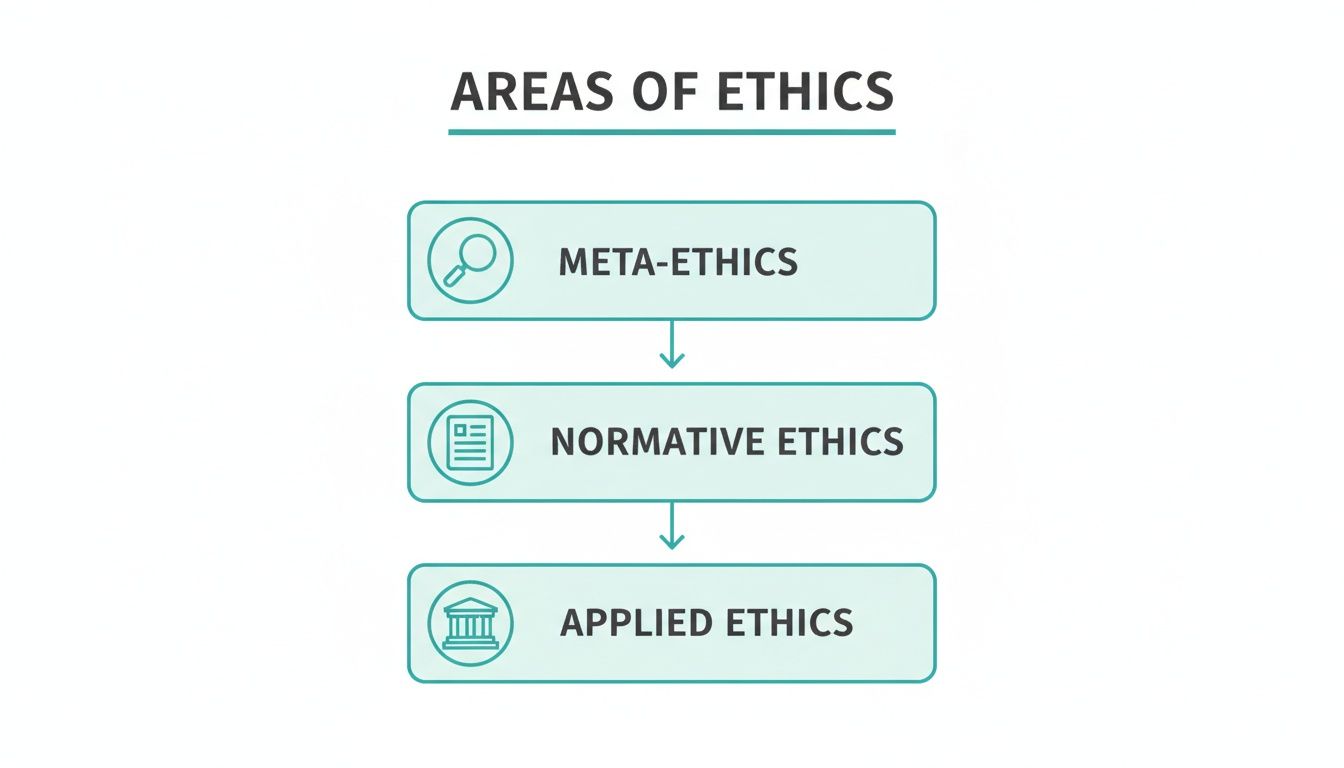
Meta-Ethics (The Foundation): This is the philosophical bedrock, tackling questions like, "What does 'right' mean for our organization?" and "Where do our moral principles come from?" For a business, this translates to defining core values—the fundamental beliefs that underpin your entire corporate culture and guide your approach to risk.
Normative Ethics (The Blueprint): This branch provides the "what." It translates foundational values into actionable standards and rules. Think of your code of conduct, anti-corruption policies, or specific guidelines for handling conflicts of interest. This is the blueprint for compliant behavior that everyone is expected to follow.
Applied Ethics (The Construction): This is where policy meets reality. Applied ethics deals with the high-stakes, real-world dilemmas your teams face daily. How do we govern AI responsibly to avoid bias? How do we handle a sensitive internal investigation without violating EPPA guidelines? This is the most critical area of ethics for managing human-factor risk.
This diagram shows how these three areas flow into one another, moving from the big-picture concepts of Meta-Ethics to the practical, on-the-ground execution of Applied ethics.
This progression is essential. Without it, you end up with a major gap between your compliance policies and what your people actually do, creating significant unmanaged risk.
The Three Branches of Ethics Explained for Business Leaders
Area of Ethics | Core Question | Business Relevance & Impact |
|---|---|---|
Meta-Ethics | Where do our values come from? What does "right" mean for us? | Defines the organization's core mission and cultural DNA. It's the "why" behind your code of conduct and risk appetite. |
Normative Ethics | What are the rules we should follow? What standards define good conduct? | Creates the specific policies and codes of conduct that guide employee behavior, ensure compliance, and mitigate liability. |
Applied Ethics | How do we handle this specific real-world dilemma? | Governs the practical application of policies in high-risk areas like AI governance, data privacy, conflicts of interest, and internal threat detection. |
This structure isn't just theoretical; a failure to connect these areas creates massive operational blind spots. For example, many companies have strong anti-fraud policies (Normative ethics) but lack a non-intrusive system to detect the early indicators of fraud (Applied ethics), leaving them vulnerable until after a loss occurs.
When a disconnect like this exists, it leaves your managers—the people on the front lines of ethical decision-making—without the tools to enforce the company's stated values. Ultimately, mastering each area of ethics is essential for moving from a reactive, investigative posture to one of proactive, ethical prevention. It's how you build a resilient organization and reinforce the cultural ROI of integrity.
Putting Ethics into Practice on the Business Frontline
If normative ethics is the architectural blueprint for corporate behavior, then Applied Ethics is the high-stakes construction site where those plans meet reality. This is the single most critical area of ethics for any organization serious about managing human-factor risk. It’s where abstract principles are tested in scenarios with real financial, legal, and reputational consequences.
This is where your risk management strategy truly succeeds or fails. It stops being about what’s written in your code of conduct and starts being about what your team does when faced with a tough decision. A breakdown here doesn’t just violate a principle; it creates costly incidents that damage your balance sheet and shatter stakeholder trust.

Key Arenas of Applied Business Ethics
For any modern enterprise, applied ethics isn’t one big topic but a series of specialized domains, each with unique risks. A proactive defense requires visibility into these subfields before they escalate into full-blown crises.
Here are the areas that matter most:
Business and Corporate Ethics: This covers everything from fair market competition and corporate social responsibility to transparency in financial reporting. Failures here lead directly to fraud, crippling conflicts of interest, and regulatory fines that can wipe out shareholder value.
AI Ethics: As companies rush to adopt AI, they are simultaneously adopting a new class of human-factor risks. We’re talking about algorithmic bias in hiring, major data privacy violations, and a lack of transparency in automated decisions. A biased AI system is a legal liability that poisons your talent pipeline and tarnishes your brand.
Professional Ethics: This drills down into the specific codes of conduct tied to roles in finance, law, HR, and other licensed fields. For Compliance leaders, this means ensuring every employee adheres to the unique duties and obligations their job demands to prevent professional misconduct.
A huge part of making these principles stick is learning how to ethically handle employee complaints. This is a frontline stress test that reveals whether an organization is truly committed to its stated values.
Shifting from Reaction to Proactive Prevention
The old-school approach to applied ethics was purely reactive. You’d wait for a whistleblower report or a major incident, then launch a costly and adversarial forensic investigation after the damage was done. This model is slow, expensive, and almost never gets to the root cause of the failure. Modern ethical risk management demands a complete shift in mindset—from reactive forensics to proactive prevention.
An ethical framework is only as strong as its ability to prevent harm, not just document it after the fact. The goal of applied ethics in business is to create an operational environment where compliant choices are the easiest choices to make.
This requires a system that gives you early visibility into potential trouble without resorting to invasive surveillance or legally toxic monitoring that violates EPPA regulations. Instead of using surveillance tools hoping to catch misconduct, a proactive system identifies patterns that suggest a potential conflict of interest, allowing for an early, non-confrontational intervention. For more on this forward-thinking approach, explore our guide on redefining human capital risk management.
By focusing on prevention, organizations can build a resilient ethical infrastructure that fosters a genuine culture of integrity and protects the institution from preventable harm.
The True Cost of Ethical Blind Spots in Risk Management
Ignoring any area of ethics in your business isn’t just a philosophical problem—it's a direct threat to your bottom line. Ethical blind spots create operational vulnerabilities that outdated, reactive risk management strategies are powerless to stop. The consequences manifest as real financial losses, regulatory penalties, and deep cultural damage.
Legacy methods often make this problem worse. Approaches centered on invasive employee surveillance or legally questionable "lie detection" technologies don't just fail to prevent risk; they actively create new liabilities. These suspect-centric tactics can trigger severe penalties under frameworks like the Employee Polygraph Protection Act (EPPA) and GDPR, exposing your organization to costly litigation and regulatory scrutiny.

Quantifying the Damage of Ethical Failures
The financial fallout from ethical lapses goes far beyond initial fines. The business case for ethical governance is written in the language of loss prevention and sustained growth.
Consider the cascading costs:
Legal Fees and Fines: A single compliance breach can spiral into millions in regulatory fines and drawn-out legal battles that drain resources and management focus.
Employee Turnover: A culture poisoned by distrust and invasive oversight watches its best talent walk out the door. The cost to recruit, hire, and train a replacement can exceed 200% of their annual salary.
Reputational Harm: In today's hyper-connected world, one ethical scandal can destroy decades of brand equity, driving away customers and investors.
This environment of escalating risk is only intensifying. Global compliance complexity has surged, with 85% of executives reporting increased demands over the last three years, according to a recent PwC survey. This reflects a regulatory environment where corporate governance and fraud prevention are top priorities for leadership. You can learn more about these critical compliance findings on PwC.com.
The Unviability of Reactive Investigations
Traditional, reactive investigations are fundamentally broken. They are designed to assign blame after the damage is done, trapping organizations in a costly cycle of incident response. This approach guarantees you are always one step behind the next internal threat. You can discover more about the true cost of reactive investigations in our detailed analysis.
By the time a traditional investigation begins, the core failure has already occurred. The financial loss, data breach, or reputational hit has been taken. An ethical, proactive strategy is the only way to get ahead of this damage curve.
This reality makes a compelling case for a new standard in ethical risk management—one built on proactive, non-intrusive prevention. Modern enterprises can no longer afford the financial or cultural price of waiting for ethical failures to become full-blown crises. The only defensible strategy is to prevent them from happening in the first place.
Building an Ethical Framework That Actually Works
Knowing the different areas of ethics is one thing; operationalizing that knowledge requires a practical blueprint. An effective ethical framework is a living system woven into daily operations, not a dusty policy binder. It turns abstract principles into solid governance and clear workflows that guide people toward compliant decisions.
This journey starts with a code of conduct that is reinforced through continuous training and transparent reporting channels where people feel safe speaking up. True ethical governance makes integrity the path of least resistance.
From Policy to Proactive Oversight
A written policy is just the starting line. The real work is turning policy into practical oversight—the kind that's effective without making employees feel they are under suspicion. Outdated methods leaned heavily on invasive surveillance, which breeds distrust and creates legal minefields under regulations like EPPA.
The new standard is using AI-driven technology for proactive prevention, not after-the-fact punishment. Platforms like Logical Commander's E-Commander centralize internal risk intelligence, giving HR and Compliance teams the insights to spot risk signals before they escalate into misconduct. It’s an approach focused squarely on preventing human-factor risk without resorting to legally dangerous surveillance methods.
An ethical framework fails the moment it becomes reactive. Its true value lies in its ability to proactively identify and mitigate risks, preserving both organizational assets and employee dignity. Waiting for an incident means the framework has already broken down.
Embedding Ethics into Daily Operations
Operationalizing ethics means making it a part of everything you do. This demands a commitment that goes far beyond annual training.
Here are a few concrete steps:
Develop Dynamic Training: Use scenario-based training that challenges employees to work through realistic ethical dilemmas relevant to their roles.
Establish Clear Governance: Create a cross-functional ethics committee with leaders from Legal, HR, and key business units to ensure policies are practical and supported.
Implement Non-Intrusive Technology: Adopt tools that identify potential conflicts of interest or policy deviations without accessing private communications. This is how you gain crucial risk intelligence while preserving privacy.
The boardroom is already getting the message that ethics and compliance are top priorities. Recent data shows 70% of compliance leaders are highly engaged in risk management, signaling a clear shift toward proactive, ethical leadership.
For any business building an ethical framework, proactively preventing data privacy issues is non-negotiable. A resource like a comprehensive GDPR compliance checklist is an invaluable tool for ensuring your policies meet tough global standards. By taking these steps, you can build a resilient ethical infrastructure that doesn't just keep you compliant—it becomes a powerful competitive advantage.
The New Standard in Ethical Risk Technology
Smart organizations are ditching outdated, reactive methods to future-proof their risk strategies. The new standard for managing human-factor risk is built on a simple premise: proactive prevention is always superior to reactive investigation. This means embracing ethical, AI-driven technology that flags risk signals early, long before they escalate into costly incidents.
This modern approach fundamentally changes the role of technology in risk management. Instead of acting as a surveillance tool, its purpose is to deliver objective, actionable intelligence that reinforces a culture of integrity. This is the new benchmark in every relevant area of ethics, proving that effectiveness and employee dignity are deeply connected.
Moving Beyond Invasive Surveillance
The old risk management paradigm was built on a foundation of suspicion. Legacy systems often rely on invasive methods like monitoring employee communications or using legally perilous surveillance techniques. These approaches don't just create massive legal exposure under frameworks like the EPPA; they destroy the trust essential for a healthy corporate culture.
The new standard, embodied by Logical Commander, flips this model completely. Our EPPA-aligned platform is designed from the ground up to be non-intrusive. It does not engage in surveillance or any form of secret monitoring. Instead, our AI uses advanced analysis to detect the indicators of human-factor risks—like potential conflicts of interest or fraud patterns—without accessing private employee communications.
The goal of ethical technology is not to catch people doing wrong, but to create an environment where it is difficult for risks to go unnoticed. It shifts the focus from policing individuals to safeguarding the entire organization.
This distinction is everything. By focusing on contextual risk signals rather than personal communications, organizations can maintain a high level of security and compliance while fully respecting employee privacy.
Compliance and Dignity by Design
An ethical risk management platform must have compliance baked into its very design. This means building technology that operates within strict legal and ethical boundaries, with employee dignity as a core function.
Logical Commander achieves this through a firm commitment to key principles:
No EPPA-Sensitive Methods: Our system uses absolutely no lie detection, interrogation logic, or psychological pressure. It is built to support HR and Compliance, not to replace their judgment.
Proactive, Not Punitive: The intelligence we provide is for prevention. It enables early, non-confrontational interventions that guide behavior, rather than punishing misconduct after the fact.
Preservation of Privacy: The platform operates without invading personal digital spaces, ensuring all risk detection activities are both ethical and legally defensible.
This ethical, non-intrusive approach makes Logical Commander the new standard for organizations committed to protecting their assets and their people. For a deeper dive into how technological innovation revolutionizes internal risk prevention, our detailed analysis offers further insights.
Partner with Us to Build a More Ethical Future
Mastering every area of ethics is no longer just a defensive play—it's a clear competitive advantage. The days of launching costly, reactive investigations after the damage is done are over. The new standard is proactive, ethical prevention that protects your organization's assets, reputation, and most importantly, its people.
Making that strategic shift requires a partner who understands how to manage human-factor risk without resorting to invasive, EPPA-sensitive methods.

Join the PartnerLC Ecosystem
We invite B2B SaaS providers, consultants, and resellers to join our PartnerLC program. This is your chance to offer clients a genuinely effective, non-intrusive solution for internal risk management that sets a new industry benchmark.
By joining our partner ecosystem, you can:
Create new revenue streams by offering a high-demand, ethical risk management platform.
Deliver exceptional value to your clients with an EPPA-compliant, AI-driven solution that solves a real business problem.
Strengthen your market position as a leader in proactive, integrity-focused business practices.
Let's build a future where ethical prevention is the cornerstone of every successful organization.
Your Questions on Business Ethics and Risk, Answered
When it comes to putting ethics into practice, leaders in Compliance, HR, and Risk often have pressing questions. Let's tackle some of the most common ones we hear, cutting straight to the practical application of these ideas.
What Is the Most Important Area of Ethics for a Business?
While all areas are connected, Applied Ethics is where the rubber meets the road. It is the most critical area of ethics for day-to-day operations because it translates principles into action.
This is where you grapple with tangible challenges like corporate governance, AI ethics, professional conduct, and data privacy. Focusing on Applied Ethics is how you build actionable policies and smart controls that directly reduce concrete business risks—such as compliance violations, internal fraud, and costly reputational damage. It’s the bridge between high-level principles and your bottom line.
How Can AI Help Manage Risk Without Violating Privacy?
The key is to use AI for prevention, not surveillance. Ethical AI risk management tools are intentionally non-intrusive and EPPA-compliant, like the framework built into platforms such as Logical Commander.
Instead of invasive methods like monitoring employee communications, this ethical approach analyzes contextual data to spot potential risk indicators. It might flag a clear conflict of interest or a pattern that suggests a policy violation is imminent. By focusing on objective risk signals instead of personal behavior, you can get ahead of problems without ever creating a culture of suspicion.
Is a Proactive Ethical Approach More Effective Than Investigations?
Absolutely. Traditional, reactive investigations are a sign of failure. They are incredibly expensive, destructive to employee morale, and only begin after the damage—financial loss, data breach, or reputational harm—has already occurred. A proactive approach, covering every relevant area of ethics, is about preventing incidents before they start.
By fostering a culture of integrity and using non-intrusive tools to identify early warning signs, you reduce financial losses, legal liabilities, and reputational harm. Prevention is always more effective and less expensive than remediation.
When you can identify and neutralize risks before they escalate, you protect your company, its assets, and its people far more effectively than any after-the-fact investigation ever could.
Ready to adopt the new standard in ethical, proactive risk management? Logical Commander Software Ltd. offers an EPPA-aligned platform that helps you prevent internal threats without surveillance.