%20(2)_edited.png)

A Practical Guide to Ethics and Workplace Integrity

In a world this connected, a company’s approach to ethics is no longer a private conversation—it's a public statement about what you stand for. A solid ethical foundation isn't just a nice-to-have; it's the engine driving employee retention, customer loyalty, and real, sustainable growth.
Why Your Workplace Culture Matters Now More Than Ever
Think of your ethical culture as your company’s immune system. When it’s strong, it naturally fights off risks like misconduct, fraud, and the kind of reputational damage that can sink a business. But when it's weak, the organization is left wide open to costly problems that rot trust from the inside out.
A healthy culture has a direct, measurable impact on everything from day-to-day operations to your long-term financial performance. It's not just a feel-good metric.
For instance, companies that genuinely live their ethical values build deep, unshakable trust. This translates into a huge business advantage. Just look at the numbers: a staggering 92% of workers say it’s a priority to work for an employer that values their well-being. That’s a direct line between ethical treatment and your ability to attract and keep top talent.
The Real-World Payoff of an Ethical Workplace
Putting real effort into your ethical culture isn’t about avoiding legal trouble; it’s about creating a high-performance environment where people are proud to show up and customers are proud to support you. It yields tangible returns across the entire business.
The key advantages are clear:
You Keep Your Best People: When employees feel respected and trust that the company operates fairly, they stick around. This cuts down on the massive cost of turnover and keeps valuable institutional knowledge from walking out the door.
Your Brand Becomes a Magnet: Customers today are voting with their wallets, and they're choosing businesses that align with their own values. A reputation for integrity can become your single most powerful marketing asset.
Innovation Actually Happens: An ethical workplace builds psychological safety. It creates a space where employees feel secure enough to voice new ideas, flag problems, and collaborate openly without fearing unfair blowback.
A healthy ethical culture is the bedrock on which a resilient, innovative, and profitable organization is built. It’s a shift from a simple compliance checklist to the operational standard for how you do business, day in and day out.
Ultimately, a sharp focus on ethics and workplace integrity is a strategic imperative. It kicks off a virtuous cycle: satisfied employees drive customer loyalty, which in turn fuels sustainable growth. This guide will give you a practical roadmap for building exactly that kind of organization.
The Core Principles of Workplace Ethics
Think of your company's ethical principles as its operating system. This system runs quietly in the background, guiding every single decision, interaction, and process. When it's well-designed and consistently updated, the entire organization just runs smoothly. But when it's buggy or outdated, crashes are inevitable.
These principles aren't abstract ideals floating around in a handbook. They are the actionable behaviors that form the very foundation of trust. Understanding them is the first real step toward building a resilient culture that people respect. A strong ethical core directly influences employee retention, customer loyalty, and sustainable growth.
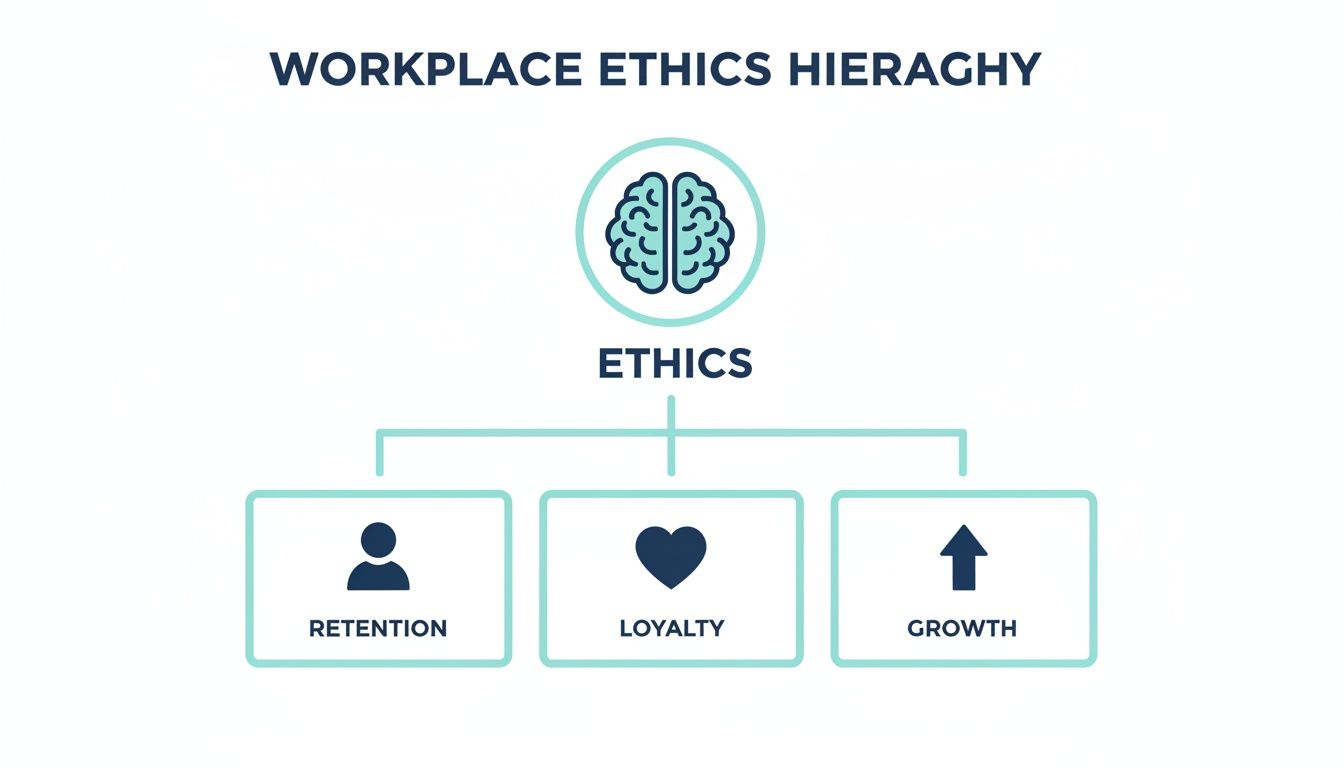
As this shows, a real commitment to ethics is the starting point for building a workplace that people genuinely want to be a part of, which is what ultimately drives business success.
To make these concepts concrete, let's break down the core pillars of workplace ethics. These aren't just buzzwords; they're the practical building blocks of a high-integrity culture.
The Five Pillars of an Ethical Workplace
Ethical Pillar | What It Means | Example in Action |
|---|---|---|
Integrity | A rock-solid commitment to honesty and strong moral principles—doing the right thing, even when no one is watching. It’s about aligning your actions with your stated values, every time. | A sales rep honestly admits their product isn't the right fit for a customer, rather than pushing for a sale that will only lead to dissatisfaction down the road. |
Accountability | The ownership of outcomes, both good and bad. It’s the opposite of a blame culture. | A leader doesn't point fingers at their team when a project misses its deadline. Instead, they take responsibility for the failure, figure out what went wrong, and implement changes to make sure it doesn't happen again. |
Transparency | Clear, open, and honest communication about company decisions, performance, and challenges. | Instead of hiding poor quarterly results, a CEO openly discusses the challenges and lays out a clear plan to address them, trusting employees to be part of the solution. |
Fairness | Ensuring that rules are applied consistently and that every employee has an equal opportunity for success, free from favoritism or bias. | Promotions are based purely on merit, and disciplinary actions are handled uniformly, regardless of an employee's role or relationship with management. |
Respect | The fundamental acknowledgment of the inherent dignity and value of every single person. | This shows up in everyday interactions: actively listening in meetings, valuing diverse perspectives, and maintaining a professional tone in every email and conversation. It’s about creating a workplace free from harassment, discrimination, and bullying. |
These pillars don't stand alone; they reinforce each other. A culture of respect makes it easier for people to be transparent. Accountability is impossible without integrity. Together, they create the stable operating system your organization needs to thrive.
An ethical workplace isn't built on grand gestures but on the million small, consistent decisions made every day that reflect a deep commitment to these core principles.
As technology continues to reshape the workplace, these ethical considerations become even more critical. For a deeper look at how these principles apply to emerging tech, it’s worth exploring some practical Responsible AI principles.
Navigating Common Ethical Risks and Dilemmas
Knowing the principles of workplace ethics is one thing, but spotting them in the wild—during a hectic Tuesday afternoon with deadlines looming—is a completely different ballgame. The real measure of a company’s integrity isn’t found in a handbook; it’s revealed when people are squeezed between competing pressures.
Ethical dilemmas rarely show up as a clear-cut choice between good and bad. They’re almost always dressed in shades of gray, where the path of least resistance might quietly betray a core value. The key is to get good at spotting these ethical red flags early, long before they fester into bigger problems that poison morale and break down trust.
Unmasking Conflicts of Interest
One of the sneakiest and most common ethical traps is the conflict of interest. It’s not about someone trying to do the wrong thing. It’s about being in a situation where your personal interests—or those of a close friend or family member—could cloud your professional judgment. The mere potential for bias is the problem.
Imagine a manager needs to hire a vendor for a big project. As it happens, their cousin’s small marketing agency throws a proposal into the ring. Even if that manager is convinced they can be 100% objective, the situation is already a conflict.
The Dilemma: If they pick their cousin's firm, will anyone on the team truly believe it was a fair fight?
The Risk: If they keep the relationship a secret and it comes out later, their integrity is shot, and the entire procurement process looks rigged.
The only way forward is with radical transparency. The manager needs to immediately disclose the relationship to their boss and step away from the final decision. This protects their reputation and, just as importantly, upholds the company’s commitment to a level playing field.
A conflict of interest isn't defined by a negative outcome. The mere existence of a situation that could compromise objectivity is the risk itself. Proactive disclosure is the only effective defense.
This same logic applies to accepting lavish gifts from suppliers, running a side hustle that competes with your employer, or using company connections to get a personal leg up. In a healthy ethical culture, people are encouraged to constantly ask themselves, "Could this situation make it hard for me to act purely in the company's best interest?" If the answer is even a hesitant "maybe," it's time to speak up.
Navigating Insider Risks and Misconduct
Beyond conflicts of interest, a whole range of internal ethical threats can crop up. These can be anything from minor policy infractions to serious misconduct that puts the company's stability, reputation, and finances on the line. Getting good at recognizing these risks is the first step toward building a resilient defense.
Here are a few all-too-common examples of these internal dilemmas:
Misuse of Company Resources: This is more than just grabbing a few pens from the supply closet. It’s using company software, gear, or paid time to run a personal side business. It’s a breach of trust that can also create serious legal and security holes.
Data Privacy Breaches: An employee snooping on sensitive customer or colleague data without a legitimate business need is a massive ethical and legal failure. Whether it’s driven by simple curiosity or something more malicious, the damage is the same.
Harassment and Discrimination: Nothing kills psychological safety faster than a toxic or exclusionary environment. This isn’t just about overt acts; it’s the inappropriate jokes, biased comments, or unfair treatment that tells someone they don't belong. It’s a profound ethical breakdown.
Falsifying Information: Whether it's puffing up sales numbers to hit a quota, fudging an expense report, or sugarcoating project progress for a client, dishonesty corrodes trust from the inside out. A culture where people feel pressured to bend the truth is a breeding ground for much bigger failures.
Successfully navigating today's landscape of ethics and workplace challenges takes more than a rulebook. It demands a culture of sharp awareness, where people are trained and empowered to recognize these dilemmas on sight. By turning abstract principles into practical, real-world recognition skills, organizations build the muscle memory needed to act with integrity when it truly counts.
How to Build Your Ethical Framework
Tossing a list of values on the wall is a great first step, but principles alone won't build an ethical workplace. You need a formal structure—a practical blueprint that turns those values into consistent, everyday actions.
Think of it like building a house. Your ethical framework is the architectural plan that ensures everything is strong, stable, and built to last. Without it, your approach to ethics and workplace integrity is just guesswork, relying on individual good intentions rather than a shared, systematic commitment. A solid framework gives your people clarity, protects the organization, and offers a clear path for navigating tricky ethical situations when they pop up.
This blueprint is made of a few essential, connected components. Each piece reinforces the others, creating a structure that’s far stronger than the sum of its parts. Let's break down the core elements you need to construct your organization’s ethical foundation.
Start with a Clear Code of Conduct
Your Code of Conduct is the cornerstone of your entire ethical framework. This can't be a dense legal document that gathers dust on a server. A great Code is a practical, easy-to-read guide that translates your company’s core values—like integrity, respect, and accountability—into clear expectations for behavior.
An effective Code of Conduct does three things really well:
It Sets Clear Expectations: It uses simple language and relatable examples to explain what is and isn't acceptable when it comes to things like conflicts of interest, data privacy, and how people treat each other.
It Guides Decision-Making: It empowers employees by giving them a reference point when they face an ethical gray area, helping them make choices that line up with company values.
It Establishes a Universal Standard: It makes sure that every single person, from the C-suite to the front lines, is held to the exact same high standard.
Implement Supportive Policies and Protections
While the Code gives you the big-picture vision, specific policies are needed to tackle critical risk areas in more detail. Think of these as the supporting walls and beams of your ethical house, providing strength exactly where it’s needed most.
An ethical framework is only as strong as its weakest link. A powerful Code of Conduct can be completely undermined by a lack of safe reporting channels or a failure to hold people accountable for their actions.
Key policies and protections include:
Anti-Harassment and Anti-Discrimination Policies: These must be crystal clear, defining unacceptable behaviors and outlining a straightforward process for reporting and investigation.
Whistleblower Protections: A speak-up culture is impossible if people fear retaliation. A secure, confidential reporting channel—and a strict non-retaliation policy—are non-negotiable.
Conflict of Interest Disclosures: Create a formal process for employees to proactively declare potential conflicts. This turns a potential crisis into a manageable situation through simple transparency.
Integrate Ethics into Performance Management
For an ethical framework to have any real teeth, it has to be woven directly into the systems that measure and reward performance. If a company only rewards hitting sales targets, it implicitly tells employees that how they get there doesn't matter. This creates a dangerous gap between stated values and what actually happens on the ground.
Unfortunately, this is where a lot of organizations fall short. A recent study found that only 31% of organizations evaluate ethical behavior in performance reviews. This gap helps explain why major integrity failures keep happening; written codes mean very little if they aren't tied to the appraisal, discipline, and reward systems that actually shape employee behavior. Find out more by reading the full report on the world's most ethical companies.
To close this gap, build ethical conduct right into your performance review process. Make integrity a measurable competency alongside technical skills and business results. This sends an unmistakable message: character and conduct are just as critical to success as hitting your numbers. To get a better handle on how to evaluate these qualities, explore our guide on using integrity assessments in the workplace.
Fostering a Speak Up Culture
You can have the most brilliant ethical frameworks and policies in the world, but they're useless without one thing: a speak up culture. Think about it. If your people are afraid to voice concerns, report misconduct, or even just admit they made a mistake, those rules are just words on a page.
This is where psychological safety becomes the single most important ingredient in any program focused on ethics and workplace integrity.

At its core, psychological safety is the shared belief that it's safe to take risks on a team. It means employees feel confident they won’t be embarrassed, shut down, or punished for speaking up with ideas, questions, or concerns. It’s that gut feeling that allows someone to say, "I think we're heading in the wrong direction here," without fearing for their job.
A culture of silence, on the other hand, creates a massive blind spot for risk. When people stay quiet, small problems fester and grow into full-blown crises, from minor compliance breaches to catastrophic ethical failures. Proactively building psychological safety isn’t just a “nice to have”—it’s one of the most powerful risk mitigation strategies you can have.
What Psychological Safety Looks Like in Practice
Cultivating this environment isn't about being "nice"; it's about being intentional. It requires leaders to actively model and reinforce behaviors that build trust and dismantle fear, day in and day out.
Here are a few ways to make it real:
Model Vulnerability: When leaders openly admit their own mistakes or acknowledge they don’t have all the answers, it gives everyone else permission to do the same. This simple act can transform a team's dynamic from one of fearful perfectionism to one of collaborative learning.
Respond Constructively: How you react when someone brings you bad news is a moment of truth. If you shoot the messenger, you can be sure you'll never hear bad news again until it’s way too late. Thanking them for their courage and focusing on solutions reinforces that speaking up is valued.
Encourage Dissent: Actively pull different viewpoints into meetings. Ask questions like, "What are we missing here?" or "What's the argument against this approach?" This frames disagreement as a valuable contribution, not a challenge to authority.
Psychological safety is the lubricant for an ethical engine. It allows all the moving parts—policies, reporting systems, and individual integrity—to work together smoothly instead of grinding to a halt under the friction of fear.
The High Cost of Silence in Certain Industries
The level of psychological safety often varies wildly between industries, which directly impacts the likelihood of unreported misconduct. For instance, The Global Report from The Culture Factor shows that tech and banking tend to score higher on safety.
Conversely, industries like aviation and manufacturing often report lower levels due to more rigid, hierarchical norms. In these environments, employees are far less likely to speak up, which severely hinders the early detection of critical issues. You can explore more insights on how industry norms affect workplace safety from The Culture Factor.
This shows a clear, undeniable link between a constrained speak-up culture and elevated organizational risk. Investing in robust training is one of the most effective ways to start closing this gap. You can learn more about designing programs that build both competence and confidence in our guide to creating effective corporate compliance training.
Ultimately, an environment where every voice can be heard isn’t just healthier—it’s fundamentally safer and more resilient.
Using Technology for Proactive Ethical Oversight
Traditional approaches to workplace ethics often feel like you're always one step behind. An issue blows up, an investigation kicks off, and the organization is left trying to clean up the mess. But what if you could spot the warning signs before an ethical breach ever happens? This is exactly where modern technology is changing the game for integrity in the workplace.
Think of it this way: a fire extinguisher is critical, but a smoke detector is what stops a small spark from turning into a catastrophe. Old-school methods are the fire extinguisher—you only use them once the flames are visible. New, ethical-by-design technology is the smoke detector, picking up the earliest signals of risk so you can step in and prevent a crisis.
This isn't about invasive surveillance or snooping on employees' private messages. In fact, it's the complete opposite. The most effective platforms are built on a foundation of privacy, designed to analyze patterns and metadata—never personal content—to flag potential risks with dignity and respect.
Shifting from Reaction to Prevention
The fundamental idea is to move from a reactive "wait-and-see" model to a proactive "know-first, act-fast" strategy. Instead of depending entirely on someone to blow the whistle, technology can help identify structural weak points or behavioral patterns that correlate with known risks. This allows your organization to intervene early, maybe by offering extra training or clarifying a policy, long before a situation escalates.
This proactive stance is made possible by a few key capabilities:
Pattern Recognition: AI can spot communication patterns that might suggest a hidden conflict of interest—like an unusual spike in interaction between an employee and a new vendor—without ever reading the content of their conversations.
Early Signal Detection: These systems can flag anomalies that would be totally invisible to a human reviewer, such as procedural shortcuts that could be early indicators of fraud or data exfiltration attempts.
Privacy-Preserving Architecture: Modern platforms are built to comply with global regulations like GDPR. They anonymize data and focus on objective, structured indicators, ensuring employee privacy is always protected.
Technology designed for ethical oversight serves as a powerful decision-support tool, not a replacement for human judgment. It provides objective data points that empower HR and Compliance teams to conduct fair, focused, and effective inquiries while respecting employee dignity.
Ethical-by-Design in Practice
So, what does this actually look like day-to-day? An ethical oversight platform might flag that an employee in procurement has suddenly started communicating with a newly registered, single-director company at a very high frequency. The system doesn't know what they're discussing, but it recognizes that this pattern matches indicators for potential bid-rigging or conflicts of interest.
This alert isn't an accusation; it's a neutral, data-driven prompt for a routine check. It gives the compliance team a chance to discreetly verify that all proper procedures were followed, turning a potential crisis into a simple governance check.
By focusing on observable behaviors and patterns, these tools help organizations uphold their standards consistently and fairly. For those interested in a deeper dive, our guide on ethical behavioral analytics explores how this technology works while putting privacy first. This approach transforms risk management from a reactive, punitive process into one that is proactive, preventative, and fundamentally more ethical.
Your Questions, Answered
Even with a great framework, real-world questions about ethics always come up. It's one thing to have a policy on paper; it's another to make it work day-to-day. Let's tackle some of the most common questions leaders and teams face when turning ethical principles into practice.
What's the First Step a Small Business Should Take?
For a small business, the best first move is to create a simple, clear Code of Conduct with your employees, not just for them. This shouldn't be a dense legal document nobody reads. It needs to be a practical guide that reflects your core values, like respect and integrity.
The key is to include relatable, real-world examples of what's expected and what's out of bounds. Most importantly, leadership has to live and breathe this code every single day. The next step is just as crucial: create a safe, straightforward way for people to ask questions or flag concerns, even if it’s just a single, trusted person. That blend of clear expectations and an open door builds the trust you need for an ethical culture to take root.
How Can You Measure if an Ethics Program Is Actually Working?
Measuring the health of your ethics program is about more than just counting incident reports. A real picture emerges when you look at a mix of metrics that capture both how people feel and what’s actually happening.
Some of the most telling indicators include:
Employee Engagement and Trust Surveys that ask direct questions about psychological safety, ethical perceptions, and whether employees trust leadership to do the right thing.
Speak-Up Data where you analyze the types of reports coming in. It might sound strange, but an increase in questions or reports on minor issues can actually be a great sign—it shows people trust the system enough to use it.
Employee Turnover Rates, especially looking at regrettable losses and what people say about culture or management in their exit interviews.
Business Metrics like customer satisfaction scores and the health of your supplier relationships, which often get better when your internal culture is strong.
The goal is a balanced scorecard that blends perceptual data with operational outcomes. That's how you get a true measure of your culture's health.
To help centralize your policies and make guidance easy to find, understanding what knowledge base software can do is a big help. It supports a transparent culture where answers to common ethical questions are readily available to everyone.
What Is the Role of Middle Management?
Middle managers are, without a doubt, the most important part of making an ethical workplace a reality. They are the ones who translate high-level corporate policies into the daily experience for most of your employees. Their actions and attitudes have a massive impact on their teams.
You can break their role down into three critical jobs:
To Model the right behavior. Their actions are under a microscope, and they set the tone more than anyone else.
To Create a safe space within their own teams. People need to feel they can speak up about mistakes or concerns without fear of retaliation.
To Enforce standards fairly. They have to address the small issues consistently before they snowball into major problems.
The biggest failures often happen when there’s a gap between what senior leaders say and what middle managers actually do. That's why training and empowering your managers to handle ethical dilemmas is one of the smartest investments you can make. They are the true keepers of your company’s ethical culture.
At Logical Commander Software Ltd., we believe in turning ethical principles into operational reality. Our E-Commander platform helps organizations proactively manage integrity risks without invasive surveillance, providing the tools to know first and act fast. It replaces fragmented spreadsheets and inconsistent investigations, enabling HR, Compliance, and Legal teams to collaborate effectively while preserving employee dignity. Discover how our ethical-by-design technology can strengthen your governance and protect your organization's most valuable asset: its trust. Learn more at https://www.logicalcommander.com.