%20(2)_edited.png)

What B2B SaaS Means and How It Shapes Modern Business

Updated: Feb 17
At its core, B2B SaaS means a business is renting software from another business over the internet. Forget the old days of buying a physical CD-ROM and installing a program once. Today, your company pays a subscription fee—usually monthly or yearly—to use a specific application right through your web browser or a mobile app.
Breaking Down The B2B SaaS Model
That term "B2B SaaS" might sound technical, but it's really just three simple ideas working together. Once you pull them apart, the entire model makes perfect sense. Let’s look at each piece of the puzzle.
Business-to-Business (The Who)
First, the "B2B" part tells you exactly who the customer is. Unlike consumer apps you use every day like Spotify or Netflix (which are B2C, or Business-to-Consumer), B2B SaaS products are built exclusively for professional organizations.
These tools are designed from the ground up to solve specific business problems—managing customer relationships, making accounting easier, or securing sensitive internal data. Everything about the product, from its features to its pricing and support, is created with a corporate user in mind.
Software as a Service (The What and How)
"SaaS" describes both the product (software) and how it’s delivered (as a service). A great way to think about it is like renting specialized equipment instead of buying it. A construction company doesn’t need to own a massive crane for a single project; they just rent one when they need it.
It’s the same idea here. A business doesn't need to buy, own, and maintain complex software on its own servers. Instead, it simply accesses the software through the cloud. This model hands off all the responsibility for updates, security, and maintenance to the provider, freeing up the customer’s time and resources.
The real value of SaaS is shifting the burden of ownership. Your company gets powerful, up-to-date technology without the massive upfront investment and ongoing headache of managing it all in-house.
This service-based approach isn't a niche trend anymore; it’s the dominant force in enterprise technology. In fact, B2B SaaS has become mainstream infrastructure, with projections showing that SaaS applications will make up 85% of all business software by the end of 2025.
To give you a better sense of how these pieces fit together, here's a quick summary of the core characteristics that define the B2B SaaS model.
B2B SaaS Core Characteristics at a Glance
Characteristic | Description | Business Impact |
|---|---|---|
Delivery Model | Software is hosted by the vendor and accessed by customers over the internet via a web browser or API. | Eliminates the need for on-premise installation, maintenance, and hardware. Frees up IT resources. |
Customer Target | Products are designed specifically for professional organizations to solve business challenges. | Features, pricing, and support are all tailored to corporate needs, not individual consumers. |
Pricing Structure | Customers pay a recurring subscription fee (monthly or annually) instead of a one-time license fee. | Converts a large capital expenditure (CapEx) into a predictable operating expense (OpEx). Lowers the barrier to entry. |
Relationship | The subscription model creates a continuous, long-term relationship between the vendor and the customer. | Vendors are incentivized to provide ongoing value, support, and product updates to ensure customer retention. |
This table shows how the delivery, customer focus, and pricing all work together to create a model that is fundamentally different from traditional software.
The Subscription Model (The Why)
Finally, the subscription model is the financial engine that makes B2B SaaS work. It completely replaces the old world of one-time, perpetual software licenses with a predictable, recurring payment structure. This creates huge benefits for both the vendor and the customer.
For the customer: It dramatically lowers the initial cost of entry, making powerful tools accessible without a massive capital investment. Costs become a predictable operating expense.
For the provider: It creates a stable, recurring revenue stream, which allows for continuous investment in product improvements and customer support.
This ongoing relationship is what a B2B SaaS platform is all about—it’s a true partnership, not just a one-off transaction. It creates an environment where the provider is deeply motivated to ensure the customer's success in order to keep their business.
The Critical Differences Between B2B and B2C SaaS
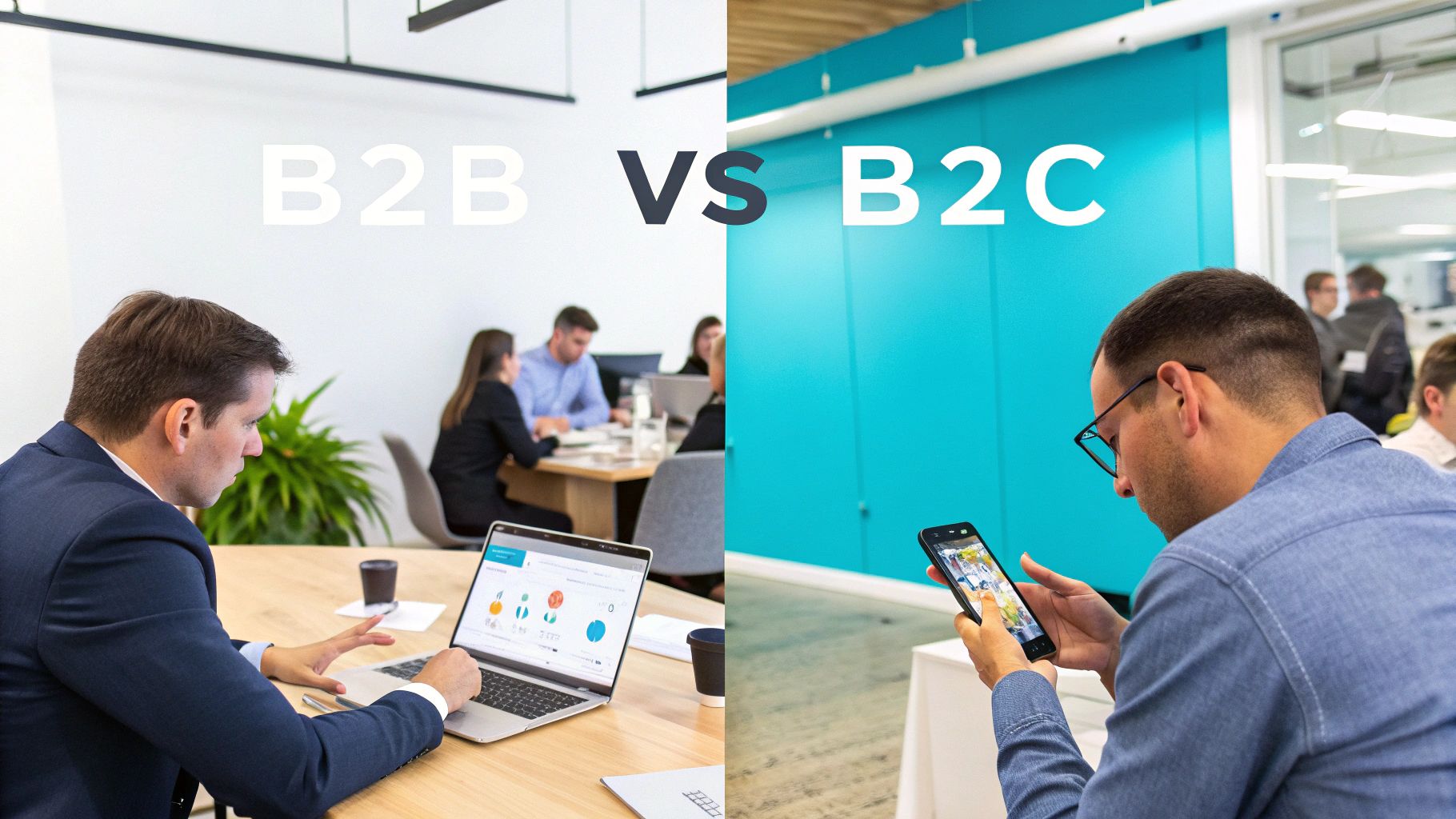
While B2B and B2C SaaS both run on subscriptions, they operate in completely different universes. Selling to a business is a strategic, long-term journey. Selling to a consumer is often a quick, emotional decision. Understanding what B2B SaaS means compared to its consumer-facing cousin is crucial for anyone involved in buying or selling software.
Think of it like buying a vehicle. A consumer (B2C) might impulsively buy a car in a single afternoon based on its color, style, and brand appeal. But a business (B2B) buying a fleet of delivery vans? That’s a long, drawn-out process involving multiple departments—Finance, Operations, and Legal—each digging into performance specs, long-term costs, and maintenance contracts.
Sales and Marketing Are Worlds Apart
The B2B sales cycle is significantly longer and more complex, period. It’s not uncommon for a single deal to involve a dozen decision-makers, from the end-users who will live in the software daily to IT, security, and the C-suite. A single enterprise deal can take months to close, bogged down by product demos, security reviews, and painstaking contract negotiations.
In contrast, B2C sales are almost always low-touch and high-volume. The whole machine is fueled by mass-market advertising and self-service sign-ups. The decision to subscribe is made by one person in a matter of minutes, not by a committee over several quarters.
The core difference lies in the customer relationship. B2B is about building a long-term strategic partnership, while B2C is focused on a high volume of individual, transactional sales.
This single distinction shapes everything from product design to the kind of customer support you can expect.
Product Requirements and Pricing Complexity
B2B SaaS platforms are built to solve specific, complex business problems. They are engineered for collaboration, ironclad security, and seamless integration with other corporate systems. Features like granular user permissions, audit logs, and compliance certifications aren't nice-to-haves; they are non-negotiable requirements for enterprise buyers.
B2C apps, on the other hand, are designed for individual enjoyment or simple personal tasks. Their entire focus is on a slick user experience and dead-simple functionality. Security is a background concern, not a primary selling point.
This complexity bleeds directly into the pricing:
B2B Models: Pricing is almost always tiered, based on the number of users, specific features, or usage volume (e.g., Basic, Pro, and Enterprise plans).
B2C Models: Pricing is typically a simple, flat-rate monthly or annual fee for one person's access.
To make these differences crystal clear, let's break them down side-by-side.
Comparison B2B SaaS vs B2C SaaS
The table below lays out the key operational, sales, and product differences between software sold to businesses versus software sold to individual consumers. It highlights just how different these two worlds are, even though they both use a subscription model.
Attribute | B2B SaaS (e.g., Logical Commander) | B2C SaaS (e.g., Netflix) |
|---|---|---|
Primary Goal | Increase efficiency, solve complex operational problems, and ensure compliance. | Provide entertainment, convenience, or personal productivity. |
Sales Cycle | Long and consultative, involving multiple departments (IT, HR, Security, Finance). | Short and transactional, often self-service and immediate. |
Pricing | Complex, tiered pricing based on users, features, or usage. | Simple, flat-rate subscription fees for individual use. |
Key Features | Robust security, deep integrations, user permissions, audit trails, and compliance tools. | Simple user interface, ease of use, and content library. |
Customer Support | Dedicated account managers, technical support, and in-depth onboarding. | Automated help centers, chatbots, and email support. |
As you can see, the goals, processes, and features are fundamentally different. B2B SaaS is built for organizational resilience and efficiency, while B2C SaaS is built for individual use and engagement. This distinction is the starting point for understanding the entire B2B SaaS landscape.
How B2B SaaS Companies Make Money: Business and Pricing Models
To really understand what B2B SaaS means, you have to look at how these companies actually make money. It’s not about a simple one-and-done software sale. The entire business is built around packaging value in a way that aligns with a customer’s own growth.
Think of the pricing model less as a price tag and more as a strategic tool. It's designed to create a long-term partnership, where the cost scales with the value you get.
Most companies run into a few common pricing strategies when they’re looking for new software. Each one is built for a different kind of customer and a different way of working, so knowing the difference helps you find the right fit.
Common Pricing Strategies
These are the models that determine how you’ll get billed for the service:
Per-User Pricing: This is the most straightforward model. You pay a flat fee for every person on your team who needs access. It’s predictable, easy to budget, and works perfectly for tools where individual access is everything, like a CRM.
Tiered Pricing: You'll often see features bundled into packages like 'Basic,' 'Pro,' and 'Enterprise.' This is a smart approach that lets you pay only for what you need right now, but it gives you a clear path to upgrade as your team—or your needs—get bigger.
Usage-Based Pricing: With this model, you pay for what you actually consume. Think data storage, API calls, or the number of transactions processed. It’s ideal for services where consumption can swing wildly because it ties your cost directly to the value you receive.
The right pricing model isn't just a number—it’s a reflection of the vendor's understanding of its customers. A good model grows with you, ensuring you only pay for the value you actually use.
Getting a handle on these pricing structures is the first step. The next is understanding how these companies actually get their products in front of customers.
Product-Led vs. Sales-Led Growth
Behind every successful B2B SaaS company, you'll find one of two primary growth engines—or a mix of both.
Product-Led Growth (PLG): Here, the product itself does the heavy lifting to acquire new customers. Think of companies that hook you with a freemium version or a free trial. You can sign up, start using the tool, and see its value for yourself long before you ever speak to a salesperson. This is a common strategy for tools with a massive potential user base and a clear, easy-to-grasp value proposition.
Sales-Led Growth (SLG): This is the more traditional route, relying on a skilled sales team to find, nurture, and close deals. It’s absolutely essential for complex, high-ticket products sold to large enterprises. In that world, the buying process involves multiple stakeholders, intense security reviews, and custom contracts that a self-serve model just can't handle.
Many of the smartest companies blend these two approaches. They might use a PLG motion to bring in smaller teams and then have their sales team step in to land those bigger enterprise accounts. To see how all these pieces fit together, you can dive deeper into the fundamentals of the SaaS B2B business model in our complete guide.
The Numbers That Drive a B2B SaaS Business
To really get what B2B SaaS means on a business level, you have to understand the numbers that run the show. These companies aren't just chasing one-time sales. Their success hinges on a handful of key performance indicators (KPIs) that reveal the true health, staying power, and growth potential of their subscription model.
Think of these metrics like the vital signs a doctor checks. A single number doesn’t tell the whole story, but together, they paint a crystal-clear picture of whether the business is thriving or just getting by. Speaking this language is essential for anyone buying, selling, or investing in B2B SaaS.
The Foundation: Recurring Revenue
The most fundamental metric of all is Annual Recurring Revenue (ARR), or its monthly twin, Monthly Recurring Revenue (MRR). This isn't just total revenue; it's the predictable, contractually obligated income a company knows it can count on over the next year. It’s the lifeblood of the SaaS model because it creates stability and a clear baseline for growth.
A rising ARR is a sign of a healthy, expanding customer base and is the number one indicator of scale. When you hear a SaaS company talking about its growth, they are almost always talking about its ARR.
The Cost of Growth: Customer Acquisition Cost
Next up is Customer Acquisition Cost (CAC). Put simply, this is the total amount of money a company spends on sales and marketing to land one new customer. It covers everything from sales team salaries and marketing campaign budgets to ad spend.
A low CAC is great, but the number is meaningless on its own. Its real importance only comes into focus when you stack it up against the value that customer brings in over time.
A sustainable B2B SaaS business is one that can consistently acquire new customers for less than the total revenue they will generate. This simple equation is the core of a scalable growth engine.
The Payoff: Customer Lifetime Value
That brings us to Customer Lifetime Value (LTV). This metric is all about predicting the total revenue a business can expect from a single customer account over the entire course of their relationship. A high LTV is a fantastic sign, showing that customers are sticking around longer and spending more—clear proof of a valuable product and happy clients.
The real magic happens when you compare LTV to CAC. A healthy LTV-to-CAC ratio is generally considered to be 3:1 or higher. This means for every dollar spent to win a customer, the company gets at least three dollars back.
The Leaky Bucket: Churn Rate
Finally, there’s churn, which measures the rate at which customers cancel their subscriptions. It’s the natural enemy of recurring revenue and one of the most critical numbers to keep an eye on. High churn can cripple even a fast-growing company.
Recent market data really drives home the importance of retention. While the industry average monthly churn rate has improved to around 3.5%, some sectors like Education have seen revenue churn spike, showing how economic pressures can test customer loyalty. Keeping that churn rate low is non-negotiable for long-term health, as you can see in these 2025 B2B SaaS startup benchmarks.
Real-World Examples of B2B SaaS Companies
Theory is one thing, but seeing B2B SaaS in action is what really makes the concept click. These tools are the engines running quietly in the background of almost every successful business, handling everything from customer relationships to the complex, high-stakes world of internal governance.
Let's look at a few examples to see just how diverse this space is.
Many of these are household names. Salesforce, for instance, basically created the modern CRM (Customer Relationship Management) category, giving sales teams a single source of truth for managing leads and customer data. In the same way, Slack completely changed how teams talk, replacing clunky email chains with real-time, channel-based collaboration. Both solve widespread, "horizontal" business needs that almost every company has.
A New Frontier in Enterprise Risk
While tools for sales and communication are now standard, a more specialized—and arguably more critical—category is rapidly taking center stage: internal risk and compliance management. This is where B2B SaaS moves beyond simple productivity to tackle some of the most sensitive challenges an enterprise faces, protecting the organization’s integrity from the inside out.
A prime example here is Logical Commander, an AI-powered platform designed for HR, Compliance, and Security teams. It helps organizations get ahead of internal threats, misconduct, and human capital risks. The key difference is its ethical-by-design framework, which completely rejects invasive employee surveillance.
Instead of reacting after the damage is done, this new generation of B2B SaaS makes proactive risk management possible while preserving employee dignity and privacy. It's proof that powerful technology and ethical governance don't have to be at odds.
This flowchart shows how key B2B SaaS metrics connect, from the initial cost of acquiring a customer to generating long-term revenue.
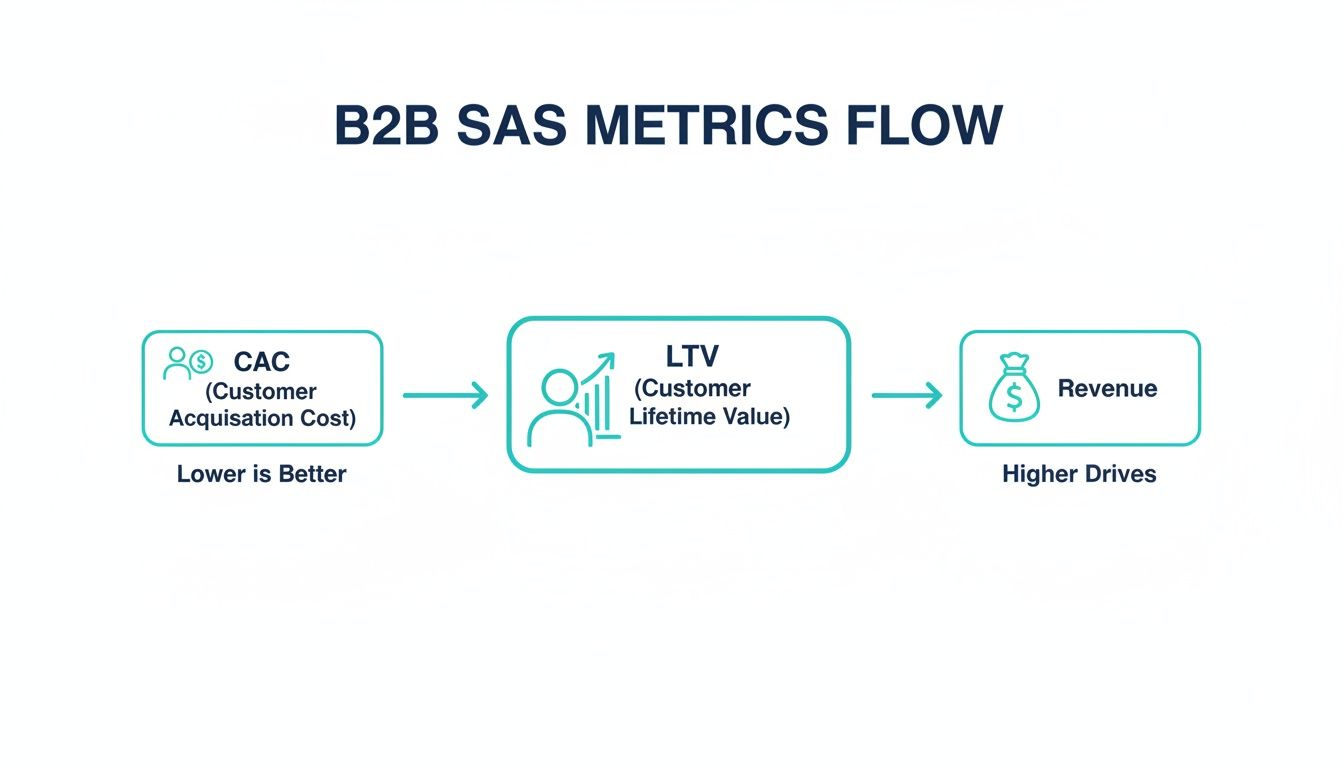
As you can see, a sustainable business model hinges on making sure the Lifetime Value (LTV) of a customer is significantly higher than the initial Customer Acquisition Cost (CAC).
Platforms like Logical Commander show just how specialized and sophisticated B2B SaaS has become. They offer solutions for critical functions that demand more than just efficiency—they require deep alignment with legal, regulatory, and ethical standards. This is the future of enterprise software: highly specialized tools that solve specific, high-stakes problems with both precision and responsibility. They aren't just software; they are core components of modern corporate governance.
A Practical Guide to Choosing the Right B2B SaaS
Picking a new B2B SaaS solution is a high-stakes decision. This is especially true for departments like HR, Security, and Compliance, where governance isn't just a buzzword—it's everything. You have to look past the slick demos and flashy features to conduct some serious due diligence.
This means digging into a vendor’s technical backbone, data handling practices, and even their ethical principles to make sure they're a true fit for your organization. A sloppy evaluation process can expose you to massive risk. A structured framework is your best defense against signing on with a tool that creates more problems than it solves.
Your Vendor Evaluation Checklist
Before any contract gets signed, your cross-functional team—and that absolutely has to include IT, Legal, and key department heads—needs to put the vendor through its paces. They must meet critical governance, risk, and compliance (GRC) benchmarks.
Here are the non-negotiable areas to investigate:
Security and Compliance Certifications: Look for hard proof that they adhere to international standards. Certifications like ISO 27001 for information security and attestations like a SOC 2 report aren't just nice-to-haves; they are baseline indicators of a mature security posture.
Data Privacy Adherence: The vendor has to show you exactly how they comply with relevant privacy laws. This includes GDPR for protecting EU citizens' data and CCPA/CPRA for California residents. Ask to see their data processing agreements and privacy policies. Don’t just take their word for it.
Seamless and Secure Integration: The software has to play nice with your existing tech stack without punching new holes in your security. Get confirmation that they offer secure APIs and have a proven history of successful integrations with your core systems, like your HRIS or identity management platforms.
The procurement process isn't just about buying software; it's about onboarding a new business partner. Their commitment to security and ethics becomes an extension of your own, directly impacting your organization's reputation and resilience.
Look Beyond the Tech to the Ethical Framework
Finally, it’s crucial to understand a vendor’s core principles, especially when the software will handle sensitive employee data or internal risk. The real meaning of a B2B SaaS partnership is revealed when their ethical framework is crystal clear.
For example, a platform like Logical Commander is built on an "Ethical by Design" foundation, which means it explicitly rejects any form of invasive employee surveillance. This commitment ensures that technology serves to uphold dignity and privacy, not undermine it.
Choosing a partner with a transparent, ethical approach is a key part of an effective integrated risk management solution that protects both the company and its people.
Common Questions About B2B SaaS
When you're looking at different solutions for your business, you're bound to have some questions. Let's dig into some of the most common ones we hear from decision-makers trying to choose the right tools for their teams.
Isn't On-Premise Software Safer and More Powerful?
That used to be the conventional wisdom, but the game has completely changed. The biggest advantage of B2B SaaS is the strategic shift from ownership to access.
With on-premise software, you're looking at a massive upfront capital expense for licenses and the servers to run it on. Then comes the real headache: the ongoing burden of maintenance, security patching, and manual updates, all of which fall squarely on your IT team's shoulders.
B2B SaaS flips that model on its head, turning a huge capital investment into a predictable operating expense. You get immediate access to powerful tools without the nightmare of managing the infrastructure. The real-world benefits are huge:
Drastically Lower Upfront Costs: Forget buying expensive servers or paying for massive perpetual licenses.
Always Up-to-Date: The vendor handles all the updates. You always have the latest features and critical security patches without lifting a finger.
Scales With You: You can add or remove users as your needs change on the fly, paying only for what you actually use.
How Can I Trust a Third Party with My Company's Data?
Data security is a shared responsibility, but reputable B2B SaaS vendors carry almost all of the weight. They are responsible for securing not just their application, but the entire cloud infrastructure it runs on. The best providers prove this through rigorous, independent third-party audits and certifications.
When you're evaluating a vendor, don't just take their word for it. Look for hard proof of their commitment to security frameworks like ISO 27001 and SOC 2. These aren't just badges they put on a website; they are concrete evidence of a mature, audited security program designed to protect your most sensitive data.
How Do I Pick the Right B2B SaaS for My Department?
This is the most important question. Start by clearly defining the problem you need to solve, not the list of features you think you want. Get a small, cross-functional team together that includes the people who will actually use the software every day, along with someone from IT and Legal.
Once you have your core needs defined, create a shortlist of vendors and evaluate them against the same consistent framework. Insist on product demos that solve your specific, real-world use cases, not just a canned sales pitch. Check for seamless integration with the systems you already rely on, and always, always perform thorough due diligence on their security and compliance posture before you sign anything.
At Logical Commander Software Ltd., we provide an AI-driven platform designed for HR, Compliance, and Security teams to proactively manage internal risks with an ethical-by-design framework. Learn how our solution can protect your organization's integrity.