%20(2)_edited.png)

A Practical Guide to B2B SaaS for Enterprise Leaders

Updated: Feb 5
Business-to-Business (B2B) Software as a Service (SaaS) is a model where software is licensed on a subscription basis and hosted centrally by the provider. For enterprise buyers, it means you access powerful tools over the internet rather than owning and maintaining the infrastructure yourself. This simple shift completely changes how you buy and use technology.
What B2B SaaS Really Means for Your Business
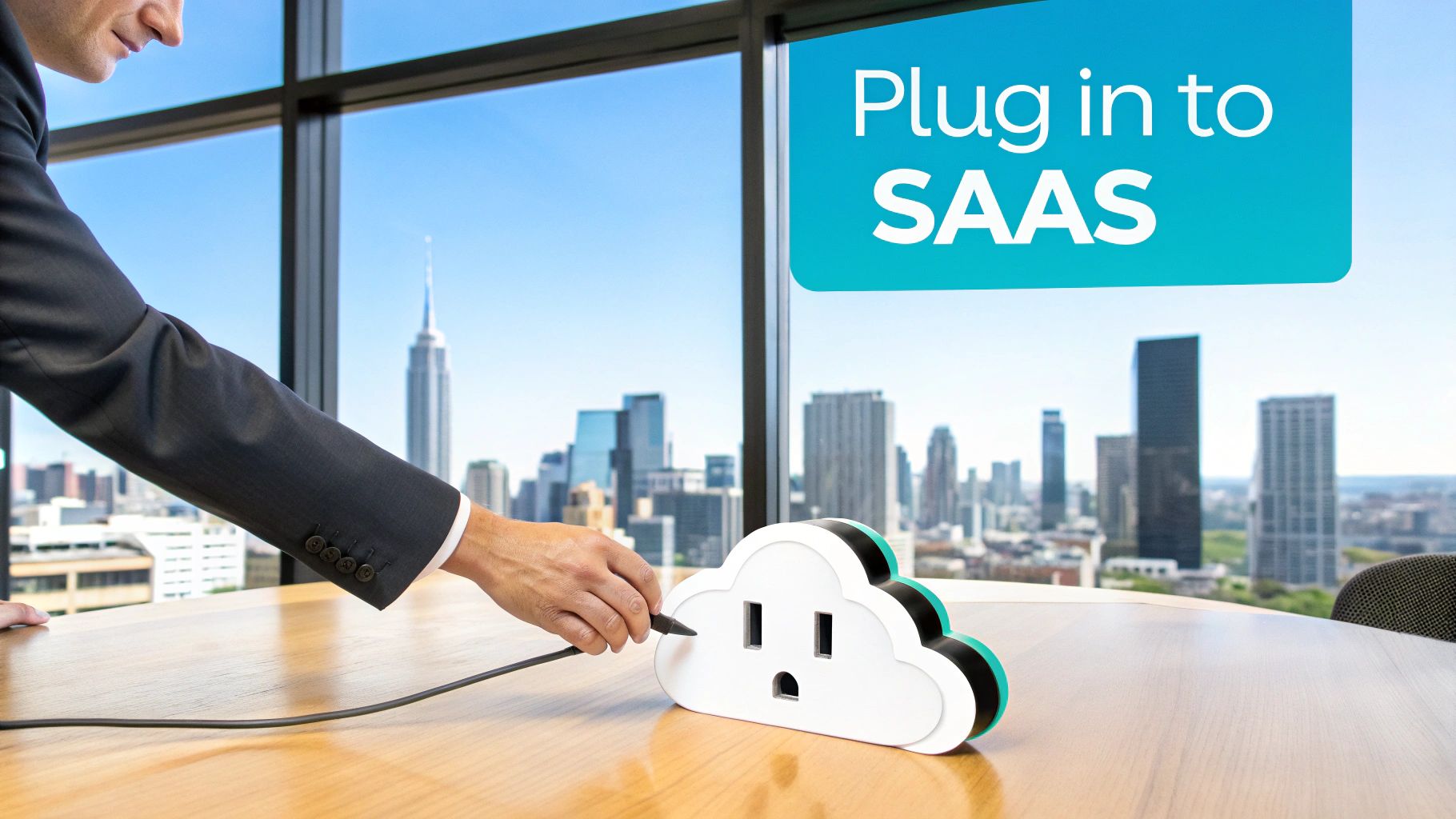
Let's cut through the technical jargon. Think of traditional, on-premise software like building your own power plant. It's a massive, resource-heavy project that demands a huge upfront investment, specialized staff for round-the-clock maintenance, and constant upgrades just to keep the lights on.
The B2B SaaS model is a totally different game. It’s like plugging your entire enterprise into a secure, expertly managed utility grid. You get immediate access to all the power you need, whenever you need it, without ever worrying about the generators, the wiring, or the engineers running the facility. That’s the core strategic shift SaaS offers.
Shifting from Capital to Operational Expenses
This "utility grid" approach completely transforms your financial strategy. Instead of a massive capital expense (CapEx) to buy software licenses and hardware, you move to a predictable operational expense (OpEx).
This shift brings some serious advantages:
Greater Budget Flexibility: Your costs become a predictable monthly or annual subscription. This makes financial planning far simpler and frees up capital for other strategic initiatives.
Reduced Total Cost of Ownership (TCO): You get to eliminate the hidden costs tied to maintenance, security patches, hardware refreshes, and all the dedicated IT overhead that comes with them.
Effortless Scalability: Need to add more users or access new features? You just adjust your subscription. Scaling up or down becomes a simple commercial conversation, not a complex engineering project.
This strategic pivot from ownership to access is why the B2B SaaS market is seeing such explosive growth. Valued at $390.5 billion in 2025, it's projected to hit $793.1 billion by 2029, showing just how fast organizations are ditching outdated models for more agile, cloud-based solutions. You can get more insights on the state of B2B SaaS in 2025.
Accessing Continuous Innovation
Maybe the most important benefit for leaders in Risk, HR, and Compliance is getting immediate access to innovation. In a world where regulations and threats change constantly, waiting for an annual software update is no longer a viable option.
With a B2B SaaS platform, updates, new features, and crucial security enhancements are rolled out continuously and automatically. This means your tools for managing critical functions like internal risk are always current. You effectively gain the power of a dedicated R&D team without adding a single person to your payroll, ensuring your organization stays agile, compliant, and secure.
How Modern B2B SaaS Architecture Works
To really trust a B2B SaaS platform with your organization's sensitive data, you need to look under the hood. While the technical jargon can sound intimidating, the core concepts are all built on the principles of security, efficiency, and—most importantly—connectivity.
Think of it this way: a well-designed architecture is the non-negotiable foundation that keeps your data secure, the service reliable, and the platform ready to grow with you. Let’s pull back the curtain on the key components that make it all work, using the analogy of a high-security, luxury apartment building designed exclusively for enterprises.
Understanding Multi-Tenancy
At the heart of almost every modern B2B SaaS platform is a concept called multi-tenancy. In our apartment building analogy, the SaaS provider owns and maintains the entire structure—the foundation, the power grid, the water supply, and the world-class security team guarding the entrance.
Every customer, or "tenant," gets to benefit from this incredibly robust, shared infrastructure.
However, each tenant has their own private, locked apartment unit. Inside that unit, all of their belongings (your data) are completely isolated and inaccessible to anyone else. This model is incredibly efficient. Costs for maintenance, security, and utilities are shared across all tenants, yet privacy and security are never compromised. This is exactly how top B2B SaaS providers deliver powerful, enterprise-grade services at a predictable cost.
The Role of Cloud Infrastructure
That massive, secure apartment building needs to be built on solid ground. This is where major cloud providers like Amazon Web Services (AWS), Microsoft Azure, and Google Cloud come in. They supply the global infrastructure—the data centers, servers, and networking—that a B2B SaaS platform is built upon.
Using these established cloud giants provides critical advantages that enterprises demand:
Global Scalability: The platform can easily handle more data and users as your organization grows, without hitting performance walls.
High Availability: These providers guarantee exceptional uptime, often promising 99.9% availability or higher, meaning the service is almost always online when you need it.
Disaster Recovery: They have redundant systems spread across different geographic locations, ensuring your data is safe even if a regional outage occurs.
A B2B SaaS provider’s choice of cloud infrastructure is a direct reflection of its commitment to reliability and security. By building on a foundation like AWS or Azure, they inherit decades of security expertise and a global footprint that would be impossible for a single company to replicate.
APIs: The Key to a Connected Enterprise
Now, imagine your secure apartment needs to connect to other essential services, like the mailroom, the parking garage, or a local grocery delivery service. You wouldn't just hand them the master key to your front door. Instead, you'd use a secure, controlled access point—like a special delivery slot or an intercom system.
In the software world, this is exactly what an Application Programming Interface (API) does.
APIs are the secure communication channels that allow different software systems to talk to each other without exposing their internal workings. For a platform like Logical Commander, this isn't just a feature; it's absolutely essential. APIs are what enable the system to integrate seamlessly with your existing HR information systems (HRIS), security tools, and other critical enterprise software.
This integration is what transforms a standalone tool into a central hub for your operational workflow. For instance, an API can pull relevant employee data from your HR system to inform a risk assessment, all without manual data entry or ever compromising the security of either platform.
To see how this works in practice, you can explore our detailed guide on a risk management API integration platform. This level of connectivity ensures data is always consistent, cuts down on manual work, and provides a unified view of risk across your organization, making the entire system more powerful and efficient.
Breaking Down B2B SaaS Pricing and Contracts
When you’re evaluating an enterprise B2B SaaS platform, the technology is only half the story. The commercial model—the pricing, the terms, the fine print—is every bit as critical. A good commercial structure creates a genuine partnership that helps you grow. The wrong one? It leads to surprise costs, budget headaches, and a whole lot of friction.
You have to look past the sticker price and really dig into the total cost of ownership (TCO). This is all about figuring out how a vendor's pricing will scale with your actual usage, your team’s size, and where your organization is headed in the next few years. A clear, straightforward commercial model is usually the first sign you’re dealing with a partner you can trust.
Common B2B SaaS Pricing Models
SaaS providers have come up with a few common ways to structure their pricing to fit different kinds of customers. Getting a handle on how each one works is the first step to finding a model that won't just fit your budget today, but will make sense for the long haul.
You’ll almost always run into one of these three models:
Per-User, Per-Month (PUPM): This is the classic. You pay a simple, flat fee for every person who needs a license. It’s predictable and a breeze to budget for, which makes it perfect for organizations where the number of users stays relatively consistent.
Usage-Based Pricing: With this model, your costs are tied directly to how much you use the platform. You pay for what you consume, whether that’s measured in API calls, data stored, or actions completed. It’s incredibly scalable and ensures you’re never paying for seats that just sit empty.
Tiered or Feature-Based Packages: Here, vendors bundle their features into different packages, often labeled something like Basic, Pro, or Enterprise. Each tier unlocks more advanced functionality for a higher price, letting you pick the package that lines up with what you need right now.
The architecture behind the scenes is what makes these flexible models possible.
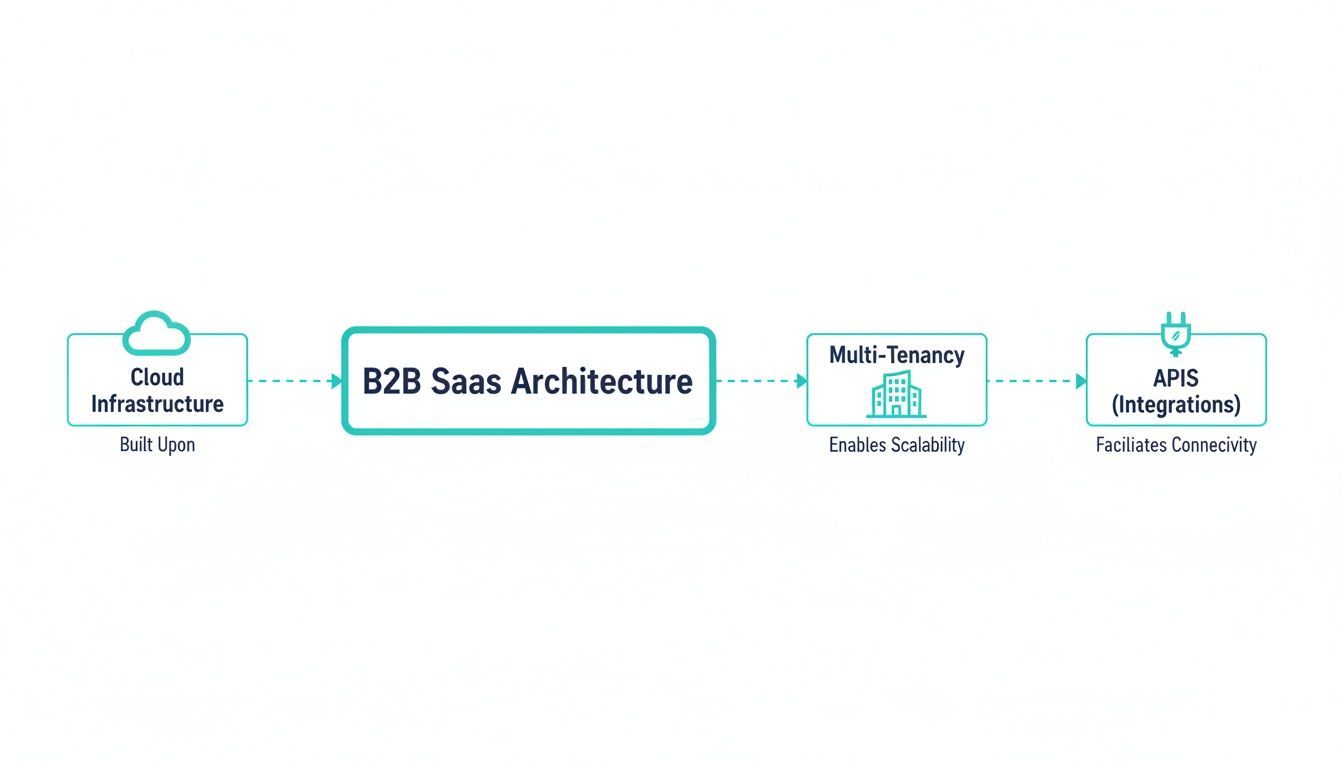
This diagram shows how cloud infrastructure, a multi-tenant setup, and APIs all work together to deliver a service that can scale up or down with your needs. To get a better grasp of how these recurring revenue models work, it’s worth exploring a detailed explanation of the subscription business model. That knowledge is key to judging the long-term value of any potential partner.
To make sense of these options, let’s break them down side-by-side.
Comparing Common B2B SaaS Pricing Models
Pricing Model | How It Works | Best For | Potential Drawback |
|---|---|---|---|
Per-User, Per-Month (PUPM) | A fixed monthly fee is charged for each individual user with access to the platform. | Stable teams where the number of users doesn't fluctuate much. Predictable budgeting. | Can get expensive if you have many occasional users. You pay for licenses even if they aren't being used. |
Usage-Based | Costs are directly tied to consumption metrics like API calls, data storage, or transactions. | Businesses with fluctuating needs or those wanting to ensure they only pay for what they use. | Can be difficult to predict and budget for, especially if your usage spikes unexpectedly. |
Tiered Packages | Features are bundled into different packages (e.g., Basic, Pro, Enterprise) at different price points. | Companies that want to start small and scale up, adding functionality as their needs evolve. | You might end up paying for features in a tier that you don't actually need just to get one critical function. |
Ultimately, the best model depends entirely on your operational needs. A predictable user base might benefit from PUPM, while a business with variable demand will find usage-based pricing far more efficient.
Reading Between the Lines of Enterprise Contracts
Okay, so you've found a pricing model that works. Now comes the really important part: the contract. This legal document is the blueprint for your entire relationship with the vendor, and a few specific clauses need a very close look from your HR, Risk, and Legal teams.
An enterprise SaaS contract is more than a purchase agreement; it's a blueprint for partnership. It defines responsibilities, sets performance expectations, and establishes the rules of engagement for a long-term relationship.
Make sure you zero in on these three areas:
Service Level Agreements (SLAs): An SLA is the vendor’s written promise on performance, especially guaranteed uptime. For any enterprise-level service, you should be looking for at least 99.9% availability. The SLA must also spell out exactly what happens—like service credits or other penalties—if they fail to hit that mark.
Data Ownership and Portability: This has to be crystal clear. The contract must state, without any ambiguity, that you own your data. Period. It also needs a solid data portability clause that details how you can export your data in a standard, usable format if you ever decide to leave.
Exit Strategy and Termination: Never get locked in. A clear exit strategy is non-negotiable. The contract should lay out the exact terms for termination, the required notice periods, and the vendor’s duty to help you transition smoothly.
The Bigger Picture: What’s Happening in the B2B SaaS Market?
Understanding the financial health of the B2B SaaS market gives you valuable context for these commercial talks. While the market is still growing, it’s not as white-hot as it was a few years ago. Median growth rates for 2024 are hovering around 25%, down a bit from 30% in 2023.
This cooling-off period means vendors are more focused than ever on keeping their existing customers happy. As a result, we've seen average monthly churn drop dramatically, from 7.5% in late 2021 to just 3.5% in early 2024. For a platform like Logical Commander, which is all about preventing insider misconduct, strong customer retention is a powerful signal of the trust and real-world value the platform delivers.
Your Vendor Evaluation and Procurement Checklist
Choosing the right B2B SaaS partner is one of the most important strategic decisions your organization will make. It’s about so much more than just comparing feature lists or prices. You are selecting a partner that will become deeply integrated into your daily operations and entrusted with your most sensitive data.
This requires a methodical evaluation process that goes far beyond a slick sales demo. For leaders in HR, Risk, and Security, this means scrutinizing a vendor's technical foundation, regulatory alignment, and long-term viability. The goal is to find a true partner invested in your success, not just another software supplier.
This checklist gives you an actionable framework to guide your procurement journey, making sure you cover all the critical bases before you even think about signing a contract.
Foundational Security and Compliance Verification
Before you even discuss a single feature, you have to validate a vendor's security and compliance posture. These certifications aren't just badges; they are proof of rigorous, third-party audits that verify a company’s processes for protecting information. In the world of B2B SaaS, these are non-negotiable table stakes.
Your initial diligence should confirm the following:
ISO 27001 Certification: This is the international gold standard for information security management. It proves the vendor has a systematic, repeatable approach to keeping sensitive company information secure.
SOC 2 (Type II) Report: A SOC 2 report details how a company safeguards customer data and how well those controls are actually working. A Type II report is crucial because it assesses these controls over a period of time, not just at a single moment.
Data Privacy Adherence (GDPR & CCPA): The vendor must clearly articulate how its platform complies with major privacy regulations like GDPR in Europe and CCPA/CPRA in California. Don't be afraid to ask for their data processing agreements and privacy policies.
A vendor that treats compliance as a core design principle—rather than an afterthought—builds its platform "under regulation." This ensures that every feature and workflow is inherently aligned with legal and ethical standards, protecting both your organization and your employees.
This level of scrutiny is especially important for solutions that manage human capital and internal risk. To better understand this area, our guide on third-party risk management software offers additional context.
Technical and Integration Capabilities
A powerful platform that can't connect to your existing systems creates data silos and soul-crushing manual work, defeating the entire purpose of the investment. Assessing a vendor’s technical flexibility is crucial for ensuring a smooth integration into your enterprise ecosystem.
Don't just take their word for it. It's time to dive into the specifics.
API Documentation Review: Ask for access to their API documentation. It should be clear, comprehensive, and well-maintained. Your technical team can quickly tell if it provides the endpoints needed to connect with your HRIS, security, and other critical systems.
Integration Case Studies: Request real-world examples of how they have integrated with systems similar to yours at other client organizations. This is where the rubber meets the road, providing actual proof of their capabilities.
Scalability and Performance: Inquire about their architecture and how it supports growth. Ask for hard metrics on uptime, latency, and how they handle sudden spikes in usage.
Vetting for a True Partnership
Finally, your evaluation has to assess the human element. A vendor's financial stability, customer support quality, and ethical alignment are just as important as the software itself. A great product backed by a weak company is a significant long-term risk.
Here's how you look beyond the product:
Request Customer References: Talk to current customers of a similar size and in a similar industry. Ask pointed questions about their experience during implementation, the quality of ongoing support, and the vendor's responsiveness to feedback.
Demand a Proof of Concept (POC): Never, ever skip this step. A POC allows you to test the software in your own environment with your own data. This is the ultimate test to validate a vendor's claims and ensure the solution truly meets your team's needs.
Assess Financial Stability: For a long-term partnership, you need a vendor that will be around to support you. Ask about their funding, profitability, and long-term business roadmap.
By following this structured approach, you move beyond simple feature-shopping. You begin the process of identifying a strategic B2B SaaS partner that is secure, reliable, and genuinely committed to your success.
Navigating Security and Regulatory Compliance
In any high-stakes business, especially when you're dealing with human-factor risk, security and compliance aren't just features. They are the absolute bedrock of trust. For any B2B SaaS platform handling sensitive information, this foundation is completely non-negotiable.
This is what separates a tool that creates risk from a partner that helps you manage it.
It means you have to look past the surface-level marketing claims and dig into the specific frameworks that govern modern data protection. Knowing what these certifications and regulations actually mean for your organization’s data is crucial. It gives you the power to tell the difference between vendors who just bolt on compliance features and those who build their entire platform on a regulatory-first foundation.
Decoding Key Security and Privacy Certifications
When a vendor says their platform is secure, you need proof. In the world of enterprise SaaS, that proof comes in the form of internationally recognized certifications. These aren't just badges for a website; they represent tough, independent audits of a company's systems, processes, and controls.
Think of them as a full structural inspection for a digital service. They confirm that the provider has a systematic, repeatable approach to protecting your information.
Here are the big ones to look for:
ISO 27001 (Information Security): This is the global gold standard. It verifies that a vendor has established and maintains a formal Information Security Management System (ISMS). This isn't just about firewalls; it’s a structured framework for managing sensitive company data, from risk assessment to incident response.
ISO 27701 (Privacy): This is a critical extension to ISO 27001, zeroing in on privacy information management. It provides a clear framework for managing Personally Identifiable Information (PII) and shows a real commitment to data privacy, aligning with the principles of regulations like GDPR.
A vendor holding both of these has proven its dedication to security and privacy at a fundamental level.
Built Under Regulation, Not Bolted On Later
Many software vendors treat regulations like a checklist—a list of features to add after the product is already built. A truly trustworthy partner takes a completely different path: they build their platform under regulation.
This means compliance isn't an afterthought. It's baked into the DNA of the software architecture and every single workflow from day one.
A platform designed 'Built Under Regulation' ensures that every feature inherently reinforces legal and ethical standards. This approach is critical for tools that support HR and risk functions, as it guarantees that technology serves to protect both the organization and its employees' dignity and rights.
For example, a regulation like the Employee Polygraph Protection Act (EPPA) strictly prohibits using lie detector logic. A compliant-by-design platform like Logical Commander doesn’t just avoid these methods—it makes them technologically impossible within the system.
Translating Global Regulations into Software Design
Dense regulations like the General Data Protection Regulation (GDPR) can feel like a mountain of legal jargon. But their core principles translate directly into practical software design that you can actually see and verify.
Let’s break down what key GDPR principles look like inside a B2B SaaS platform:
Data Minimization: The platform should only collect the data that is absolutely essential for its stated purpose. It avoids overreach, protecting employee privacy by design.
Purpose Limitation: Data collected for one reason (like a conflict of interest disclosure) cannot be used for another unrelated purpose without consent. The software must have technical controls to enforce this separation.
Storage Limitation: The system must include automated policies for data retention and deletion, ensuring sensitive information isn't kept indefinitely without a legitimate business or legal reason.
When you’re evaluating a vendor, ask them to show you exactly how their platform’s architecture enforces these principles. Their ability to give you a clear, confident answer is a powerful indicator of their compliance maturity.
For a deeper dive, our guide on how to conduct a thorough security risk assessment offers a valuable framework. This proactive approach ensures the technology you adopt reinforces ethics and protects your organization from the ground up.
Implementing SaaS and Leading Organizational Change
Here's a hard truth: deploying new software is just a project, but getting people to actually use it is a mission. The technical side of integrating a new B2B SaaS platform—the APIs, the data migration—is often the easy part. The real challenge, and where you'll find the most value, is navigating the human side of the equation.
Without a deliberate strategy for managing organizational change, even the most powerful platform will fail to deliver its promised ROI. It’s never enough to just hand your teams a new tool. You have to lead them through the process of adopting new workflows, new mindsets, and new habits.
A Phased Approach to Implementation
A successful B2B SaaS rollout is a carefully choreographed process, not a sudden flip of a switch. It starts long before the software ever goes live and is built on a foundation of solid stakeholder alignment. A structured, phased approach is the only way to ensure everyone is ready for the transition.
Consider this phased game plan:
Stakeholder Alignment: Before a single line of code is touched, get the leaders from HR, Legal, IT, and Risk in the same room. This core group needs to agree on the project's goals, scope, and what success actually looks like. A unified front here is non-negotiable for sending a consistent message across the business.
Data Migration and System Integration: Next, you get into the weeds. Work closely with the vendor and your IT team to map out the technical integration. This means mapping data fields, scrubbing existing data clean for migration, and setting up the APIs that will connect the new platform to your current systems, like your HRIS.
User Training and Workflow Redesign: This is far more than just teaching people where to click. Develop a comprehensive training program that’s tailored to different user groups. The focus should be on demonstrating how the platform plugs into redesigned, more efficient workflows for critical tasks like internal investigations or compliance reporting.
Leading Change and Building Buy-In
The biggest hurdle you'll face is almost always resistance to change. People are comfortable with their existing processes, and a new tool can feel like a major disruption. Your number one job is to turn that skepticism into enthusiasm by clearly communicating the "why" behind it all.
Focus your efforts on proactive communication and genuine support:
Communicate the Value: Don't just talk about features. Explain exactly how the new platform will make employees' jobs easier, cut down on manual work, and contribute to the organization's overall security and integrity. Frame it as an investment in their success.
Address Concerns Head-On: Create open forums where people can ask tough questions and voice their concerns. Acknowledging their anxieties and giving transparent answers is the fastest way to build trust.
Identify and Empower Champions: Find those enthusiastic early adopters in key departments. These champions become your boots on the ground, providing peer-to-peer support, sharing success stories, and building positive momentum from the inside out.
The ultimate goal of change management is to create genuine buy-in, where employees see the new B2B SaaS platform not as a mandate from leadership, but as a powerful tool that helps them perform their roles more effectively and ethically.
Measuring What Matters Most
Finally, to prove the platform’s value to leadership, you have to move beyond simple usage stats. Success needs to be measured with key performance indicators (KPIs) that tie directly back to the strategic goals you defined during the stakeholder alignment phase. These are the metrics that show a tangible return on investment.
Focus on KPIs that demonstrate real operational impact, such as:
Reduced Investigation Times: Track the average time from an incident report to its final resolution, showing exactly how the platform is speeding up your response.
Improved Auditability: Measure the time and resources it takes to prepare for internal or external audits, highlighting the efficiency gains from having centralized, clean documentation.
Proactive Incident Mitigation: Quantify the number of potential risks your team identified and addressed before they could escalate into significant issues.
By focusing on these outcomes, you prove that the B2B SaaS implementation wasn't just another software project—it was a strategic initiative that made the entire organization stronger.
When you're looking at different B2B SaaS solutions, especially for something as critical as internal risk, you’re bound to have questions. Let's dig into some of the most common ones we hear from decision-makers trying to navigate this space.
How Is My Data Secured in a Multi-Tenant B2B SaaS Environment?
This is a big one, and rightly so. In a properly built multi-tenant environment, your data is always logically isolated and encrypted, both when it's moving and when it’s stored. Think of it like a high-security bank vault filled with individual safe deposit boxes. While the building's guards and cameras protect everyone, only you hold the key to your specific box.
Any reputable vendor should be able to prove this with certifications like SOC 2 and ISO 27001. These aren't just badges; they are rigorous, independent audits that validate a company's controls for keeping your data segregated, confidential, and secure at all times.
What Happens to Our Data if We Terminate the Contract?
Enterprise-grade B2B SaaS contracts absolutely must have clear data portability and exit clauses. These terms spell out the exact process, format, and timeline for getting all of your organization's data back if you decide to end the agreement.
A trustworthy partner will give you a straightforward path to export your information in a standard, usable format, like CSV or JSON. It is vital to review these terms during procurement to confirm you maintain full ownership and control over your data, no matter what happens with the relationship.
How Do SaaS Platforms Stay Updated With Evolving Regulations?
Leading B2B SaaS providers, especially those in compliance-heavy fields, treat regulatory alignment as a continuous activity, not a one-off project. They have dedicated teams whose entire job is to monitor global regulatory changes.
Updates are rolled out automatically through the cloud, which means your organization stays compliant without needing manual patches or disruptive system overhauls. This agility is a massive advantage over on-premise software, where update cycles are slow and expensive, often leaving you exposed to new compliance risks while you wait.
Ready to see how an ethically designed platform can proactively manage internal risk without resorting to invasive surveillance? Logical Commander Software Ltd. offers a new approach.