%20(2)_edited.png)

A Strategic Guide to Compliance in Business

Updated: Jan 5
In plain English, compliance in business means making sure your company and everyone in it plays by the rules—all the applicable laws, regulations, industry standards, and ethical guidelines. But it's so much more than a legal obligation; it's the strategic backbone for operating with integrity and building a business people can trust.
Rethinking Compliance Beyond a Simple Checklist

For far too long, compliance has been treated like a chore—a reactive, box-ticking exercise you do just to avoid getting fined. This outdated view frames compliance as a cost center, a necessary evil to be managed, not embraced. In today’s world of intense scrutiny and complexity, that minimalist approach just doesn’t cut it anymore.
A much smarter, more strategic view is taking hold. Modern leaders see effective compliance as a proactive driver of growth, reputation, and resilience. It’s about building an ethical culture from the inside out, one that protects not just the bottom line but also your people and your brand. This flips compliance from a defensive game into a powerful competitive advantage.
This shift isn't happening in a vacuum. A few powerful forces are pushing HR, Security, and Risk leaders to think differently.
The Evolution of Business Compliance From Reactive to Proactive
The table below breaks down the critical shift from the old way of thinking about compliance to the modern, proactive model that’s becoming the new standard.
Dimension | Reactive Compliance (The Old Way) | Proactive Compliance (The New Way) |
|---|---|---|
Mindset | A cost center focused on avoiding penalties. | A strategic advantage that builds trust and resilience. |
Timing | Acts after an incident has already occurred. | Identifies and mitigates risks before they cause harm. |
Process | Manual, siloed, often reliant on spreadsheets. | Integrated, automated, and system-driven. |
Goal | "Tick the box" and meet minimum legal standards. | Build a sustainable culture of integrity. |
Tools | Spreadsheets, basic checklists, incident logs. | Centralized platforms, AI-driven insights, risk analytics. |
This evolution is about moving from a culture of enforcement to a culture of integrity, turning compliance from a burden into a core part of how a healthy business operates.
The Forces Driving a New Approach
The regulatory world is a moving target, with new rules constantly emerging to govern everything from data privacy to supply chain ethics.
Complex Regulations: Laws like the EU’s Forced Labor Regulation (EUFLR) and even marketing rules like the CAN-SPAM Act create huge obligations. A single email violating CAN-SPAM can trigger fines up to $53,088, showing just how high the stakes are.
Rising ESG Demands: Stakeholders—investors, customers, and employees—are demanding real transparency and accountability on Environmental, Social, and Governance (ESG) issues. A strong, proactive compliance program is the only way to meet those expectations.
Pervasive Digital Risks: As business becomes more digital, the risk of data breaches, insider threats, and other digital disasters skyrockets. Proactive compliance is your first line of defense, helping you spot and fix these weak points before they do real damage.
A proactive compliance framework changes the core question from, "What's the bare minimum we have to do to stay out of trouble?" to "How can we operate with integrity to build a stronger, more trustworthy organization?"
This change demands a move away from siloed, manual processes managed in spreadsheets. The real goal is to create an integrated system that connects departments and turns regulatory headaches into valuable operational intelligence. Technology is key here, allowing organizations to monitor risks ethically and respond effectively. By operationalizing policies and centralizing risk data, you build a resilient foundation for sustainable growth.
The Two Sides of Compliance: Legal and Ethical
Think about building a house. You wouldn't dream of starting without a solid foundation and a structure that meets every single local building code. That’s the legal and regulatory side of compliance—the non-negotiable rules you absolutely must follow to operate.
These rules are the concrete, steel, and wiring of your business. They dictate everything from how you handle customer data under GDPR to meeting workplace safety standards. They are the explicit "must-dos" and "must-not-dos" laid down by governments and industry bodies.
Failing to meet these standards isn't a minor slip-up; it's like building on unstable ground. The consequences can be catastrophic, leading to hefty fines, legal battles, and a total loss of your license to operate. It’s the absolute baseline for survival.
Understanding Legal and Regulatory Mandates
Legal compliance is all about the external rules your organization is required to obey. These aren't suggestions; they are enforceable laws with clearly defined penalties for getting it wrong.
Here are just a few areas where legal compliance is front and center:
Data Privacy and Security: Regulations like GDPR in Europe and CCPA in California set strict rules for how personal data is collected, stored, and used.
Financial Reporting: Public companies have to live by Sarbanes-Oxley (SOX) requirements to guarantee financial transparency and shut down fraud.
Workplace Safety: Standards from agencies like OSHA dictate the conditions needed to keep employees safe from physical harm.
Anti-Corruption Laws: The Foreign Corrupt Practices Act (FCPA) in the US, for instance, strictly prohibits bribing foreign officials.
To get a feel for how specific these rules can be, you can explore guides on topics like the UAE Commercial Companies Law. Resources like this show just how complex and jurisdiction-dependent legal adherence really is.
The Equally Vital Ethical Dimension
Now, picture that house again. The foundation is solid and the structure is up to code. But what about the design, the layout, and the overall environment? Is it a place where people feel safe, respected, and valued? This is the ethical side of compliance.
Ethical compliance is about the principles that guide behavior when the law is silent or unclear. It’s about building a culture of integrity that goes way beyond just avoiding penalties. It’s about doing the right thing, even when nobody is forcing you to.
Ethical compliance is about the "should we" questions, while legal compliance is about the "must we" questions. Both are essential for creating a resilient and trustworthy organization.
This is where your company’s values come to life. It’s about fostering honesty, managing conflicts of interest, promoting fairness, and ensuring every single decision reflects the organization's core principles.
Where Ethics and Law Intersect
While they seem distinct, legal and ethical compliance are deeply connected. An ethical lapse, like an unmanaged conflict of interest, can quickly spiral into a legal violation like bribery or fraud. A strong ethical culture acts as an early warning system, stopping issues before they become legal nightmares.
Think about these common scenarios where ethics are the first line of defense:
Conflicts of Interest: An employee favors a vendor owned by a family member, even if it's not the best deal for the company.
Use of Company Resources: Someone uses a corporate credit card for personal expenses, blurring professional and private lines.
Intellectual Property: A team member shares confidential project details with a former colleague now at a competitor.
The compliance technology market is exploding to help companies manage these complex risks. The compliance data management sector alone is projected to hit $16.6 billion in 2025 and is racing toward $41 billion by 2034. This growth is fueled by a massive surge in standards adoption; ISO 27001 certifications are soaring, with 81% of firms pursuing or holding them in 2025—a 14% jump from 2024. You can read more about these critical compliance statistics and trends to see where the market is headed.
How to Build a Resilient Compliance Framework
A resilient compliance framework isn't some static document you lock in a filing cabinet and forget about. Think of it as the central nervous system for your company's integrity. It's a living, breathing system that has to adapt to your business and the world around it, connecting every department to a shared set of rules and values so everyone is moving in the same ethical direction.
Building this system requires a blueprint. A truly effective framework rests on five interconnected pillars that work together to prevent, detect, and respond to risk. If you neglect even one, the whole structure becomes vulnerable.
This process flow shows how a foundation of legal and ethical principles is the only real path to a resilient business.
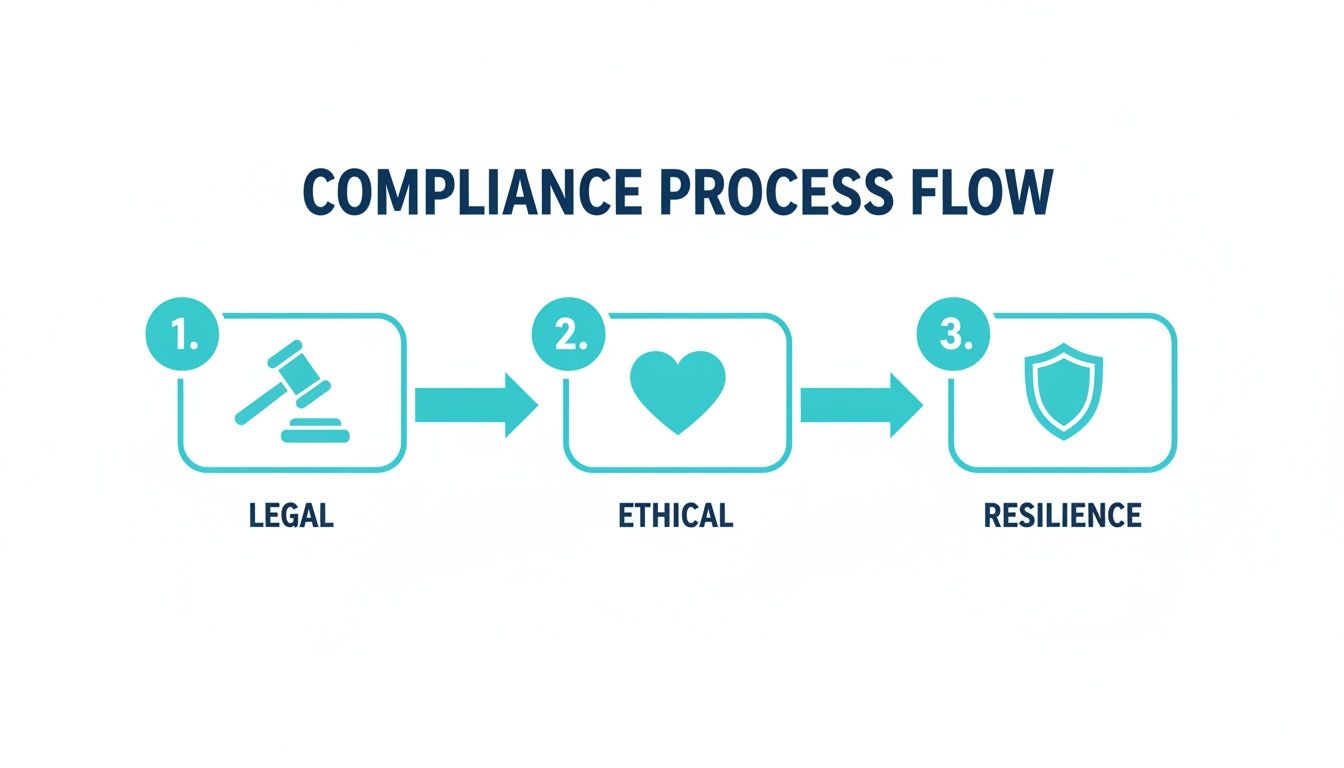
As you can see, resilience isn't an accident. It’s the direct result of weaving both the mandatory legal rules and your core ethical principles into the very fabric of your operations.
Component 1: Establish Clear Policies
The very first pillar is creating clear, accessible, and practical policies. These are your foundational rulebooks, translating complex laws and abstract values into everyday guidance your employees can actually use. Policies packed with vague language or dense legalese are completely useless; they have to be written for the people who need to follow them.
Your policies should cover everything from anti-corruption and data privacy to workplace conduct and conflicts of interest. For example, a clear data handling policy wouldn't just mumble something about GDPR. It would give specific, unambiguous instructions like, "Never share customer PII (Personally Identifiable Information) in unsecured channels like Slack or personal email."
A strong policy library gives everyone a clear point of reference for making the right call, forming the bedrock of any serious compliance in business strategy.
Component 2: Ensure Strong Governance
Policies are meaningless without governance—the structure of accountability that makes sure the rules are actually followed. This is all about defining who is responsible for what, from the board of directors all the way down to front-line managers. Strong governance assigns ownership and creates a crystal-clear chain of command for any compliance issue.
A critical, often overlooked part of governance is establishing the right business entity from the start. Understanding different legal formations, such as the various Canadian business structures, is a foundational step that defines your legal obligations from day one. That choice impacts everything from liability to tax compliance.
A well-governed compliance program ensures there are no gray areas. It clearly designates a Chief Compliance Officer or a similar role and empowers them with the authority and resources needed to oversee the entire framework effectively.
Ultimately, governance is about making compliance a shared responsibility, championed by leadership and understood by everyone.
Component 3: Deliver Comprehensive Training
You can have the best policies in the world, but if your team doesn’t know they exist—or doesn't understand them—they're just expensive paperweights. This is where comprehensive and continuous training comes in. Effective training isn't a one-and-done onboarding video; it's an ongoing program that keeps key principles top-of-mind.
Modern training ditches the dry lectures and uses real-world scenarios, interactive modules, and regular refreshers. Instead of a boring presentation on anti-bribery laws, an effective module might walk a salesperson through a scenario where they're offered an extravagant gift, forcing them to navigate the company's gift policy to respond appropriately.
This practical approach ensures people don't just memorize the rules, but actually know how to apply them in their daily work.
Component 4: Implement Continuous Monitoring
So, how do you know if your policies and training are actually working? Through continuous monitoring. The old model of flying in for periodic, manual audits is slow and reactive, usually discovering problems long after the damage is done. Modern compliance depends on proactive, automated monitoring.
These systems give you real-time visibility into potential risks without resorting to invasive surveillance. For example, instead of reading employee emails, a system might flag objective risk indicators like large data transfers to personal devices or unusual access to sensitive financial records outside of business hours. This approach respects privacy while identifying patterns that warrant a closer look.
This move from periodic spot-checks to continuous oversight lets you detect and neutralize risks before they escalate into major incidents. You can learn more by exploring our detailed guide to building a compliance risk management framework that integrates these modern principles.
Component 5: Create Transparent Reporting Channels
The final pillar is creating safe, accessible, and transparent channels for employees to report concerns. A "speak-up" culture is one of the most powerful tools in your compliance arsenal. Your people are often the first to notice when something is wrong, but they'll only come forward if they feel psychologically safe.
This requires giving them multiple options to report what they see, such as:
Anonymous Hotlines: Allowing employees to voice concerns without fear of immediate identification.
Designated Compliance Officers: Providing a direct, human point of contact for sensitive issues.
Digital Reporting Platforms: Offering a structured and confidential way to submit concerns online.
Crucially, every single report must be taken seriously, investigated impartially, and followed up on. When employees see their concerns lead to real action, it reinforces their trust in the entire system, closing the loop and making your whole framework stronger.
Creating a Culture of Integrity and Accountability
A perfectly designed compliance framework is useless if it just sits on a shelf. The real strength of your program isn’t in the policies themselves, but in the people who bring them to life every single day.
True resilience comes from building a culture where integrity isn't just a top-down mandate—it's a shared value. This means shifting the focus from enforcement to empowerment. When you get this right, compliance stops being a siloed function and becomes a collective responsibility.
This foundation is built on clarity. Everyone, from the C-suite to the front lines, needs to understand their specific part in upholding the company’s standards. Without that shared understanding, even the best-written policies are just words on a page.
Defining Roles and Fostering Collaboration
Modern compliance is a team sport. It demands seamless collaboration between departments that, in the past, often operated in their own worlds. Each player has a distinct but connected role in spotting and neutralizing risk.
The Chief Compliance Officer (CCO): This leader is the central strategist. They oversee the entire framework, advise leadership, and make sure the program stays sharp and relevant.
HR and People Operations: This team is on the front lines of culture. Their job is to weave compliance principles into hiring, onboarding, training, and performance management.
Security and IT: As the guardians of your digital assets, this department puts the technical controls in place to enforce data privacy policies and protect against internal risks.
Every Employee: Each team member is a sensor for the organization's health. They have a fundamental duty to understand the policies that affect them, act with integrity, and speak up when something feels off.
When these functions work in concert, they create a powerful, unified defense. Imagine HR flagging a behavioral concern during a review. Security can then correlate that with unusual data access, allowing for a proactive response before a small problem becomes a major incident.
Cultivating a Speak-Up Culture
The single most valuable asset in any compliance program is an employee who feels safe enough to raise their hand and voice a concern. A "speak-up" culture, built on a bedrock of psychological safety, is your best early-warning system for hidden risks.
But here’s the catch: employees will only report potential misconduct if they genuinely trust the system and believe they’ll be protected from retaliation.
A healthy speak-up culture is one where reporting a concern is seen as an act of loyalty to the organization and its values, not as a disruption. It requires unwavering commitment from leadership to protect whistleblowers and act decisively on every report.
This trust isn't built overnight; it's earned through consistent action. You have to provide multiple, easy-to-access reporting channels—like anonymous hotlines or dedicated digital platforms—and ensure every single submission is investigated impartially.
When people see that their concerns are taken seriously and lead to real outcomes, they’re far more likely to come forward again. Building an ethical workplace culture is a continuous process that requires reinforcing these principles through both words and, more importantly, actions.
Measuring the Health of Your Compliance Culture
You can’t manage what you don’t measure. Gauging the health of your compliance culture means looking beyond simple pass/fail metrics. You need a blend of quantitative and qualitative data to get a true picture of how well your values are actually taking hold across the organization.
Consider tracking a balanced scorecard of indicators:
Training Engagement: Don't just look at completion rates. Are employees actively participating in sessions? Are they asking thoughtful, challenging questions? High engagement is a great sign that the material is actually resonating.
Incident Report Volume: An increase in reports isn't always a bad thing. In fact, it often means employees trust the reporting process more, not that there are suddenly more problems. A sudden drop, on the other hand, could be a red flag for a culture of fear.
Employee Surveys: Use anonymous pulse surveys to ask direct questions about ethics. Ask if people feel comfortable reporting misconduct, if they believe leaders act with integrity, and if they really understand the company's code of conduct.
Time to Resolution: How quickly are reported incidents investigated and closed? A swift, fair process sends a powerful message that the organization takes these matters seriously.
By analyzing these metrics together, leaders can get a clear, honest view of their cultural health, spot areas for improvement, and take targeted action to reinforce integrity and accountability.
Using Technology for Smarter Compliance Management

Trying to manage compliance with spreadsheets and scattered email chains is like navigating a modern highway with a horse and buggy. It’s slow, riddled with errors, and simply can't keep up with the speed and complexity of today’s business risks. To get a real handle on compliance in business, organizations have to turn to technology.
Modern platforms offer a way to automate workflows, centralize risk intelligence, and create a complete, auditable trail of every compliance action. This isn't just about efficiency. It's about gaining the operational visibility needed to spot and neutralize risks before they cause serious financial or reputational harm. The right tech transforms compliance from a reactive, paper-pushing exercise into a proactive, strategic function.
This shift is already happening. A staggering 85% of global companies say compliance requirements have grown far more complex in just the last three years. In response, 49% now use tech for 11 or more compliance tasks, with training (82%), risk assessments (76%), and monitoring (75%) leading the charge. With 82% planning to increase investments in automation, the trend is clear. PwC's Global Compliance Survey offers more insights into how companies are adapting to these challenges.
Ethical Monitoring Over Invasive Surveillance
The idea of using technology to monitor internal activities often brings up images of a "Big Brother" surveillance culture that destroys trust. But the goal of modern compliance technology isn't to spy on people. It's to identify objective risk indicators in an ethical, privacy-safe way.
Think of it like a smoke detector in an office building. It doesn’t watch the employees; it monitors the air for specific particles that signal a potential fire. In the same way, advanced compliance platforms are built to detect factual, high-risk events, not to make subjective judgments about anyone's intentions or character.
This approach hones in on patterns that violate established company policies, such as:
An employee trying to access a highly sensitive project folder they aren't assigned to.
A large volume of confidential data being moved to an external, personal storage device.
Communication with a vendor who has been flagged for a potential conflict of interest.
By focusing on these objective, verifiable indicators, the system provides an early warning without crossing ethical or legal lines. It flags the "what," not the "who" or "why," allowing human experts to conduct a fair investigation based on concrete evidence.
From Reactive Tools to Proactive Intelligence
For years, compliance tools were purely reactive. They were used after an incident to investigate what went wrong, acting more like digital forensics kits than proactive risk management systems. Today’s leading platforms flip that model on its head by focusing on prevention.
The core principle of smart compliance technology is to shift from investigating past failures to anticipating future risks. This is about knowing first and acting fast, transforming scattered data points into actionable intelligence.
Instead of waiting for a whistleblower report or a failed audit to reveal a problem, these systems continuously scan for early warning signs. They centralize information from across the organization, breaking down the dangerous silos that often hide emerging threats. For instance, a signal from HR about an employee under extreme pressure could be correlated with a security alert about unusual login activity, creating a much clearer risk picture.
This integrated approach is the foundation of effective compliance risk management software, which connects disconnected departments under a single, unified operational platform.
Centralizing Risk and Ensuring Auditability
One of the biggest headaches in compliance is maintaining a consistent, auditable record. When information is scattered across spreadsheets, emails, and disconnected systems, proving due diligence to regulators becomes a nightmare. A centralized technology platform solves this by creating a single source of truth.
Every policy acknowledgment, training completion, incident report, and investigation step is logged in one secure, traceable system. This creates an unshakeable audit trail that demonstrates the organization's commitment to its compliance framework. For leaders in HR, Security, and Compliance, this isn't just a convenience—it's a critical shield against legal and regulatory scrutiny. It provides definitive proof that the company has a robust system in place to uphold its legal and ethical obligations, making every action documented, transparent, and defensible.
Your Action Plan for Strategic Compliance
Alright, let's turn all this theory into a practical game plan. Shifting your company’s approach from a reactive, box-checking chore into a genuine strategic advantage starts with a few deliberate steps. This is about moving beyond the chaos of scattered spreadsheets and siloed departments for good.
Your first move is to take an honest, unflinching look at where you stand right now. Where are the real gaps? Are you still leaning on manual tracking for critical tasks, leaving the door wide open to human error and massive blind spots? Pinpointing these vulnerabilities is the first step in building a rock-solid case for a smarter approach.
Building Your Business Case
Getting buy-in for a modern, unified platform isn't just a tech request; it's a strategic imperative. You have to frame the conversation around the tangible value it delivers, moving it away from "cost" and toward "investment."
Here’s how you do it:
Talk About Risk Reduction: Start by putting a number on the potential cost of non-compliance. Think fines, legal fees, and the kind of reputational damage that takes years to repair. A centralized, tech-driven system gives you a defensible, auditable trail that stands up to scrutiny.
Highlight Operational Efficiency: Do the math. Calculate the hours your teams waste every week on manual data entry, chasing down information from other departments, and scrambling to prepare for audits. This is time that could be spent on work that actually grows the business.
Show the Power of Collaboration: Make it clear how a single source of truth breaks down the walls between HR, Security, and Legal. When everyone is working from the same playbook, you can spot and respond to risks faster and with far more precision.
This reframes the entire discussion. You're no longer just asking for a budget; you're showing how proactive compliance in business directly protects the bottom line.
The ultimate goal is to turn business risk into strategic intelligence. A modern, tech-enabled framework doesn't just prevent negative outcomes; it provides the visibility needed to make smarter, more ethical decisions that strengthen the entire organization.
The path forward is clear. It’s time to adopt a proactive, ethical, and technology-driven approach to managing compliance. When you do, you’re not just safeguarding the organization’s future—you’re building a resilient culture of integrity that becomes a true competitive advantage. This is your chance to lead the charge.
Your Questions, Answered
When you’re in the trenches trying to build a resilient compliance program, theory is one thing, but practice is another. Leaders in HR, security, and risk management often run into the same practical questions. Let's dig into some of the most common ones we hear from decision-makers.
These aren't textbook definitions. They’re straight answers designed to give you clarity on the real-world challenges of turning compliance policy into a living, breathing part of your culture.
What Is the Difference Between Compliance and Risk Management?
It’s easy to see them as the same thing, but they’re two sides of the same coin. Think of compliance as the set of non-negotiable rules you absolutely must follow—the specific legal and regulatory standards like GDPR or SOX. It’s about adhering to external mandates.
Risk management, on the other hand, is a much broader strategic function. It’s the process of identifying, assessing, and neutralizing all potential threats to the business, including financial, operational, and reputational risks. Compliance is a critical piece of risk management, but risk management also covers strategic threats where no explicit law exists.
How Can Small Businesses Handle Compliance Effectively?
Small businesses don't have the massive resources of a large enterprise, but compliance is just as critical for them. The trick is to be smart, scalable, and focused. You don't need to boil the ocean; start by identifying the biggest risks for your specific industry and location.
Prioritize Core Policies: Start by creating simple, clear policies for the absolute essentials like data privacy, workplace conduct, and conflicts of interest. Get the fundamentals right first.
Use the Right Tech: Ditch the manual spreadsheets. Cost-effective software can automate tracking and training, saving you time and dramatically reducing the risk of human error.
Get Expert Guidance: It’s worth the investment to consult with a legal or compliance expert for the initial setup. This ensures your foundation is solid from day one.
A small business can build a formidable compliance program by tackling the highest-impact areas first and scaling its efforts as the company grows.
Who Is Ultimately Responsible for Compliance in an Organization?
While a Chief Compliance Officer (CCO) might run the day-to-day program, the ultimate responsibility for compliance sits squarely with the board of directors and senior leadership. They’re the ones accountable for setting the ethical tone, allocating the right resources, and ensuring a culture of integrity is more than just a poster on the wall.
But on a practical, daily basis, compliance is everyone's job. Every single employee has a duty to understand and follow the policies that apply to their role. This sense of collective ownership is what transforms a compliance program from a binder on a shelf into a core part of how the company operates.
How Do You Measure the ROI of a Compliance Program?
This is a tough one for many leaders because the greatest value of compliance is in what doesn't happen. The primary ROI comes from cost avoidance.
A proactive program that prevents even one major incident can pay for itself many times over. You're not just measuring dollars saved; you're measuring the crises you avoided—the fines, legal battles, reputational hits, and lost business that never came to pass because your framework held strong.
Logical Commander Software Ltd. provides an AI-driven enterprise platform that turns compliance from a reactive chore into proactive, strategic intelligence. By identifying ethical risk indicators without invasive surveillance, our E-Commander platform helps you know first and act fast, protecting your organization while respecting your people. Learn how to build a resilient, privacy-safe compliance framework at https://www.logicalcommander.com.