%20(2)_edited.png)

Elements of effective compliance program: Core Components for Success

Updated: Jan 5
An effective compliance program is far more than a dusty rulebook collecting cobwebs on a shelf. It’s a living, breathing system that acts as your organization's immune system. Its entire purpose is to proactively identify and neutralize regulatory, legal, and ethical threats before they snowball into real harm, protecting your reputation and paving the way for sustainable growth.
The Strategic Value of a Modern Compliance Program
It’s time to stop thinking of compliance as a cost center. It's a strategic asset. A reactive, "check-the-box" approach just doesn't cut it anymore. Today, regulators, customers, and partners expect a proactive, ethics-driven culture that weaves integrity into the very fabric of your business. This shift turns compliance from a defensive chore into a powerful value driver that builds deep, lasting trust.
A truly effective framework is built on a handful of foundational elements that all work in concert. This isn't just a list of tasks; it’s a cohesive strategy focused on being proactive, driven by ethics, and creating real business value.
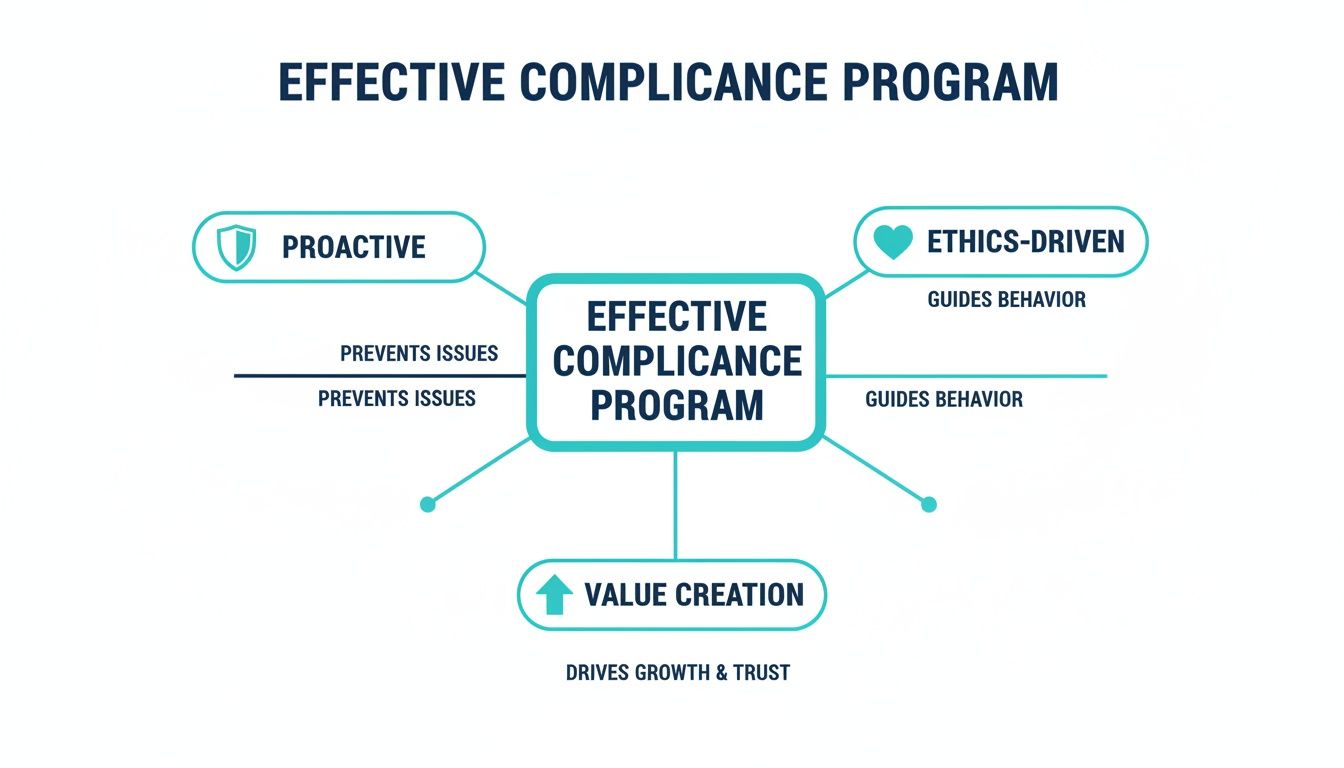
This visual drives home a critical point: a modern program isn’t just about dodging penalties. It's about nurturing an ethical core that actively fuels business success. To really get your arms around what this means in practice, this practical guide to risk and compliance offers some great insights into managing both the legal must-haves and the operational hazards.
Foundational Principles of an Effective Program
At its heart, a successful program is what moves an organization from simply following rules to genuinely embodying its values. The core elements of an effective compliance program are designed to build a resilient and accountable organization from the ground up. This really comes down to three key activities:
Proactive Risk Identification: Actively hunting for potential trouble spots instead of waiting for them to pop up during an audit or, worse, after an incident.
Integrated Policies: Weaving compliance requirements directly into daily workflows so that doing the right thing becomes a natural, seamless part of getting the job done.
Cultural Reinforcement: Using training, communication, and clear leadership to constantly reinforce what’s expected and what the organization stands for.
A well-designed compliance program doesn't just prevent wrongdoing; it empowers employees to make the right decisions with confidence, turning every team member into a guardian of the organization's integrity.
When you bring these components together, you create a system that does more than just shield you from legal and financial penalties. It actually strengthens your position in the market as a trustworthy, reliable, and ethical company to do business with.
Establishing Your Compliance Foundation

Every strong building needs a solid foundation, and an effective compliance program is no different. Three core elements—strong governance, a sharp risk assessment, and crystal-clear policies—provide the essential support for everything that follows. Without them, even the most well-intentioned efforts can crumble under regulatory pressure.
These pillars aren't just administrative boxes to tick. They are active, dynamic components that set the tone, define your priorities, and give your entire organization the practical guidance it needs to operate with integrity, day in and day out.
Governance and Tone from the Top
If there’s one thing that makes or breaks a compliance program, it’s the tone from the top. When leadership visibly champions and consistently demonstrates a commitment to ethical conduct, it creates a powerful ripple effect across the entire company. This goes far beyond just appointing a compliance officer and calling it a day.
Real governance means leaders are actively involved. They allocate the necessary resources, and most importantly, they hold themselves accountable to the same high standards they set for everyone else. Employees are smart; they see when executive actions match up with company values—and when they don’t. This perceived authenticity is what turns compliance from a theoretical concept into a lived reality.
When employees see that leadership holds compliance in high regard, they are encouraged to do the same. This visible commitment is the bedrock of an ethical culture, turning policies into principles that guide everyday decisions.
Proactive Risk Assessment
Once leadership has set the direction, the next job is to map the terrain. A compliance risk assessment is your organization’s GPS, helping you identify and navigate the specific hazards your business faces. It’s a methodical process of looking at your operations from every angle to pinpoint where you are most vulnerable to legal, regulatory, or ethical breaches.
An effective risk assessment boils down to answering two fundamental questions:
Where are we operating, and what specific regulations apply to us?
What activities or processes inside our business could potentially violate these rules?
For example, a fintech company handling customer data must obsess over its risks related to privacy laws like GDPR. A manufacturer, on the other hand, might focus more on environmental regulations and supply chain integrity. This targeted approach ensures your compliance efforts are concentrated where they matter most, making every dollar and hour count. In fact, this is one of the key pillars in any essential governance policy framework, as it informs every action you take afterward.
Crafting Clear Policies and Procedures
With a solid understanding of your risks, the final foundational step is creating the rulebook. Policies and procedures are the tangible guidelines that translate your ethical principles and legal duties into practical, everyday instructions for your team.
The goal here is to create documents that are actually useful—accessible, easy to understand, and integrated into daily workflows, not buried in some forgotten folder on the company intranet. For example, a cornerstone of any robust program involves mastering record retention guidelines to ensure information is managed correctly from creation to disposal.
These documents must be living resources, regularly updated to reflect new regulations or changes in your business. When employees have clear, straightforward guidance, they’re empowered to make the right calls with confidence, reinforcing the strong foundation you’ve built.
Bringing Your Compliance Program to Life
You’ve built a strong foundation with leadership buy-in, a solid risk assessment, and clear policies. But a plan on paper is just theory. Its real value comes to life when it’s activated through your people and processes.
This is where you turn passive documents into active, daily practices. It's about bringing the program to life with targeted training, vigilant monitoring, and trustworthy reporting channels that people actually use. These are the elements that transform a static rulebook into a dynamic system that breathes life into your company's ethical culture.
Training and Communication That Actually Sticks
Even the most brilliant policies are useless if your employees don't know they exist or, worse, don't understand how to apply them in the real world. Effective training and communication are the bridges connecting your compliance framework to the daily decisions your teams make.
This means getting far away from the dreaded once-a-year, check-the-box training session. Nobody remembers those.
Instead, think of training as an ongoing campaign. It needs to be engaging, relevant, and tailored to the specific risks different teams face. Your sales team, for example, needs deep-dive training on anti-bribery rules, while your IT crew requires intensive education on data privacy. It's no surprise that 42% of compliance professionals say that just getting employees trained on policies is a top challenge.
The goal of training isn't just to inform, but to empower. A well-trained employee doesn't just know the rules; they understand the 'why' behind them and can confidently navigate ethical gray areas when they arise.
Effective communication is also a two-way street. It's not just leadership talking at employees. It’s about creating a dialogue where questions are welcome and updates are shared openly. To learn more about designing education that has a real impact, explore our detailed guide on building an ethical and low-risk corporate compliance training program.
Monitoring and Testing Your Controls
So, how do you know if your compliance program is actually working? You can't just cross your fingers and assume your policies are being followed. Monitoring and testing are the engine room of your program, giving you the critical feedback loop that shows what’s working and where you’re vulnerable.
These two activities are different but work hand-in-hand:
Monitoring: Think of this as the dashboard in your car, providing constant, real-time feedback. These are ongoing checks built right into your daily operations, like an automated alert that flags an unusually large payment to a new vendor.
Testing (or Auditing): This is more like taking your car to the mechanic for a full diagnostic. It involves periodic, deep-dive reviews of specific areas, like a quarterly audit of the marketing team's expense reports to check for policy violations.
You need both. Monitoring catches issues as they happen, while testing uncovers systemic problems that might not be obvious from the day-to-day view. A staggering 65% of compliance professionals agree that using technology to automate these processes is the key to making them manageable and affordable.
Creating Safe Channels for Reporting and Investigations
The final piece of the puzzle is having a system for when things go wrong. Because eventually, they will. Reporting and investigation mechanisms give your employees a safe, confidential way to raise concerns without fearing retaliation. This is one of the most vital signs of a healthy compliance program.
You can use an anonymous hotline, a dedicated email address, or a web portal. Honestly, the tool you use is less important than the trust employees have in the process. They have to believe their concerns will be taken seriously and investigated without bias.
Once a report comes in, a clear, consistent, and fair investigation process has to kick in. This ensures every allegation is handled methodically, protecting both the whistleblower and the person being accused. This process is what builds institutional trust and proves the company is committed to its standards, no matter who is involved.
Of course. Here is the rewritten section, crafted to sound like it was written by an experienced human expert.
Putting Teeth into Your Policies
A compliance program is only as strong as its follow-through. It’s one thing to have a beautifully written policy manual, but it’s another thing entirely to prove that those policies mean something in the real world. This is where the rubber meets the road—where accountability becomes tangible and your program’s reach extends beyond your own four walls.
This is all about creating a system where rules are actually enforced, every action is documented, and risk is managed even when it’s coming from your partners. These elements are what show regulators, customers, and your own people that your commitment to compliance is a core operational discipline, not just corporate lip service.
Enforcement and Corrective Action
Let's be blunt: a policy without consequences is just a suggestion. The element of enforcement and corrective action is what gives your compliance program its authority. It sends a clear, unambiguous message that violations—whether they’re accidental slip-ups or intentional misconduct—will be handled fairly and consistently for everyone, from the front lines right up to the C-suite.
Just imagine a workplace where some employees get a slap on the wrist for breaking the rules, while others face serious consequences for the same mistake. That kind of inconsistency guts morale and signals that the policies are arbitrary. A structured disciplinary process, applied uniformly and communicated clearly, is the bedrock of a culture built on integrity.
But this isn't just about punishment. It's about showing that compliance is a serious business responsibility. Corrective actions can be as simple as required retraining for an honest mistake or as serious as termination for deliberate wrongdoing. The key is that every incident becomes a teachable moment to reinforce your standards and prevent the same issue from happening again.
Consistent enforcement is the ultimate proof of an organization's ethical commitment. It sends an unmistakable message that no one is above the rules, reinforcing the 'tone from the top' with tangible action.
The Power of Meticulous Recordkeeping
Often dismissed as a tedious chore, recordkeeping and documentation is secretly one of the most powerful parts of a great compliance program. Don’t think of it as filing paperwork; think of it as building your case. You're creating a definitive, rock-solid audit trail that proves your due diligence to anyone who comes knocking.
When an incident happens or an auditor shows up, your best defense is your ability to produce clean, organized records on the spot. This documentation should capture everything—from who completed what training and when, to policy sign-offs, to the specific details of every investigation you've conducted.
For instance, the Office of Inspector General (OIG) is crystal clear on what it expects to see in investigation records. You need to be able to show:
A clear breakdown of the alleged violation and the steps you took to investigate it.
Copies of all interview notes and key documents you reviewed.
A log of every single witness interviewed.
The final outcome of the investigation and any disciplinary or corrective actions taken.
This level of detail transforms compliance from an abstract goal into a tangible, evidence-based operation and shows you have a systematic grip on managing risk.
Managing Third-Party Risk
In today’s interconnected world, your risk profile doesn’t stop at your own front door. It extends to every single vendor, supplier, contractor, and partner you bring into your ecosystem. Third-party risk management is the critical element that accepts this reality, shielding your organization from vulnerabilities that you might "inherit" from your business relationships.
Your reputation is on the line with every partner you onboard. A vendor with sloppy data security could trigger a breach of your customer data. A supplier with unethical labor practices could ignite a massive reputational crisis for your brand.
Managing this risk effectively isn't a one-off task; it's a structured, ongoing process:
Due Diligence: Before you even think about signing a contract, you have to vet potential partners thoroughly. This means digging into their financial stability, their compliance track record, and their security protocols.
Contractual Safeguards: Your contracts must include ironclad compliance expectations, the right to audit them, and clear consequences if they fail to perform.
Ongoing Monitoring: Risk doesn’t magically disappear once the ink is dry. You need to continuously monitor your partners for any changes in their risk profile that could suddenly become your problem.
By treating your partners’ compliance as a direct extension of your own, you build a far more resilient and trustworthy business network.
Using Data to Drive Continuous Improvement
A truly modern compliance program is never static. It’s a living, breathing system designed to learn, adapt, and get smarter over time. This brings us to the final, critical element: metrics and continuous improvement. This is what transforms compliance from a rigid set of rules into a data-driven, strategic function that constantly evolves.
Think of it like a high-performance engine. You wouldn’t just build it and assume it runs perfectly forever. You’d install a dashboard with gauges measuring speed, temperature, and fuel efficiency to monitor its health and make adjustments. Metrics are the gauges for your compliance program, giving you the real-time feedback you need for peak performance.
Moving Beyond Vanity Metrics
Effective measurement goes far beyond tracking simple things like completion rates for annual training. While that number is nice to have, it tells you nothing about whether the training actually changed anyone's behavior. Instead, a mature program focuses on key performance indicators (KPIs) that offer genuine insight into your ethical culture and risk landscape.
The real goal is to connect your data points to actual outcomes. By analyzing trends in hotline reports, investigation outcomes, and other key data, you can spot the early warning signs and proactively shut down risks before they snowball into major incidents.
Identifying Meaningful KPIs
So, what should you actually be tracking? The most effective metrics provide a window into how your employees are interacting with the program and the underlying health of your culture. This data-driven approach is gaining serious traction globally.
For instance, a recent report on program effectiveness found that 65% of German compliance programs rated collecting and analyzing data for real-time insight as their highest priority. They focus on tracking misconduct trends (53%), employee engagement with ethics resources (56%), and hotline complaints (54%) to gauge real impact. You can read the full research about compliance effectiveness to dig deeper into these global trends.
Consider tracking metrics like these:
Time to Close Investigations: How long does it take your team to resolve a reported issue? A decreasing timeframe often points to a more efficient and responsive process.
Substantiation Rate: What percentage of allegations are confirmed after an investigation? A rate that’s consistently too high or too low could signal issues with either your reporting culture or the quality of your investigations.
Hotline Usage by Department: Are reports clustered in one specific area? This could pinpoint a localized leadership or process problem that needs immediate attention.
Repeat Offenses: Are the same issues or individuals popping up again and again? This is a flashing red light indicating gaps in your corrective actions or training.
A data-driven compliance program shifts the conversation from "Are we compliant?" to "How effective are we?" It turns raw data into actionable intelligence that empowers smarter, more informed decisions.
The Role of Technology in Continuous Improvement
Trying to manually collect, aggregate, and analyze this data from scattered spreadsheets and siloed systems is a monumental task—and nearly impossible to do well. This is where technology becomes your most important ally.
Modern platforms bring all this data together into a unified dashboard, creating a single source of truth for all your compliance activities. This empowers your team to make smarter decisions that strengthen governance across the board. By centralizing this information, specialized compliance risk management software can reveal patterns and connections that would otherwise stay hidden.
This continuous loop of measuring, analyzing, and refining is what separates a good compliance program from a great one. It ensures your efforts stay relevant, targeted, and truly effective at safeguarding your organization’s integrity and reputation.
When you think about the core elements of an effective compliance program, don't picture a disconnected checklist. That's the old way. Instead, see them as a deeply interconnected framework, one designed to build real institutional resilience. The most forward-thinking compliance programs are making a strategic pivot right now—moving away from a defensive, reactive posture and into one that is proactive, and even predictive.
This isn't about just enforcing rules anymore. It's about using smart, ethical technology to empower good decision-making from the inside out and strengthen governance at its very core. We're moving beyond simply stopping misconduct and into actively cultivating a culture of integrity.
From Cost Center to Competitive Advantage
The ultimate goal here is to create an environment where doing the right thing is simply part of your company's operational fabric. Get this right, and you protect your reputation, build unshakable trust with stakeholders, and safeguard your people.
When compliance becomes an organic part of how business gets done, it finally sheds its reputation as a cost center.
The future of compliance isn't about avoiding fines; it's about building an ethical foundation so strong that it becomes a genuine competitive advantage, fostering trust and enabling sustainable, long-term success.
This proactive stance is what transforms compliance into a value driver. It signals a commitment to integrity that resonates with customers, partners, and the top-tier talent you want to attract and keep.
Embracing an Ethical, Proactive Model
Adopting this forward-thinking model isn't just a technical upgrade; it requires a new mindset. You have to shift from asking, "What must we do to stay out of trouble?" to "How can we build a system that encourages and supports ethical behavior at every turn?"
This strategic shift involves a few key actions:
Using technology for early detection: This means leveraging tools that can identify the early warning signs of risk without ever resorting to invasive, trust-destroying surveillance.
Strengthening ethical culture: It's about focusing on training and communications that build a shared commitment to the company's core values, making them more than just words on a wall.
Driving continuous improvement: This is where you use data and clear metrics to constantly refine your program, ensuring it gets more effective over time.
By embracing these principles, you can build a compliance function that doesn't just protect the organization from risk but actively fuels its growth and success.
Your Questions, Answered
Even with the best roadmap, building out the core elements of an effective compliance program is going to bring up questions. Let's dig into some of the most common ones we hear from leaders trying to move from a theoretical plan to a living, breathing framework that actually protects their organization.
Getting these nuances right is what separates a program that just exists on paper from one that genuinely fosters an ethical culture and strengthens the business.
What Is the Single Most Important Element of an Effective Compliance Program?
While every element is connected, "Governance and Tone from the Top" is the one that everything else leans on. Think of it as the keystone in an arch—pull it out, and the whole structure comes crashing down.
Without genuine, visible commitment from leadership, things like policies and training are just empty gestures. They lack the authority and resources to make a real impact. But when leaders consistently champion integrity, put real budget behind the program, and hold themselves to the same standards, they set a powerful, non-negotiable example for everyone else. This is the foundation all other elements are built on.
Visible leadership commitment is the difference between a compliance program that exists on paper and one that thrives in practice. It turns abstract rules into shared values that guide real-world decisions every single day.
How Can a Small Business Implement a Compliance Program Without a Large Budget?
A small business can build a highly effective program by being smart, scalable, and ruthlessly focused. You don't need a massive budget, but you absolutely need to be targeted in where you spend your time and money.
The goal isn't to replicate a Fortune 500 program; it's to create something right-sized for your company that shows a real commitment to doing business the right way.
Here’s how to get started:
Start with a Risk Assessment: First, figure out where your biggest fires are likely to start. A solid risk assessment points you to your most significant vulnerabilities, ensuring your limited resources go where they'll have the biggest impact.
Develop Simple Policies: Forget the legal jargon. Craft clear, straightforward policies that directly tackle those high-priority risks. Make them easy for everyone to actually read and understand.
Leverage In-House Training: You don’t need fancy software. Run training sessions internally using practical, real-world scenarios that are relevant to your team’s daily jobs. A good conversation is often more effective than a generic online module.
How Does Technology Help Improve a Compliance Program?
Technology is what elevates a compliance program from a manual, siloed chore into an integrated, data-driven system. It acts as the central nervous system, connecting all the moving parts and turning scattered information into real, actionable intelligence.
With the right tech, leadership gets a real-time view into the health of the program, you get an unimpeachable audit trail for regulators, and your teams can collaborate to shut down potential issues faster and more effectively. It’s about replacing messy spreadsheets and inconsistent workflows with a single source of truth.
For example, technology can:
Centralize Risk Data: Pull risk information from every corner of the organization into one cohesive dashboard.
Automate Control Monitoring: Automatically flag weird anomalies or deviations from policy, letting you intervene before a small problem becomes a crisis.
Streamline Investigation Workflows: Create a structured, trackable process for managing investigations from start to finish, which is critical for ensuring fairness and consistency.
By automating the routine tasks, technology frees up your compliance team to focus on the strategic work that actually strengthens your ethical culture.
At Logical Commander Software Ltd., we believe that technology should strengthen governance and ethical decision-making, not replace it. Our E-Commander platform is designed to provide proactive, privacy-preserving risk detection, helping you identify early signals of misconduct before they cause damage. Discover how to build a more resilient and ethical organization by visiting https://www.logicalcommander.com.