%20(2)_edited.png)

A Guide to Enterprise Risk Management in Modern Business

Updated: Jan 6
Enterprise risk management (ERM) isn't just another corporate buzzword. It's a top-down, holistic strategy that weaves risk-awareness into the very fabric of your organization. Think of it less like a fire extinguisher you only grab when you see flames and more like a sophisticated navigation system for your entire business—one that helps you steer around threats and even harness uncertainty to your advantage.
Defining Your Course Through Business Uncertainty
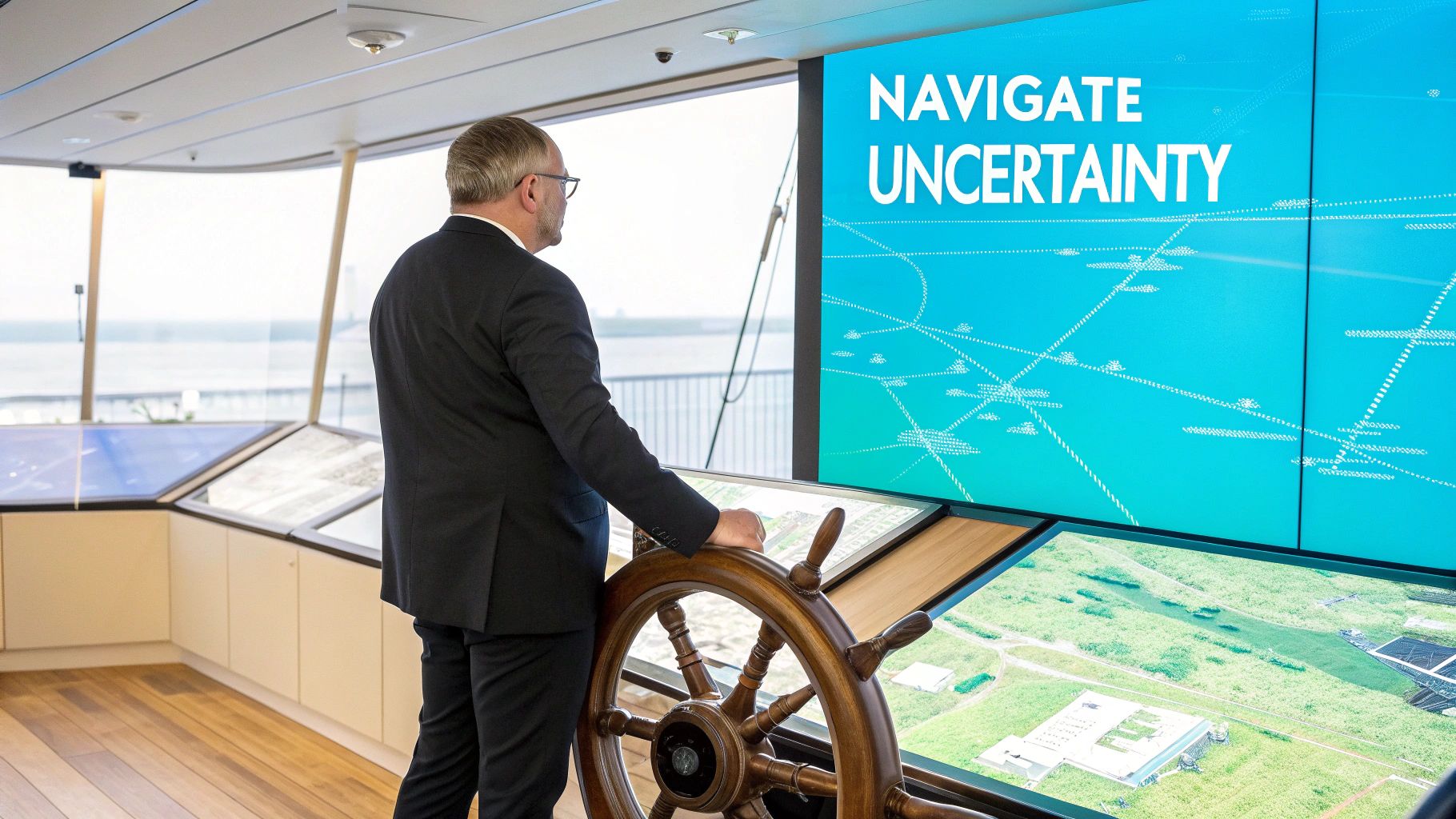
Imagine you’re the captain of a massive cargo ship. Your job isn’t just to dodge icebergs. It's about reading the winds and currents to find the fastest, safest route to your destination, outpacing the competition along the way. That, in a nutshell, is modern enterprise risk management.
It’s a framework that forces risk-conscious thinking into every decision, from the boardroom all the way to the front lines. In today's hyper-connected world, risks don't stay in their neat little boxes anymore. A supply chain hiccup can ignite a financial crisis, which then torches your company’s reputation.
The old way of doing things—where finance only worries about money and IT only deals with cyber threats—is dangerously obsolete. It creates massive blind spots where the biggest threats love to hide.
The Shift from Defense to Strategic Advantage
A mature enterprise risk management program does more than just play defense. It gets departments like HR, Security, Compliance, and Operations all rowing in the same direction, creating a unified strategy for both resilience and growth.
This is a fundamental shift. Instead of just trying to prevent loss, a solid ERM framework builds an organization that is agile enough to thrive in chaos. It’s about creating a culture where thinking about risk is second nature.
This strategic pivot helps leaders answer the tough questions with real confidence:
Are we taking on the right amount of risk to actually hit our growth targets?
Do we have a single, unified view of our most critical vulnerabilities?
Can we adapt—quickly—if the market suddenly shifts or new regulations drop?
Is our team actually equipped to spot and seize emerging opportunities?
An ERM program provides a complete view of the organization, breaking down silos to facilitate better collaboration and communication. This allows leaders to make risk-conscious decisions that protect the company while pursuing beneficial opportunities.
To illustrate this evolution, it helps to see the old and new models side-by-side.
The Shift from Traditional Risk Management to Modern ERM
This table contrasts the outdated, siloed approach to risk with the modern, integrated ERM framework, highlighting the critical evolution in strategic thinking.
Aspect | Traditional Risk Management | Enterprise Risk Management (ERM) |
|---|---|---|
Scope | Siloed, focused on individual departments (Finance, IT, etc.) | Holistic, integrated across the entire organization |
Focus | Primarily defensive, aimed at preventing specific losses | Strategic, balancing risk-taking with opportunity pursuit |
Ownership | Managed by individual department heads or specialists | Driven by senior leadership and the board, with broad ownership |
Objective | Minimize downside risk and avoid negative events | Optimize risk appetite to achieve strategic objectives |
Approach | Reactive, responding to incidents after they occur | Proactive, identifying and mitigating risks before they escalate |
The contrast is stark. One approach is about cleaning up messes; the other is about preventing them from happening in the first place while clearing a path for growth.
Why ERM Is No Longer Optional
The need for a structured ERM approach has become urgent. Things like rapid digital adoption, shaky global supply chains, and an ever-expanding web of regulations mean risks are more tangled and complex than ever.
The data backs this up. Shockingly, research shows that less than 20% of enterprise risk owners feel they are actually meeting expectations for risk mitigation. That’s a massive performance gap, and it’s leaving a lot of companies exposed.
A well-built enterprise risk management program closes that gap. It standardizes how you report on risk, sharpens your focus on what truly matters, and ensures your resources are pointed in the right direction. Ultimately, it gives leadership the confidence to make bold, informed decisions in a world that’s anything but predictable. This guide will show you how to build that confidence.
Understanding Core ERM Frameworks and Standards
To build a strong enterprise risk management program, you need a blueprint. Just like an architect relies on detailed plans to make sure a skyscraper is structurally sound, risk leaders use established frameworks to build ERM programs that are consistent, effective, and auditable.
These aren't rigid, bureaucratic rulebooks that dictate every tiny detail. Instead, think of them as strategic toolkits that provide a solid foundation. A blueprint ensures the foundation is solid and the support beams are in the right place, but it doesn’t tell you what color to paint the walls. In the same way, ERM frameworks provide the essential structure, leaving you room to customize the program to fit your company’s unique culture and goals.
This structured approach is crucial. It ensures everyone in the organization is speaking the same language when it comes to risk. It creates a common way to identify, assess, and respond to threats, preventing the siloed, inconsistent efforts that plague so many less mature programs.
COSO: The Governance-Focused Blueprint
One of the most widely adopted frameworks comes from the Committee of Sponsoring Organizations of the Treadway Commission (COSO). Originally famous for its work on internal controls, COSO's ERM framework is especially popular in organizations with a heavy focus on governance, compliance, and financial reporting.
The real strength of the COSO framework is how it directly connects risk, strategy, and business performance. It helps leaders answer a critical question: how do our risks impact our ability to hit our strategic objectives? This makes it an incredibly powerful tool for aligning risk management activities with what the C-suite and the board care about most—hitting performance targets.
Its components guide organizations through the key areas:
Governance and Culture: Sets the tone from the top, emphasizing ethical values and board oversight.
Strategy and Objective-Setting: Aligns risk appetite with the overall business strategy.
Performance: Involves identifying, assessing, and responding to risks in day-to-day operations.
Review and Revision: Calls for continuous monitoring and improvement of the ERM program.
Information, Communication, and Reporting: Ensures risk data is shared effectively across the organization.
By focusing on these integrated components, COSO gives you a comprehensive roadmap for embedding risk management into the very structure of the business.
ISO 31000: The Flexible, Principles-Based Model
While COSO is often seen as more prescriptive, the ISO 31000 standard offers a more flexible, principles-based approach. Published by the International Organization for Standardization, it’s designed to be adaptable to any organization, no matter its size, industry, or sector.
ISO 31000 is less of a step-by-step manual and more of a universal guide built on principles for effective risk management. It really emphasizes that ERM should be woven into all organizational activities and decisions, creating a proactive, risk-aware culture. The standard is particularly helpful for managing a broad spectrum of risks, including operational ones. For a deeper look, you can explore our detailed guide on the operational risk management framework to see these principles in action.
The ultimate goal of ISO 31000 is to create and protect value. It improves performance, encourages innovation, and supports the achievement of objectives by proactively addressing uncertainty.
The framework is built around three key elements:
Principles: Core beliefs like integration, customization, and continuous improvement.
Framework: The structure that helps integrate risk management into all significant activities.
Process: The practical steps for identifying, analyzing, evaluating, and treating risks.
This adaptability makes ISO 31000 a fantastic choice for organizations looking for a versatile model that can evolve right alongside their business.
Whether you end up choosing COSO, ISO 31000, or even a hybrid model, using a formal framework is non-negotiable. It ensures your enterprise risk management program is built to last, giving you the stability needed to navigate uncertainty with confidence.
Your Practical Roadmap to Implementing an ERM Program
Rolling out an enterprise risk management (ERM) program isn't a flip-the-switch project. It's an evolution. The goal is to shift your organization's entire mindset from reacting to problems to proactively getting ahead of them.
Think of it like building a city's infrastructure. You don't lay every single road and bridge at once. You start with the main highways—the critical arteries—and then methodically build out the rest of the network.
The very first step, and the one that makes or breaks the entire effort, is getting genuine buy-in from senior leadership. If the board and the C-suite aren't fully behind the initiative, it will starve for resources and authority. Their support sets the crucial "tone at the top," signaling that risk management is a core business strategy, not just another compliance checklist.
Stage 1: Assembling Your Team and Defining the Rules
Once leadership gives the green light, the real work begins. This first stage is all about building the foundation for your entire program.
Form a Risk Committee: This can’t be a siloed effort. Pull together a cross-functional team with leaders from Finance, Legal, HR, IT, and Operations. Their different perspectives are exactly what you need to get a 360-degree view of the company’s risk landscape.
Establish a Charter: This is your program's constitution. The charter is a formal document that spells out the ERM program's mission, scope, authority, and responsibilities. It ensures everyone knows the rules of engagement from day one.
Define Risk Appetite: Leadership needs to go on the record and state clearly what kind and how much risk the organization is willing to take on to hit its strategic goals. This isn't just a number; it's a guiding philosophy that will shape every risk decision you make.
A fast-growing tech startup, for instance, might have a huge appetite for innovation risk but almost zero appetite for anything that touches customer data security or regulatory compliance. Getting that clarity upfront keeps everyone aligned.
Stage 2: Identifying and Assessing Your Unique Risks
With your foundation in place, you can start mapping out your organization’s specific risk universe. This isn't a one-and-done task; it's a continuous cycle of discovery and analysis.
The goal is to move past the obvious threats and uncover the interconnected risks that love to hide in departmental silos. A risk workshop with your newly formed committee is a fantastic way to kick this off and get people brainstorming together.
After you've identified the risks, you need to assess them. A common and effective method is to score each risk on two key dimensions:
Likelihood: How probable is it that this event will actually happen?
Impact: If it does happen, how bad will the consequences be for the business?
This scoring process, often plotted on a risk matrix, helps you prioritize. It separates the critical few threats that need immediate attention from the trivial many that you can simply monitor. The diagram below shows how frameworks like COSO and ISO 31000 provide the structural blueprint for this process.

This visual shows how COSO offers a governance-focused structure while ISO 31000 provides a principles-based approach. Both are essential guides for your ERM journey.
Stage 3: Developing and Implementing Your Response
Once you've assessed your risks, it's time to decide what to do about them. Not every risk needs to be crushed with an aggressive mitigation plan. There are generally four ways you can respond.
Response Strategy | Description | When to Use It |
|---|---|---|
Mitigate | Implement controls or processes to reduce the risk's likelihood or impact. | For high-priority risks that are within your control to influence. |
Transfer | Shift the financial burden of the risk to a third party. | Common for financial risks, often handled through insurance policies. |
Avoid | Decide not to engage in the activity that creates the risk. | Used when a risk's potential impact is too severe to justify the opportunity. |
Accept | Acknowledge the risk and do nothing, accepting the potential consequences. | Appropriate for low-impact, low-likelihood risks that fall within your risk appetite. |
Documenting these decisions in a risk register is absolutely essential. This is your central log for tracking every risk, its assessment, the response you chose, who owns that response, and the status of any action plans.
Stage 4: Monitoring, Reporting, and Cultivating Culture
An ERM program is a living, breathing system that needs constant attention. Ongoing monitoring is how you make sure your risk responses are actually working and how you spot new threats as they emerge.
A mature enterprise risk management program is not a project with an end date. It is a fundamental change in how an organization makes decisions, embedded into its culture and daily operations.
This final stage is about setting up Key Risk Indicators (KRIs) to act as your early-warning system. Regular, clear reporting to the risk committee and the board keeps leadership in the loop and maintains accountability. To make this all manageable, many organizations use specialized enterprise risk management tools to automate monitoring and centralize reporting.
Ultimately, the goal is to build a risk-aware culture where every single employee understands their role in managing risk. When people at all levels feel empowered to spot and flag potential issues, your ERM program stops being a top-down mandate and becomes a shared organizational value.
Navigating the Top Risks Modern Enterprises Face
A solid enterprise risk management program isn't about abstract theories or frameworks. It’s about getting your hands dirty and confronting the real-world threats that challenge your business every single day. The modern risk landscape is a tangled web where one small event can set off a chain reaction across the entire company.
Getting a handle on the primary risk categories is the first step toward building a truly resilient organization. Each one brings its own unique set of problems, but they all demand a unified, strategic response.
Operational Risks: These are the dangers lurking in your daily grind. Think critical supply chain failures, unexpected equipment breakdowns, or even simple human error that compromises quality or safety.
Financial Risks: This bucket covers anything that could hammer your bottom line. Market volatility, credit defaults from key customers, sudden cash flow shortages, and shifting interest rates all fit here.
Strategic Risks: These threats strike at the very heart of your business model. They often pop up from outside forces, like a disruptive new competitor, a sudden shift in consumer tastes, or a technology that makes your core product look obsolete.
Compliance Risks: The maze of laws and regulations just keeps getting more complex. A misstep with standards like GDPR or industry-specific rules can trigger crippling fines, legal battles, and serious damage to your brand.
The Dominance of Cyber and Insider Threats
While every category matters, two specific threats consistently hijack the conversation in boardrooms and executive surveys. In our deeply connected world, cyber attacks and insider threats have shot to the top of the list for organizations of all sizes.
The data makes this impossible to ignore. Cyber risks have surged to become the #1 concern for companies around the globe. According to a recent survey of 2,941 decision-makers, cyber attacks now top the list of global risks for the third time in a row, ranking higher than even business interruption and economic downturns.
One of the most disruptive cyber threats is the Distributed Denial of Service (DDoS) attack, making effective strategies for mitigating DDoS attacks essential for keeping the lights on. When you combine these external attacks with the equally dangerous threat from insiders—whether malicious or just careless—you’re facing a huge challenge.
Connecting the Dots in a Scattered Landscape
Here’s the real problem: the warning signs for these modern risks rarely show up in a neat, tidy package. They’re scattered as isolated data points across different departments, making them incredibly easy to miss.
A minor compliance issue flagged by Legal, an unusual access pattern noticed by IT, and a behavioral concern documented by HR might seem completely unrelated. In reality, they could be fragmented pieces of a single, escalating insider threat.
This fragmentation is exactly where old-school, siloed risk management fails catastrophically. Each department is stuck seeing only its small piece of the puzzle, leaving the organization blind to the bigger picture until it’s far too late.
This reality highlights the urgent need for a unified, technology-driven platform. A truly effective enterprise risk management system must connect these disparate dots, pulling together information from HR, Security, and Compliance. By turning isolated signals into a coherent, actionable picture, leaders can finally see emerging threats clearly and intervene before a small problem spirals into a full-blown crisis.
How Technology and Ethical AI Are Reshaping ERM
The days of wrestling with spreadsheets and disconnected software to manage enterprise-level risk are numbered. In a world of high-speed threats, these manual, reactive methods are like trying to stop a tidal wave with a bucket. They simply can’t keep up.
This new reality has shoved technology into the spotlight, turning ERM from a backward-looking chore into a proactive, forward-looking discipline. Leading this charge is artificial intelligence, which is quickly becoming a non-negotiable tool for any serious ERM program.
This isn't some far-off trend; the shift is happening right now. Research shows that by 2025, a full 70% of risk managers plan to put AI at the center of their strategies. We’re already seeing a stunning 35% year-on-year growth in AI adoption within risk frameworks. These numbers aren’t hype—they reflect an urgent need to get ahead of threats that move too fast for human teams alone. You can see more on this in this detailed analysis of ERM's future.
Moving From Reaction to Prediction with AI
Think of an AI-powered platform as a central nervous system for your organization. It pulls in massive datasets from every corner of the business—HR, security, finance, compliance—and processes it all in real time. A human analyst might need weeks to make sense of that much information, but AI algorithms can spot hidden patterns and subtle connections almost instantly.
This completely changes the risk management game. Instead of waiting for a quarterly audit to tell you something went wrong, your ERM team gets predictive alerts about potential issues before they ever have a chance to escalate.
AI is already making a huge impact in a few key areas:
Pattern Recognition: Spotting unusual transaction sequences that might signal fraud.
Anomaly Detection: Flagging abnormal network access that could be the first sign of a breach.
Predictive Analytics: Forecasting potential supply chain disruptions based on geopolitical rumblings and market data.
Automated Compliance: Continuously scanning operations to make sure they align with ever-changing regulations.
An AI-driven ERM system doesn't just manage risk; it anticipates it. By connecting disparate data points that human teams would likely miss, it provides the foresight needed to act proactively, turning a defensive necessity into a strategic advantage.
This leap forward allows leaders to finally shift from damage control to prevention—a far more effective and less costly place to be.
The Non-Negotiable Role of Ethical AI
But all that power comes with a profound responsibility. The potential for misuse—through invasive surveillance, biased profiling, or opaque decision-making—is a massive risk in its own right. This is why the concept of ethical AI is no longer a talking point but an operational requirement for modern ERM.
Ethical AI is built on a foundation of transparency, privacy, and human dignity. It flat-out rejects surveillance and judgment-based models. Instead, it creates systems that provide objective indicators to support human experts, not replace them.
This approach is absolutely critical when you’re dealing with sensitive internal matters like employee integrity and insider threats. For example, instead of using invasive monitoring to "catch" employees, ethical AI tools identify structured risk signals—like a conflict of interest or a procedural vulnerability—while preserving individual privacy. To see how this privacy-first model works, you can read our guide on detecting insider threats with ethical AI.
Ultimately, technology’s true purpose here is to empower the human experts in HR, Compliance, and Security. By giving them early, objective signals, ethical AI lets them "Know First, Act Fast!" without ever compromising employee trust or crossing legal boundaries. It ensures prevention is not only effective but also humane and compliant.
It’s Time to Build a More Resilient, Proactive Organization
Let's be clear: effective enterprise risk management isn't a project with a finish line. It’s a fundamental shift in how your business operates. The goal is to move ERM from a simple compliance checkbox to a powerful driver of strategic growth and real-world resilience.
This journey is about embedding risk awareness so deep into your company’s DNA that proactive thinking becomes the default. It completely changes how your organization deals with uncertainty. Instead of just reacting to crises after the damage is done, a mature ERM program lets you see challenges coming and turn potential disasters into managed outcomes. It’s about protecting your most valuable assets—your reputation, your capital, and your people—with foresight and integrity.
From Cost Center to Competitive Edge
The surging demand for solid ERM programs tells the whole story. The enterprise risk management market is on track to explode from $10.5 billion to $23.7 billion by 2028, a sure sign that leaders are finally investing serious money in resilience.
And it’s easy to see why. A staggering 41% of organizations face three or more critical events every single year, yet only 35% of financial leaders feel their risk processes are truly up to the task. You can discover more about these risk management statistics and see for yourself just how wide the gap is between good intentions and actual execution.
This is where an integrated, ethical, and technology-driven approach gives you a decisive advantage. When you unify insights from HR, Compliance, and Security, you create a complete, holistic picture of your risk landscape. This is how you start connecting the dots between seemingly random events and spot emerging threats before they can do real harm.
Proactive ERM isn't just a cost of doing business. It's a powerful competitive advantage that allows your organization to face uncertainty with confidence, turning the principle of 'Know First, Act Fast!' into your operational reality.
Take a hard look at your organization's current risk maturity. Ask yourself how a modern ERM framework, backed by ethical technology, could elevate your strategy from reactive to preventive. By embracing this proactive approach, you empower your team to not just protect the organization, but to drive it forward with clarity and purpose, making sure it can thrive in any environment.
Your ERM Questions, Answered
Even with the best roadmap, hitting the ground with a new ERM framework always brings up questions. Let's tackle some of the most common ones we hear from leaders in HR, Compliance, and Security to give you clear, straightforward answers.
What Is the Difference Between ERM and Traditional Risk Management?
Think of traditional risk management like having separate security guards for each building on a corporate campus. Each guard does a decent job protecting their own building, but they don't talk to each other. This leaves the roads, parking lots, and open spaces between the buildings completely vulnerable.
Enterprise Risk Management (ERM) is the central command center that sees the entire campus. It links all the security feeds, spots coordinated threats moving from one area to another, and sends resources where they're needed most. ERM gives you that holistic, top-down view, weaving risk management together across every department to protect the whole organization, not just its individual parts.
How Often Should We Review Our ERM Framework?
An ERM framework is a living document, not a "set it and forget it" binder on a shelf. Your business is always changing, and so are the risks you face. At an absolute minimum, you need to conduct a comprehensive review of your ERM framework annually.
But a calendar date isn't the only trigger. A formal review should happen immediately after any major organizational shift, such as:
A significant merger or acquisition.
Launching a new product line or entering a new market.
Major changes in regulatory requirements.
A critical risk event that blindsided you and revealed a major vulnerability.
Continuous monitoring is the day-to-day work, but these formal reviews are non-negotiable for keeping your strategy sharp and aligned with your business goals.
What Are the Most Common Hurdles in ERM Implementation?
Rolling out an effective ERM program is a serious undertaking, and nearly every organization runs into the same handful of obstacles. Knowing what they are ahead of time is half the battle.
Here are the usual suspects:
Lack of C-Suite Buy-In: If senior leadership isn't genuinely championing the effort, any ERM initiative will starve for resources and authority.
A Culture Resistant to Change: If employees see risk management as just more bureaucracy or a way to get in trouble, they simply won't participate.
Siloed Departments and Data: Getting different departments to stop protecting their turf and actually share information is often a huge political and technical fight.
Outdated Technology: Trying to get a unified view of risk while relying on spreadsheets and disconnected systems is practically impossible.
The biggest challenge isn't just spotting risks; it's building a culture where every single employee feels a sense of ownership in managing them. A truly successful program turns risk awareness from a departmental chore into a shared organizational value.
Tackling these issues head-on is the only way to build a program that delivers real resilience and strategic value.
Navigating these complexities requires a new approach—one that unifies risk intelligence across your organization. Logical Commander Software Ltd. provides an AI-driven platform that empowers HR, Compliance, and Security teams to proactively manage internal risks ethically and effectively. Instead of reacting to incidents, our system helps you Know First and Act Fast, all while preserving employee privacy and dignity. Discover how to build a more resilient organization by visiting https://www.logicalcommander.com.