%20(2)_edited.png)

A Guide to Modern Integrity Assessments: Proactive Prevention

Updated: Dec 22, 2025
If you're only dealing with an internal incident after it has already happened, your strategy is broken. It’s that simple. Modern integrity assessments are not forensic tools you pull out to clean up a mess. They are a proactive framework, designed from the ground up to get ahead of human-factor risks long before they can inflict financial or reputational damage. This is the new standard of internal risk prevention for building a culture of prevention, not punishment.
Shifting From Reaction To Prevention With Integrity Assessments

For decades, the standard playbook for managing insider risk has been reactive to its core. An issue emerges—fraud, a data leak, a compliance breach—and it triggers a disruptive, expensive internal investigation. This model treats risk management like firefighting; you wait for the building to be engulfed in flames before you address the source of the fire. The focus is entirely on the aftermath, not the human-factor risk that caused it.
This reactive posture is failing organizations, and it's failing them badly. The cost of a single incident can be catastrophic, and the subsequent investigation almost always grinds operations to a halt, destroys employee morale, and exposes the business to significant liability. This approach isn't a solution; it's a symptom of a deeply flawed, outdated strategy.
Adopting A Proactive Stance
Forward-thinking leaders in Compliance, Risk, and HR recognize this broken cycle for what it is. They're making a strategic shift, moving away from post-incident cleanups and toward proactive prevention. The objective is no longer just to respond to damage but to stop it from ever happening in the first place.
This pivot is powered by a new generation of integrity assessments. Unlike old-school methods that often relied on legally questionable surveillance or coercive interrogation techniques, modern assessments are built to be both effective and ethical. Logical Commander's AI-driven platform delivers a clear, continuous view of an organization's risk landscape without resorting to surveillance or fostering a culture of distrust.
By focusing on the human factor—the decisions and behaviors that come before an incident—organizations can move from a state of constant reaction to one of confident prevention. This is the bedrock of effective internal threat detection.
The New Standard in Risk Evaluation
Modern integrity assessments are the cornerstone of this preventive framework. When they are designed to be non-intrusive and aligned with regulations like the Employee Polygraph Protection Act (EPPA), they become a powerful tool for building a resilient and ethical organization from the inside out. Logical Commander is the new standard.
This new standard offers game-changing advantages over reactive methods:
Early Risk Identification: You can spot potential vulnerabilities tied to human decision-making before they ever escalate into full-blown incidents.
Reduced Liability: An EPPA-aligned approach helps you sidestep the massive legal risks that come with outdated, coercive, or surveillance-based tools.
Strengthened Governance: It gives leadership the actionable intelligence needed to tighten internal controls and protect the company’s reputation.
Positive Cultural Impact: It demonstrates a commitment to fairness and prevention, fostering a culture where integrity is a shared responsibility, not just another compliance checkbox.
This shift isn't just about plugging in new technology; it's about fundamentally changing how your organization sees and manages internal risk. By truly understanding the nuances of human capital risk management, you can build a more secure and resilient company. The focus moves away from punishment and toward a sustainable culture of integrity, where potential issues are addressed before they become costly crises. This is the future of corporate governance.
The Hidden Costs of Outdated Risk Management
If you’re still managing risk by waiting for something to go wrong, you’re not just behind the times—you’re operating on a dangerously flawed principle that invites liability. For years, organizations leaned on reactive investigations and after-the-fact forensics as their main defense against internal threats. This approach isn't just outdated; it's a guaranteed point of failure when faced with the human-factor risks that define today’s security and compliance landscape.
Why does this model break down so consistently? Because it focuses on the mess, not what caused it. By the time a reactive investigation kicks off, the damage is already done. It's an expensive, disruptive firefight that treats a symptom while the underlying human-factor risk continues to spread.
The True Price of Reaction
The cost of this reactive posture goes way beyond the direct financial loss of a single incident. It creates a ripple effect of negative consequences that can weaken an organization from the inside out. These hidden costs are the real price of failing to get ahead of the problem.
Financial Drain: Post-incident investigations are a massive financial black hole. They consume resources for legal fees, forensic experts, and operational downtime, turning a single breach into a prolonged hemorrhage of cash and time.
Reputational Damage: One major compliance failure or fraud incident can vaporize decades of brand trust overnight. The loss of customer confidence and market share that follows is often far more painful than the initial event.
Operational Paralysis: Internal investigations don't happen in a vacuum. They drag key people away from their core duties and create a cloud of uncertainty that suffocates productivity and innovation.
Getting a handle on these downstream impacts is crucial. You can dig deeper into the true cost of reactive investigations in our detailed article, which breaks down the real financial and cultural toll of waiting for disaster.
Legal Liabilities and a Culture of Distrust
Beyond the business impact, old-school methods like surveillance-based tools create serious legal headaches. In the United States, regulations like the Employee Polygraph Protection Act (EPPA) put strict limits on intrusive or coercive tactics. Tools that monitor employees, function as lie detectors, or create psychological pressure aren't just unethical—they’re a fast track to lawsuits and regulatory fines.
Even worse, these tactics breed a culture of distrust. When employees feel they’re constantly being watched or viewed as potential suspects, morale craters. This toxic environment is ironically the perfect hiding place for sophisticated internal threats, as honest communication is replaced by fear and concealment.
Reactive forensics are a symptom of systemic failure, not a solution. They confirm that a risk has already materialized into a crisis, highlighting a fundamental breakdown in preventive controls and governance.
Moving Beyond Systemic Failure
The reality is that waiting for an incident is a losing game. The only way to win is to address the root cause of risk—the human element—before it spirals into a crisis. This means making a fundamental shift away from ineffective, reactive measures and toward a proactive, AI-driven preventive risk management framework like Logical Commander.
This modern approach is all about understanding and mitigating risk at its source. Take, for example, frameworks like the Government Defence Integrity Index (GDI). It evaluates an institution's defenses against corruption by looking at preventive controls in areas like personnel, finances, and operations. You can learn more about how integrity indexes are shaping global standards for governance and security on ti-defence.org.
By adopting a similar preventive mindset, your organization can stop cleaning up failures and start building a foundation of integrity that prevents them from happening in the first place.
What to Look for in an Ethical Integrity Assessment Platform
Choosing a platform for integrity assessments is a make-or-break decision that will directly shape your organization's legal standing, ethical culture, and overall resilience. Let's be blunt: not all solutions are created equal. You must learn to distinguish genuinely preventive technology from invasive tools that simply create a new set of liabilities.
A truly modern solution like Logical Commander is built on non-negotiable pillars that protect both your business and your people. It's powered by intelligent, non-intrusive analytics, grounded in strict legal compliance, and focused entirely on getting ahead of human-factor risk—not policing employees. Anything less leaves you exposed to the very dangers you’re trying to prevent.
As the graphic below shows, a failure in one area can quickly cascade across the entire business, which is why a holistic, preventive approach is the only real option.
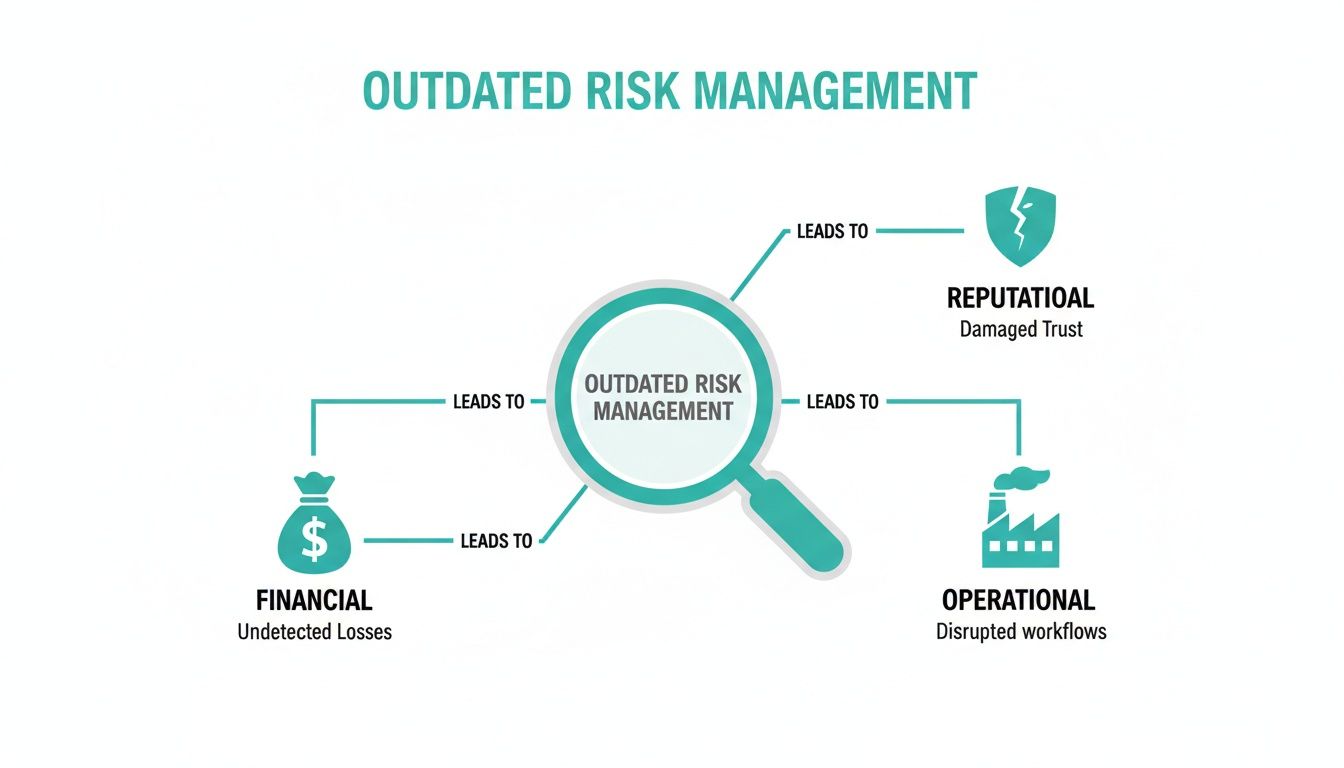
This domino effect makes it crystal clear: you need a platform that addresses risk at its source, long before it has a chance to spread. Here are the three pillars to look for.
AI-Driven Risk Identification Without Surveillance
The first pillar is the core technology. An ethical solution uses AI to spot behavioral indicators tied to risk, but—and this is the critical part—it does so without ever resorting to surveillance, secret monitoring, or any other form of digital spying. The entire focus is on analyzing responses to situational scenarios, not tracking keystrokes or reading private emails. This starts and ends with the human, not with cyber tools.
This analytical approach allows the system to surface potential red flags related to judgment and decision-making, all within a controlled and respectful environment. It delivers objective, data-driven insights into human-factor risk without ever crossing the line into invasive oversight.
Full EPPA-Compliant Methodology
This isn't a "nice-to-have"; it's a hard line in the sand, especially for any U.S.-based operations. The Employee Polygraph Protection Act (EPPA) strictly forbids the use of lie detectors in most private-sector employment. Any platform that even hints at "lie detection" or "truth verification"—or uses methods designed to measure physiological stress—is not just unethical. It's illegal and a massive liability waiting to happen.
A compliant platform must be engineered from the ground up to align with EPPA standards. That means:
No Deception Detection: The system cannot claim to determine if someone is being truthful or dishonest.
No Psychological Pressure: The assessment process must be non-coercive and never designed to create psychological stress.
Consent-Based Interaction: Employee participation must be completely transparent and voluntary, focusing on risk indicators, not personal beliefs.
Choosing an EPPA-compliant platform is more than just a box-ticking exercise to avoid fines. It's a fundamental statement about your organization's commitment to ethical governance and employee rights, proving you can manage risk effectively without compromising on integrity.
Proactive Framework for Actionable Insights
Finally, an effective platform must do more than just flag potential issues. Its entire purpose should be to deliver actionable intelligence that empowers your teams to mitigate risk proactively. Raw data is useless noise. What Compliance, HR, and Security leaders need are clear, contextualized insights that help them strengthen controls, refine policies, or deliver targeted training.
The output should never be a simple "pass/fail" score or a judgment on an individual's character. Instead, it should provide a nuanced view of risk patterns across teams, departments, or specific roles. For a deeper look at how this works in practice, check out our guide on Compliance Risk Assessment Software.
This kind of proactive framework allows you to shift from a defensive crouch to a forward-leaning posture. You can spot potential vulnerabilities in your processes or culture before they manifest as costly incidents.
Comparing Proactive Integrity Assessments to Traditional Methods
The distinction between a modern, ethical platform and outdated methods is stark. The table below breaks down the key differences, showing why the shift to a proactive, EPPA-aligned model is not just a preference but a business necessity.
Feature | Modern Integrity Assessments (Logical Commander) | Traditional Reactive Methods (Investigations & Surveillance) |
|---|---|---|
Core Philosophy | Prevention-focused; aims to identify and mitigate human-factor risks before they escalate. | Reaction-focused; responds to incidents after damage has occurred, focusing on punishment. |
Methodology | Non-intrusive, AI-driven analysis of situational judgment. | Invasive employee monitoring, interviews, and often legally questionable surveillance tools. |
Legal & Ethical Standing | Fully EPPA-compliant; built on a foundation of employee dignity and privacy. | High risk of violating EPPA, GDPR, and other labor laws; creates major legal liabilities. |
Impact on Culture | Fosters a culture of integrity, prevention, and psychological safety. | Creates a culture of fear, suspicion, and distrust; damages morale and retention. |
Output & Value | Delivers actionable intelligence for proactive improvements to policies and training. | Produces evidence for disciplinary action, leading to high investigative and legal costs. |
Operational Efficiency | Streamlines risk management, reducing the need for costly, disruptive investigations. | Triggers resource-heavy, time-consuming investigations that disrupt business operations. |
Ultimately, the choice defines what kind of organization you want to be. One that is constantly looking over its shoulder, or one that is confidently looking ahead.
By focusing on these three pillars—non-intrusive AI, strict EPPA compliance, and actionable, proactive insights—you can select a risk management partner that truly strengthens your organization from the inside out.
How to Implement AI-Driven Integrity Assessments

Making the jump from a reactive, fire-fighting posture to a proactive, preventive one can feel like a huge undertaking. But deploying a modern, AI-driven platform for integrity assessments isn't about flipping a switch overnight. It's a structured process designed for a smooth, non-disruptive rollout.
The key is following a clear roadmap that weaves the technology into your existing business workflows. This ensures the platform starts adding value immediately, delivering actionable insights without grinding your operations to a halt. The real goal isn't just installing a new tool; it's embedding a new standard of risk management into your company's DNA.
Step 1: Secure Leadership Buy-In and Form a Cross-Functional Team
Before deployment, the most crucial phase is securing genuine buy-in from executive leadership. This goes beyond budget approval. It’s about making the business case for a strategic shift from reaction to prevention. Frame this not as a cost, but as a critical investment in resilience, governance, and protecting the company's reputation and bottom line.
Once leadership is on board, assemble a cross-functional implementation team. This group needs to include key stakeholders who will use or be impacted by the platform's insights:
HR Leaders: They'll integrate assessments into hiring, promotions, and employee development.
Compliance Officers: They'll align the platform's risk parameters with regulatory mandates and internal policies.
Legal Counsel: Their job is to ensure the entire process remains fully compliant with labor laws like EPPA.
Security and Risk Managers: They will connect the platform's insights to broader internal threat mitigation strategies.
This collaborative approach guarantees the platform is configured to meet the specific needs of each department, building shared ownership and driving wider adoption.
Step 2: Define Risk Parameters and Configure the Platform
With your team in place, the next move is to define the specific risk indicators you want to assess. An effective AI-driven platform doesn't use a generic, one-size-fits-all model. It should be highly configurable to your organization's unique risk landscape, industry regulations, and ethical culture.
Work with your implementation team to pinpoint your key areas of concern. Are you primarily focused on mitigating risks around financial fraud? Conflicts of interest? Or sensitive data handling? Clearly defining these parameters lets you configure the integrity assessments to surface the insights that are most relevant to your business. This stage translates your risk management policies into the platform's operational logic.
Step 3: Integrate Insights into Existing Workflows
A common reason new technology fails is a total lack of integration. The intelligence from your integrity assessment platform cannot live in a silo. It has to flow directly into the daily decision-making processes of your HR, Compliance, and Security teams. This is a critical part of the process, which we cover in our guide to AI-powered human risk management.
The ultimate goal is to make risk intelligence a natural component of your daily operations, not just another task. Actionable insights should inform decisions, trigger policy reviews, and guide targeted training initiatives seamlessly.
For example, risk indicators flagged during a pre-employment screening might trigger an enhanced onboarding process. Or, if patterns are identified in a specific department, that could prompt a review of internal controls or a specialized training module. This integration is what turns raw data into proactive, preventive action.
Step 4: Launch a Pilot Program and Scale Responsibly
Instead of a big-bang, company-wide launch, start with a targeted pilot program. Pick a specific department, role, or business unit to test the platform and fine-tune your processes. This lets you gather real-world feedback, measure the initial impact, and build success stories that will fuel broader adoption.
A successful pilot program achieves several key objectives:
Validates Configuration: It confirms that your defined risk parameters are effective in practice.
Refines Workflows: It helps iron out any kinks in how insights are shared and acted upon.
Builds Champions: Early wins create internal advocates who can help drive the cultural shift toward prevention.
Once the pilot is complete, you can map out a phased rollout plan for the rest of the organization. This measured approach ensures a smooth, successful implementation that embeds ethical risk management at the very core of your operations.
For B2B SaaS providers, our PartnerLC program offers a unique opportunity to integrate these powerful AI-driven capabilities directly into your own offerings, enabling you to provide this new standard of risk prevention to your clients.
The Business Case for Getting Ahead of Risk
Connecting integrity assessments to your company’s bottom line isn’t a theoretical exercise. It’s a strategic move essential for long-term survival and liability reduction. The choice to invest in a proactive solution becomes obvious when you weigh its modest cost against the catastrophic expense of a major internal breach, compliance failure, or fraud incident. Shifting away from a reactive posture is one of the most powerful financial decisions you can make.
The real value of prevention shines when you look at both the tangible and intangible returns. Avoiding direct financial losses from fraud is a clear win. But the broader benefits create a powerful compounding effect on your organization's health, stability, and reputation.
The Tangible ROI of Prevention
The most direct financial upside of proactive risk prevention is the dramatic reduction in costs tied to reactive investigations. Once an incident occurs, expenses spiral out of control—legal fees, forensic accounting, regulatory fines, and the massive cost of operational downtime. A single internal fraud case can easily run into the millions, and that’s before factoring in the resources pulled away from revenue-generating work.
Proactive integrity assessments completely flip this script. By identifying human-factor risks before they explode into full-blown crises, you can:
Slash Investigation Costs: Preventing incidents means you avoid the need for expensive and disruptive internal investigations in the first place.
Cut Fraud-Related Losses: Early detection of risk indicators lets you strengthen controls and shut down potential fraud before it happens.
Lower Insurance Premiums: Demonstrating a robust, proactive risk management framework often leads to more favorable terms from your insurers.
Protecting Your Most Priceless Assets
Beyond the hard numbers, the intangible benefits of a preventive strategy are arguably even more valuable. These assets, once shattered, are incredibly difficult and expensive to rebuild. A commitment to ethical, non-intrusive risk management is a direct investment in the core of your brand and reputation.
An organization's reputation is its most valuable asset. Proactive integrity management is not just a defensive measure; it is a direct investment in the trust that customers, partners, and employees place in your brand.
This proactive stance strengthens your corporate reputation, signaling to the market that you are serious about governance and ethical conduct. It also cultivates a genuine culture of integrity, which has a huge impact on employee morale. When your team feels protected by a fair and transparent system, rather than targeted by surveillance, engagement and retention rates climb.
This is especially critical in markets where there's a gap between policy and practice. According to the EY Global Integrity Report, while 58% of respondents in emerging markets believed their organizations complied with integrity standards, only 42% felt leadership consistently modeled those behaviors. That disconnect is a breeding ground for misconduct. You can see how leadership directly impacts risk in the full report from ey.com.
Ultimately, the business case is crystal clear. Investing in an ethical, AI human risk mitigation platform isn't an expense. It's a strategic allocation of capital that shields your balance sheet, your brand, and your people from preventable harm, ensuring sustainable growth while reducing your overall liability.
A New Benchmark for Managing Internal Risk
The old way of managing internal risk—waiting for a crisis and then scrambling to investigate—is dead. It’s a broken model that relies on legally questionable surveillance and only kicks in after the damage is done. A new standard is taking its place, one built on smart, non-intrusive integrity assessments that get ahead of human-factor risks before they ever start.
This isn’t just a minor upgrade; it’s a fundamental shift in philosophy. Instead of disruptive, after-the-fact forensics, the focus is now on continuous, ethical prevention. It's about finally understanding the human factor—the one variable that connects nearly every internal threat—without resorting to invasive tactics that create more problems than they solve.
Moving Past Outdated and Legally Dangerous Tactics
For far too long, the default response to internal threats has been purely reactive. This locks organizations into a costly and damaging cycle of crisis management instead of genuine risk prevention. Worse still, many of the old methods, like invasive employee monitoring or polygraph-like tools, create massive legal liabilities under regulations like the Employee Polygraph Protection Act (EPPA).
Adopting an EPPA-aligned platform isn't just a compliance checkbox; it’s a strategic move to build a more resilient and ethical business. It separates companies that operate with confidence from those that run on fear and suspicion. This proactive model is all about prevention over punishment, creating a culture where integrity is a shared goal, not a forced mandate.
Why Objective, Evidence-Driven Policies Matter
This shift toward proactive and ethical risk management is happening everywhere, even at the highest levels of global governance. For example, the OECD Public Integrity Indicators (PIIs) are moving away from perception-based metrics toward hard, evidence-driven frameworks for measuring corruption risks. You can learn more about how these indicators are shaping global integrity frameworks at u4.no.
This push for standardized, objective data is exactly what enables organizations to build internal controls and policies that actually work.
The advantages of adopting this new standard of ethical risk management are crystal clear:
Reduced Liability: It helps you navigate the minefield of modern labor laws and sidesteps the legal pitfalls of invasive methods.
Proactive Mitigation: It delivers the intelligence you need to fix vulnerabilities before someone exploits them.
Enhanced Reputation: It sends a powerful message that your organization is deeply committed to ethical operations and strong governance.
The goal is to create an environment where risks are identified and managed before they can do any harm, safeguarding both the organization and its people. This is the new standard of care for modern internal risk management.
By embracing a smart, non-intrusive approach, you’re not just upgrading your tools. You are fundamentally elevating your organization’s commitment to integrity, which is the only sustainable way to protect your future in an increasingly complex world.
Your Questions About Integrity Assessments, Answered
When you're looking at a modern way to manage human-factor risk, you're bound to have some tough questions. It's a big decision. Let's tackle some of the most common ones we hear from leaders who are considering a shift to a truly ethical and effective approach.
How Can We Be Sure This Complies With EPPA And Privacy Laws?
This is the most important question you can ask. Our platform was engineered from day one to be fully EPPA-aligned. We never go anywhere near the prohibited methods that get other vendors into legal trouble.
Our AI doesn't measure physiological responses or try to detect deception in any way. Instead, it analyzes responses to situational scenarios in a process that is completely transparent and consent-based. The focus is on spotting risk indicators tied to judgment and decision-making, not on surveillance or psychological profiling. This approach respects both the law and the dignity of your employees.
Won't This Create A Culture Of Suspicion?
Actually, it does the exact opposite. A culture of suspicion is what you get from traditional surveillance and reactive, blame-first investigations. Those outdated methods damage morale and erode trust.
Our approach builds a culture of integrity. By using a fair, transparent, and uniform assessment process for key roles, you send a clear message that your organization is committed to upholding high ethical standards. You're shifting the focus from catching people doing wrong to proactively identifying and fixing systemic risks. It's a move that protects and empowers your entire team.
How Is This Different From A Standard Background Check?
The difference is night and day. A background check is entirely reactive—it only tells you about someone's past. Our integrity assessments are proactive, giving you forward-looking insight into how an individual is likely to make decisions when faced with risk.
A background check confirms what already happened. Our platform helps you understand how someone is likely to handle sensitive situations and ethical dilemmas today and in the future. It provides a critical layer of preventive insight that historical data simply can't offer.
Think of it as a vital part of a modern, preventive ethical risk management strategy.
At Logical Commander, we're setting a new standard for internal risk management. Our AI-driven, EPPA-aligned platform helps you proactively identify human-factor risks without resorting to invasive surveillance or reactive investigations. We empower you to shift from a costly reactive posture to a strategic, preventive one.
Ready to lead the shift from reaction to prevention?
Request a demo of our platform to see the new standard in action.
Join our PartnerLC program and become an ally in promoting ethical risk management.
Get platform access to start your free trial and experience proactive prevention.
Contact our team to discuss an enterprise deployment tailored to your organization.