%20(2)_edited.png)

Enterprise Risk Management Business: Build a Resilient Strategy Today

Enterprise Risk Management, or ERM, is more than just a corporate buzzword—it’s a complete shift in how a business sees and handles threats. Instead of playing whack-a-mole with problems as they pop up, a strong ERM strategy gives you a single, unified view of every potential threat to your company’s goals, turning uncertainty into a real strategic advantage.
Understanding the Foundations of Enterprise Risk Management
At its heart, ERM isn’t just about dodging bullets; it’s about creating value. Think of it as your company's central nervous system. It’s constantly sensing changes in the environment—both threats and opportunities—and sending clear signals across the entire organization to coordinate an intelligent, unified response. This system ensures every department, from HR to security to finance, is working from the same playbook.
This proactive stance is a world away from the old, siloed methods. In the past, individual departments managed their own risks in isolation, like different crew members on a ship trying to navigate a storm without talking to each other. One team might be watching for financial icebergs, another for operational squalls, and a third for compliance whirlpools. This fragmented approach left huge gaps for major risks to slip through, often leading to a full-blown crisis no one saw coming.
The Shift from Reactive to Proactive
The modern business environment is simply too interconnected and fast-paced for that outdated model. Digital transformation, dizzying regulations, and rising ESG (Environmental, Social, and Governance) expectations demand a unified strategy. A formal ERM program dismantles these internal silos, creating a panoramic view of the entire risk landscape.
An effective ERM program transforms risk from a purely defensive chore into a strategic enabler. It provides the clarity needed to take calculated risks, seize opportunities with confidence, and build a more resilient organization prepared for whatever lies ahead.
This isn't just a trend; it's a fundamental change in how successful organizations operate. You can see it in the money being invested. The global enterprise risk management market was valued at USD 5.83 billion in 2024 and is projected to climb to USD 9.58 billion by 2032. This explosive growth shows just how vital these capabilities have become. You can see the complete analysis on Introspective Market Research to understand the expanding market for ERM tools.
Traditional vs Modern Enterprise Risk Management
The evolution from a reactive, check-the-box mentality to a proactive, strategic framework is the defining feature of modern ERM. The old way was about damage control; the new way is about building resilience.
This table breaks down the fundamental differences between these two approaches.
Aspect | Traditional Risk Management | Modern ERM Strategy |
|---|---|---|
Focus | Siloed and reactive; addresses risks department by department after they emerge. | Holistic and proactive; integrates risk into strategic planning across the organization. |
Goal | Minimize losses and meet minimum compliance requirements. | Create and protect value by optimizing risk-taking and building institutional resilience. |
Methodology | Based on historical data, audits, and static checklists. | Forward-looking, using data analytics and continuous monitoring to anticipate future threats. |
Ownership | Confined to specific functions like finance or internal audit. | A shared responsibility, embedded in the culture and owned by everyone from the board to the front lines. |
Outcome | Creates a culture of fear and avoidance; often misses interconnected risks. | Fosters a risk-aware culture that enables smart, confident decision-making. |
As you can see, the modern approach isn't just a different process—it's a completely different philosophy. It treats risk as an integral part of the business, not something to be handed off to a compliance team.
Key Benefits of an Integrated ERM Strategy
When you adopt an enterprise-wide view of risk, you gain several clear advantages that strengthen your organization from the inside out. Instead of disjointed, reactive efforts, a unified ERM program delivers real business value.
Improved Strategic Decision-Making: With a full understanding of potential risks and opportunities, leadership can make smarter choices that align with the company's risk appetite and long-term goals.
Enhanced Operational Efficiency: Centralizing risk information gets rid of redundant processes and improves how you allocate resources, making sure your efforts are focused on the threats that truly matter.
Stronger Regulatory Compliance: A holistic program makes it far easier to track and manage obligations across various regulatory frameworks, cutting down the likelihood of costly fines and penalties.
Increased Organizational Resilience: By anticipating threats and having response plans ready to go, the business is better equipped to withstand and recover from disruptions, protecting its reputation and bottom line.
Getting Started with Core ERM Frameworks and Governance
Putting an enterprise risk management strategy into action is about more than just good intentions; you need a solid structure to make it work. Think of frameworks like COSO's "Enterprise Risk Management – Integrating with Strategy and Performance" or the ISO 31000 standard as the architectural blueprints for your organization. They’re not rigid instruction manuals, but flexible guides for building a resilient, risk-aware culture from the ground up.
These frameworks are incredibly useful for establishing a common language for risk that everyone across the business can understand. This shared vocabulary is what finally breaks down the walls between HR, Legal, Compliance, and Security. When everyone is speaking the same risk language, information flows freely, and an insight from one team can spark a crucial action in another.
This diagram shows how all the pieces fit together, with a strong foundation supporting functional execution, which in turn delivers on the company's overarching strategy.
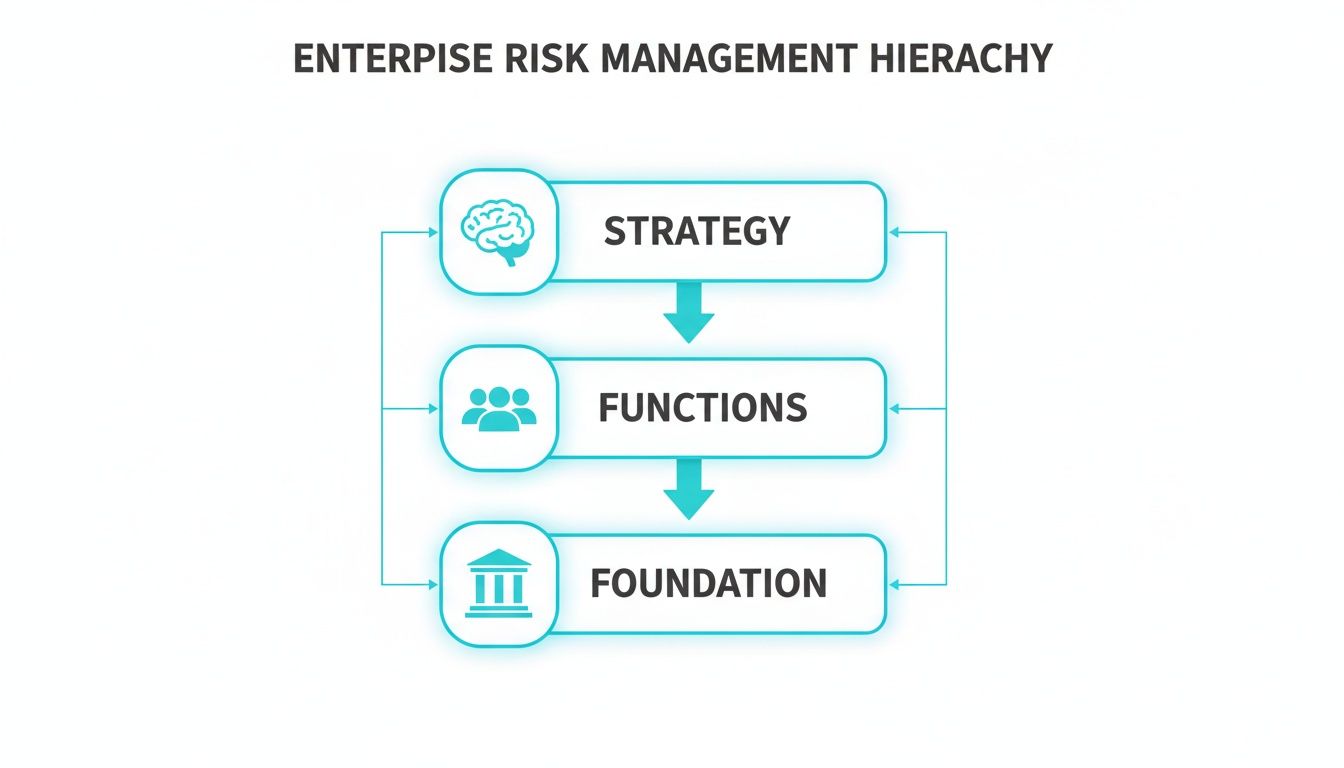
This unified approach ensures that managing risk isn’t just a side project—it’s woven into the very fabric of how your business operates.
Establishing a Clear Governance Structure
A framework is only as good as the governance that holds it together. Strong governance clarifies who is responsible for what, creating clear lines of accountability from the front lines all the way up to the boardroom. This isn't about adding red tape; it's about making sure risk intelligence is captured, communicated, and acted on efficiently.
The first step is defining the roles of key stakeholders. This ensures that oversight and decision-making are handled at the right levels of the organization.
Key Roles in ERM Governance:
Board of Directors: Provides the ultimate oversight. They set the organization's risk appetite and make sure the entire ERM program lines up with strategic goals.
Senior Leadership (C-Suite): Champions the ERM program from the top. They bake risk considerations into strategic planning and make sure the right resources are available to make it successful.
Risk Committee: This is a dedicated group, often a subset of the board or senior leadership, that provides focused governance and guidance on all risk management activities.
Business Unit Leaders: They own the risks within their departments. They're on the hook for identifying, assessing, and managing risks as part of their day-to-day operations.
For a deeper dive into structuring these responsibilities, explore these essential corporate governance best practices that can reinforce your ERM program. This kind of structure makes sure risk management is an active, living process—not a static document that gathers dust on a shelf.
Defining Your Risk Appetite and Tolerance
One of the most critical jobs of governance is to formally define the organization's risk appetite. This is a high-level statement that outlines how much and what type of risk you’re willing to accept to achieve your goals. Are you a cautious cruiser or a speedboat built for high-stakes racing? The answer shapes your entire strategic approach.
A well-defined risk appetite acts as a guardrail for decision-making. It empowers employees to take calculated risks that align with strategic goals while avoiding exposures that could lead to unacceptable losses or reputational damage.
Once you’ve defined your risk appetite, you can set specific risk tolerances. These are the measurable levels of risk the organization will accept for different categories. For example, a company might have a near-zero tolerance for compliance violations but a much higher tolerance for the market risks that come with a new product launch.
As you start to formalize these ideas, using a practical guide to developing a risk management plan can help translate abstract concepts into concrete, actionable steps for every team. This process is what turns your ERM framework from a plan on paper into a powerful business function.
How to Identify and Assess Hidden Business Risks
A solid enterprise risk management strategy is less about planning frameworks and more about actively hunting for threats. The most dangerous risks are rarely the ones staring you in the face, like a market downturn or a supply chain hiccup. They’re the hidden vulnerabilities lurking inside your processes, your culture, and your people.
Uncovering these subtle threats demands a deliberate, structured approach. You can’t just rely on past incidents or gut feelings. You need proven methods that force your team to look beyond the obvious financial and operational hazards and have some brutally honest conversations.
Methods for Uncovering Nuanced Risks
To really get a handle on your risk landscape, you have to get proactive. A couple of the best tools for this are risk workshops and scenario analysis.
A risk workshop isn’t just another meeting. It’s a focused session that gets leaders from different departments—HR, Security, Compliance, Operations—in the same room to brainstorm potential threats.
This cross-functional dialogue is absolutely critical. The HR team might see the early warning signs of employee disengagement that the security team would miss, while compliance can connect those signs to potential integrity violations. To pinpoint vulnerabilities tied to your people, for example, you need to conduct effective HR risk assessments.
Scenario analysis, on the other hand, is all about playing out plausible "what-if" situations. What if a key employee with access to sensitive data suddenly resigns to join a competitor? Walking through that scenario step-by-step will immediately expose weaknesses in your offboarding procedures, data access controls, and non-compete agreements that would have otherwise stayed invisible.
Distinguishing Between Assessment Types
Once you’ve identified a potential risk, the next job is to figure out how much it could actually hurt. This is where risk assessment comes in, and it’s generally broken down into two types. Each serves a distinct purpose.
Qualitative Assessment: This is your first pass. It uses descriptive scales (like low, medium, high) to rank risks based on their perceived likelihood and impact. It’s fast, intuitive, and great for getting your priorities straight without getting bogged down in complex calculations.
Quantitative Assessment: This method puts a hard dollar amount on the risk. It answers the question, "If this happens, how much could it cost us in real money?" This takes more data and analysis, but it delivers the concrete numbers you need to make big investment decisions, like buying insurance or funding new security controls.
The goal isn’t to eliminate all risk—that’s impossible. It's about understanding it with enough clarity to make smart decisions. A qualitative assessment helps you triage your risks, while a quantitative one helps you justify the resources needed to manage them.
The Power of Structured Indicators
For too long, risk identification has relied on subjective judgment, which is inconsistent and often biased. Modern platforms are flipping this on its head by focusing on structured indicators—objective, observable data points that signal a potential risk without making accusations or assumptions.
This approach turns scattered information into actionable intelligence. Instead of relying on a manager's "gut feeling" about an employee, a system might flag a pattern of objective indicators like policy violations, access anomalies, and conflicts of interest.
This focus on objective data is helping drive massive growth in the risk management market. The global risk management arena is projected to explode from USD 14.93 billion in 2025 to USD 40.20 billion by 2032. Operational risk—which includes internal failures and human errors—represents a huge 35.7% of that. This data-driven, objective method provides the early warnings needed to act proactively, turning your ERM program into a powerful protective shield for the entire business.
Weaving ERM into the Fabric of Your Business
An enterprise risk management program is only as good as its execution. If it just lives in a binder on a shelf or a forgotten folder on a server, it’s not doing its job. For an enterprise risk management business strategy to actually work, you have to weave it into the daily rhythm of the company.
This isn’t about adding another layer of bureaucracy. It’s about tearing down the invisible walls that separate critical functions like HR, Compliance, and Security. Forget the siloed spreadsheets and disconnected databases. A truly integrated approach creates a single, unified view of risk across the entire organization.
When these teams operate from the same playbook, something powerful happens. An early warning sign of misconduct flagged by one department can trigger a proactive response in another, stopping a small issue from snowballing into a full-blown crisis. It ensures those critical signals don’t get lost in translation between teams.
Bridging Human Resources and Risk
HR sits at the nexus of people, policy, and performance, making it an absolute goldmine of risk intelligence. When you plug ERM directly into HR functions, routine processes become powerful tools for risk mitigation. Think about it—hiring and background checks can be fine-tuned with risk data to spot potential integrity issues before an offer is even made.
This is especially critical for getting ahead of people-centric threats. For a deeper dive, our guide on effective human capital risk management breaks this down further. When HR and risk management are in sync, the business gets a much clearer picture of potential insider threats, conflicts of interest, and other ethical weak spots.
Connecting Compliance and Security Operations
Compliance and Security are your organization’s guardrails, but they’re far more effective when they work in lockstep rather than in parallel. A connected ERM platform lets the Compliance team embed risk assessments directly into policy management. As new regulations pop up or internal policies get an update, the associated risks are immediately flagged, assessed, and routed for action.
This connection gives the Security team something they rarely have: context. Instead of just chasing down technical alerts and potential breaches, they can see how human behavior and gaps in compliance might be creating the vulnerabilities in the first place.
Key Integration Points:
Policy Management: Directly linking new policies to risk assessments to proactively close compliance loopholes.
Incident Response: Sharing data between security flags and compliance investigations to build a complete, 360-degree view of any event.
Training and Awareness: Using real risk data to aim training programs at the specific departments and people who need them most.
This collaborative approach means both teams are actively working together to prevent incidents, not just clean them up after the fact.
A truly integrated ERM program makes it possible to trace an issue from its earliest signal all the way to its final resolution. It provides an auditable, transparent record that connects the dots between a minor policy exception, a subsequent security flag, and a potential compliance breach.
Achieving this level of insight is flat-out impossible with disconnected systems. By bringing these core functions together on a single platform, leadership finally gets the visibility needed to understand root causes, not just symptoms. This transforms the enterprise risk management business function from a cost center into a strategic asset that actively protects the organization’s integrity and reputation.
The Role of Ethical AI in Proactive Risk Management
Technology is completely changing the game in enterprise risk management, giving us powerful new ways to get ahead of threats. But this progress brings up a huge question: how do you use artificial intelligence without crossing non-negotiable ethical and privacy lines?
The answer is found in a new breed of AI platforms that are ethical by design.
These modern systems draw a firm line between proactive risk identification and invasive employee surveillance. Outdated tools often fall back on creepy monitoring or psychological profiling, which only breeds a culture of distrust and opens up a legal can of worms. An ethical approach, on the other hand, focuses only on objective, structured risk indicators—just the facts that signal potential weak spots, without ever making a judgment call on someone's character or intent.

This focus on objectivity isn't just good practice; it's a strategic necessity. It’s how you protect employee dignity and privacy while also staying on the right side of tough global data protection laws like GDPR.
Augmenting Human Judgment, Not Replacing It
One of the biggest myths about AI is that it’s here to take over the jobs of human risk managers. The truth is, its real value is in making them better at what they do.
AI algorithms can sift through massive amounts of structured data at a speed and scale that no human team could ever match. This allows them to surface the faint signals that traditional methods would almost certainly miss.
Think of it like a sophisticated diagnostic tool for a doctor. The machine can analyze thousands of data points to highlight potential red flags, but the final diagnosis and treatment plan are still in the hands of the experienced medical professional. Ethical AI works the same way in an ERM context.
It gives your HR, Compliance, and Security teams early warnings and connects the dots between seemingly unrelated indicators, empowering them to make smarter, faster, and more informed decisions. The system flags the "what," but the "why" and "what's next" are always left to human judgment, investigation, and due process.
Shifting from Reaction to Proactive Prevention
The single greatest advantage of bringing ethical AI into the fold is the ability to finally shift from a reactive to a proactive stance. Traditional risk management usually finds problems only after the damage is done—an incredibly expensive and inefficient way to operate.
An AI-driven system, however, can spot the subtle warning signs that come before major issues like internal misconduct or integrity violations.
An ethical AI platform acts as an early warning system, giving organizations the crucial window of opportunity to intervene and mitigate a risk before it escalates into a crisis. This protects not only the company's finances and reputation but also the individuals involved by enabling supportive, corrective action over punitive measures.
This proactive capability is transforming how organizations approach internal threats. For a more detailed look, you can explore our guide on detecting insider threats with ethical AI, which explains how this technology pinpoints risk without compromising employee trust. This shift toward prevention is becoming a cornerstone of modern enterprise risk management business strategies.
The Growing Reliance on AI in ERM
This move toward AI-powered risk management isn't some niche trend; it's rapidly becoming the industry standard. Projections show that by 2025, a staggering 70% of risk managers will place AI at the center of their ERM strategies, driven by the need for advanced predictive analytics to counter rising threats.
This trend is fueling incredible market growth, with GRC software expected to soar from USD 38 billion in 2024 to USD 138 billion by 2030. You can discover more ERM trend insights from Diligent to see how quickly the field is advancing. This rapid adoption underscores a clear reality: using ethical AI is no longer just an option—it’s essential for building a resilient and competitive organization.
Measuring the Success of Your ERM Program
How do you prove the value of a crisis that never happened? This is the core challenge for any great enterprise risk management business strategy.
An effective ERM program is brilliant at prevention. Its biggest wins are the disasters that don't happen. This makes demonstrating its return on investment a unique puzzle. Success isn't measured by the incidents you handle, but by the ones you sidestep entirely.
To show that value, you have to move beyond just counting incidents. The goal is to focus on metrics that reveal the program’s real strategic contribution and reframe risk management from a necessary cost into a function that actively protects and creates value.
Key Performance Indicators for ERM Success
The right key performance indicators (KPIs) tell a compelling story about your program's effectiveness. Instead of focusing only on lagging indicators (what already happened), a strong ERM program tracks leading indicators that show you're in control and building resilience.
Here are a few powerful KPIs to get you started:
Reduction in Investigation Time: How quickly are potential issues spotted, triaged, and put to bed? A shorter timeline from the first signal to a final resolution is hard proof of efficiency and proactive intervention.
Improved Audit and Compliance Scores: Higher scores on internal and external audits are direct evidence that your controls are working and the organization is meeting its regulatory obligations.
Number of Risks Mitigated Before Escalation: This is a crucial metric for proving preventive value. It tracks how many potential issues were addressed at an early stage before they could blow up into financial or reputational damage.
Reduction in Control Failures: Seeing fewer internal controls fail is a clear sign that your ERM processes are strengthening the company's operational backbone.
These metrics provide the tangible evidence you need. They show leadership not just how the company is reacting to risk, but how it is actively getting ahead of it.
The Role of a Unified Platform in Reporting
Trying to gather and present this data with scattered spreadsheets and disconnected departmental tools is next to impossible. A unified operational platform like E-Commander is essential for creating a single source of truth for all risk-related activities. It gives you the real-time dashboards and auditable records needed for clear, compelling reporting.
With a centralized platform, every action—from the initial identification of a risk indicator to the final resolution—is documented. This creates a transparent, auditable trail that proves due diligence and demonstrates the program's effectiveness to leadership, board members, and regulators.
This structured approach transforms reporting from a tedious, manual chore into an automated, strategic function. You can easily generate reports that connect specific risk mitigation activities to positive business outcomes.
For instance, you can show a direct correlation between improved pre-hire risk screening and a 15% reduction in post-hire integrity violations over six months.
By presenting this kind of data-driven narrative, you demonstrate that the enterprise risk management business function is not just a defensive shield but a strategic asset. It protects the company's reputation, secures its financial stability, and strengthens its operational resilience, clearly proving its indispensable value.
Your Questions, Answered
When you're building out an enterprise risk management strategy, a lot of questions come up. Even with a clear plan, leaders often need to work through the details. Let's dig into some of the most common questions we hear from organizations trying to get ahead of risk.
What Is the Difference Between ERM and Traditional Risk Management?
The biggest difference comes down to scope and mindset. For years, "risk management" happened in silos. The finance department worried about financial threats, IT handled cyber risks, and everyone operated reactively, cleaning up messes as they happened. That’s the traditional model.
Enterprise risk management (ERM) flips that script entirely. It's a holistic, top-down approach that weaves risk awareness into the company's core strategy. Instead of just playing defense in separate corners, ERM proactively scans the horizon for threats across the entire organization, all with the goal of protecting and creating value.
Which ERM Framework Should My Business Use?
There's no single "best" answer here—the right framework depends on your industry, size, and the specific regulations you have to follow. But a few are consistently popular for good reason:
COSO ERM Integrated Framework: This is a big one in the U.S. and is fantastic for tying your ERM efforts directly to strategy and performance goals.
ISO 31000: As an international standard, this one is incredibly flexible. It offers a set of principles and guidelines that almost any organization can adapt.
NIST RMF: If cybersecurity and IT risk are your biggest headaches, especially if you're in tech or work with the government, NIST is the gold standard.
Most businesses pick one of these as a starting point and then tailor it to fit their unique DNA. The goal isn’t to rigidly follow a template; it's to find a structure that actually supports your strategic goals.
The most effective enterprise risk management programs don’t just adopt a framework—they adapt it. A framework should serve the strategy, giving everyone a common language and structure that empowers smart, proactive decisions, not create more red tape.
How Do We Start Building a Risk-Aware Culture?
A risk-aware culture absolutely has to start at the top, but it’s built from the ground up. It all begins when senior leaders stop treating risk management like a compliance chore and start consistently talking about it as a shared responsibility.
This means providing real, ongoing training, not just a once-a-year webinar. It means creating channels where employees can flag potential risks without fearing they'll be punished for speaking up. And it means celebrating the wins when someone spots a problem early.
When every single person on your team understands the part they play in protecting the organization, risk awareness stops being a program and becomes part of how you operate, day in and day out.
Ready to move from reactive firefighting to proactive prevention? Logical Commander Software Ltd. provides a unified operational platform that helps you identify internal risks ethically and effectively, without invasive surveillance. Our AI-driven system strengthens your HR, Compliance, and Security functions, enabling you to know first and act fast.
Discover how E-Commander can build a more resilient organization at https://www.logicalcommander.com.